Science & Tech

Twenty years after the Columbia disaster, a NASA official reflects on lessons learned

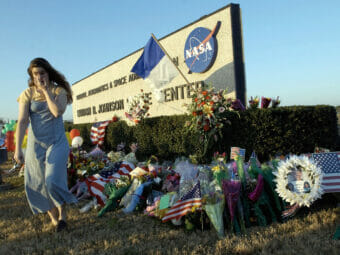
Mourners left a makeshift memorial outside NASA’s Johnson Space Center in Houston after the Columbia disaster on Feb. 1, 2003. (Brett Coomer/Getty Images)

It’s been exactly 20 years since the Space Shuttle Columbia disintegrated as it returned to Earth, killing all seven astronauts on board: commander Rick Husband, pilot Willie McCool, mission specialists Kalpana Chawla, Laurel Clark, Michael Anderson, David Brown and payload specialist Ilan Ramon of Israel.

Their mission — the 28th flight for Columbia, which became NASA’s first shuttle to fly in space some two decades earlier — was focused on research on physical, life and space sciences. The crew spent their 16 days in space conducting some 80 experiments before preparing to return to Florida’s Kennedy Space Center on the morning of Feb. 1, 2003.

Instead, the shuttle broke apart over northeast Texas, near Dallas, shortly after reentering Earth’s atmosphere and minutes before it was due to land.

Debris from the space shuttle Columbia streaks across the Texas sky as seen from Dallas on Feb. 1, 2003. (Jason Hutchinson/AP)

Temperature and tire pressure readings from the left side of the shuttle vanished, Mission Control lost contact with the crew and Texas residents saw streaks of smoke in the sky as debris began falling to the ground.

Pam Melroy, NASA’s deputy administrator and an astronaut who helped lead part of the Columbia investigation, told Morning Edition‘s Steve Inskeep that she remembers that day: She was in Florida getting ready to greet the crew.

“The space shuttle is coming back through the Earth’s atmosphere at Mach 25, and so it’s going to arrive within a second of when it’s predicted,” she recalled. “And so it was a moment where we all looked around and said, ‘How could this be happening? The space shuttle isn’t here.’ And that’s when we realized it wasn’t coming back.”

An investigation blamed physical and cultural problems

Columbia Space Shuttle debris covers the floor of the RLV Hangar Kennedy Space Center, Florida in May 2003. (NASA/Getty Images)

Over the next few weeks, NASA recovered thousands of pieces of debris, including the crew members’ remains, across parts of Texas, Arkansas and Louisiana.

And an investigation board released a report later that year detailing the physical and cultural problems behind the disaster.

A piece of foam insulation had broken off the shuttle’s propellant tank and hit the edge of its left wing just over a minute into its Jan. 16 launch, which was captured on camera. But the exact location and extent of the damage was not clearly visible to engineers, and NASA management reportedly did not address their concerns during the shuttle’s time in space because they believed little could be done about it.

The report found that a hole on the left wing allowed atmospheric gasses to enter the shuttle during its reentry, which caused it to overheat and break apart. It said there were things NASA could have done, like having the crew repair the wing damage or rescuing them from the shuttle.

It also blamed “cultural traits and organizational practices” for minimizing safety issues over the years, as well as low funding and strict scheduling. Investigators called on NASA to be more proactive in its efforts and replace the shuttle with a new system, as well as for more government support.

NASA officials including Deputy Administrator Pam Melroy, far left, visit the Space Shuttle Challenger Memorial at Arlington National Cemetery during NASA’s Day of Remembrance in January 2022. (Bill Ingalls/NASA via Getty Images)

Melroy says Columbia was top of mind when she commanded a mission to the International Space Station in 2007, especially because she had been part of the 2003 investigation, looking at crew training, equipment and procedures.

“I was very focused on doing everything in my power to use that learning to protect the crew in case of a mishap,” she said. “And I think all commanders feel that way, but I know it was very much on my mind throughout the whole mission to use that knowledge and ensure that the crew was as safe as possible. Fortunately, I didn’t have to.”

NASA suspended space shuttle flights for two years after the Columbia tragedy and went on to retire the space shuttle program altogether in 2011.

NASA says lessons from the past shape its future goals

NASA recovery team members watch as NASA’s Orion Capsule approaches after splashing down in the Pacific Ocean, west of Baja, Calif., following a successful uncrewed Artemis I Moon Mission on December 11, 2022. (Mario Tama/Getty Images)

Melroy says the Columbia disaster had a substantial impact on NASA, as did two other major disasters: the Apollo 1, which caught fire during a pre-launch test in 1967, and the Challenger, which exploded seconds after liftoff on Jan. 28, 1986. She thinks the agency “evolved more” after each of those incidents.

“If people died for this knowledge, we’re going to learn from it,” she said. “And I think that was the first step. But beyond that, the key lesson that we learned from Columbia was around schedule pressure but also around organizational silence — making sure that voices are heard inside the agency that have concerns about safety and making sure that those concerns get elevated to the right decision-makers.”

NASA holds an annual Day of Remembrance to honor astronauts who died in the line of duty. This year’s had a special focus on the Columbia anniversary, as Houston Public Media reported.

Evelyn Husband Thompson, the wife of Columbia’s commander, spoke on behalf of family members, according to HPM.

“In the past twenty years, the Columbia families have had celebrations, and sorrow, and life experiences,” she said. “One of us became a parent, and some of us are now grandparents.”

A portrait of the STS-107 crewmembers aboard the Space Shuttle Columbia in early 2003. From the left (bottom row), wearing red shirts to signify their shift’s color, are Kalpana Chawla, Rick D. Husband, Laurel B. Clark, and Ilan Ramon. From the left (top row) are David M. Brown, William C. McCool and Michael P. Anderson. (NASA/Getty Images)

NASA is now preparing for a new era of spaceflight, hoping its Artemis mission will put the first woman and first person of color on the lunar surface by 2025.

Will lessons learned from tragedies like Columbia play a role in those efforts?

“Absolutely,” Melroy says. “We are very proud of the lessons that we’ve learned and we’re incorporating them now.”

The audio for this story was produced by Ziad Buchh and Mansee Khurana, and edited by Jan Johnson.

Copyright 2023 NPR. To see more, visit https://www.npr.org.

Alaska’s small glaciers are on their way out

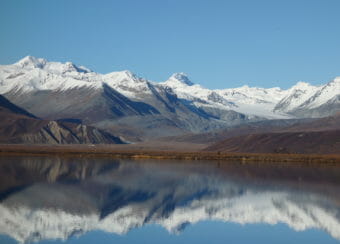
Gulkana Glacier, here seen from Summit Lake off the Richardson Highway, is shrinking back into the mountains of the Alaska Range. (Photo by Ned Rozell.)

Glaciers worldwide are withering. Half of them will disappear by the end of this century, and much of the ice lost will vanish from mountains in Alaska, scientists say.

Authors of a recent cover story in the journal Science used high-performance computers to predict the fates of 215,547 glaciers on Earth. They excluded the great ice sheets of Greenland and Antarctica.

Their conclusions: Goodbye to Bird, Crow, Daisy, Dogshead, Polychrome, Prospect, Red, Rex, Shakespeare and Spoon glaciers by the year 2100. If not earlier.

True, most of us won’t be here in 77 years either, but warmer air temperatures will probably erase those Alaska glaciers and a few dozen more — including an Anchorage water source named Eklutna Glacier — before then.

A visitor stands on the shore of a lake near Worthington Glacier, which is accessible by the Richardson Highway not far from Valdez. (Photo by Ned Rozell.)

UAF Geophysical Institute scientists including David Rounce (now at Carnegie Mellon University in Pittsburgh) and Regine Hock are the lead authors on the study.

Using supercomputers at UAF, they forecast the future of the world’s glaciers under a few different warming scenarios, each of which humanity is currently speeding past.

“Even under the very optimistic scenario corresponding to the goal of the Paris agreement, about half of the glaciers are expected to be lost by the end of the century,” Hock said.

In their data-set, the scientists looked at glaciers all over the world, in regions they called Arctic Canada North, Central Asia, and Russian Arctic, among a dozen others. Alaska is one of the places with the most ice to lose. Alaska’s glaciers have already shrunk in elevation three feet each year during the past two decades.

Alaska glaciers are huge contributors to global ice loss because there are so many of them, and a lot of them are huge. Many Alaska glaciers are also at low elevations where gravity conveyor-belts their ice into the melting zone.

If the planet’s temperatures continue on this trajectory, favorite roadside glaciers will slip out of sight. This will likely play out in most Alaska glacier-towns, including Juneau, by the end of the century.

“Mendenhall Glacier may not disappear completely, but it will certainly retreat so much that it won´t be visible from the visitor center, even for the (most optimistic) scenario,” Hock said.

Visitors take images of Mendenhall Glacier near Juneau in summer 2022 from inside the Mendenhall Glacier Visitor Center. (Photo by Ned Rozell.)

Aside from aesthetics, why does the disappearance of glacier ice matter? Hock said that all that fresh water now dumping into the Gulf of Alaska will affect ocean circulation and ecosystems.

Also, worldwide seas could rise half a foot from the loss of glacier ice by 2100.

Rounce compiled a list of more than 200 named Alaska glaciers that will be gone by the end of the century if the planet’s average yearly temperature rises 4 degrees C from what it was before the Industrial Revolution. That’s a lot of goodbyes.

Here’s the list:


  • Adams Glacier
  • Aho Glacier
  • Alexander Glacier
  • Anderson Glacier
  • Andrei Glacier
  • Andrews Glacier
  • Annin Glacier
  • Arey Glacier
  • Baby Glacier
  • Baker Glacier
  • Baldwin Glacier
  • Barnard Glacier
  • Bear Lake Glacier
  • Bench Glacier
  • Bettles Glacier
  • Bird Glacier
  • Boundary Glacier
  • Bravo Glacier
  • Brilliant Glacier
  • Burns Glacier
  • Cantwell Glacier
  • Canyon Glacier
  • Cap Glacier
  • Carl Glacier
  • Cascading Glacier
  • Casey Glacier
  • Chamberlain Glacier
  • Charpentier Glacier
  • Cheja West Glacier
  • Chigmit North Glacier
  • Chigmuit South Glacier
  • Chikuminuk Glacier
  • Clara Smith Glacier
  • Claremont Glacier
  • Clark Glacier
  • Clear Glacier
  • Coal Glacier
  • College Glacier
  • Concordia Glacier
  • Contact Glacier
  • Corbin Glacier
  • Crab Glacier
  • Crow Glacier
  • Cul-de-sac Glacier
  • Daisy Glacier
  • Dartmouth Glacier
  • Deadman Glacier
  • Detached Glacier
  • Dickinson Glacier
  • Dixon Glacier
  • Dogshead Glacier
  • Doroshin Glacier
  • Downer Glacier
  • Eagle Glacier
  • Eaglek Glacier
  • East Alapah Glacier
  • East Yakutat Glacier
  • Echo Glacier
  • Eklutna Glacier
  • Exit Glacier
  • Explorer Glacier
  • Falling Glacier
  • Ferguson Glacier
  • Fleischmann Glacier
  • Flute Glacier
  • Fourth Glacier
  • Girdled Glacier
  • Gooseneck Glacier
  • Gracey Creek Glacier
  • Gray Glacier
  • Greenpoint Glacier
  • Heiden Glacier
  • Henry Glacier
  • Hidden Glacier
  • Hogback Glacier
  • Holyoke Glacier
  • Hubley Glacier
  • Hummel Glacier
  • Hunter Creek Glacier
  • Icicle Glacier
  • Indian Glacier
  • Irene Glacier
  • Johnson Glacier
  • Johnson Glacier
  • Johnson Glacier
  • Kachemak Glacier
  • Kadachan Glacier
  • Kashoto Glacier
  • Killey Glacier
  • Kings Glacier
  • Koniag Glacier
  • Kulavok Glacier
  • Lafayette Glacier
  • Lare Glacier
  • Latouche Glacier
  • Le Blondeau Glacier
  • Leaking Glacier
  • Lechner Glacier
  • Leffingwell Glacier
  • Lemon Creek Glacier
  • Little Jarvis Glacier
  • Loomis Glacier
  • Lowell Glacier
  • Marshall Glacier
  • Martin Glacier
  • Maynard Glacier
  • McCall Glacier
  • McCallum Glacier
  • McCarthy Creek Glacier
  • McCarty Glacier
  • McCune Glacier
  • Metal Creek Glacier
  • Milk Glacier
  • Mineral Creek Glacier
  • Mint Glacier
  • Morse Glacier
  • Mother Goose Glacier
  • Muth Glacier
  • Neacola Glacier
  • Nelson Glacier
  • North Baird Glacier
  • Nugget Creek Glacier
  • Ogive Glacier
  • Okpilak Glacier
  • Organ Glacier
  • Patton Glacier
  • Pedro Glacier
  • Pegmatite Glacier
  • Penniman Glaciers
  • Polychrome Glacier
  • Popof Glacier
  • Porcupine Glacier
  • Prospect Glacier
  • Ptarmigan Glacier
  • Puget Glacier
  • Rainbow Glacier
  • Ranney Glacier
  • Rasmuson Glacier
  • Raven Glacier
  • Red Glacier
  • Rex Glacier
  • Riley Creek Glacier
  • Ripon Glacier
  • Roaring Glacier
  • Romer Glacier
  • Saksaia Glacier
  • Saussure Glacier
  • Schubee Glacier
  • Schwanda Glacier
  • Scidmore Glacier
  • Seefar Glacier
  • Seth Glacier
  • Shakespeare Glacier
  • Shephard Glacier
  • Shiels Glacier
  • Silver Glacier
  • Skee Glacier
  • Slope Glacier
  • South Glacier
  • Split Glacier
  • Split Glacier
  • Split Thumb Icefall
  • Spoon Glacier
  • Stony Glacier
  • Sumdum Glacier
  • Sunrise Glacier
  • Surprise Glacier
  • Talkeetna Glacier
  • Tasnuna Glacier
  • Texas Glacier
  • The Knife Creek Glaciers
  • Thiel Glacier
  • Through Glacier
  • Thumb Glacier
  • Tigertail Glacier
  • Tikke Glacier
  • Tired Pup Glacier
  • Tkope Glacier
  • TlikakilaNorthFork
  • Toboggan Glacier
  • Tok Glacier
  • Toklat1
  • Toklat2
  • Tommy Glacier
  • Tongue Glacier
  • Tonsina Glacier
  • Trail Glacier
  • Truuli Glacier
  • Tsina Glacier
  • Twentyseven Mile Glacier
  • Twin Glacier
  • Ultramarine Glacier
  • Villard Glacier
  • Warm Creek Glacier
  • Wedge Glacier
  • West Alapah Glacier
  • West Gulkana Glacier
  • West Yakutat Glacier
  • Westbrook Glacier
  • White Glacier
  • Whittier Glacier
  • Williams Glacier
  • Windy Glacier
  • Yuri Glacier

Kodiak rocket crashes at spaceport after launch

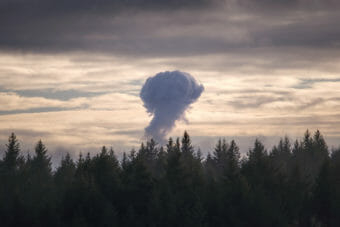
A black plume was visible from the city of Kodiak shortly after ABL’s launch attempt on Jan. 10, 2023. (Photo by Brian Venua/KMXT)

A rocket launched from Kodiak’s spaceport Tuesday afternoon crashed shortly after ignition, with damage at the spaceport confirmed by the rocket’s creator.
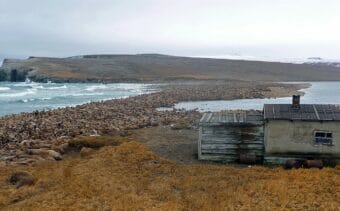
ABL Space Systems confirmed that its RS-1 rocket experienced an anomaly during liftoff from the Kodiak Pacific Spaceport. All nine of the rocket’s engines shut down prematurely and it did not reach orbit. The rocket then “impacted the pad and was destroyed,” the company said on Twitter.

A black plume of smoke was visible from the city of Kodiak, rising from the area near the spaceport complex on Narrow Cape around 2:30 p.m. Tuesday, shortly after the rocket’s planned takeoff time of 2:27 p.m.

A spokesperson for ABL said via email that all personnel on the ground at the complex were safe, although there is damage to the launch facility. As of 9 p.m. Tuesday, the company said via Twitter that “fires have subsided” at the complex.

The company also tweeted, “This is not the outcome we were hoping for today, but one that we prepared for. We’ll revert with additional information when available. Thanks to all for the support.”

ABL said it was going through its anomaly response procedures in coordination with the Pacific Spaceport Complex and the Federal Aviation Administration.

This would have been ABL’s first successful launch of its RS-1 rocket – the company has been trying to launch from the Kodiak Pacific Spaceport Complex since the fall.

Alaskans invited to tell Congress what climate change means for them

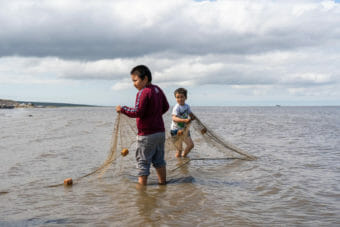
Two children fish along the banks of Baird Inlet on July 20, 2020 in Mertarvik, Alaska. Residents of Newtok have been slowly relocating to Mertarvik as coastal erosion makes Newtok unsafe. (Photo by Katie Basile/KYUK)

Across Southeast Alaska, heavier rains, changing snowfall, warming waters and ocean acidification are making profound changes to the environment.

In the Alaska chapter of the upcoming National Climate Assessment, a team of scientists, educators, and community leaders from across the state are asking what those changes mean for people. Until Jan. 27, they’re inviting Alaskans to help answer that question by submitting feedback on a draft of the assessment.

Alyssa Quintyne, a community organizer with the Alaska Center and one of the co-authors of the Alaska chapter, said it’s a way to draw attention to the everyday impacts of climate change.

“It’s an opportunity for us regular-degular people to essentially tell the story of what is happening in our own state, to other states and to Congress. So it’s a pretty big deal,” she said.

The National Climate Assessment is a congressionally mandated research report organized by the U.S. Global Change Research Program. It doesn’t mandate any specific actions, but Quintyne says it will help guide people working on climate solutions.

“Lawmakers who are looking at this assessment and thinking about, ‘Oh, wow, I didn’t know that was happening in my seat. What are actions that I could possibly take?’ Researchers who say, ‘Oh, hey, there’s a gap in something that we are not studying.’ So we can come up with some real solutions, and services,” she said.

Henry Huntington, a researcher with the Ocean Conservancy and the report’s lead author, said this version of the assessment focuses on humans more than ever before.

“Our charge, our assignment, has been altered a bit, which is to focus more on the society side. And what does this mean for people? What does this mean for people around Alaska, rather than, you know, getting into the details of the biophysical system,” he said.

The draft will go through a peer-review process, where researchers will help to refine and add to the climate assessment, but Huntington says he hopes that a more diverse group of Alaskans will submit their feedback this time around.

“What the public comment can do that the academic review can’t do is to tell us, are we making sense? Are we speaking to a wider audience?” he said. “We’d like this to be a report that has some relevance and speaks to people who it affects through livelihoods, through their recreation, through their interests.”

Huntington says the draft chapter moves beyond the natural environment to include discussions of COVID-19, housing discrimination, healthcare, crisis response and even internet access.

He says it’s important to highlight these new topics because climate change doesn’t happen in isolation. He hopes that the assessment will show how the changing environment could make existing social vulnerability and inequality worse.

“It’s that idea that climate change is happening within the broader social context that’s already there. And it’s going to add more stress to what we’re already experiencing,” he said.

Quintyne hopes that the comments submitted this month will help make the climate assessment the most useful resource it can be.

“We’re doing it for education, we’re doing it for awareness, but we’re also doing it for empowerment,” she said. “So people can make the best informed decisions moving forward, whether they be someone like me, whether they be the president, whether they be a fisher out on the Yukon.”

Alaskans who wish to review the draft submit comments can do so online. Comments are due by Jan. 27 at 8 p.m.

A wilderness guide stumbled upon Alaska’s northernmost glacier — one not marked on any map

The Shublik Mountains stretch parallel to the Arctic coast in March of 2022, about 6 miles from the northernmost glacier in the U.S. (Photo by Matthew Sturm)

The Shublik Mountains stretch parallel to Alaska’s Arctic coast, with rocky ridges surrendering to miles and miles of North Slope tundra. Talus and boulder fields, as well as occasional short willows, cover the stark landscape, but tucked in between slopes is a glacier — one that, as it turns out, is not marked on a map and is the northernmost in the country.

“Here, in 2022, when it feels like everything has already been discovered, there’s a glacier that doesn’t show up anywhere,” said Zachary Sheldon, who owns Alaska Guide Co. based in Valdez. He was the first person to identify that the glacier wasn’t recorded on a map. “I’m a bit of a glacier nut so it excites me,” he said.

Located at 69.50912, -145.51683, the glacier is 30 miles from the coast and 10 miles northwest of the Brooks Range. According to a USGS publication, glaciers in Alaska haven’t been found north of Brooks Range.

“It is the northernmost glacier in the U.S.,” said U.S. Geological Survey glaciologist Louis Sass. “It isn’t registered or recorded.”

The glacier is around 1/10 of a square mile — or between 50 and 60 acres, said Matthew Sturm, a geophysics professor with the University of Alaska Fairbanks’ Geophysical Institute and the leader of its Snow-Ice-Permafrost Group. Being so small, the glacier is at high risk of disappearing.

“Throughout the world, the smallest glaciers are disappearing due to climate change,” Sturm said. “And here’s this little glacier way up north. … When they were counting the kids in the classroom they forgot to count this little guy.

“It’s just nice to know it hasn’t melted away.”

Discovery

When Sheldon moved to Alaska 15 years ago, he came across the Dictionary of Alaska Place Names, which lists features of the state’s landscape. About 13 years ago, Sheldon started putting all locations from the book into a digital database to catalog the geography of Alaska. Today, the 40-year-old wilderness guide is still working on the same database. He also built a map showing the names of slope runs, the ratings of ice climbs and other details useful to outdoor enthusiasts who want to quickly get a sense of the area.

Last month, Sheldon was tracing the outlines of glaciers so he could have an accurate glacier layer on his map. He was looking at the glacier database and the satellite images from far out. Then he would take a closer look — and that’s how he found the glacier up north.

A screenshot from Caltopo shows the northernmost glacier, which is in the Shublik Mountains and not registered in glacier databases. (Photo courtesy of Caltopo)

Sheldon checked the GLIMS Glacier Database, or the Global Land Ice Measurements from Space, as well as the USGS database and topographic maps but found no record of the glacier.

“This glacier doesn’t exist anywhere, which is what caught me,” Sheldon said.

In the early 2000s, glaciers in this area of the Shublik Mountains were added to the Randolph Glacier Inventory, a global database of glacier outlines, said Sass with USGS. The process relied on fairly coarse satellite imagery, and small features the size of the glacier found by Sheldon show up as 15 by 30 pixels.

“We don’t have the ability to manually verify that the inventory is correct or complete,” Sass said. “This means that the existing inventory is likely missing hundreds or even thousands of glaciers, and likewise, it may be including many features that are not actual glaciers or that are no longer glaciers.”

An effort is underway to improve the global database of glaciers using the higher-resolution satellite images available now, Sass said. However, with such a high volume of data, it isn’t really possible to add a single outline to the existing inventories.

‘We know it’s a glacier’

Located this far north, the glacier is probably covered with snow most of the year, so it could have been easy to confuse it with a snowfield, Sheldon said. But the satellite image clearly shows the formation’s glacial features.

The main difference between a glacier and a snowfield is that a glacier is made of solid ice and has internal movement, while a snowfield is made of porous snow and stays in place, said Sturm with the Geophysical Institute.

“The snowfield doesn’t move,” he said. “It changes size, year to year, but it’s just there — there’s no internal flow — whereas glaciers are flowing.”

A satellite image, most likely taken in late summer, shows the lines in the ice of the glacier, indicative of flow, Sturm said.

“The metamorphism of the ice creates foliation like the pages of a book, so we know it’s a glacier,” Sturm said. “If you walked up that thing, you can be walking on what felt like rock most of the way, then you’d walk on glacier ice, then you get to the seedy upper end of it and it’d be snow.”

Most of the glacier is shaded by the mountains, which helps slow the melt. The tongue of the glacier is covered with debris that can also shield the glacier from melting.

The northernmost glacier in the U.S.

What makes the glacier discovery even more exciting to Sheldon is that it’s so far north. While glaciers are not uncommon at much higher latitudes — for example, in Greenland or in Canada — those northern formations are typically surrounded by water that helps them get new snow, Sheldon said.

Sturm said that besides the availability of water sources, better storm tracks also nurture glaciers.

“This is an interesting glacier because it’s neither high nor in a place where there’s a lot of snow,” Sturm said.

But glaciers in the Brooks Range — and north of it — are different from the glaciers farther south in Alaska, Sass said. None of them get much precipitation in the winter, but in summer, the conditions can be fairly wet. And the Saddlerochit and Shublik ranges stick farther north and get slightly more precipitation than ranges farther east, Sass said.

“In the late summer, once the sea ice is out, the north slope of the Brooks Range can be very wet,” he said. “The determining factor for glacier existence up there is whether or not that late summer precipitation falls as snow or rain. That is mostly determined by elevation. That particular feature is only at 4,500 feet, but that is high enough when you are that far north.”

After his finding, Sheldon added the glacier to his map, labeling it as “Northernmost.” He contacted GLIMS, suggesting adding it to their database, but he shared a sense of urgency to do more — for example, to photograph the glacier this summer and take a core sample from it to get it dated.

“Glaciers, 99% of them aren’t growing,” Sheldon said. “Its time is limited.”

This story originally appeared in the Anchorage Daily News and is republished here with permission.

Intense meteor brightens Southcentral Alaska’s winter solstice

A bright white light in the sky, seen from a doorbell camera on a house along a snowy street.
A meteor spotted early Wednesday. (Courtesy Lisa Switzer)

The winter solstice may be short on sunlight, but Alaskans saw a different kind of illumination Wednesday from a falling meteor widely seen across Southcentral Alaska.

Many people in the Talkeetna area said they heard the meteor as it passed overhead. Multiple people posted comments on social media about it, too, describing the meteor as amazing and fast, and saying it lit up the whole sky. Some also posted video footage from their home security cameras, showing a brilliant blue flare.

(Courtesy of Joe Tate)

National Weather Service Climatologist Brian Brettschneider’s Nest door camera recorded the sight in Anchorage’s predawn skies, heading from north to south just before 6 a.m.

Reached by phone Wednesday morning, Brettschneider said the meteor was the first one he’s seen on his doorbell camera.

“This is the most impressive one I’m familiar with in the area,” Brettschneider said.

Meteors are debris from asteroids, comets or other celestial bodies. According to NASA, most meteors burn up in Earth’s atmosphere. Among the nearly 50 tons of debris that descends toward Earth each day, a few rocks can reach the ground and become meteorites.

University of Alaska Fairbanks physics professor Mark Conde said Wednesday that meteors travel at a minimum speed of just under 7 miles per second.

Most are dust particles, but meteors large enough to be heard from the ground are bigger. Conde estimated the size of Wednesday’s rock at somewhere from a grape to a golf ball.

“I think there are many objects that size hitting the Earth every day, but most of them go unseen because either it’s daytime or there’s just no one there to look,” Conde said.

The meteor may be from the Ursid meteor shower, which began Dec. 17 and is expected to peak Thursday and Friday. According to Space.com, the Ursids – pieces of debris from the comet 8P/Tuttle – are typically a low-intensity shower, more widely visible this year due to coinciding with a new moon.

KTNA’s Philip Manning contributed reporting to this story.

Site notifications
Update notification options
Subscribe to notifications