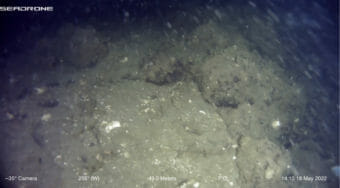
A view of the weir from an underwater drone. (Image courtesy of Sealaska Heritage Institute)
An underwater discovery on the west side of Prince of Wales Island shows that people have lived in what we now know as Southeast Alaska for at least 10,000 years. And scientists say it may support the theory that the Pacific coast was first settled by people traveling along the shoreline, living off the sea.
Canadian archeologists, in partnership with Sealaska Heritage Institute, found the weir in Shakan Bay — the culmination of a search that started when a weir-like shadow showed up on a sonar image more than a decade ago.
Fish weirs are barriers used to trap or redirect fish. They’re some of the earliest forms of fish traps, and they’re still used today. The team was able to date the submerged weir based on when it would have been at sea level — at least 10,000 years ago.
Sealaska Heritage Institute President Rosita Worl says the weir not only shows that Indigenous people were living in Alaska that long ago, it reveals how North America’s earliest communities could take root here.
“Generally scientists think that you have to have agriculture to develop a civilization,” said Worl. “I think what we see here is that the Indigenous people developed the technology to harvest significant numbers of fish. So you can see the beginning of what turns out to be a very complex culture.”
She says the discovery also supports the coastal migration theory over the other main theory — that the earliest peoples traveled on an interior land route.
“It was previously thought that the occupation of the Americas was through an ice free interior corridor,” Worl said. “But that corridor wasn’t opened up until later.”
Archeologist Kelly Monteleone says the discovery helps rebut a main argument against the coastal migration theory, which is that there aren’t a lot of archaeological sites to prove it.
“But that’s because we haven’t really looked,” she said. “The amount of work we’ve done is so small in comparison to what’s been done terrestrially.”
Monteleone has been looking for the weir for more than a decade, when something that looked like a fish weir showed up on a sonar image.
“Until we could actually get eyes on it, we couldn’t confirm it was really a weir,” Monteleone said.
She got funding to search for the weir in 2012 but didn’t find it. She’d been looking in the wrong place. This year, she found it right away.
“I felt so validated after spending, you know, 12 years of my life talking about this potential fish weir.,” she said.“I have presented on this all over the world. So to finally find it was just so exciting.”.
She found the weir by piloting an underwater drone outfitted with a camera. Video footage shows a jumble of shell and algae-covered rocks. Moneteleone says she knows it’s a weir because rocks wouldn’t naturally be in stacks or formations like the ones they found underwater.
She’ll continue her underwater research with the Sealaska Heritage Institute in Southeast Alaska next summer. There’s some sonar evidence for shell middens — piles of shells that indicate human presence and often contain artifacts. She’ll be looking for those and more archaeological sites that explain how and when the earliest people got here.
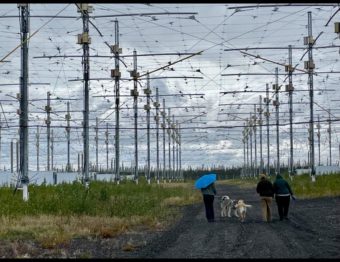
During a recent open house, visitors walk their dogs beneath an antenna field used to heat the upper atmosphere during space physics experiments at a facility known as HAARP between Glennallen and Tok. (Photo by Ned Rozell.)
In this wild place where dump truck drivers once tipped load after load of gravel onto the moss to make roads and building pads, scientists rolled open an iron gate one recent Saturday afternoon.
They invited in conspiracy theorists, reality-TV hosts and salmon fishermen from Chistochina to the grounds of a mysterious antenna field. It’s a facility that some claim has caused caribou to walk backward. It has been rumored to activate earthquakes and to hold human souls in a sort of northern purgatory.
Scientists were a bit to blame for all the allegations of weirdness out here between the Copper and Gakona rivers. First off, they used an acronym to name it — HAARP, which stands for High-frequency Active Auroral Research Program.
That acronym added to the mystery of the field of antennas, which can heat a region of space far above our heads with radio waves powered by five powerful diesel generators, each the size of a fuel truck.
The science of studying a region we can’t see by perturbing it with enough electricity to power a small city — located in a place where wolves and bears pad along silently across its few gravel roads — is hard to wrap your head around.
A few people really do understand HAARP, though. They were standing on those smoothed piles of gravel that Saturday, when the foreboding metal gate clicked open.
My former boss, Sue Mitchell (now retired), initiated this “open house” a few years ago. She was there again in 2022, greeting people at the first table of the first building visitors walked into. I asked her why.
“So we could be as transparent and open as possible,” she said. “Throw open the gate, and show people what’s here.”
When she worked at the Geophysical Institute, Mitchell took the considerable hit of answering phone calls about the HAARP facility. She had no answers for people who were sure the antenna field was somehow controlling their minds.
“My hope has been, by showing people what really goes on, the facts will speak for themselves,” she said. “That doesn’t always work. People sometimes make decisions emotionally, not always based on the facts.”
It doesn’t help when the facts are so hard to understand. Here’s a try:
The antenna field at this 5,408-acre site, far from any Alaska town, was first a chunk of black-spruce forest and wetlands that U.S Air Force officials purchased from the Native corporation Ahtna in 1989. The idea was to use the location to build an over-the-horizon radar that would allow technicians to observe bombers or missiles that might be headed for America over the pole.
Due to the end of the Cold War, that radar was never built. Instead, Air Force workers installed a field of 18 antennas that broadcast high-frequency waves up to the ionosphere, the region of space that is home to the aurora.
The antenna field over the years grew to 180, each powered by two transmitters. A researcher has called it the world’s largest ham radio.
The upper atmosphere-heating facility named HAARP is located on about 5,000 acres between the small Alaska towns of Glennallen and Tok. (Photo by Ned Rozell.)
HAARP is a group of high-frequency radio transmitters (in the ham-radio band) powered by five diesel generators — four from tugboats and one from a locomotive. When activated, the transmitters send a focused beam of radio-wave energy into the ionosphere, 50-600 miles overhead.
Since it opened in 2003 with funding the late Sen. Ted Stevens helped secure, HAARP has hosted many scientists doing basic science on the auroral zone.
Others used it to do applied research for the military. In one study, researchers used the antenna array to heat a part of the ionosphere that in turn acted as a low frequency antenna that could send an ocean-penetrating signal to a submarine. That ping could tell a submarine captain to surface in order to receive conventional radio communications.
This place almost fell to bulldozers in 2012, when the Department of Defense wanted to get out from under the cost of running the facility — which includes about $250,000 each year just to heat the dozens of transmitter buildings in the winter.
About then, Bob McCoy, the director of the Geophysical Institute and a space physicist himself, lobbied for the institute to take over the site. Scientists rallied around him, as did the university president at the time.
At the same time, leaders of the National Research Council held a workshop about HAARP. They wrote a 70-page report on science that could be accomplished with the facility.
“Even though it’s esoteric and hard to understand, it’s the best,” McCoy said in 2015.
The university administration gave McCoy a loan to keep HAARP running. He gambled that he could pay it back by drumming up business from scientists. They would use the transmitters and pay for it with grants from funding agencies. That gamble is paying off, with a new 5-year grant from the National Science Foundation.
McCoy was there at the entrance to HAARP, too, answering questions from people like Michael Lewis of Anchorage.
Geophysical Institute Director Bob McCoy poses with visitor Michael Lewis from Anchorage during a recent open house of the ionosphere-heating facility known as HAARP between Glennallen and Tok. (Photo by Ned Rozell.)
Lewis, who wore a baseball hat he had covered with tin foil (apparently for fun), said he had always wanted to see the facility. McCoy posed for a photo with him.
Visitors were allowed all over the grounds of the facility during the open house. Swampy ground limited them to driving and walking the few miles of road and gravel pad, including the dormant transmitter array.
Scientists and engineers were stationed at strategic points to explain what the complicated equipment did when it was on. A few guests were ham-radio enthusiasts, but most seemed to be just curious people.
After the five-hour open house ended, the black gate shut behind the final car. Then, HAARP reverted to what it is most of the year: a silent pile of gravel sprouting with antennae. There, songbirds on their way south flitted through the spruce and on the ground beneath the antenna masts.
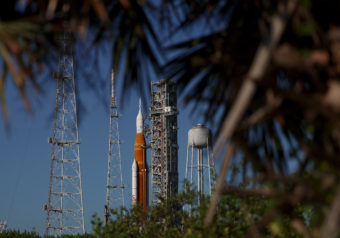
NASA’s Artemis I rocket sits on launch pad 39-B after the launch was scrubbed at Kennedy Space Center on September 06, 2022 in Cape Canaveral, Florida. (Photo by Joe Raedle/Getty Images)
NASA says it hopes to attempt another launch of the unmanned Artemis I moon mission later this month.
During a press conference on Thursday, space agency officials said they were eyeing Sept. 23 or Sept. 27 as possible dates.
The announcement came shortly after NASA scrubbed a planned launch over the weekend because of a recurring liquid hydrogen fuel leak.
“Certainly if they decide that is not the right thing to do, we obviously will support that and stand down and look for our next launch attempt,” said Jim Free, associate administrator of NASA’s Exploration Systems Development Mission Directorate.
Meanwhile, NASA engineers continue to repair the connection on the rocket where the liquid hydrogen leak was detected. Officials said they would conduct a tanking test to ensure the repairs were successful before any future launch.
“The team is making great progress. Morale is good. We’re still excited for this opportunity that we’ve got,” said Mike Bolger, manager of NASA’s Exploration Ground Systems Program.
Saturday’s cancelled launch was the second within a week. The first attempt to launch the rocket on Aug. 29 was also scuttled, due to what turned out to be a faulty sensor.
Artemis I is planned as an uncrewed flight test around the moon.
Copyright 2022 NPR. To see more, visit https://www.npr.org.
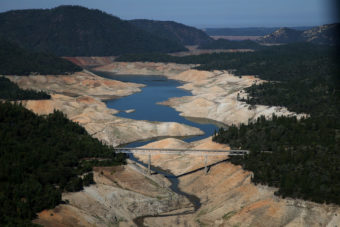
Data centers have become integral to a global economy that’s powered by digital information. However, many of the facilities depend on water to keep from overheating. That is further straining water resources in places like California, where Lake Oroville is almost dry due to severe drought that’s being fueled by climate change. (Photo by Justin Sullivan/Getty Images)
Data centers are springing up around the world to handle the torrent of information from the expanding web of devices ingrained in people’s lives and the economy. Managing that digital information gusher is big business. It also comes with hidden environmental costs.
For years, companies that operate data centers have faced scrutiny for the huge amounts of electricity they use storing and moving digital information like emails and videos. Now, the U.S. public is beginning to take notice of the water many facilities require to keep from overheating. Like cooling systems in large office buildings, water often is evaporated in data center cooling towers, leaving behind salty wastewater known as blowdown that has to be treated by local utilities.
That reliance on water poses a growing risk to data centers, as computing needs skyrocket at the same time that climate change exacerbates drought. About 20% of data centers in the United States already rely on watersheds that are under moderate to high stress from drought and other factors, according to a paper co-authored last year by Arman Shehabi, a research scientist at Lawrence Berkeley National Laboratory.
Yet relatively few companies have been willing to talk about the issue publicly because of the still-limited attention it gets. Sustainalytics, which assesses risks related to environmental, social and governance (ESG) issues, recently said it looked at 122 companies that operate data centers and found just 16% had disclosed information about their plans for managing water-related risks.
“The reason there’s not a lot of transparency, simply put, [is] I think most companies don’t have a good story here,” says Kyle Myers, a vice president at CyrusOne, a data center company.
The challenge comes down to a basic tradeoff companies face in trying to keep data centers cool, Myers says. They can either consume less water and use more electricity. Or they can use less energy and consume more water.
“Water is super cheap,” Myers says. “And so people make the financial decision that it makes sense to consume water.”
Facebook parent Meta, which operates a data center in Prineville, Ore., is one of several big tech companies that have promised to put more water back into the environment than they consume by 2030. (Photo by Andrew Selsky/AP)
In addition to their own cooling needs, data centers rely on power plants that often require a lot of water to operate.
Pushback is already emerging
In the United States, there are about 2,600 data centers, many of which are clustered around Dallas, the San Francisco Bay area and Los Angeles, according to a 2021 report by the U.S. International Trade Commission.
All told, a mid-sized data center consumes around 300,000 gallons of water a day, or about as much as 1,000 U.S. households, says Shehabi of Lawrence Berkeley National Laboratory. Their direct, on-site consumption ranks data centers among the top 10 water users in America’s industrial and commercial sectors.
Water is “front and center on [the industry’s] radar, for sure,” says Todd Reeve, CEO of Business for Water Stewardship, which works with companies on water issues.
Recently, some data center companies have faced opposition from communities and water conservationists. In 2015, the city of Chandler, Ariz., passed an ordinance allowing officials to turn down requests for new water uses if they are not aligned with the city’s plan for economic development. And in 2019, Google agreed to limit its use of groundwater in South Carolina after a two-year fight with local groups that had raised concerns that aquifers were being depleted.
Companies “are developing tactics and strategies, in some cases changing their ideas and their plans for where they will operate or where they will construct data centers, in large part because of the emerging water issues,” Reeve says. However, many companies won’t talk about their activities, he says, in part because “this is a new and upcoming issue, [and] our knowledge of water stress is evolving very quickly.”
Companies say they’re looking for solutions
The impacts of worsening drought are being felt throughout the global economy. Rivers that serve as crucial trade routes in Europe are running low. Factories in China have closed to save water and electricity. And American industries that rely on water from the Colorado River could see their supplies shut off amidst a decades-long drought.
“Which sector is going to get the water? How [is] water going to be prioritized? So, these are the types of considerations, I believe, that will be important to consider more and more in the future,” says Kata Molnar, a water expert at Sustainalytics.
Among those in the data center industry willing to speak out are some of the world’s biggest tech companies.
Google, Microsoft and Facebook parent Meta have all said they will replenish more water than they consume by 2030. Approaches being considered include working with local water utilities, better recycling of water data centers use and less water-intensive cooling methods.
“Minimizing our water use, being transparent with our water data, and restoring water in high water stress regions are key pillars of our water stewardship program,” Meta said in a statement. The company says most of its data centers reduce water consumption by using outdoor air for cooling.
In addition to using new technology, some experts have said companies can reduce their environmental footprint by building data centers in places with plenty of water. For now, however, real estate decisions appear to be primarily dictated by where customers are located.
“When we’re siting, we look at the availability of power and we look at water,” says Myers of CyrusOne. “But I don’t think we’re close to a world where we’re just going to set up in an area that doesn’t have a natural [business] advantage for data centers.”
As long as that’s the case, the industry will have to innovate its way out of a problem that is only getting worse. In the next decade, Myers says, “water is going to be king.”
Reeve of the Business for Water Stewardship insists companies are preparing accordingly, albeit behind the scenes in many cases.
“I do think there’s more than just what meets the eye,” Reeve says. “There’s a lot of innovation in there that just is not fully disclosed or available to the public.”
Copyright 2022 NPR. To see more, visit https://www.npr.org.
Harry Potter Lake, at the top of this drone photo, after most of its water drained into a nearby creek on Alaska’s North Slope in early July 2022. (Photo by Allen Bondurant)
“Lakes seem, on the scale of years or of human life spans, permanent features of landscapes, but they are geologically transitory, usually born of catastrophes, to mature and die quietly.” — George Evelyn Hutchinson, “A Treatise on Limnology,” 1957.
Harry Potter Lake did not die quietly. Water in the basin on Alaska’s North Slope cut through a 30-foot strip of tundra in early July 2022. The lake then roared into a creek. The creek swelled like a python for a day, robbing Harry Potter Lake of the majority of its water.
Scientists know this because they were watching the lake with game cameras and satellite images.
Chris Arp of the University of Alaska Fairbanks Water and Environmental Research Center named Harry Potter Lake because his daughter was enjoying the book series when he first encountered the lake. It also somewhat resembled a wizard’s hat when seen from above.
Arp and other scientists were monitoring the lake because it’s in an area oil companies are considering for development. The lake was large enough that while standing on one side of the water-filled oval in that flat, buggy landscape, you could not see the far shore.
Harry Potter Lake, at the top of this photo, as it looked four years ago, perched 10 feet above and 30 feet away from the creek that in 2022 received most of its water. (Photo by Chris Arp)
During field work four years ago, Arp noticed that the lake basin was perched 10 feet above the creek level. If gravity had its way, lake water would some day make it into the creek.
Arp noticed a trickle of water between the lake and the river in summer 2021. When he returned this summer, the water was doing its thing.
“By late June that water had begun to cut a major niche, which increased the flow and caused it to erode even faster,” Arp said from Deadhorse after returning from the lake basin in mid-August. “We realized then it was going to go soon.”
Judy Kayaak Creek — the nearby stream that received all that water — flows into larger drainages that empty into the Arctic Ocean northwest of the village of Nuiqsut.
On July 7, 2022, the erosive power of the water cut a new channel, sending a torrent of lake water flooding into the creek.
Judy Kayaak Creek pirated almost the entire volume of Harry Potter Lake in about 24 hours. The creek raged with 100 times its normal volume during the peak flow.
“It was probably strong north winds in early July that ultimately pushed enough water over that outlet to trigger the failure,” Arp said.
Alaska’s treeless North Slope is peppered with lakes that have formed because of surface water that thaws frozen ground. Those lakes have emptied themselves for at least 10,000 years or so, leaving behind scars on the landscape and fertile places for new plants.
Drained lake basins make up more than half of the Arctic coastal plain, the part of the Alaska map that most resembles Swiss cheese.
The disappearance of Harry Potter Lake is “kind of a tree falling in the forest type of thing,” according to Arp. Rarely do people get to see it.
Meteorologists at the National Weather Service warned the residents of the village of Nuiqsut, who might have fish camps along the creek, to be watchful for the sudden pulse of water (which did no reported damage).
Other living things have noticed the absence of Harry Potter Lake. Arp flew over the basin one last time on Aug. 15. He noticed it was full of ducks, shorebirds and other waterbirds attracted for some reason to the ponded, muddy lake bed.
“It was kind of amazing how fast they moved in,” he said.
Crews carefully coiling more than 800 miles of subsea fiber-optic cable destined for the seafloor between Unalaska and Kodiak. (Photo courtesy of John Edge/GCI)
A group of federal officials is in Alaska this week to learn about the unique challenges the state faces when it comes to broadband connectivity.
Speaking at a broadband summit Tuesday morning in Anchorage, Assistant Commerce Secretary Alan Davidson told the audience that the new federal infrastructure bill passed in will send a lot of money to Alaska over the next five years to bolster broadband access.
Assistant Commerce Secretary Alan Davidson speaks at a broadband summit in Anchorage on Aug. 9, 2022. (Photo by Wesley Early/Alaska Public Media)
“This is a once-in-a-generation opportunity,” Davidson said. “People say that, but it’s quite true. These kinds of resources, they don’t come along very often. We’re going to spend tens of billions of dollars in this country. We’re going to spend billions here in Alaska, most likely.”
Alaska Republican U.S. Sen. Dan Sullivan coordinated Tuesday’s summit, bringing together state, tribal and federal officials to discuss the broadband internet in the state and the incoming funds. The infrastructure bill allocates $65 billion across the country to help ensure people have access to affordable, high-speed internet.
Alaska Federation of Natives co-chair Ana Hoffman said the federal funding could be a huge help in Alaska, which Davidson described as one of the least connected states in the country when it comes to broadband.
During one of the summit’s panels, Hoffman underscored the need to bridge the digital divide between Alaska and the rest of the nation.
“All the players have a chance to participate in this process and really bring solutions to our communities that are so desperate for them, and look forward to them,” Hoffman said. “It’s really bringing this first-class service to first-class people. And we deserve it.”
Davidson also announced an agreement between the National Telecommunications and Information Administration and the Bureau of Indian Affairs to streamline the permitting process for high-speed internet projects on tribal lands.
Gov. Mike Dunleavy signs a bill establishing an Alaska Office of Broadband to coordinate federal funds received by the state. (Photo by Wesley Early/Alaska Public Media)
Gov. Mike Dunleavy described the announcement as “huge.”
“You don’t want to start gearing up folks to be trained to be laying down fiber, to the tune of thousands of individuals, connecting some of the broadband and there’s no job yet because we’re still drawing out the permitting process,” Dunleavy said.
At the summit, Dunleavy also signed a bill that establishes an Office of Broadband, which will coordinate federal funding the state receives for broadband projects. The bill also establishes a statewide Broadband Advisory Board.
In addition to the summit, Sullivan is also accompanying the federal officials on trips to Bethel and other Yukon-Kuskokwim villages as well as Kodiak later this week. They already made stops in Fairbanks and Tanana.
Close
Update notification options
Subscribe to notifications
Subscribe
Get notifications about news related to the topics you care about. You can unsubscribe anytime.