Science & Tech

An engineer from Alaska is helping NASA send humans back to the moon — and maybe to Mars

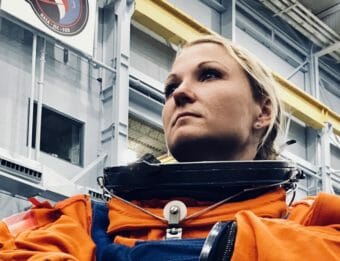
NASA Crew Systems Engineer Jessica Vos (NASA)

The first rocket launch in NASA’s mission to send humans back to the moon — and hopefully, someday, to Mars — blasts off next month, and one of the people working on it got her start in Alaska.

Jessica Vos is originally from Anchorage and a Chugiak High School graduate. Now she’s the crew systems engineer for NASA’s Orion program, under the Artemis campaign.

Vos says her job is very human-focused, as she and her team work to provide astronauts traveling from Earth to the moon and back again with everything they need for a successful mission.
Listen:

The following transcript has been lightly edited for clarity.

Jessica Vos: So I do like to liken to it unto, you know, if you were to take a camping trip, like car camping. You’ve got a lot of stuff that you can pack into this vehicle and a lot of different configurations that you’re probably going to move between. You’ve got a launch configuration and an orbit configuration, and then reentry and post-landing configurations. So very similar to how you would pack your car to get to your camping location, and then once you get there, you unpack it and you you’ve set up your (camp) and, “Hey, we’re gonna stay here for a week,” and then you do day hikes from there. So the type of equipment that you bring is, you’ve got things that you need nominally, but then you’ve also got emergency medical kits, and you’ve got potentially ways to put out a fire or compasses to recover yourself from getting lost in the woods. Things of that nature, right?

Casey Grove: Well, how did you get started here? And I guess maybe I should even back up from that, I heard you’re from Alaska originally. So tell me about that, where are you from, and also as part of that, how did you get into science and engineering?

Jessica Vos: Of course, yeah, so I was actually born at Providence Hospital in Anchorage. We lived in Anchorage, we lived in a trailer park area right off of Muldoon. And at about, I think it was about third grade, maybe nine years old or so, we moved out to Chugiak. We lived in the North Woods neighborhood. And I remember the sign, and it said, “Welcome to North Woods, with fully paved streets and plumbing.” Like it was a super remote neighborhood, but they were, you know, developed enough to attract people to come and live there.

And yet our streets still had a dirt road at the end with a what we called a frog pond, which was just a big lake. It all, of course, has been developed since then. But back when we lived there, it allowed for us to have some pretty dark skies. And my dad was always into astronomy. He had several telescopes in the house and had stacks of Scientific American magazines around all the time. So rather than what many youngsters are doing today, and picking up their phones or iPads and going to YouTube and learning about this stuff, I had a Scientific American magazine that I was fascinated by. And so I’d asked my dad questions, he’d pull out his telescope, which by the way, one of those telescopes was so large that it took up half of our garage. We had a two-car garage, but you can only put one car in it, because the other half belongs to this ginormous telescope.

Casey Grove: That’s awesome. So you were talking a little bit already about the the mission that you’re working on and your part in it, that has aims to put people back on the moon. I wonder what sort of things are different now that we’re trying to do this, you know, so many decades later? What has changed? Or what challenges still exist that you’re running into?

Jessica Vos: Yeah, that’s a great question. So when the Apollo program, or the Apollo campaign, was put in place in the ’60s, there was a very specific goal. You know, it was very politically driven. And man, there were some tough lessons learned there. You know about the Apollo 1 fire, I’m sure. And what we learned in that program is super essential and carries right into what we’re doing right now from an Artemis architecture or the Artemis campaign. However, the end goal is a little bit different. We’re really, this time when we’re going to the moon, it’s about how do we develop a system, more sustainable architecture, so that we can really live and work in cislunar space and on the lunar surface, very similar to how we’ve done with the International Space Station for the past 20 something years, right? It’s been continuously manned now, hanging out in low-earth orbit, doing all kinds of awesome science. But to go back to that camping analogy, that’s like putting your tent out in your backyard, right? If anything goes wrong, if it rains too hard, or your lantern goes out, or you don’t have the right stuff, you just come inside. Being farther away from Earth, it’s like that difference between putting your tent in your backyard versus putting your tent, you know, several hundred miles away next to a river, versus putting a tent on the top of Everest. So in our minds, that tent on top of Everest is more like our Mars expedition.

Casey Grove: Recently you you were talking to some kids at the Alaska Museum of Science and Nature, in the Mountain View neighborhood here in Anchorage, about your work. What kind of questions did they ask you? What do kids ask you about what you do? What do you end up talking to them about? What’s that like?

Jessica Vos: Yeah, that’s a great question. You know, of course, there’s always the, “How do you use the restroom in space?” Very important. People need to know. And then, “What happens to that?” and, you know, the answer is different. It depends on which spacecraft you’re talking about, what mission you’re talking about, the duration of the mission, how many people are involved. In general, they like to relate. Especially young kids, their world consists of going to school, having breakfast, lunch and dinner, you know, cleansing and taking baths or showers, and then using the restroom. So their questions are very like, “Well, what do meals look like? Do they get dessert? Is there ice cream? How do you eat a cheeseburger? Is there cheeseburgers?” You know, all of those kind of just fundamental daily life things that we do, which, of course, there is an answer for all of those things, how we do them in space. So yeah, that’s the kind of questions we get.

Casey Grove: Alright, well Jessica, I only have one more question for you. It just came up. Are there cheeseburgers in space?

Jessica Vos: So the answer is there are. My understanding is there’s a rehydrated double hamburger patty. And rather than using bread or buns, because those can create a lot of fod, they kind of crumble and then now you’ve got all this floating mess of crumbs that the air revitalization system filters have to collect. And that just gets gross. So instead, they often use tortillas. And then I don’t know the answer on the cheese. But I do know that they do have condiments that are basically kind of the same way we would use those on Earth. We would just kind of squeeze them out of a packet and make sure we get as much of that on to the actual patty or the tortilla as we can, and any droplets of it will float, and the astronauts often just kind of scoop that up with their mouths.

Casey Grove: That’s amazing. I just thought you’re gonna say, “No, there’s no cheeseburgers in space, sorry.”

Jessica Vos: No, there is, yeah.


Scientists have picked up a radio signal ‘heartbeat’ billions of light-years away

The bottom half of the image is taken up by a billowing nebula with stars shining through it
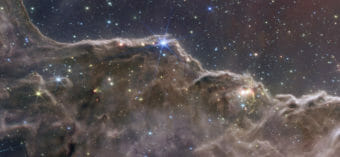
This image released by NASA on Tuesday, July 12, 2022, combined the capabilities of the James Webb Space Telescope’s two cameras to create a never-before-seen view of a star-forming region in the Carina Nebula. Captured in infrared light by the Near-Infrared Camera (NIRCam) and Mid-Infrared Instrument (MIRI), this combined image reveals previously invisible areas of star birth. (Image by NASA, ESA, CSA, STScI via AP)

Astronomers at the Massachusetts Institute of Technology have picked up repetitive radio signals from a galaxy billions of light-years from Earth.

Scientists have not been able to pinpoint the exact location of the radio waves yet, but suspect the source could be neutron stars, which are made from collapsed cores of giant stars.

The signals have been occurring steadily and last up to three seconds, researchers say. Most fast radio bursts, or FRBs, only last a few milliseconds.

“Within this window, the team detected bursts of radio waves that repeat every 0.2 seconds in a clear periodic pattern, similar to a beating heart,” MIT said in a statement.

On Dec. 21, 2019, researchers at the Dominion Radio Astrophysical Observatory in British Columbia, Canada, picked up a signal of a potential FRB, according to the MIT statement.

“Not only was it very long, lasting about three seconds, but there were periodic peaks that were remarkably precise, emitting every fraction of a second — boom, boom, boom — like a heartbeat,” said Daniele Michilli, a postdoctoral researcher in the Massachusetts Institute of Technology’s Kavli Institute for Astrophysics and Space Research. “This is the first time the signal itself is periodic.”

Data on the bursts, including their frequency and how they change based on where the source is located in proximity to Earth could help researchers determine at what speed the universe is expanding.

The announcement about the repetitive radio signals follows the release earlier this week of the first images of the universe from the James Webb Space Telescope. Those images reveal some galaxies formed more than 13 billion years ago.

Copyright 2022 NPR. To see more, visit https://www.npr.org.

CDC clears the way for vaccinations for children 6 months to 5 years old

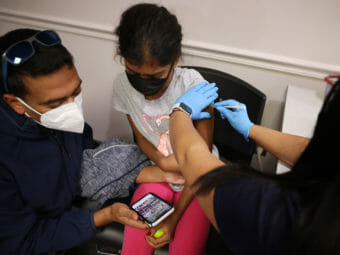
A child receives the Pfizer BioNTech COVID-19 vaccination at the Fairfax County Government Center on November 04, 2021 in Annandale, Virginia. The federal government approved the coronavirus vaccine for children between the ages of 5 and 11 this week. (Photo by Chip Somodevilla/Getty Images)

Providers across the country can start vaccinating kids ages 6 months to 5 years as early as this coming week after regulators cleared the final authorization steps on Saturday.

An independent panel of advisers to the U.S. Centers for Disease Control and Prevention voted on Saturday to recommend vaccinating all children in the age group with one of two separate COVID-19 vaccines manufactured by Moderna and Pfizer-BioNTech.

“I am fully confident that vaccines should be recommended,” said Dr. Grace Lee, the chair of the panel and a pediatrician at Stanford University. “We can clearly prevent hospitalizations and death, and we have the potential to prevent long term complications from infection that we don’t yet understand well.”

CDC director Dr. Rochelle Walensky quickly endorsed the recommendation, the final step before the vaccines could be rolled out.

“We know millions of parents and caregivers are eager to get their young children vaccinated, and with today’s decision, they can,” Walensky said in a statement. “I encourage parents and caregivers with questions to talk to their doctor, nurse, or local pharmacist to learn more about the benefits of vaccinations and the importance of protecting their children by getting them vaccinated.”

During a two-day meeting starting Friday, the panelists reviewed data from clinical trials by both pharmaceutical companies, as well data on the need for vaccines for this age group.

According to the CDC, as of May 28, more than 400 children 0-4 years have died due to COVID.

“Among people ages 1-4, COVID is fifth most common cause of all causes of death,” said Dr. Matthew Daley, speaking at the meeting Friday.

And data from older children and adults show that vaccination prevents death, said Daley, a senior clinician investigator at Kaiser Permanente’s Institute of Health Research. In fact, he added, among people 5 years and older, the unvaccinated are 10 times more likely to die from COVID than the vaccinated.

“Phrased another way, deaths from COVID-19 are preventable through vaccination,” he said.

The vaccine made by Moderna for 6-month-olds to 5-year-olds is a two-dose series, given four weeks apart. The Pfizer-BioNTech vaccine for 6-month-olds to 4-year-olds is a three-dose series. The first two shots are given three weeks apart, and the third one eight weeks after the second shot.

The CDC advisory panel voted 12-0 in favor of recommending both vaccines for this group of children, concluding that both vaccines protect children in this age group against symptomatic COVID-19, and the benefits outweigh possible risk.

“I am tremendously excited,” said Dr. Adam Ratner, head of pediatric infectious diseases at NYU Langone Medical Center and a spokesperson for the American Academy of Pediatrics.

“This is a day a lot of us have been waiting for since the very beginning of the pandemic,” he told NPR.

Many providers across the country have already pre-ordered the vaccine and can start administering it as early as this coming week.

“In early June, our state department of health put out a call for pre-orders,” says Dr. Jennifer Shu, a pediatrician based in Atlanta.

She pre-ordered both the Pfizer and Moderna vaccines and is expecting to start making appointments and giving the shots on Tuesday.

“We’ve had a lot of interest in the vaccine,” she told NPR. “Our phones have been ringing off the hook.”

Data from a survey conducted in February showed that around half of parents of this age group “said they would definitely or probably vaccinate their child once they become eligible,” said the CDC’s Dr. Sarah Oliver, speaking at Saturday’s meeting.

A third of parents said they “definitely or probably would not vaccinate their child,” she added. And a fifth of respondents said they would within three months of vaccines becoming available.

“This infection kills children,” said Dr. Beth Bell, a member of the panel and a public health expert at the University of Washington, speaking at the meeting. “We have an opportunity to prevent that and every parent will want to consider that calculus as well.”

Copyright 2022 NPR. To see more, visit https://www.npr.org.

Millions of pounds of fiber cable are en route to Unalaska to bring high speed internet to the region

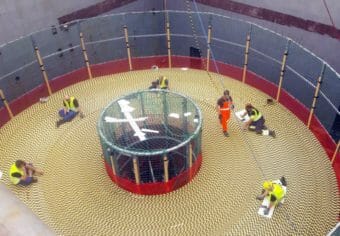
Workers on top of a giant spool of cable on a ship
Crews carefully coiled more than 800 miles of subsea fiber into two tanks that were built on the M/V Vertom Thea in Germany. (Photo courtesy of John Edge/GCI)

Nearly 2,000 tons of subsea fiber has begun the journey from Europe to Alaska and its eventual home on the ocean floor along the Aleutian Chain.

The fiber — which is the foundation of GCI’s 800-mile Aleutians Fiber Project — would close the digital divide and bring high speed internet to homes in some of the most remote communities in the nation, including Unalaska.

In a statement, GCI said the construction and delivery of the specialized fiber is a major project milestone amid global production and supply chain issues.

“Subsea fiber, like what will be used in GCI’s AU-Aleutians Fiber Project, isn’t something that’s just sitting in a warehouse, waiting to be loaded onto a plane for its next deployment, and it’s not something you can buy from your local electronics store,” said Rebecca Markley, GCI’s principal portfolio program manager.

“It takes a highly specialized facility to build hundreds of miles of armored, sealed fiber specifically designed and made to order for large-scale infrastructure projects,” Markley added. “There aren’t many companies in the world capable of meeting the material needs of a project like AU-Aleutians — and even if they can, it doesn’t happen overnight.”

Because there are so few companies that can build the fiber needed for the project, GCI contracted with a cable producer in Germany late last year.

More than 3.7 million pounds of subsea fiber – with segments up to 230 miles long – has now been loaded onto a cargo ship and is traveling the 12,000 miles to Unalaska, according to the company.

It will make its way through the English Channel, across the Atlantic Ocean, through the Panama Canal, and up the Pacific coast to British Columbia where it will then be loaded onto two cable installation vessels and complete its journey across the Gulf of Alaska to Unalaska.

The Aleutians Fiber Project will run from Kodiak along the south side of the Alaska Peninsula and the Aleutians.

The project is scheduled to deliver service to the communities of Unalaska and Akutan by the end of this year, Sand Point and King Cove by the end of 2023, and Chignik Bay and Larsen Bay in late 2024.

“While some GCI projects have required us to practically move mountains, the AU-Aleutians Fiber Project has practically required us to part the proverbial seas,” said GCI Rural Affairs Director Jen Nelson. “The logistics of making a project like this possible are complex, but the end result of delivering transformational levels of connectivity to the Aleutians makes every foot of fiber and years of work worth it.”

The project is expected to cost $58 million. GCI was awarded a $25 million grant from the U.S. Department of Agriculture in support of the project in late 2020.

What does a black hole sound like? NASA has an answer

""
A bounty of black holes surround the Sagittarius A supermassive black hole which lies at the center of our Milky Way Galaxy. (Photo by NASA/CXC/Columbia Univ./C. Hailey et al.)

For the first time in history, earthlings can hear what a black hole sounds like: a low-pitched groaning, as if a very creaky heavy door was being opened again and again.

NASA released a 35-second audio clip of the sound earlier this month using electromagnetic data picked from the Perseus Galaxy Cluster, some 240 million light-years away.

The data had been sitting around since it was gathered nearly 20 years ago by the Chandra X-Ray Observatory. The decision to turn it into sound came only recently, as part of NASA’s effort over the past two years to translate its stunning space photography into something that could be appreciated by the ear.

“I started out the first 10 years of my career really paying attention to only the visual, and just realized that I had done a complete disservice to people who were either not visual learners or for people who are blind or low-vision,” NASA visual scientist Kimberly Arcand told NPR in an interview with Weekend Edition.

While the Perseus audio tries to replicate what a black hole actually sounds like, Arcand’s other “sonifications” are more or less creative renditions of images. In those imaginative interpretations, each type of material — gaseous cloud or star — gets a different sound; elements near the top of images sound higher in tone; brighter spots are louder.

For more examples of NASA’s sonifications, go to the agency’s Universe of Sound web page. Or read on to learn more from Arcand about the venture.

Interview Highlights

On how the black hole audio was made

What we’re listening to is essentially a re-sonification, so a data sonification of an actual sound wave in this cluster of galaxies where there is this supermassive black hole at the core that’s sort of burping and sending out all of these waves, if you will. And the scientists who originally studied the data were able to find out what the note is. And it was essentially a B-flat about 57 octaves below middle C. So we’ve taken that sound that the universe was singing and then just brought it back up into the range of human hearing — because we certainly can’t hear 57 octaves below middle C.

On sonifying an image of the center of the Milky Way Galaxy

So, we actually take the data and we extrapolate the information that we need. We really pay attention to the scientific story to make sure that conversion from light into sound is something that will make sense for people, particularly for people who are blind or low vision. So our Milky Way galaxy — that inner region — that is this really sort of energetic area where there’s just a whole lot of frenetic activity taking place. But if we’re looking at a different galaxy that perhaps is a little bit more calm, a little bit more restive at its core it could sound completely different.

­­­­­­­­On the sonification of the “Pillars of Creation” photograph from the Eagle Nebula in the Serpens constellation:

This is like a baby stellar nursery. These tall columns of gas and dust where stars are forming and you’re listening to the interplay between the X-ray information and the optical information and it’s really trying to give you a bit of the text.

These soundscapes that are being created can really bring a bit of emotion to data that could seem pretty esoteric and abstract otherwise.

Copyright 2022 NPR. To see more, visit https://www.npr.org.

Citizen science program uses artificial intelligence to track thousands of humpback whales

The flukes of a humpback whale still visible as it dives below the surface
“Old Timer” may be the oldest known humpback, first sighted Lynn Canal, Southeast Alaska 1972. Also sighted as PWF-NP1117 and HIHWNMS-2017-2-25WWG01A01 (Photo by Jim Nahmens, courtesy of Happy Whale)

It’s a special moment, watching a gigantic humpback going for a deep dive. The whale’s back arches and the tail swings up, disappearing below the surface like the pointed toes of an Olympic diver.

The black-and-white patterns on the underside of a whale’s tail fins, or flukes, are unique. Now a citizen science program called Happy Whale uses artificial intelligence to quickly identify humpbacks from those patterns.

Through photographs shared by whale watchers, Happy Whale has recorded thousands of whales that travel to and from Alaska.

“Like facial recognition, we can tell who it is,” said Ted Cheeseman, an expedition scientist who has studied whales all over the world, including in Antarctica. He co-founded Happy Whale as a way to track humpbacks, a species that’s known to travel thousands of miles.

It’s helping to answer a lot of questions about their individual behavior.

“Who does the whale hang out with? Does the whale have a calf?” Cheeseman said. “What is the larger story here such that we can build family relationships and so on, tell more of the story of the individual. To me, that’s a huge part of this.”

The difference between this photo ID program and others in the past is the manpower needed. Happy Whale uses an automated computer program to ID the photos instead of people doing it by hand. Just one full-time and two part-time employees run the database and confirm the results.

The program started in 2015 but took years to test and fine tune. Now, whale watchers can share their fluke photos and locations to the online database, which has identified 68,000 humpbacks worldwide.

The program started with 18,000 whale photos that had been previously identified by hand. Cheeseman says Happy Whale is more efficient.

“Somebody gives me a dataset of a thousand photos, it used to be that that would be an hour per photo,” Cheeseman said. “The actual matching time is now insignificant. If someone gives me a thousand photos I can tell them the next day that, ‘Oh, 700 of them are these known whales and these 300, those are probably new.'”

The program has documented about 30,000 humpbacks in the North Pacific, which Cheeseman expects is about 70% of the population.

Participants are rewarded for their work. They usually get an initial response within a few days to a week and get notices when their whale is spotted again.

Dennis Rogers, a long-time whale watching guide in Petersburg, has uploaded over 5,500 photos to the program.

“It’s very interesting just to see the migrations,” Rogers said. “Some of these whales go to Hawaii for the winter, and they’re re-sighted there, which we get a notification when that re-sighting happens. Some of our whales go to Mexico. It’s real interesting, some of our whales go to Mexico one year and to Hawaii the next year.”

Rogers encourages his clients to send in their photos as well. He says other tracking systems, including satellite tags, can fall off whales within days.

“This is purely un-invasive and gives a great amount of information over time. Some of our whales, we’ve been tracking close to 40 years,” Rogers said.

The program has found some unusual migrations in Alaska’s individual whales, said Scott Roberge, a board member for Petersburg’s Marine Mammal Center.

“They’ve followed one from Alaska to Hawaii to Japan back to Alaska,” Roberge said. “Made the loop of the North Pacific.”

Roberge also contributes photographs and enjoys getting the feedback.

“It’s incredible to get that information and to get the email that says, ‘Oh, the whale that you took a picture of last summer was just found in Hawaii, and it just had a baby,” he said.

Cheeseman believes that over 95% of humpbacks in Southeast Alaska are in the database already. But the program is expanding. Cheeseman hopes to automate dorsal fin recognition within the year, which would allow them to identify and track orcas and other species a lot faster.

Cheeseman gave a presentation in Petersburg on May 18 at the Wright Auditorium.

Site notifications
Update notification options
Subscribe to notifications