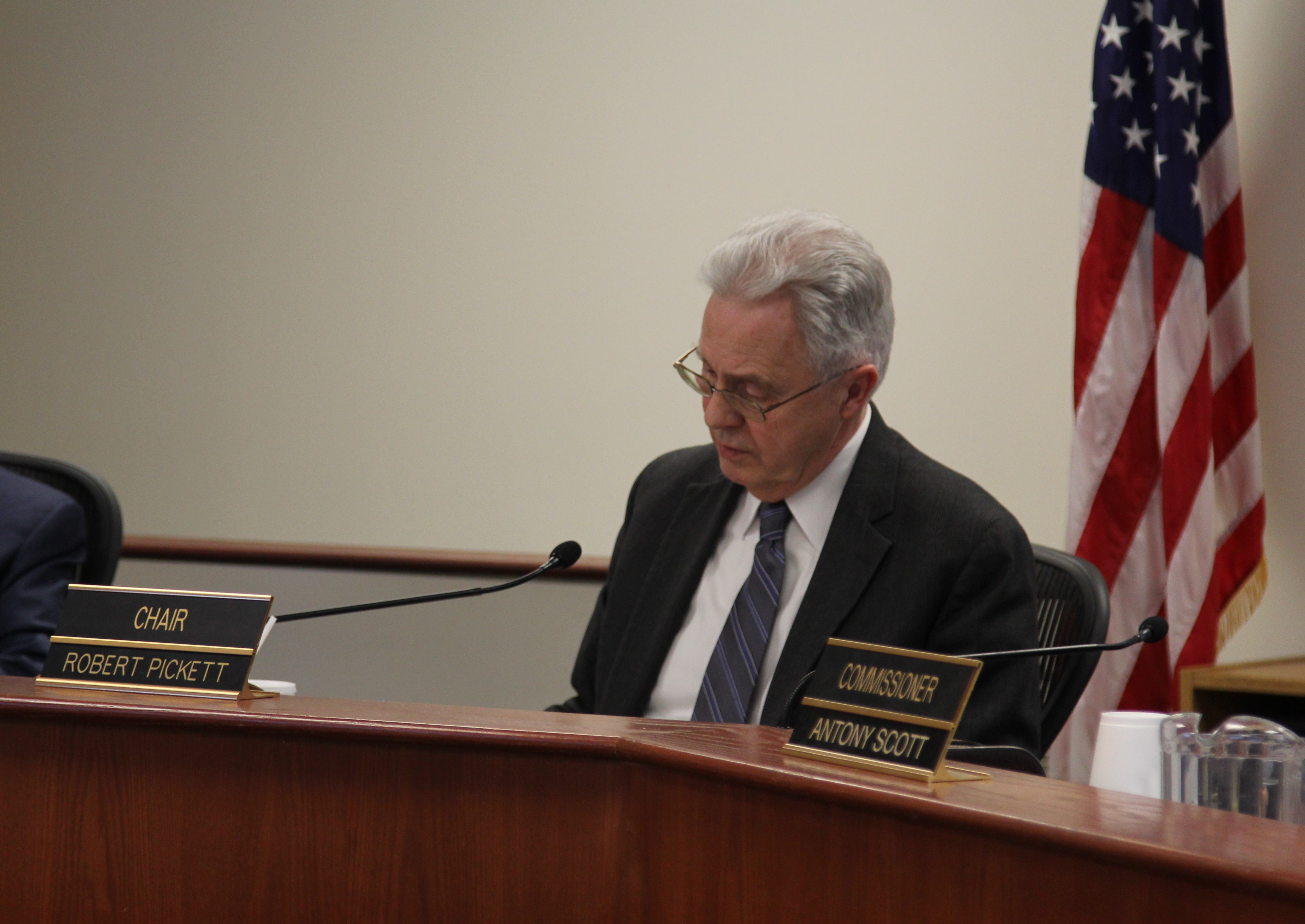
Regulatory Commission of Alaska Chair Robert Pickett at a February meeting in downtown Anchorage about the proposed BP-Hilcorp deal. (Photo by Tegan Hanlon/Alaska Public Media)
The state regulatory commission overseeing a major part of Hilcorp’s proposal to purchase BP’s entire Alaska business says it needs more time to weigh Hilcorp’s request to keep its finances confidential. It’s the second delay this year.
In the order issued Tuesday, the Regulatory Commission of Alaska said it will extend its deadline to March 12 to decide on Hilcorp’s request to shield its financial statements from public view. It’s asking the private oil company for more information.
Meanwhile, the RCA also granted a less-controversial request from Hilcorp and BP: The companies’ purchase and sale agreement for BP’s pipeline assets will remain confidential during the commission’s review process.
The RCA is charged with overseeing the portion of the pending $5.6 billion deal that includes BP’s stakes in the trans-Alaska pipeline. The oil companies announced the sale in August. It’s one of the state’s largest oil industry deals, and needs to clear several regulatory hurdles.
In RCA filings, BP and Hilcorp are arguing that the public release of their financial information during the commission’s review process would damage their businesses and give their competitors an unfair advantage.
In public comments, however, some Alaskans have demanded financial transparency from Hilcorp. They say they want assurance that the company has the resources to operate the assets it wants to buy, and also that it has the money to respond to any costly oil spills.
The RCA, in its order Tuesday, said that the argument made by Hilcorp and BP in support of their requests for confidentiality of their financial information isn’t as strong as their argument about the purchase and sale agreement.
The commission is asking Hilcorp and BP to file an explanation of the specific harm that would result from the disclosure of the financial statements they’ve already submitted to the commission. It also wants to know whether any of the financial records must be filed with a federal agency.
Copies of the president’s fiscal year 2021 budget move down a conveyor belt at a printing facility. (Photo courtesy of Federal Depository Library Program)
Several large cuts to Alaska programs are included in the 2021 budget the Trump administration sent to Capitol Hill Monday.
As in past years, President Donald Trump proposes to slash the Denali Commission. Its funding to build rural Alaska infrastructure, like village power plants and erosion control, would be reduced almost 60%.
But the president’s budget is not binding. It’s more of a suggestion. Congress decides.
“Congress doesn’t pay attention to the president’s budget exercise,” Sen. Mike Enzi, R-Wyo., told Politico.
Year after year, Trump has proposed to cut funding to the Denali Commission, and Congress has protected it. The commission is a priority for Sen. Lisa Murkowski, R-Alaska, who sits on the Senate Appropriations Committee.
Trump’s budget also assumes oil companies will pay more than $1 billion for drilling rights in the Arctic National Wildlife Refuge this year, plus $442 million in 2021. The revenues would be split evenly between the state and federal government, according to the terms of the 2017 legislation that lifted the ban on drilling in the refuge.
The Interior Department has done environmental research to prepare for an ANWR lease sale, but the auction was postponed last year, with no new date announced.
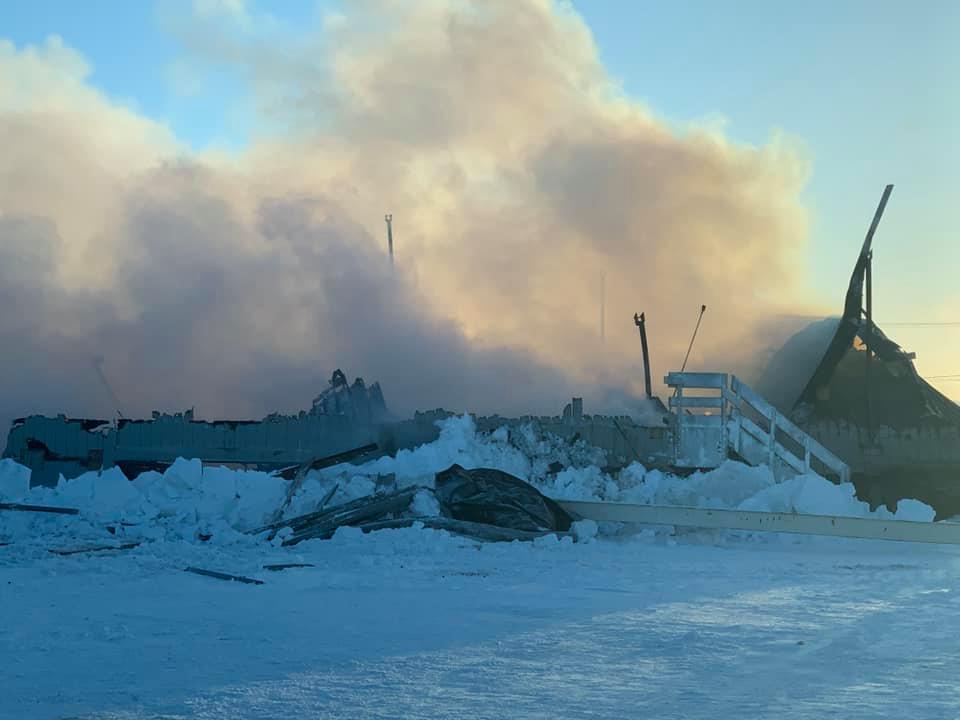
Smoke fills the air in the North Slope village of Kaktovik. A fire destroyed much of the community’s only school on Feb. 7. (Photo courtesy of Amanda Kaleak)
The village of Kaktovik is still clearing the rubble after a Friday morning fire destroyed much of the only school in town. The community plans to rebuild the school, but the timeline is still unknown.
Kaktovik Mayor Amanda Kaleak said the first priority is restoring a sense of normalcy for the students as they resume school.
“We have a five-plex that we’re going to be using for classrooms,” she said. “Just getting everything to where the kids don’t have to fall back, and so we don’t have to extend the school year any longer.”
Kaleak said the city hopes to get kids back into classes next week.
Currently, the city building’s internet bandwidth isn’t set up to accommodate the needs of the students, so that is something Kaleak said is being worked on. Additionally, the building will need more power to adjust to the students.
Kaleak said the North Slope Borough met with Kaktovik officials over the weekend to discuss the long-term plans for replacing the school. While the building was insured, she said, the borough doesn’t yet know how long it will take to build a new school.
“There’s still all that rubble and all the frames and stuff of what was once our new gym and our school that are still there,” Kaleak said. “We still have the fire marshal here investigating. So after they have that all turned over, then we will be able to demo all that and go from there.”
“We will rebuild,” Kaleak continued. “That’s our plan. Everyone’s in high hopes.”
Kaleak said the students and the community are still in shock over the loss of the school. She said about 20 students were away at a basketball tournament in the village of Atqasuk when the fire started last week. They returned home to a huge loss.
“We had all our banners from every award that we ever won, from the ’70s and ’80s, all the trophies,” Kaleak said. “All those memories. It’s kinda hard to think about it.”
When they do end up rebuilding the school, staff will be able to decorate with the sportsmanship trophies the boys and girls won during their weekend tournament.
Mike Sfraga, left, wearing glasses, speaks at the Alaska Legislature’s annual Joint Armed Services Committee meeting in the Capitol in Juneau on Thursday. Sfraga is the director of the Polar Institute at the Wilson Center, a Washington, D.C., think tank. He told state lawmakers that Alaska will be at the front line of global competition over Arctic Ocean resources. Sen. Donny Olson, D-Golovin, is in the foreground. (Photo by Andrew Kitchenman/KTOO and Alaska Public Media)
A national expert on Arctic policy told state lawmakers on Thursday that Alaska will be at the front line of global competition over Arctic Ocean resources.
Mike Sfraga, director of the Polar Institute at the Washington, D.C.-based think tank the Wilson Center, said climate change is making the Arctic Ocean more accessible.
“That’s why I’ve called Alaska the nation’s vanguard, because this is a new ocean,” he said. “This is a new landscape of competition. And that’s why we must be diligent in what we do, I believe, in the state of Alaska.”
Sfraga said Alaska can no longer be seen as isolated. He noted that China has invested in a gas pipeline through Siberia. And Russia has developed both commercial and military sites in the Arctic.
Sfraga said the U.S. should develop a deep-water port in or near the Arctic. He said research suggests it could be at Nome or another site. And he said the country should be prepared to invest heavily in the project.
“This nation needs a deep-water port,” he said. “We just need one. And we have more reports than we can stack on a table — pick one. And then do a Manhattan Project on it. I mean, if it’s Nome, let’s go all in on Nome.”
Sfraga also said the U.S. should establish a greater military presence in the Arctic.
Sfraga’s testimony was part of the annual meeting of the Legislature’s Joint Armed Services Committee.
Watch the latest legislative coverage from Gavel Alaska.
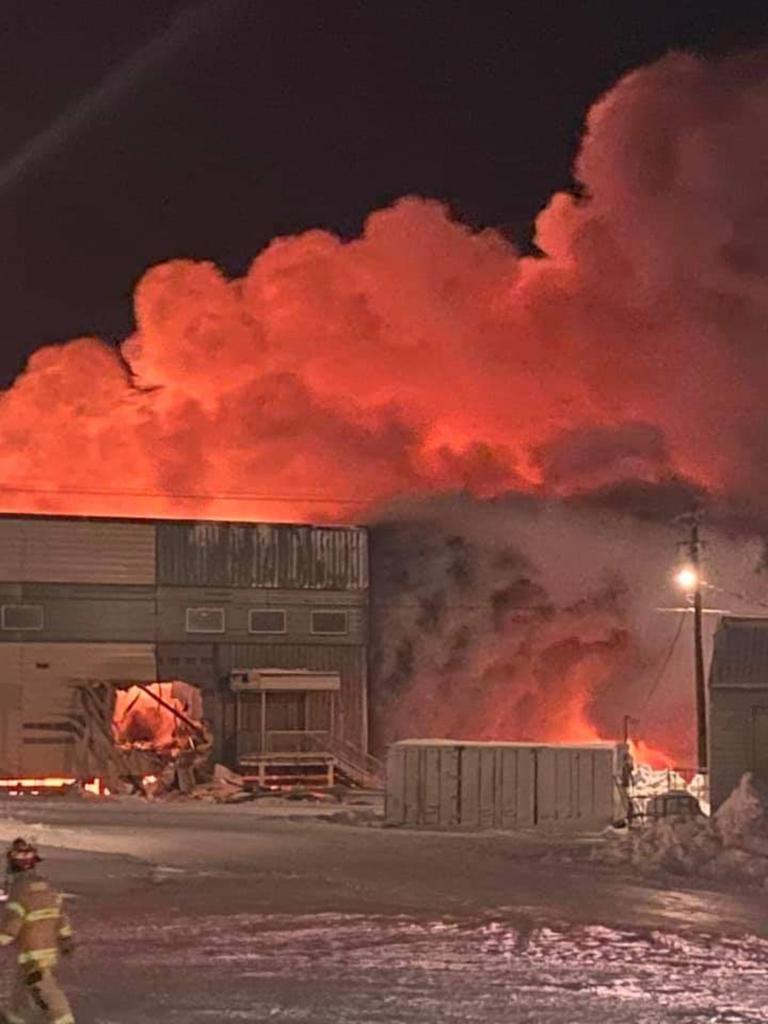
A fire engulfs the school in the North Slope village of Kaktovik on Feb. 7. (Photo courtesy of Melvin Jack Kayotuk)
The school in the North Slope village of Kaktovik is a “total loss” after a fire burned Thursday night into early Friday morning, according to local officials.
North Slope Borough Mayor Harry Brower Jr. said there were no injuries to report. He said the weather, which dipped to -35 degrees, made fighting the fire difficult for first responders. Western winds between 16-18 mph had hit the community all morning.
Kaktovik resident Wayne Kayotuk said he brought his son to the gymnasium at the Harold Kaveolook School on Thursday night.
“When I brought my son there and let him play, I could smell something in the air,” said Kayotuk. “But I thought it was just smoke from the landfill burning.”
That was around 6 p.m. By around 8 p.m., Kayotuk said the building was on fire. By midnight, it was engulfed.
In a Facebook message posted at about 3:30 a.m., the North Slope Borough School District wrote that everyone had been evacuated from the school and fire departments were trying to contain the fire.
According to Kaktovik City Clerk Katheryn Aishanna, officials had a heater going at the school to thaw frozen pipes, and the heater ignited a fire. She wrote that Kaktovik Mayor Amanda Kaleak says the school is a “total loss.”
Local residents posted video and photos of the fire, showing tall, bright-orange flames across the dark early morning sky.
Our only school on fire. About 80 students from a small isolated village in northern Kaktovik, Alaska (population 250-300). Was -40 without windchill, firefighters equipment not working in this cold. All we can do is watch. So many memories in there for me. pic.twitter.com/Uf2x3FyO9S
The school was a gathering place for the 250-person village, and it was connected to a recently-opened $16 million basketball gymnasium.
“We lost a community place,” said Kaktovik resident Marie Rexford. “It’s where everyone goes to for their gym nights. What are they going to do now? What are the kids going to do now? What is the community going to do now?”
She said the whole town is feeling immense sorrow.
“A lot of the community members are crying,” Rexford said by phone. “Our kids got no more school. How long is it going to take to build our school?”
Kaktovik is the easternmost village in the North Slope Borough, about 50 miles north of the Brooks Range. It’s the only village within the boundaries of the Arctic National Wildlife Refuge.
Reporter Nat Herz with Alaska’s Energy Desk contributed reporting from Anchorage.
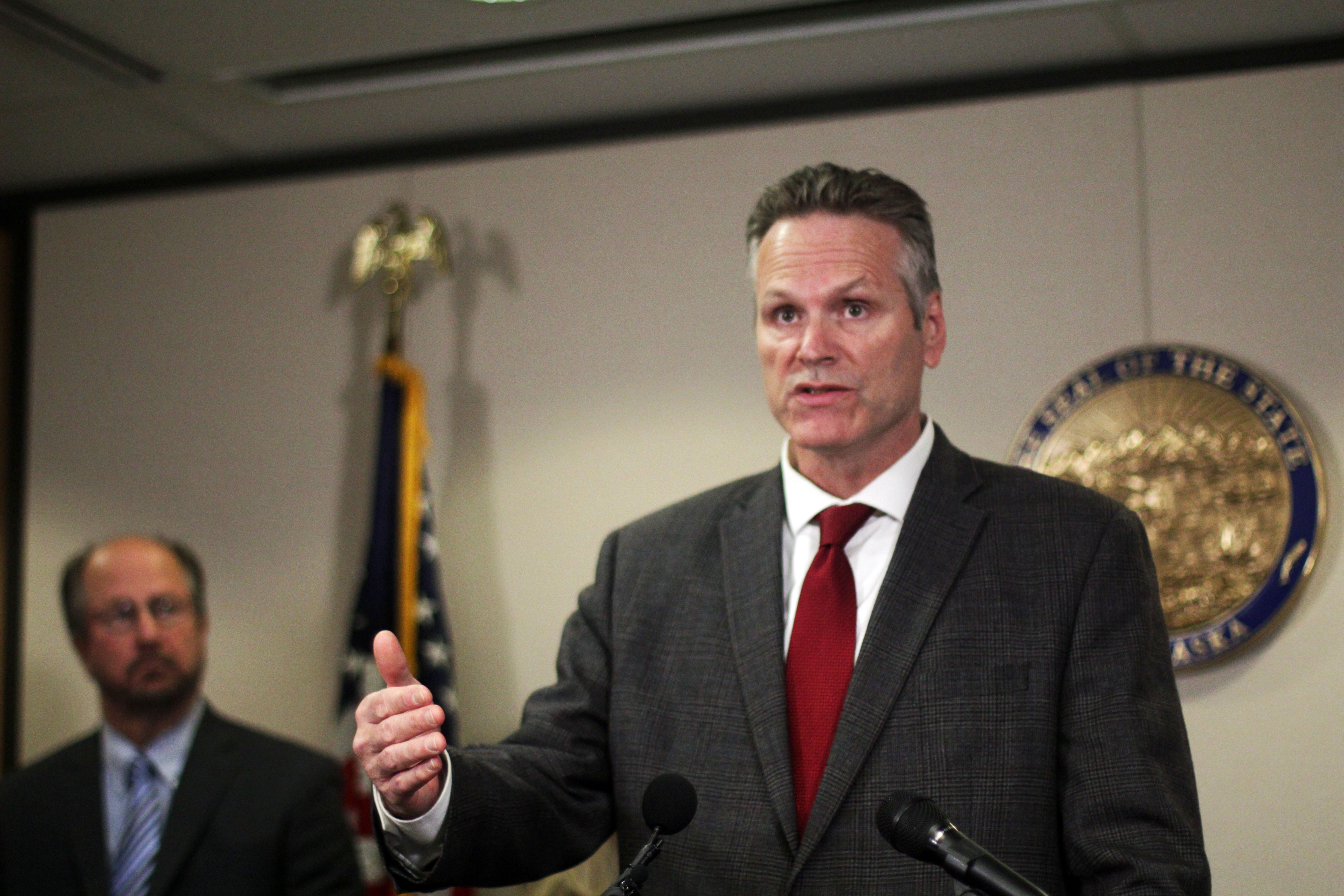
In response, Alaska Gov. Mike Dunleavy suggested he could cut off the millions of dollars a year that the state pays to the Wall Street firm. Now, Goldman is playing defense: Last week, it hired a lobbyist, Wendy Chamberlain, to represent its interests in the state.
Chamberlain, one of Juneau’s most successful lobbyists, will advocate for Goldman on “issues relating to financing, investment strategies and advisory activities in Alaska,” according to a report she filed with state regulators.
Chamberlain and a Goldman spokesperson, Andrew Williams, both declined to comment. But Chamberlain’s hiring should help the company preserve its business in Alaska, said Larry Persily, a former deputy revenue commissioner for the state.
“They’re an investment house — it is a smart investment,” Persily said. “They’re not going to change their policy on Arctic, oil and gas, green energy, renewables — that’s something they’ve decided they’re going to stick with. But for $75,000, they can make sure they don’t make too many enemies up here that would cost them a lot of money.”
Goldman’s new environmental policy says it will “decline any financing transaction that directly supports new upstream Arctic oil exploration or development,” including in the Arctic Refuge.
The policy says climate change — which scientists agree is driven by the consumption of oil and other fossil fuels — is “one of the most significant challenges of the 21st century.” And it cites potential impacts of Arctic drilling on habitat for endangered species and Indigenous people’s subsistence livelihoods.
Producing oil from the Arctic Refuge has long been a goal of Alaska’s political leaders and the oil industry, and Congress formally opened the area to leasing in 2017. After Goldman’s announcement, Dunleavy told Fox Business that the policy is “unfortunate,” adding that Alaska is an “oil state.”
“We do a lot of business with Goldman Sachs,” he said. “We’re going to have to reevaluate that, have a discussion with them.”
The next day, Dunleavy’s administration fired Goldman from a group of Wall Street firms it had hired to help borrow money to pay off state tax credits owed to oil companies. The borrowing plan has been stalled by a lawsuit, but if it moves ahead, the decision could cost Goldman between $200,000 and $300,000 in compensation, said Deven Mitchell, the state’s debt manager.
Far more valuable, however, is Goldman’s relationship with the Alaska Permanent Fund, a $67 billion pool of state-owned investments originally seeded with state oil revenue. The fund, managed by the Alaska Permanent Fund Corp., generates the cash used to pay Alaskans’ annual dividend checks.
Over the past three years, the corporation has paid Goldman a total of $16.9 million in fees for managing a chunk of the permanent fund’s assets. The firm currently manages some $400 million for the fund.
Goldman’s management fees declined last year as one of the permanent fund’s investment programs was discontinued. But beyond that, the fund’s relationship with the company doesn’t appear to be in jeopardy, and Dunleavy does not appear to be pushing the fund’s board of trustees to take any action, according to Craig Richards, the board’s chair.
“I’ve had no conversations with the governor or the governor’s staff at all on the subject,” Richards said. “There’s been no proposal, that I’m aware of, to act in any way. My personal point of view is that there’s a very strong sense of not getting involved in politics.”
After Dunleavy referenced his desire to have a “discussion” with Goldman on Fox Business, he did have an hour-long phone call with the company’s chief executive, David Solomon, according to Dunleavy’s public schedule. Dunleavy’s spokesperson, Jeff Turner, did not respond to a question about what was discussed.