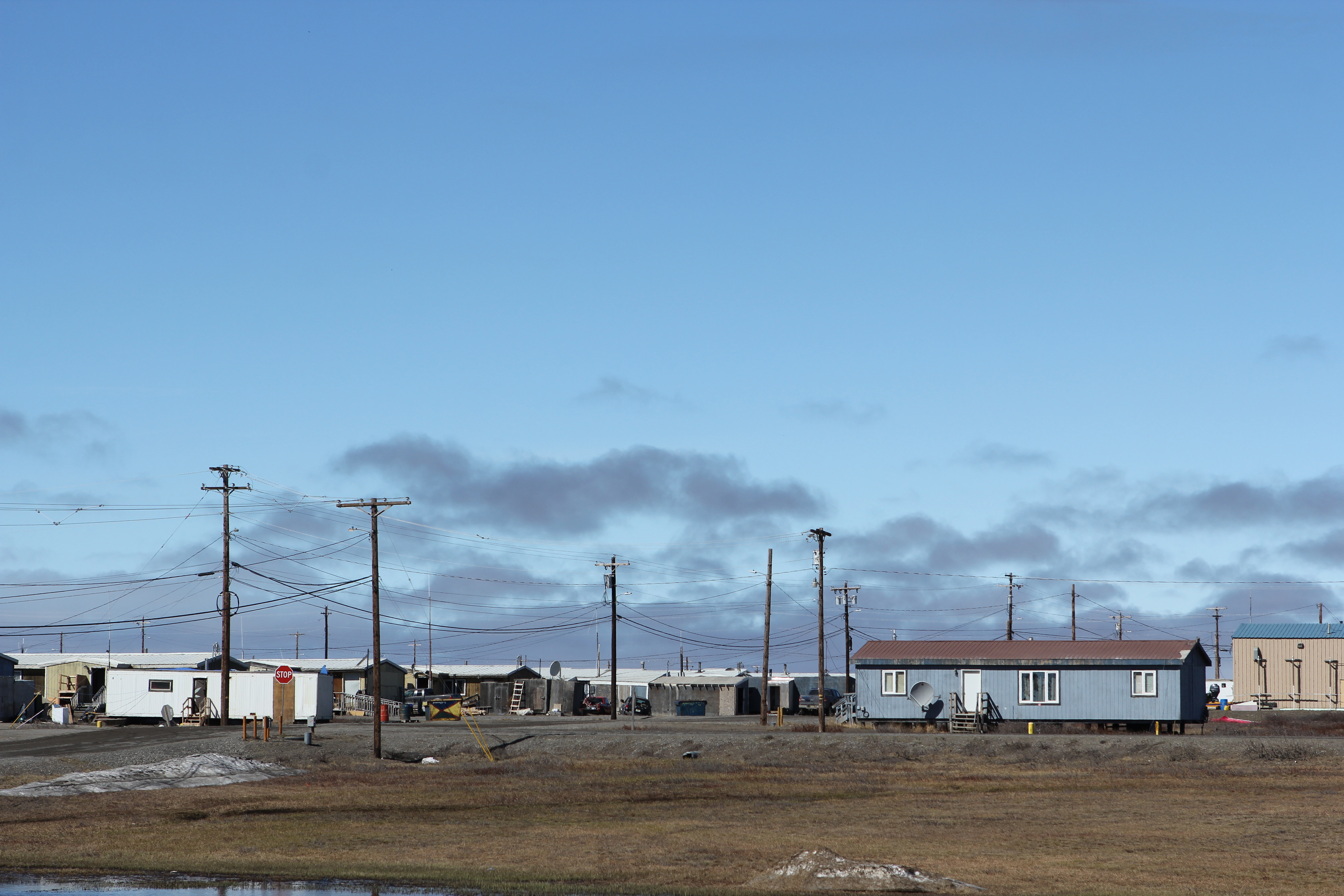
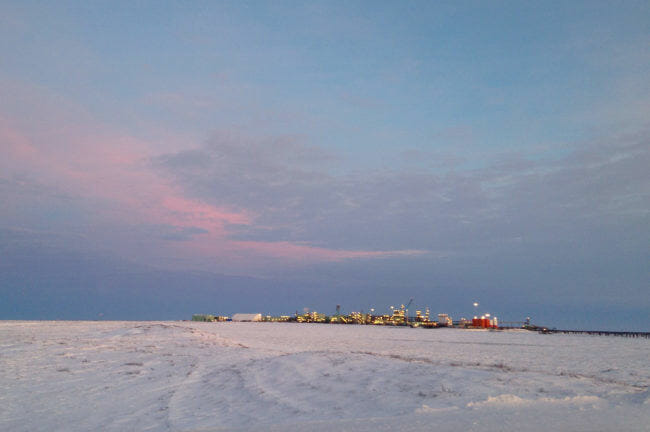
Nuiqsut in June 2018. The village is near a growing number of oil developments in the western Arctic. (Photo by Elizabeth Harball/Alaska’s Energy Desk)
U.S. District Court Judge Sharon Gleason has rejected a legal challenge to the Trump administration’s approval of oil drilling and other industrial activity near Nuiqsut.
The North Slope village sits at the eastern edge of the National Petroleum Reserve in Alaska, and it’s become increasingly surrounded by oil development.
The local Alaska Native village corporation, Kuukpik Corp., has negotiated deals with oil companies, and residents have been rewarded with cash payments and cheap natural gas for heating. But some residents say that they have growing concerns about the oil industry’s impacts on subsistence wildlife and air quality.
In March, Nuiqsut’s tribal government joined with five national environmental groups to sue the Bureau of Land Management. They alleged that the agency failed to perform an adequate environmental review of ConocoPhillips’ exploration work that was authorized for the previous winter, which included drilling at up to eight sites, building 100 miles of ice roads and snow trails, creating 23 ice pads and an airstrip and installing temporary housing
Gleason upheld the environmental review in a 73-page decision released Thursday. She ruled that the review did not violate the National Environmental Policy Act or the Alaska National Interest Lands Conservation Act, as the tribal government and environmental groups alleged.
BLM spokesperson Eric Tausch declined to comment. The tribal government’s administrator and ConocoPhillips officials did not immediately respond to requests for comment.
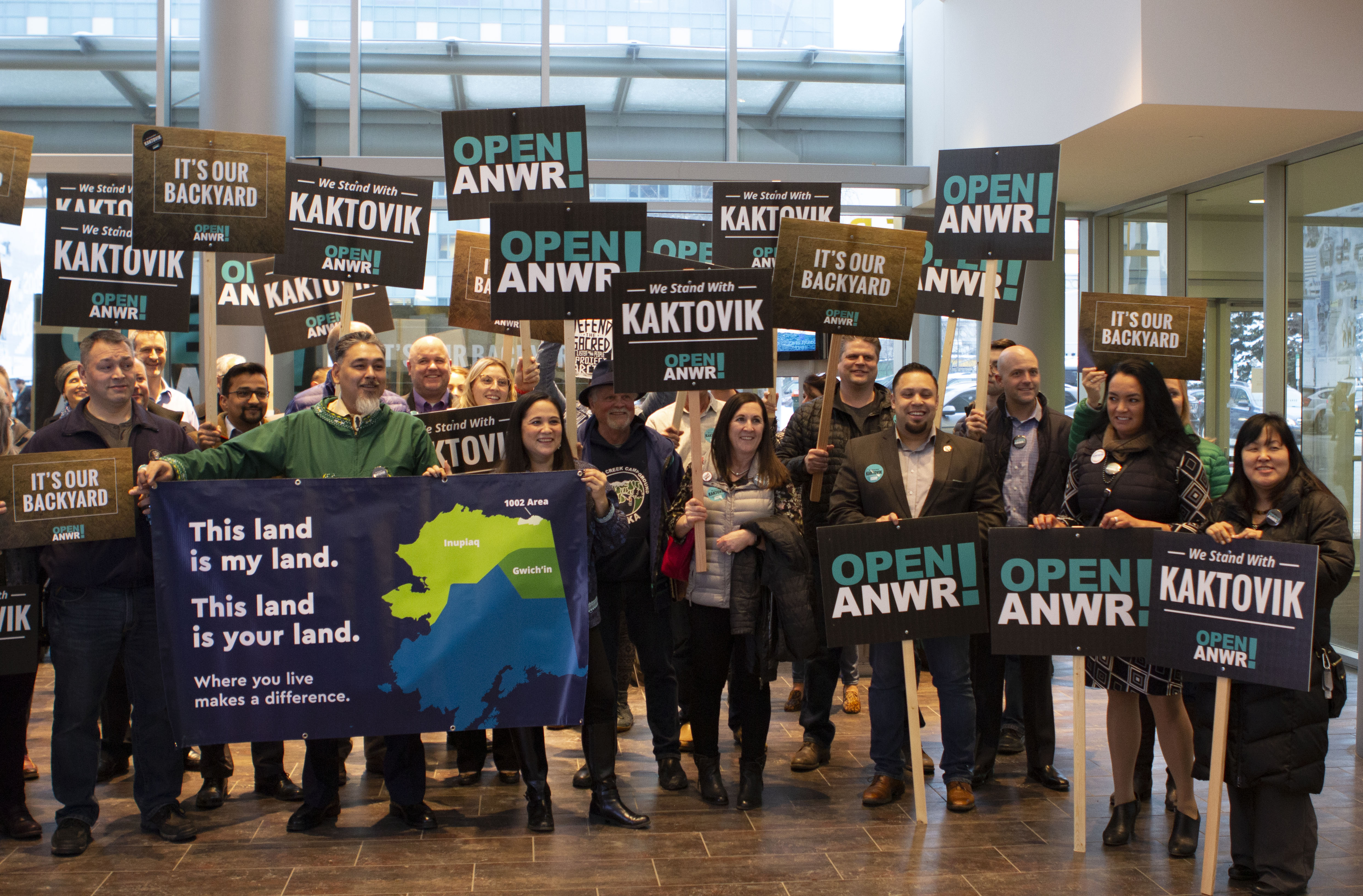
Arctic Slope Regional Corp. leaders and supporters held a press conference outside an Anchorage public meeting on oil leasing in the Arctic National Wildlife Refuge on Feb. 11, 2019. (Photo by Elizabeth Harball/Alaska’s Energy Desk)
The Alaska Native regional corporation for the North Slope collected $22.5 million from a pair of oil companies after Congress opened the Arctic National Wildlife Refuge’s coastal plain to drilling in 2017, according to corporate documents.
Arctic Slope Regional Corp., whose 13,000 Alaska Native shareholders own the oil rights to 140 square miles along the coastal plain, has long been one of the most aggressive advocates for opening the refuge to oil development. The payment, referenced in ASRC’s latest annual report, underscores just how much the corporation had to gain from the congressional action. It stands to benefit further if the oil companies, BP and Chevron, ultimately find and produce petroleum on its property.
ASRC’s 92,000 acres, along with the 1.6 million acres of federal lands in the coastal plain, were all off-limits to drilling until late 2017, when Congress passed the tax overhaul that opened the area to development. ASRC previously confirmed that a payment had been made under an existing, decades-old lease agreement with the oil companies, but it declined to reveal the amount.
ASRC is the largest Alaska-owned business, with annual revenues exceeding $3 billion and more than 15,000 employees inside and outside the state.
The corporation is heavily invested in oil and gas, with its own refineries and an oil-field services business; it also collects royalties from oil production on some of its lands outside the Arctic Refuge.
Those holdings have proven valuable to its owners: ASRC’s most recent annual dividend was $7,000 for each shareholder with the standard 100 shares. But the corporation’s pro-development position has recently caused tensions with other Alaska Native groups, whose members say they’re threatened by global warming. And ASRC recently withdrew its membership from the Alaska Federation of Natives.
ASRC spokesperson Ty Hardt declined to comment on the payment from the two oil companies. A Chevron spokesperson, Veronica Flores-Paniagua, and a BP spokesperson, Meg Baldino, each confirmed that the payment had been made, but declined to comment further. Officials at Hilcorp, which is acquiring BP’s stake in the Arctic Refuge lease in a pending business deal, declined to comment.
ASRC’s shareholders are descendants of the Iñupiat people who originally inhabited the North Slope, and the corporation acquired roughly 5 million acres of land through the 1971 Alaska Native Claims Settlement Act. The act granted a dozen Alaska Native regional corporations a total of $960 million and 44 million acres, or a little more than 10% of the state’s total area. In exchange, Alaska Native groups set aside their aboriginal land claims, which had delayed construction of the trans-Alaska oil pipeline.
When the act passed, ASRC was barred from claiming potentially valuable oil-bearing lands in the Arctic Refuge and the National Petroleum Reserve in Alaska, because those areas had already been set aside by the federal government. But a decade later, ASRC struck a deal with President Ronald Reagan’s administration to trade 101,000 acres of the corporation’s land within Gates of the Arctic National Park for 92,000 acres of subsurface rights within the refuge — around the village of Kaktovik.
The land trade set the stage for a 1984 lease between ASRC, BP and Chevron, and it also gave them the right to drill the only exploratory test well ever placed in the Arctic Refuge. The results from the well are still one of the oil industry’s most tightly-guarded secrets, though a New York Times report last year suggested that they were not promising.
After the well was drilled, both the corporate and federal lands along the coastal plain remained closed to actual oil production until Congress’ 2017 vote. ASRC had allowed Chevron and BP to suspend their lease payments while the closure remained in place, said Teresa Imm, an ASRC resource development executive, in an interview last year.
ASRC was a major participant in the lobbying campaign to open the refuge to oil development, nearly doubling its federal lobbyist spending in 2017 to $590,000, according to figures compiled by the Center for American Progress, a Washington, D.C.-based liberal advocacy group.
ASRC’s lands along the coastal plain are far from existing oil infrastructure, meaning development there could still be decades away. But drilling opponents are already questioning how the ASRC-controlled area fits into the Trump administration’s plans to open the refuge’s federal lands to development, and they want to know what environmental safeguards will apply.
“ASRC lands potentially being open to oil and gas is a major change in private land use that must be clearly addressed,” a coalition of more than two dozen opponents wrote in a March comment letter to the Bureau of Land Management, which is leading the environmental review in advance of drilling in the refuge. The groups added: “BLM must be clear on this point.”
BLM officials pointed to the agency’s written response to the letter, which was published as part of a 2,100-page document that addressed the thousands of unique public comments on the Trump administration’s draft environmental review.
That review, BLM wrote, “is not intended to address ASRC’s management of oil and gas exploration and development on its lands.” Restrictions and environmental safeguards adopted by BLM, the agency added, “will only apply on federal lands within the coastal plain.”
Any development on ASRC’s land would still have to comply with national environmental laws like the Clean Water Act and Marine Mammal Protection Act, which could trigger permitting and other requirements for individual projects. And the 1983 land trade also gave the U.S. Fish and Wildlife Service authority to review proposed oil development on ASRC lands, and includes a list of specific environmental safeguards that companies must follow.
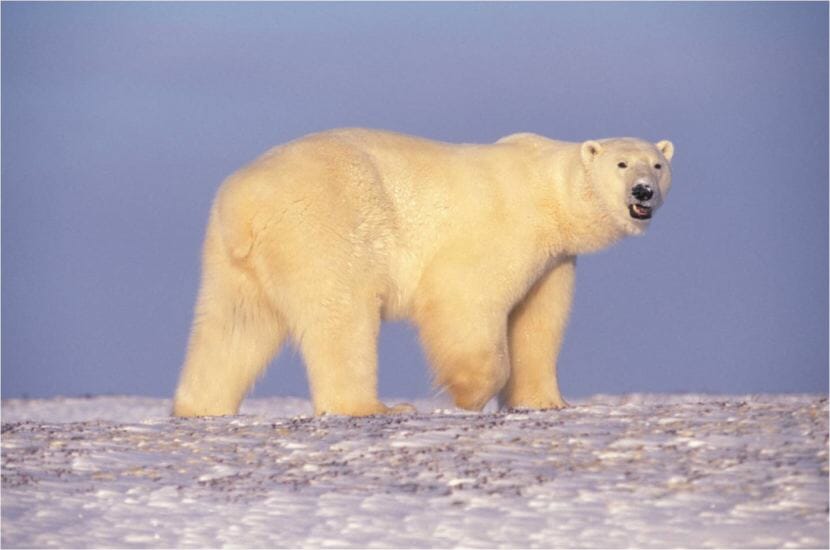
A polar bear in Arctic Alaska. Subsistence harvest levels of Chukchi Sea polar bears have just been raised, based on new data about the population’s health. (Photo Credit: Terry Debruyne/USFWS)
Last year, a company asked the Trump administration for permission to take the first steps toward oil drilling in the Arctic National Wildlife Refuge: running a convoy of special oil-detecting trucks along the refuge’s coastal plain, to determine how much petroleum lies below.
But the Trump administration never gave the go-ahead, with the U.S. Fish and Wildlife Service saying that the initial proposal didn’t comply with federal rules under the Marine Mammal Protection Act. That rule limits harm to polar bears, which are listed as threatened under the Endangered Species Act. A government shutdown also delayed work on the application from the company, Houston-based SAExploration, which has never said publicly exactly why the project did not move ahead.
Now, a newly-published study by the Fish and Wildlife Service and the U.S. Geological Survey shows what kinds of precautions companies could take to obtain federal approval to explore for oil in sensitive polar bear habitat. By using heat-sensing cameras to detect dens, and accepting strict limits on when to survey specific areas of the coastal plain, the study says that polar bear disturbance can be dramatically reduced – from as many as eight dens if no restrictions are applied, to one or less using the most conservative approach.
“A carefully-designed survey can reduce your potential impacts to the bears pretty far – to the point where you might be getting to a place where you may be able to meet determinations under the Marine Mammal Protection Act,” said Ryan Wilson, a Fish and Wildlife Service polar bear biologist and one of the two authors of the study, published in the Journal of Wildlife Management.
The study offers a window into the push and pull between the competing stakeholders and statutes that are shaping the future of the Arctic Refuge – the top Trump administration appointees and oil industry pushing to access the coastal plain after Congress passed a law opening the area to drilling in 2017, the environmental organizations fighting them and the Fish and Wildlife Service employees charged with enforcing the Marine Mammal Protection Act, which was enacted in 1972.
Wilson once worked for an environmental organization, The Wilderness Society, and he said in an interview that the study was not influenced by Trump administration political appointees, who have pushed to expand oil development across Alaska’s North Slope.
Ryan Wilson, a biologist with the U.S. Fish and Wildlife Service, poses for a photo in his Anchorage office. A polar bear skull sits on the shelf behind him. (Photo by Nat Herz/Alaska’s Energy Desk)
The study’s findings offer a basic blueprint for how the oil industry might move forward with what’s known as a seismic survey across the coastal plain. But, they do not equate to authorization or approval for a specific project.
An Anchorage-based official with one environmental group, Defenders of Wildlife, noted that such a survey is only an initial phase of oil development. If the results are promising, companies would move ahead with test wells and then permanent infrastructure, which would bring additional impacts. And even with the precautions suggested by the study, the survey’s risk of disturbing polar bears would not be reduced to zero, said Defenders of Wildlife’s senior Alaska representative Pat Lavin.
“Even with extensive restrictions and making favorable assumptions about the impacts that would follow, the risk of injury or death to polar bears cannot be eliminated,” Lavin said. “And that’s without building anything.”
The study grew out of the 2018 proposal from SAExploration, which specializes in seismic surveys. The company, working with three Alaska-based Native corporations, wanted to run its survey across the entire coastal plain, with its dozen trucks running along grid lines spaced 200 meters apart.
The effort would have run 24 hours a day, supported by dozens of additional vehicles and at least one camp that would accommodate 150 people.
Those plans were complicated by the Southern Beaufort Sea population of polar bears, which number about 900 and are vulnerable to declining sea ice caused by global warming.
The Marine Mammal Protection Act bars disturbances to polar bears and other species, but it allows the Fish and Wildlife Service to authorize occasional incidental impacts, including in cases where development has a “negligible impact” on a population. One metric commonly used by the federal government is known as “potential biological removal,” and using that measure, Alaska Natives’ annual subsistence harvest – which has a higher priority under the act – already exceeds that level for the Southern Beaufort Sea bears. And that means that the Fish and Wildlife Service has little wiggle room to authorize accidental impacts on the bears from oil exploration.
That dynamic creates complications for companies like SAExploration.
The oil industry does its exploration work during the winter, when its vehicles won’t damage the Arctic tundra – and that’s the same season in which polar bears den. Disturbances can make it less likely for cubs to survive, since they can be exposed to the Arctic winter if they leave their dens, or use more energy if they stay.
The new study assumes that just 20 dens will be scattered across the entire coastal plain in a given winter. But the Fish and Wildlife Service assumes that industry activity within a mile could cause a disturbance, creating potential conflicts for every den, given SAExploration’s proposal to run its trucks along grid lines separated by just 200 meters.
Wilson was working with the Fish and Wildlife Service to analyze SAExploration’s initial survey plans, and determined its impacts would likely be too big to comply with the Marine Mammal Protection Act’s restrictions, he said. But through discussions with company officials, he added, they developed a revised plan, in which earlier in the winter, when cubs would be more likely to remain inside their dens, SAExploration would avoid areas with denser dens.
To help assess the impacts of the different plans, Wilson created a computer model, which is the basis for the newly-published study, co-authored by George Durner, an Anchorage-based zoologist for the USGS.
The study looked at five different types of proposed surveys, with different timing and area limitations like the ones contemplated by Wilson and SAExploration, and it used the computer model to run 1,000 different simulations of each one. It also assessed how the use of the heat-sensing cameras, to detect heat rising from polar bear dens, could help reduce impacts.
Wilson demonstrates the model that formed the basis for his recent paper in the Journal of Wildlife Management. (Photo by Nat Herz/Alaska’s Energy Desk)
Without the heat-sensing cameras or any restrictions on the time and space of the survey, the study predicted that industry activity would cross the one-mile threshold of roughly eight dens before the bears had emerged – though that number fell to roughly 2.5 dens if companies used the heat-sensing technology.
The most restrictive plan, by contrast, divided the survey area in 28 different blocks, then set specific dates when the work could begin for each one, leaving the most important denning areas until later in the winter. It also split the survey into two years, allowing the work to start later in the winter and reducing the likelihood of encountering a den with bears still in it.
The study predicted that with those limitations, the survey would impact, on average, 0.5 dens – and using the heat-sensing technology reduces that to 0.2.
Wilson reiterated that those findings do not necessarily mean that a proposal incorporating those timing and area restrictions will necessarily be approved by the Fish and Wildlife Service.
“It’s not making judgment calls or anything,” he said. “It’s trying to help inform decision-makers, applicants and the general public about what we need to be considering if if we really are going to try to find this balance between development and conservation of polar bears.”
One big question that the study leaves unanswered is whether agreeing to the timing and area limits would make the seismic survey too expensive, or logistically complex, for the oil industry to undertake. SAExploration officials declined to comment, and Kara Moriarty, the head of the Alaska Oil and Gas Association, said she did not want to speculate.
Moriarty’s group, which advocates on the oil industry’s behalf, supports using the “best available science” to minimize impacts on wildlife, she said.
But she also argued that the study gives a kind of “worst-case scenario” look at development – and that companies would likely take precautions to reduce risks below the levels the study assumes.
“We do have really good management techniques at play now, and that are effective at identifying, mitigating, minimizing any type of impact to the bear,” she said. “Because that’s the last thing we want.”
There’s no seismic work planned inside the refuge this winter. But it’s likely that new surveys will be proposed after the federal government holds its first lease sale for the coastal plain, which is expected some time in 2020.
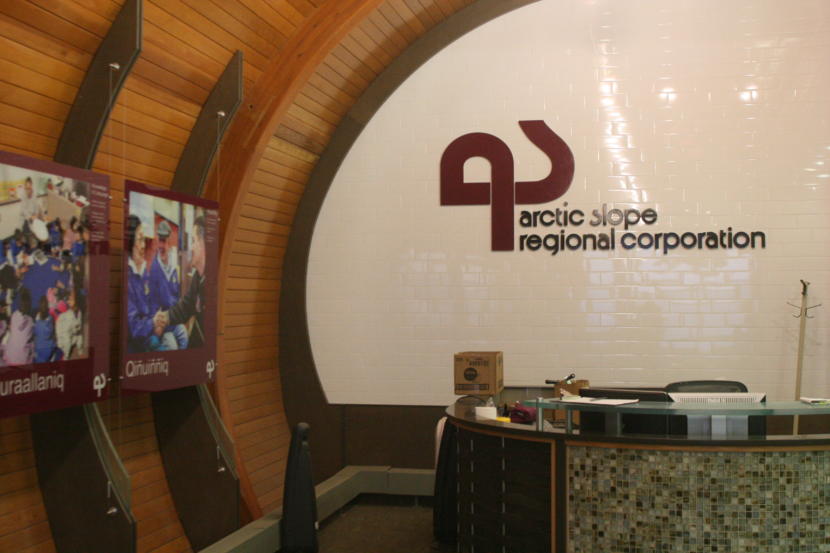
The Arctic Slope Regional Corporation’s corporate headquarters in Utqiaġvik, Alaska. January, 2018. The corporation announced its withdrawal from the Alaska Federation of Natives in December, 2019. (Ravenna Koenig/ Alaska’s Energy Desk).
Long before Arctic Slope Regional Corporation (ASRC) announced its withdrawal from the Alaska Federation of Natives (AFN) last week, there were signs of a schism between Alaska’s largest Native corporation and most influential Native advocacy group.
At the center of it: oil, ASRC’s responsibilities to its shareholders, AFN’s wider responsibilities to its member groups and growing pressure caused by climate change’s impacts on infrastructure and subsistence.
Tensions between ASRC and AFN appeared to be building in recent years. In a hard-fought U.S. Senate race in 2014, AFN took the rare step of endorsing a candidate: incumbent Democrat Mark Begich, who delegates praised for his connection to rural Alaska and his support for Natives’ subsistence traditions.
Board members of ASRC, meanwhile, endorsed Begich’s Republican opponent, Dan Sullivan, citing his support for “responsible energy development.” And while AFN endorsed Democrat Hillary Clinton in 2016, ASRC’s executives celebrated at the Trump White House a year later, after Congress approved the legislation opening part of the Arctic National Wildlife Refuge to oil development.
ASRC is charged with representing the business interests of some 13,000 Inupiat shareholders. It explained its withdrawal from AFN last week by saying only that the corporation intends to focus on the needs of the North Slope. An ASRC spokesman, Ty Hardt, declined to be interviewed or answer questions about the decision.
But ASRC says the decision was under consideration for more than a year. And in fact, North Slope Native organizations have long had a fraught relationship with AFN, stemming in part from members’ unique homeland, which lies atop billions of barrels of oil.
A more complete explanation of ASRC’s decision, according to people who have worked with the corporation, is that global warming has put new pressure on the existing fault lines among the different institutions that look out for Alaska Natives’ well-being.
Alaska’s 12 regional corporations, including ASRC, are big for-profit businesses, with a relatively narrow focus on generating revenue to support cash dividend payments to shareholders. Tribal governments and nonprofits, meanwhile, are more focused on providing services and supporting Natives’ social welfare.
Climate change threatens to pit those interests against each other in new ways. Tribal governments and nonprofits say they’re being saddled with climate change’s costly impacts, while some regional corporation leaders see greenhouse gas regulations as a potential threat to their bottom line.
“On one side, you have monetary impact, and on the other side you have even greater impact on the planet itself,” said Roy Huhndorf, the former chief executive for Cook Inlet Region Inc., the Native regional corporation for Southcentral Alaska.
“I think Native corporations are the same, in a microcosm, as the Exxons and BP’s of the rest of the world who don’t want to abandon oil production now because it hurts them financially,” he said. “On the other hand, you can understand where the rest of the world is wanting to go.”
Native corporations are some of Alaska’s largest and most influential businesses, with ASRC at the top of the heap.
ASRC’s revenues last year exceeded $3 billion, with dividends of $7,000 paid to each shareholder with 100 shares, according to the corporation’s annual report. It has more than 13,000 employees spread across Alaska and beyond, working in six major areas of business.
Among ASRC’s holdings is PetroStar, which owns oil refineries in Valdez, and near Fairbanks in North Pole. It sold a record 356 million gallons of oil products last year and generated $885 million in revenue. ASRC also owns an oilfield services company, with more than 2,300 workers in Alaska, that does engineering, construction and permitting for some of the world’s largest oil and gas companies, in both Alaska and the Gulf of Mexico.
The corporation also benefits directly from oil development on its own land entitlement of nearly 5 million acres on the North Slope — an area almost the size of New Jersey. It collects royalties from oil production in the Colville River Unit, home of ConocoPhillips’ Alpine field, and reported natural resource earnings averaging $50 million a year over the past three years.
ConocoPhillips’ Alpine facility on the North Slope, which pays oil royalties to Arctic Slope Regional Corp. (Photo by Elizabeth Harball/Alaska’s Energy Desk)
At AFN’s convention in October, when two teenage delegates were pushing for approval of a statement declaring an emergency on climate change, ASRC’s board chair, Crawford Patkotak, pushed back. He asked to add language to preserve Natives’ “rights to the resources,” saying that the declaration risked inviting “unnecessary regulation” with devastating economic effects.
Patkotak wasn’t the only regional corporation leader who was concerned: Gail Schubert, chief executive of the Nome-based Bering Straits Native Corp., also urged delegates to be cautious. Native corporations, she said, “were charged with creating economies, delivering dividends and other benefits to our shareholders.”
“I understand and accept and have said publicly that we are experiencing climate change,” Schubert said. “But I also want to make sure that we don’t do something, as a body, that allows outside groups to come in and basically dictate what we can do and can’t do in terms of both our natural and our subsistence resources.”
Several other delegates argued against Patkotak’s proposed language before it was rejected, including Esau Sinnock, a young man from the village of Shishmaref, on the Chukchi Sea coast in western Alaska. Rising sea levels are forcing residents there to consider relocation.
“My one and only home is being eaten by the sea,” Sinnock said. “It’s very important to talk about climate change urgently, right now, because it affects so many indigenous people.”
Diverging interests among regional corporations like ASRC and other Native organizations are not new — they date back to the 1971 Alaska Native Claims Settlement Act, which created the corporations.
But in addition to those institutional fissures, the North Slope is also unique as a region. When AFN voted overwhelmingly to urge President Richard Nixon to sign the 1971 legislation, representatives of the Arctic Slope Native Association vehemently disagreed.
They objected to the settlement because it allowed the state of Alaska — not ASRC — to keep the North Slope’s most valuable oil-bearing lands. And it also required ASRC to share its oil revenues with other regional corporations, though those other corporations would also have to share their resource revenue with ASRC.
“They’ve got a righteous argument in saying they should have been able to select lands that they traditionally used ahead of the state, but they weren’t — the state had already finished selecting the land by the time ASRC had come into existence,” said Huhndorf, the former CIRI executive. “They feel that they were used from all sides.”
ASRC, in its announcement last week, said it intends to focus “on the various needs within Alaska’s North Slope, where there is an increased degree of alignment as well as additional efficiencies related to shared geography and other interests.”
The corporation’s perspective won’t be completely lost from AFN, because some of the corporation’s shareholders will still belong to the federation, as delegates from the North Slope’s regional nonprofit, village corporations and tribal councils.
“They’re still Native people, so it doesn’t end cooperation and talking or working together on things,” said Julie Kitka, AFN’s president. “We don’t second guess them, we don’t attribute motives to them — we take them at face value.”
Karlin Itchoak, an ASRC shareholder who directs the Anchorage office of The Wilderness Society, an environmental organization, said that the urgent challenge posed by climate change makes it an especially important time for Alaska Native organizations to work together.
“Stopping all dialogue at AFN is not being a part of the solution,” he said. “It would be better if folks could just get along and work together and agree to disagree. Stay at the table and continue to have a dialogue on how we can mitigate the adverse environmental impacts of climate change that are directly related to extraction.”
No corporation goes forward with development without considering the environmental consequences and impacts on villages — and without doing everything possible to make sure it’s safe, said Georgianna Lincoln, a board member of Doyon Ltd., the regional corporation for Interior Alaska.
But the debate around climate change will “absolutely” force other Native corporation boards to have similar conversations to the one ASRC’s must have had before its decision to withdraw from AFN, she added.
“We have to reassess where we are,” Lincoln said, “because times have changed.”
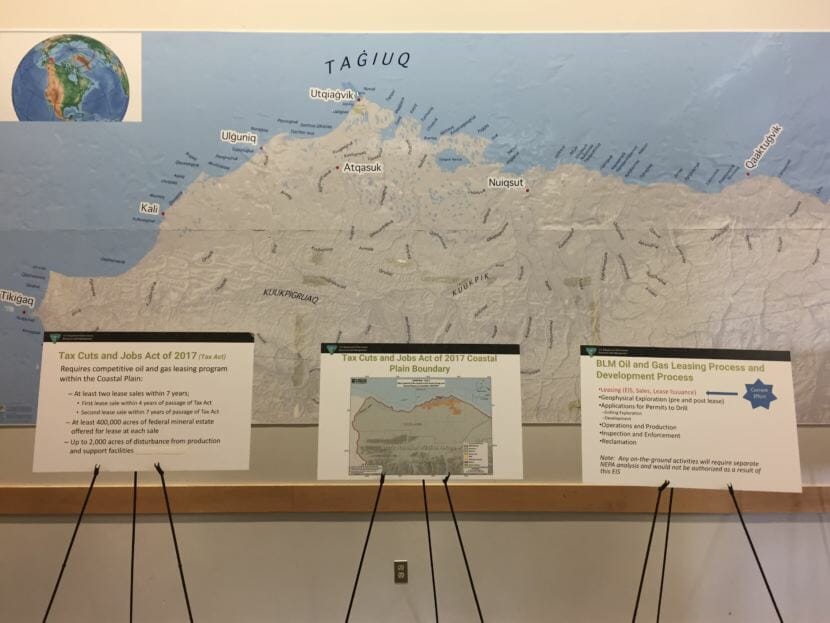
Slides put out by the Bureau of Land Management at the Utqiaġvik scoping meeting for drilling in the Arctic National Wildlife Refuge, May 31st, 2018. The investment bank Goldman Sachs says it won’t finance oil ventures in the refuge, or elsewhere in the Arctic. (Photo by Ravenna Koenig/ Alaska’s Energy Desk.)
Groups trying to block oil development in the Arctic National Wildlife Refuge won a commitment from a Wall Street heavyweight this week.
The investment bank Goldman Sachs says it won’t finance ventures to explore or develop oil prospects in the refuge, or elsewhere in the Arctic.
Ben Cushing of the Sierra Club has been pressing financial institutions to adopt such environmental policies, and several European banks already have.
“Goldman Sachs, with their policy they just released, became the first major U.S. bank to rule out funding for Arctic oil, as well as for new coal-fired power projects,” he said.
Other companies that restrict financing for Arctic drilling are Royal Bank of Scotland, Barclays and HSBC.
“I don’t think they’re much more than symbolic,” said economist Nick Loris. He focuses on energy issues at the Heritage Foundation.
He says the bank policies aren’t going to prevent drilling in the refuge.
“If there is economic interest in oil and gas development in the state of Alaska, someone is going to finance them,” Loris said.
Gov. Mike Dunleavy said in an interview on Fox News that the state will have to re-evaluate its relationship with Goldman Sachs in light of the bank’s policy.
The Department of Interior is in the final phase of its environmental review and is expected to schedule an auction for drilling rights to the coastal plain of the refuge in early 2020.
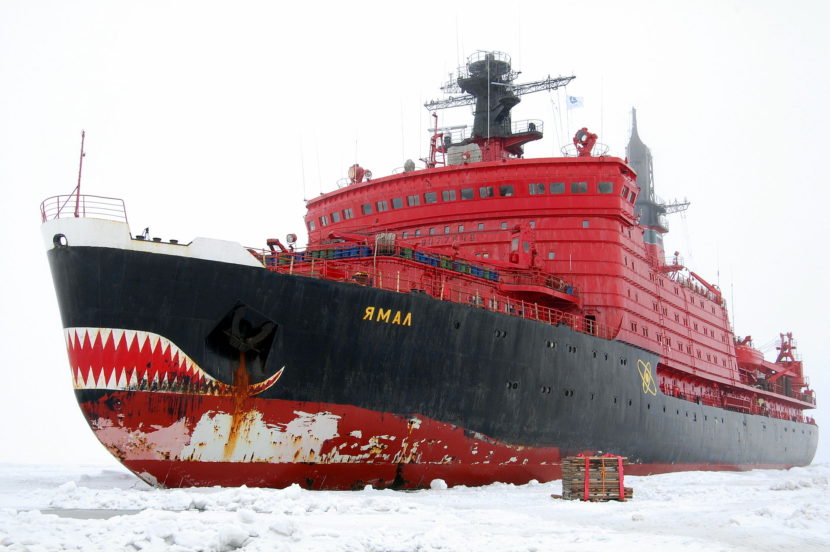
Icebreaker Yamal during removal of manned drifting station North Pole-36. August 2009. (Creative Commons photo by Pink floyd88)
Russia and China have stepped up their game in the Arctic this year, while the United States is just waking to the strategic power competition in the region.
That’s what Heather Conley, a Russia expert at the Center for Strategic and International Studies, and other witnesses told a U.S. Senate panel on Thursday.
Conley said perhaps the year’s most troubling news was about Russian missiles.
“Four days ago, the announcement by the Russian military (was) that they are placing S400s at each of their military units across the Russian Arctic, calling it a de facto anti-missile dome,” Conley said. “So, today we are already potentially losing access to the Arctic because of Russia’s growing military footprint.”
Congress has finally agreed to allow the Coast Guard to begin building six new icebreakers, after a decade of talking about it. Conley said Congress needs to fund an ongoing Arctic initiative so it doesn’t wait another decade to build other necessities, like an Arctic port.
Conley said Russia and China are able to assert themselves in the Arctic now because they committed to their strategic initiatives years ago.
“We continue to believe that we can just hold this minimalist position, do the bare minimum, and it’s going to be OK, and I want to challenge that notion,” Conley said.
Sherri Goodman, a senior strategist at the Center for Climate and Security, said Russia is increasing its control over the Northern Sea Route and becoming more aggressive with U.S. allies in the Arctic.
“Just last month, Russia tested a hyper-sonic missile for the first time in the Arctic and plans to launch their first weaponized icebreaker by 2023,” Goodman said.
Showing how far America lags behind, Sen. Dan Sullivan asked the hearing witnesses if the United States is able to assert its presence to counter foreign overreach in Arctic waters.
“Does the U.S. military have the capability to do a freedom of navigation operation in the Arctic?” he asked.
The U.S. conducts freedom of navigation operations, or FONOPS, by sailing in international waters to assert its rights and counter any disputed territorial claims.
Conley answered definitively: “No, neither the Navy nor the Coast Guard could do a freedom of navigation operation in the Arctic today.”
No one disagreed.
The hearing was in the Commerce Committee’s Subcommittee on Security, which Sullivan chairs.
Close
Update notification options
Subscribe to notifications
Subscribe
Get notifications about news related to the topics you care about. You can unsubscribe anytime.