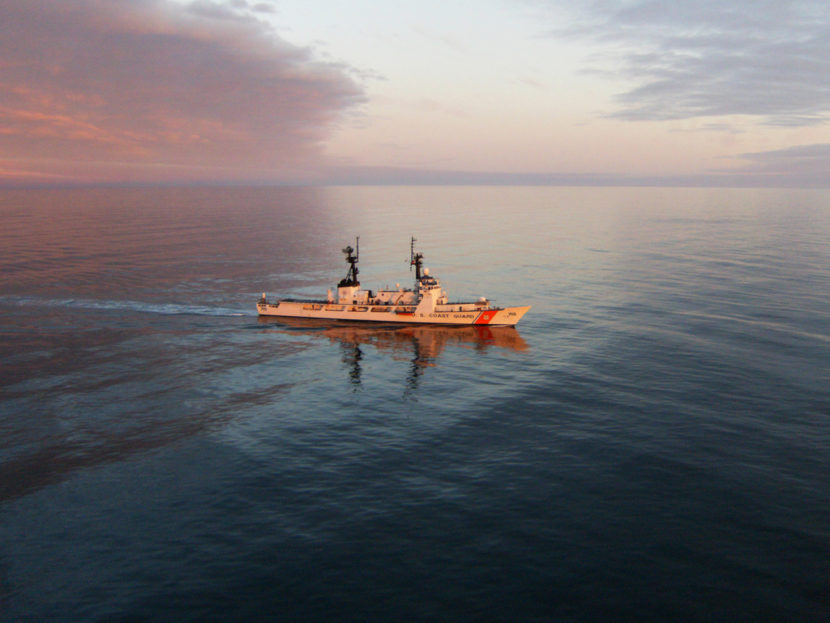
The Coast Guard Cutter Hamilton steams toward Utqiagvik (then called Barrow) to perform a search and rescue drill for the first time in the Arctic in 2008. The Coast Guard Cutter Hamilton was the first high endurance cutter to be in Arctic waters for the Coast Guard with the sole mission of homeland security. (U.S. Coast Guard Photo by Petty Officer Richard Brahm)
For ship travel, the Arctic is a new frontier, with an ocean of possibilities and few rules. A bill advancing in the U.S. Senate aims to allow new maritime opportunities while designing a framework that ensures safety.
“It’s not very often that you are able to really start with a blank sheet, and in this case, even though we’re seeing stepped up volume of traffic, it’s still a pretty blank sheet up there,” said Sen. Lisa Murkowski, the bill’s sponsor. “So let’s make sure that we’re doing this right.”
Her bill is called the “Arctic Shipping Federal Advisory Committee Act.” It establishes a 15-member committee to advise Congress and secretary of the U.S Department of Transportation.
Murkowski said the committee will give Alaskans and coastal residents a voice as the sea ice recedes and marine traffic increases. She said whalers, walrus hunters and fishermen are already crossing paths with more commercial ships.
“If we don’t have levels of engagement and communication by those who live there, with those who are passing through there, that’s not a good set up here,” Murkowski said.
Sen. Dan Sullivan, a co-sponsor, said the bill will help engage the federal government in Arctic transportation needs.
“Russian President Vladimir Putin sees the Arctic as the new Suez Canal, and he has every intention of controlling these vital transit routes,” Sullivan said in a written statement. “As sea ice recedes further and shipping lanes open, America must strongly assert its sovereignty and step up to hostile nations that seek to undermine our economic and national security interests in the region.”
The governors of Alaska and Washington can each nominate one member to the committee. One seat is reserved for an Alaska tribal member. There is also a seat to represent subsistence users and one for coastal communities.
The bill cleared the U.S. Senate’s Commerce Committee on Wednesday. Its next stop is the Senate floor.
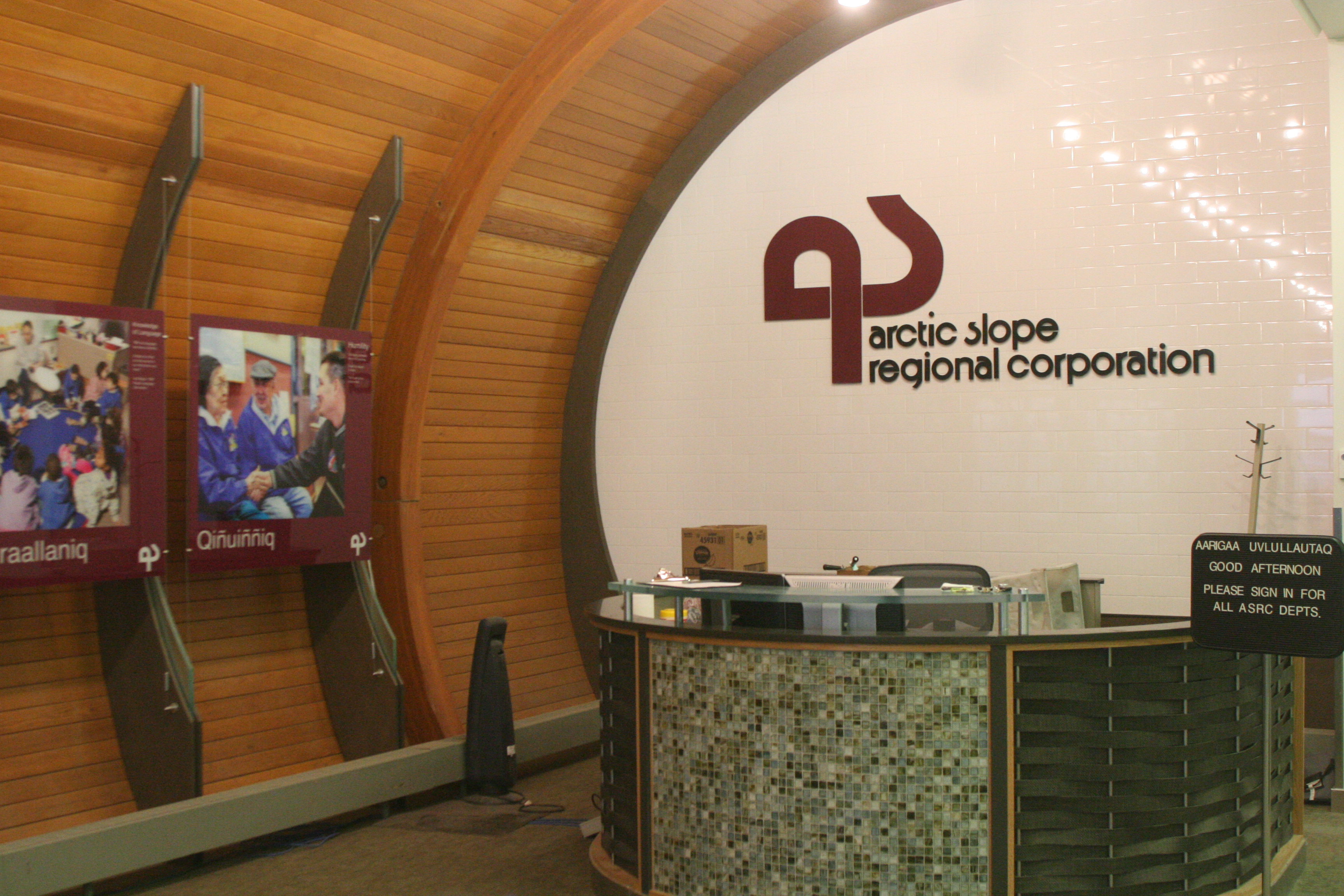
The Arctic Slope Regional Corp. corporate headquarters in Utqiaġvik in January 2018. (Photo by Ravenna Koenig/Alaska’s Energy Desk)
A powerful Alaska Native corporation is withdrawing from the Alaska Federation of Natives at the end of this year.
In a news release sent out late Friday afternoon, Arctic Slope Regional Corp. Director of Communications Ty Hardt wrote that the organization’s board of directors voted unanimously to end its membership in AFN on Dec. 31.
“With this decision, ASRC intends to focus on the various needs within Alaska’s North Slope, where there is an increased degree of alignment as well as additional efficiencies related to shared geography and other interests,” Hardt said.
According to the release, the corporation had been in talks about withdrawing “for more than a year.”
The statement does not include specific issues or areas of divergence between ASRC and AFN, and Hardt did not answer multiple phone calls Friday evening. The Utqiaġvik-based company serves Iñupiat shareholders living primarily in Alaska’s North Slope. It is the largest corporation based in Alaska.
Particularly on issues around climate change and government regulation, fissures have emerged between ASRC and other influential tribal and corporate entities in Alaska. During the most recent AFN convention in Fairbanks, a resolution on whether to declare a climate emergency stalled for more than an hour, with many of the most vocal opponents hailing from the North Slope region.
ASRC would be the only Alaska Native corporation in the state not to be a member of AFN, which is the state’s largest Native organization. All 11 other Alaska-based regional corporations, along with 12 regional nonprofit organizations and 171 village corporations, are part of the federation.
A spokesperson for AFN did not return calls Friday evening.
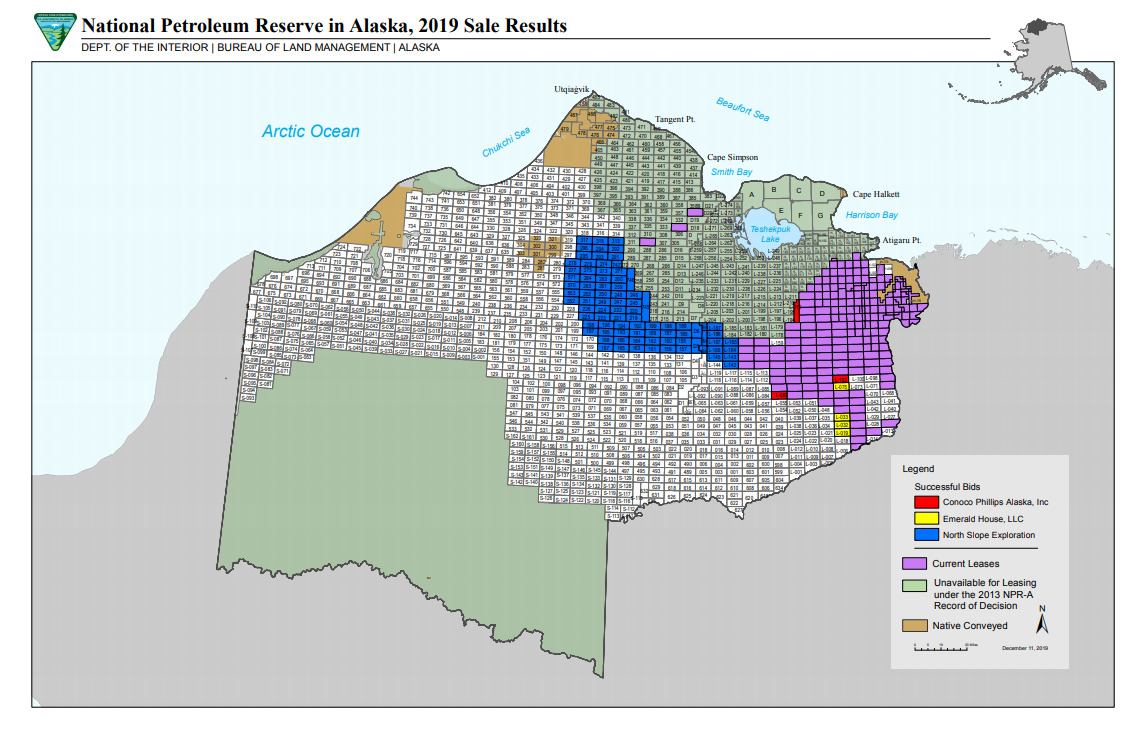
A map of the Dec. 11, 2019, lease sale shows North Slope Exploration’s winning bids, in blue. (Courtesy Bureau of Land Management)
Armstrong Oil and Gas, the Denver-based independent oil company, is pushing into a big newswath of federal oil leases on the North Slope, after making one of Alaska’s biggest discoveries in years.
North Slope Exploration, a newly-formed company managed by Armstrong, was the biggest bidder in a federal lease sale Wednesday in the National Petroleum Reserve in Alaska, the Indiana-sized area west of Prudhoe Bay.
North Slope Exploration bid roughly $10.5 million to win more than 80 leases in a swath across the middle of the reserve. They total roughly 1 million acres, an area larger than the state of Rhode Island.
ConocoPhillips and another company, Emerald House, each bid on a few more tracts. The total area bid on by companies was the most since 2004.
Critics blasted the sale as a “carbon bomb” that would worsen global warming while granting companies cheap access to federal resources. But President Donald Trump’s administration, which has pushed aggressively to increase oil production on the North Slope, praised the results.
“This, we believe, reflects the continuing interest in developing resources in the largest single block of federally-managed lands in the United States,” said Ted Murphy, a top Alaska official with the Bureau of Land Management, which conducted the lease sale.
The reserve had been neglected by industry for years until a pair of major new discoveries were announced in 2017 in a rock formation, the Nanushuk, that extends across the reserve. Companies had drilled dozens of wells into the Nanushuk but largely missed its potential until those two fields were found — one by ConocoPhillips that it’s calling Willow, and another by Armstrong known as Pikka.
The search for Pikka was recounted in a recent Wall Street Journal profile of the company’s chief executive, Bill Armstrong, which described him as the last of a dying breed — one of the “wildcatters” who search for new and undiscovered oil fields.
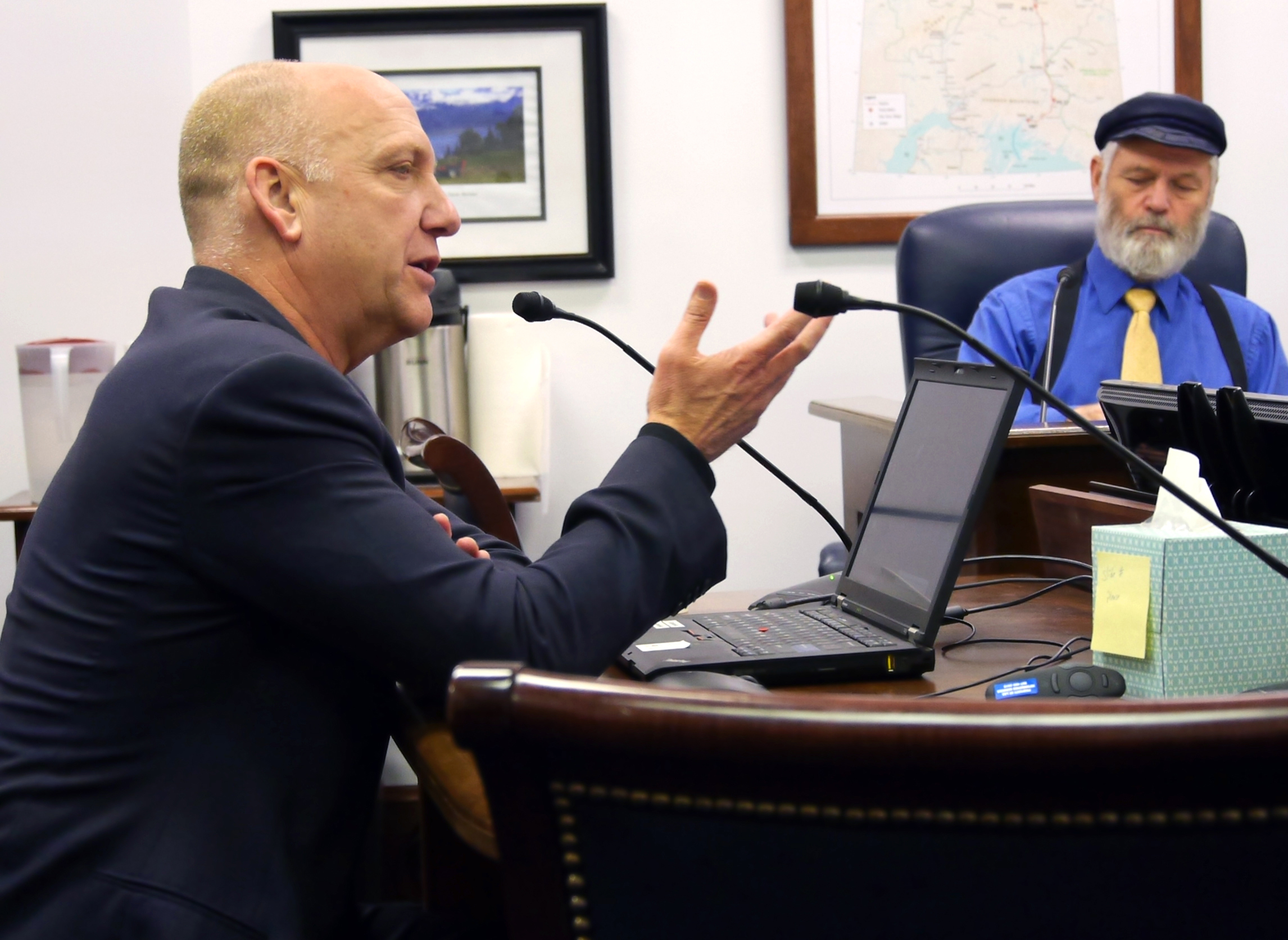
Bill Armstrong, president and CEO of Armstrong Oil and Gas, testifies at a state legislative hearing in 2016. (Photo by Skip Gray/360 North)
While wildcatters were the “longtime stars” of the industry, today’s oil companies are now spending less on exploration and are discovering fewer new deposits, the profile said. It labeled Armstrong “the last prospector” — a quirky Texan who wears jeans and Armani shirts, and dribbles a basketball around an indoor court in his Denver office. He sold his stake in the Pikka field for $850 million to a Papua New Guinea company, Oil Search, that’s now trying to bring the project into production.
Pikka is projected to produce up to 120,000 barrels of oil a day, or about one-fourth of the trans-Alaska pipeline’s current flow.
Armstrong didn’t respond to a request for comment Wednesday.
Trump administration critics quickly attacked the lease sale results on both environmental and fiscal grounds. The left-leaning, D.C.-based Center for American Progress noted that Alaska is already the country’s fastest warming state, and pointed out that the leases were sold for an average of roughly $11 an acre.
“Oil speculators are getting a sweetheart deal and taxpayers are getting the shaft,” Senior Fellow Matt Lee-Ashley, who worked in the U.S. Interior Department during the Obama administration, said in a statement. “Today’s bargain basement lease sale is just the latest example of the Trump Administration selling off America’s public lands for pennies on the dollar.”
Lee-Ashley also noted that the bid amounts undercut predictions about how much oil revenue will come from development in the Arctic National Wildlife Refuge, to the east.
When lawmakers passed the 2017 tax reform package that opened the refuge’s coastal plain to development, the Congressional Budget Office said it expected $1.8 billion in gross revenue from leasing over the following decade.
With roughly 1.6 million acres available for leasing, as the Trump administration has tentatively proposed, meeting the CBO’s projections would require the average price per acre to exceed $1,000.
The Arctic is rapidly and dramatically changing, with continued warming of the air, land and sea.
That’s the theme of the 2019 Arctic Report Card from the National Oceanic and Atmospheric Administration.
The report card was released Tuesday at a conference in San Francisco. While the general message is not a surprise, some of the specifics are sobering. Here are four big takeaways.
1. Surface air temperature is rising.
In 2019, the Arctic did not quite set a record, but look at the trend.
“The average annual surface air temperature over land for 2019 was the second highest since 1900,” said Matthew Druckenmiller from the National Snow and Ice Data Center. “The six hottest years on record in the Arctic have all taken place in the last six years.”
2. Change brings more change.
Consider permafrost. As it thaws, it releases carbon to the atmosphere — as much as 600 million tons a year.
“This thawing of permafrost may now be acting to accelerate global climate change,” Druckenmiller said.
A warmer Arctic also means a greener Arctic, but those plants don’t suck up enough carbon to balance the increase.
A warmer climate means permafrost emits carbon in winter, too. And a new study suggests the winter carbon release is two or three times higher than previously known.
3. The Bering Sea has now had two winters in a row that were almost ice-free.
That’s part of a larger picture: Sea ice is in retreat across the whole Arctic.
“The 13 lowest summer ice extents have been in the last 13 years,” said Donald Perovich, a Dartmouth College professor who studies sea ice.
He said old ice is disappearing. Ice more than four years old is thicker and more resilient, he said, and young ice is more vulnerable to the elements. Back in the 1980s, Pervich said, about a third of the ice cover was made of that old, thick ice.
“It covered an area roughly the same size as the United States east of the Mississippi,” he said. “Now, in March of 2019, it’s 1% of the ice cover, and all that’s left is an area the size of the state of Maine.”
4. These changes cause direct harm to real people.
Mellissa Johnson is Iñupiaq and lives in Nome. She was invited to speak at the report card rollout. She explained that her community depends on sea ice. It’s the platform they need to hunt marine mammals.
Johnson said it used to be that hunters only had to travel 10 or 20 miles to reach the ice.
“And now it’s, at minimum, 50 miles out, is where the sea ice is. And it’s having treacherous impacts to our hunters,” she said.
The warmer environment is degrading their food sources, too, she said, and that leaves less to go around. Animals have a thinner fat layer. Sea birds are sick. Berries don’t ripen when they used to.
And Johnson said they need snow cover and ice to travel between communities.
“Without that, we become limited,” she said. “We become isolated. We become continuously sparse in our sharing.”
This is the 14th annual Arctic Report Card. It’s a peer-reviewed document compiled by 81 scientists from a dozen countries.
The Western Alaska village of Newtok in August 2016. Because of encroaching erosion, the village is in the process of relocating. (Photo by Eric Keto/Alaska’s Energy Desk)
Ten years ago, the Army Corps of Engineers released a report that detailed the impacts of erosion in Alaska Native communities.
Don Antrobus is the program manager for the Denali Commission’s Village Infrastructure Protection Program. He helped guide an updated report that documents three environmental threats facing the communities: erosion, thawing permafrost, and flooding.
Antrobus said those environmental threats are made worse by climate change.
“In order for communities to develop good solutions, they need to fully understand the site-specific threat,” Antrobus said.
The Army Corps and researchers at the University of Alaska Fairbanks conducted the research and wrote up the report at the behest of the Denali Commission. It took three years and $700,000.
Antrobus said that more specific information is needed to fully understand the threats.
“One of the approaches that we’re taking, to try to kind of paint a bull’s-eye around what those additional data collection needs are, is to not only say that you need additional information, but to identify these are the specific types of communities, specific vulnerability analyses that are necessary,” Antrobus said.
This report examines 187 communities, most of them in Western Alaska near or right on the coast or near a river. It ranks them according to how bad the threat is endangering their infrastructure.
The rankings are complex. The report separates the three threats and ranks each community under each threat. Then the report combines all three for each community and ranks the communities that are in the biggest trouble.
“There is a little bit of uncertainty based on that availability of data, so it shouldn’t be taken as hard and fast,” Antrobus said.
The top two most threatened communities are Shaktoolik and Shishmaref, both close to the Bering and Chukchi seas.
“We were looking at flooding, erosion, and permafrost degradation threats to community infrastructure. And so I think it’s natural that a lot of … the greatest flooding threats that we’re gonna see are gonna be along the coast,” Antrobus said.
These villages have endured catastrophic erosion and storms, and the dwindling sea ice means that there is less protection for the shoreline. The ocean is nibbling closer to communities, forcing some, like Shishmaref, to consider relocation.
Other communities sit right next to a riverbank, like Napakiak and Newtok in the Yukon-Kuskokwim Delta. Newtok is relocating entirely, while Napakiak wants to move its school.
Antrobus said that the report could help communities figure out their biggest threat. For some, erosion is the biggest. For others, it’s flooding. He said this report is just a one-time effort, but he hopes government agencies and villages can fill in the gaps in data, and apply for funding to do so.
A flow line curves above the horizon on the western North Slope. (Photo by Elizabeth Harball/Alaska’s Energy Desk)
Oil company Hilcorp and one of its drilling contractors each paid more than $25,000 in penalties earlier this year after a worker was killed last December on one of Hilcorp’s rigs on the North Slope.
Shawn Huber, 36, died at the Milne Point field when the rig’s operator accidentally opened a set of hydraulic jaws and dropped a 700-pound, 31-foot section of drilling pipe that struck Huber in the head, according to the companies’ internal investigation subsequently submitted to state workplace safety regulators. The operator was distracted, according to the investigation, because he was training a colleague.
Some six months later, Hilcorp paid $25,000 in state-assessed fines for violating a pair of safety regulations — one that says employers shouldn’t allow rig workers to stand or pass under “suspended loads,” and another that requires appropriate disinfectant to be used after a blood spill. A Hilcorp supervisor instructed rig workers to clean up after the accident, and some of them weren’t wearing gloves, exposing them to bloodborne illnesses, according to a state investigator’s report.
Hilcorp’s contractor, Kuukpik Drilling, paid its own $30,000 fine for five violations — two that were the same as Hilcorp’s, two more that had to do with unsafe use of a stepladder, and another for the company’s failure to protect Huber from the hazards of his job.
Huber, who was working for Kuukpik, had more than 10 years of drill rig experience, and was married with three children, according to his obituary.
Public interest in Hilcorp, a privately owned company, has risen sharply since the company announced in August that it would buy BP’s assets in Alaska for $5.6 billion. If approved by state regulators, the purchase would give Hilcorp a major stake in two of the highest-profile assets in Alaska’s oil industry, the Prudhoe Bay field and the trans-Alaska pipeline.
The details of Huber’s death and the subsequent penalties were laid out in a pair of inquiries conducted by the state’s workplace safety agency, Alaska Occupational Safety and Health, and released in response to a public records request. The agency, known as AKOSH, found both Hilcorp and Kuukpik Drilling responsible for the accident, which appears to be the first worker death on the North Slope’s oil fields since 2012.
Officials at Kuukpik Drilling referred requests to parent company Kuukpik Corp., whose chief executive, Lanston Chinn, declined to comment.
A Hilcorp spokesperson, Justin Furnace, responded to a request for an interview with a prepared statement that called Huber’s death “a tragic event for the entire Hilcorp Alaska family.”
“We have worked closely with AKOSH on their investigation, as well as our own,” Furnace said. “We have reviewed the findings of this work closely to determine how we can apply lessons learned to improve workplace safety with both our employees and with contractors that provide services to us in the field. The safety of our personnel and anyone associated with our operation is always our top priority.”
The accident took place at the aging Milne Point field, northwest of Prudhoe Bay, which Hilcorp co-owns with BP.
Huber’s 11-person crew began their work shift at midnight Dec. 7 after 18 hours off-duty, according to the internal investigation written by officials from Hilcorp, Kuukpik Drilling and a third company, Aurora Drilling. After a short safety meeting, workers started “normal drill rig activities,” pulling segments of drilling pipe out of the well, the investigation said.
Two hours later, Huber was on the rig floor, walking around a piece of drilling pipe that was coming out of the well. He was spray painting it, to indicate that the end was damaged.
The drill’s operator was working from a console, controlling a set of hydraulic jaws used to pull the 31-foot sections of pipe from the well, then lower them off the floor. At the same time, he was describing his actions to another worker that he was mentoring, the investigation said.
As the drill operator lowered a piece of pipe that had previously come out of the ground, he was describing how to open the jaws and release it when he accidentally took the two steps required to do so, according to the investigation and a separate memo written by state regulators.
When he realized what was happening, the operator tried to reverse himself by pressing a “close” button on his joystick, “while also yelling over the intercom to alert the crew,” the investigation said.
Two other workers on the rig floor heard the operator’s yell and reacted, the investigation said. But Huber did not appear to respond, and he was hit by the top end of the pipe as it fell an estimated 28 feet. Trained medical responders arrived within three minutes, and a nurse practitioner arrived within nine minutes, but Huber was pronounced dead roughly an hour later at Milne Point’s clinic, according to the companies’ investigation.
The investigation identified two “root causes” for the accident — first, that the drill operator was “performing two tasks at the same time” by operating and mentoring. And second, there were “contradictory requirements” when it came to workers’ exposure to overhead loads. The companies had “safe work practices” in place to limit exposure, the investigation said, but employees were still sometimes exposed when they were working.
Kuukpik Drilling’s safety manager, Sonny Kula, told a state regulators that “the procedure that was being followed was normal operating procedure.”
After the accident, the companies said they’d put several safeguards in place to correct the workplace safety violations.
First, at the request of a Hilcorp drilling superintendent, a technology company changed the rig’s controls to block the operator’s normal two-step procedure from opening the hydraulic jaws within a specific range of heights, unless the operator took a special third step to override the restriction. That system was tested within three days of the accident.
Second, Hilcorp and Kuukpik Drilling sent regulators a diagram that set out a “restricted work area,” and a list of tasks that are barred while the rig is operating, like the one Huber was doing. “Workers with essential operations are permitted within the fall zone, but not directly under the load,” Kula wrote in a memo to state regulators.
And third, Kuukpik Drilling required all its workers to retake a bloodborne illness training program.
The companies’ assessment of the accident’s root cause — the driller’s distraction and the “contradictory requirements” around overhead loads — appears to be “thoughtful and thorough,” said Deb Kelly, who spent three years supervising AKOSH as a top official at the Alaska Department of Labor.
But it’s the companies’ responsibility to make sure that when workers do make mistakes like the rig operator’s, the results aren’t catastrophic, added Kelly, who reviewed the state’s case files at Alaska Public Media’s request.
“An employer should never put employees in a position where a moment’s inattention will cause a fatality,” she said. “You have to have as many layers of safety as you can practically apply, so that a lot of things have to go wrong before someone gets hurt.”