Arctic

As Arctic ice melts, will the Navy return to Adak?

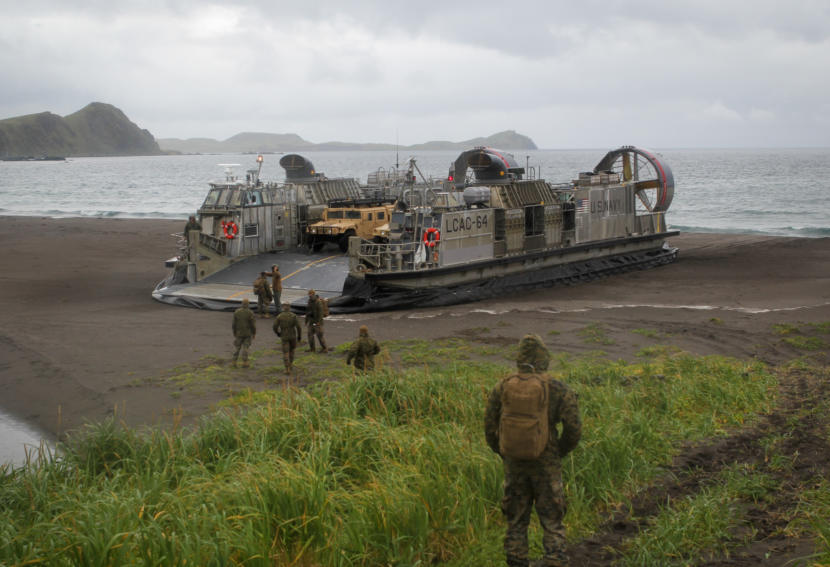
An LCAC, a hovercraft the Navy uses to transport material from ship to shore, lands on the beach at Kuluk Bay on Adak as part of military exercises. (Photo by Zachariah Hughes/Alaska Public Media)

Amid the wind, waves and rain, a strange ship roared through Kuluk Bay toward the shores of Adak. It looked out of place, speeding past misty green mountains of the western Aleutian Islands, a cross between a speedboat and an industrial fishing barge. With alarming speed, it lurched from the shore onto the beach, kicking up dark swirls of sand and sea-spray. Its cargo trickled down off a ramp: Humvees, U.S. Marines, a compact green bulldozer. Everything you would need in an invasion.

For the first time in more than 30 years, the Navy and Marine Corps are holding large-scale exercises in the Aleutians designed to test their capabilities in a cold-climate environment. It’s been more than two decades since the Pentagon shuttered a large naval airbase on the island that once housed 6,000 service members and their families. Now, with Arctic sea-ice melting, shipping traffic increasing, and shifting defense priorities, the military is weighing whether it wants to return to Alaska’s Bering Sea.
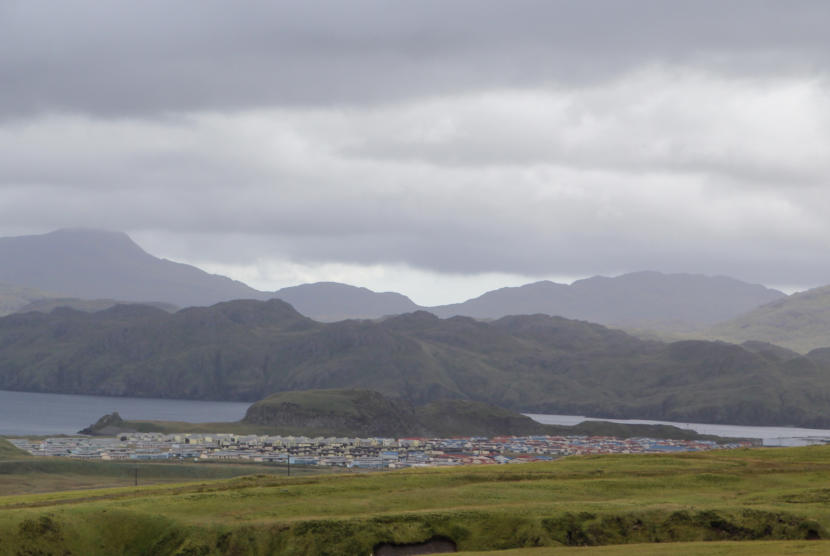
Houses built for military families on the north side of Adak before the Base Realignment and Closures Act in 1995 led the Defense Department to shutter operations on the island by 1997. (Photo by Zachariah Hughes/Alaska Public Media)

One of the biggest boosters for that idea is Aleut Corporation, an Alaska Native regional corporation that owns much of Adak’s land. The corporation sees in the military a potential anchor tenant on an island that could transform into a hub for trans-polar shipping in the coming decades. But on a rainy morning this September, Rear Admiral Cedric Pringle’s concerns were more immediate: Would the weather let up enough for the training to even happen?

“You can’t simulate this,” Pringle said from the beach as he was hit with wind strong enough to make his eyes water. The day before, powerful gales and a low cloud ceiling led military leaders to postpone their plan to have Marine battalions storm the beach as attack helicopters helped seize a nearby airfield. Though the conditions are normal for the western Aleutians, it was enough to scramble a planned visit by Navy Secretary Richard V. Spencer.
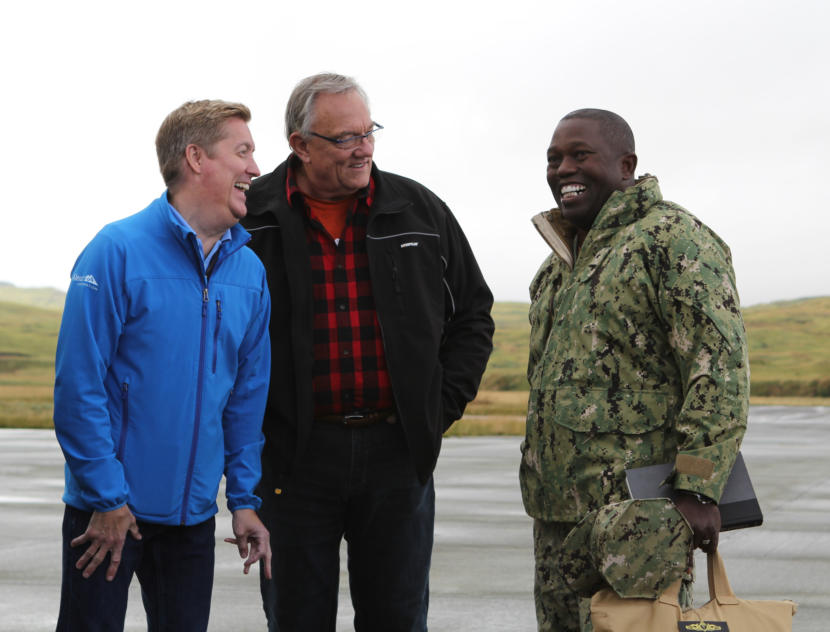
Rear Admiral Cedric Pringle, right, greets Aleut Corporation CEO Thomas Mack, left, and the company’s military liaison Paul Fuhs upon landing in Adak. (Photo by Zachariah Hughes/Alaska Public Media)

Pringle is in charge of 15,000 seamen and marines, many of whom were seeing Alaska for the first time as part of the Arctic Expeditionary Capabilities Exercise.

“From a Navy-Marine stand point, we looked at this exercise as an opportunity to conduct training in a very, very challenging environment,” Pringle said. They also worked with the Coast Guard, which has a more consistent presence in Alaska and was helping train infantry Marines in search and rescue operations.
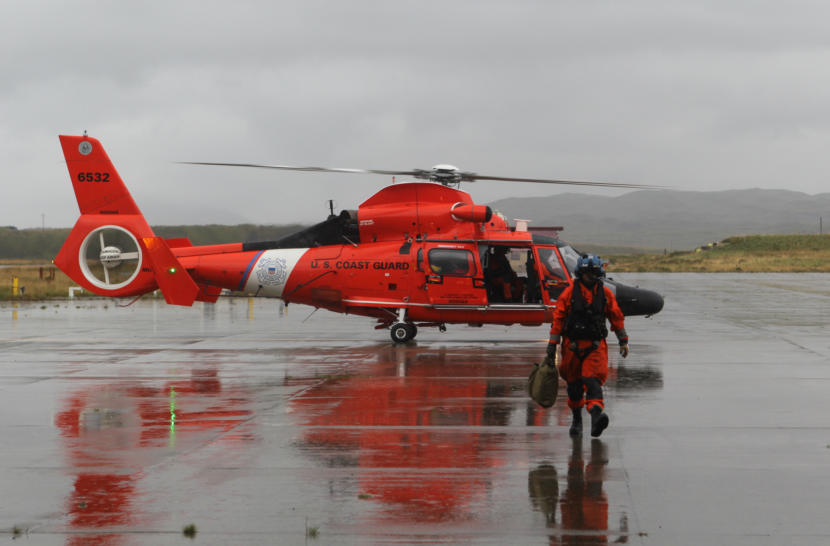
A Coast Guard helicopter on-site to help train Marines in search and rescue operations as part of the military exercises on Adak. (Photo by Zachariah Hughes/Alaska Public Media)

More broadly, the exercise was a chance for the military to assess whether moving large numbers of troops and supplies from a warship out in the ocean onto shore would work in an environment much farther north than the Navy is accustomed to.

“That’s exactly what we’d do with a combat situation,” Pringle said. “That’s exactly what we would do in a humanitarian situation, as well.”

As part of the same exercise, a concurrent operation in Seward tested a bulk liquid transfer from ship to shore, the sort of technique that would allow you to transfer fuel to a devastated port.

A few hours after Pringle departed, the LCACs landed on Adak’s shores. “Landing Craft, Air Cushion” vehicles are airboats powered by massive industrial fans that float above the waves on an inflatable cushion the size of a basketball court. They are loud and fast, designed to ferry equipment from warships after infantry troops establish beachheads.
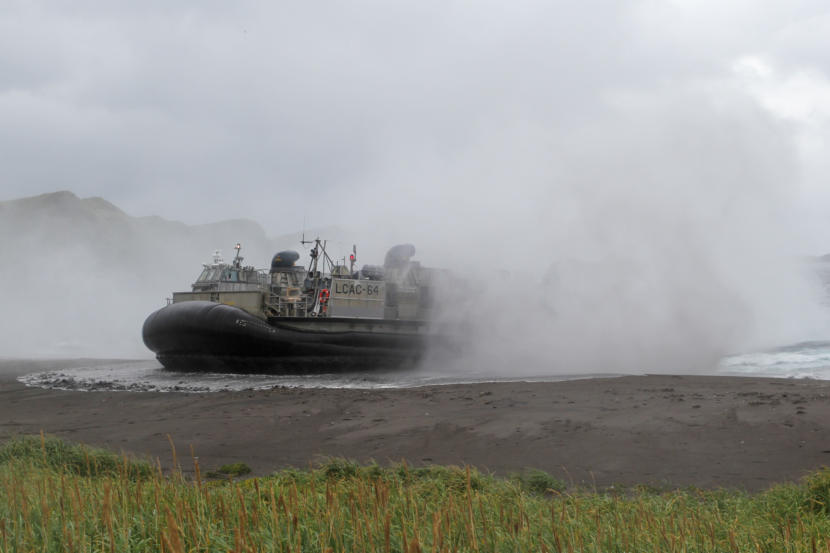
A “Landing Craft, Air Cushion” vessel traveled around 13 nautical miles from a warship off the coast, carrying trucks, troops, and a bulldozer. (Photo by Zachariah Hughes/Alaska Public Media)

A delegation from the Aleut Corporation watched the LCACs from the shore.

“The Aleut Corporation is very pleased that the military is here,” said CEO Thomas Mack. “And we look forward to a continued relationship.”

Aleut is hoping that the Navy will re-establish some kind of permanent presence on the island, whether that’s basing personnel here or regularly conducting trainings. The company sees Adak as offering the military a strategic location.

“With the opening of the Arctic, with the different things that are going on geopolitically in the world, Adak is in a place that the U.S. needs to utilize. And we want to be a part of that,” Mack said.

What makes Adak different from other Alaska communities lobbying for military assets — and the federal dollars they bring — is that almost every building on the island once belonged to the Defense Department. Adak was a staging point for the American military’s Aleutian campaign. During the Cold War, the Navy maintained an anti-submarine base on the island, with thousands of people living in pre-fabricated houses and blocky barracks. In the 90s, the federal government closed its base on Adak. Under a transfer agreement, the Aleut Corporation purchased most of the military’s land and facilities (the southern part of the island is a National Wildlife Refuge).
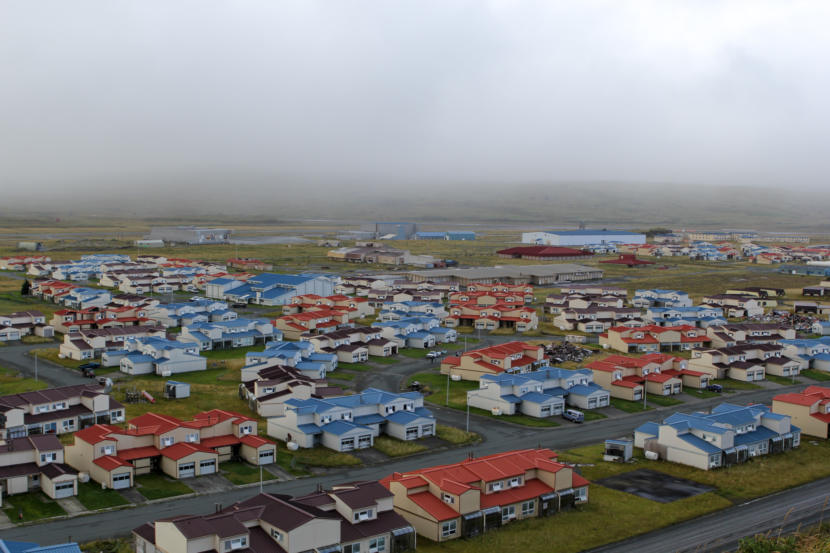
The most modern pre-fabricated houses built by the military before it ended major basing operations on Adak. Some of the buildings are in good shape, while others are totally collapsed from exposure to the harsh environment. (Photo by Zachariah Hughes/Alaska Public Media)

Now, a small permanent civilian population, between 100 and 300 depending on the time of year, lives on the island, many of whom work at a fish processing plant. But the remnants of a much larger, semi-abandoned community remain all around. From a ridge line above the beach you can stare out at suburban-style cul-de-sacs filled mostly with vacant houses, many of which are partially destroyed from the scouring winds. Roads crisscross the rolling mountains. Up in the hills are crumbling concrete barracks and rusting power stations. There’s an old McDonald’s boarded up not far from a daycare building that now houses a small grocery store.

This large imprint is a problem for Adak’s viability as a town. Paul Fuhs is the military liaison for the Aleut Corporation, and he said that if Navy came back, it would go a long ways toward reviving the town.
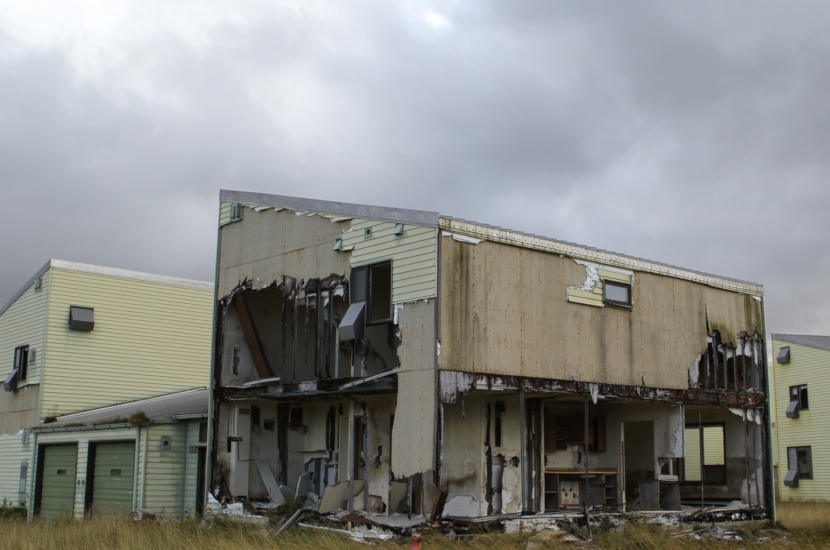
Many of the houses built by the military have been destroyed by wind and storms that batter Adak. (Photo by Zachariah Hughes/Alaska Public Media)

“They would be an anchor tenant,” Fuhs said. “One of the challenges for the community here is that the base was so big before that all the utilities are on too large a scale to operate.”

If the military returned, it would convert what are liabilities for the local government and Aleut Corporation into opportunities for national defense, according to Fuhs. Dilapidated barracks in the hills could be used for urban warfare training, for example, instead of sitting empty and unused. The sub-Arctic environment, which threw the exercise’s timelines into disarray, is another selling point.

”When you’re in a war you don’t get to pick your weather,” Fuhs said. “They like it, it’s a challenge. They want to challenge their troops.”

Though scheduling and planned visits from higher-ups were scrambled by conditions, according to Lieutenant Rochelle Rieger, spokesperson for the Navy’s 3rd Fleet, troops successfully practiced seizing an airfield and conducting a mock air-raid on Adak.

Weather is hardly the only barrier for increased activity. Adak is 444 miles from the nearest population hub, Unalaska, and over 1,200 miles from Anchorage. But with melting Arctic sea ice, the Aleut Corporation envisions a possible cargo shipping hub on Adak that could serve vessels transiting the Northern Sea and Trans-Polar routes. If they can get the military committed to increasing its presence, that might bring compounding benefits from rising commercial interest in the island.
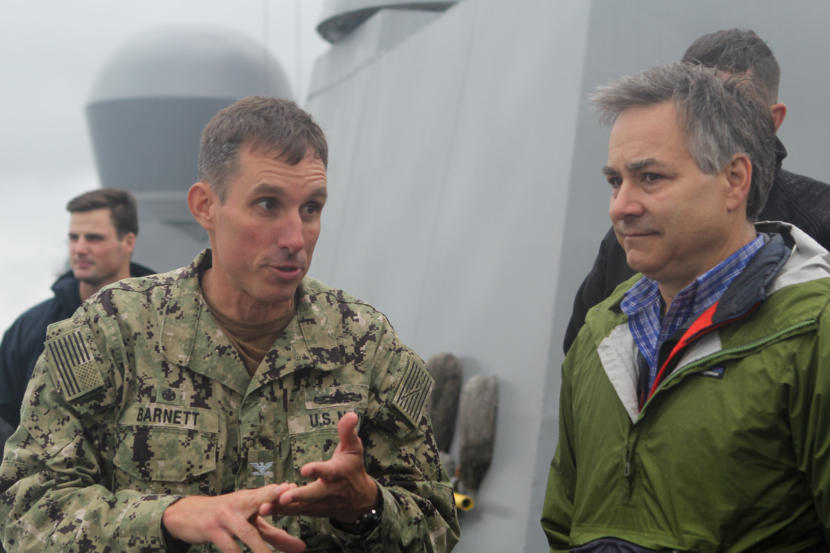
Capt. John Barnett speaking with George Pollock, president of Aleut Enterprise, speaking aboard the USS Somerset, which took part in the military’s exercises. (Photo by Zachariah Hughes/Alaska Public Media)

“We’ve done everything that we can to show them that they’d be welcome here and that we’re ready to facilitate anything that they want to do,” Fuhs said.

Asked whether the Navy has plans to re-establish a permanent presence on Adak, Rieger said, “Potential basing in Alaska is something the Navy is looking at, but the specifics are pre-decisional at this point.”

In the meantime, the military and policy-makers have to figure out where Alaska fits in the country’s approach to national defense and a warming planet.
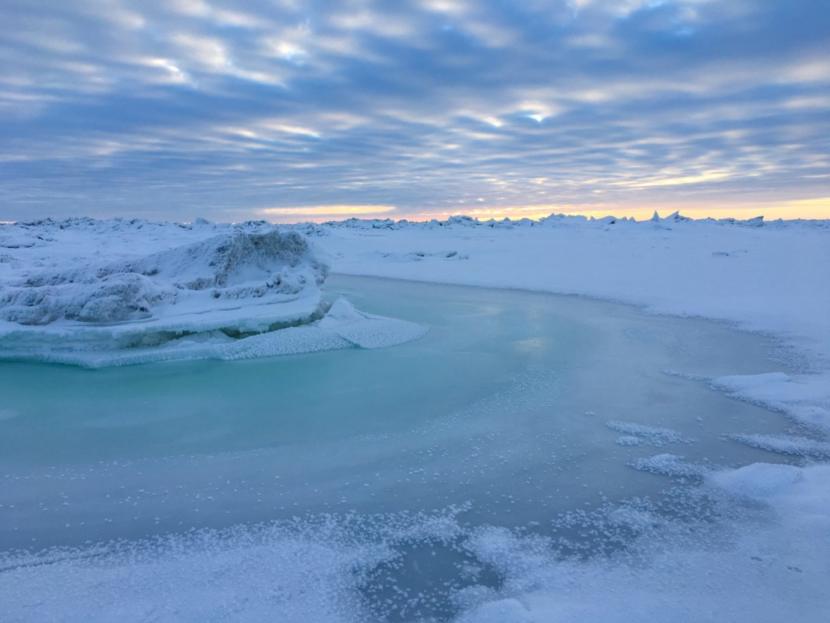

8 key takeaways for Alaska in a major new United Nations report on climate change

Sea ice near Nome, Jan. 29, 2018. (Photo by Zoe Grueskin/KNOM)

The United Nations on Wednesday released a major new report on how climate change is affecting the world’s oceans and frozen areas, like glaciers, ice sheets and permafrost. It contains stark warnings on how rising emissions will affect the environments that blanket most of the earth’s surface — and much of Alaska.

University of Alaska Fairbanks Professor Emeritus Gary Kofinas was one of more than 100 experts from around the world who authored the report, helping lead the chapter focused on polar regions.

Kofinas acknowledged that for Alaskans, a lot of what’s in it won’t be a surprise.

“Much of what’s happening in polar regions, particularly the Arctic, will be something that people experience firsthand in Alaska,” Kofinas said. “For example, thawing permafrost, changes in seasonality that affect the harvesting for subsistence users and harvesters in general, changes in fisheries, those sorts of things.”

“But what might be new to Alaskans is the scale of change,” he said.

Here are just a few of the report’s takeaways for Alaska, along with related news coverage.

1. “Ice sheets and glaciers worldwide have lost mass.”

2. “Permafrost temperatures have increased to record high levels.”

3. “Between 1979 and 2018, Arctic sea ice extent has very likely decreased for all months of the year.”

4. “Arctic residents, especially Indigenous peoples, have adjusted the timing of activities to respond to changes in seasonality and safety of land, ice, and snow travel conditions.”

5. “Warming-induced changes in the spatial distribution and abundance of some fish and shellfish stocks have had positive and negative impacts on catches, economic benefits, livelihoods and local culture.”

6. “Summertime Arctic ship-based transportation (including tourism) increased over the past two decades concurrent with sea ice reductions.”

7. “Coastal protection through hard measures, such as dikes, seawalls, and surge barriers, is widespread in many coastal cities and deltas.”

8. Scientists have high confidence that things are going to keep changing — the ocean will continue to warm and marine heatwaves will increase in frequency and intensity, glaciers will continue to lose mass, snow cover is expected to continue to decline and sea ice extent in the Arctic is expected to keep shrinking.

But Kofinas said one of the report’s key messages is that while some climate impacts are already unavoidable, people can still make choices that affect how severe those impacts will be.

“Hardships will be experienced. Adaptation will be needed. But the question is, to what extent, and will we be able to keep pace with those changes?” he said.

About 300 BP union employees will keep their jobs — for now

BP’s operations center at Prudhoe Bay. (Photo by Elizabeth Harball/Alaska’s Energy Desk)

About 300 BP union workers at Prudhoe Bay will remain in their jobs, at least through the end of their current contract.

That’s according to Hilcorp, the oil company set to take over BP’s entire business in Alaska.

But the leader of the union representing those workers said he remains uncertain about Hilcorp’s relationship with labor going forward.

“We haven’t had any formal meetings with them yet,” said Kristjan Dye, president of United Steelworkers Local 4959.

“Until we really sit down and talk to them, I don’t know for sure,” Dye said.

Prudhoe Bay is split, in terms of workers. On the west side of the oilfield, BP Alaska has about 300 United Steelworkers employees. On the east side, all employees are at-will. That’s a legacy from when Prudhoe Bay was owned by two separate oil companies, before BP purchased Arco in 2000.

Dye said his union negotiated its latest contract with BP in January, and it includes an agreement that the 300 workers have jobs for three years, even if BP sells to another company.

Which is, of course, exactly what happened in August, when Hilcorp announced it intends to buy all of BP’s Alaska business for $5.6 billion.

In an emailed statement, Hilcorp spokesperson Justin Furnace said, “Hilcorp will honor the existing labor contracts governing union employees associated with the acquisition.”

But Dye said he still feels uncertain about union workers’ long-term prospects with Hilcorp.

“The interesting time may come when the contract has to be renegotiated. Then, we’ll just have to see what happens,” he said.

Hilcorp did not respond to emailed questions about what happens after the contract with United Steelworkers ends, or if the company currently employs any union laborers.

Dye said he doesn’t know if the union’s relationship with Hilcorp will be much more difficult than its relationship with BP. United Steelworkers sued BP last year over a contract dispute. And, he said, some workers were frustrated that BP wasn’t exploring for oil more aggressively.

“Right now, people have kind of mixed emotions because on one hand, they realize we’re getting a new employer and that they aren’t really union friendly,” Dye said. “But on the other hand, they would like to start making oil again and Hilcorp does have a reputation for making oil.”

BP’s sale also included the company’s interest in the trans-Alaska pipeline. Harvest Alaska, a Hilcorp affiliate, will take BP’s place at the owner’s table when the sale is finalized.

And Alyeska now employs a blend of union and non-union employees, according to Michelle Egan, a spokesperson for Alyeska Pipeline Service Company.

“Changing a TAPS owners does not change the union make-up of our workforce or the workforce of our contractors,” Egan said in an email.

Hilcorp’s Harvest Alaska will be part of the group of owners that approves contracts going forward, which also includes affiliates of ConocoPhillips, ExxonMobil and Unocal.

In a follow-up email, Egan said, “I can’t speculate about what might happen in the future,” and described Ayeska as “agnostic” on unions, adding, “we don’t dictate the terms of any contractor’s relationship with their employees.”

Other BP employees may be leaving Prudhoe Bay much sooner than their union counterparts. They have been given three options — to apply for jobs with BP outside Alaska, to request to leave BP with a severance package or to apply for a job with Hilcorp.

Attack in Saudi Arabia highlights Alaska’s diminishing role on the global oil stage 

https://www.flickr.com/photos/specialk80731/8229830783/in/pool-northslope
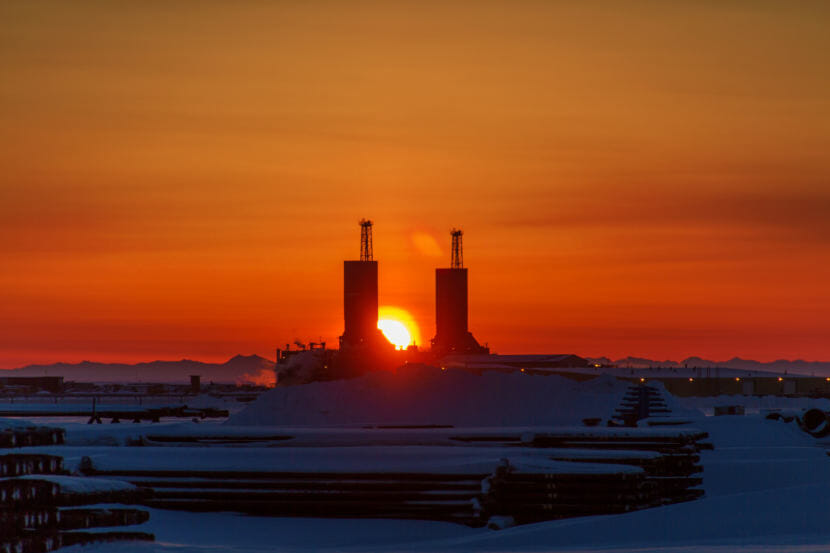
Sunrise on the North Slope behind the two new Parker drilling rigs. (Photo courtesy Kevan Dee)

Over the weekend, attacks on an oil field and processing facility in Saudi Arabia knocked out more than 5% of the world’s daily oil production.

It was the biggest disruption of global oil supply in decades.

Politically, the attacks have generated a lot of momentum. And, briefly, oil prices spiked.

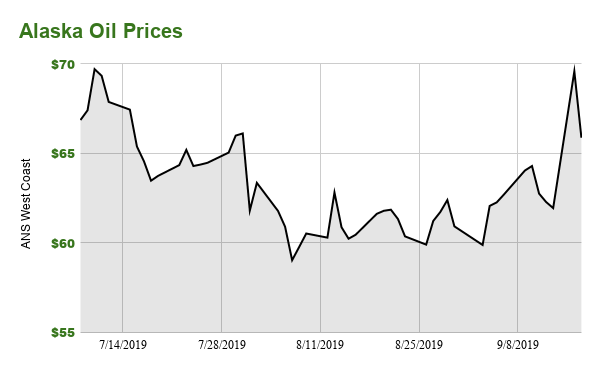
In Alaska, that meant that on Monday, Sept. 16, North Slope crude prices jumped to their highest level in more than two months.

But that jump was short-lived, and the incident hasn’t had a lasting impact on oil prices — or what those prices are predicted to be in the future.

(Graphic by Rashah McChesney/Alaska’s Energy Desk, using data from the Alaska Department of Revenue)

There are a few reasons for that. One is that Saudi Arabia’s energy minister announced on Monday that it is already supplying oil to customers at pre-attack levels. Prince Abdulaziz bin Salman pledged that that country would be back at normal production by the end of the month.

“It was surprising news, and the market reacted thinking there was going to be a lot of supply taken off the market, and it turns out the news wasn’t as bad as feared,” said Alaska Department of Revenue Chief Economist Dan Stickel.

Typically, when oil prices inch up, that’s good for Alaska’s budget. But, a one-day bump in prices isn’t going to do much for Alaska’s bottom line.

“Any short-term volatility isn’t going to have much impact on the budget,” Stickel said. “Right now, prices are below what we had in the latest revenue forecast.”

That revenue forecast is the state’s semi-annual prediction of how much money will be coming in and where it comes from. It’s a big part of how the state develops its fiscal plan. And the price of oil is central to that forecast.

Right now, the Department of Revenue is getting ready to put out its semi-annual forecast. It usually comes out in December.

But some things are going to be different this year.

In the past, the state would bring in oil experts from other parts of the country and the rest of the world. In a closed-door meeting, the outside experts and state economists would come up with an oil price prediction that would drive state spending for the next year.

Stickel said they’re not doing it that way this year: “We are going to look at the futures market as the basis for our price forecast.”

That’s it. No price-forecasting session. No out-of-state experts. Just state employees checking futures and using global oil prices as an indicator of what’s in store for the state.

Stickel said there are a few reasons for the change. A big one is money.

Department of Revenue Commissioner-designee Bruce Tangeman, right, presents the spring revenue forecast to the Senate Finance Committee in Juneau on March 18, 2019. He was accompanied by the department economist Dan Stickel.
Alaska Department of Revenue Chief Economist Dan Stickel, left, with Revenue Commissioner Bruce Tangeman at a Senate Finance Committee meeting in Juneau on March 18, 2019. (Photo by Skip Gray/360 North)

“We’re going to save a lot of time and expense by just using the public forecast source,” Stickel said. Paying the dozens of state employees and outside experts to gather in one place was expensive.

Also, there’s a lot of widely-available information now about global oil markets — and the things that drive prices — that wasn’t available when the state started predicting oil prices.

Stickel said the shift will also help people understand how Alaska is getting its oil price predictions.

“The idea is that it won’t be a group of us just sitting down and deciding on the price forecast. It will have a rather transparent protocol,” he said. “Anyone can say, ‘OK, this is how they grabbed the futures market price.’”

Another factor is that Alaska’s production has declined. The state is putting less oil into the market than it used to.

Stickel said Alaska’s production represents about 0.5% of daily global demand.

It isn’t clear if the change in the way the state forecasts the price of its oil will have a measurable effect on the way the state does business.

Rather, it’s a reflection of Alaska’s diminishing role in the oil markets that it sells into.

“Alaska is now a price taker,” Stickel said.

As opposed to being a price maker. Being a price taker basically means that the state doesn’t produce enough oil to impact prices in the markets that it sells into.

“We used to be a more significant supplier to a smaller market. Now we’re a smaller supplier in a more global market,” he said.

Seattle City Council votes to withhold business from Arctic Refuge oil companies

Seattle skyline. (Creative Commons photo by Bryce Edwards)

The Seattle City Council voted Monday to avoid doing business with any company that leases land in the Arctic National Wildlife Refuge to explore for oil.

Council member Mike O’Brien sponsored the resolution.

“The attempt here to make it clear to anyone attempting to do business up there,” said O’Brien. “We will be certainly trying to figure out how to prevent those leases from going forward, but we want to make sure that nobody shows up to buy the land, because it is understood that the social license to drill in the Arctic has now been removed by the American people.”

The U.S. House of Representatives and the U.S. Senate voted to allow oil exploration and lease sales in the refuge in the 2017 tax bill. That’s been a goal of Alaska’s congressional delegation for decades. It’s also a priority of President Donald Trump’s Interior secretary: The Interior Department is working to hold the first ANWR lease sale before the end of the year.

The Seattle City Council took a voice vote on the proposed ANWR boycott, with no audible opposition.

O’Brien is on the board of the Sierra Club. Several environmental groups have been campaigning to pressure corporations to steer clear of the Arctic Refuge.


US military exercises come with indications of a growing Navy presence in Alaska

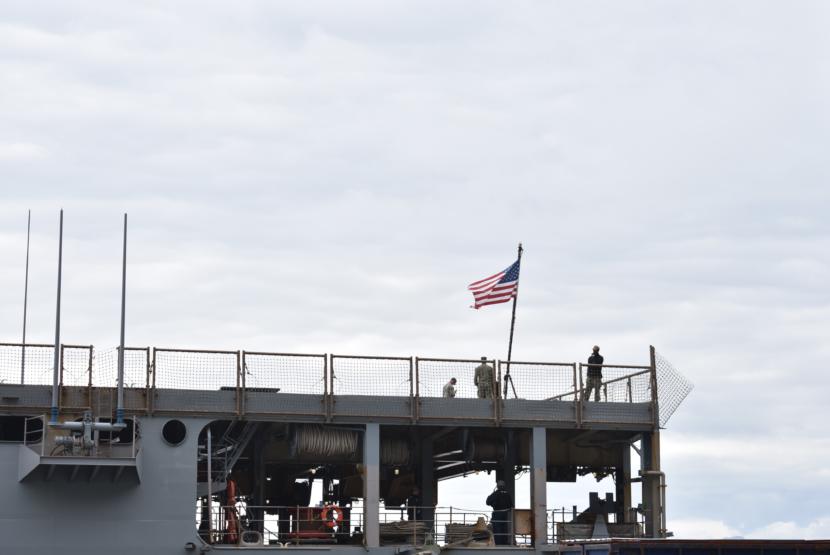
U.S. Navy personnel stand on the flight deck of the USS Comstock, docked in Kodiak, Sept. 10, 2019.
U.S. Navy personnel stand on the flight deck of the USS Comstock, docked in Kodiak, Sept. 10, 2019. (Photo by Kavitha George/KMXT)

The USS Comstock docked in Kodiak on Tuesday, en route to participate in a joint forces military training exercise spread across the Gulf of Alaska and the Aleutians. The visit comes as U.S. Navy officials indicate the possibility of an increased naval presence in Alaska, and what that might mean for the future.

Kodiak’s Pier 2 is used to hosting cruise ships and large crab boats this time of year. So a 600-foot Navy warship was a little out of place on Tuesday.

The USS Comstock, home-ported in San Diego, arrived in Kodiak around noon. For many aboard, including the ship’s captain, Cmdr. Kevin Culver, it was their first time in Alaska. Culver’s crew is making its way north for training, along with several other detachments of the Navy and the Marine Corps.

“We’re one of the first ones here,” Culver said on a tour of the sixth-floor steering room. “So you know, what a better place to stop than Kodiak and wait for everybody else to catch up to us.”

Across Southcentral Alaska and the Aleutians, some 3,000 service members are participating in the joint forces Arctic Expeditionary Capabilities Exercise this month. The exercises range from disaster relief logistics to tactical response drills.

Training in Alaska is a routine activity for naval forces. Northern Edge back in May was a massive joint forces exercise that happens every two years, not to mention the Navy SEALs’ cold weather training facility that operates on Kodiak’s Spruce Cape.

But Alaska might be seeing more of the Navy soon. As sea ice recedes and Arctic waters open up, protecting American interests in the far north is becoming more of a priority.

You might remember back in 2007 when Russian submersibles descended two miles below the North Pole ice cap to plant a flag on the ocean floor. It was more a publicity stunt than a true “claim” to the seabed, but that growing competition for Arctic resources, as well as control of increasingly navigable waterways, is what the Navy wants to get ahead of.

“All the trading nations of the world are going to seek to take that shortcut to the markets,” Rear Adm. Scott Gray told KMXT in an interview May. “So we’ll see an increase in shipping and transportation up here. And so our presence up here is just a continuation to ensure that we protect the sea lanes for trade for all nations and that we are trained and ready to operate in the difficult environment that is the north.”

For that reason, the Navy has begun looking at establishing a more permanent foothold in Alaska, according to Gray as well as Navy representatives in Kodiak this week.

Senior Chief Petty Officer Brandon Raile stands on Kodiak’s Pier 2 outside the USS Comstock, Sept. 10, 2019.
Senior Chief Petty Officer Brandon Raile stands on Kodiak’s Pier 2 outside the USS Comstock, Sept. 10, 2019. (Photo by Kavitha George/KMXT)

“What’s happening is the Navy is looking at its options,” Senior Chief Petty Officer Brandon Raile from Alaskan Command Public Affairs said in an interview on the Pier 2 dock on Tuesday. “We formerly had two installations here in Alaska: Adak and Kodiak. Obviously, we gave Kodiak to the Coast Guard. Adak was turned back over to the Aleut Corporation. So right now we have no basing options here. So in order to be proactive, of course we are looking into what the options are.”

One option might be a strategic port involving the Navy, Coast Guard and Department of Commerce, set up along the Bering Sea, according to a U.S. Naval Institute interview with Navy Secretary Richard V. Spencer in January.

As far as the Navy coming back to Kodiak, Raile said it’s not an impossibility, though there isn’t a clear timeline in place.

“Nothing is off the table at this point,” he said. “We are in the early stages of looking at everything.”

The USS Comstock will be in Kodiak through the weekend. The Arctic Expeditionary Capabilities Exercise wraps up at the end of the month.

Site notifications
Update notification options
Subscribe to notifications