Northwest

Proposed Ambler project underscores promise and peril of the Alaska Native Claims Settlement Act

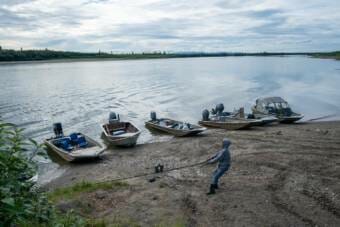
Martha Wood secures her boat on Thursday, July 22, 2021 in Ambler. Wood was fishing for sheefish when her line broke, and returned to shore to get a replacement. (Loren Holmes / ADN)

To Bryant Sun, a 17-year-old from the Iñupiat village of Shungnak, plans for a nearby open pit mine and 200-mile access road pose too much of a risk to his family’s traditions of subsistence hunting and fishing.

In this remote Northwest Alaska region, where the only way in and out is on a plane or boat, groceries can be impossibly expensive: $10 for a bottle of salad dressing or a box of cereal.

So Sun’s family, and many others, depend on seasonal harvests of moose, caribou, bears, berries and fish. They have two subsistence cabins — one upriver from town and one downriver.

“Traffic that’ll be going through there, with all that equipment and stuff — they’ll just scare everything off,” Sun said in an interview outside his Shungnak home in July. “That road would affect everything, I’d say.”

Sun’s village sits on the banks of the upper Kobuk River, a murky, fertile ribbon of water that connects Shungnak with two other predominantly Native villages, Ambler and Kobuk. Just north are the Brooks Range foothills, where a mining company, Ambler Metals, is drilling to test the viability of a potentially lucrative copper prospect.

From left, Bryant Sun, Mark Griest, Baron Jones, and Kaden Douglas hang out on July 23, 2021 in Shungnak. All four boys are rising seniors. Sun’s family, and many others, depend on seasonal harvests of moose, caribou, bears, berries and fish, and he is concerned about the proposed Ambler Access Road. “Traffic that’ll be going through there, with all that equipment and stuff, they’ll just scare everything off,” Sun said. “That road would affect everything, I’d say.” (Loren Holmes / ADN)

Fred Sun, Bryant’s father, works at Ambler Metals’ mining camp in the mountains.

A map showing thr route of 211 mile Ambler Road (Kevin Powell / ADN)

His passion for subsistence is equal to his son’s. But after years in the mining industry, Fred, 47, is comfortable with the idea of the project 25 miles from his home.

“When you’re Bryant’s age, you don’t really have bills to worry about. He’s never even bought a gun before, and he uses guns all the time. He doesn’t realize everything he uses to help fill our freezer costs money,” said Fred, who’s also the president of Shungnak’s tribal council. “We can’t live our subsistence lifestyle without having a job.”

The divide between father and son reflects a wider ambivalence about the mine and road projects that extends across the three Upper Kobuk River villages. It also reflects tensions embedded in the federal legislation that settled Indigenous Alaskans’ land claims: the Alaska Native Claims Settlement Act, which turns 50 this month.

The act aimed to clear the way for construction of the trans-Alaska pipeline by extinguishing Indigenous land claims, with a transfer of 44 million acres — about 10% of the state — to dozens of newly formed Native-owned corporations.

Fishing nets and a hide hang outside Miles Cleveland’s Ambler home in July. (Loren Holmes / ADN)

Congress’ vision behind the legislation was at least partially one of self-determination: Indigenous shareholders could, in theory, sustain their urban and rural lifestyles with profits from management and development of their corporate lands.

But the act was also meant to assimilate Native people into the capitalist system. And development and natural resource extraction can clash with subsistence traditions of hunting, fishing and gathering.

The projects near the Suns’ home embody the tensions between the region’s economy and subsistence culture, as Northwest Alaska’s regional, Native-owned corporation, NANA, is participating in the preliminary stages of the mine’s development. As part of a deal it struck with Ambler Metals, NANA’s shareholders are being hired to work on an exploratory drilling effort, and NANA land is being used as a staging area.

The Bornite camp, photographed on July 24, 2021. Copper was discovered in the area in 1947, and a 328m exploration mine shaft was drilled by Kennecott in the 1960s, which showed economically viable mineral potential. In 1965 another large deposit was discovered nearby at Arctic, increasing mining interest in the area. Bornite sits on NANA Regional Corporation land, while Arctic, around 15 miles northeast from Bornite, sits on state land. (Loren Holmes / ADN)

NANA executives say the drilling and exploration process they’re participating in will help them decide if the balance is right. And that process requires deliberation and continuing discussion with affected communities and shareholders, said Lance Miller, NANA’s vice president of natural resources.

“You still have to have something that makes sense economically. It has to make sense socially, environmentally — that triple bottom line,” he said.

The mine still faces a number of obstacles before it can be built, including securing substantial financial investment and major federal permits. Environment groups and tribes near the road’s route have also filed lawsuits challenging key Trump-era environmental approvals.

But for now, the project continues to move forward.

Geo techs Samantha Horner, left, and Braden Son catalog core samples from the Arctic deposit on July 24, 2021 inside the core shack at Bornite. Horner is from Kobuk and Son from Shungnak, the two closest communities to the mineral deposits. (Loren Holmes / ADN)

Living off the land

The Upper Kobuk, like many areas of rural Alaska, straddles the modern and traditional.

Residents have internet-equipped cellphones, order packages from Amazon and can reach Anchorage by plane in a matter of hours. But yearly rhythms still largely revolve around the subsistence calendar.

In the spring, there’s duck and beaver hunting, and sometimes bear. In the summer, people harvest sheefish from the river, set nets for chum salmon and gather blueberries, salmonberries and cranberries. Fall is hunting season for caribou and moose.

Frances Williams pulls a salmon from a subsistence setnet on the Kobuk River Thursday, July 22, 2021 near Ambler. (Loren Holmes / ADN)
From left, Jeremy Williams, Dwayne Johnson and Frances Williams float down the Kobuk River after checking a subsistence setnet. (Loren Holmes / ADN)

One state survey showed that in a single year, Ambler’s collective subsistence harvest added up to 600 pounds of food per resident, while Shungnak’s and Kobuk’s are both several hundred pounds.

Those resources are especially important given the high cost of groceries and the scarcity of high-paying jobs in the Upper Kobuk: In Ambler, for example, the median household income is $45,000, far below the statewide figure of $75,000.

“Food is so expensive up here. Gas is so expensive. Everything’s expensive,” said Miles Cleveland, 70, a borough assembly member from Ambler. “You need a job to go to the store.”

Clara Jones, 49, has three freezers at her home in Ambler, plus another in a tent outside, that preserve the harvests she shares with family members and friends — including many in other villages and even on the road system.

On a warm July day, she watched from the riverbank as her son motored out on the Kobuk to set a subsistence net for chum salmon; she’d already cut up and shipped 30 sheefish to relatives elsewhere.

“All the rich resources we have here, we can live off of,” Jones said. “That’s how we always were taught by our grandparents, and we continue to do it. And I’m hoping to pass it on to my children, my grandkids.”

Clara Jones shows one of her several freezers filled with subsistence foods on Thursday, July 22, 2021 in Ambler. Jones, 49, has three freezers, plus one in a tent outside her home, that preserve the harvests she shares with her family members, including many in other villages and even outside Anchorage. (Loren Holmes / ADN)

A history of prospecting

Prospectors first began searching for minerals in the Upper Kobuk around 1900. By the 1960s, a subsidiary of mining giant Kennecott Copper Co. was setting up summer camps for helicopter-assisted exploration.

One Shungnak elder, Neal Sheldon, said he used to walk several hours across the tundra into the mountains to work at the mining camp, known as Bornite. Fred Sun’s father worked with prospectors, too; he would leave Bornite late after his shift as a camp dishwasher, and drink tea that colleagues left warming over the coals of a fire they’d set at the halfway point on their walk back to their village.

Today, Ambler Metals, a joint venture between Vancouver and Australian mining firms, uses the Bornite camp as a base for its exploratory drilling sites perched on sheer cliffs deeper in the mountains.

A drilling rig platform sits near an active rig at the top of a ridge at the Arctic deposit on July 24, 2021, about 20 miles north of Kobuk. Arctic, discovered in 1965, is the most advanced exploration project in the Ambler Mining District, and has an estimated 39.5 million metric tons of mineral resources consisting primarily of copper, zinc, lead, gold and silver. (Loren Holmes / ADN)

If it’s built, the mine could employ hundreds of people and produce hundreds of millions of dollars in wages, and boosters say its minerals would aid the world’s transition away from fossil fuels. But it would place a major industrial operation in the Upper Kobuk watershed.

In spite of the risk the project poses, some residents already have a level of comfort with the mining industry because they’ve worked at the existing Red Dog project, 150 miles to the northwest.

That large mine sits on NANA-owned land and is operated by multinational Canadian company Teck; it opened three decades ago and employs hundreds of NANA shareholders, some whose yearly incomes reach $100,000 or more.

Red Dog has also made hundreds of millions of dollars in royalty and tax-like payments to NANA and the Northwest Arctic Borough, which describe the mine as a foundation of the region’s economy.

Before Red Dog was built, some residents were worried about its impacts on subsistence, and the mine has faced lawsuits and criticism from a neighboring village over its environmental record. But many local leaders and residents now hail it as a success story.

“They’ve been a good partner,” said Cleveland, the borough Assembly member. “They’ve done great things for a lot of us, as far as employment and people that work there.”

Red Dog’s supply of ore, though, is now running low, prompting tough questions about what will come next.

Miles Cleveland, Sr. sits in his home on Thursday, July 22, 2021 in Ambler. “They’ve been a good partner,” said Cleveland, 70, an elder and borough assembly member from Ambler, speaking about Red Dog, the large open-pit zinc mine which has been operating on NANA land for about 30 years. “They’ve done great things for a lot of us, as far as employment and people that work there.” (Loren Holmes / ADN)

The road

There are important differences, however, between Red Dog and the Upper Kobuk project.

The new mine would tap a deposit that is smaller and less lucrative than Red Dog. Its major deposit also does not sit on NANA land, though NANA’s deal with Ambler Metals allows the Native corporation to take a stake in the mine if it’s built.

Then, there’s the road.

Red Dog also ships out its minerals on a road built for that purpose. But its route connects the mine only to an isolated port on the Chukchi Sea coast, with no communities along the way.

The Ambler road would connect the Upper Kobuk to the rest of Alaska.

Starting from the Dalton Highway — the road from Fairbanks to the North Slope oil fields — it would end in the area of the mine, which lies near other mineral deposits that could also be developed.

The route is expected to connect to Kobuk, and potentially to Shungnak and Ambler as well.

And that makes residents nervous.

An access road runs between the community of Kobuk and the Bornite camp in the Ambler Mining District, on July 24, 2021. The area has been explored for its mineral potential since the 1950s, and contains a number of significant copper, zinc, lead, gold, silver and cobalt deposits. (Loren Holmes / ADN)

Upper Kobuk locals say the caribou they harvest already face pressure from sport hunters on fly-in trips. And many residents worry the road could bring in even more hunters from Fairbanks or Anchorage.

There’s also the potential for collisions with caribou or other impacts on wildlife from mineral-hauling trucks, which could make as many as 170 trips a day during peak production. And if the additional mineral prospects along the road’s route are built into mines, that could add to the pressure.

“I’m just worried about it messing up the migration route,” said Jones. “Everybody depends on their game.”

Alaska’s economic development agency, and others involved in the road’s planning, say the route will be open only to private use — not to hunters or for other recreational purposes.

Skeptics cite the case of the Dalton Highway, where the northern stretches were initially closed to the public before the state government opened them in the 1990s. Local and tribal interests sued to block the move, citing risks to subsistence harvests and public safety, but a 1994 Alaska Supreme Court decision allowed the opening to proceed.

The groups pushing the Ambler road say the circumstances are different. In its 1994 decision, the Supreme Court cited a federal right-of-way grant for a “public road,” while the Bureau of Land Management says the federal grant for the Ambler road would be specifically for “limited access” and not open to the public.

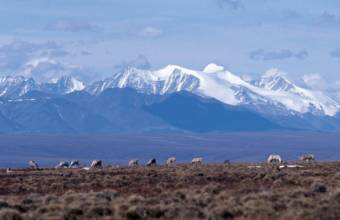
A mountain rises up from the Kogoluktuk River valley on July 24, 2021 near Kobuk. (Loren Holmes / ADN)

Road supporters also argue that NANA wants to keep the road closed to the public where it stretches across its lands, and NANA itself says it’s counting on an “ironclad assurance” that access remains “private and controlled.” Boosters also say federal permits can restrict use of the road and that mine operators would want to limit access to ensure the safety of their trucks.

Many locals are unconvinced those limitations can be enforced.

“They say the road is basically going to be for the mine itself. But you know how the United States works,” said Chuck Schaeffer, a NANA shareholder who works as a supervisor at the Bornite camp and still thinks the project’s benefits are worth the risks it poses. “Give it 10 or 20 years and everybody’s going to be using the roads. What does that mean? The rivers, the migration of the caribou herds — it’s going to affect everything.”

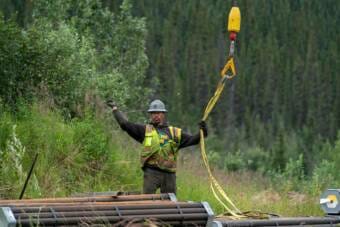
Assistant camp manager Chuck Schaeffer, left, helps George Smith prepare drilling pipe to be airlifted to a drill site on July 24, 2021 at the Bornite camp. (Loren Holmes / ADN)

The road project also faces some intense opposition in villages in the Koyukuk River valley. The route travels through that region, but residents are largely shareholders in Doyon instead of NANA.

Critics say Koyukuk River residents would take on all the risks from the road, without the benefits from NANA’s potential stake in the project.

Then, there’s a worst-case scenario of a spill or accident at the mine that could contaminate the Kobuk River.

“Every mine has a tailings — what happens if it fails?” asked Shungnak resident Anthony Norris, 31. “That’s a disaster.”

George Smith communicates by radio to helicopter pilot Andrew Chan as he lifts a load of drilling pipe on July 24, 2021 at the Bornite camp. (Loren Holmes / ADN)

A huge word

But in the Upper Kobuk, at least, some residents also say the mine and road projects could come with significant benefits.

One is the road’s potential to bring cheaper goods and access to a region that faces extremely high prices, like the $10 for a gallon of gasoline that Ambler residents were paying this summer.

Not everyone is convinced that the road would significantly reduce costs: The Upper Kobuk would still be a 450-mile drive from Fairbanks, and it’s not certain that all three villages would be able to connect to the route.

Carl Snyder fishes for sheefish with his son Carl Jr., 5, on July 25, 2021 in Kobuk. (Loren Holmes / ADN)

Carl Snyder fishes for sheefish with his son Carl Jr., 5, in Kobuk. (Loren Holmes / ADN)

But supporters envision a road link making life in the Upper Kobuk more sustainable. There’s also the potential for construction jobs and work at the mine, though projections say it would only operate for a dozen years.

Many Upper Kobuk residents already have summer work at the mining camp at Bornite, like Fred Sun.

Sun, in an interview, pointed out that more than half the members of Shungnak’s tribe live outside the village, and that many NANA shareholders live outside the region. The road and mining project could be a means to keep more of them in rural Alaska, he suggested.

“I have so many friends and relatives that live in Fairbanks and Anchorage who would rather live in Shungnak. But there are just no opportunities there — there’s no work, the cost of living is too high,” Sun said. “It kind of hurts a lot. If my kids decided to, I’d like them to have the opportunity to live at home, if they so choose.”

Children play in Kobuk on July 25, 2021. (Loren Holmes / ADN)

Ambler Metals’ final decision on whether to build the open pit mine is still likely three years away.

As the mine and road projects continue to move forward, Upper Kobuk residents on both sides of the issue, and those withholding judgment for now, say they will continue advocating for the best interests of their villages.

But in interviews, many said they don’t think their opinions will matter.

“Regardless of what we say and how we say it, that road is definitely going to be shovel-ready within three to five years. And there’s not a darn thing we can do about it,” said Conrad Douglas, 64, a city council member in Ambler.

An unfinished road leads from Shungnak northeast toward the community of Kobuk, the Dahl Creek airstrip, and the Ambler Mining District on July 23, 2021. Kobuk and the Dahl Creek airstrip are around eight miles from Shungnak. (Loren Holmes / ADN)

Ambler Metals President Ramzi Fawaz said the mine will not be built without “social acceptance” and “social license” — which, he said, his company has not yet obtained.

“I’m not there yet,” he said. “This is an ongoing thing, and it will continue to be ongoing. Nothing is taken for granted.”

Fawaz is originally from Lebanon. He has worked on resource development projects around the world and only recently moved to Alaska to oversee the mining project.

In an interview, at his company’s Anchorage headquarters at the base of a corporate office tower, he acknowledged that he can’t fully grasp the stakes for the villages nearby.

But, he added: “I have lived and done a lot of projects in similar environments, and what I’m hearing doesn’t surprise me.”

“It is genuine, it is important and it goes to the heart of how people live and what they want and what they desire and what they fear,” he said. “I’m going to do my utmost to understand and respect and do what I’m told, and what I’m being advised. And that’s all I can do.”

Ambler Metals employs some locals with long histories in the region, and who also say they appreciate the weight of the debate.

Schaeffer, the Bornite camp supervisor, believes the project offers worthy benefits. But he does not discount its risks.

Schaeffer supports “responsible development,” he said.

But, he added, the “responsible” in that phrase is a “real huge word.”

This story is part of a reporting collaboration between Alaska Public Media, Indian Country Today and the Anchorage Daily News on the 50th anniversary of the Alaska Native Claims Settlement Act. Funding for the ANCSA project was provided by the Alaska Center for Excellence in Journalism. 

Many see Red Dog as an ANCSA success story. What happens when the ore runs out?

1989 file photo of Red Dog Mine. (Bill Roth/ADN)

It can feel counterintuitive to see the massive Red Dog mine, dug into the mountains of Northwest Alaska, as an essential support to the region’s Indigenous tradition of living off the land.

The operation, run by multinational mining company Teck, is industrial: open pits, a huge mill and trucks hauling zinc and lead concentrates to the coast for shipping.

A map showing the location of the Red Dog Mine. (Kevin Powell/ADN)

But one crucial fact makes Red Dog very different from other large mines: It sits on land owned by NANA, the Native corporation for Northwest Alaska that itself is owned by some 15,000 Indigenous shareholders with roots in the region.

NANA took possession of the land that’s now the Red Dog mine after Congress approved the 1971 Alaska Native Claims Settlement Act, which transferred roughly 10% of the lands in the state to Indigenous-owned corporations.

In a landmark agreement with a Teck predecessor company in 1982, NANA agreed to let the firm access its lands. Teck, in return, shares profits from mineral sales along with jobs for Indigenous shareholders and NANA-owned companies, and NANA participates in the mine’s oversight.

Some residents have been skeptical all along, and the mine has not delivered on all of its promises. But decades later, NANA executives and many Northwest Alaska residents describe the Red Dog deal as the kind of success that their leaders originally envisioned.

The mine, they say, is a steady source of jobs and cash in a place where those things are otherwise hard to find.

But Red Dog also has a limited lifespan: Its operators say there could be just 10 years until the mine’s supply of ore runs out. And that fact is casting uncertainty across the state — over the economy in Northwest Alaska, the communities in the region near where NANA is eyeing a new mine, and the Native corporations statewide that depend on the Red Dog revenues that NANA is legally required to share with them.

Hundreds of NANA shareholders now work at the mine, earning yearly salaries that can reach $100,000 or more. The money, mine boosters say, is essential for sustaining life in the region’s remote villages, where residents can pay $10 a gallon for gas that fuels the snowmachines and boats they use for traditional harvests.

“Since we merged with a Western culture, everything needs cash,” said Tristen Pattee, a NANA shareholder who works at Red Dog. “It’s just required now.”

Kituq Williams skips his snowmachine on the Kobuk River on Thursday, July 22, 2021 in Ambler. In the distance is Jade Mountain, an important source of Jade, the Alaska state gem. (Loren Holmes/ADN)

Ambler

Pattee’s home village of Ambler, on the upper Kobuk River, has a poverty rate nearly triple the state average.

The nearest university is 300 miles away, reachable only by plane. Pattee dropped out of college after a semester.

At 36, his job at Red Dog has made him an economic anchor in the village of 300 people.

Pattee buys gas for family members to get out on the river to hunt and fish, or to pick up firewood. And he’s invested more than $100,000 in his own business, boating tourists to the Great Kobuk Sand Dunes or to see caribou swim across the Kobuk on their yearly migration.

Pattee started his career at Red Dog just out of high school in 2004, driving huge mining trucks. He now works rotations in the mine’s environmental department, with responsibilities that include air and water sampling.

Tristen Pattee, holding the fish, works at Red Dog and runs a tourism business in his home village of Ambler, taking tourists on the Kobuk River. His earnings from the mine have made him an economic anchor in his community. (Courtesy Tristan Pattee)

Outside the mine, Pattee said, he saw no clear job prospects in Ambler. The likely alternatives were going back to school or working with his father’s bar business in Anchorage.

“But there are a lot of people in the village that would have no opportunities like that,” Pattee said. “If this place didn’t exist, it would be very difficult.”

Stories like Pattee’s are scattered throughout the villages of Northwest Alaska. NANA’s agreement with Teck requires Red Dog to give a hiring preference to NANA shareholders, and 750 currently have jobs with the mine, including contractors.

Many shareholders work at the mine for a few years, acquiring skills they can use back home, then return to their village. Upriver from Ambler in the village of Shungnak, former Red Dog employee Fred Sun is now working at another mining prospect much closer to his hometown.

Sun, 47, is an avid subsistence hunter and fisherman. But he says those activities wouldn’t be possible without the cash he earns from the mining industry.

“Nobody has dog teams anymore, at least in our area. We need gas, we need ammunition, guns to hunt animals with,” he said. “They kind of mix together, you know? We can’t live our subsistence lifestyle without having a job.”

Lee Stalker, left, waves to a passing boat as Stalker and his son Herman Stalker prepare to subsistence set net fish for salmon on Wednesday, July 21, 2021 at South Tent City in Kotzebue. (Loren Holmes/ADN)

Mixed attitudes on Red Dog

Academic and economic studies have shown that Red Dog’s impacts on the Northwest Arctic are substantial, with one showing that the mine, in previous decades, provided more than 10% of jobs in most villages. NANA shareholders collectively earned nearly $50 million at the mine last year, according to Teck.

At the same time, those studies have shown some of Red Dog’s unfulfilled potential.

Many of the mine’s Indigenous workers actually reside outside the Northwest Arctic Borough: Only about 20% of Teck’s workforce lives in the region.

Turnover is high, with roughly 75% of Red Dog workers leaving within a decade —  though research shows that many workers who leave maintain higher incomes than the rest of the region’s population.

And while NANA and Teck’s predecessor originally set a goal for its workforce to be nearly 100% shareholders by 2001, it’s long been stuck at closer to 60%. The biggest obstacle is filling what Cole Schaeffer, the mine’s human resources superintendent, calls “technical and professional” jobs that require more training — and which some Alaska Natives may pass up at Red Dog if a similar position is available in an urban environment.

There are plenty of NANA shareholders, including some who have worked at Red Dog, who don’t see the mine as crucial. Some argue the shift work pulls them away from their families and makes it hard to plan their subsistence harvests. Others say there’s enough work in the region’s villages to pay their bills.

Conrad Douglas points to an erosion control project next to his house on Thursday, July 22, 2021 in Ambler. “Regardless of what we say and how we say it, that road is definitely going to be shovel-ready within three to five years. And there’s not a darn thing we can do about it,” he said. (Loren Holmes/ADN)

“The Upper Kobuk villages can survive on their own, without the help of the mines,” said Conrad Douglas, 64, an Ambler City Council member who’s worked at Red Dog and calls the mine a “scar on our property.”

Community leaders in Kivalina, the only village downstream from Red Dog, also say they’ve borne a disproportionate share of the mine’s impacts.

They’ve long maintained that Red Dog’s discharge has contaminated their water supply and subsistence resources, even though it’s closely regulated by the state government.

“We still don’t harvest our beluga the way we used to when we were growing up. The berry-picking sites are still places that we avoid,” said Millie Hawley, the administrator of Kivalina’s tribal government.

NANA shareholders in Kivalina receive annual dividend payments from the corporation. But Hawley said residents are dissatisfied that more of them aren’t hired to work at the mine, in spite of an extra hiring preference for shareholders from the village. And Kivalina still lacks piped water and sewer systems, even as Red Dog generates hundreds of millions of dollars in yearly profits and can produce 5% of the global zinc supply.

The Red Dog zinc and lead mine port operations are on the shore of the Chuckchi Sea South of Kivalina, AK in Northwest Alaska on Wednesday, August 6, 2014. The mine is a joint venture between Teck Alaska Incorporated and NANA Regional Corporation, the native corporation for Northwest Alaska. (Bob Hallinen/ADN)

“The state benefits. The borough benefits. The people in the NANA region, shareholders benefit,” Hawley said. “But Kivalina has taken the brunt of it all. Other people get paid in wages, and we get paid in negative impacts.”

NANA’s executives said they’ve tried to be good partners with Kivalina, and acknowledged that there’s room to improve their relationship with the village. The corporation convenes a subsistence committee that includes representatives from Kivalina, and earlier this year, the mine delayed the start of its shipping season in response to members’ concerns about effects on hunting of bearded seal and beluga whales.

NANA executives also said the dynamics are complicated by the fact that global warming and thawing sea ice are forcing Kivalina’s relocation.

“The potential challenges that Kivalina faces can be compounded by the idea that they’re in the watershed of a world-class mine — and yet they are a community that experiences some pretty intense poverty and challenges,” said Liz Qaulluq Cravalho, NANA’s vice president of lands. “And we have invested in ways to tackle some of those things.”

A Bering Air plane flies over Kivalina before landing on the runway in 2012. (Loren Holmes/ADN)

Red Dog’s wastewater discharge, meanwhile, must meet the standards of its Clean Water Act permit overseen by the Alaska Department of Environmental Conservation. Department officials said that while Red Dog has periodic permit violations like other large mines, its discharge is too diluted to be detectable at Kivalina’s water source, some 50 miles away.

“From a simple dilution standpoint, the water is as safe as if the mine didn’t exist,” Allan Nakanishi, a DEC engineer, said in an interview.

A settled debate

While differences of opinion about Red Dog persist, debate over the mine has been largely settled for the past three decades.

But the not-too-distant future could test residents’ ideas about getting by without it.

Teck says Red Dog has enough ore to keep operating until 2032, at which point it will have to shut down without additional supply.

There’s a major deposit 10 miles from Red Dog that could extend the mine’s life by decades, said Les Yesnik, Red Dog’s general manager.

But Teck’s understanding of the geology in that area is still uncertain. And Yesnik said the company is still working with neighboring villages to make sure they’re comfortable with the potential impacts from development — including a new road that would have to be built to the deposit.

It could take five years before it’s clear if the project is viable, Yesnik said.

Red Dog’s future is enormously consequential for the region. In addition to the royalty that Teck shares with NANA, it makes yearly payments in lieu of taxes that cover 80% to 90% of the Northwest Arctic Borough’s annual budget.

The mine’s importance also extends far beyond Northwest Alaska. That’s thanks to provisions in the 1971 Native claims settlement legislation that require Native corporations to share 70% of their natural resource revenues.

Satellite view of the Red Dog Mine, Aug. 12, 2021. (Planet Labs PBC)

That means that of NANA’s $175 million in proceeds from Red Dog in 2020, it redistributed $100 million, according to the corporation’s annual report. In some years, the mine has been responsible for more than half of all the resource revenue shared statewide between the regional corporations.

The regional corporations, in turn, share half of that redistributed revenue to the roughly 150 village corporations operating in their areas. And for many of those village corporations, the money can make up more than half of their annual revenues.

“It’s the difference between being unprofitable on a steady-state basis versus being able to maintain a certain degree of solvency — without having to consider really difficult decisions like selling your land,” said Nathan McCowan, who chairs a group that represents village corporations, the Alaska Native Village Corporation Association.

Red Dog’s eventual closure, McCowan said, could have major impacts on the operations of those village corporations. And many of them maintain essential services in rural communities hundreds of miles from Red Dog, like grocery stores or fuel distribution operations.

Both NANA and the Northwest Arctic Borough, meanwhile, are conscious of the need to diversify.

But for now, Red Dog remains a major economic engine for the region and for NANA shareholders. And the borough’s efforts to promote alternatives like tourism and green energy don’t appear likely to replace mining’s impact in the near future.

“Those will not carry a region,” said Lance Miller, NANA’s vice president of natural resources.

With a successor for the mining industry missing and Red Dog’s future uncertain, NANA is now eyeing a new copper prospect — one that’s just 20 miles upstream from Pattee’s village of Ambler.

George Smith signals to a helicopter to lift a load of drilling pipe on July 24, 2021 at the Bornite camp. (Loren Holmes / ADN)

That project presents a different set of considerations from Red Dog: It would come with a new, 200-mile road that could connect the remote Upper Kobuk River villages to the rest of Alaska. Residents and local leaders are split.

Supporters cite the potential for jobs and cheaper access to food and commodities to help sustain their communities. Opponents say the new road and mine threaten their subsistence harvests and way of life.

This story is part of a reporting collaboration between Alaska Public Media, Indian Country Today and the Anchorage Daily News on the 50th anniversary of the Alaska Native Claims Settlement Act. Funding for the ANCSA project was provided by the Alaska Center for Excellence in Journalism. Read more from the series.

Alaska author’s new book follows life among Arctic caribou herds

Courtesy of Seth Kantner

Seth Kantner sees his life today as a continuation of the subsistence life he grew up with in northwest Alaska, with some new additions: commercial fishing in the summer, writing in the winter and photography in the spring and fall.

In the last several years, he’s gathered images and stories from the caribou herds that live near his home on the south side of the Brooks Range. His latest book, “A Thousand Trails Home,” recounts those tales, his own story and how they all intersect in a part of the country that’s experiencing climate change at a staggeringly rapid pace.
Kantner capped off a three-week tour through Alaska, Washington and Montana with a visit to Homer this week.

Listen here:

The following transcript was lightly edited for length and clarity.

Sabine Poux: Seth, thanks for being here. Your new book, “A Thousand Trails Home,” came out last month. Can you talk about how long this book has been in the works? When did you start writing?

Seth Kantner: Probably about nine years ago. And the photographs, probably 30 years ago, without the idea of a caribou book. More just wanting to get photos of the land, and the caribou were hard to resist — big herds of caribou — when you got a camera. The book was supposed to be out Sept. 1, after all these years, and then was held up for a couple extra months in a shipping container on the barges. And so it was a little bit of a rocky start.

Sabine Poux: Affected by the supply chain problems that we’re hearing a lot about.

Seth Kantner: Yep. Yeah.

Sabine Poux: I know that you’re a big photographer. And you have managed to capture these really vivid descriptions of the things you’re doing and seeing while also taking photos and writing. How do you balance all of that at once? Do you have a process when you’re out and how you think about writing?

Seth Kantner: I don’t have a process at all. I don’t think I was born with organizational skills. But they’re along the south side of the Brooks Range, where I was born and raised. Our life was so focused on the land, I think I carried on with that, a searching-for-food type of life. But then I just added searching for stories and searching for photographs to that. So, in my mind, it feels like a subsistence way of life with some new additions. And then the seasons kind of decide — maybe winter would be more writing, and fall and spring would be more photographing and then summer would be trying to make a living.

Sabine Poux: Do you see the photos and writing as complementing each other? Do you think that when a reader takes it in, they have to take in all of that to get the full picture of what you’re trying to communicate?

Seth Kantner: I think it helps with this book. Obviously, if I wrote a novel, I would feel like photographs would take away from that experience you have, or you fall into another world and you’re surrounded by that world. And so my first book was “Ordinary Wolves” in 2004 and, similarly, there were things I really wanted to say. I just chose fiction as the way to say it. And so with this, yeah, I feel like kind of to say enough about caribou, I really wanted photographs mixed with words. Which definitely makes a much more complicated project.

Sabine Poux: Your first book is a novel, and this book of course is more autobiographical. Do you feel like there are things that you were able to freely write about and say in a novel that maybe you aren’t when you’re writing in such a first-hand way? The things that character deals with in “Ordinary Wolves,” I imagine, are paralleling your experience. But of course, you’re writing through another character.

Seth Kantner: Yeah, you hit it dead on there. That book is autobiographical, and I was urged to write it as nonfiction. Apparently it would have sold better, et cetera. But I was adamant that if I wanted to describe a situation that may or may not be admirable for the for the person portrayed by my words, then writing a fictional person, I could say “so-and-so did this.” And if you had a real person’s name tied to that, well, good luck with feeling free with what you say.

Sabine Poux: A lot of the people reading your work will have never been to this part of the state. And, at the same time, you’re writing about issues of identity and issues about race that are very real to the people who live there. How do you balance explaining a place to people who have no frame of reference, and doing a place justice for the people who are actually from this part of the country?

Seth Kantner: That, I would find, wasn’t a balance. It’s more like all at one end of the teeter-totter. I just spend endless amounts of time weeding through my words and being suspect of each one. Does this do its job, is this fair? But also, is it as descriptive as possible? And so this book, I joke — but it’s not too much of a joke — that it took an extra five years because of the politics of talking about some issues that a lot of people disagree on, like the difference between sport hunting and subsistence and user rights, and then ways of hunting caribou now versus 50 years ago. So each one of those felt like a dangerous swamp I was heading into as far as trying to say the truth and and be fair at the same time. And then not always good things to be said.

Sabine Poux: Right. And your educational background is in journalism. So I imagine fairness and considering things from a lot of sides is very front of mind for you.

Seth Kantner: Yeah. I think my upbringing is stronger than my journalism training. But the journalism training in Missoula, Mont., they were adamant about if you’re using a quote, it has to be the real thing, you can’t just sort of make one up. And adamant about, you know, if something’s 95% true, it’s fiction still. It’s not nonfiction. So yeah, I hadn’t thought of it until you said it, but I think that those journalism ethics from that school have kept me on the desire to stay as true as possible.

Sabine Poux: Then, of course, you mentioned controversial topics. A big part of life in northern Alaska is dealing with the effects of climate change. Do you see communicating messages about how climate change is impacting that part of the state as a major reason that you’re writing these stories? Is that something you think about a lot in your writing?

Seth Kantner: Absolutely. Yeah. I think it would be different if I made a living off of writing, that I might be writing for money. In this case I’m not, so I write about what I care about. And that’s the land and the caribou and being able to hunt in the future and have wild lands. And I don’t mean wild lands to look at, I mean wild lands to live on.

But yeah, climate change has really affected that part of Alaska. I guess it’s sort of the ground zero for the most warming and the most effects of climate change on the planet. And so the permafrost is melting and the ice is not freezing as consistently as it did, and then we’re getting rain in the winter which would coat the land with ice and make so animals perish and or have a hard time getting their food.

And so all those effects are sort of exaggerated in my mind because of the fact that I’m so tied to the land and I expect the caribou at this time of year, as do other people there.

Twenty five years ago, I was sort of nervous about talking about climate change, which I did, but people were very quick to call you a “greenie” or a “bunny hugger” or something. And that’s interesting because the amount of change up in northwest Alaska is so intense that now, 25 years later, I’m not a bunny hugger and everybody’s a believer. You can’t help up there being that, because of the change.

One simple thing is we travel on ice, we don’t have roads. So those are our roads, and if it doesn’t get cold like it used to and we don’t have those trails and traveling routes, then you can’t kind of pretend that there’s no climate change. So, anyway, the long and the short of that is that it’s kind of a relief not to be accused of being some animal lover, making up this weird stuff — that climate change is finally not such a big discussion.

Sabine Poux: Well, it sounds like you recognize, too, that you’re in this position where you see these effects so prominently in a way that most people — even in this part of Alaska — just wouldn’t really see.

Seth Kantner: Yeah. I think that getting your food from the land makes you notice. And if I shop totally at Costco — which, I love Costco — and traveled in cars on roads, I think it would be so much harder to see, even if it was around you. And so traveling on ice and eating from the land just makes those changes obvious.

Sabine Poux: You also have written a children’s book. What was it like writing for a younger audience?

Seth Kantner: The children’s book — I guess that the whole publishing effort was so dismaying that I’ve kind of lost memory of what it was like before that, just the actual writing of the story. At that point, my daughter was pretty young when I was writing that. So I considered her and I more like siblings because we played together a lot, and mentally I’m sort of on that level. So yeah, I was always making up stories every day and night for her and it was fun to write one down. It was surprising to me how complicated the next steps were with publishing and illustration and stuff. And otherwise, I think I would love to write children’s stories. Just because I like that age. I like kids and I like that age.

Sabine Poux: Speaking of kids, do you have a first memory of caribou? Is there a memory you can think back to?

Seth Kantner: Yeah. The funny thing is that the caribou were so ubiquitous in my life that they just sort of flowed through everything, in spring and fall. We didn’t see them in the middle of summer. But yeah, I do have that first memory of waking up in the old igloo and scared because there was nobody there and stumbling outside, probably no shirt, and who knows what else, probably four years old. And calling for my parents, and they were just sort of around the front of the hill there, gutting a caribou.

So in that time of year, the caribou swim across the Kobuk toward our place. Caribou are constantly flowing by the house and constantly — not constantly, but every day — so some would come ashore. And apparently they needed a caribou, needed meat, and they were working on it. So I remember the caribou in the melting-out grass and my parents bending over it and me sort of really grateful to see them. I don’t know about the caribou. I was just a little kid looking for parents.

November sea ice extent in the northern Bering is the best since 2012

An aerial view of Unalakleet, with open water along the coast in 2019. (Zachariah Hughes, Alaska Public Media)

Through the weekend of Nov. 13, sea ice extent in the Chukchi Sea was well above the average from the last thirty years.

“So far, Chukchi Sea ice is developing much quicker this year than it has in all recent years,” climatologist Rick Thoman explained.

Thoman, with the Alaska Center for Climate Assessment and Policy, or ACCAP, has Chukchi Sea ice data going back to 1979. Current sea ice extent in Northern Alaska waters is the highest it’s been since November 2001, according to the National Snow and Ice Data Center’s sea ice index.

https://twitter.com/AlaskaWx/status/1459928137077182466

As of Nov. 13, the main ice pack had already reached the northern coast of the Seward Peninsula, Thoman said.

“What we have right now is fairly typical in the sense that ice tends to start to grow out from the Alaska and the Chukotka coast. This year it’s actually kind of met down towards the Bering Strait, so there’s really no open water now just north of the Bering Strait, between Chukotka and the Alaska side,” Thoman said.

Thoman suspects the rest of open water in the Chukchi Sea could be ice covered by the end of November.

As of Nov. 17, sea ice in the Bering Sea has covered much of the Eastern Norton Sound along the coastline of the Seward Peninsula except for an area in front of Nome. Sea ice had also started forming on the southern edge of St. Lawrence Island.

This is much more favorable for Western Alaska compared to the sea ice conditions the region experienced last year. The last couple winters in the Bering and Chukchi Seas have featured record low sea ice extents.

Thoman says all the pieces for sea ice growth, like colder surface temperatures and sustained northern winds, came together this year in the Bering Strait region.

“Really since early October, we’ve been in a persistently cold pattern,” he said. “Not quite every day was below normal, but most days below normal (temperatures). And so we didn’t have our thumbs on the scales with very warm waters that had to be extracted out, and we’ve had a weather pattern that has been conducive for ice formation.”

Based on current forecast models, the entire Norton Sound could be covered in ice by the end of November. There’s also a good chance of sea ice extending all the way south to the Pribilof Islands this winter, which hasn’t happened in recent years, according to Thoman.
Major COVID outbreak puts Savoonga into lockdown

Savoonga
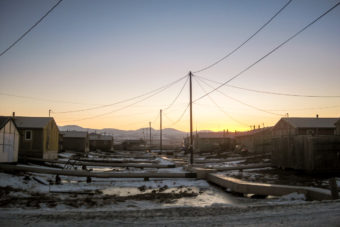
Savoonga in December 2013. (Photo by Anna Rose MacArthur/KNOM)

Roughly 15% of residents in the remote community of Savoonga have COVID-19, the Norton Sound Health Corporation said this week.
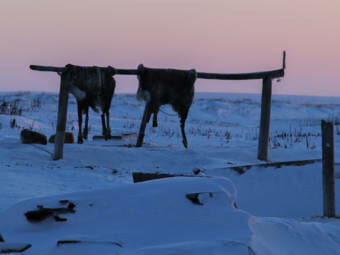
Savoonga is on St. Lawrence Island, out in the Bering Sea. The health corporation on Monday reported 115 COVID-19 cases in the community of less than 800 people. The most recent 55 cases are considered community spread.

The community is under lockdown and movements are limited, said Delbert Pungowiyi, a tribal member of the Native Village of Savoonga.

“Eighty-plus percent of our adults are fully vaccinated, and I think that is making a positive impact on the effects of COVID,” said Pungowiyi. “So Savoonga has done a complete lockdown right now. We can venture out to the post office and check our boxes — a few people at a time that can go in there. Everyone has to wear their masks.”

The local store is only accepting orders by phone, said Pungowiyi.

Last week, Nome’s City Manager Glenn Steckman said the health corporation had recently done significant testing for COVID-19 in Savoonga. That may factor into why so many cases were identified so quickly.

The outbreak of COVID-19 began with six cases in Savoonga on Oct. 26. Two weeks later, the local case count reached the highest on record for the community since the pandemic hit Western Alaska.

Pungowiyi worries about elders in the community.

“But I do believe they’ve been fully vaccinated. So far there have been no serious medevacs or hospitalizations that I have heard of,” Pungowiyi said.

Pungowiyi noted that Savoonga ran out of isolated quarantine locations for residents who test positive, as the community is experiencing a housing crisis. Many multi-generational families share a two-bedroom home, fitting eight to 10 people in a space meant for four.

Due to the massive spike in COVID-19 cases, the Bering Strait School District has issued “high risk” status for the Hogarth-Kingeekuk Sr. Memorial School in Savoonga. There are at least 20 positive cases among students, according to the district.

Supplies and aid are being sent to Savoonga from relatives and donors across the state.

New research shows how Alaska subsistence harvesters are having to adapt to climate change

A man ice fishes in northwest Alaska. (Kristen Green)

It’s no secret that climate change has affected how — and when — Alaskans harvest subsistence foods.

But what are the biggest impacts? How much has the warming climate changed things? And how are subsistence harvesters dealing with that change?

Well, a new study in the journal Ecology and Society aims to answer those questions, specifically as they pertain to the Northwest Alaska communities of Kotzebue and Kivalina.

Kristen Green is a co-author on the study and an Alaska-based Ph.D. student in environment and resources at Stanford University. She says a lot of research on subsistence adaptations due to climate change has been theoretical, so she and her fellow researchers went to interview the harvesters themselves.

Listen here:

The following transcript has been lightly edited for clarity.

Kristen Green: Well, since we were working with Alaska Native communities, it was really important to us to partner with them through every step of the research project. So, as we were first coming up with the idea, we started conversations with the Native Village of Kotzebue first and then later Kivalina, and trying to understand what questions might be meaningful to the community. From there, we started to focus on this idea of access and harvest, and developed a research protocol where we decided that we would interview expert harvesters throughout the region and ask them about what was most impacting the ways that they got to where they hunted and harvested. We asked them what changes they were seeing with respect to animal availability. And we also asked them how they’re responding to those changes and what their ideas were going forward.

Casey Grove: Just to be clear, what animals are we talking about?

Kristen Green: We asked people what was most important to them with respect to harvesting and caribou. The people there often refer to themselves as caribou people. It’s a symbolic animal for cultural and nutritional sustenance. So that was a of course a very important species. Ice seals, especially bearded seal, beluga whale are also really important. And as you get out to Kivalina, marine species become even more important based on their location. So marine mammals and fishes as well, particularly things like chum salmon and sheefish.

Casey Grove: So a pretty big range of things it sounds like.

Kristen Green: That’s right. harvesters in the region definitely have a range of food sources that they rely on because they do harvest seasonally throughout the year. And when you look at the seasonal harvest, you do see in every month of the year, people are harvesting things. And that’s actually one thing that we’ve found: some of those harvesting seasons are shifting a little bit relative to the past. And we believe that’s correlated with sea ice retreats.

Casey Grove: The season changing and how much?

Kristen Green: We saw changes in three key species. For bearded seal, harvest is now beginning in early May instead of late May. For chum salmon, harvest is now starting sometime in June, mid-June, when it used to start in early July. And for beluga whale, it’s now beginning in mid- to late May. And anywhere from two to three weeks earlier for all those species in that total window of harvest is also often more narrow and more unpredictable with some of the changes in the weather.

Casey Grove: Is the quantity of pounds of food is changing too?

Kristen Green: We didn’t specifically ask about pounds of food harvested in our study, it was outside the scope of our work. But we did hear from the two years that we asked people questions about this, that there were some years where it was much harder for them to get bearded seal. And we suspect that people are relying on other things to fill in for food that they’re not able to get — sometimes relying more on the fish in a year where they can’t get seals or they’re trading more with other communities or their families.

Casey Grove: And it kind of stands to reason if you have to spend more energy, more time or money trying to harvest the same amount of food that that’s just an overall greater difficulty than in the past.

Kristen Green: Absolutely. And that’s one of the things that we found is the amount of time you have to harvest, the amount of financial resources you have — whether it’s gasoline to be able to travel farther to find animals, or whether it’s access to multiple types of transportation. So having a snowmachine and boat and a four-wheeler, if you have access to all those, you may be able to access harvest more than someone who can’t.

Casey Grove: This study, it strikes me as very intensive on the talking, almost in a journalistic sort of way, that you’re you’re getting a lot of information by talking to people. And I wonder what was that like? I mean, it sounds like a lot of interviews and a lot of direct communication with folks?

Kristen Green: It was a really meaningful aspect of this study that people in Kivalina and in Kotzebue were so willing to share their stories with us and we spent time at people’s houses and fish camps, having coffee with folks and really hearing the stories of change that they’d experienced and also some of their optimism for the future. We also did look at some of the quantitative environmental trends to see how they compare to what the harvesters’ stories were and they both had similar stories about climate change. But I think the nuances, that when you’re talking to people, you’re able to gather a much broader context for climate change and potential ways to adapt to them than when you just are looking at the numbers.

Site notifications
Update notification options
Subscribe to notifications