Heroin has been at the center of two anti-drug enforcement efforts in different Alaska towns.
Alaska State Troopers seized heroin and meth in Anchorage that troopers say was intended to be sent to Nome.
Troopers seized 8 ounces of heroin and 1 ounce of crystal methamphetamine last week.
In Nome, Alaska State Troopers’ Western Alcohol and Narcotics Team troopers and the Nome Police Department teamed up to conduct search warrants at several locations in Nome thought to be a part of heroin distribution throughout the city.
WAANT ended two separate investigations resulting in the arrest of Benjamin Milton, 34, and Rayne Aukongak, 30, according to troopers.
Milton and Aukongak were both arrested on separate counts of distribution and possession of heroin.
After the arrest, the two men were remanded to Anvil Mountain Correctional Center for misconduct involving a controlled substance.
Aukongak had a bail hearing earlier Wednesday afternoon. Since being remanded, Milton has had no further hearings as of yet.
An overdue snowmachiner, who was traveling to Fairbanks from Shungnak, by way of Huslia, has been found dead near Selawik Hot Springs.
Travis Loughridge, 27, left Shungnak about noon Saturday and was expected to arrive in Fairbanks by Monday evening.
A search-and-rescue team was deployed from Shungnak after Loughridge was not heard from, according to the Alaska State Trooper dispatch.
Ground searchers located Loughridge’s snowmachine and body about 7 p.m. Tuesday near Selawik Hot Springs, which is the midpoint between Shungnak and Huslia.
Loughridge likely broke through the ice at a water crossing and suffered from hypothermia, troopers said.
Efforts to recover Loughridge’s body still are ongoing because of cold weather and frozen terrain, but his next of kin has been notified.
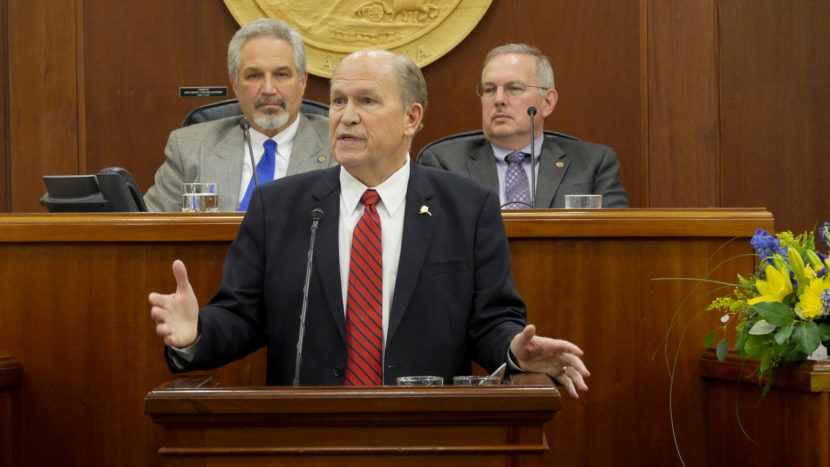
Gov. Bill Walker delivers his State of the State Address to the Alaska Legislature on Wednesday. Behind him, left to right, are Senate President Pete Kelly, R-Fairbanks, and House Speaker Bryce Edgmon, D-Dillingham. (Photo by Skip Gray/360 North)
Same concepts, new Legislature.
In his annual State of the State Address on Wednesday, Gov. Bill Walker pushed a lot of the same ideas and proposals for solving the state’s budget crisis as last year.
Walker said the state government risks spending all of its savings if it denies there’s a problem and hopes for oil prices to rise.
“Here’s the hard truth: Denial doesn’t make the problem go away. Hope doesn’t pay the bills,” Walker said. “We need to pass a plan to stabilize our fiscal future and we need to do it now.”
The gap between state spending and the money it brings in from oil, as well as other taxes and fees, is roughly $3 billion.
Walker renewed his call for a series of measures he proposed last year. They include drawing money for the budget from Permanent Fund earnings. Walker also wants to introduce an income tax. Walker said relying heavily on spending cuts would hurt the state’s economy.
“Whatever your plan may be, put it out there,” Walker said. “And let’s get to work to find a solution. But if your plan does not close the fiscal gap, be sure to also identify the amount from our dwindling savings it’ll take each year to cover the gap under your plan.”
Walker said the state Board of Education is taking a series of steps to improve schools.
And he called for more efforts to reduce deaths from heroin and prescription opioids, by limiting the number of opioids in prescriptions, and strengthening a database used to track opioids.
Walker said the state government will seek to involve every sector of the state to address climate change.
“It is one of the greatest challenges of our era,” Walker said. “We look forward to working with you to create a legacy of timely response.”
Walker’s speech touched on other topics. He called for oil drilling in the part of the Arctic National Wildlife Refuge. And he said he’ll continue efforts to build a natural gas pipeline.
Lawmakers from both houses say they’ll offer more details on their budget plans in the coming weeks.
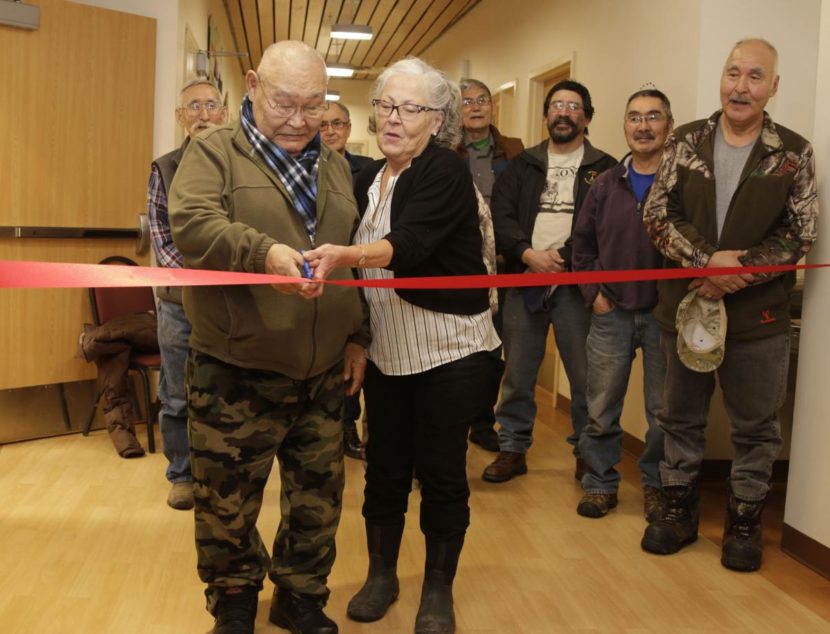
James Charlie Sr., YKHC Honorary Board Member, and Gloria Simeon, YKHC Board Vice Chair, perform the ribbon cutting ceremony at the opening of the Yukon Kuskokwim Ayagnirvik Healing Center on January 11, 2017, surrounded by YKHC board members. (Photo by Dean Swope/KYUK)
Between the two open blades of a pair of scissors stretches a thick red ribbon across the hallway of the new Yukon-Kuskokwim Ayagnirvik Healing Center. Holding the scissors are Gloria Simeon, YKHC Board vice chair, and James Charlie Sr., honorary board member.
The ribbon falls in half with one cut, and the two ends flutter to the new wooden floor of the approximately $12.8 million facility as the crowd applauds and cheers. At one end of the hallway are 16 beds for inpatient alcohol treatment as well as an exercise room, craft rooms, and a kitchen. Down the other end are rooms for outpatient counseling for both alcohol and opioid addiction.
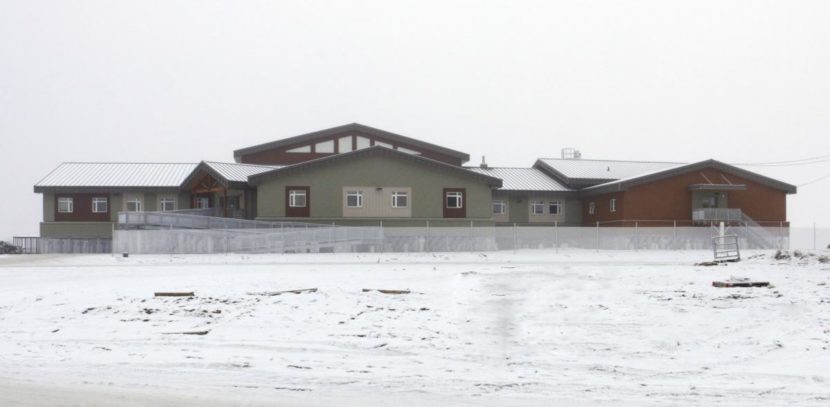
People in the Yukon-Kuskokwim Delta seeking treatment for alcohol addiction now have a newer, more spacious facility to help them. And with the new building, there is renewed hope for treating a disease that has long affected many lives in the region. The Yukon-Kuskokwim Health Corporation celebrated the opening of the Yukon-Kuskokwim Ayagnirvik Healing Center on Wednesday.
The Yukon-Kuskokwim Ayagnirvik Healing Center celebrated its opening on January 11, 2017. (Photo by Dean Swope/KYUK)
In the middle sits a small gym with a single basketball hoop. Here, dozens of community members and YKHC board members and employees are gathering to commemorate the building’s opening.
Honorary Board Member James Charlie Sr. begins the ceremony with a prayer of thanksgiving.
“Quyana for this opportunity to get together to open this building,” he prayed, “which will help our people who need help in getting rid of alcoholism or other drugs.”
Gratitude and hope for a better future echoes throughout the morning’s speeches. Board members thank those who first began offering alcohol treatment in Bethel in the 1970s. Administrators thank the funders and construction workers who made the building possible. Ray Watson, Director of the Healing Center, thanks the employees filling the room, who every day guide patients toward recovery.
Ray Watson, Director of the Yukon Kuskokwim Ayagnirvik Healing Center, thanks all the employees who help guide patients toward recovery. (Photo by Dean Swope/KYUK)
“I always say,” Watson told the crowd, “I have a deep respect for those kind of people who choose this kind of work because it takes a lot of humility and love towards their fellow human beings to help them heal.”
Watson knows this work well: first as a patient in the 1980s, then as a counselor, and now as the center’s director.
“I always say the people who enter into counseling are the lucky ones because there are so many out there who don’t have that, or at this point in time, they’re not there yet,” Watson said.
Many speakers noted that everyone in the Delta knows someone in the region who struggles with alcohol or drugs. They might even one day seek treatment themselves.
The facility actually opened six weeks ago. Watson said the patients were sent on an ‘outing’ for the ribbon cutting to protect their confidentiality. But after the ribbon is thrown away, the cake eaten, and the balloons taken out, those patients will return. They may have to come back repeatedly if they relapse.
This new center, located behind the Bethel post office, was set to open a couple years ago. But in October of 2014, the partially constructed building caught fire and burned to the ground. Construction began again.
Diane Kaplan is the President and CEO of the Rasmuson Foundation, one of the building’s funders. She said that the fire and rebuilding can be seen as a metaphor for recovery.
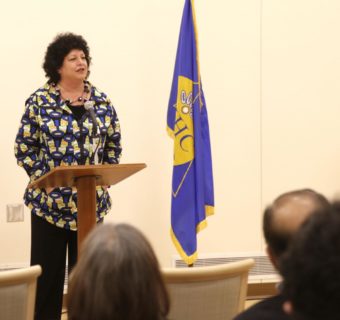
Diane Kaplan, President and CEO of the Rasmuson Foundation, addresses the crowd at the ribbon cutting ceremony at the Yukon Kuskokwim Ayagnirvik Healing Center on January 11, 2017. (Photo by Dean Swope/KYUK)
“People who don’t understand a lot about this disease will say, ‘Well how many people went into this facility and got sober?’ Well very often it doesn’t happen the first time,” Kaplan said. “So I think we can look at what happened to this building as there was a great effort to build it, and then something happened, and it fell down, and now it’s been picked up again. And that really is the message for people who struggle with alcohol.”
But as Director Watson said and can attest, recovery, like the new building, is possible.
A missing person case for Anchorage police turned into a death investigation on Thursday.
A graduate of Nome-Beltz Junior/Senior High School, Martina Painter, 25, was found dead Thursday afternoon. She was the only person in a blue four-door Dodge Dart located in a parking lot near University Lake Park in Anchorage.
A family member had contacted Anchorage Police Department about 11 p.m. Wednesday and filed a missing person’s report, claiming Painter had gone out for the evening with a friend but had not returned home.
An autopsy conducted today in Anchorage concluded that the lone occupant of the car was Martina Painter. The cause of death has not been determined. An investigation is ongoing.
Anchorage homicide detectives have conducted several interviews and are currently not looking to speak with anyone else regarding this incident.
A Facebook profile matching Painters said she had previously worked at Norton Sound Health Corporation, Nome. It also said she had attended the University of Alaska Fairbanks.
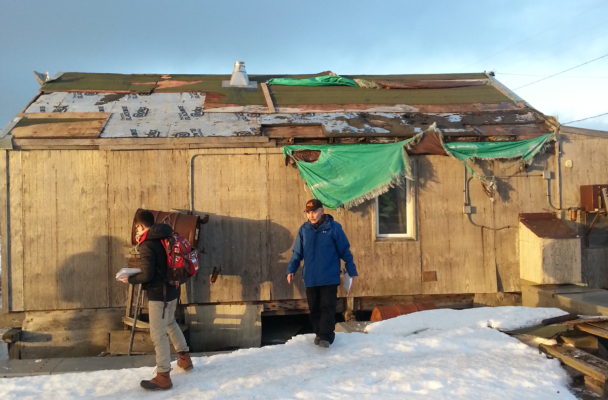
Mayor Myron Kingeekuk and a Red Cross employee survey storm-damaged homes in the community. (Photo by Davis Hovey/KNOM)
In the final days of 2016, a Bering Sea storm battered St. Lawrence Island, causing wind and water damage to many buildings in Savoonga.
The community declared a local disaster and asked for assistance from the state in order to restore their livelihoods.
As of Friday, 30 residents are claiming storm damage to their homes or shelters, along with the community’s teen center and the city office.
Each building that suffered damage from the winter storm has to go through a damage assessment conducted by the Alaska Department of Homeland Security and Emergency Management.
Alaska Department of Homeland Security’s John Ramsey described the criteria he’s looking for when conducting a damage assessment.
“We look and see if the building is: Number One, livable or not, if it’s a home, if there (are) any damages, what the extent of the damage is, so we know if it’s habitable or not,” Ramsay said. “If there’s any emergency housing that needs to be done for individuals or families at the time a disaster happens, and, then, basically just do a tally to see what the impact on the community is for a disaster.”
Ramsey was in Savoonga back in 2011 after another storm left the community without power for four days.
Savoonga Mayor Myron Kingeekuk believes this latest storm caused more structural damage than the storm in 2011.
“We’re at Harry’s house right now,” Kingeekuk said with a sigh. “After the storm died down we repaired the roof, and we just found out that the attic got damaged by water. So he tore off his whole carpet in there, so hopefully, we get help for her and we still got to look at lots of homes.”
Two DHSEM employees, two Red Cross representatives and Kingeekuk walked from home to home trying not to fall on the slick, ice-covered roads.
Alaska Homeland Security emergency management specialist Karl Edwards led the damage assessment by asking each homeowner more or less the same questions.
“After the roof fell off or came off, did you get any water damage?” Edwards asked. “Did you have any electrical problems, is the Toyo (stove) still working.”
Some buildings were missing chunks of siding or roofing; others had tarps covering some openings where walls used to be, and many structures had foundation issues.
During the height of the storm on New Year’s weekend, when winds were reported to be gusting at more than 117mph, Savoonga’s school was used as a safe haven.
Principal Ralph Lundquist and most of the school employees were out of town for winter break that weekend, creating a poorly supervised environment for the 93 community members staying in the temporary shelter.
Fairbanks Red Cross disaster program manager Michael Verrier said the Red Cross can provide shelter management training, free of charge, to help community members in Savoonga become self-sustaining during storm disasters.
“We have volunteer shelter instructors that can help give shelter training and do a shelter exercise with interested people that are within the community, so that when an event like this happens in the future, there’s people that are within the community that are able to open the shelter, keep it safe, keep it secure as best as possible,” Verrier said.
Verrier and his colleague from the Red Cross stayed in Savoonga until Sunday to complete their own damage assessment in conjunction with the Homeland Security. Verrier said the Red Cross could provide financial assistance to individuals in the community so they can repair their damages, but the Red Cross cannot buy materials directly for them.
Ultimately, Savoonga is asking the state for assistance through a disaster declaration letter, but Karl Edwards with Homeland Security explains there is a limit to the needs his department can meet.
The rest of the aid would have to come from either volunteer organizations, the governor, or both.
“They requested assistance from the state, from my office to help them through the disaster process, so that entails myself and some others coming out, looking at the community, trying to total up the damage, and then, we present it to the Disaster Policy Cabinet,” Edwards said. “The Disaster Policy Cabinet will make a recommendation to the Governor, and then, the Governor will make the final decision as to what we’re going to do for this community.”
Kingeekuk hopes this disaster declaration letter will result in his community getting the help it needs. It is unknown how long it will take for a disaster declaration letter to be submitted to the Disaster Policy Cabinet, but Edwards is confident that the process will be expedited.
Close
Update notification options
Subscribe to notifications
Subscribe
Get notifications about news related to the topics you care about. You can unsubscribe anytime.