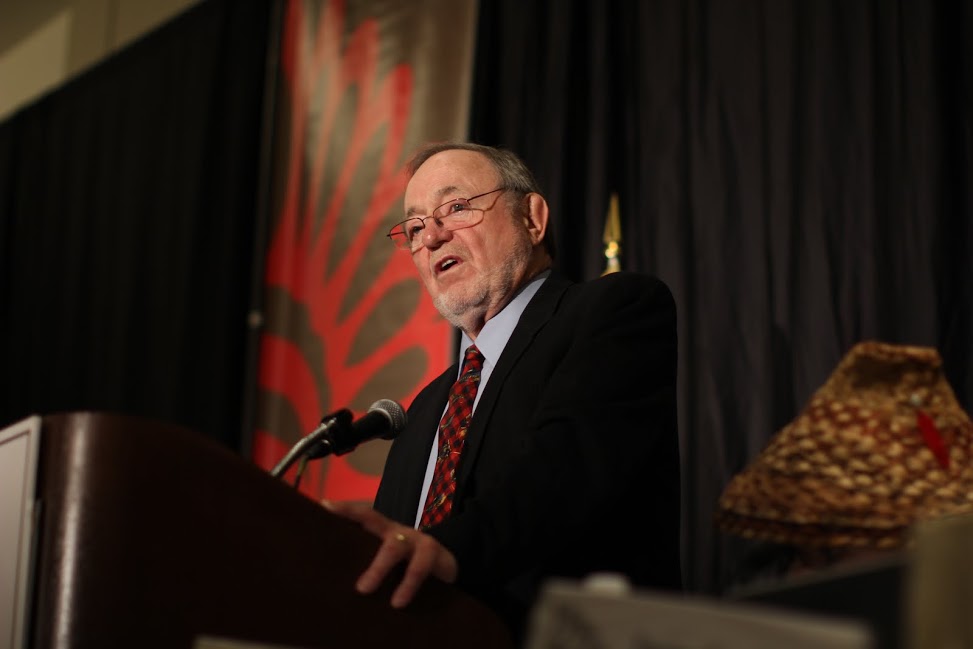
Rep. Don Young, R-Alaska, speaks to the National Congress of American Indians in March 2014. (Photo courtesy Office of Rep. Don Young)
Once President Barack Obama signs the National Defense Authorization Act into law, the City of Galena will acquire a hefty plot of public land — 1,290 acres where the Campion Air Force Radar Station used to be located will be conveyed to Galena for the purpose of preventing future flood damage to the city.
Congressman Don Young added the provision for the Galena land transfer to this year’s version of the measure, which has already passed through the House and the Senate.
The congressman’s communications director Matt Shuckerow said Young has put in years of work to achieve this goal.
“In the previous NDAA, he was able to secure this amendment in the House version, but unfortunately through final negotiations, a number of land transfer provisions were ultimately excluded, so that’s the challenge we faced last year. He came back to the table with it again this year, and we were able to secure that, so we are very proud of that,” Shuckerow said.
Galena could use this land for further protection from natural disasters, such as flooding, Shuckerow said.
“In 2013, there was massive flooding from the Yukon River, and they have had threats in the past and will continue to have them in the future, and that’s in part because of the low level land in which the city is built,” Shuckerow said. “By securing the transfer, this gives Galena the option to potentially move that town, to ensure their safety from future floods.”
It is unclear what Galena will do with this land, but Shuckerow claims the land is no longer in use and the community requested the transfer happen.
Ultimately, the Secretary of the Interior will have to convey this land, and that could fall to Ryan Zinke, President-elect Donald Trump’s appointee for the position.
Shuckerow said regardless of who is Secretary of the Interior, this bill will be enacted.
“The Congressman spoke extensively with the incoming nominee, Representative Ryan Zinke,” Shuckerow said. “They had a great conversation and talked about some of their different issues that we face, and while they may have some differences on some issues, the Congressman ultimately felt positive about their conversation in terms of management and the understanding that we need to break down some of the needless bureaucracy, and we need to make sure that we can streamline development.”
The NDAA can become law if Obama puts his signature on it, or if he takes no action on it within a certain amount of time.
Shuckerow expects the bill will be passed before Obama’s term ends.
President Obama today issued an executive order creating the “Northern Bering Sea Climate Resilience Area.” The area covers more than 100,000 square miles off Alaska’s western coast, from the mouth of the Kuskokwim to just north of the Bering Strait. The president’s order withdraws about 40 percent of the area from offshore oil and gas leasing. It also reaffirms an existing ban in the area on bottom-trawl fishing.
Alaska’s congressional delegation pre-reacted, before the order came out, warning the president not to close off any more of Alaska’s ocean. Sen. Dan Sullivan later said Obama imposed “a unilateral action to hurt Alaskans.”
But for 64-year-old Harry Lincoln, a subsistence hunter from Tununak, this isn’t a case of the president imposing his will on distant seas. Lincoln is chairman of the Bering Strait Elders Group. He said he was stunned to learn the president has acted on the urgent request of the 39 tribes Lincoln represents.
“It’s the happiest moment I ever had in my life!” Lincoln said.
Native American Rights Fund attorney Natalie Landreth said it’s a historic action.
“The level of presidential responsiveness to a group of some of the poorest and smallest native communities in the United States is the real story here,” she said.
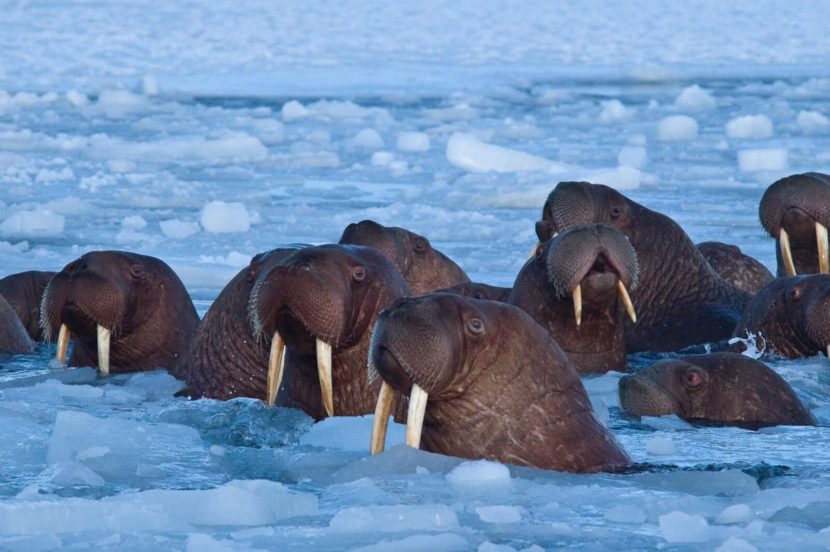
She said the story began not in Washington, but in Bethel, in July of 2015, just before the president’s Alaska visit. The Bering Sea Elders were meeting and Landreth was there as their attorney. The elders, she said, were worried about the decline of sea ice and what the predicted increase in ship traffic would mean for the marine mammals they hunt.
“And then somebody said — I wish I could remember who: ‘Let’s ask the president for help.’ And I said, that’s what you’d call a hail Mary. And then I had to explain what that was,” Landreth recalled.
The term is applied to desperate efforts, with almost no chance of success. But, Landreth said, the elders resolved to try.
“Over the past 15 months,” the attorney said, “people from rural Alaska went to the president’s office and said, ‘This is what we need.’”
The order, she said, mirrors a resolution the Bering Sea Elders passed in June. Landreth said it can prevent the kind of conflict seen now with the Standing Rock Sioux over the North Dakota Access Pipeline, because a main theme of Obama’s order is the early inclusion of Bering Sea tribes in federal decision making that concerns their region.
“It’s not just the text of the order,” she said. “It’s the fact that the president would spend an inordinate amount of time to try to help these people. I’ve never seen that in my life. I’m not sure that we’re going to see it again.”
The area the president is withdrawing from oil leasing is roughly Norton Sound, the southern strait and around St. Lawrence Island.
Gov. Bill Walker issued a statement saying he supports tribal leaders in their efforts to protect their resources, but that he’s concerned about lost development opportunities for the state.
Landreth said the withdrawal doesn’t harm the economy because it has been offered and explored in the past, with no results.
“This is not a commercially viable area,” she said. “It just isn’t.”
And now that’s less likely than ever. Obama used a provision of the offshore leasing act known as 12(a). Drilling opponents maintain these kind of withdrawals are permanent. Alaska Congressman Don Young said he plans to ask the next president, Donald Trump, to reverse this order. That’s legally possible, but historically, these orders tend to endure.
Rachel Waldholz contributed to this story from Anchorage.
Two men were rescued Saturday, Dec. 3, near Nome after being reported overdue from ATV travel out of the community of White Mountain.
The Alaska Rescue Coordination Center received a report of the missing men, who had planned to travel by single all-terrain vehicle from White Mountain to Nome.
Coordinating with Alaska State Troopers, a UH-60 Black Hawk helicopter was deployed out of the Nome Army National Guard armory.
Alaska Army Guardsmen with the 1st Battalion, 207th Aviation Regiment located the men an estimated 40 miles east of Nome.
The two were transported to the Nome Fire Department for medical evaluation, after having spent the night under a tarp Friday.
The community of Stebbins has been experiencing an ongoing “water crisis” for the better part of this week.
City Administrator Nora Tom said water pipes are breaking, the trucks hauling water are in need of repairs, and the community is waiting on the needed parts.
One concerned citizen said people in Stebbins can’t take showers at the community washeteria and instead must travel to St. Michael.
Stebbins’ water supply is limited. If the situation continues without change, Tom said, then the community will be completely out of water by the end of December.
It is unclear at this time how long it will take to restore the community’s water supply.
The Kuskokwim river from the seawall in Bethel. There was no snow and ice was barely visible in the warm November of 2014. (Photo by Dean Swope/KYUK)
Climate change has been the subject of many discussions, and scientists say that the Arctic is feeling the effects more significantly than the rest of the globe.
The results of a study gathered from University of Alaska Fairbanks-led interviews says climate change is having a significant effect on subsistence and travel activities in Alaska.
Assistant professor Todd Brinkman was the lead researcher on the article published in October in the science journal Climatic Change.
He says they were tipped off by villages in Alaska about how the changing weather patterns are hindering subsistence efforts.
“We started hearing from many rural communities in the Interior and Northern Alaska that the weather was changing, and it was forcing people to make different choices in regards to how they go out and hunt,” Brinkman said.
Brinkman points to an example from Wainwright, located on the northern coast of the state. Sea ice that whalers use to get out to the Chukchi Sea to look for bowhead whales has been declining and getting thinner over the years.
They started whaling with bigger boats in the fall.
Brinkman and his team spoke with over 70 hunters and collected data beginning in 2010.
One of their biggest findings was that out of 47 identified relationships between subsistence and climate change, well over half depended on getting to the hunting area or resource. He also adds that his team’s findings line up with their models for climate change, and that there is still more research to be done.
Though the Interior and northern coasts are far from the Yukon-Kuskokwim Delta, Mark Leary, who lives in Napaimute on the upper Kuskokwim, agrees that the weather has been changing over the years.
It has even been keeping him from one of his favorite seasonal hunts.
“The best hunting, in my experience, for birds has been when they first come and you could still go by snowmachine,” Leary said. “But it’s been so thawed out all over, that the birds are more spread out and we can’t go by snowmachine.”
Leary is referring to springtime goose and duck hunts, known in Yup’ik as nayuryaq or nutegyaq.
He says that the lack of snow, and the cycle of thawing and freezing in recent winters, has made it impossible for hunters to make it out onto the muddy tundra of spring with their snowmachines.
He said that the river breakup, which usually happens long after waterfowl have returned and settled in, has even beaten the geese.
“Like last year the ice went out and the birds weren’t even here. You know, it’s like ‘What do we do now?’” he said. “And we thought, ‘The ice went out early, maybe the fish will come early.’ But they didn’t really come early.”
Because of the fast warming last spring, Leary says the river broke up faster in April. He was still using his truck on the river less than a month before the ice washed out. He hopes that this year things will be different.
“Truck, snowmachine and boat in one month,” Leary said.
The lack of snow, Leary says, has caused low water breakups in recent years. In a normal spring season, the snow in the upper Kuskokwim area and in the mountains would melt and wash the ice out — so much water that it sometimes caused a flood when there was an ice jam.
Brinkman has heard many of the same concerns about traveling hazards in the communities he’s researched, and he said that the stories are the same across the whole state.
“What was striking was that all the communities were in agreement that these changes are having a significant impact on their ability to travel across the land,” Brinkman said. “So it wasn’t isolated to any one community, it wasn’t isolated to any one type of subsistence resource, it was affecting all of them.”
With the lack of snow due to melting or warm winters, many people are now using ATV’s or four-wheelers to get around since snowmachines have trouble in low-snow conditions. The riverbanks in parts of the state are eroding, especially in some coastal areas.
Brinkman and Leary both say that subsistence users have adapted to these new challenges, but it’s getting harder for some families.
Last year on the Kuskokwim, Akiak musher Mike Williams Sr. nearly lost some of his dog team when a large chunk of land which held his dog yard washed into the Kuskokwim. Leary adds that he’s also seen multiple breakups over the last five falls, which were unheard of before 10 years ago.
Brinkman’s article focuses on subsistence access.
In ecology, the availability of a subsistence resource depends on three factors: abundance of population, distribution of the resource in an area, and the accessibility of the resource for the hunter. Brinkman said that last factor is more important than he thought.
“We often make the assumption that if there’s plenty of fish and game in the area, that hunting opportunities are going to be good,” he said. “Our research demonstrated that even if local populations are healthy and plentiful, if people can’t get out there to them then the resource isn’t available to them.”
Brinkman and his team are in their first year of a new study with the National Aeronautics and Space Administration, or NASA. They are sending GPS-equipped cameras to nine communities. Hunters and travelers will use them to take pictures of the effects of climate change, whether it’s erosion, freaky seasonal weather patterns, or anything that could be attributed to a changing climate.
Teams will then visit some of these areas to investigate, or as they call it in the space program, to “ground truth” the data and match it up with imagery taken from space.
Close
Update notification options
Subscribe to notifications
Subscribe
Get notifications about news related to the topics you care about. You can unsubscribe anytime.