Northwest

Workshop to discuss threats of ocean acidification on Alaska waters

The world’s oceans are becoming more acidic and, like climate change, it’s happening at a faster rate in the far north waters of Alaska.

A workshop to be held Wednesday in Anchorage aims to bring together scientists and stakeholders to better understand the threat ocean acidification poses to the state.

The workshop is being streamed in nine other communities around the state, including Sitka and Juneau.

Not only are the world’s oceans about 30 percent more acidic today than they were 300 years ago, the rate at which they’re acidifying is faster than at any other time on record.

Chris Whitehead is the environmental program manager for the Sitka Tribe of Alaska.

“So, more carbon in the air getting absorbed by seawater makes it more acidic,” Whitehead said of ocean acidification.

The tribe has been testing toxins in shellfish for years, but soon it will start testing the waters for levels of acidity.

Ocean acidification poses a particular threat to marine animals at the bottom of the food chain, according to Whitehead.

“Like if you’re a little tiny clam or a terapod, which are these little tiny plankton that form really delicate shells,” Whitehead said, “your shell can’t form.”

That’s because the more acidic ocean water is, the more corrosive it is.

That worries people like Hannah Heimbuch, who’s planning on attending the ocean acidification workshop.

“A lot of my questions are around the food web and predator-prey dynamics,” Heimbuch said.

Heimbuch lives in Homer, where she fishes commercially.

“There are so many unanswered questions about how (ocean acidification) will affect the ecology of the marine environment,” Heimbuch said. “As a salmon fisherman, I would like to know how it will affect what the fish I catch eat.”

Along with catching fish, Heimbuch also works for the Alaska Marine Conservation Council as a community fisheries organizer.

She’s been focused recently on ocean acidification, trying to inform people about the effects it may have on Alaska’s waters.

“And one of the ways that we have been doing that is by working with the Alaska Ocean Observing System, AOOS, on the Alaska Ocean Acidification Network,” Heimbuch said.

It’s that network that organized the workshop on the “State of the Science” of ocean acidification.

There will be remarks from researchers and policymakers, panel discussions with scientists from around the state, and presentations on lessons learned from the Pacific Northwest.

The workshop is free online, and will stream directly to some of the state’s major fishing communities like Unalaska, Kodiak and Sitka. Hannah Heimbuch said ocean acidification poses a direct threat to their local economies for those communities.

“I think that folks that are based in coastal Alaska understand that we need to take that long term view and really try to better understand these big-picture changes happening out in the ocean,” she said.

Because, Heimbuch said, at the current rate of ocean acidification, it won’t be long before those changes will be felt on shore.

In Sitka, a remote viewing of the workshop is being held at the Island Institute from 8 a.m. to 5 p.m. Wednesday.

You can find a link to stream the workshop online. The presentation is also being streamed in Cordova, Fairbanks, Homer, Seward, Kodiak, Nome and Unalaska.
Army Corps proposes rules for mining company’s treatment of historic sites

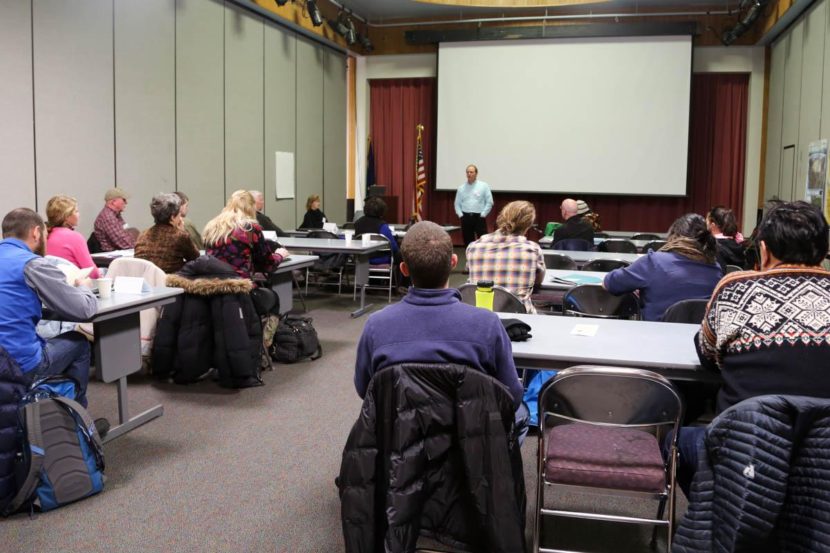
Richard Darden, USACE Project Manager on Donlin Gold, addresses stakeholders at a Bethel meeting on how Donlin Gold will be legally required to treat historical sites if permitted. Nov. 21, 2016.
(Photo by Celina Angaiak/KYUK)

What’s going to happen if the Donlin Gold mine is green-lighted and historical sites become disrupted? That’s another part of the Donlin saga that the U.S. Army Corps of Engineers is deciding as the federal agency chooses whether or not to recommend permitting the project.

The Corps is drafting a legally binding document for Donlin to follow if the project gets the go-ahead. The document, called a programmatic agreement, describes how Donlin will treat known and yet-to-be-discovered historical sites it encounters during the large mining project’s development. The Corps plans to release a draft of the document in early 2017 and then collect comments from federal, state, tribal, and municipal groups before issuing a final agreement.

The Corps held a meeting in Bethel on Monday to talk about this agreement with groups who weren’t able to attend a similar meeting in Anchorage last month.

Only three of the 14 groups invited attended the Bethel event: AVCP Inc., the City of Georgetown, and Kwethluk Inc. None raised public concerns during the gathering.

Richard Darden, USACE Project Manager on Donlin Gold.
(Photo by Celina Angaiak/KYUK)

Richard Darden is the Donlin Project Manager for the Corps and led the discussion. He says for those who couldn’t attend the meeting, there’s still time to get involved.

“The folks who weren’t able to come today can still participate in the remainder of the process very effectively,” he said, “because we’ll provide comprehensive information when we distribute materials and a draft programmatic agreement. And we can be in touch with those folks on a more individual basis between now and then.”

Since 2004, 70 historical sites have been discovered at the project sites, which include the mining area, pipeline corridor, and transportation points like runways, ports, and roads. The sites range from artifact clusters to cabins to caves.


AMCC inmates prepped for work on the North Slope

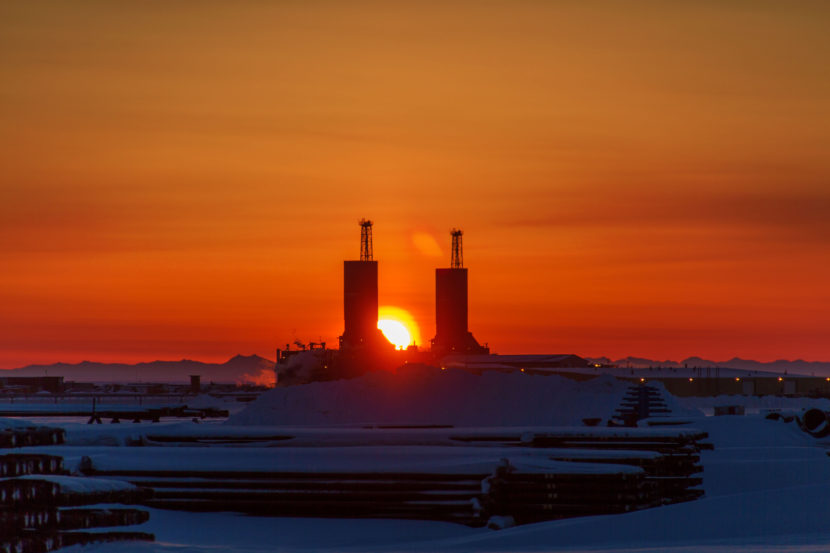
North Slope Drill Rigs at sunrise
The sun rises on the North Slope between drill rigs, Nov. 6, 2012. (Creative Commons photo by Kevan Dee)

Anvil Mountain Correctional Center, or AMCC, was the latest correctional facility in Alaska to host a North Slope Training Cooperative (NSTC) course for its inmates today. This eight to nine-hour training includes safety handbooks, course evaluations, and, of course – cups and cups of coffee.

Rus Bilak, a health and safety instructor for Environmental Management Incorporated began the class by informing the 23 all-male group that in order to work jobs on the Slope, they will need to be safe at all times. Bilak says, “If you can’t work safely, you can’t work here.”

NSTC training is comprised of six different learning modules, also called a “six-pack,” along with a newer addition focused solely on working around hydrogen sulfide (H2S). Bilak warns this deadly gas smells like rotten eggs.

“Hydrogen sulfide is a gas that is flammable, and it is toxic; it’s present on the Slope just like as much as it’s present anywhere where there is natural decomposition of organic material happening in anaerobic environments. It could be in storage tanks, it could be in the sewer, it could be in the swamp, which is another name for it; it’s a swamp gas,” stated Bilak.

After completing the day of modules, and after filling out the necessary paperwork, the inmates will receive an NSTC card. Bilak says that employees working jobs on the Alaska gas pipeline in the North Slope area must have an NSTC card, so this sets up the inmates for potential job success after they finish their time.

“I think once they are still here it’s easier to get them all together and provide this training, rather than hoping that once they get out they will seek this training on their own,” said Bilak, “…at that point, they will probably have to pay out of their own pocket.”

Currently, the “6-pack” training costs $190 and takes 8-9 hours to complete, then the hydrogen sulfide (H2S) course costs $15 and could take another hour. This training is only available in Alaska and is not taught online.

Even with the NSTC card in hand, this group of inmates is not guaranteed job placement on the Slope; they must still go through the application process after their release from AMCC. Bilak says he does not know how many employees work on the Slope, nor how many of them were former convicts.

Rural lawmakers wield power without recent precedent

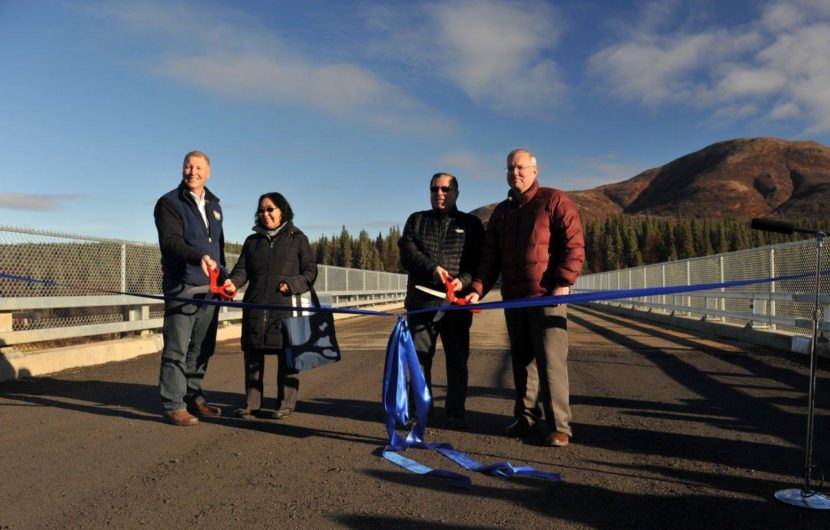
Wood River Bridge ribbon cutting
DOT Commissioner Marc Luiken, Aleknagik Mayor Jane Gottschalk, Sen. Lyman Hoffman and Rep. Bryce Edgmon cut the ribbon on the Aleknagik Wood River Bridge in October 2015. In 2017, Hoffman will be the Senate Finance Committee co-chairman and Edgmon will be House speaker. (Photo by Misty Nielson)

Dillingham Democrat Bryce Edgmon will be the first speaker of the Alaska House of Representatives from off the road system or outside of Southeast Alaska since Nome’s Howard Lyng in the Territorial Legislature of 1941.

And other rural lawmakers will hold more important leadership posts in the next legislature than they have had in decades.

Edgmon and two key committee chairmen are from northern or western Alaska.

Nome Democrat Neal Foster will be co-chairman of the House Finance Committee. Bethel Democrat Lyman Hoffman will be co-chairman of the Senate Finance Committee. It will be the first time both budget-writing committees will have chairs from Bush Alaska since 1990. Hoffman also was a finance chair then, when he served in the house.

Edgmon said the rural leaders are part of a broader regional balance that will be good for the entire state.

“I think it will be good for rural Alaska, and from my standpoint, it’s always good to have regional diversity on the finance committees,” as well as other committees, Edgmon said.

Rural lawmakers have a tradition dating back decades of joining majority caucuses. But this session they’re playing a particularly central role in control of the House. Edgmon and Foster joined with three Republicans to switch from the current Republican-led majority to the primarily Democratic incoming majority.

What this means for rural residents is uncertain. Rural lawmakers have traditionally argued for maintaining or increasing government services. Service increases will be difficult due to the state’s budget crisis. But the incoming House majority is interested in striking a balance that includes both spending cuts and new revenue, like a broad-based income or sales tax, to maintain services. Edgmon expects Foster and his finance committee co-chair Paul Seaton will keep this in mind.

“Both individuals – Rep. Seaton from Homer, Rep. Foster from Nome – are very committed to taking a balanced approach to figuring out the fiscal challenges that lie ahead,” Edgmon said.

Former University of Alaska Southeast political scientist Clive Thomas noted the state government funds a large share of jobs in rural Alaska. And Thomas expects the rural lawmakers to be at the forefront in defending school funding.

“It’s a major income generator in most villages – probably the major income generator – so I think that’s one of the things that they will be concerned about and want to protect,” Thomas said.

Edgmon said there’s another historic element of the new leadership.

“I’m very proud to be the first speaker of Alaska Native heritage,” Edgmon said. “And that’s something that I hope can serve as a role model for future speakers with Alaska Native blood.”

Edgmon said he’s a little less than a quarter Aleut, and he also grew up learning Yupik words and phrases in Dillingham, where the two cultures overlap.

“I grew up in a small town, so I bring small-town values to whatever I do,” Edgmon said. “And I think by nature I’m somebody who listens first and I’m not always the biggest talker in the room. And maybe that hearkens back to my Alaska Native upbringing.”

The budget’s effect on rural areas and the rest of the state will be clearer in mid-December, when Gov. Bill Walker is scheduled to unveil his budget proposal.

McGuire served as Nome Nugget’s editor and publisher for 34 years

The editor and publisher of Alaska’s oldest newspaper passed away Thursday morning after fighting a battle with cancer, just shy of her 73rd birthday.

Nancy McGuire purchased The Nome Nugget in 1982 and served as its editor and publisher for 34 years, the paper reported Thursday.

McGuire was born in 1943 in Pittsburgh, Pennsylvania. She graduated from Indiana University of Pennsylvania in 1965 with a master’s in education as a biology major; she then taught in high school and university classrooms in her home state before moving to Nome in 1973.

In Nome, McGuire first worked for the University of Alaska-Fairbanks Northwest Campus. In her early years in town, she also worked for the Norton Sound Health Corporation regional hospital and with the Alaska Science Foundation. McGuire volunteered for many years, the Nugget reports, as an EMT with the Nome Volunteer Ambulance Department; she is also credited with forming the first internet service provider in Nome.

McGuire got her start at the Nugget as a part-time reporter.

Her tenure as the head of the Nome weekly newspaper, from 1982 onwards, endured for nearly half of her lifetime — and led to her being awarded the Alaska Press Club First Amendment Award in 2012.

She built a rapport with Nugget readers, in part, through weekly editorials, which were often platforms for frank opinions on current affairs or politics in Nome, the state of Alaska, or the nation.

The last of McGuire’s editorials was published on Thursday, Nov. 17, the same day as her death, and was both a defense of the editorial form itself and a valediction to her readers.

“An effective editorial starts the reader thinking. That’s its job. I hope my editorials have done that—stimulated thought about what has been happening—bad or good—for our community over the 34 years I have been editor and publisher of The Nome Nugget,” McGuire wrote. “I have loved Nome and the folks in our community and our village neighbors since the day I took over in 1982. I must depart soon. I will bid an affectionate farewell to all.”

McGuire battled cancer for over a decade.

With her passing, the Nugget will continue under private ownership, according to the newspaper’s obituary for McGuire.

A funeral Mass will be held for Nancy McGuire at 2 p.m. Saturday, Nov. 19 at St. Joseph Catholic Church in Nome.

Offshore gold mining barge runs aground in Nome’s harbor

A barge involved with offshore gold mining ran aground early Wednesday morning in Nome’s harbor.

The barge, the Eddie, is owned and operated by Phoenix Offshore Mining, Port Director Joy Baker said.

A surge of waves made the barge’s spuds break free, leaving the jackup legs of the rig unsupported, Baker said.

The barge was lifted up by the waves, then started free floating, which also caused the vessel to lose its excavator.

Phoenix President and CEO John Keeley is working with various equipment and a crew to address the situation.

Harbormaster Lucas Stotts said the port staff are in contact with the Coast Guard and the Alaska Department of Environmental Conservation.

They are waiting for calmer waters before they attempt to dislodge the vessel.

It is unclear at this time how long the process will take.

Site notifications
Update notification options
Subscribe to notifications