Alaska State Troopers thwarted two attempts to import alcohol to the community of Elim over the weekend.
Troopers seized an estimated total of 10 liters of alcohol in Nome Sunday, Jan. 8, in two separate incidents: one, an estimated 7 liters, the other about 3 liters.
Airline passengers believed to be involved in the alcohol smuggling attempts were traveling from Nome to Elim, a local option community where alcohol sales and importation are banned.
Suspects have been identified.
The total number and names of those suspects have yet to be released, as troopers continue their investigation.
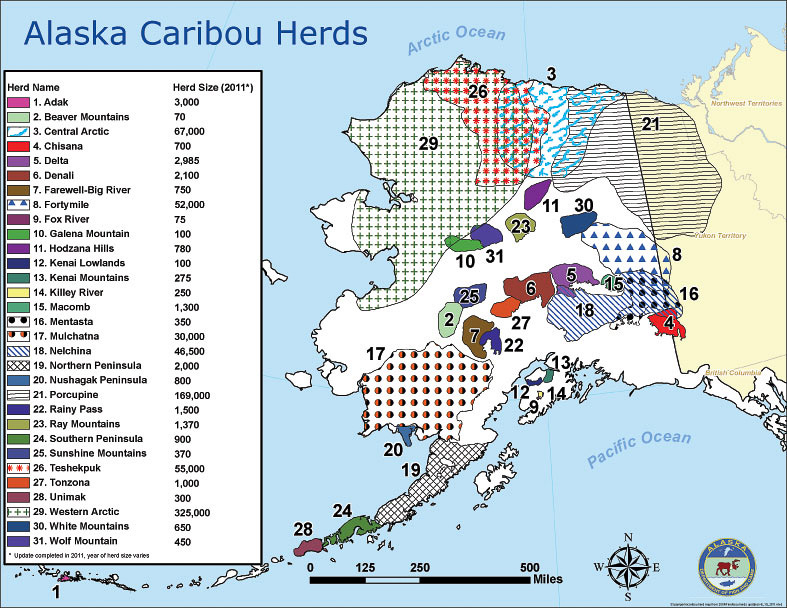
The working group voted to support a proposed change to a registration permit hunt in units 21, 23, 24, and 26. (Map by Alaska Department of Fish and Game)
In a meeting last month, the Western Arctic Caribou Herd Working Group voted to give its official support of the Department of Fish and Game’s proposal to modify the caribou hunt structure in five northern hunting units.
The working group’s Dec. 19 votes support changes to four different proposals that outline current hunting regulations: most notably, the establishment of registration permit hunts within hunting units 21, 23, 24 and 26.
Those units stretch from Bethel up to Utgiavik, encompassing thousands of acres. Unit 23 is most famously known as home to the Western Arctic Caribou Herd, and, as of last April, is off limits to non-resident hunters.
The proposed change to the structure would not affect the ban of non-residents put in place by the federal subsistence board.
The units in question currently use a harvest registration system.
Supporting a registration permit hunt would give the Fish and Game board power to require mandatory reporting from people who buy the licenses.
The current harvest registration system does not require people to accurately track what they kill.
The ability to require reporting can lead to stronger data surrounding herd conditions, allowing for more frequent herd evaluations.
If numbers were found to be worrisome, then the permits would increase the Department of Fish and Game’s ability to quickly close or open seasons.
The working group also voted to support hunt camp spacing and extending unit 23’s boundaries, while opposing a no-fly zone above hunting units on the North Slope.
With the Western Arctic Caribou Herd’s official support, the Department of Fish and Game will go on at a later time to either pass or reject the supported proposed changes.
Passed proposals will come into effect July 1, 2017.
A crew works on a sewer system in a rural Alaska village. Photo courtesy USDA Rural Development.
Introduced in February of last year, the Water Resources Development Act, now called the Water Infrastructure Improvements for the Nation Act, has officially been signed into law. After passing the president’s pen December 16th, the bill brings money to improve Alaskan water and sewer conditions all over the state.
Senator Dan Sullivan says it providesa brand new program: “I think it’s going to disproportionately benefit Alaska, because we have the most challenges on this issue.” Provisions in the bill provide $300 million over a 5-year period.
That’s good news for any of the 30 communities in Alaska that go without access to water or wastewater services.
Though the bill no longer carries the $1.4 billion in funding like its earlier version, Sen. Sullivan says big-ticket projects, like the creation of a harbor for Little Diomede, weren’t abandoned.
The WIIN Act will help with the creation of harbors in Craig, St. George, and Elfin, as well. Additionally, the bill accommodates a deep draft port feasibility study. Sullivan says the bill encourages the Army Corps of Engineers to look past Shell’s withdrawal from the Chuckchi Sea, which, he says, is a leading reason why the study was put on hold.
“What the bill does is that it instructs the Corps of Engineers that they need to focus not just on the oil and gas issues with Shell but broader national security benefits that would accompany an Arctic deep-draft port.”
According to Senator Sullivan, 3,300 rural Alaska homes lack running water and a flush toilet.
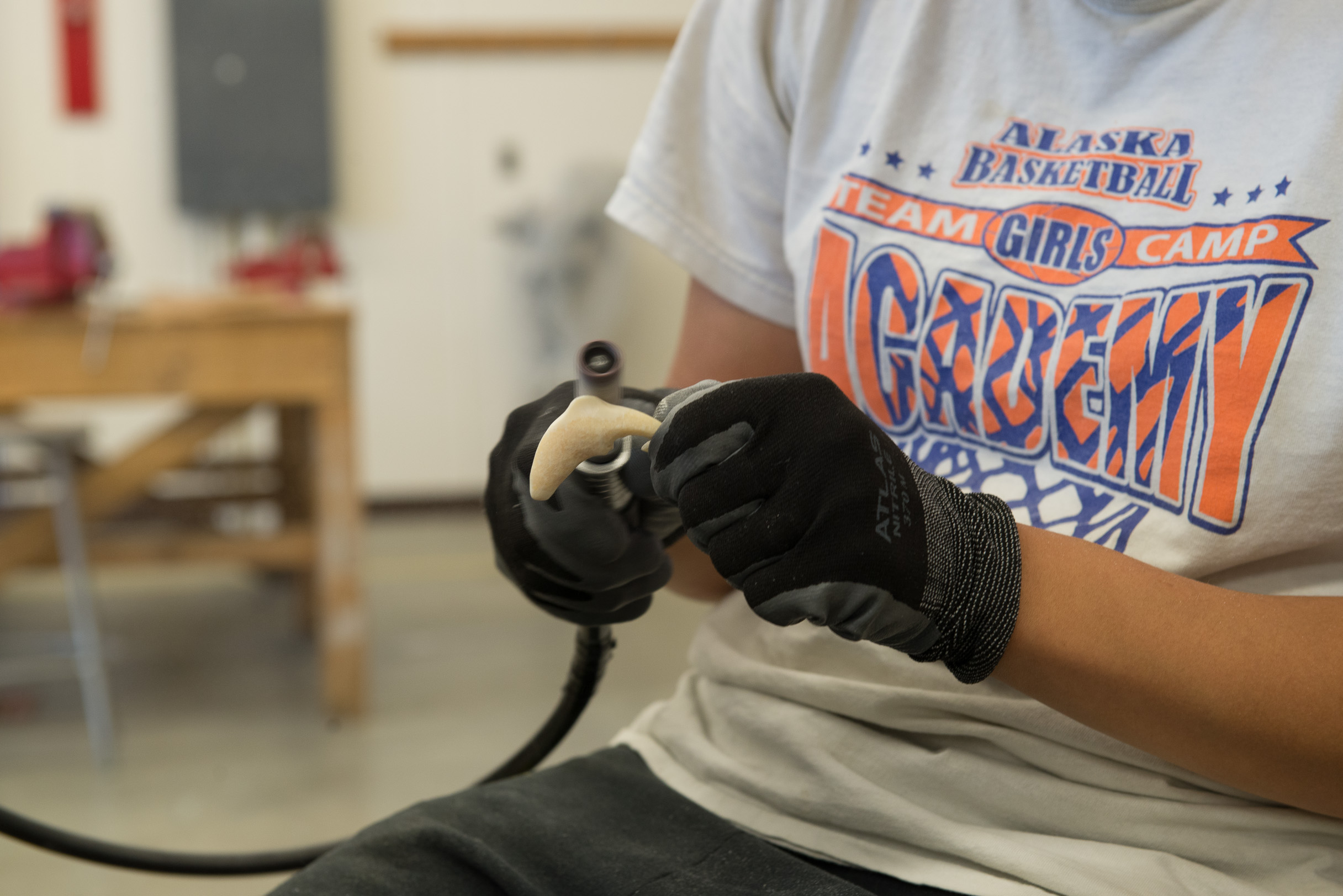
A student uses a a Dremel tool to shape her fish carving. Master ivory carver Jerome Saclamana taught students in Nome the tradition in August 2015. (Photo by Mitch Borden, KNOM)
The Alaska State Council on the Arts is urging Alaska’s congressional delegation to protect Native use of ivory after recent domestic ivory bans.
The council, which is a part of the state Department of Education and Early Development, submitted a resolution to the delegation last month, emphasizing the rights of Alaska Native people to subsist and legally acquire walrus, mammoth and mastodon ivory for use “as a primary creative medium or an incorporated material into artwork.”
The council said in a release Wednesday it is committed to protecting artistic expression of Alaska Native people through cultural practices — whether traditional, contemporary or customary.
The focus of the State Council on the Arts is to “advance creative endeavors” for individuals around Alaska.
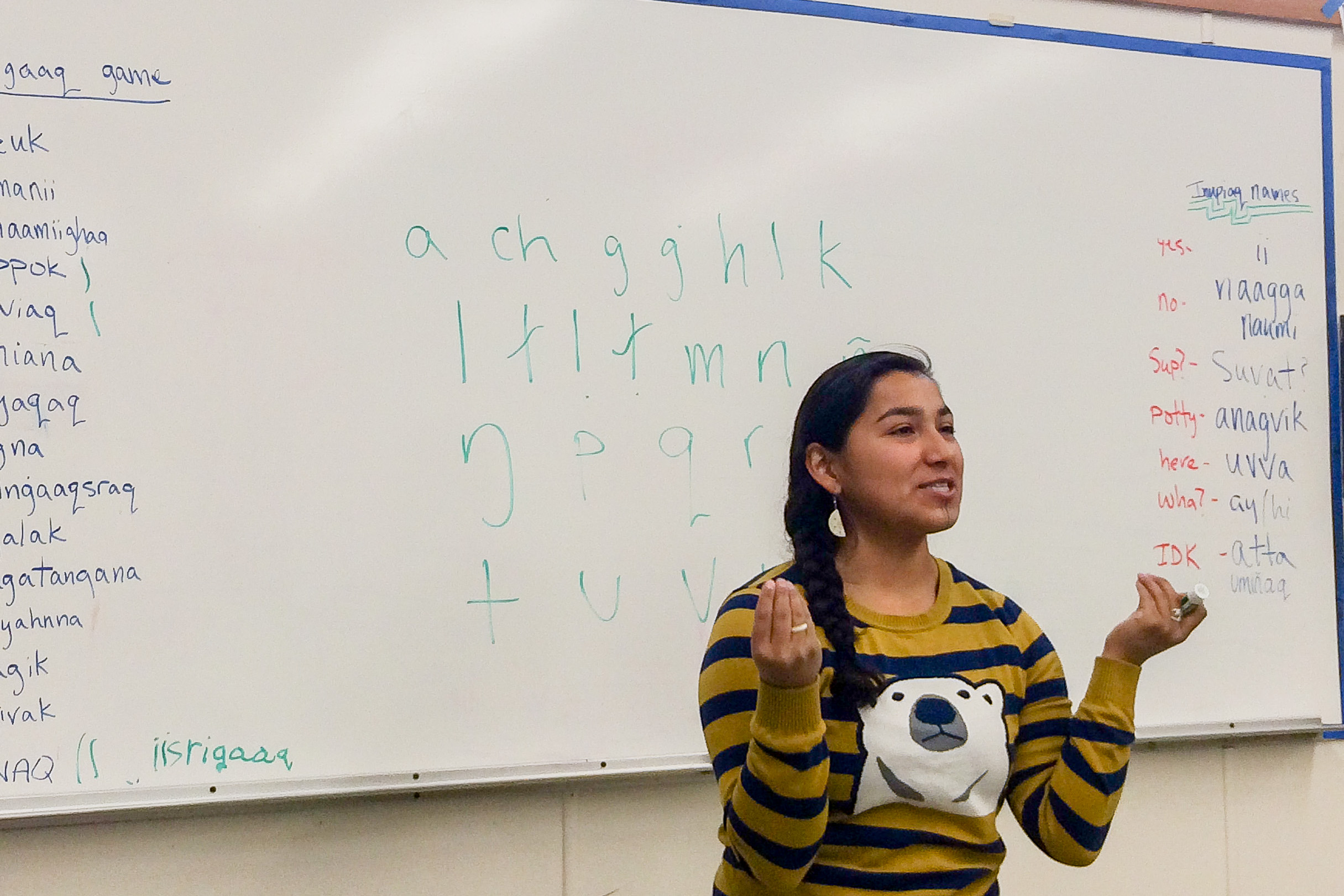
Marjorie Tahbone, the new vice chair of Inuusiq, Inc., teaching an Inupiaq class at the Nome high school in 2014. Inuusiq, a new non-profit, is creating a language nest in Shishmaref to revitalize Inupiaq culture and language. (File photo by KNOM)
Coming to the region at the start of the new year is a “nest” project focused on Inupiaq language revitalization.
A Nome-based non-profit organization called Inuusiq Inc., which started up this year, is spearheading the project.
“So, Inuusiq Inc. was created by four young Inuit women,” Innusiq chair Iviilik, or Hattie Keller said. “We started this non-profit because we felt like we’re lost, there’s a piece of us that is missing. We felt disconnected as Native people from our culture.”
For those who don’t speak Inupiaq, the word inuusiq means “Life, or our way of life in Inupiaq,” Keller said. “Its sole purpose is to reclaim what we feel is lost, and that’s our language, our culture, our values, our practices.”
Many Native Alaskans’ sense of loss of culture or language started generations ago.
It had a lot to do with the trauma Native people experienced while in school, according to Keller.
“I visited Shishmaref in April,” Keller said. “I spoke to an elder, and I asked her: how did you go to school and how was it, and she told me when she went to school they only were able to speak English. They were hit on the hand, or put outside and made to stand outside all day if they spoke any Inupiaq. So, this is two to three generations before me.”
Keller said it takes about three generations of people to integrate a spoken language into a family, so that’s how many generations this language nest will use at one time.
“In 2017, it’ll be tangible,” Keller said. “We’ll have an Inupiaq linguist and a teacher or child care provider that will help the linguist. In turn, the child-care provider/teacher will learn from the linguist while teaching our children, because most likely, our Inupiaq linguist will be an elder. So that’s three generations: the linguist, the next generation is a teacher, and then, the new generation is our children, (ages) zero to 3.”
Keller said for now, this language nest will be based in Shishmaref and will focus on children that are up to 3 years old, kind of like a day care facility but with some differences.
“What makes it a language nest instead of just a day care is that it’s going to provide the parents and the grandparents with learning materials,” Keller said. “Right now, we are renting a building from the city of Shishmaref; it’s the old Northwest campus building. And in future locations, we would like to go throughout the region; progressively, we’ll move to the children as they grow older in different grades. Hopefully, we’ll go to preschool next and then, after preschool, Headstart.”
Ultimately, Keller’s vision for Inuusiq’s role in language and cultural revitalization in the region is much bigger.
She said with enthusiasm, “So, my overall goal in, let’s say, the next 50 years, is that we speak four languages. We speak English, we speak Inupiaq, we speak St. Lawrence Island Yupik, and Yupik.”
Inuusiq has already started hiring employees for 2017, including teachers and linguists, to begin working at the new language nest located in Shishmaref.
Reno Moore pulling stock on opening day of the AC Quickstop liquor store in May 2016. (Photo by Geraldine Brink/KYUK)
Three businesses are vying for Bethel’s final liquor store license.
One business has already submitted its application, and the other two are in the three-week public notice period required before applying.
If the other two get their applications in on time, it’ll be up to the Alaska Alcoholic Beverage Control Board to decide which of the three businesses holds the final license.
The Limit: Bethel is limited to just three liquor store licenses because of its population size. State law sets a limit of one license per 3,000 people or a portion of that, so Bethel gets three.
The Deadline: The two businesses in the public notice phase have to submit their applications by the second weekend of January in order to compete with the already submitted application. That’s because only applications submitted within the same 30 days are considered competing. The clock started ticking on December 16 when Kusko Liquor submitted its application first.
If all the applications are received before the second weekend of January, the board will decide on one applicant at its next meeting using some of the following criteria:
If an application doesn’t meet all state and local requirements, then it’s out.
If an application is protested by its local government and the board approves the protest, then it’s out.
If the board determines any application isn’t in the public’s interest, then that one’s out. The factors for considering public interest are safety, suitability, size of the premises, proximity to other licensed premises, and community amenities associated with the premises like entertainment, dining, and tourism. The local governing body can also add its preferences and priorities to this list.
If there are still competing applications after these factors have been considered, the board will resort to a drawing, essentially pulling a name out of a hat and declaring it the winner. Any loser has a right to appeal.
The board next meets in February 2017.
Close
Update notification options
Subscribe to notifications
Subscribe
Get notifications about news related to the topics you care about. You can unsubscribe anytime.