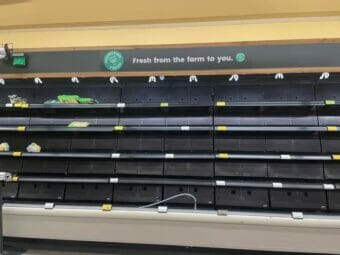
Safeway’s produce section was nearly cleaned out after rough weather delayed food shipments to the island; March 4, 2023. (Kirsten Dobroth/KMXT)
Grocery store shelves in Kodiak were bare this weekend after rough weather delayed food deliveries to the island. An emergency cargo flight filled with provisions landed in Kodiak Sunday morning to help fill the gap.
Kodiak depends on barges to bring in everything from milk and meat to cereal and bread. The last barge delivery was nearly two weeks ago, on Feb. 22.
Safeway on Mill Bay Road is the only large grocery store on the island. And store management expected a resupply stop ahead of this past weekend. But snowstorms and gusty weather, including hurricane-force winds, scuttled those plans.
“In my entire career, I’ve never seen two successive bypasses,” said Mike Murray, the store director of Kodiak’s Safeway.
He said with the exception of some nonperishable goods, the store had been nearly cleaned out by this weekend.
“Frozen foods was catastrophic,” said Murray. “I have just a few bags of frozen vegetables and pizzas, etc. And then on into the dairy aisle where we ran out of milk, virtually all milk products, eggs, cheese, probably 85% of our yogurt, and 70% of our juice products.”
The store’s produce shelves were also nearly empty. The bread aisle took a big hit. So did the meat department. Several restaurant owners also posted in a popular community Facebook page that they were running low on supplies.
Management from Safeway and shipping company Matson chartered a military transport plane to fly in an emergency food delivery on Sunday morning. Kodiak-based Advantage Air Freight helped unload supplies once they landed.
Murray said they were able to source some provisions from the grocery chain’s Anchorage warehouses, but it took a boots-on-the-ground effort to get other products back to the island.
“Whatever milk or meat products we got was a handful of people in Anchorage going from store to store picking up what they could, what those stores could spare so that we could fill that airplane out,” he said.
Murray said it’s only a fraction of what they needed, and shelves were almost bare again Sunday night. The next barge was scheduled to arrive in Kodiak on Monday evening.
U.S. Secretary of Veterans Affairs Denis McDonough met with local veterans on Feb. 23, 2023 in Bethel, Alaska. (MaryCait Dolan/KYUK)
More than a dozen veterans shared their concerns with U.S. Secretary of Veterans Affairs Denis McDonough and U.S. Rep. Mary Peltola (D-Alaska) during a listening session in Bethel last week.
“They stressed the high cost of living here in Bethel or in the Y-K Delta,” said Bethel’s Veterans of Foreign Wars (VFW) Post 10041 Commander Henry Hunter Sr. “Just to fly from Hooper Bay, I think it’s about $600 one-way. So it’s pretty expensive for those veterans.”
Peltola and McDonough answered their questions for nearly two hours on Feb. 23. Veterans said that they were concerned about the lack of benefits and internet access, Alaska’s high cost of living, and their concerns about the U.S. being dragged into a war between Russia and Ukraine.
When it comes to veterans in rural Alaska, McDonough said that citizens from rural communities across the country serve at a higher rate than citizens living in urban or suburban areas. When those servicemembers separate or retire, they often return home to their small communities.
Alaska Natives, in particular, serve at a high rate.
“I thought it was really important to come out here to Bethel and to see the particular life that our veterans here live,” McDonough said. “So that we are making sure that we’re getting care available to them, getting benefits that they’ve so earned and so richly deserve available to them in a reasonable way, not making them have to fly halfway across the biggest state in the union to get that done.”
One big issue that came up was the rate of veteran suicide. The most recent data available is from 2020, and one sobering metric is clear: more U.S. vets have died by suicide in the last 10 years than service members who died from combat in Vietnam. Alaska Sen. Dan Sullivan is co-sponsoring a proposal for the VA to study the effects of medical cannabis on vets with post-traumatic stress disorder (PTSD) and chronic pain.
“We want to make sure they take a hard look at whether there isn’t a way for us to get better access to research, the potential uses of cannabis for things like PTSD,” McDonough said.
Veterans in attendance and at large said that they don’t think the government is doing enough. McDonough said the VA’s clinical priority is to reduce and end veteran suicide. Recently, the VA invested $3 million into an app for Native veterans to reduce suicide. McDonough said that it connects veterans who are at risk or in crisis to care in their home communities.
“So this is precisely the kind of activity that we wanted to invest in to see if we can grow it so that other veterans in Alaska, and then other veterans across the country, can get access in a timely way to the care they deserve,” McDonough said.
Ignatius Hunter and Tom Jimmy outside of the Yuut Elitnaurviat dorms. (Francisco Martínezcuello/KYUK)
On Feb. 10, the forecast called for heavy snow in Bethel with temperatures reaching 10 below. Two teenagers decided it was good idea to go outside after school to build igloos near the Yuut Elitnaurviat dorms. It’s a study in engineering, architecture and history.
KYUK’s Francisco Martínezcuello followed their two-day progress and joined them inside the igloo. Here’s an audio postcard about this experience.
The lunchroom of the Tuluksak school, where John Mark Hammonds first worked in the Yupiit School District. (Olivia Ebertz/KYUK)
After a week without running water, administrators in Tuluksak say that they are on the verge of closing the village’s school.
Principal Kary DelSignore said that the trouble started on Thursday, Feb. 9 when a line leading from the water plant broke, leaving the school and all of the teacher housing without running water.
That water plant is a portable one on loan from the Yukon-Kuskokwim Health Corporation, which sent a technician out to take a look.
“He was not able to find the leak,” DelSignore said. “He said that even if they did find the leak, that the equipment is not currently available in Tuluksak to get to it and fix it.”
There’s a temporary workaround, but it requires trucking a 200 gallon plastic container back and forth from the water plant to the school and would afford just a fraction of the water the school and teacher housing would normally use.
“We’re trying our best to conserve water where we can. We’re making choices that we shouldn’t be having to make in the schools,” DelSignore said. “You know, pulling out the honey buckets, doing things like that. Having to choose, you know, ‘will we feed you today? Will you be able to wash your hands?’ What can we do? Can we provide you with drinking water? Nope, we don’t have any drinking water right now that is safe for you in the school.”
The lack of water is making it difficult to cook food in a clean environment, and DelSignore and Yupiit School District Superintendent Scott Ballard say that it’s putting the health and safety of children and staff at risk.
“Our teachers are going, they’re working on their weekends to help pump water. They’re working in the evening to help pump water,” DelSignore said.
Then, those teachers head home to honey buckets and cold showers.
“Its just become very, very difficult and we are in need from some assistance from the state,” DelSignore said.
But it’s not exactly clear where that help should come from. DelSignore and Ballard said that they have reached out to Bethel’s Sen. Lyman Hoffman and the commissioner of the Alaska Department of Education.
“Whether it’s the National Guard, whether it’s another state, you know, water, health and safety, environmental agency coming in. They have the tools that we don’t have available in this rural community to help us and get this fixed quickly,” DelSignore said.
In the meantime, as each day passes Ballard said that they may not be able to keep the school open.
“Right now, we’re just trying to assess whether those teachers can even make it to next week because they basically stated that they’re exhausted and they haven’t had showers in a week,” said Ballard. “If all of our teachers are so exhausted and so frustrated without even being able to maintain basic personal hygiene, they’re gonna leave and we won’t have a school.”
ABL Space Systems’ RS1 rocket on the launchpad at Kodiak’s Pacific Spaceport Complex, November 2022. (ABL Space Systems)
California-based aerospace company ABL Space Systems was hoping for its first successful rocket launch from Kodiak’s Pacific Spaceport Complex last month. But instead, a black plume of smoke was visible from the city of Kodiak just minutes after liftoff. Extensive cleanup is ongoing at the facility — and more information is emerging about the crash.
ABL had been trying to launch from Kodiak since the fall, and had scrubbed several times leading up to the launch failure on Jan. 10.
No one was hurt, but some of the facility’s infrastructure was damaged or destroyed when the rocket tumbled back to earth.
Kodiak’s Pacific Spaceport Complex is owned and operated by Alaska Aerospace, and ABL is one of two companies that launch from the facility. The other company, Astra, successfully launched its first commercial rocket carrying satellites from Kodiak in March of last year, after a fiery crash back in 2020.
ABL’s RS-1 rocket shortly after liftoff on Jan. 10, 2023. The rocket was destroyed after its engines shut down prematurely. (Courtesy ABL Space Systems)
According to ABL’s website, once successfully launched, its RS1 rocket would be a game-changer for the satellite launch industry, requiring less time and fewer people to get satellites into space.
Alaska Aerospace’s Chief Executive Officer Milton Keeter said all launch plans are developed with oversight from the Federal Aviation Administration, which requires a flight safety analysis for each mission.
“Whenever we have these operations and testing, the public’s interest is high – pretty much the highest,” he said. “So, safety is paramount for us.”
ABL is still investigating what went wrong, but the company said via Twitter on Jan. 18 that the rocket reached an altitude of more than 700 feet before its engines shut down about 11 seconds into liftoff.
In its investigation with the FAA, ABL identified several possible contributors to the crash, including pressure spikes and temperature rises just seconds after liftoff. Evidence of fire or smoke may have shut down several of the rocket’s sensors.
The 88-foot rocket landed about 60 feet from the launch pad and exploded with 95% of its fuel still on-board. According to Alaska’s Department of Environmental Conservation, 5,200 gallons of fuel were released in the crash.
ABL did not agree to speak on tape for this story. But a spokesperson for the company said last week that the fuel was contained to an area near the launch site, and most of it likely burned off. Nearby beaches were not impacted by the spill, according to the company. Clean-up crews also scoured the area with metal detectors for any physical debris.
Alaska Aerospace and ABL are currently working with DEC and the state’s Department of Natural Resources on a remediation plan for the area. According to documents submitted to DEC, an Anchorage-based firm, Restoration Science & Engineering, has been hired to sample the site’s soil and groundwater. Local construction company Brechan has also been hired to help with cleanup.
Keeter said the process has been moving quickly.
“We have a draft plan that’s going to DEC currently as we speak,” he said.
A black plume was visible from the city of Kodiak shortly after ABL’s launch attempt on Jan. 10, 2023. (Brian Venua/KMXT)
January’s failed launch came after a summer of complaints from locals over closures to public recreation areas near the Spaceport complex. At a Kodiak Island Borough Assembly meeting on Feb. 2, following the January crash, interim borough manager Dave Conrad said he’s heard again from community members about safety near the complex.
“There’s a lot of concern on things detonating in the atmosphere, and potential pollution and additional restrictions to the road,” Conrad said.
ABL said it’s learned a lot from January’s failed launch, and the company still has 15 to 20 employees on the island. The company is currently working on the next iteration of its first commercial rocket.
Alaska Aerospace’s Keeter said they’ve also learned from January’s crash, and plan to make some modifications to the facility as they rebuild.
“When the original pads were laid out, the way they were positioned, were probably not the not the best,” he said. “So, we’ll reconfigure the layout of the pad.”
He said they’re hoping to have any site cleanup and construction for the rebuild complete in three to four months.
Gov. Mike Dunleavy joined Lori Townsend for Talk of Alaska on Jan. 31, 2023. (Matt Faubion/Alaska Public Media)
Alaska Gov. Mike Dunleavy says he’s going to pursue legal action against the Environmental Protection Agency’s veto of the Pebble mine. On Tuesday’s Talk of Alaska, he called the EPA’s final determination a political decision.
“It’s on state land. We traded land for this particular mineral find,” he said. “The whole premise of Alaska as a going concern, as an entity, as a sovereign is that we were to develop our resources. That’s the irony of this whole thing.”
The EPA has vetoed mining at the Pebble deposit in southwest Alaska, exercising a rarely-used power under the Clean Water Act to ban and restrict the discharge of mining materials in waters around the site. It says doing so will “help protect the most productive wild salmon ecosystem in the world.”
Some Bristol Bay tribes started petitioning the EPA to use that veto authority in 2010, and the process has flip-flopped between three presidential administrations. Dunleavy, meanwhile, has been one of the most vocal opponents of the EPA’s actions at the Pebble deposit.
Opponents of the mine are celebrating the decision, and Dunleavy said he understands that some don’t like the Pebble project.
“But as governor, my job is to make sure that we take advantage of every opportunity,” he said. “I believe we have the best environmental standards in the world. And I think it’s… I think it’s a sad day for Alaska for the country.”
The U.S. Army Corps of Engineers denied Pebble a federal permit in 2020, but the company appealed that decision.
EPA officials said in a news conference on Monday that this ban is specific to the Pebble deposit and does not apply to any other projects in the state. But Dunleavy called the EPA’s action a “dangerous precedent.” He also said it was one in a series of projects that could have provided jobs in Alaska but were struck down.
“The irony of a lot of these projects that are trying to be shut down is that they’re located in some of the poorest areas of our state,” he said. “Now, what’s the answer for some of those folks that want to develop their resources, whether it’s Kokhanok, whether it’s out of Pedro Bay, Iliamna, what’s the alternative for them? A check from the government?”
Opponents of the mine say it would threaten the region’s ecosystem as well as the Alaska Native cultures that rely on traditional harvesting of wild foods, like salmon.
The Bristol Bay Native Corporation echoed other groups that cheered the EPA’s decision.
“We’re ecstatic that the EPA issued the final determination,” said Daniel Cheyette, the corporation’s senior vice president for lands and resources. “We do want to develop. But we want to develop in ways that are sustainable for the region and supported by the majority of the folks that live in the region and that are our shareholders.”
Cheyette calls the EPA’s decision a major brick in the wall to protect the region’s salmon-based economy. But he said the Bristol Bay Watershed needs an even bigger wall to protect it from projects like Pebble Mine; the corporation plans to ask Alaska’s congressional delegation for help in passing legislation to head off mining and other potentially harmful development in the region.
Alaska’s congressional delegation had mixed responses to the announcement. Sen. Dan Sullivan said that while he opposed Pebble, the EPA’s actions could set a precedent for development on state lands. Sen. Lisa Murkowski reiterated her opposition to the mine but said she supports mining in the state and that the Biden administration has a responsibility to support other projects. Meanwhile, Rep. Mary Peltola supports the EPA’s use of its veto authority at the site.