Weather

Juneau beats Fairbanks to first snowfall for first time in 70+ years

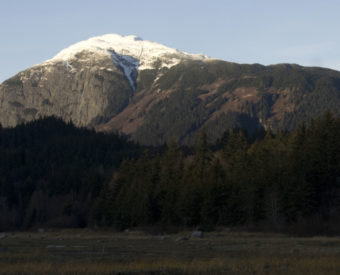
Snow covers Mount Juneau, Sunday, Oct. 16. (Photo by Tripp Crouse/KTOO)

National Weather Service meteorologist Edward Liske said this season is the first-time Juneau has seen measurable snowfall before Fairbanks since about 1940.

The National Weather Service reported Sunday that Juneau is one of the first communities in the state to see measurable snowfall this year.

“Fairbanks has not seen any snow yet so far this season, neither has Anchorage. Nome has had zero. Kotzebue has had zero,” Liske said. “The only place that really has had measurable snow this season has been Barrow with a tenth of an inch so far.”

Liske said Juneau has seen snow earlier in the past. In 1974 and again in 2000, Juneau saw its earliest snowfalls on Oct. 2.

This year, Liske said Juneau saw 2 inches of snow in downtown Sunday, 5 inches near the airport and 8-9 inches at the National Weather Service Forecast Office in the Mendenhall Valley.

The precipitation started as a sudden mix of rain and snow that hit Juneau on Saturday, interrupting what Liske called unusually warm conditions.

“As we started getting heavier and heavier rain, or heavier and heavier (precipitation), it just made the surface temperatures colder and colder to the point that the rain changed over to snow during Saturday evening,” Liske explained.

But, he said the snowy weather was short-lived. It was already reverting to rain Sunday evening.

He predicted Juneau will continue to see warmer and rainier weather through the rest of the week, and the snow will most likely melt.

Before the early snowfall, Liske said an area of high pressure called a ridge surrounded much of Interior Alaska and the Gulf of Alaska giving Juneau uncharacteristically dry October weather.

“That ridge has actually been deflecting a lot of our storm systems that we usually see farther south,” Liske said.

“The storms that the Pacific Northwest has been seeing over the last several days (are) basically those storm systems that have been deflected farther south.”

He said that ridge has mostly collapsed.

Liske also said this entire year has been much warmer than usual for Juneau.

That plus this month’s earlier dry weather, and this most recent early-season snowstorm, has led him to conclude: this year has been “odd to say the least.”

Storm Leaves Thousands Without Power In Pacific Northwest

Waves batter a seawall on Friday in Seattle. The remnants of a typhoon brought rain and wind to the Pacific Northwest on Friday and Saturday. Elaine Thompson/AP
Waves batter a seawall on Friday in Seattle. The remnants of a typhoon brought rain and wind to the Pacific Northwest on Friday and Saturday.
Elaine Thompson/AP

A pair of storms brought strong winds and heavy rain to parts of Washington state and Oregon this weekend.

The National Weather Service reported the remnants of a typhoon caused wind gusts around 50 mph on Saturday evening in Washington state, and heavy rain flooded some roads. More than 25,000 people lost power.

The weather service predicts more rain in the region on Sunday.

Sunday morning, Puget Sound Energy, the major electrical utility for the Seattle region, said crews were still working to restore electricity to tens of thousands of people.

Overnight on Friday, another typhoon-remnant flooded parts of northwest Oregon. The Portland Tribune reported rain and wind delayed trains in Portland and caused the city’s streetcar service to shut down briefly on Friday night.

But the biggest problem was the wind, which the National Weather Service says gusted to 50 mph in Portland and up to 80 mph in some places on the coast. It brought down trees and power lines across northwest Oregon. The Tribune reported 37,000 people were without power on Saturday afternoon, and on Sunday Portland General Electric said electricity still had not been restored to more than 4,200 people.

Both storms were forecast to be more serious than they turned out to be because the National Weather Service initially thought they would hit the coast more directly than they did. On Friday, the National Weather Service office in Seattle issued a warning for damaging winds and heavy rain, and forecast wind gusts of 65 to 70 mph on Saturday for the area around the city.

In preparation for the storm, Seattle’s mayor activated the city’s emergency operations center, and warned residents to “defer traveling during the storm.”

The Portland Bureau of Transportation warned of “flying debris” and recommended that residents cancel unnecessary travel.

On Sunday, some people took to Twitter to point out that the winds in Seattle had not been as strong as predicted, and some expressed frustration that the National Weather Service had not predicted the storm more accurately.

The National Weather Service responded with tweets pointing out the many difficulties of forecasting a storm coming over the ocean, and sharing a map of the storm’s trajectory from the south Pacific all the way to the Pacific Northwest.

Copyright 2016 NPR. To see more, visit http://www.npr.org/.

After Hurricane Matthew, Floodwaters Rise To Record Levels In North Carolina

When Hurricane Matthew lost strength and headed out to sea over the weekend, the storm took its high winds and driving rains with it.

But it left behind water — from the record rains that fell during its trip up the southeastern U.S. coast. And particularly in North Carolina, the long-gone storm has continued to threaten lives as floodwaters rise, sometimes to record levels, flowing over the banks of rivers and threatening dams.

The hurricane killed hundreds of people in Haiti and elsewhere in the Caribbean, and more than two-dozen people in the U.S. have died as a result of the storm, The Associated Press reports.

More than half of those deaths occurred in North Carolina, where rescue operations are still underway.

Early forecasts had predicted that Hurricane Matthew would turn out to sea before causing much damage in North Carolina. But the storm stayed along the U.S. coast for longer than expected, making landfall in South Carolina and bringing torrential rains to both the Carolinas.

A “serious inland flooding event” began immediately, according to the National Hurricane Center, and the consequences are still unfolding as the rainwater flows downriver.

On Monday, volunteers, U.S. marshals and water-rescue crews used helicopters, boats and massive trucks to save people stranded in Lumberton, N.C., after the Lumber River burst its banks, the AP says.

“The rescue teams were expected to be back at work across eastern North Carolina on Tuesday as the deluge rolled downstream toward the Atlantic Ocean,” the wire service writes. “At least three rivers were forecast to reach record levels, some not cresting until Friday.”

On Monday night, President Obama signed a disaster declaration to make federal funds available to help North Carolina cope with the flooding, the AP says.

Jay Price of member station WUNC got a close look at the floods in Lumberton on Monday. He told NPR that he has seen places where the floodwaters were topping the roofs of cars. “You’re dealing with just massive amounts of water,” he said.

In what he called an “ironic juxtaposition,” the sun came out and it was bright and clear in the storm-stricken towns.

“The weather’s great — picture perfect, in fact,” he said. “It’s kind of startling.”

The crisis is far from over. In some cases, the floodwaters aren’t expected to crest until Friday.

“Nobody quite knows how bad it’s going to be in some of these communities, but they know it’s going to be at or close to record levels,” Price says.

He notes that Matthew brought “huge amounts” of rain, topping 15 inches in some areas. And that rain fell on already saturated ground.

“The water just has nowhere to go,” he said. “When I drove in, I was for miles and miles nowhere near any river.

“There were yards [flooded], there were fields flooded. And it was just because the soil was saturated and couldn’t really accept any more water.

“It’s just rising everywhere,” Price said.

Meanwhile, hundreds of thousands of customers across the South still didn’t have electricity. The lights went out for millions of people and businesses after Matthew arrived on the coast. In some cases, it will take weeks to get the power back on, utilities say.

Copyright 2016 NPR. To see more, visit http://www.npr.org/.

Juneau family leaves Orlando on last flight out ahead of Hurricane Matthew

A Juneau family managed to leave Orlando, Florida, roughly two hours before the airport was closed because of approaching Hurricane Matthew.

Ryan Stanley, Laura Hosey and their 10-year-old daughter Meadow said Orlando International Airport was fairly quiet and not at all chaotic when they arrived. The airport was reportedly busier earlier in the day as many flights were canceled ahead of the oncoming hurricane and passengers scrambled to rebook.

Their previously-booked flight departing on Thursday evening turned out to be the last Alaska Airlines flight out of the airport for the day. Passengers applauded as the aircraft lifted off from the runway.

The Stanley family safely arrived in Juneau on Friday afternoon after an overnight stop in Seattle.

The family initially traveled to the East Coast for a business trip that was combined with a stopover at The Wizarding World of Harry Potter in Orlando.


Watch this video of the last Alaska Airlines flight departing Orlando International Airport before it is closed on Thursday evening. Passengers applaud as the aircraft lifts off from the runway and storm clouds are visible in the distance. (Video courtesy Ryan Stanley)

Hurricane Matthew Blamed For 7 Deaths In N.C.; Flood Perils Continue

Chief of Police George Brothers walks along what used to be a four-lane national scenic byway that's now covered in sand after Hurricane Matthew hit the beach community of Edisto Beach, S.C., Saturday. David Goldman/AP
Chief of Police George Brothers walks along what used to be a four-lane national scenic byway that’s now covered in sand after Hurricane Matthew hit the beach community of Edisto Beach, S.C., Saturday.
David Goldman/AP

At least 16 deaths are now associated with Hurricane Matthew, the powerful storm that made landfall in South Carolina as it made its way up the Atlantic coast Saturday. After more than a foot of rain fell in several parts of North Carolina, officials said seven people died from the storm.

“As the sun rises in North Carolina and the blue sky returns, our state is facing major destruction and sadly, loss of life,” Gov. Pat McCrory said Sunday. “This storm is not over for North Carolina.”

Emergency crews in the state had performed 887 swift water rescues by Sunday morning, McCrory said.

Now rated as a post-tropical cyclone, Matthew is moving eastward away from North Carolina, according to the National Hurricane Center. In its 2 p.m. ET update on the storm, the center said Matthew’s center was 150 miles east of Cape Hatteras.

But while work crews are contending with fallen power lines and downed trees, flooding — particularly from swollen rivers — remains a key concern in North Carolina, South Carolina and Georgia, where many waterways that are absorbing torrential rainfall aren’t expected to crest until Monday or Tuesday.

As of early Sunday afternoon, the AP reported, “The death toll in the U.S. climbed to at least 16, nearly half of them in North Carolina.”

Two North Carolina counties — Tar Heel and Bladen — had more than 16 inches of rain, McCrory said in an update as officials took stock of the situation on Sunday. The governor said he has signed an expedited major disaster declaration that’s being sent to President Obama, so that the state can quickly receive federal assistance.

“As of mid-morning Sunday, there were more than 760,000 power outages in central and eastern North Carolina,” according to member station WUNC.

Here are more updates on the storm’s effects:

In South Carolina: “Currently more than 700,000 homes are without power,” South Carolina Public Radio’s Vince Kolb-Lugo reports in Columbia. “Meanwhile, authorities continue to monitor the levels of two rivers, the Waccamaw and Little Pee Dee, which are both expected to rise even more in the coming days.”

In Georgia: “The mandatory evacuation notice along the Georgia coastline is lifted, so residents here can start returning to their homes,” NPR’s David Schaper reports. “But in Savannah, Chatham County Chairman Al Scott is warning them not to just yet, because he says conditions in many areas are still not safe.”

In Haiti, where the storm killed hundreds of people: “A massive relief effort is being mounted for hurricane-ravaged parts of Haiti,” NPR’s Jason Beaubien reports from Port au Prince, “with President Obama urging Americans to give whatever they can.”

Jason adds:

“Aid groups say they’re sending in relief supplies by any means possible including boats, trucks and small planes. The main road linking the capital Port au Prince with the hardest-hit part of the country was initially blocked after Matthew tore across the south of Haiti. Despite a bridge being washed away, trucks from the United Nations and aid groups are now getting across by driving through a shallow point in the river.”

Copyright 2016 NPR. To see more, visit http://www.npr.org/.

U.S. Rushes Aid To Haiti, Where Hurricane Matthew Killed Hundreds

Residents carry a coffin containing the remains of a pregnant woman killed by Hurricane Matthew, in Jeremie, Haiti. People across southwest Haiti are salvaging what they can from wreckage the Category 4 storm caused. Dieu Nalio Chery/AP
Residents carry a coffin containing the remains of a pregnant woman killed by Hurricane Matthew, in Jeremie, Haiti. People across southwest Haiti are salvaging what they can from wreckage the Category 4 storm caused.
Dieu Nalio Chery/AP

As fears are confirmed about the extent of the damage Hurricane Matthew inflicted on Haiti — with a government agency saying 470 people died in one district alone — USAID is airlifting more than 480 metric tons of relief supplies to the small nation.

An official in Haiti’s Civil Protection Agency tells the AP that in addition to the 470 deaths he’s confirmed in one district, “The death toll is sure to go up.”

The U.S. aid agency says it’s sending supplies that could help up to 100,000 people, including 40,000 blankets, 20,000 hygiene kits, and nearly 18,700 kitchen sets. Some of the aid will be delivered by the U.S. Navy.

From Port au Prince, NPR’s Jason Beaubien reports for our Newscast unit:

“Tens of thousands of people remain in shelters after the storm. The USAID shipments includes rolls of plastic sheeting to help people temporarily replace roofs that were ripped away by the Category 4 hurricane.

“The U.S. Navy amphibious transport ship Mesa Verde is also expected to arrive off the coast with 700 sailors and Marines aboard. The Navy plans to use helicopters and landing craft to ferry relief supplies ashore.”

The U.S. Department of Defense’s role in the aid effort comes after Hurricane Matthew crippled access to southwest Haiti and other hard-hit areas, washing out bridges and roads.

The immediate need for food and shelter could mushroom into other needs in the near future. As Jason reported yesterday, “Hundreds of thousands of people had their homes partially or totally destroyed. Crops have been wiped out.”

And as NPR’s Rebecca Hersher reported for the Two-Way this week, “Amidst the flooding, the specter of a spike in cholera cases has aid organizations worried that the physical destruction of buildings could be just the beginning of Matthew’s deadly effects in Haiti.”

Rebecca also noted that Hurricane Matthew has forced another delay in Haiti’s already-delayed presidential election.

Copyright 2016 NPR. To see more, visit http://www.npr.org/.
Site notifications
Update notification options
Subscribe to notifications