Weather

Hurricane Stays Offshore As It Moves Up Florida’s Coast, Nears Georgia, Carolinas

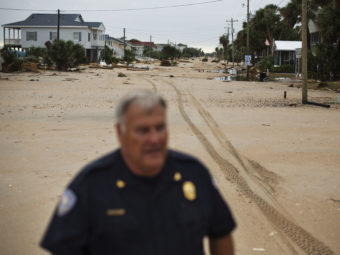
Hurricane Matthew is traveling north along the Florida coastline with sustained winds of 120 mph and gusts up to 150 mph — but the most powerful winds primarily stayed offshore, sparing the coast from the worst-case-scenario damage.

The Category 3 storm, even at a distance, has had gusts on land of more than 100 mph, causing power outages for more than 1 million customers as of 3 p.m. ET, according to the office of Florida Gov. Rick Scott.

Storm surge flooding remains a threat even as the hurricane skirts the shore. And forecasters emphasize that the powerful storm could easily move a few miles west, with devastating consequences.

“We have been very fortunate that Matthew’s category 3 winds have remained a short distance offshore of the Florida Coast thus far,” the National Hurricane Center says, “but this should not be a reason to let down our guard. Only a small deviation to the left of the forecast track could bring these winds onshore.”

If you want a close look at what, exactly, southern Florida managed to dodge, NOAA Hurricane Hunters flew a plane right through the eyewall and into the eye of the storm.

That eyewall — where the strongest winds are — has brushed against the Florida coast and will be traveling “over or very near” northeastern Florida and then Georgia later today.

On Saturday, Hurricane Matthew will pass parallel to the South Carolina coast. Initial forecasts projected the storm would affect the southern section of the state; hurricane warnings are now in effect for the entire South Carolina coastline as well as parts of North Carolina.

Throughout that area, the National Hurricane Center warns of a dangerous storm surge and potentially life-threatening inundation levels, in addition to the risk of hurricane-force winds.

The storm is not expected to weaken significantly over the course of Friday afternoon, and even when it begins to lose strength, it is anticipated to remain a hurricane for its entire journey up the coast.

President Obama addressed reporters after being briefed by emergency chiefs at FEMA headquarters. “This is something to take seriously,” he said, advising people in evacuation zones to move inland. “We hope for the best but we want to prepare for the worst.”

Obama has declared a state of emergency in several states, to allow federal funds to be used for disaster relief.

As NPR reported yesterday, millions of people were ordered or advised to head inland as state governors issued strongly worded evacuation orders.

Forecasters emphasized that the storm would be traveling along the coast in such a way that a small deviation could either send it directly onto land or out to sea, making it difficult to predict outcomes. Given the strength of the storm, if the eyewall hits land it could have historic consequences.

Thousands of flights in the region have been canceled, and Amtrak has suspended some routes. Cruise ships have changed their schedules too — in some cases, resulting in longer trips, The Associated Press reports.

The AP notes that according to forecasters, rain and storm surge may be more dangerous than the eye-popping wind speeds at the center of the storm: “They said the major threat to the Southeast would not be the winds — which newer buildings can withstand — but the massive surge of seawater that could wash over coastal communities.”

Hurricane Matthew killed hundreds of people in the Caribbean — mostly in Haiti, where the full extent of the devastation is still being evaluated.

Copyright 2016 NPR. To see more, visit http://www.npr.org/.

Millions Of Coastal Residents Warned To Flee Inland As Hurricane Nears Florida

People bike on the beach ahead of Hurricane Matthew in Atlantic Beach, Fla., on Wednesday. Droves of people in the U.S. have begun evacuating coastal areas ahead of the storm, which tracked a deadly path through the Caribbean in a maelstrom of wind, mud and water. (Photo by Jewel Samad/AFP/Getty Images)

For Florida residents who think they can ride out Hurricane Matthew, Gov. Rick Scott has just three words:

“Evacuate, evacuate, evacuate.”

“There are no excuses. You need to leave,” he said on Thursday morning. “This storm will kill you. Time is running out.”

Along the coast in Florida, Georgia and South Carolina, millions of residents have been urged to head inland as the powerful hurricane makes its approach.

The storm is strengthening as it batters the Bahamas and moves toward Florida, the National Hurricane Center says. As of late Thursday morning, the storm is a Category 4 that’s expected to near the Florida coast late Thursday and early Friday, the agency forecasts.

Dozens of people died as the storm tore through Haiti, Cuba and now the Bahamas, including at least 23 dead in Haiti alone.

In Florida, more than 3,000 people were already in shelters as of Thursday morning, The Associated Press says. More than 1.5 million people in the state have been “urged or ordered to leave the coast,” the wire service wrote.

Hospitals and a nursing home near Daytona Beach are transferring patients and residents to facilities farther inland, the AP says.

Not everyone is retreating from the coast: One resident of Cape Canaveral told the AP he plans to ride out the storm in his RV less than a mile from the shore. “The hype is going to be worse than the actual storm. I feel I can do quite well,” he said.

Scott exhorted any Floridians thinking similarly to change their minds immediately. “If you’re reluctant to evacuate just think of all the people this storm has already killed,” he said. “You and your family can be among these numbers if you don’t take this seriously. ”

He warned of winds between 100 and 150 mph, capable of taking down even well-built houses. “No one should take any chances,” he said.

In Georgia, where the coastline is relatively short, Gov. Nathan Deal is urging more than 500,000 people to evacuate — the first time the state’s coast has been evacuated in 17 years, the AP reports.

Many residents are under voluntary evacuation orders, but mandatory evacuation has been ordered east of Interstate 95 in all six counties — an area that includes the city of Savannah. Lanes of traffic on Interstate 16, the major east-west corridor leading to Savannah are being reversed so traffic flows only westward, the Atlanta Journal-Constitution reports.

Tens of thousands of people on Tybee Island and in low-lying communities had already been ordered to head inland, The Journal-Constitution said.

In South Carolina, some 1.1 million people have been urged to leave their homes, The Post and Courier reports.

South Carolina Gov. Nikki Haley has said she’ll call for more evacuations if necessary, our Newscast unit reports.

South Carolina state troopers (right) lead the first wave of cars evacuating on the reverse lane of Interstate 26 on Wednesday, as the state prepares for Hurricane Matthew. (Photo by Mic Smith/Associated Press)

Haley had already taken the unprecedented step of ordering all lanes of Interstate 26 in South Carolina to travel west out of Charleston. The idea for the lane reversal was developed after Hurricane Floyd in 1999, which caused massive congestion as the interstate was packed with fleeing coastal residents.

So far, there haven’t been reports of excessive congestion in South Carolina. But an altercation between police and a motorist over evacuation routes resulted in the exchange of gunfire late Wednesday, leaving the motorist injured, the AP reports.

Floyd, the storm that caused such memorable traffic jams, ultimately veered away from South Carolina and left relatively little damage in the state. Haley told residents that it was still possible that Matthew, too, would shift away, but that based on current forecasts, residents should travel at least 100 miles from the coast.

“If you don’t get out in time, then you might get stuck,” Haley said, according to the Post and Courier. “I think that’s the worst-case scenario.”

On Thursday morning, Haley said some 175,000 South Carolinians had evacuated so far. “That’s not enough,” she said, according to The State.

Governors in all three states have declared a state of emergency in coastal regions. Meanwhile, more than 2,600 flights have been canceled in anticipation of the storm, FlightAware reports.

Matthew’s arrival near northern Florida and Georgia could pose an unusual threat, Bob Henson writes for Weather Underground. Northern Florida and Georgia rarely see major hurricanes — Category 3 or stronger — and so communities there are less experienced with coping with such strong storms.

“The most recent major hurricane along the Georgia coast was in 1898,” he writes.

The last Category 3 or higher to hit the U.S. at all was Wilma in 2005, the AP notes — the storm struck in southwest Florida and killed five people.

Whether Matthew will actually make landfall is unclear. The National Hurricane Center explains that the storm is “forecast to take a track roughly parallel to the coastline.” That means a “very small deviation” could cause landfall along the coast — or, alternately, send the storm offshore.

The AP explains that the eye of the storm doesn’t need to cross over land to be dangerous and destructive. “In some ways, the worst case scenario would be if the storm’s eye stays just offshore, enabling it to feed over water and avoid weakening while its strongest hurricane winds keep smacking the beaches,” the wire service reports, citing a University of Miami meteorology researcher.

As the Two-Way reported yesterday, Matthew had a devastating impact in Haiti, washing out roads and raising concerns that the country’s cholera crisis could grow even worse.

Copyright 2016 NPR. To see more, visit http://www.npr.org/.

In Haiti, slow revelations about the scale of Hurricane destruction

People help each other across the river La Digue in Petit Goave, Haiti, on Wednesday, a day after Hurricane Matthew raked the island nation. (Photo by Hector Retamal/AFP/Getty Images)

The wind ripped roofs off buildings. It flattened trees. It snapped power poles.

The rain, in some places more than 2 feet of it, washed out bridges and flooded entire communities, cutting people off as it drowned their homes.

Two days after Hurricane Matthew made landfall in southwestern Haiti as a Category 4 storm, the extend of the destruction in the hardest hit parts of the country is still unclear, NPR’s Jason Beaubien reports from the capital, Port-au-Prince. “Aid groups still don’t know the exact number of people who need new homes, need new roofs [or] who are actually even dead or missing'” he says.

Dozens of people have died across the Caribbean as a result of the storm. The Haitian civil protection service says at least 23 people in Haiti are confirmed dead, 25 are injured and 2 are missing so far, and those numbers are expected to rise.

A photo taken Wednesday shows the river La Digue southwest of the capital, Port-au-Prince, where the storm caused the collapse of a bridge on the only road linking the capital to Haiti's southwest. (Photo by Hector Retamal/AFP/Getty Images)
A photo taken Wednesday shows the river La Digue southwest of the capital, Port-au-Prince, where the storm caused the collapse of a bridge on the only road linking the capital to Haiti’s southwest. (Photo by Hector Retamal/AFP/Getty Images)

“Communication out of [the southwest] has been really difficult because many of the cell towers went down, and many people just don’t have electricity,” Beaubien reports.

In the capital, a main priority is repairing a bridge that collapsed on National Route 2, which is the only road linking the capital to the southwest, according to a spokesman for the civil protection service.

Until the bridge is repaired, the main way for supplies and relief workers to get from Port-au-Prince to the areas that took the brunt of the storm’s force is by helicopter or ship.

Haiti’s de facto president, Jocelerme Privert, flew over the southern part of the country on a U.S. Coast Guard plane with the U.S. ambassador to Haiti, Peter Mulrean, on Wednesday.

Hurricane Matthew caused vast destruction in Jeremie, Haiti. Dozens of people have died across the Caribbean as a result of the storm. The country's civil protection service says at least 23 people in Haiti are confirmed to have died. (Photo by Carlos Garcia Rawlins/Reutes)
Hurricane Matthew caused vast destruction in Jeremie, Haiti. Dozens of people have died across the Caribbean as a result of the storm. The country’s civil protection service says at least 23 people in Haiti are confirmed to have died.
(Photo by Carlos Garcia Rawlins/Reutes)

“One of the key things that came out of that flyover … was that they need to identify where they can even get in and land helicopters,” says Beaubien.

U.N. peacekeepers who had already been stationed in Haiti spent Wednesday trying to clear local roads around the capital, he reports. The U.S. Navy has dispatched three vessels, including the USS George Washington aircraft carrier, to help with the relief effort in the Caribbean.

Men push a motorbike through a flooded street in Leogane, Haiti. U.N. peacekeepers already in Haiti spent Wednesday trying to clear local roads around Port-au-Prince. (Photo by Dieu Nalio Chery/Associated Press)

Among the buildings damaged or destroyed by the Hurricane were some that were to serve as polling places in Haiti’s long-delayed presidential election, which had been scheduled for Sunday, according to the head of Haiti’s provincial electoral council.

On Wednesday, the council announced the vote would be postponed and did not say when it would be rescheduled.

Amidst the flooding, the specter of a spike in cholera cases has aid organizations worried that the physical destruction of buildings could be just the beginning of Matthew’s deadly effects in Haiti. The waterborne disease has killed thousands of people since it was introduced in Haiti by U.N. workers in 2010.

A boy pumps water close to his family's flooded home in Leogane on Wednesday. (Photo by Hector Retamal/AFP/Getty Images)
A boy pumps water close to his family’s flooded home in Leogane on Wednesday. (Photo by Hector Retamal/AFP/Getty Images)

“A lot of our assistance is going to focus on water and sanitation, which is probably the primary means of inhibiting the spread of cholera,” Dave Harden of the U.S. Agency for International Development told reporters on Wednesday. “We will also get plastic sheeting and shelter kits out there available as needed to the most vulnerable people, and this too will help create a hygienic environment.”

Elsewhere in the Caribbean, other island nations were also assessing the damage from Hurricane Matthew. Images from the Dominican Republic, Haiti’s neighbor to the east, images showed streets flooded and neighborhoods underwater.

Streets were inundated in a neighborhood in Santo Domingo, Dominican Republic, on Tuesday. Hurricane Matthew dumped rain across the island of Hispaniola, which is split into the Dominican Republic in the east and Haiti to the west. (Photo by Erika Santelices/AFP/Getty Images)In Cuba, the National Hurricane Center said as much as 20 inches of rain had fallen in some eastern areas, and warned that “life-threatening flash floods and mudslides are likely in central and eastern Cuba.”

In the Bahamas, high winds and torrential rain battered Nassau on Wednesday. The National Hurricane Center said Thursday morning that a hurricane warning was in effect for the central and northwestern Bahamas, and that the outer bands of the storm were already approaching Florida.

Copyright 2016 NPR. To see more, visit http://www.npr.org/.

Hurricane Matthew Looms As A Category 4 Storm

Forecasters expect Hurricane Matthew to pass between Jamaica and Hispaniola before hitting parts of Cuba and the Bahamas. NHC/NOAA
Forecasters expect Hurricane Matthew to pass between Jamaica and Hispaniola before hitting parts of Cuba and the Bahamas.
NHC/NOAA

It may weaken somewhat as it spins in the Caribbean, — but forecasters still say that Hurricane Matthew will likely bring winds topping 100 mph when it makes landfall. Parts of Haiti, Cuba and Jamaica are on alert, as Matthew’s maximum sustained winds were measured at 140 mph Saturday afternoon.

Hurricane conditions could hit Jamaica and Haiti by Monday, with tropical storm conditions possible by late Sunday, the National Hurricane Center says. It adds that hurricane conditions could also hit eastern Cuba by Monday night.

Matthew strengthened into a category 5 storm at the end of the week before weakening somewhat Saturday; the NHC’s forecasters say the storm is “expected to remain a powerful hurricane through Monday.”

Citing data from an Air Force Reserve Hurricane Hunter aircraft, the weather agency said that as of Saturday morning, Matthew’s maximum sustained winds were near 145 mph, with higher gusts.

A satellite image shows Hurricane Matthew's location around midday Saturday. The storm is expected to move to the north and northwest. NOAA
A satellite image shows Hurricane Matthew’s location around midday Saturday. The storm is expected to move to the north and northwest.
NOAA

The hurricane center’s Robbie Berg says Matthew is expected to “remain a very dangerous major hurricane” as it moves to the northwest and north across the Caribbean, through at least Monday.”

Forecasters say while Matthew is expected to experience some gradual weakening over the next 24 hours, “conditions appear conducive for restrengthening once Matthew moves into the Bahamas” after the storm passes the islands of Jamaica, Hispaniola, and Cuba.

Copyright 2016 NPR. To see more, visit http://www.npr.org/.

Weather service issues high wind warning for early Friday

Wind spins a turbine at Coast Guard Station Juneau, Sept. 29, 2016. The Goldbelt Mount Roberts Tramway is visible between the blades. (Photo by Jeremy Hsieh/KTOO)
Wind spins a turbine at Coast Guard Station Juneau on Thursday. The Goldbelt Mount Roberts Tramway is visible between the blades. (Photo by Jeremy Hsieh/KTOO)

The National Weather Service is forecasting 40 mph winds with gusts up to 70 mph beginning early Friday.

The service has issued a high wind warning for downtown Juneau and Douglas in effect from 1 a.m. to 4 p.m. Friday.

Winds of that speed can uproot trees, knock branches down and damage property, including vessels and aircraft moored and tied down outdoors.

Alaska Electric Light and Power spokeswoman Debbie Driscoll said the electric utility is ready for outages.

“We’re basically prepared 365 days a year, so we have crews available to respond to any issue that comes up, 24 hours a day. However, in this case, what we do is we alert the duty engineer that’s expected to be on this evening and then we notify our Thane operation center and we make sure our line crew is aware of the high wind warning.”

Nonetheless, Driscoll suggests people keep an outage kit on hand, with items like a battery-operated radio, fully charged cell phone and warm blanket in case of an outage.

To report outages, call the utility’s after hours line at 586-AELP. The utility also takes outage reports and posts updates online at its website, as well as its Facebook and Twitter accounts.

Gardentalk – Preparing for Jack Frost’s arrival

Hoar frost accumulates on grass, leaves and other vegetation in this picture taken on Douglas Island in November 2014.
Hoar frost accumulates on grass, leaves and other vegetation in this picture taken on Douglas Island in November 2014. (Photo by Matt Miller/KTOO)

Southeast Alaska gardeners, of course, have noticed temperatures dropping overnight, raising anxiety and concerns over possible frost damage to their flowers and late season vegetables.

Juneau gardeners nearest the Mendenhall Glacier are expected to experience the first frost of the season before other Juneau residents.

“If you look out at night, it’s 35 degrees, and it’s clear at 7 o’clock at night, you can be pretty much be assured it’s going to freeze at night,” said Master Gardener Ed Buyarski.

Buyarski says there are several things that gardeners can do to minimize or preclude any frost damage to tender flowers like dahlias, begonias and fuschias.

Garden vegetables like tomatoes, zucchini and potatoes are also vulnerable to colder temperatures.

Buyarski recommends placing tarps or blankets over the plants to provide a layer of heat protection. It may be a good idea to elevate the blankets and tarps so that plants don’t get frosted by physical contact.

He doesn’t recommend using clear or thin plastic sheeting since it will not offer any real heat protection.

For potatoes, Buyarski recommends cutting the vines off at ground level and cover the garden bed with a tarp or plastic to shed the rain and allow the potatoes to cure in the soil.

Another common technique is filling up buckets with water so that they act as a heat sink.

“It takes a lot more cold to freeze the bucket of water,” Buyarski said. “If you’ve got several of them between your tender plants, then that too will protect them from freezing until the water freezes.”

Potted plants that are still blooming, particularly those with brittle stems, should be moved closer to the house where they would be sheltered from the heavy wind and rain.

Listen to the September 22 edition of Gardentalk on fall frost protection:


Site notifications
Update notification options
Subscribe to notifications