Alaska Native Government & Policy

Historic agreement gives Kuskokwim tribes say in fish management

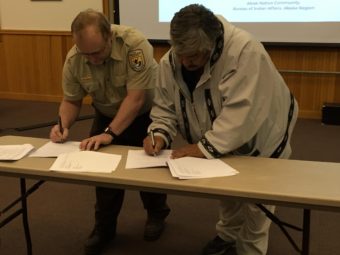
Chair Mike Williams Sr. signs the MOU with USFWS Yukon Delta Refuge Manager Ray Borne. (Photo by Charles Enoch/KYUK)

The Kuskokwim River Inter-Tribal Fish Commission signed a historic memorandum of understanding, or MOU, with the U.S. Fish and Wildlife Service. The agreement is the first formalization of co-management between the Alaska tribes along the Kuskokwim River and the federal government.

The full Kuskokwim River Intertribal Fish Commission, made up of representatives from village tribes all along the Kuskokwim, gathered at the Cultural Center in Bethel to take part in the Commission’s annual meeting, including the signing of the memorandum of understanding. Mike Williams Sr. of Akiak is the Chair of the commission.

“I’m really excited about the MOU, to work formally with the USFWS and the KRITFC, to make sure that our people have enough to eat and that we have enough escapement of our king salmon and salmon upriver,” Williams said.

Partners in the MOU include the U.S. Fish and Wildlife Service, the Alaska Department of Fish and Game, the Association of Village Council Presidents, and the Tanana Chiefs Conference.

The Commission was formed in May 2015 following an initiative presented by Deputy Secretary of the Department of Interior Mike Connor at the 2014 Alaska Federation of Natives Convention. Conner’s initiative calls for federal managers to integrate tribes into the management of Kuskokwim salmon fisheries in federal waters. The MOU is the first part of a two-part project called the “Partnership Project.”

The second part of the project is the creation of a detailed management framework. The Commission has brought forward a proposal to be discussed by the Commission, the Kuskokwim River Salmon Management Working Group, the Alaska State Office of Subsistence Management, and the U.S. Fish and Wildlife Service.

Since managers forecast a better king run this year, the management framework includes a proposal by the Intertribal Fish Commission for a subsistence harvest of 40 thousand king salmon, over 20 thousand more than last year.

According to the MOU the Yukon Delta Wildlife Refuge manager, based at the Refuge headquarters in Bethel, will consult with the Commission before making management decisions for the Kuskokwim salmon fishery in federally managed waters. Commission member Greg Roczicka said they will try to integrate state managers into the plan.

“And they have not developed the management plan yet, they have said they wanted to have a ‘blended management,’ and they came out with the idea that their blended management would say that they’ll limit it to federally qualified users and let the state manage all the openings and closings. The state does not have the options for calling what some might say is an allocation or to the harvest shares that we’re trying to get equitably, federal does.”

The commission expects to hear back from federal managers on the proposal by Wednesday this week.

New tribal court programs aim to reduce recidivism

Youth Wellness Court held a meeting on XX to hear feedback from the community. Next, it will appoint members to an advisory board. (Photo by Elizabeth Jenkins/KTOO)
Youth Wellness Court held a meeting in April to hear feedback from the community. Next it will consult with elders and appoint an advisory board. (Photo by Elizabeth Jenkins/KTOO)

Two new tribal court programs are getting off the ground at Central Council Tlingit and Haida Indian Tribes of Alaska. They’re focused on reducing recidivism.

At the Elizabeth Peratrovich Hall,  a framework is being created.

It’s part of a larger conversation to identify what’s holding some people back from reaching their potential. Namely, things such as childhood trauma, unstable home lives and a disconnect from culture.

Colleen Belardi is one of the coordinators at Central Council’s Youth Wellness Court. She said the program is still being developed.

“What we do know is that we would like to intervene with youth in the court system … and also kids who may be at risk of becoming involved in the court system,” Belardi said.

The juvenile court could take the shape of therapeutic court or family conferencing. It’s funded by a 3-year $550,000 grant from the U.S Department of Justice. But they want to make the program sustainable.

Belardi said mentorship will play a key role.

“We want to teach them traditional ways — putting up food, carving, what is it to have an elder in your life and what does that mean to have an elder in your life.”

Elizabeth Peratrovich Hall is the new location of Central Council's tribal court. (Photo by Elizabeth Jenkins/KTOO)
The Andrew Hope Building is the new location of Central Council’s tribal court, which is located on the third floor. Elizabeth Peratrovich Hall is on the first floor. (Photo by Elizabeth Jenkins/KTOO)

A different program aimed at helping adult offenders is also underway.

Tribal Judge Debra O’Gara said the program primarily handles family law, but soon it will also be able to sentence some criminal cases.

State court judges reached out to the tribe, O’Gara said. Central Council signed an agreement with the state in April.

Defendants who plead guilty or are found guilty will be able to have their cases transferred to Central Council. From there, they’ll go through circle sentencing.

“We will have more time to delve into what is causing (them) to do this criminal behavior,” O’Gara said. “We’ll also have more time to inform the defendant as to what the effect their behavior has had on their family or what effect (it’s) had on their family or anybody who is harmed by that behavior.”

O’Gara said four other tribes up north have had success with the program. Eventually, Central Council wants to offer circle sentencing in other Southeast tribal courts.

Typically in the state court system, she said, the prosecutor or the judge have no connection to the defendant.

“Whereas in tribal court, we’re going to have family members and members … of their own tribe there, and often their grandma or grandpa or aunts or uncles or parents or siblings are going to be there in the court and have to explain why they’re doing what they’re doing.”

O’Gara says criminal behavior can sometimes be linked to poverty, childhood trauma or substance abuse. Depending on the case, the sentencing outcome could be job training or treatment — recommendations which will be sent back to the state.

The adult program could start up by the end of summer. O’Gara says she hopes it brings healing.

Editor’s note: A photo caption incorrectly stated the new location of the tribal court is at Elizabeth Peratrovich Hall. It’s actually located on the third floor of the Andrew Hope building, which also houses Elizabeth Peratrovich Hall. 

Tlingit leader remembered for land claims role

John Borbridge Jr. speaks at a 2011 Native American Heritage Month luncheon. (Photo courtesy Tlingit Haida Central Council)
John Borbridge Jr. speaks at a 2011 Native American Heritage Month luncheon in Juneau. (Photo courtesy Tlingit Haida Central Council)

Tlingit leader John Borbridge Jr. died Tuesday. He was a significant player in the campaign for Alaska Native land rights.

Borbridge was a teacher and coach in Juneau and Sitka before being drafted in 1965 to lobby for aboriginal interests in Washington, D.C.

He went on to head up the Alaska Federation of Natives and the Central Council of Tlingit and Haida Indian Tribes of Alaska.

In a 2011 address, Borbridge stressed that the Alaska Native Claims Settlement Act was about much more than creating corporations.

“It is the story of the people who are members of the tribe beginning to understand the extent and nature of their rights and the rights that they have asserted through their predecessors,” he said.

In the late 1950s, Tlingits and Haidas won partial compensation from the federal government for the land they lost when the Tongass National Forest was created.

Tlingit Haida Central Council President Richard Peterson said Borbridge led the charge to include all tribes in the next Congressional battle.

“During the original talks for the Alaska Native Claims Settlement Act, there was a lot of desire from other regions to leave Southeast out because they felt like we’d already been dealt with. … I know he worked to make sure we were included,” he said.

In his address, at the University of Alaska Fairbanks, Borbridge said he knew tribal members needed more than money.

“We wanted land. That was the dream I had for our people. Land. It is cruel to be living in the midst of beautiful land, land that belonged to the Forest Service, belonged to the state of Alaska or territory of Alaska,” he said.

Once the claims act became law, Borbridge chaired the board of directors of Sealaska, the regional Native corporation for Southeast.

Longtime board member Albert Kookesh said Borbridge was impressive, but calming.

“I talked to people who he coached at Sheldon Jackson and at Juneau-Douglas High School and he never raised his voice.  And that’s what happened at the Sealaska board room, too,” said Kookesh, a former state senator.

“He was very persuasive and such a great speaker. When he presented a proposition to the board, it was thorough, it was thought out and he was very articulate,” he said.

Other Sealaska officials referred to his authentic voice and organizational abilities.

Borbridge was also the first full-time president of the Tlingit Haida Central Council, building programs and hiring staff starting in 1967.

Current President Peterson said he’ll be badly missed.

“As with any of our elders, you lose that piece of history, that resource you can turn to and talk about why we did what we’ve done and why it’s important to what we do today,” he said.

There’s no word yet about services.

Editor’s note: This report was updated with comments from Albert Kookesh and a new photograph.

Can teaching Native languages improve graduation rates in Alaska?

This is first time UAS has had graduates with a Bachelor of Liberal Arts in Alaska Native Languages and Studies. (Photo by Lisa Phu/KTOO)
The University of Alaska Southeast graduated its first Alaska Native Languages and Studies majors in 2014. (Photo by Lisa Phu/KTOO)

Many of Alaska’s rural schools are not working. Low student performance and high teacher turnover are just two of more obvious indicators of problems in these mostly Native school districts. Those working in the schools say it’s time for radical changes.

Paul Berg has taught in Alaska for more than 40 years — 10 of them in villages.

“You want to see racism go to a village school,” said Berg. “You’ll see Outside, usually Anglo teachers have the best jobs, the most pay. Vast majority of administrators will be Anglo. It is not working. The statistics and the data are very clear. ”

Berg, now 70, teaches high school students during the summer and works as a cross-cultural specialist for the Goldbelt Heritage Foundation. He, among other educators meeting this month at the University of Alaska’s Natives Studies Conference, describes schools as colonial forces not that much different from the boarding schools of years ago that punished Native children for speaking their languages.

“Education is the means whereby a culture perpetuates itself and transfers itself to the young. Public education has taken this away from the Yupik, the Inupiat, the Aleut and others and given basically middle-class America to these people,” said Berg. “As to the degree that they wish that… that should be their choice but they should have the inalienable undeniable right to transfer the culture and the language to their children. It’s called the right of culture sovereignty and English-speaking nations are among the last on earth to recognize it.

Xh'unei Lance Twitchell addresses the crowd that had gathered for the signing of HB 216, a bill making Alaska's Native languages official state languages. (Photo by Jennifer Canfield/KTOO)
Xh’unei Lance Twitchell addresses a crowd at the 2014 Alaska Federation of Natives Convention. At the event, Gov. Sean Parnell signed HB 216, a bill making Alaska’s Native languages official state languages. (Photo by Jennifer Canfield/KTOO)

“My prayer is that Tlingit is going to live forever because we want our little babies to be talking,” said Xh’unei Lance Twitchell.

He is using every means possible to make sure his children speak his Native language. He speaks Tlingit to them instead of English, knowing that the media environment will make sure they learn English. He wants bilingual and Tlingit immersion schools. He sees the shortfall in state education funds as an opportunity, because it prompts many to ask the question — why keep spending lots of money on a system that doesn’t work?

Diane Hirshberg is the director of the University of Alaska Anchorage Center for Education Policy Research. She has studied the indigenous education systems throughout the world to find out which were successful, and why.

“So we’re talking from Maori students to Greenlandic students to Hawaiian to lower-48 American Indian. And it is really clear that ownership of the schools, some degree of self-determination is necessary,” said Hirshberg. “It’s not sufficient. It’s not enough but it’s how you get started.”

Hirshberg joins many Alaska Natives in advocating that the state help tribes access federal Indian Education funds to support Native schools. They argue it’s time to spend money on something that works.

“I don’t know to what extent the state is willing to say, ‘Well, it’s OK. You can get this other funding, legally it’s allowed. Maybe you should take this on. You know, it relieves the pressure,’” said Hirshberg. “The state constitution says we must provide an education, but if those students are receiving the education from a voluntary tribal run system that is paid from outside, is the state willing to set up the conditions for that to happen?”

Natives living in rural Alaska say they need successful schools teaching their children Native language and traditions. Rayna Hartc, whose mother’s family is Yupik, says failing to provide such an education is not an option.

“The failure to educate a child in our area isn’t just that the child doesn’t get an education. For us it very often becomes a civil rights issue, a human rights issue because many of these children don’t fit in and they don’t belong and lead to … to suicide,” said Hartc. “This isn’t an educational issue. This is the right of a child to have a vibrant and viable future.”

Rayna Hartc is acting superintendent at the Yupiit School district.

U.S. will not support ban on international trade of polar bear products

Polar Bears (Photo by Atwell Gerry, U.S. Fish and Wildlife Service)

The United States will not support an international ban on the trade of polar bear products at an upcoming meeting on endangered species.

In a statement released last week, the U.S. Fish and Wildlife Service said it remains concerned about the commercial use of polar bear hides, but it said it won’t encourage the ban.

“We are putting our resources into working in collaboration with other polar bear range states to address climate change and mitigate its impacts on the polar bear as the overwhelming threat to the long-term future of the species,” the agency said in its statement.

Inuit leaders and organizations from Canada have been lobbying the U.S. for the last year. Polar bear sport hunting is an important industry to the Inuit economy.

Polar Bear sport hunting has not been legal in the U.S. since the passage of the Marine Mammal Protection Act in 1972.

Delegates from across the globe will meet in South Africa this fall at the Convention on International Trade in Endangered Species of Wild Fauna and Flora, or the CITES Conference.

The 2013 CITES Conference was the last time the U.S. attempted to ban the international trade of polar bear products. Forty-two countries voted against the ban, and 38 voted in favor of it.

Central Council seeks revenue to expand programs

Richard Peterson, Tlingit-Haida Central Council president, addresses the closing banquet during April's 81st tribal assembly in Juneau. (Photo courtesy Tlingit-Haida Central Council)
Richard Peterson, Tlingit-Haida Central Council president, addresses the closing banquet during April’s 81st tribal assembly in Juneau. (Photo courtesy Tlingit-Haida Central Council)

Southeast Alaska’s largest tribal organization wants to expand its service programs. Part of the effort could be funded by profits from a business it’s about to purchase.

The Central Council of Tlingit and Haida Indian Tribes of Alaska lists more than 33,000 members.

President Richard Peterson said some don’t get enough attention.

“We divide ourselves and say, ‘They live in Seattle. Why should we serve them?’ Or ‘They’re living in the village. Why do we care?’ We are Tlingit and Haida people. That’s why we care,” he said.

Programs include financial assistance, child care, occupational training, vocational rehabilitation and case management.

But Peterson said most programs reach only part of Southeast Alaska. He and other Central Council officials want that to change.

“We need to create our own income, our own revenue streams that allow us to do what we want with our funds and serve who we want with our funds, wherever they live.”

That income would come from a business purchased by the council.

Richard Rinehart of the Tlingit Haida Tribal Business Corp. said one was identified, but it didn’t meet the corporation’s goals.

“The board wanted something that was more strategic, something that had more possibilities for growth in the future. And we were able to find one that is national in scale, they have a national presence, and that we believe we can grow, double (or) triple the size in a relatively short period of time,” Rinehart said.

He said that growth would come because a Native-owned, small business gets a preference when bidding for federal contracts. Many Alaska Native corporations use what’s called the 8(a) program to raise revenue.

Rinehart wouldn’t identify the business because of a non-disclosure agreement with the seller. He said an announcement could come this month.

Central Council President Peterson said goals include improved services to veterans and turning its vocational training program into a tribal college.

He also said it’s time to expand Tlingit language programs to include Haida and Sm’álgyax, the Tsimshian language.

“We have to hold each other up. We can’t say this language versus that language. We have to have equality there,” he said.

The Tlingit-Haida Central Council gained authority in March over foster care and some other state services for Native children in the region.

Peterson told tribal assembly delegates that’s an important step toward sovereignty.

“Our families are hurting. They’re broken. The power isn’t in the state to restore our families. It’s within us. And we need them to get out of our way to do so,” he said

The new authority will help the council place Native children in Native foster homes. A separate court decision told the state to recognize child support orders issued by tribal courts.

Site notifications
Update notification options
Subscribe to notifications