Alaska Native Government & Policy

Scholarship program boosts training for Alaska Native teachers

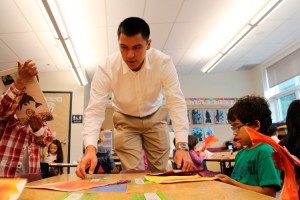
Juneau’s Joshua Jackson earned both Bachelor’s and Master’s degrees in Education in the PITAAS program. (Photo courtesy of UAS)
Juneau’s Joshua Jackson earned both bachelor’s and master’s degrees in education in the PITAAS program. (Photo courtesy of UAS)

While 15 percent of the state’s population is Alaska Native, fewer than 5 percent of its teachers are.

To address this imbalance, the U.S. Department of Education and the University of Alaska Southeast have teamed up to create a scholarship program to groom future teachers and administrators while they’re still in college.

When children think about what they want to be when they grow up, many things would top the list above teacher. But there are exceptions.

Ronalda Cadiente-Brown says teaching can be really appealing to those of us who had good early experiences in education.

“I would venture to guess that if you asked anyone about their experiences in education … you would have an answer. As well as if you asked, ‘Who was your least favorite?’ you would have an answer. Everyone has that experience.”

Cadiente-Brown is the director of Preparing Indigenous Teachers & Administrators for Alaska Schools — or PITAAS. It’s part scholarship program, part support network for helping Native students find success training for a challenging career.

“Oftentimes if they’re coming from a rural area, they’re feeling the heartstrings to be home. Life goes on, and the challenges of dealing with tremendous loss and grief while they’re a student. I’ve seen students step away for a year to get their footing, and return back. So there are a lot of different pathways that are unique to any individual.”

PITAAS is funded by the U.S. Department of Education, but it’s a competitive program. Cadiente-Brown says she accepts about 10 students a year. Applicants have to have been in college for at least two years, with a 3.0 minimum grade-point average. Education majors, though, can enroll as freshmen. Some of her students are already in graduate school.

She says she’s seen a dramatic shift toward acceptance of cultural traditions, since when her mother was in school. Students no longer have to leave their cultural identities at the door.

“And our work today is really about helping to restore that identity. And colleges play a role in that as well. Look at some of the programming that’s available today. You have Native languages being taught in higher education, which is very different from washing it out of an individual.”

Cadiente-Brown was an assistant principal — and later principal — of Juneau’s alternative high school. Her transition to administration came after earning a master’s degree at Stanford. A Tlingit, she says she often encountered Native students who couldn’t quite wrap their heads around her success. Just her presence would turn around their expectations. And low expectations, she says, were rampant in our public schools.

“Probably the most criminal aspect that I saw was low expectations of Alaska Native students. And kids know it. When I worked with high school students they would again and again share that teachers just don’t care.”

Cadiente-Brown herself could have gone down a much different path. Her generation straddles the line between cultural barriers to success and the opportunity that programs like PITAAS now provide.

She says her own early circumstances shaped her decision to pursue an education.

“I come from a very large family myself. And some of my older siblings became teen parents — highly intelligent, very frustrated with formal education. And I’d have to say that they were some of my very early teachers, because I saw how they were struggling to make ends meet, raising families, that very early responsibility. And I always tell them I took the easy way: I stayed in school.”

Cadiente-Brown has been running PITAAS since 2011. Since the program’s inception 16 years ago, 271 students have received scholarships and 256 have received degrees. 50-percent of graduates come from rural parts of the state, and almost three-quarters are female.

Sitka Tribe opens biotoxin lab to monitor PSP

Lab manager Michael Jamros stands with Chris Whitehead, founder of the Southeast Alaska Tribal Ocean Research group. The lab hopes to be regional testing hub for commercial and casual shellfish harvesters alike. (Photo by Emily Kwong/KCAW)

With warming ocean temperatures, the risk of paralytic shellfish poisoning can linger all year-round, and Alaska has only one Food and Drug Administration certified laboratory to test shellfish. There are no labs to protect those digging for their dinner, but that may soon change.

At the end of the month, the Sitka Tribe of Alaska will open an environmental research laboratory and – with all hope – take a bite out of the testing market.

This time last year, the room in the corner of Sitka Tribe of Alaska’s (STA) Resource Protection Department was bare. And now, it’s got a fume hood, test tubes in every color, and a $49,000 machine.

Michael Jamros is the lab’s new manager. And the “robot” in question is a plate reader, one of several machines that can analyze toxins in shellfish. After the shellfish arrive, Jamros shucks all the meat out and puts it in a blender to homogenize it. He then extracts the toxins and removes the solids using a centrifuge.

Using a pipette, Jamros will dispense the solution in 96 tiny wells on one plastic plate. Imagine filling a tray with batter for 96 muffins, but instead of putting it in an oven, he feeds it into a plate reader.

Jamros is running an ELISA assay, measuring the toxicity of each well. The results appear on his laptop. “From here we have our data that we can calculate from and figure out how much toxin is in our samples,” he said.

You hear that? Data. Cold, hard numbers that take the guesswork out of eating butter clams or blue mussels. In Southeast, there’s never been a way for subsistence harvesters to assess the risk of paralytic shellfish poisoning or measure harmful algal blooms, or HABs, which load shellfish with toxins until now.

Chris Whitehead is STA’s environmental program manager and the driving force behind the lab, set to open in May. “Native people have been harvesting clams for thousands of year. A lot of the elders I talk to don’t do it anymore because they just don’t know. So, to be able to bring that back and be able to utilize that resource is huge,” Whitehead said.

When he came to Sitka in 2013, Whitehead wanted to create a warning system for clam diggers, like in Washington state. “The Washington Department of Health has a great website so you can see what beaches are open or closed. And when I got to Alaska there wasn’t anything.”

Whitehead called up Alaska’s Department of Environmental Conservation, which tests all commercial shellfish for the state. He discovered, however, there would be a time lag to ship shellfish to Anchorage and await results. “The turnaround time for the (DEC) data – to actually be usable for us and to prevent human health issues – wasn’t going to work,” he said.

Given this, Whitehead decided to pursue a local solution by creating his own marine biotoxin program right here in Southeast. He locked in $1 million in grant funding for the next three years. He formed Southeast Alaska Tribal Toxins (SEATT), a coalition of 13 other tribes in the region and organized trainings for them with state and federal agencies, like NOAA, to be “eyes in the water,” monitoring local beaches for toxic blooms.

“So those sites will be monitored at the expense of the tribe and the resources that the tribes have every other week. So every tide cycle pretty much,” Whitehead said.

The lab uses new technology, including the ELISA and receptor binding assay (RBA), to test for the presence of toxins in shellfish, without resorting to live mice. (Emily Kwong/KCAW)

Jerry Borchert was in Sitka to lead one of those trainings. Borchert coordinates marine biotoxin management for the state of Washington.

In speaking with KCAW, he said, “My first time here was a year ago in September. It was a smaller group. I think there were six tribes at the time and for a lot of these folks, this was brand-new to them. Looking at plankton, trying to identify what a harmful species looks like, how to record it, how to share this information, and it’s those same tribes in the beginning that are now the teachers and the program is expanding. This is amazing.”

With the new laboratory, subsistence harvesters can hopefully send their shellfish to Sitka and get test results back in one business day. Eventually, the lab hopes to run tests for commercial entities – like shellfish growers and processors.

But some hurdles remain. The lab needs the blessing of an alphabet soup of agencies, like the FDA, to become a full-fledged regulatory lab, on par with the one on Anchorage. Borchert said, “Long term stability is something I’m a little concerned with. The state regulatory folks are finally coming to these workshops and I’m hoping they can recognize what can happen.”

For his part, Whitehead is taking it one step at a time. The lab is running test samples all this month and sending their results to NOAA in Seattle, for verification. If those check out, the lab will begin accepting subsistence shellfish as early as May.

Regional Native corporation campaigns to reduce quorum requirement before descendants enroll

Calista Corporation is campaigning to reduce quorum requirements at its annual shareholder meetings to prevent invalidating future meeting votes and wasting corporation money when a quorum isn’t met.

Current quorum stands at an over 50 percent majority. Calista wants to reduce that to a one-third or about 33 percent requirement, and the corporation wants it to happen before descendants enroll as shareholders next year.

The corporation has one shot to make the change before the pending influx— the annual shareholders’ meeting in July. To rally support, a Calista committee is visiting communities across the Yukon-Kuskokwim Delta to outline their campaign before the gathering.

Thom Leonard, Calista Communications Manager, says quorum for annual shareholder meetings average 50.07 percent, barely over the needed 50 percent majority. Leonard says the corporation fears that average could plummet with descendants enrolling next year, a change passed at the 2015 meeting and a move expected to triple shareholder numbers from about 13,000 to around 40,000.

The corporation expects this surge of younger voters will reduce the likelihood of reaching quorum in the future based on voting trends among young Alaskan voters. According to the Division of Elections, in 2014 less than 41 percent of 18 to 34-year-old registered voters cast ballots in the Alaska general election.

Leonard says lower voter turnout would mean wasted time and money for Calista and its shareholders. An unmet quorum invalidates votes and forces Calista to spend about $100,000 to reschedule its annual event. The corporation hopes reducing its quorum requirement will buffer these potential losses.

So far over 30 percent or 14 of the corporation’s 41 annual meetings have failed to meet quorum. Only one of those meeting, in 1998, did Calista reschedule.

Leonard says the one-third quorum requirement aligns with quorum standards in the majority of its tribes across the Yukon-Kuskokwim Delta where 33 of the 56 tribes have an average quorum requirement of 31 percent.

A Calista shareholder relations committee will meet with shareholders in Bethel on April 25 at 6 p.m. at the Cultural Center to discuss their quorum campaign and provide corporation updates.

Experts: Nomadic tradition waning, but Natives’ connection to land persists

Members of the In Amundsen's Footsteps expedition team, from left: Graham Burke, of New Zealand; Wayne Hall, of Eagle, Alaska; and Tim Oakley, of the United Kingdom. (Photo courtesy of InAdmundsensFootsteps.com)
Members of the In Amundsen’s Footsteps expedition team, from left: Graham Burke, of New Zealand; Wayne Hall, of Eagle, Alaska; and Tim Oakley, of the United Kingdom. (Photo courtesy of InAdmundsensFootsteps.com)

Tim Oakley may by now finally have caught up on sleep lost during a monthlong expedition through northern Yukon Territory and Alaska, when he retraced the route taken more than a century ago by legendary Norwegian explorer Roald Amundsen.

He’s now working on a report of his journey for the Royal Geographical Society.

“We’ve been asked to write a paper showing comparative data on how it was for Roald Amundsen, in 1905 and what we experienced,” he said.

Oakley is a geographical society fellow, and he says his report will outline observations of many changes that’s occurred since Amundsen’s journey through the same stretch of wilderness Oakley’s three-man team traveled through on their grueling journey by dogsled from Herschel Island to Eagle, Alaska. Those changes include the disappearance of trails along the route – and the Native people who used them.

“Back in 1905,” he said, “all the Inuit and the Athabaskans were nomadic – trading and moving about and leading their traditional ways of life. Whereas today, now they all live in villages.”

Oakley says he thinks that reflects a change in the relationship between the Inuvialuit people and the land on which they’ve lived for thousands of years.

But Mike Koskey, an assistant indigenous-studies professor with UAF’s Center for Cross-Cultural Studies, says he think that’s a bit of an overstatement.

“The culture is not lost; the culture has changed,” he said. “Just as ours isn’t the same culture that our forefathers lived in, let’s say, the 17th century.”

Koskey’s spent years studying the indigenous peoples of Northern Alaska and Canada. And he agrees with Oakley’s view that Native people in the region have become less nomadic over the past couple of centuries. But Koskey says Arctic Native peoples’ relationship to the land remains strong, as shown by their continued harvest of food from the land and Arctic Ocean.

“Whether we’re talking about Inuit peoples or Athabaskan Dene peoples, their culture is still very much tied to the land,” he said.

Oakley says he’ll complete his report by September. And meanwhile, he plans to talk with students in the U.K., Norway and elsewhere about his journey.

For Native Americans, Health Care Is A Long, Hard Road Away

In January, Cody Pedersen, 29, was stabbed in the neck. It took the ambulance over two hours to arrive in Cherry Creek, where he lives. It's in the Cheyenne River Indian Reservation in South Dakota. Misha Friedman for KHN and NPR
In January, Cody Pedersen, 29, was stabbed in the neck. It took the ambulance over two hours to arrive in Cherry Creek, where he lives. It’s in the Cheyenne River Indian Reservation in South Dakota.
Misha Friedman for KHN and NPR

Cody Pedersen and his wife, Inyan, know that in an emergency they will have to wait for help to arrive.

Cody, 29, and his family live in Cherry Creek, a Native American settlement within the Cheyenne River Indian Reservation in north central South Dakota.

The reservation is bigger than Delaware and Rhode Island combined. But Cherry Creek has no general store, no gas station and few jobs.

When Inyan, 34, was preparing to give birth to her two youngest children, doctors scheduled her to have cesarean sections in a hospital rather than having her wait until she was in labor to come in.

In January, Cody was stabbed in the neck. It took an ambulance two hours to arrive.

The road to Cherry Creek is 17 miles of gravel and is often inaccessible in harsh South Dakota weather. Misha Friedman for KHN and NPR
The road to Cherry Creek is 17 miles of gravel and is often inaccessible in harsh South Dakota weather.
Misha Friedman for KHN and NPR

A 17-mile gravel road in Cherry Creek connects to a better road that eventually leads to Eagle Butte, the largest town on the reservation and home to just over 1,300 people. That’s where the closest doctors are.

When Cody runs out of gas money, he has to pay $40 to a neighbor to take him to the health center in Eagle Butte. But he can’t do that before lucking out and securing an appointment, calling at 7 a.m. on the day he wants to see a doctor.

Clinics like the one Cody goes to don’t allow patients to schedule appointments in advance.

There’s a clinic in Cherry Creek, but it has been closed for weeks. Their 11-year-old daughter Makrista missed school for two weeks because they couldn’t get a doctor’s note to vouch that her head lice had gone away.

Before the 1950s, most Native Americans lived in reservations or near them. Then, with support from the federal government, many started moving to large cities, looking for employment opportunities and better education. Today, more than half of Native Americans live in urban areas.

The federal government is obligated by law to provide medical care to American Indians and Alaska Natives, and it does so through the Indian Health Service, an agency of the Department of Health and Human Services. There are also tribal-run health centers set up on reservations. And 20 states have Urban Indian Health Programs, which receive IHS funding to provide medical services and support to American Indians who don’t live on reservations.

Every Tuesday, Edie Hoff, an Urban Indian Health clinic nurse, drives over 100 miles from Sioux Falls, S.D., to Wagner, site of the nearest Indian Health Service clinic. She picks up free medicine for Native Americans who are still registered as residents of the reservation but live in Sioux Falls. Misha Friedman for KHN and NPR
Every Tuesday, Edie Hoff, an Urban Indian Health clinic nurse, drives over 100 miles from Sioux Falls, S.D., to Wagner, site of the nearest Indian Health Service clinic. She picks up free medicine for Native Americans who are still registered as residents of the reservation but live in Sioux Falls.
Misha Friedman for KHN and NPR

But there are still significant gaps in care, both on the reservation and in town. The IHS is chronically underfunded. It receives a set amount of money each year to take care of 2.2 million native people — no matter how much care they may need. On the reservation, IHS facilities often don’t have services that people elsewhere expect, such as emergency departments or MRI machines. And those limited facilities can be hours away by car. In town, reaching care is easier, but clinics also don’t have enough funding to meet all of the health needs of the community. And people can’t get the free medication they are entitled to through the IHS anywhere but an IHS facility.

Donna Keeler is executive director at South Dakota Urban Indian Health, which has been providing health services to the American Indian population since 1977. Keeler says her clinics in Sioux Falls and Pierre receive federal grants, but that a federal prisoner has more health care funding allocated for his care than an urban American Indian does.

Hoff picks up prescriptions at the Indian Health Service clinic in Wagner. The pharmacy staff member is part of the U.S. Public Health Service Commissioned Corps. Misha Friedman for KHN and NPR
Hoff picks up prescriptions at the Indian Health Service clinic in Wagner. The pharmacy staff member is part of the U.S. Public Health Service Commissioned Corps.
Misha Friedman for KHN and NPR

In 2013, Indian Health Service spending for patient health services was $2,849 a person, compared with $7,717 for health care spending nationally, according to a report from the National Congress of American Indians. That despite the fact that Native Americans typically have more serious health problems than the general public, including higher rates of diabetes, liver disease and unintentional injuries.

Keeler says most of her clients are the poorest of the poor. In other states, American Indians with low incomes can sign up for expanded Medicaid. But South Dakota lawmakers haven’t expanded Medicaid coverage to low-income adults, leaving thousands of people, most of them urban, poor American Indians, without health coverage.

Gov. Dennis Daugaard, a Republican, has left the door open to a special legislative session this year in which lawmakers could consider a Medicaid expansion proposal, but consideration of such a proposal isn’t guaranteed. If South Dakota did expand Medicaid, it would give clinics like the one Keeler runs additional funding, since the Medicaid reimbursement rates are higher than what IHS provides.

Still, even without Medicaid expansion, the Urban Indian Health clinic is an improvement for patients like Joe Marrowbone, Cody Pedersen’s brother. Marrowbone moved out of Cherry Creek and off the reservation partially to get out of the cycle of poverty prevalent there, he says. It was an added bonus that access to health care for his family dramatically improved.

Joe Marrowbone left the reservation and moved to Sioux Falls for a job. He and his wife, Connie, play with daughters Grace and Alicia. Misha Friedman for NPR
Joe Marrowbone left the reservation and moved to Sioux Falls for a job. He and his wife, Connie, play with daughters Grace and Alicia.
Misha Friedman for NPR
Living in Sioux Falls means that Marrowbone can get checkups and other health care at the Urban Indian Health clinic (right). Misha Friedman for KHN and NPR
Living in Sioux Falls means that Marrowbone can get checkups and other health care at the Urban Indian Health clinic (right).
Misha Friedman for KHN and NPR

Marrowbone works as a janitor at a religious school in Sioux Falls. The Sioux Falls Urban Indian Health clinic is much closer to his home than it would be if he lived in Cherry Creek, and there’s also the option of getting care at a local hospital. As a result, the family rarely has to wait long. Instead of worrying about where his health care is coming from, Marrowbone can focus on a new goal: trying to adopt his niece, Savannah, after her mother died.

Access and lack of funding are just two problems with Native Americans in South Dakota. Difficulties coordinating patient records also hamper their care.

Jami Larson, 32, grew up in Pierre and is a member of the Lower Brule Sioux tribe. She is a registered nurse who specializes in diabetes care among Native Americans. Misha Friedman for KHN and NPR
Jami Larson, 32, grew up in Pierre and is a member of the Lower Brule Sioux tribe. She is a registered nurse who specializes in diabetes care among Native Americans.
Misha Friedman for KHN and NPR

Jami Larson, a resident nurse at Urban Indian Health Programs in Pierre, is frustrated that none of the systems with the Indian Health Service, tribal-run clinics or the Urban Indian Health Programs share patient data with each other. Each clinic has its own records, and patients who don’t keep up with their own records often have to repeat immunizations or lab work.

For Larson, herself an American Indian, the year and a half that she’s spent as a nurse at the clinic in Pierre has allowed her to develop deep relationships with her patients.

Larson goes shopping with Alan and Ruthie Marshall and explains how to choose food based on nutrition labels. Larson also uses food props to illustrate healthy choices. Misha Friedman for KHN and NPR
Larson goes shopping with Alan and Ruthie Marshall and explains how to choose food based on nutrition labels. Larson also uses food props to illustrate healthy choices.
Misha Friedman for KHN and NPR

She says that care for them would improve if the clinics, hospitals and doctors serving American Indians worked together. For now, Larson is leaving her own mark the best she can: On many days, you can find her visiting patients to make sure they’re on track, or going food shopping with some to help them get food that will keep them as healthy as possible.

This story and the related photo essay were produced through a collaboration between Kaiser Health News and NPR.

Photographer Misha Friedman says he tries “looking beyond the facts, searching for causes, and asking complex and difficult questions.” His work has been featured by many media organizations, including NPR, The New Yorker, Sports Illustrated, Der Spiegel and GQ.

Kaiser’s Andrew Villegas contributed to this report.

Copyright 2016 NPR. To see more, visit http://www.npr.org/.

Togiak tribe banishes Dillingham man for 10 years

Fish drying in the village of Togiak. (Public Domain photo by U.S. Fish and Wildlife Service)

The Togiak traditional council has rolled out the “not welcome” mat to a Dillingham man they say has been importing alcohol and drugs into the community.

This is the second time in a year that the Togiak tribe has banished an individual from the village. Last fall, local air carriers were informed that the first of them, a 23-year-old from Dillingham, was no longer welcome in Togiak. On Friday letters went out that the second had been banished as well. He, a brother to the first, is 26 years old.

“I think we need to do this, to protect our future children, and our elders, because they’re vulnerable. It’s been getting worse, and we’re saying enough is enough,” said traditional council president Jimmy Coopchiak.

The tribe has decided not to publicly release the men’s names. Because the allegations of drug and alcohol importation leveled against the men are not based on state criminal complaints or filed in open court, KDLG has withheld their names from this report.

Local airlines confirmed that the tribe had asked them not to allow either of these brothers passage to the village.

Banishments from tribal lands in Alaska are not necessarily common but are not unheard of. The procedure appears to be of renewed interest as communities wrestle with the epidemic of heroin and meth use.

“It’s rare, but we are exercising our sovereign authority as a federally-recognized tribe,” said Togiak tribal court clerk Helen Gregorio.

Gregorio said banishment begins with a petition to the tribal council, which then meets with the court’s three-judge panel. Once the banishment order has been signed, the tribe says its police force will arrest the men if they set foot on their tribal lands.

The first man was banished for life, the most recently banished for the next 10 years.

Coopchiak said the council is taking more petitioned cases under consideration right now, these involving actual tribal members who live in Togiak.

“If it’s a tribal member, we have the authority to revoke their membership in our tribal membership,” he said.

Coopchiak and other officials in Togiak, a dry village, say the amount of hard drugs and alcohol coming in has spiked dramatically in the past two years. They blame that in part on direct cargo flights from Anchorage, and a lack of enforcement. They say they are asking the state and federal governments for help, hoping for funding and expanded jurisdiction for their tribal police and court.

Site notifications
Update notification options
Subscribe to notifications