
Alaska coronavirus news

Live updates and information on COVID-19 in Juneau and Alaska

Alaska should expect about as many visitors as in 2018 and 2019, cruise line rep says

A cruise ship moored at Skagway’s ore dock. (Photo by Emily Files/KHNS)

The cruise industry says Alaska can expect about 1.5 million ship passengers to visit this season. But with the first cruise ship of the season expected to arrive in Skagway on April 26, questions remain about the vaccination rates of visitors and the extra hurdles required to enter Canada.

Brian Salerno is Cruise Lines International Association’s senior vice president for maritime policy. On Wednesday, Mike Swasey talked with Salerno to get an industry perspective on what Alaskan’s should expect from the coming season.

Listen here:

This transcript has been lightly edited for clarity.

Mike Swasey: Brian, thanks so much for being here. I’m just going to ask you this straight out — how many people are coming to Skagway this summer?

Brian Salerno: You know, I don’t have it broken down. But overall, for Alaska, we’re estimating about 1.5 million passengers, that’s on 600 voyages by 40 individual ships. So the season will probably start out a little bit slower and will gradually build, but that’s the guess-timate right now.

Mike Swasey: And how does that compare to, let’s say, 2018 to 2019?

Brian Salerno: Well, I think it’s roughly comparable, to you know, pre-pandemic levels.

Mike Swasey: I’ve had a lot of questions, Brian, about the ArriveCan app. You know, specifically in Skagway, a lot of tours will emanate from Skagway and go up into Canada. And so one of the questions I’m getting from tour companies is, will everyone that gets on a cruise ship be required to fill out an ArriveCan app before they depart on their cruise ship?

Brian Salerno: That’s my understanding, yes. If the ship is going to call in Canada, and virtually all of them will — other than potentially the rare U.S.-flagged vessel that has no need to stop in Canada — there would be a need to complete the ArriveCan app as a condition of entry into Canada. And the cruise lines are prepared to check that upon embarkation so that it doesn’t become an issue during the course of the trip.

Mike Swasey: Okay, and then I’m told by Canadian officials that once they have filled out that ArriveCan app, it’s good for the duration of their cruise. So they don’t have to update it throughout the cruise. And then they can utilize that to, let’s say, leave from Skagway and go up to the Yukon. Is that similar with the information that you’ve gotten?

Brian Salerno: That’s my understanding as well.

Mike Swasey: Okay. Another question a lot of people have asked is, will everybody on board the cruise ships be vaccinated?

Brian Salerno: Sure, well, most people will be. You know, there may be a few exceptions, obviously, children under five aren’t required to be. There’s some question about whether, you know, children under 12 would be. But overall, the cruises that are operating to Alaska and certainly into Canada are going to have extremely high vaccination rates.

Most will operate at 95% crew and passengers. Even those where it’s just below the 95% threshold, which would characterize them as highly vaccinated, still above 90% in virtually every case. Plus, everybody getting on board the cruise ship needs to be tested. And there’s very limited time windows for obtaining that test. So everybody that you’re on a ship with is vaccinated and recently tested. And then, of course, there’s other layers of protection that are in place — new sanitation procedures and air filtration, plus the ability to respond if somebody does in fact come down with symptoms. So it’s a highly protected environment.

Mike Swasey: Brian, throughout the years, we’ve had a lot of international travelers come to Skagway. Will the cruise season this year look similar? Will there be an international flair, or will it be mostly folks from the Western Hemisphere?

Brian Salerno: Good question. You know, we’re seeing more interest in international travel now that many of the travel restrictions have been lowered. I think we’re still going to see a lot of international visitors to Alaska because it’s on a lot of people’s bucket lists. But predominantly, I think, you know, probably Western Hemisphere, at least to start.
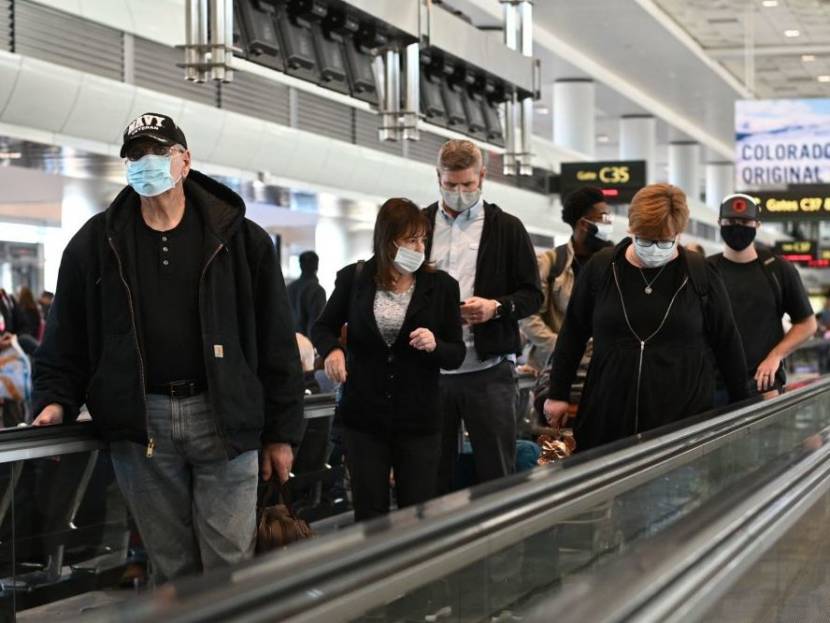
CDC extends transportation mask mandate until May 3

Masked travelers on an airport conveyer belt
Travelers will need to continue to wear protective face masks at airports, on planes, trains, buses and transit hubs, as the CDC is extending the mask requirement for travelers. (Photo by Robyn Beck/AFP via Getty Images)

The Biden administration is extending its face mask requirement for public transit for another 15 days. That means travelers will still need to mask up in airports, planes, buses, trains and at transit hubs until May 3.

The mask travel requirement had been set to expire this coming Monday.

The Centers for Disease Control and Prevention is keeping in place its mask order “in order to assess the potential impact the rise of cases has on severe disease, including hospitalizations and deaths, and health care system capacity,” according to an agency spokesperson.

The spokesperson also confirmed that the Transportation Security Administration, which handles enforcement of the order, is extending its security directive and emergency amendment for another 15 days.

The decision was made in response to the increasing spread of the omicron subvariant in the U.S. and an increase in the 7-day moving average of cases, which have risen by nearly 10% over the last two weeks nationally. Certain states are seeing much larger increases in new cases.

Copyright 2022 NPR. To see more, visit https://www.npr.org.

Alaska businesses have until April 15 to apply for 2nd round of pandemic relief grants

Sitka fishing vessels in harbor on Jan. 18, 2018. (Photo by Jacob Resneck/KTOO)
Sitka fishing vessels in harbor on Jan. 18, 2018. Commercial fisherman who own and operate their own boats may be eligible for the second round of the state’s pandemic relief program for businesses, Southwest Alaska Municipal Conference director Shirley Marquardt said. (Photo by Jacob Resneck/KTOO)

Alaska businesses hurt by the COVID-19 pandemic have until April 15 to apply for tens of millions of dollars from a second round of federal pandemic relief funding.

But that’s only if they didn’t get money during the state’s first series of American Rescue Plan Act grants.

Even if business owners applied and were turned down during that first round of the Alaska ARPA Business Relief Program, they can still give this second round a shot, said Shirley Marquardt, executive director for the Southwest Alaska Municipal Conference.

“If you applied, but you did not get any funding, for whatever reason … you can go back and you can apply again here on round two,” Marquardt said. “And I would really strongly urge people to do that.”

To be eligible, applicants have to show they’ve lost at least half or more of their gross revenue from 2019 to 2020 due to the pandemic.

The state Legislature originally allocated $90 million from the Covid State and Local Fiscal Recovery Funds, which is a part of Alaska’s ARPA funding, to go toward the tourism and business relief grant program. Of that original amount, there’s about $34 million dollars left in the state’s ARPA pot.

Unlike the CARES program, this grant isn’t first-come, first-serve, and all approved applicants will get funding, according to Marquardt.

You might not get all of the funding you asked for,” she said. “It completely depends on the number of complete, full applications that they’ve received and reviewed by the cutoff date.”

With about a week left to apply, Marquardt said there’s still plenty of money to go around.

“They have not had anywhere near the applications turned in as they did on the first round last year, where there were tens of thousands,” she said. “Right now, it’s in the very low hundreds.”

Marquardt said the pandemic affected Southwest Alaska differently than the rest of the state. Even within the region, she said the economic effects varied.

For example, in Kodiak, she said there are more businesses that rely on tourism and were devastated by the lack of visitors. In Unalaska, the effects were more localized to the fishing industry.

“We’re not visitor-based,” Marquardt said. “And we don’t have a university system that supports us. We don’t have a hospital system that supports us, like Kodiak does. We have fishing. So the impacts to the communities were more so for the processors and the harvesters.”

Only one Unalaska small-boat fisherman applied for the first round of funding, according to Marquardt. She said that was a missed opportunity for the community.

“Any commercial fisherman who owns and operates his own boat, or hers, is completely eligible,” she said. “You just have to be able to show your tax documents that go, ‘Yeah, this is what happened to me in 2020. I lost 50% of my revenue.’”

Businesses who received money through other programs, like the PPP or through tribal funding, are still eligible for this round of ARPA funding, Marquardt said. And if they qualify, businesses can use their money however they want.

She said there’s no reason not to apply if you’re an Alaska business owner who lost at least half of your revenue and didn’t get funding in that first round.

It’s either a yes or no,” she said. “And if it’s a yes, it comes in the form of a check — a very large check — that you can then use to pay off debts.”

Applications are due by 5 p.m. on April 15. Find more information on the State of Alaska’s website, and more resources at SWAMC.org.

Wolverines, lynx and moose: Fish and Game screens wildlife for COVID

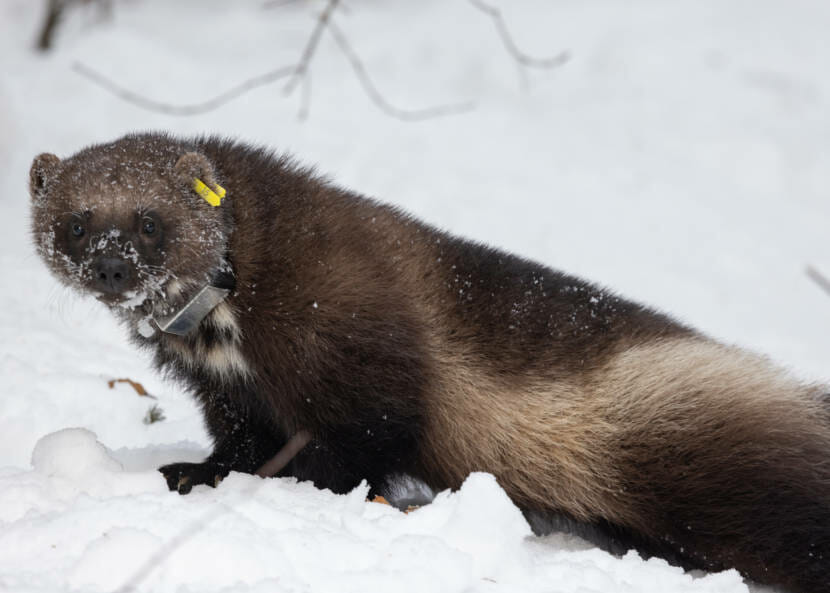
A wolverine in a tracking collar. (©ADF&G, used with permission, photo by David Saalfeld)

The Alaska Department of Fish and Game has started testing wildlife for COVID-19. It’s part of a partnership with the U.S. Geological Survey’s National Wildlife Health Center and the Centers for Disease Control and Prevention. Scientists want to make sure a new variant doesn’t emerge in animals and then infect people.

But Kimberlee Beckmen, a wildlife health veterinarian for Fish and Game, says not to worry too much about getting COVID-19 from an animal.

“It’s more a concern of us infecting wildlife and if wildlife could become a reservoir, but that hasn’t been shown yet,” she said.

When she says “reservoir,” she means the risk is that the virus could take hold in an animal population, mutate and infect humans with a new variant.

In Alaska, biologists are collecting samples from a number of mammals: moose that live near residential areas, lynx (because they’ve gotten it in zoos down south) and mustelids — that’s wolverines, minks and martens. There are plans to test caribou and Sitka black tail deer, as well as seals and belugas in the North Slope Borough.

If you’re wondering how you test a beluga for COVID-19 — yes, you swab the blowhole. For other animals, it’s a nasal swab, pretty much the same as how we test people.

“We stick it up in both nostrils, but we go way deeper,” said Beckmen. “I mean, we go way up to the level of the eye and roll it around and then put it in the media and then that gets sent to the lab.”

Other states have tested bears. Beckmen says Alaska will likely do the same when they come out of hibernation because bears that have been exposed to human garbage are at elevated risk for infection.

She says the state has submitted over 100 samples for testing but hasn’t gotten many results back yet because an avian influenza outbreak on the East coast is keeping labs busy.

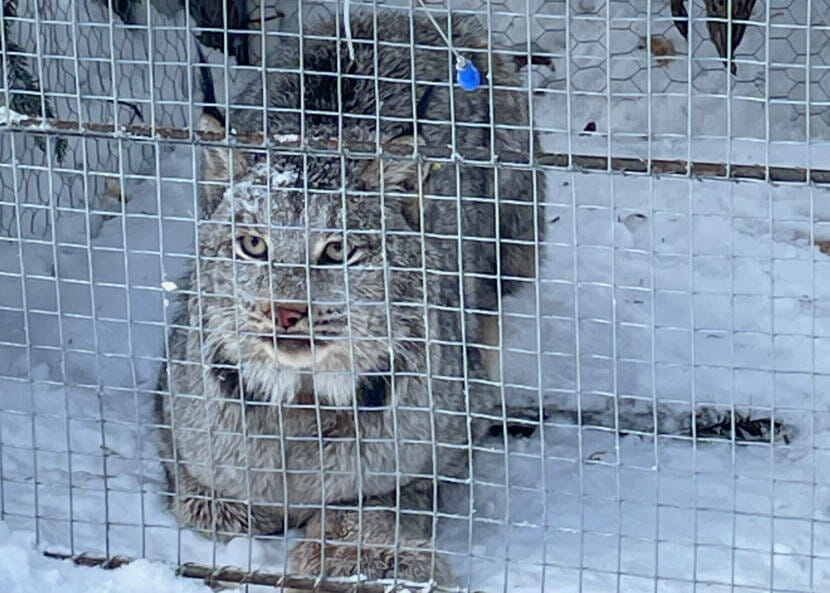
A lynx in a trap. (©ADF&G, used with permission, photo by David Saalfeld)

David Saalfeld is an Anchorage-based wildlife biologist who added COVID-19 testing to his regular fieldwork this winter. He live-traps wolverines and lynx with walk-in traps that don’t harm them. Then he sedates the animals so he can collect samples like nasal swabs and a blood draw.

He says he added COVID screening about halfway through his season.

“So it’d be not a ton of animals, even say two or three wolverine and seven or eight lynx that I sampled,” he said.

There’s currently no evidence that COVID-19 can be passed by handling or eating meat from wild game. Fish and Game recommends hunters use the same precautions as always: wear gloves, clean knives and don’t touch any weird looking tissue.

Hunters can report sick animals or strange behavior to Fish and Game.

Centennial Hall is ‘Juneau’s living room’ again as the Folk Festival returns in-person

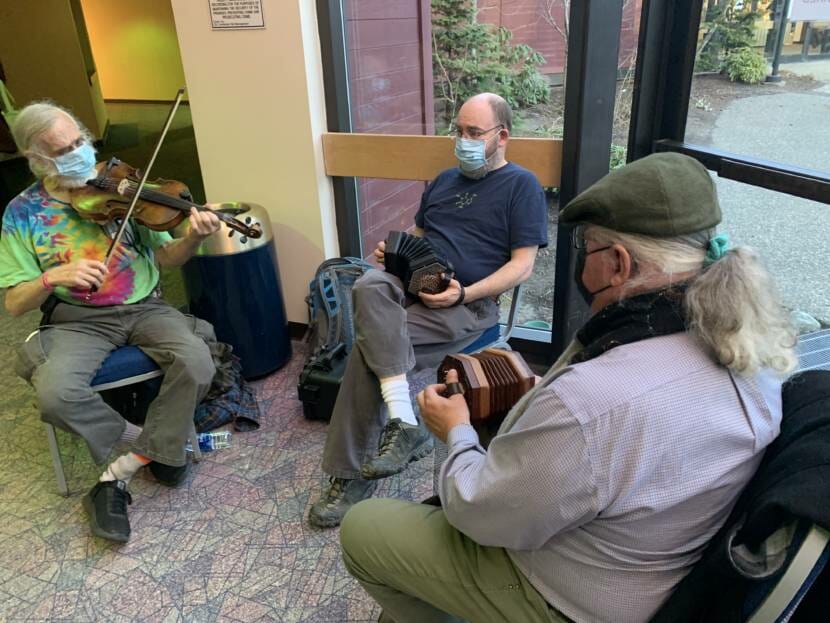
Some of the best entertainment at the Alaska Folk Festival can be found in the hallways, where old friends meet and new friends are made (Photo by Rhonda McBride).

Centennial Hall is once again alive with the sounds of fiddles and banjos — not just on the main stage, but in the entryways and hallways, where musicians pull up folding chairs for impromptu jam sessions.

On most evenings of the Alaska Folk Festival, Greg McLaughlin camps out in a corner with his concertina. He says his fingers are a little clumsy at finding the tunes his friends like to play. Since the pandemic, he’s out of practice playing with other people.

“It’s good to see the friends again,” McLaughlin said. “That’s the most magical thing about folk festival, getting together and playing tunes with friends.”

Some, like Sam O’Toole from Cordova, are experiencing culture shock. He says he hasn’t mingled in a large crowd since the festival’s in-person concerts went on hiatus two years ago. And it’s a little overwhelming.

“It’s going to take a week, and then some,” said O’Toole, who started taking in the festival in small doses on Monday.

Concert-goers get wrist bands after giving proof of vaccination. (Photo by Rhonda McBride).

For others, it feels like a long drought is over.

“I think COVID has made us realize how important we are to each other — the ability to gather, how important that is to our lives,” said Laura Lucas, who has been coming to the festival since it started almost a half-century ago.

Although the folk festival is not quite the same as it was pre-pandemic, Lucas says she’s glad organizers are requiring masks and proof of vaccination.

While the city dropped its mask mandate at the end of February, a recent COVID outbreak at the Capitol was a reminder that gatherings in Juneau still come with some risk. But thanks to volunteers who stepped up to help with the COVID screening, entry into the festival, a free event, is going quickly.

For one family, the pandemic was an opportunity to learn to play their instruments.

The Koski family made its first festival debut Monday night, with Travis on guitar, his son Warren on banjo and fiddle, his oldest daughter Ruby singing the lead and Gracie, the youngest, strumming a ukulele with her small hands.

Their performance at the festival was a goal the family set five years ago, when they began taking music lessons together as a group. Although they had worked hard for this moment, they were nervous going on the big stage and visibly relieved when their set of traditional gospel songs drew warm applause from the crowd.

“It’s very welcoming to everybody,” said Travis Koski. “Everybody’s invited to play. And it’s a friendly crowd, really supportive community.”

The Koski Family Band performed old time favorites Monday night like, “Will the Circle Be Unbroken.” (Photo by Rhonda McBride)

And it’s the Folk Festival audiences over the years that have helped to cultivate performers like Taylor Vidic, a Juneau singer-songwriter, who believes she was 12 when her music teacher encouraged her to join other musicians on stage.

On Tuesday night, she performed her first solo act as if she had known the stage all her life — well, at least more than half of her life.

On stage, she chided Mark Ridgeway — the emcee for Tuesday night — about his age.

“Mark, I heard you say earlier that your first folk festival was 1993,” she said, “And I just realized, if you ever forget, you can just ask me when I was born.”

The crowd heartily applauded the joke and her music.

Vidic had planned to make her solo debut two years ago, but the pandemic got in the way. It also sidelined her in the midst of launching a career as a professional musician and a performer in Skagway.

Yet during that time, she wrote three new songs.

“I am thankful to have been taught how to be a little more still over the last few years,” Vidic said, “and I hope I can carry that forward.”

Kathy Petraborg-Ensor and Craig Smith, warming up back stage. Although they were minutes away from their performance, they were still trying to figure out their set list (Photo by Rhonda McBride).

Many performers, like Craig Smith and Kathy Petraborg-Ensor of Juneau, are glad to see this time of enforced isolation come to an end. In their duo, Heartstrings, they sing gentle harmonies, which before the pandemic they shared with many friends who would gather in their living room to enjoy music. But since the pandemic, Smith says, it’s only been the two of them. And now it’s hard getting used to the idea of playing before a big crowd.

“There’s a big difference between that hall and our living room. Because with COVID, that’s the only place we’ve been playing,” Smith said.

But Smith says it feels great to see musicians back on the Folk Festival’s main stage at Centennial Hall, which he calls “Juneau’s living room” — a place to share music, laughter and friendship with the whole community.

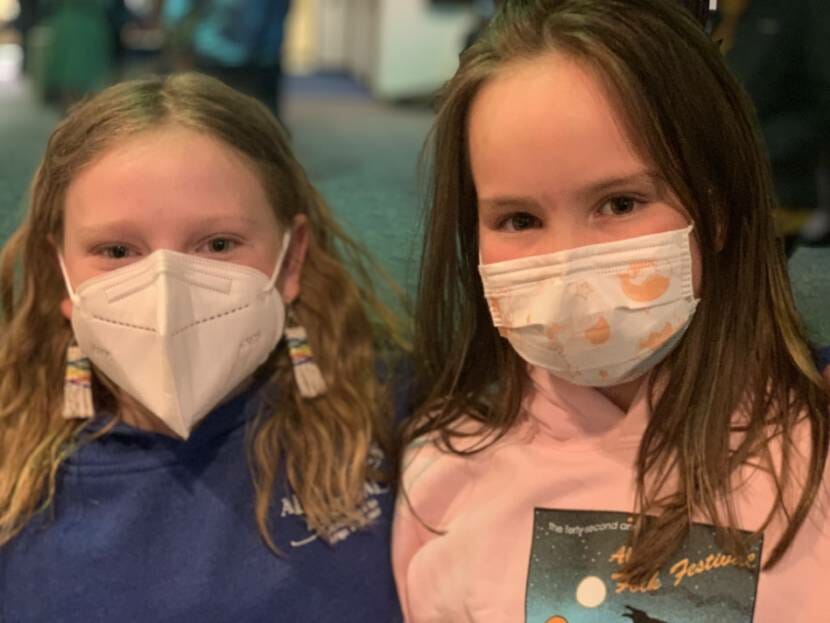
Although Molly Heidemann and Georgia McGuire are only in the third grade, they’re happy to see the return of in-person concerts, because they’ve missed the music and the fun (Photo by Rhonda McBride).

And that includes two third-graders, Georgia McGuire and Molly Heidemann, who say they missed being a part of the festival.

“It makes me feel happy and makes me feel like people worked hard to do it,” Georgia said. Her friend Molly chimed in, “So, I’ll dance in my chair, get up and dance.”

The 47th Annual Alaska Folk Festival continues at Centennial Hall through April 10. Evening and weekend concerts will be broadcast on KRNN 102.7 & 103.1 and online.

Disclaimer: KTOO partners with the Alaska Folk Festival to broadcast the festival on KRNN and a live webstream on ktoo.org/folkfest. Additionally, one of KTOO’s Arts, Culture and Music producers is on the Alaska Folk Festival’s board of directors.

Alaska renters face uncertainty as federal pandemic rental assistance nears end

Photo portrait of a young woman standing by an empty street
Haines resident Emma Brouillette, 18, benefitted from COVID rental assistance. With the program ending, she’s struggling to find more affordable housing. (Photo by Corinne Smith/KHNS)

Tens of thousands of Alaska tenants got help with rent during the pandemic. But the federal rental assistance program is set to expire by the early summer, and many still face challenges finding and affording housing.

Eighteen-year-old Haines resident Emma Brouillette has moved three times since graduating from Haines High school last year.

“It’s definitely really scary,” she said. “So my rent is $1,000 a month. I get around $450 every week for my paycheck. So I don’t actually get to save any of that.”

Brouillette works in the kitchen for a heliski tour company. She says paying for a studio apartment in town, plus utilities and food, is a stretch. She’s been supporting herself since she was sixteen. She says that with her qualifications, finding an entry level job that pays a living wage has been difficult.

“Between COVID and us not having tourism, so many businesses are closed, there’s not too many jobs out and about that can offer sort of a lot of progression,” Brouillette said. “So I’ve been doing my best to look around for jobs that can provide. And with COVID, so many people are having that same struggle. So people are sticking to their apartments, sticking to where it’s safe.”

Last fall, Brouillette was working at a local pizza restaurant and struggling to get by when she saw a posting and applied for COVID rental assistance.

“I found it to be incredibly helpful,” she said. “Because it helped with my mental state with my stress, it wrote that off as one less thing that needed to be done, and allowed me to work on myself.”

Now, with federal funding ending, she’s looking for a better paying job and a more affordable place, ideally splitting costs with a roommate.

But she says it’s also hard to save for a deposit for a new place while covering her bills.

“I have a job, and I’m able to pay for things, but I’m not able to look at a better job,” Brouillette said. “With my lease ending, if I want to try to find a new place, I need to find another source of income so I’m able to pay that first month of rent and that down (payment) deposit so I can actually move.”

31-year-old Joe Aultman-Moore is facing similar housing challenges. He was displaced from his home during the deadly Beach Road landslide in 2020. His cabin was deemed too risky to return to.

“When that was rendered unlivable after the slide, I essentially had to move into town somewhere,” he said. “I had to scramble to find a place in the middle of winter.”

He found emergency housing following the disaster, then rented a studio apartment in Fort Seward for $850 a month. As a former tour guide, but with no summer tours during the pandemic, he qualified for the COVID rental assistance.

“That’s made living in town possible throughout the continuing pandemic,” Aultman-Moore said. “But once that ends, I’m essentially going to have to move out of there. So, you know, continuing on, it’s pretty much still up in the air.”

Aultman-Moore says he was able to put away savings during that time and is working toward building his own tiny home.

“My long term plan going forward is to build a tiny house and stop paying for rent. Because that’s the only way that it makes sense to continue to live here,” he said. “Because, yeah, like rent going up and seasonal workers coming in and the renting situation constantly shifting around here. It’s just, it’s impossible to manage.”

The Alaska Housing Finance Corporation says it has distributed more than $220 million from the federal COVID relief program. In all, 100 Haines households benefited.

Housing Corporation spokesperson Stacey Barnes said one-third of all renters in the state applied, and over 66,000 Alaskans benefited.

“The idea that an individual or a family was questioning where they may sleep the next night or the next month because they lost hours associated with their job, maybe they lost their job altogether,” Barnes said. “Or maybe they had to care for a family member who became closely in contact with someone else who had COVID. Or perhaps they had COVID themselves. And so knowing that financial relief was on the way, was something that has made a tremendous impact.”

The program paid any past rent due, then made direct rental payments  landlords in three-month installments. In the Haines Borough alone, that totaled over $660,000 in assistance. There were two rounds of funding over the last year, but assistance is now set to end by early summer.

“While our country is now coming out of the COVID pandemic, those individuals are able to return to full employment, and make the decisions that are in the best interest of their family without having completely drawn down their savings without having built up huge credit card debt. And by maintaining the security of their housing,” Barnes said.

But renters are still facing major challenges affording housing.

Heather Parker is an attorney with Alaska Legal Services based in Juneau. She says they’re seeing an increase in evictions across Southeast Alaska in recent months as tenants face the end of federal rental assistance.

“Even though this particular COVID housing benefit is kind of coming to an end, I just want people to know that state and federal law still applies. And there are still obligations that landlords and tenants have under state law,” Parker said.

In particular, Parker says tenants have process rights during evictions.

Janine Allen is an advocate with Southeast Alaska Independent Living based in Haines. She says with federal rental assistance ending, they’re working to connect seniors and people with disabilities with additional assistance like for food and fuel. But housing availability continues to be a major challenge, especially for those on a fixed income.

“The housing situation in Haines seems hard for pretty much everybody right now, regardless of your income. And then if you have a disability or if you’re a senior it’s just nearly impossible.”

Looking ahead, renters like Joe Aultman-Moore, whose Beach Road cabin was condemned, say more needs to be done to address housing options and affordability.

“You’re on a treadmill,” he said. “And if anything goes wrong, like if you stumble in the slightest, you’re gonna go flying off that treadmill real quick.”

Alaska Legal Services staffs a statewide housing hotline for both tenants and landlords at 855-743-1001. There are also housing resources at alaskalawhelp.org. Alaska’s 2-1-1 hotline connects residents to a variety of public benefits, including housing assistance. 

Site notifications
Update notification options
Subscribe to notifications