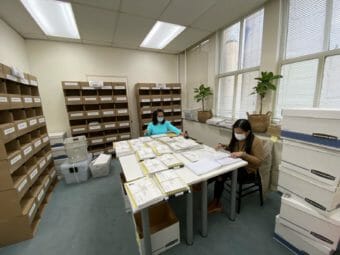
Workers with the Special Ballot Reception and Custody Group receive ballots at the Philippine Consulate General office in San Francisco. (Photo from the Republic of the Philippines, Philippine Consulate General, San Francisco)
Overseas Filipinos who registered to vote by Oct. 14, 2021 are eligible to vote in this election. If you did not register to vote by that date, you are ineligible to vote in this election.
There are two ways to vote from overseas: by mail and in person at your region’s consulate office. For Filipinos in Alaska, that office is in San Francisco.
If you plan to vote by mail, you should have received your ballot.
If your name is on either list, you’re asked to email the consulate’s office so they can send you your voting packet.
When you complete your ballot, you’re required to write your name on the ballot envelope and sign it. The ballot envelope then needs to be sealed with the paper seal included with your voting packet.
Each voting packet comes with postage stamps, but the consulate has advised voters to add one more USPS stamp before sending completed packets to the consulate. The consulate also said voters can send packets with only the stamps provided, and it would pay for postage due for any packets they receive that don’t have enough stamps.
Ballots must be returned to the Philippine Consulate General’s office in San Francisco by 4 a.m. Pacific Time on May 9.
This story is part of KTOO’s participation in the America Amplified initiative to use community engagement to inform and strengthen our journalism. America Amplified is a public media initiative funded by the Corporation for Public Broadcasting.
Filipinos in Alaska
Are you voting in the Philippine national elections? We’d like to hear from you. Tell us your story or let us know how we can help.
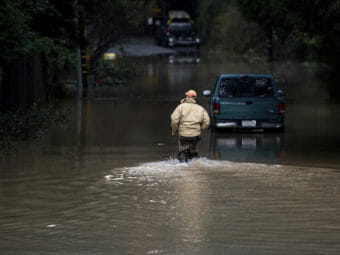
Climate change has already made storms more intense, flooding cities with more rainfall than they were built to handle. (Photo by Josh Edelson/AP)
Federal agencies are beginning to hand out billions of dollars in infrastructure spending, the largest investment ever made in the country’s water system. Much of it will go to improving pipes, drains and stormwater systems. But some scientists and urban planners are pushing to fund projects that are better adapted to the changing climate.
Instead of just gray infrastructure, supporters say the answer is green.
Green infrastructure, whether it’s large rain gardens or plants along a street median, has the same purpose as big storm sewers: to manage large amounts of water that can build up during heavy rains. Plants and soil absorb and slow runoff from rainstorms, while a stormwater drain captures water that runs down a street gutter and diverts it underground into pipes.
On a hotter planet, storms are getting more intense, and rainfall is often heavier. Flooding is on the rise in many cities. Stormwater systems are being increasingly overwhelmed by extreme rainfall. In the Northeast, the heaviest storms produce 55% more rain today compared to 1958. Last year, dozens of people drowned there when the remnants of Hurricane Ida flooded basements, streets and cars.
Still, most cities face major backlogs in maintaining the aging gray infrastructure they already have, amounting to billions of dollars nationwide. In the rush to secure federal funding to fill that void, some worry that green infrastructure will be left by the wayside.
“What good is a pristine road that’s flooded?” says Marccus Hendricks, assistant professor of urban studies and planning at the University of Maryland. “Elevating the priority of green infrastructure and stormwater systems is critical.”
How rain gardens help stormwater systems in storms
Downtown Oakland, like a lot of major cities, is mostly a hardscape of concrete. Still, on one block, the sidewalk is lined with a long strip of native California plants.
“I feel so great looking at this,” says Joshua Bradt, a project manager for the San Francisco Estuary Partnership. “I love that the plants are alive. They seem to be thriving.”
Bradt helped bring this rain garden to life, part of a $4 million dollar project to add green infrastructure to a major thoroughfare in the east San Francisco Bay Area.
When rain storms hit, the water is funneled into the rain garden from the street and sidewalk. As it soaks into the soil, it prevents that water from rushing to the stormwater drain on the corner.
In big storms, that alleviates the pressure on the stormwater system, since those drains and pipes can only handle so much water at once based on their size. When storm drains are overwhelmed, water pools in the street and can inundate buildings.
Bradt says even small rain gardens can make a difference in slowing the runoff that causes flooding. They also have the added benefit of filtering runoff to improve water quality.
Joshua Bradt looks over a green infrastructure in downtown Oakland. During storms, water from the street and sidewalk is funneled into the rain garden. (Photo by Lauren Sommer/NPR)
Cities struggle to get green infrastructure built
Green infrastructure can also help when it’s not raining. Summer heat waves are often more dangerous in cities, because concrete absorbs and radiates heat in what’s known as the “urban heat island” effect. Plants and parks can provide much needed cooling.
“If they were on every corner, it would make a tremendous difference,” Bradt says. “The reality is that a lot of city departments are already overwhelmed, and this is a hard ask.”
While both gray and green infrastructure require upfront funding for construction, green infrastructure also requires ongoing maintenance to keep the plants healthy and clean up litter. Even if cities can secure funds to build the projects, maintenance generally isn’t included. They face adding that to their annual budget, which can turn out to be a hurdle for doing green infrastructure.
In addition, the most cost-effective time to build green infrastructure projects is when cities are already doing road or construction work. But because the projects are often managed by different departments, coordination doesn’t happen.
“It’s becoming more standardized and definitely more accepted,” Bradt says. “However, I will say there just is not yet a mass movement towards this, because of how institutionalized and siloed infrastructure management and investment is.”
Bigger storms are already overwhelming cities
Whether cities spend on gray or green infrastructure, a hotter climate is adding huge costs to their budgets.
“Our challenge with climate change is that we’re seeing these big events,” says Lauren McPhillips, a water engineering professor at Penn State University. “We’re seeing massive amounts of water that we need to be able to control.”
Across the U.S., millions of miles of pipes and stormwater infrastructure stretch below city streets. Most are decades-old, designed for the storms of last century.
Federal officials with the National Atmospheric and Oceanic Administration say the agency hopes to begin the process of creating new rainfall forecasts next year. Still, that information isn’t likely to be ready in time for cities to use it for the new wave of federally funded infrastructure projects.
Planning for heavier downpours means building larger stormwater systems, but replacing miles of pipes and upsizing existing infrastructure is far more expensive than cities can afford. Experts say green infrastructure can reduce the need to replace as much gray infrastructure. If rain gardens absorb some of the runoff, stormwater pipes don’t need to be as large.
That makes green infrastructure potentially more cost-effective. A New York City study looked at using a combination of gray and green infrastructure in one neighborhood in Queens and found that using gray infrastructure alone would be twice as expensive.
Still, a handful of rain gardens won’t be enough to prevent flooding, experts warn.
“The challenge is that we need this at scale,” McPhillips says. “And especially in these older cities that have built out a lot of hard surface and have gotten rid of the ability for soils to naturally soak in rain, we have a lot to get back to correct for those issues.”
Flooding is especially problematic in low-income neighborhoods and communities of color, which generally have fewer parks and where the infrastructure is often more neglected
“The fact that the majority of communities of color lack sufficient green space compared to their white majority counterparts – that is still a problem,” says Fushcia-Ann Hoover, who works on green infrastructure at the University of North Carolina at Charlotte. “And so I think that green infrastructure does provide a possible solution.”
Replacing concrete with green plants, like this project in Emeryville, Calif., can help overwhelmed stormwater systems handle increasingly bigger rainstorms. (Photo by Joshua Bradt)
As infrastructure spending begins, green projects could be just a ‘stepchild’
Over the next five years, the Environmental Protection Agency will give states more than $11 billion for water infrastructure projects through the Clean Water State Revolving Fund. In March, the EPA released guidance encouraging those funds be used in disadvantaged communities and that states take climate change into account.
“Most cities think about the green and the gray separately, but really the power is integrating these two things,” says Radhika Fox, assistant administrator for the EPA’s Office of Water.
Still, under guidance from Congress, only 10% of the funding must be spent on green infrastructure or water efficiency projects. The last time the government provided a big infusion of infrastructure funds in 2009, the requirement was for 20% of projects to be green.
The EPA also emphasized that states have discretion and flexibility to spend the funds as they see fit. The Biden Administration has already gotten pushback from Republicans about encouraging states to consider climate change in spending infrastructure dollars. In February, top Republicans sent a letter encouraging states to ignore similar guidance from the Department of Transportation.
“It does put states in the driver’s seat in terms of identifying and working with communities within their borders to find infrastructure projects,” Fox says.
The need to repair and upgrade gray infrastructure may take priority over green projects in many communities. In 2020, municipal utilities faced a funding shortfall of $8.5 billion, according to a study from the Water Environment Federation.
“Stormwater systems, green infrastructure and other systems that are tied to the climate crisis have been a stepchild to the types of systems we pay attention to,” Hendricks says.
Copyright 2022 NPR. To see more, visit https://www.npr.org.
Donald Strayer and his wife, Julia, thought they’d found an affordable dream home in Ohio’s Appalachian mountain foothills. But after years of payments directly to the seller, he discovered the owners had kept his money and let the property fall into foreclosure. (Photo courtesy of Donald Strayer)
Five years ago, Donald Strayer thought he’d bought a dream home for his extended family. It was on a pretty spot in Ohio’s Appalachian mountain foothills, with room for him and his wife, his daughter’s family, plus their horses and goats. And he could actually afford it.
Strayer had been turned down for a bank loan because of bad credit — he says it’s because of hospital bills years ago. The 58-year-old former forklift driver has a chronic lung disease and lives off disability. Instead of a regular mortgage, he signed what’s known as a land contract directly with the seller.
The price was $39,900. For a down payment he sold his childhood home, which he inherited when his dad died, “the only thing I had in the whole world.”
For years he made monthly payments of $350 on his new home. And then “one day the sheriff just showed up,” he says. “It was foreclosed and they wanted to take my property.”
It turned out the seller’s family — to whom Strayer had been sending his payments — was keeping the money instead of paying down the mortgage. That left Strayer out a major investment, with no equity and no legal right to the property.
Land contracts and other kinds of alternative financing have been around a long time, with roots in the race-based redlining that blocked Black Americans from traditional mortgages. But legal aid experts say they became more common after the Great Recession, and as housing and rental costs have skyrocketed. They may be the only option for some, but these alternative deals pose a financial risk to families with the least to lose.
“For many American families, homeownership has been the largest source of wealth over the past century,” says Tara Roche with The Pew Charitable Trusts. “Mortgages are a key step to achieving that financial security.”
People of color and those in rural areas are more likely to use these risky arrangements
A first of its kind national survey by The Pew Charitable Trusts finds 36 million Americans — about 20% of all borrowers — have used alternative ways to finance a home at some point, including 7 million currently in such arrangements. The borrowers are largely low-income, more likely to live in rural areas, and disproportionately Hispanic and Black, reflecting the racial gap in homeownership.
Unlike mortgages, alternative financing deals are usually not recorded with any government office. They don’t start with a bank or mortgage company, and so are not subject to the same state or federal regulations.
“In most of our cases, we have handwritten notes that wouldn’t pass muster,” says Peggy Lee, an attorney with Southeastern Ohio Legal Services. She says some of her clients have even been duped into thinking a verbal contract was binding, though they’re not recognized in Ohio.
This leaves borrowers with higher costs and fewer protections. They can be suddenly evicted without a right to a normal foreclosure process. They’re shut out of tax and other homeowner benefits. The legal ambiguity prevented many from being eligible for COVID-19 financial relief or the moratorium on evictions, creating a double whammy for families most likely to suffer during the pandemic.
Another crucial distinction: usually the seller maintains the property deed until the last payment, yet the tenant is responsible for maintenance and repairs.
Marisela Orozco (foreground) is letting her sister, Marissa, live in the house she thought she would own after making almost four years of payments. But the owner disappeared, along with the title, and she worries he may return and evict them. (Photo by Laura Ziegler/KCUR 89.3)
In 2014, Marisela Orozco signed a contract to buy a house from the co-worker of a friend in Kansas City, Missouri, for $22,000. At the time she didn’t have authorization to live in the United States, spoke little English, and did not understand how property titles worked.
“Walls not done. Little bit of the bathroom finished. No good plumbing,” she said. “But I say, ‘OK,’ we fix it up’. And I move in with my kids, fixing things little by little when I have the money.”
But after 44 months of regular payments, and more than $10,000 in home improvements, the owner disappeared, never giving Orozco the title to the house.
Repeat offenders engage in “profit-driven ‘churning'”
Legal aid attorneys say they’ve seen more alternative financing since the 2008 subprime mortgage crisis, when millions lost their homes to foreclosure. Large investors bought the houses in bulk, many of them in disrepair and in economically struggling areas, then marketed alternative financing schemes to resell them.
Several state attorneys general have filed suits alleging deceptive practices. Pennsylvania recently won a partial victory when a judge ordered that 285 homes be immediately deeded to people who’d signed alternative leasing arrangements.
Some experts worry about the possibility of another spike coming out of the pandemic, as mortgage bailouts and moratoriums expire and foreclosures start to rise.
In rural Ohio, attorney Lee says given the severe housing crunch, a dilapidated home may be the only one some people can afford. But she finds it distressing to see clients invest thousands fixing up a place, believing it will pay off, when the seller never actually intends to turn it over.
“They just want to shift the burden of making repairs by letting them think they’re going to build some sort of equity in the home,” she says. “And then, oops, the first time something goes wrong… they’re in eviction court.”
The Pew survey finds a lot of repeat offenders, calling it “profit-driven ‘churning'” when an owner initiates the sale of the same house over and over.
States are starting to consider more protections for borrowers
Since it’s hard to track alternative financing arrangements, there’s been a lack of data on who uses them, where they live, and what their experiences are. Pew’s Roche hopes the information in the survey “can help inform policymakers, who are considering policies for alternative home financing borrowers.”
Some states have been trying to better protect consumers, and Roche is seeing an uptick this year in proposed legislation.
Sarah Mancini, with the National Consumer Law Center, would like to at least ensure a house is habitable, the same protection a renter would have. And in case of problems, she says there should be a process more akin to foreclosure, so tenants aren’t at risk of sudden eviction.
Beyond that, Mancini would like to see traditional, smaller mortgages more available, and not as difficult to get approved.
“We know there’s a racial wealth gap. We know that individuals of color are more likely to have experienced a bump in the road at some point that may have caused a payment default,” she says.
Instead of requiring an “unreasonably high credit score,” she says lenders should look at someone’s current income and ability to pay.
Steve Vockrodt of the Midwest Newsroom and Laura Ziegler of KCUR contributed reporting to this story.
Copyright 2022 NPR. To see more, visit https://www.npr.org.
A makeshift shelter for Ukrainians in Tijuana, Mexico. Thousands who fled the war have been arriving here and waiting to be admitted by border agents into the United States. (Photo by Carlos A. Moreno for NPR)
Ukrainians fleeing the war have been arriving at Mexico’s northern border cities by the thousands. There, they are presenting themselves to U.S. border agents and asking for temporary admission to the United States on humanitarian grounds. Thousands of Ukrainians have been let in — availing themselves of the avenues that the Biden administration has opened to ease their admission into the U.S. faster than people who have come from other countries.
But so many Ukrainians have arrived that a backlog has formed.
In Tijuana, Mexico, across from San Diego, the swelling numbers spurred into action a massive volunteer effort organized by Ukrainian-Americans and others with ties to the region. They established a sprawling makeshift shelter, brought trays of Ukrainian food from Los Angeles and San Diego, and coordinated with immigration agents to shuttle large groups to the border for processing.
Despite their quick mobilization to ensure a measure of comfort for thousands of refugees nearing the end of their journey to safety, their efforts have been overwhelmed by the unending flow of new arrivals.
Here are some of the people whose lives have converged at the U.S.-Mexico border thanks to a war a half a globe away.
“The war is still affecting her”
It took weeks for Aleksey Ivkov to convince his mother Tatiana to leave Ukraine. She’d been determined to wait the war out by sheltering in a subway tunnel in their home city of Kharkiv. But as the war intensified, she finally agreed to evacuate — and to meet her son in Tijuana.
The trip took her nine days. Ivkov drove from north of San Francisco to pick her up. He noticed immediately that loud noises startled her. As they stepped out of the Tijuana airport, the rumble of a large truck made her jump.
“The war is still affecting her,” he said. On a recent day, Ivkov and his mother were sitting in folding chairs at the shelter housing Ukrainians as they await their turn to be processed into the United States.
Tatiana, who shared only her first name, is 74, and after more than a month of anxiety said she was feeling more cheerful now, eager to see her relatives and grandchildren in California. But she’s looking forward to her return to Ukraine, and to reuniting with her partner, who because he is in his late 50s is considered of fighting age and prohibited from leaving the country.
“Once things calm down a little,” she said, “I’ll go back.”
On the shuttle to the border. (Photo by Carlos A. Moreno for NPR)Volunteers worked with Tijuana officials to turn a municipal sports complex into a shelter to house thousands as they wait for their turn to be processed at the border. (Photo by Carlos A. Moreno for NPR)A backlog meant Ukrainians were waiting two to three days for their chance to request humanitarian admission at the border. (Photo by Carlos A. Moreno for NPR)
“We need more help”
Olya Krasnykh is a Russian-American real estate executive in Silicon Valley. But when she learned of the Ukrainians arriving at the border, she set her job aside and came down to help. A tent city had formed within steps of the border crossing. Krasnykh and other volunteers worked with Tijuana city officials to move everyone into a municipal sports complex a short drive away.
It became a sprawling operation. Ukrainian-American volunteers began greeting entire planes full of Ukrainians at the airport and shuttling them to the shelter, registering them and placing them into a queue. When it’s their turn, they and their luggage are loaded onto another shuttle to the border. In recent days, people were waiting from two to three days at the shelter for their turn to come up. But the wait was getting longer, because Ukrainians are arriving in Tijuana faster than border agents can process them.
As of a few days ago, Krasnykh estimated that the shelter had registered about 10,000 people.
“It’s an operation that has been managed well by a band of grassroots volunteers,” Krasnykh said. But she added that it had grown so quickly that it now needed support from a professional nonprofit. “We’re at a breaking point where we need more help.”
“We bought like six air mattresses”
Phil Metzger had not planned for his church in San Diego to become a major stopover for Ukrainian refugees. Metzger is the lead pastor of Calvary San Diego, about a 15-minute drive north of the Mexican border. When the Ukrainians started arriving there, he thought he could lend a helping hand.
“Two weeks ago we bought like six air mattresses, thinking, let’s help a few people out,” he said. “We just had no idea. The next night, it was a hundred people.”
On a recent day, shuttles were arriving at his church loaded with people freshly admitted into the United States. Many needed some time to contact family and friends who they’d be joining in other parts of the country. They booked airplane tickets and church volunteers drove them to San Diego’s airport for the final leg of their trip. Other new arrivals needed somewhere to stay for a few nights, because not everyone was sure of their next steps.
It’s all been a little stressful, Metzger admitted.
“But I’m thankful these people are not back in Ukraine right now, because it’s dangerous,” he said. “I’m glad that they’re here.”
The shelter housing Ukrainians is entirely run by volunteers. (Photo by Carlos A. Moreno for NPR)Ukrainian refugees arrive at the Benito Juarez Sports Complex shelter. (Photo by Carlos A. Moreno for NPR)
“These are my people”
At the shelter in Tijuana, Helen Davidov was doling out Ukrainian food: bitochki, plov, and grechka. She and other Ukrainian-Americans drove it down from Los Angeles.
She placed drumsticks and fried cottage cheese cakes onto people’s plates. And she tried to make eye contact with each one.
“These are my people,” she said, her voice catching. “It’s just people. It’s horrible what’s happening right now. And if we don’t all put in a little bit, it’ll get worse.”
“It could be the last goodbye”
Last week, Iryna Merezhko flew from her home in Los Angeles to Warsaw, Poland. Then she took a train into Ukraine to meet her sister and her sister’s son Ivan at a hotel. Her sister had decided to stay in Ukraine to support the country’s soldiers, but she wanted Ivan, 14, to join his aunt in the United States.
In the hotel room, Merezhko’s sister handed her a thick stack of documents — anything a border agent might conceivably request as proof that Merezhko had permission to bring Ivan into the country. Ivan felt uneasy about leaving his parents behind.
“We told him it was going to be like a long summer break in California,” Merezhko said. “Disneyland! Universal Studios!”
At the hotel, they all exchanged tearful embraces, and promised to see each other soon. No one spoke what everyone understood.
“We knew it could be the last goodbye,” Merezhko said.
Ivan said he’d left his heart in Ukraine. “My friends, my family,” he said.
But the strength of the their family’s convictions, Merezhko said, left them no other choice. “I am very proud of my sister.”
Children played at the Benito Juarez Sports Complex shelter. (Photo by Carlos A. Moreno for NPR)At the shelter, women picked out donated clothing. (Photo by Carlos A. Moreno for NPR)Ukrainians have been arriving at other Mexican border cities, but Tijuana — with the world’s largest border crossing — has become a main point of entry to the United States for Ukrainians fleeing the war. (Photo by Carlos A. Moreno for NPR)
Copyright 2022 NPR. To see more, visit https://www.npr.org.
For one day in March, wind generated electricity surpassed coal and nuclear, and became second only to natural gas. (Photo by Parry/AP)
Wind power in the United States reached a new milestone last month.
On March 29, wind turbines produced more electricity than coal and nuclear, the U.S. Energy Information Administration, an agency that collects energy statistics for the government, says.
In the past, wind-powered electricity has gone beyond coal and nuclear on separate days, but this was the first time wind surpassed both on the same day. Natural gas is still the largest source of electricity generation in the country.
The EIA notes that in the spring and fall months, nuclear and coal generators reduce their output because demand tends to be lower, which could contribute to why wind turbines produced more electricity that day.
But wind taking the No. 2 spot may be short-lived.
The agency says electricity generation from wind on a monthly basis has been lower than natural gas, coal and nuclear generation. According to EIA projections, wind is not expected to surpass any other method in any month of 2022 or 2023.
Copyright 2022 NPR. To see more, visit https://www.npr.org.
Travelers will need to continue to wear protective face masks at airports, on planes, trains, buses and transit hubs, as the CDC is extending the mask requirement for travelers. (Photo by Robyn Beck/AFP via Getty Images)
The Biden administration is extending its face mask requirement for public transit for another 15 days. That means travelers will still need to mask up in airports, planes, buses, trains and at transit hubs until May 3.
The mask travel requirement had been set to expire this coming Monday.
The Centers for Disease Control and Prevention is keeping in place its mask order “in order to assess the potential impact the rise of cases has on severe disease, including hospitalizations and deaths, and health care system capacity,” according to an agency spokesperson.
The spokesperson also confirmed that the Transportation Security Administration, which handles enforcement of the order, is extending its security directive and emergency amendment for another 15 days.
The decision was made in response to the increasing spread of the omicron subvariant in the U.S. and an increase in the 7-day moving average of cases, which have risen by nearly 10% over the last two weeks nationally. Certain states are seeing much larger increases in new cases.
Copyright 2022 NPR. To see more, visit https://www.npr.org.
Close
Update notification options
Subscribe to notifications
Subscribe
Get notifications about news related to the topics you care about. You can unsubscribe anytime.