Nation & World

Republicans face a test of extremists’ power in Idaho’s primaries

A campaign sign for Ammon Bundy beside a rural road
Anti-government militant Ammon Bundy is among a slate of far-right candidates running for office in Idaho in 2022. (photo by Kirk Siegler/NPR)

There was a moment when cattle rancher Jennifer Ellis decided she couldn’t stand on the sidelines anymore. It was when Ammon Bundy, who led an armed takeover of a federal wildlife refuge in Oregon and was later acquitted, moved to Idaho and began mounting his campaign for governor.

“When you see him rising in the national consciousness as some kind of a cowboy rancher, that gets a little touchy,” Ellis said one windy afternoon on her ranch near Blackfoot, Idaho.

To Ellis, Bundy gave ranchers — actual, working, public lands ranchers who follow the law and pay their fees — a bad name. Self-described moderate Republicans like her viewed the scofflaw rebellion as a precursor to today’s right-wing politics of conspiracies and trolling becoming mainstreamed. Ellis is also alarmed by the meanness and threats directed at anyone with opposing viewpoints.

“It’s dividing communities,” she says. “They love the politics of fear.”

Ruby red Idaho is one of the most intense battlegrounds between moderates and extremists in the Republican Party. Its primary is next month. Political analysts see it as a national test for how far to the right the GOP can be pulled.
Ammon Bundy recently switched his affiliation from Republican to independent. But the state’s lieutenant governor, Janice McGeachin, who has cozied up to white nationalists and anti-government militias, is vying for the GOP nomination. There are also militia-backed candidates running for the state legislature, including two men also involved with the recent armed standoffs with federal agents in the West.

Attacking conservatives as RINOs

In eastern Idaho, Jennifer Ellis regrets not speaking out sooner. She’s a past president of the Idaho Cattle Association and proudly says she’s a fourth generation Idahoan.

“People like me kind of got tired of listening to the conspiracy stuff,” she says. “We just went home and went back to work, and so then the extremists were able to take control.”

So last fall, Ellis joined with a group of former Republican elected leaders here — including a retired state House speaker and state Supreme Court justice — to form the political action committee Take Back Idaho. The group has raised close to $100,000, and it’s initially trying to unseat 16 far-right legislators.

That will be a tough job in Idaho, where the far right often even attacks fellow conservatives as being RINOs, Republicans in name only.

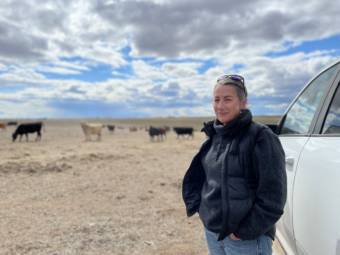
A portrait of a woman in work clothes with cattle behind her
Jennifer Ellis, a rancher and lifelong Republican, helped form Take Back Idaho to push back against extremism in her home state. (Photo by Kirk Siegler/NPR)

“There’s nothing that Republican officeholders hate worse than being called a RINO, or not Christian enough, and now we’ve got both of those operations going in this state,” Ellis says.

The state has long been associated with political extremism, but only lately has it been aligned to elements within a political party.

Around her family’s ranch on the windy high prairie, new subdivisions have sprung up lately with homes bought by newcomers, some calling themselves “refugees” from nearby blue states. Trump 2024 flags started popping up here right around President Biden’s nomination. Letters to the editor champion the former president as a “blue collar billionaire.”

In most states, Idaho’s Republican Gov. Brad Little, who’s running for reelection, would be considered a hard-line conservative. He just signed a Texas-style abortion bill. But around here, some dyed in the wool party activists consider Little too liberal.

“We are a very conservative state with nothing but blue policies,” says Doyle Beck, a former Bonneville County GOP chairman.

Beck runs a construction company in Idaho Falls and is also a state GOP delegate. He says conservatives have worked hard in recent years to steer the party toward an agenda based on liberty: eliminating most government, he says, as well as taxes on business. Beck sees the upcoming primary, and the national midterms, as a tipping point.

“The status quo is special interest groups and cronies governing the state of Idaho,” Beck says. “Take Back Idaho’s feeling like they’re losing.”

Where are the current Republicans?

At the University of Montana, political scientist Rob Saldin is tracking moderate groups like Take Back Idaho, which so far are rare.

“Where are the current high-profile Republicans who are endorsing and supporting this effort?” Saldin asks. “I don’t see many. And the ones you do, it’s like, Liz Cheney, who’s in big trouble.”

Saldin says the populist rhetoric stoked by the former president and his followers continues to appeal to the party base, and particularly people who have never voted or been politically active before. He figures that may be why some current GOP lawmakers are reluctant to speak out.

The former governor of Saldin’s state, Marc Racicot, has been writing editorials in mainstream outlets like The Washington Post lately similar in tone to Take Back Idaho. Racicot, who also chaired the Republican National Committee during the George W. Bush administration, says the party’s far-right leaders are a threat to democracy.

“There is a huge, great middle of America that is concerned about us as a republic falling apart,” Racicot told NPR.

A portrait of a grey-haired man sitting at a desk
Former Montana Gov. Marc Racicot says the far-right leaders of his party are a threat to democracy. (Photo by Kirk Siegler/NPR)

Racicot was a popular two-term governor in the 1990s. Now some of the party’s base attacks him, too, as a RINO. He calls that angry, cheap rhetoric.

“Anytime you get fat and happy about what it is you’re doing that’s not focused upon the best interest of your country first — not your party, your country first — you end up placing your form of government at risk,” Racicot says.

He added that Republicans today in his view are using hate and division as a tool to distract rather than dealing head on with tough issues facing the country.

Where are “the grown-ups”?

This was rancher Jennifer Ellis’ take as the Idaho legislature recently wrapped up its session. Lawmakers made national headlines for going after librarians for exposing kids to “harmful” books. One sponsor of a self-described election integrity bill even pushed a false notion that Canadians were crossing over the border to vote in elections here.

“I just have to wonder where the grown-ups in the room are on some of these things,” Ellis says. “We have got infrastructure that is really in peril. We have got schools that have not been funded like they should.”

On a recent afternoon, Ellis was trying to raise money for the PAC and fight extremism in the middle of calving season, one of the busiest times of the year on a ranch.

“Actually I’m surprised that they haven’t done a little bit of bellarin’,” she said, laughing, as she steered her pickup into a pasture where some newborn calves, still wet, lay with their mothers.

This time of year, when the wind kicks up dirt and mud on them, she’s often in the fields checking on things around the clock. She says true Idaho conservatives are out here on the land working.

“We’re not conspiracy theorists in Idaho; that’s never been how we’ve ran this state,” Ellis says. “It’s a meat and potatoes state. We do important things; we don’t do juvenile things.”

For Ellis and other moderates trying to pull the pendulum back toward the middle, the May 17 primary could be a big first test of that.

Copyright 2022 NPR. To see more, visit https://www.npr.org.

Refugees from Ukraine could be placed in Alaska communities where they have family ties

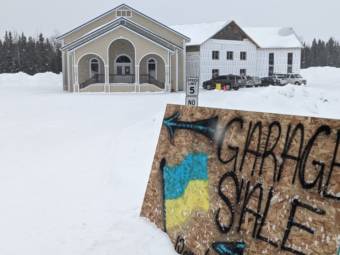
A garage sale sign with a Ukrainian flag painted on it, outside a church
A sign at Word of Life church near Delta Junction advertising a garage and bake sale to raise money to help the people of Ukraine. (Photo by Tim Ellis/KUAC)

The state’s refugee coordinator has told local officials that refugees fleeing the war in Ukraine will begin arriving in Alaska over the next year or two, and some will be placed in communities where they have family ties.

Meanwhile, members of the Slavic community in Delta Junction say that a few have already arrived.

President Biden declared two weeks ago that the United States and its European allies will soon begin helping Ukrainian refugees find homes.

“Many Ukrainian refugees will wish to stay in Europe, closer to their home,” he said in a March 24 speech to NATO officials meeting in Brussels. “But we also will welcome 100,000 Ukrainians to the United States, with a focus on reuniting families.”

Last week, State Refugee Coordinator Issa Spatrisano began informing municipal officials that Alaska’s share of those refugees will be placed in some communities beginning next year.

Delta Junction was among the first places she contacted.

“We’re aware that in our state, there are a number of Ukrainians that live in the Delta area,” she said, “and they may have family members that will come join them.”

Refugees and immigrants from Ukraine and other Slavic-speaking nations in the former Soviet Union began to settle in the Delta area in the mid-1990s, after the USSR collapsed. They now make up an estimated 15% of the area’s population.

Some of those residents are already preparing to help their Ukrainian family members get settled in.

“If we do get refugees and we find accommodations for them, like housing and everything, I’m sure we’ll be able to help them with jobs,” said Igor Zaremba, a Delta Junction resident and member of the Word of Life church. “I mean, the construction season is just picking up.”

Zaremba sat in on Tuesday’s Delta City Council meeting. After the council reviewed the letter from Spatrisano, Zaremba told them about his church’s refugee assistance plans and asked if the city can help out “… to cover the bills, to cover food expenses and all that stuff until these refugees get on their feet and get a little more self-reliant.”

Mayor J.W. Musgrove said the city can’t offer any direct assistance but can help refer them to agencies that do.

Spatrisano says she’ll also inform Anchorage and Mat-Su officials about the refugees. Both municipalities also have sizable Ukrainian populations.

“If we’re aware of something that’s going to affect your local community through the U.S. Refugee Admissions Program, our goal is never to surprise people,” she said in an interview Tuesday.

Spatrisano works for Catholic Social Services, which oversees the U.S. State Department’s Refugee Resettlement Program in Alaska. She says the agency hasn’t yet advised her office on how many Ukrainian refugees Alaska might get through the program, or when they’ll begin arriving. But she says it’s likely take a while.

“This is not going to happen overnight,” she said. “The screening processes that are required for refugees take 18 to 24 months.”

Spatrisano says her program only handles Ukrainians who will come to Alaska through the refugee resettlement program. She says others who aren’t with that program may also come to Alaska.

Delta resident Vicky Shestopalov says that some are already here.

“We actually have a refugee family right now who is visiting us,” she said.

Shestopalov says they’re only temporarily staying with her parents, who are expecting another refugee family in the next couple of weeks.

“We do have a lot of Ukrainians here, with ties directly still in Ukraine, trying to move their families out,” she said in an interview Wednesday.

Shestopalov says local Ukrainian-Americans are organizing their own refugee assistance efforts because they’re increasingly alarmed at what they’re hearing from family and friends who are still in the war zone.

“When you talk with your friend first-hand, it’s shocking,” she said. “It’s devastating, you know, and it’s just scary what’s happening there right now.”

Shestopalov says she’s glad the federal government is offering refugee status to Ukrainians. But she and other members of the local Slavic community also hope the federal government will help other victims — including Russians

She says many Russians oppose the war, and many others don’t know much about it.

“I have friends here and all over the U.S. who’ve been trying to get their Russian family members out of Russia,” she said. “They’re telling them, ‘Hey! There’s this war in Ukraine that’s happening! Get out of there before you get recruited or whatever!”

The future cost of climate inaction? $2 trillion a year, says the government

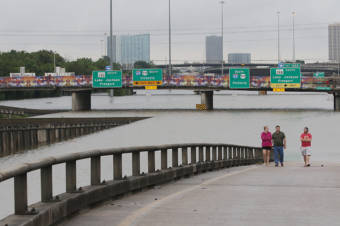
People standing on the on-ramp to a flooded interstate highway
The federal government is starting to forecast the budget impacts of climate change. Hurricane damage is a big driver, and could cause up to an additional $94 billion annually in coastal disaster response costs by 2100. (Photo by Thomas Shea/AFP via Getty Images)

With time running out to head off the worst damage from climate change, the United States government is starting to quantify the cost of inaction – for taxpayers.
The White House Office of Management and Budget (OMB) released the first ever accounting of how unchecked global warming would impact the federal budget, looking at its potential to dampen the economy as a whole, and balloon the costs of climate-related programs over time.

“The fiscal risk of climate change is immense,” wrote Candace Vahlsing, Associate Director for Climate, Energy, Environment, and Science at OMB, and Danny Yagan, Chief Economist at OMB, in a blog post discussing the analysis.

Key takeaways:

  • The economy could shrink. A lot. Based on current warming trends, OMB predicted climate change could reduce the country’s Gross Domestic Product, or economic output, by as much as 10% by the end of this century. That translates into an annual revenue loss to the federal budget of 7.1%, or about $2 trillion in today’s dollars. For perspective, the Biden Administration’s entire proposed budget for fiscal year 2023 is $5.8 trillion.
  • Costs for key programs would rise. Major storms, floods, wildfires and other extreme weather events already cause around $120 billion a year in damages in the U.S., according to OMB. Some of that cost is borne by the government, in the form of insurance programs and post-disaster aid. With unabated climate change, the costs of six types of federal, disaster-related programs could rise anywhere from $25 billion to $128 billion by the end of the century. Hurricane damage is the biggest driver, accounting for as much as $94 billion in annual coastal disaster response cost increases by 2100.
  • Some impacts are too vague to quantify. Climate risks to national security, changes to ecosystems, and infrastructure expenditures do not have a price tag attached to them yet. This also does not count the strain on other kinds of institutions. Looking beyond the federal government, the cost to public health and businesses “will be larger than the impact on our fiscal balance sheet,” wrote the report’s authors.

OMB plans to calculate and release these estimates annually, as directed by President Biden in an executive order. The analysis, while new, credits prior work by the National Oceanic and Atmospheric Administration (NOAA) and the Congressional Budget Office.

“It’s kickstarting the government doing this,” said Margaret Walls, Director of the Climate Risks and Impacts Program at Resources for the Future, a Washington research group. But, she continued, “it’s imperfect.”

Walls said she would like to see the government include the climate costs of safety net programs, such as unemployment insurance, in future versions.

Other groups are tracking the financial benefits of tackling climate change. Keeping warming within 2 degrees Celsius (3.6 degrees Fahrenheit) would generate more economic benefit globally than the cost of achieving that goal, according to the most recent report from the United Nations Intergovernmental Panel on Climate Change.

All of these efforts attempt to put a price tag on doing nothing.

“I think it will draw a lot more attention to the tradeoffs that come from acting on or ignoring climate change,” said Jeremy Symons, project manager of the Climate 21 Project, which brought together more than 150 experts to create a blueprint for how President Biden can tackle climate change. He said the OMB analysis was heartening, because it showed that even modest emissions reductions could lead to much smaller spending increases for programs like wildland fire suppression and coastal disasters.

After failing to get climate change legislation passed as a part of Build Back Better, the Biden administration is now asking for $44.9 billion in the fiscal year 2023 federal budget, towards its climate goals. That includes $15 billion for clean energy investment and infrastructure, and another $18 billion for climate resilience.

Since Congress controls the federal purse strings, that budget is simply a proposal.

Copyright 2022 NPR. To see more, visit https://www.npr.org.

It’s not too late to stave off the climate crisis, U.N. report finds. Here’s how

An array of solar panels in a green field
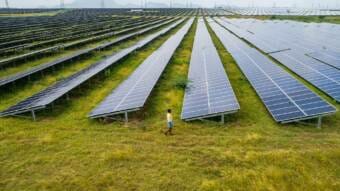
The report finds the world’s energy supply needs to shift to renewable sources, like this solar farm in Karnataka, India, but it’s not happening fast enough. (Photo by Abhishek Chinnappa/Getty Images)

The world still has time to avoid the most extreme dangers of climate change, but only if nations cut greenhouse gas pollution much faster from nearly every aspect of human activity, according to a landmark international climate science report.

The technology and solutions are available to rein in emissions, but the world is rapidly running out of time to deploy them, the report notes.

“It’s now or never,” says Jim Skea, professor of sustainable energy at Imperial College London and one of the co-chairs overseeing the report. “Without immediate and deep emissions reductions across all sectors, it will be impossible. ”

The report issued on Monday is the latest by the Intergovernmental Panel on Climate Change (IPCC), a United Nations body that brings together the world’s researchers to assess the prevailing science on planetary warming. The new report looks at worldwide efforts to cut greenhouse gas emissions and recommends next steps to keep global average temperatures from rising to catastrophic levels.

Nations and industries need to make faster, deeper cuts to heat-trapping pollution. Average annual greenhouse gasses in the last decade were the highest in human history, which means the world is not on track to limit global warming to 1.5 degrees Celsius (2.7 degrees Fahrenheit), the report says. With warming beyond that level, the planet will see increasingly dangerous heat waves, floods and storms that would affect millions of people, especially the most vulnerable.

As a crucial near-term step, “substantial reduction” in the use of fossil fuels like coal, oil and natural gas would need to happen, the report finds. By 2050, low-carbon energy like solar and wind power will need to supply the majority of the world’s energy.

Experts say this report, part of a scientific assessment done roughly every seven years by the IPCC, is likely the last to be published while the key goal of limiting warming to 1.5 degrees Celsius is still possible.

The report’s final summary was adopted after marathon negotiations among the 195 member countries of the IPCC. Some countries wanted to see more support for fossil fuel use in developing countries, as well as larger demands on developed nations to reduce emissions. Industrialized nations are the biggest emitters of greenhouse gasses, with the United States being the largest polluter over time.

The report builds on the dire warnings of two others also released in the IPCC’s Sixth Assessment Report. The first documented how heat-trapping emissions from burning fossil fuels were the “unequivocal” cause of rising temperatures. The second, released in late February, showed how billions of people around the globe are at risk of more extreme disasters.

This latest report comes amidst a renewed push for oil and gas drilling, as the war in Ukraine drives a spike in oil prices. Carbon emissions already roared back to their highest levels ever in 2021, rebounding after a decline during the pandemic.

“The truly dangerous radicals are the countries that are increasing the production of fossil fuels,” U.N. Secretary-General António Guterres said in a speech. “Investing in new fossil fuels infrastructure is moral and economic madness.”

#1 – Grow renewable energy. It’s cheap enough

The report lays out what scientists consider to be the most effective steps to reducing emissions fast. The clearest is accelerating the use of renewable energy and cutting fossil fuels. The cost of solar energy has plummeted by 85% since 2010, according to the report. Batteries have fallen by the same amount, a key technology for storing solar and wind power so it can be used when it’s dark or the wind isn’t blowing.

That makes low-carbon energy sources more economically viable than fossil fuels in many cases, the report finds. They also improve public health, since renewable energy doesn’t produce air pollution. Still, renewables are not being deployed fast enough, especially in developing countries.

A masked person in a parka walking in a city with many tall stacks emitting white smoke in the background
Heat-trapping emissions from burning fossil fuels, like these coal-fired power plants in Shanxi, China, have rebounded after dropping during the pandemic. (Photo by Kevin Frayer/Getty Images)

In order to limit warming to 1.5 degrees Celsius, the world’s energy supply would need to reach net-zero as soon as 2050, which means if the sector is still producing emissions, those emissions are captured in some way before reaching the atmosphere. That’s because other areas, like heavy industry and transportation, would likely take longer to fully cut their emissions.

Continuing the world’s existing fossil fuel energy projects at their current pace, as well as developing new ones, puts the energy sector nowhere near that necessary trajectory. The emissions from fossil fuel use would be almost double the amount needed to keep warming to 1.5 degrees Celsius. And as renewable energy grows, trillions of dollars of fossil fuel infrastructure risks becoming “stranded”, or worthless, as governments shift to cleaner energy sources.

“The sobering conclusion is that, although we have all the tools we need, emissions would need to decrease immediately and at a much larger scale than they have been,” Stephanie Roe, one of the lead authors of the IPCC report and Global Climate and Energy Lead Scientist at the World Wildlife Fund.

#2 – We’ll probably need to suck carbon emissions out of the air

Even if the world rapidly transforms where its energy comes from, some aspects of modern life will take longer to shift from fossil fuel use, like airplanes, shipping and heavy industry. Gas-powered cars being bought today will also remain on the road for potentially decades.

New technology could eventually transition those industries and vehicles away from fossil fuels. But the delay means that to avoid extreme warming, countries and companies will likely have to remove some of the carbon dioxide emissions that are already in the atmosphere, the report finds.

The most tried and tested method uses Mother Nature. Plants and soils are carbon sponges. So restoring forests and wetlands can help soak up emissions, providing a relatively low cost way of making up for emissions from other sources.

The report also points to more cutting-edge approaches, like using technology to suck carbon emissions directly from the air. That process could potentially use large amounts of energy, which would negate its climate usefulness. Some climate activists also worry it could amount to a free pass for the fossil fuel industry to keep operating and pumping out greenhouse gas emissions. The technology has a long way to go before it could make a large impact on the atmosphere, the report concludes.

#3 – Your decisions matter to slowing climate change

Changing the way humans work, live and eat in cities and buildings can have a major impact on reducing emissions, as much as 40-70% in some of those sectors, the report finds.

The report is not just talking about recycling. Redesigning and zoning cities so people live closer to where they work and can walk and bike could reduce transportation emissions by as much as a third, the report says. Electric cars that are charged with renewable energy from the grid would reduce fossil fuel use. Making buildings more energy efficient and using renewable energy like solar has a decades-long impact.

With many cities around the world still growing and urbanizing, building in a sustainable way is especially important in developing countries, the report finds. Cities are vulnerable to flooding and air pollution, as well as extreme heat waves made worse by the way pavement absorbs heat.

“There is a really amazing role that we can play, not just as consumers, but also as professionals,” Roe says. “If you’re a builder, if you’re an urban planner, if you’re an influencer or a role model, you have a role to play. And it’s not about individual actions necessarily. It’s about individual actions that make cascading impacts across society.”

Copyright 2022 NPR. To see more, visit https://www.npr.org.

Biden’s Coast Guard pick would become the 1st woman to command a military branch

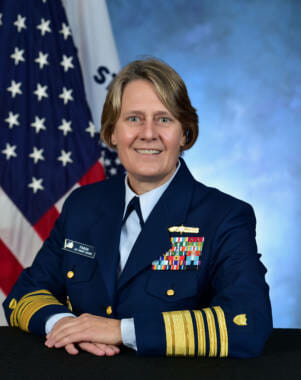
A formal Coast Guard portrait of Admiral Linda Fagan next to an American flag
Admiral Linda Fagan has been nominated to serve as the next commandant of the U.S. Coast Guard. If confirmed, she would be the first woman to lead a branch of the U.S. military. (U.S. Coast Guard photo)

President Biden has nominated Adm. Linda Fagan to serve as the next commandant of the U.S. Coast Guard, the administration announced Tuesday.

If confirmed, Fagan would be the first woman ever to lead a branch of the U.S. military, lawmakers said.

“Admiral Fagan’s nomination will inspire generations of American women to strive to serve at the highest level in the Armed Forces,” said Sen. Maria Cantwell, D-Wash., chair of the Senate Commerce Committee.

The Senate Commerce Committee has jurisdiction over the Coast Guard and is tasked with approving all promotions of the service’s officers.

“.@POTUS has finally nominated an outstanding leader for @USCG,” the Senate Commerce Committee Republicans said in a tweet. “It is important for the Commerce Committee to proceed efficiently so the Coast Guard is not left without a leader.”

If confirmed, Fagan would replace the current commandant, Adm. Karl Schultz, who is retiring. A change of command ceremony in Washington, D.C., is planned for June 1.

“Admiral Fagan is an exceptional senior Coast Guard officer and nominee, possessing the keen intellect, the depth of operational experience, and the well-honed leadership and managerial acumen to serve with distinction as our Service’s 27th Commandant,” Schultz in a statement.

Fagan, who has served on all seven continents, is currently the Coast Guard’s vice commandant, acting as second-in-command at the branch and executing the commandant’s strategic intent, among other duties.

Copyright 2022 NPR. To see more, visit https://www.npr.org.

Amid war in Ukraine, Juneau Assembly decides to maintain sister city relationship with Vladivostok

Zolotoy Bridge in Vladivostok
The Zolotoy Bridge crosses Golden Horn Bay in Vladivostok, Russia, pictured here on Sept. 20, 2019. (Creative Commons photo by porkandchicken)

Juneau and the Russian Far East city of Vladivostok have been sister cities since October of 1991. In recent years, the relationship has been largely dormant.

On Monday night, the Juneau Assembly considered formally suspending that relationship because of Russian President Vladimir Putin’s unprovoked war in Ukraine.

Since the sister city agreement was signed, locals have hosted visitors from Vladivostok. Students from Vladivostok qualify for in-state tuition at University of Alaska schools. The last Russian student to use the perk at the University of Alaska Southeast was in 2009, according to academic exchange and study abroad coordinator Dashiell Hillgartner. The student was from Yelizovo, a sister city with Homer. Juneau residents have gone to Vladivostok on educational, business and cultural exchanges too.

Like in 2018, when the Alaska String Band toured over there with support from the U.S. Department of State. The U.S. Consulate organized a July 4th concert in Vladivostok.

During the July 4th concert, the band covered The Beatles’ 1968 song “Back in the U.S.S.R.” They played with the lyrics in a way that hasn’t aged well.

“Well the Ukraine boys really knock me out
They leave the West behind
And the Moscow boys, they make me scream and shout… ”

On Monday, the Juneau Assembly was one vote short of suspending the sister city relationship. Deputy Mayor Maria Gladziszewski led the push. She said she felt like the Assembly had to do something, between the governor calling on cities to sever these ties, hearing the Ukrainian president during the Grammys and reading tweets from former U.S. ambassador to Russia Mike McFaul.

Obviously, this is not going to end the war in Ukraine. It’s a pebble. And if it helps a few people in Vladivostok think twice about what’s happening in Ukraine, and if they talk to their friends about it, and they think twice about it, perhaps eventually they could be moved to action,” Gladziszewski said.

Gladziszewski’s resolution also would have condemned Russian President Vladimir Putin and voiced support for Ukraine and its people.

The Assembly voted the resolution down, 4 to 5. Gladziszewski, Michelle Hale, Wade Bryson and Greg Smith voted yes. Beth Weldon, Carole Triem, Alicia Hughes-Skandijs, Christine Woll and Barbara Wáahlaal Gíidaak Blake voted no.

Some members said suspending the sister city status defeated the purpose of the arrangement in the first place: to promote peace and prosperity through citizen diplomacy.

“This is meant to bridge and build connection with our sister city in a way that allows for two-way communication,” Wáahlaal Gíidaak said. “Suspending that and saying we’re no longer going to communicate with you, cancels our ability to do that and also cancels their ability to communicate back to us.”

The Russian government has criminalized free speech about the war and used state media to spread false narratives about it. That’s part of why Sister Cities International, the nonprofit that facilitates these relationships, has also urged against cutting these ties.

“This is not a war that’s being led by the Russian people,” said Leroy Allala, president and CEO of the nonprofit. “It’s a war by Putin and the military and, you know, I think everyone is on the same page when they say that this war was unprovoked by Ukraine and the Ukrainian people.”

Over the years, several elements of the original sister city agreement have been neglected. It calls for at least one annual official visit from each city to the other, and a free flow of information and ideas between residents. The agreement says each city will allow freedom of communication and association in sister city activities, which now seems impossible in Putin’s Russia.

Assembly member Alicia Hughes-Skandijs said the public emailed support and opposition.

“But some of the emails we received in favor of this resolution shocked me, and only convinced me that voting against this would be the right thing to do,” she said. “They were extreme in their characterization of the Russians as a people. And it reminded me of exactly what I don’t want us to do, which is to go into a sort of Red Scare situation.”

After the resolution failed, the Assembly asked Mayor Beth Weldon to send a letter to her counterpart in Vladivostok that conveys the Assembly’s condemnation of Putin and the war, and its support for Ukraine.

Gladziszewski said she hopes the discussion renews interest in Juneau’s Sister Cities Committee.

“Our relationships with our sister cities wax and wane depending on who’s on that committee,” Gladziszewski said. “It was super strong in the early ’90s. There were people super interested in Vladivostok. As you heard, people — Vladivostokians, if that’s a word — came to Juneau. And it’s waned in recent years. It just has. So this, ironically, could reinvigorate that, and I hope that it does.”

For several months, the volunteer committee responsible for nurturing relationships between Juneau and its sister cities hasn’t had enough members to operate. Four out of seven seats on the committee are vacant.

Residents can apply to be members on the boards and committees page of the city’s website.

Juneau also has sister city status with Kalibo in the Aklan province of the Philippines and Whitehorse in the Yukon Territory of Canada.

Correction: An earlier version of this story misstated that Russian students had never attended UAS. There have been at least three since 2009.

Site notifications
Update notification options
Subscribe to notifications