Subsistence

As the Arctic warms, a changing landscape on the Chukchi Sea


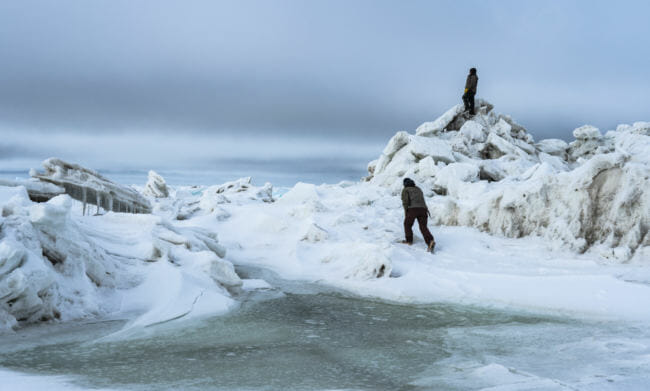
Ice researcher Andy Mahoney, joining polar bear guard Robert Nageak at the top of a pressure ridge on the Chukchi Sea off Utqiaġvik. In decades past, this landscape would have been full of much taller pressure ridges and more of them, partly due to the presence of thicker ice that survived more than one summer. That type of ice is disappearing as the Arctic warms.  (Photo courtesy of Rowan Romeyn).

It’s well established that Arctic ice is changing in dramatic ways. As the climate warms, ice coverage is decreasing, the amount of multiyear ice has gone down significantly and in Alaska, many communities are seeing the ice come in later, and leave sooner. So, what do those changes look like up close?

On a late-May evening, about a dozen graduate and post-doctoral students gather at the north edge of Utqiaġvik, by the Barrow Arctic Research Center. They’ve come to Alaska for an Arctic field school and are about to go out onto the sea ice, led by two men who have logged a lot of time out there.

One is Craig George, a wildlife biologist with the North Slope Borough since the early 1980s. He’s spent months of his life on the ice in this part of Alaska, often camped out for days or weeks at a time doing bowhead whale counts, and helping to measure and sample whales during spring whaling.

The other is Andy Mahoney, an ice researcher at the University of Alaska Fairbanks who has been coming up to Utqiaġvik for the past 18 years to study sea ice.

“Craig was there at the very beginning of my sea ice career,” Mahoney says by way of introducing George to the group.

“During the Pleistocene,” George quips.

“During the Pleistocene, yeah,” says Mahoney, “back when ice used to be ice. Before this ‘new ice’ that we’ve got now.”

The group piles onto snowmachines, and charts a path toward the Chukchi Sea, whipping over snow-covered lagoons, down the slope leading to the ocean, and over several miles of relatively flat ice close to shore.

Then, the surface gets rougher. Big piles of broken ice start appearing — pressure ridges; they’re created when big chunks of floating ice bump up against the shore-fast ice the group is snowmachining on, forcing it to crumble and push both up above the surface, which you can see, and down below it, which you can’t.

The group stops to get off the machines and look around. As Craig George surveys the landscape, he says he sees a lot of differences from when he started coming out here decades ago.

“The ice tells you what it’s made out of, when it formed,” he says. “The ridges… see the thickness? So that’s relatively thin first-year. I haven’t seen any multiyear.”

Multiyear ice is ice that’s survived at least one summer. It’s usually several feet thicker than the ice that forms and melts away in a single year. Back in the ’80s, George says he used to see a lot of it out here.

“First/second year ice looks like the Rockies, the Rocky Mountains,” George said. “And the old multiyear ice looks like the Appalachians, sort of rounded.”

A few decades ago, sixty-one percent of the ice on the Arctic Ocean was multi-year ice. Now it’s about half that.

One reason that multiyear ice matters is that it’s one of the ways the Arctic stays cold. Ice reflects heat from the sun, while water traps it. So if a ton of ice stops being ice during the summer, and instead becomes water… the Arctic is going to get warmer. Which means it won’t be able to help keep the rest of the earth cool.

The students clamber up onto a 20-foot pressure ridge. Out to the north is a seemingly endless field of ice rubble — sharp blue shards jutting up in every direction. No rounded Appalachians here.
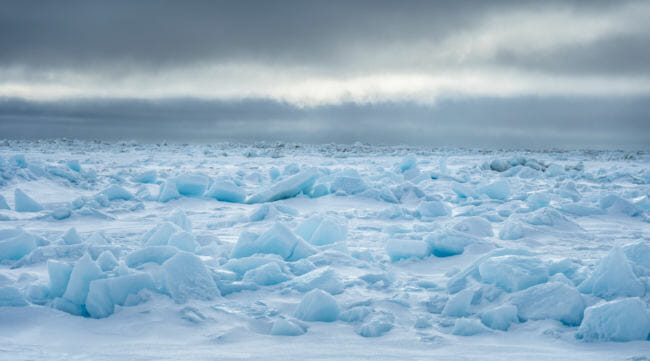
A field of ice rubble, pictured from the top of a pressure ridge. All of this ice is “first-year” ice, which means it was formed sometime in the last year. (Photo courtesy of Rowan Romeyn).

The lack of multiyear ice doesn’t just mean that certain shapes are jagged when they used to be round. Andy Mahoney says it helps explain why the landscape looks different in other ways.

“These ridges that we’re standing on, there would have been more of them, and they would have been bigger,” Mahoney says. “So it really has changed. I mean you look back at some pictures of that era, and the features that we now see, they’re something of a shadow from the past.”

There are other changes too. The ice here is forming later, and in some places this year was record thin.

But that doesn’t necessarily translate to a bad ice year for people who depend on the ice, like hunters here in Utqiaġvik. Yes, it means the window of time to hunt certain animals on the ice is shorter. But when it comes to the ice conditions that make for a good whaling year, wind, currents and weather play a huge role too.

“Weather, it plays a big factor in our hunt and this year the weather was pretty windy,” said Joseph Leavitt, an Utqiaġvik whaling captain. “Pretty windy but… our ice stayed solid… there was hardly any current on the ocean, and so it turned out to be a good year. At least, we got eight whales.”

Billy Adams is another whaler who works for the North Slope Borough Wildlife Department. He said that yes, ice is freezing later, and yes, parts are thinner, but even as they see changes in the ice, whalers are adapting.

“We just make changes to how we’re going to hunt, and when we’re going to hunt. That’s the biggest thing,” Adams said.

So even as the ice continues to change, whalers say they will keep finding ways to bring whales home to the community.

Investigation closes on Kuskokwim gray whale killing

The whale killed in the Kuskokwim River on Thursday night is butchered and the meat and blubber distributed to people up and down the river. (Photo by Katie Basile / KYUK)
The whale killed in the Kuskokwim River last summer is butchered and the meat and blubber distributed to people up and down the river. (Photo by Katie Basile / KYUK)

A letter closes the investigation into the gray whale killed last summer on the Kuskokwim River.

The final enforcement outcome was a slap on the wrist nine months after the whale swam up the river.

Local hunters discovered the whale swimming in the river near Bethel and killed it. The animal was later retrieved and butchered.

Those involved received letters from the federal government explaining that gray whales are protected and that it is illegal to kill one.

Alaska Natives can harvest certain species of whales under the Marine Mammal Protection Act and the Endangered Species Act.

The gray whale cannot be harvested for subsistence in Alaska without a quota from the International Whaling Commission.

The letters were sent by the National Oceanic and Atmospheric Administration’s Office of Law Enforcement and its Office of General Counsel in consultation with the U.S. Attorney’s office.

They outlined the law, the limitations on subsistence whaling and what is required to hunt and harvest whales.

Salmon are beginning to show up around Bristol Bay

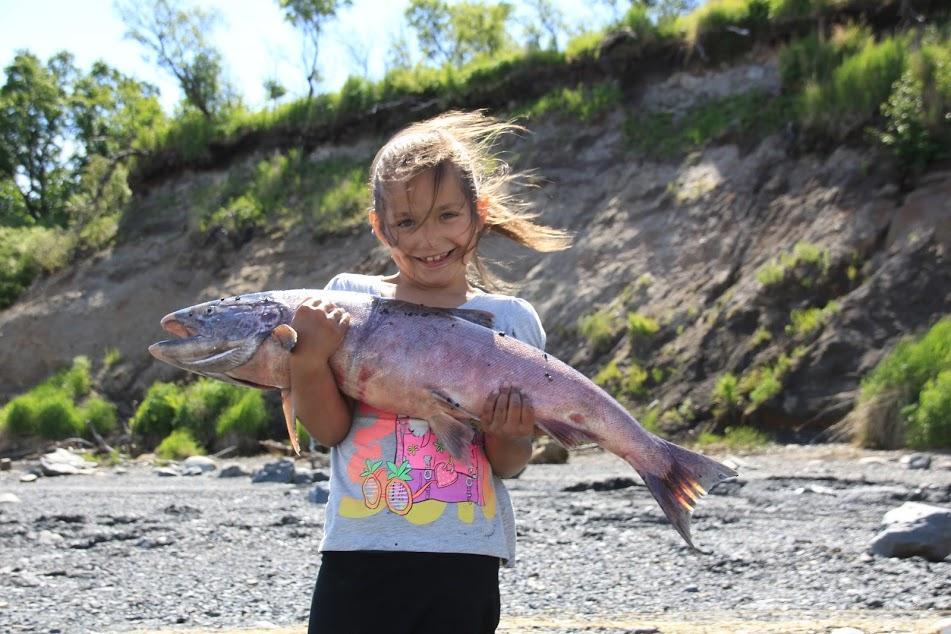
A young fisher-woman displays a King caught on Kanakanak Beach in 2017. (Photo courtesy Sarah Grace Durrance)

Salmon are beginning to hit the nets of subsistence fishermen around Bristol Bay.

Eddie Clark was fishing at coffee point near Egegik last week when he got his first salmon.

“Put the net out and got a dog on May 23,” he said. “We usually put the net out for a little bit every tide. Then around May 25, got one red.”

Clark also said he had heard that at least one king had been caught around Egegik last week since a friend in the village got to sit down to a meal of chinook.

“He enjoyed a king steak on the 25th, but he did not catch it,” Clark said. “They did get a King in Egegik on May 25, and we’ve been fishing one tide a day since then, but nothing.”

On the west side of the bay, fishermen in Clarks Point are beginning to have some luck as well.

Robert Wassily said his season didn’t start off with a bang, but, recently, he pulled in his first king of the season.

“Mine was pretty slow, but I got one, probably, 15 (or) 20 pounder, so far,” he said. “And, a couple other nets caught a couple more.”

It’ll take at least four more kings, Wassily said , for him to feel satisfied. He, also, says other than some chinook, there’s also been talk of one red salmon, a chum, and some trout being caught near Clarks Point.

Bobbie McCarr caught two kings near Dillingham, and there are reports of at least one king caught in Koliganek.

The Alaska Department of Fish and Game office in King Salmon, on the other hand, says things are pretty quiet at this point on the East side of the bay.

Hundreds of protesters turn out against ANWR coastal plain exploration

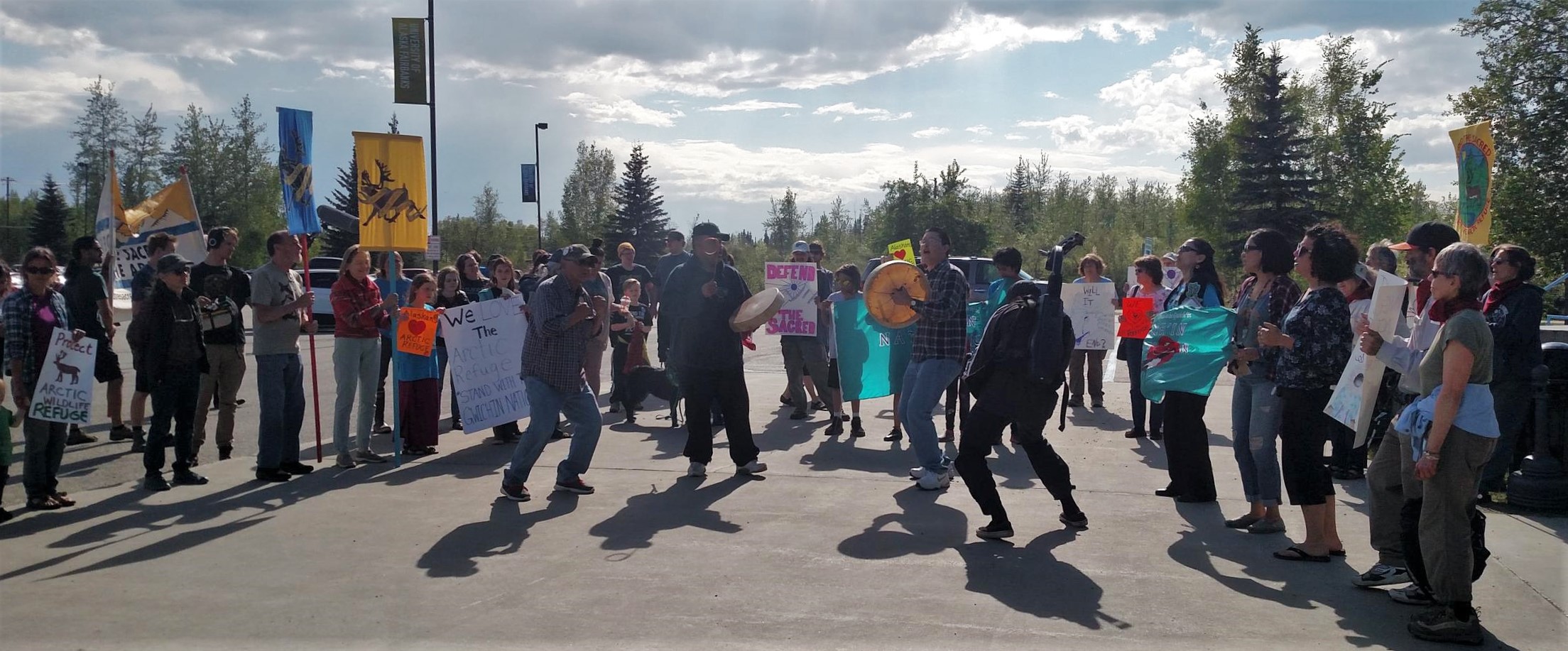
Athabascan drummers Travis Cole, Sunny Luke and Norman Carlo lead protesters to the Carlson Center in Fairbanks on Tuesday, May 29, 2018. The Bureau of Land Management was meeting on the federal plan to lease portions of the ANWR coastal plain for oil and gas development.
Athabascan drummers Travis Cole, Sunny Luke and Norman Carlo lead protesters to the Carlson Center in Fairbanks on Tuesday, May 29, 2018. The Bureau of Land Management was meeting on the federal plan to lease portions of the ANWR coastal plain for oil and gas development. (Photo by Tim Ellis/KUAC)

About 250 people turned out Tuesday at a meeting in Fairbanks to offer comments on a federal plan to launch an oil and gas leasing program in the coastal plain of the Arctic National Wildlife Refuge. Most of those who showed up for the meeting at the Carlson Center oppose the plan, because they say it would disrupt caribou calving season and harm Alaska Native subsistence, culture and the environment. Backers of the plan say coastal-plain development would boost Alaska’s economy.

Eighty-four people signed up to talk about the plan to open the coastal plain to oil and gas development. By the time a half-dozen of them had spoken, nearly 100 protesters showed up outside the Carlson Center to offer their public comments.

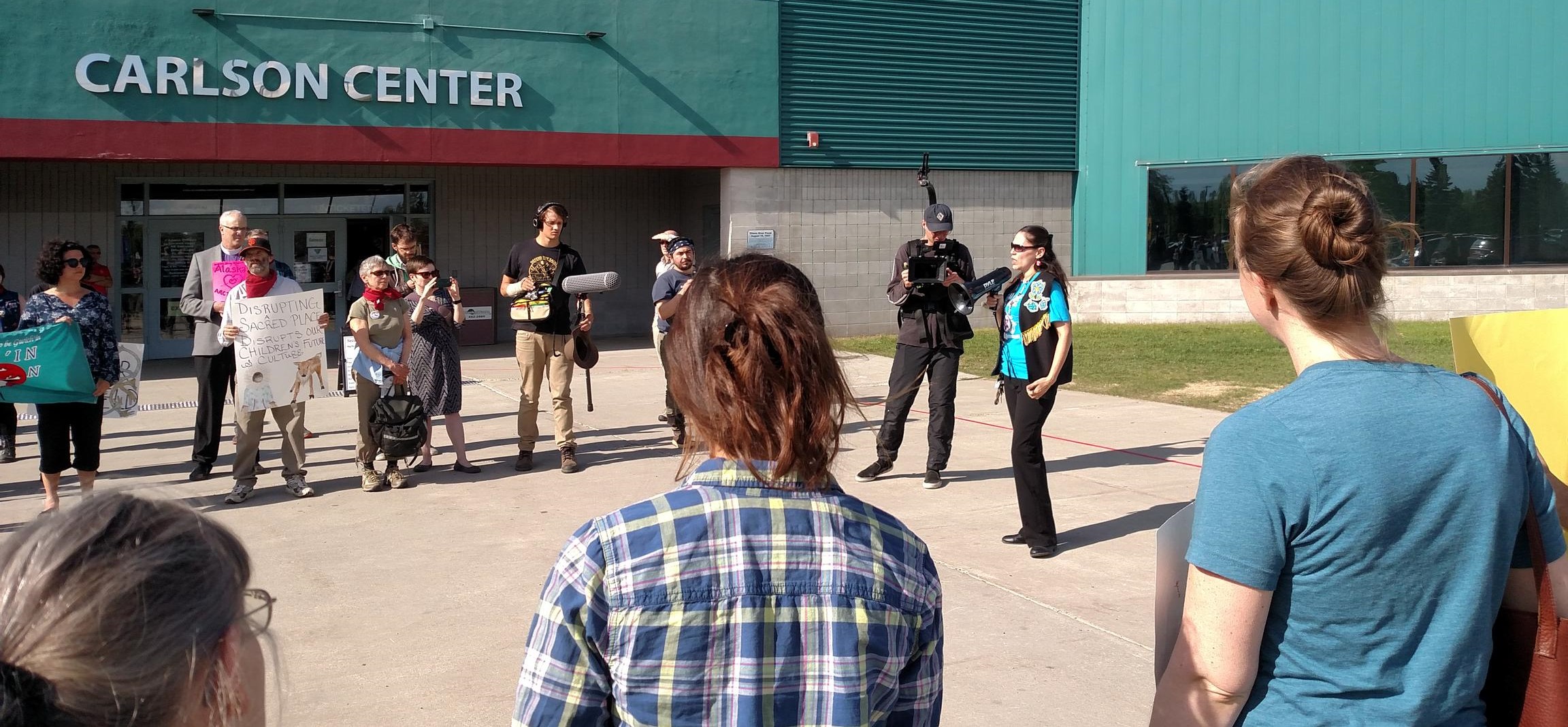
“I do have hope and faith that the Alaska Natives are going to stand up and they’re going to put a stop to this,” Fort Yukon Gwich’in Bernadette Demientieff told the crowd with a bullhorn. “Because when it comes down to it, we’re all going to be affected. Climate change don’t care if you’re upriver or downriver. We’re going to all live with the effects.”

Fort Yukon Gwich’in Bernadette Demientieff, of the Gwich'in Steering Committee addresses protesters during their rally at the Carlson Center in Fairbanks on May 29, 2018. After the protest, they went inside and joined the meeting to offer testimony against opening ANWR's coastal plain to oil and gas development.
Fort Yukon Gwich’in Bernadette Demientieff of the Gwich’in Steering Committee addresses protesters during their rally at the Carlson Center in Fairbanks on May 29, 2018. After the protest, they went inside and joined the meeting to offer testimony against opening ANWR’s coastal plain to oil and gas development. (Photo by Tim Ellis/KUAC)

Demientieff is executive director of the Gwich’in Steering Committee, which opposes development on the ecologically fragile coastal plain. Princess Daazhraii Johnson, the committee’s former executive director, said members of the organization and the Fairbanks Climate Action Coalition came to tell federal officials presiding over the meeting that oil and gas exploration will harm the Porcupine Caribou Herd and other wildlife that provides subsistence to Native peoples.

“I wouldn’t be standing here today if it wasn’t for that Porcupine Caribou Herd, if it wasn’t for the tsook-cho, the king salmon,” Johnson said.

Meanwhile, inside the Carlson, representatives from industry and labor and officials with the state Department of Natural Resources accentuated the positive. Kara Moriarty is executive director of the Alaska Oil and Gas Association, and she said extracting the coastal plain’s hydrocarbons could bring economic benefits like those that came from development of the North Slope and construction of the Trans-Alaska Pipeline System.

“It goes without saying that Alaska’s economy relies heavily on the oil and gas industry,” Moriarty said. “One-third of all jobs in the state of Alaska can be attributed back to the oil and gas industry.”

John Hopson Junior is mayor of Wainwright and president of the North Slope Borough. And he said his community and others in the region depend on the industry. “Oil and gas property tax is what pays for our services, when it comes to police and fire and schools and public works,” Hopson said.

But Steve Ginnis, the traditional chief of the Fort Yukon-based Gwichyaa Zhee Gwich’in Tribal Government, said federal officials should not proceed with developing an environmental impact statement or EIS for the lease sales because they haven’t adequately invited public comment from residents of communities that would be most affected by coastal plain development.

“I don’t understand how the United States government, and the Congress of the United States, could shortcut the process, to do what’s going on here today,” Ginnis said.

Rhonda Pitka is chief of the Village of Beaver, and she said federal officials should double the 60-day public comment period for the EIS. She said the feds should stage more meetings in Gwich’in communities and talk directly with tribal government officials — with an interpreter.

“Our chiefs are requesting that you come and consult with us,” Pitka said. “I’m requesting government-to-government consultation in the Village of Beaver. I also sent in a letter requesting that the materials be translated in Gwich’in, for our Gwich’in speakers. And that you also bring along translators.”

Village of Beaver Chief Rhonda Pitka and Assistant Interior Secretary for Lands and Minerals Management Joe Balash.
Village of Beaver Chief Rhonda Pitka and Assistant Interior Secretary for Lands and Minerals Management Joe Balash. (Photos by KUAC)

Pitka also said the meetings should be scheduled for later, because many Gwich’in are away from their villages at fish camps, preparing to harvest salmon.

“Our tribal members right now are getting ready for our subsistence season,” she said. “I’m actually missing out on getting my grandma’s fish camp ready for the fishing season.”

But scheduling the meeting around hunting and fishing seasons can be tricky, said Joe Balash. He’s a former state natural resources commissioner who now serves as an assistant secretary of the Interior, and he was one of the seven federal officials presiding over the meeting.

“The folks that live on the North Slope and participate in the whaling the season — y’know, the spring season has more or less just concluded, and there’ll be a fall season,” he said, “and we’ve got to watch that window as well.”

Balash said during a break in testimony that translating documents would be a new requirement that federal officials may want to consider, along with adjustments to the public meeting schedule. He said the first meeting in Kaktovik that was postponed has been rescheduled for next month. The next scoping meeting will be held tonight in Anchorage, followed by another on Thursday in Utqiagvik.

Public comments on the leasing program plan EIS are due by June 19.

Fishermen harvest hooligan by the bucketful on Chilkoot and Chilkat

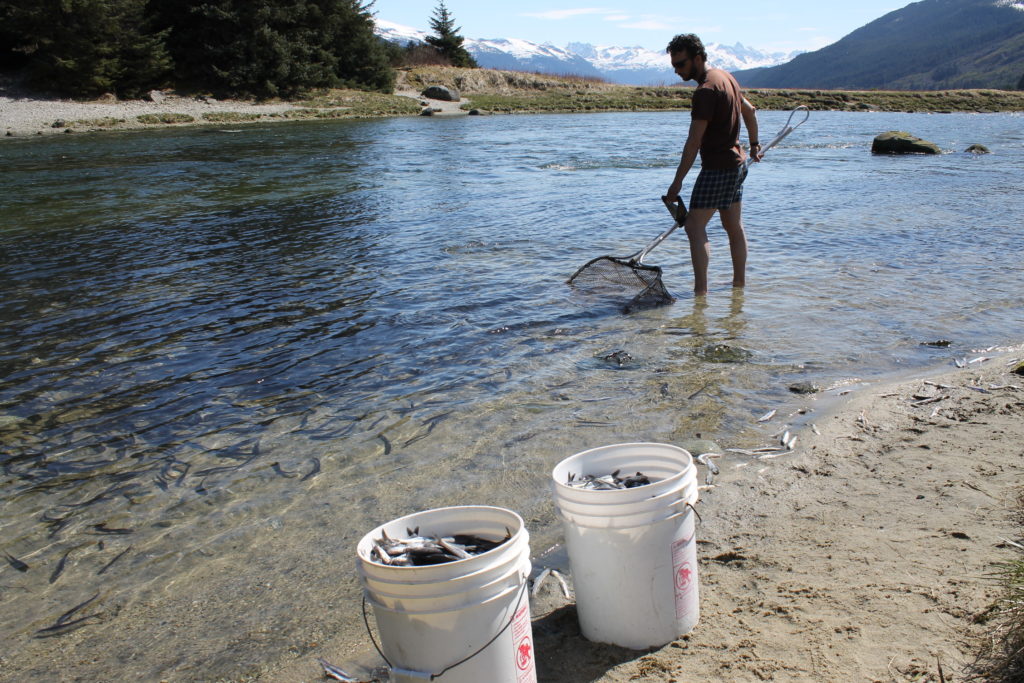
Zephyr Sincerny nets hooligan to keep as a healthy treat throughout the year. (Photo by Henry Leasia/KHNS)

Once again, the Chilkat and Chilkoot rivers are turning black with little fish scrambling upstream.

The eulachon, commonly known as hooligan, are running in full force and all kinds of different species are loving it.

At the mouth of the Chilkoot river, there’s a feeding frenzy happening.

Birds dip beaks and talons into the water, pulling out small black and silver fish with every swoop.

Off in the distance, a raft of sea lions gorges on the scaly bounty of the lutak inlet. A couple humans are enjoying the run as well.

Zephyr Sincerny waded out in the river barefoot, scooping up hooligan with a net.

He said his net is a bit heavy for harvesting the fish, but he has worked out a system.

What I end up doing is I take it out into the fish and set it on the bottom a little bit, and then I just wait,”  Sincerny said. “They usually end up flowing back and kind of swimming into the net or settling into it. Then I just lift up, and out we go.”

Sincerny said the run seems a little bit smaller than last year, but in just 20 minutes he can fill two 5-gallon buckets. That is all he needs.

At home, he will smoke, brine and add spices to the fish. Then he will vacuum seal and freeze them to enjoy for the rest of the year. He always makes sure to set aside some fish for his dog, though.

“You know we were buying fish oil to feed him, and that didn’t make a lot of sense figuring that that’s pretty expensive and we have a really great resource,” Sincerny said.

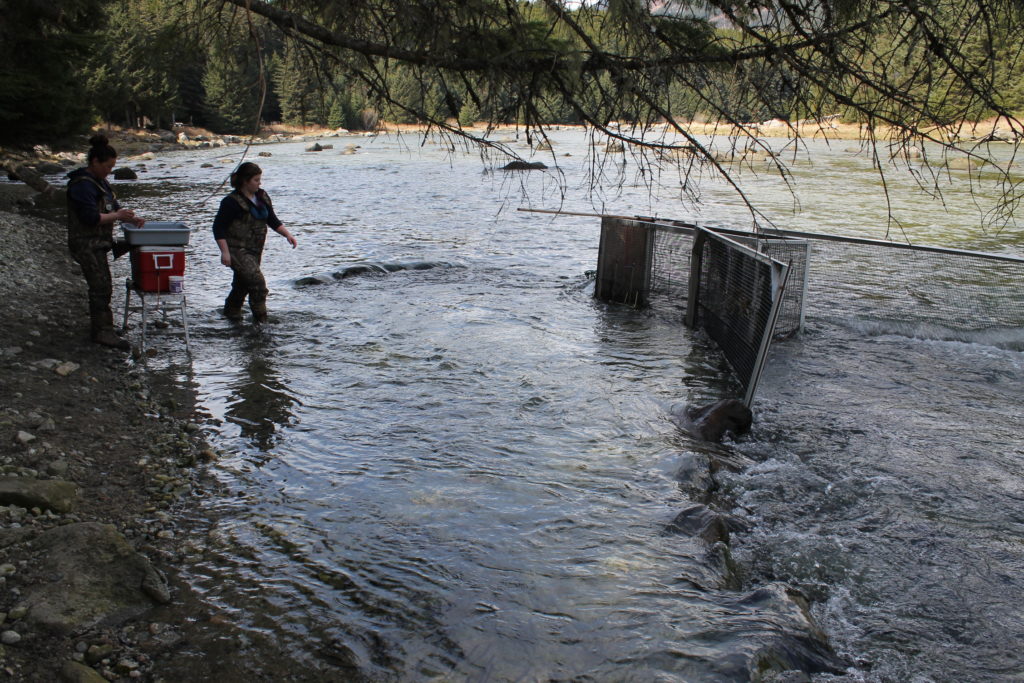
Just upstream from Sincerny, a team of researchers from the Chilkoot Indian Association collected data for a study on hooligan.

Shaleena Bott is doing an internship with the association.

She used a metal Y-shaped fish trap to collect the fish.

Researchers from Takshanuk Watershed Council mark hooligan on the Chilkoot River. (Photo by Henry Leasia/KHNS)

“We are capturing some hooligan, and we’re clipping the adipose fin. And then we’ll send up another team in a little bit to go up and count each of the hooligan to see if we can either see a marked fish or not. And then we put in a bunch of numbers to see what their biomass is,” Bott said.

Despite their popularity and abundance during runs, little is known about hooligan.

Takshanuk Watershed Council executive director Meredith Pochardt, who is involved in the hooligan study, said researchers are still trying to figure out questions about their life cycle.

Do they actually die after they spawn? There’s also some evidence that points to maybe having multiple spawners in certain populations,” Pochardt said. “And also learning a bit more about the age they return to the rivers.”

Unlike salmon, it is believed that hooligan return to a stream in their region rather than the stream where they were spawned.

The location they return to depends on a variety of factors, Chilkoot Indian Association fisheries specialist Ted Hart said.

“Usually see a good amount go to Chilkoot, so I think they might prefer Chilkoot,” he said. “But if the conditions aren’t right then they’ll head off and they can go to Skagway or they can go Ferebee also, or the Katzehin.”

The Indian association started collecting data on hooligan populations on the Chilkoot River eight years ago.

Last year the association secured a grant for the study, and with help from the Takshanuk Watershed Council the research has expanded to 11 different rivers around the Upper Lynn Canal.

Pochardt said this has given a much broader perspective on the fish.

“When we have the lower returns on the Chilkoot, that perhaps doesn’t mean that the whole northern Lynn Canal population is in decline, that could mean that maybe another river is seeing a higher return than normal,” Pochardt said.

For generations, people have subsistence fished for hooligan, or saak in Tlingit.

Hart said the oil from the fish has countless health benefits and has long been a valuable resource for this region.

“It’s like liquid gold,” Hart said.

He hopes this research will ensure that future generations can depend on this harvest.

This year’s run was a few days later and smaller than last year’s unusually large run of 12 million fish.

Hart attributed this to colder temperatures this spring that kept Chilkoot lake frozen for longer.

“Presumably, some came up to the Chilkoot and the river may have been too low, so some decided to go over to the Taiyasanka,” Hart said. “Looked like a pretty decent showing over there.”

Initial estimates show that 8.7 million hooligan came back to the Chilkoot this year.

Fears over caribou, access vs. mining’s economic promise — BLM releases public input on Ambler Road

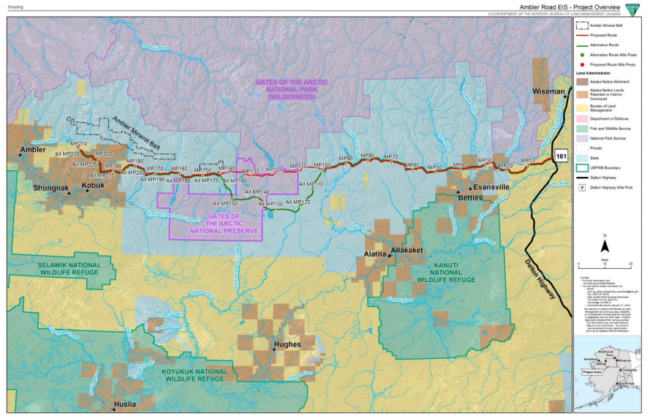
A map of the proposed Ambler Road project. The Bureau of Land Management has just released a summary of the public comments on that project. (Graphic Courtesy of HDR for the Bureau of Land Management.)

The Bureau of Land Management received thousands of public comments on the controversial proposed Ambler Road during the scoping period for the project, which ended in January. The BLM released a summary of those comments this week.

The road, which is proposed by the state, would begin at the Dalton Highway and run over 200 miles west, along the southern edge of the Brooks Range. Proponents say it’s needed to develop the Ambler mining district.

Tim La Marr with BLM said the agency received input from people on all sides of the issue.

“I was impressed with the range of comments that we got,” La Marr said. “Comments from the mining industry, comments from environmental groups, a lot of comments from the tribes… comments from people throughout Alaska and people in the Lower 48 as well.”

La Marr said that of the 7,000 or so written comments, most were form emails. But over 800 were unique messages, many with substantive suggestions for issues that BLM should consider as they assess the impacts of building the road.

Some of those comments argue the road will lead to job growth and economic benefits for the state. Others raise concerns that it would disrupt the Western Arctic Caribou Herd’s migration, or enable more drugs and alcohol to enter rural communities.

A topic that came up often in the comments was who would have access to the road. The state says the road will only be permitted for non-public, industrial use. But a number of people who commented questioned the state’s ability to keep the road closed to the public, especially over the long term.

“A lot of those comments stem from the concern that if it is opened up to public use, then that opens up a huge area in Alaska that sport hunters and fishermen can start to… use those resources at the expense of subsistence uses,” La Marr said.

The comments will help the agency develop an environmental impact statement for the project. That assessment will underpin BLM’s decision on whether to allow the road to be built on federal land.

The state is funding the federal environmental review process. The legislature appropriated funding for the project in the past, but Governor Walker has only allowed a portion of that to be spent so far.

BLM says the state has provided funding through the end of the scoping phase of the Environmental Impact Statement process. To complete the EIS, the state will need to provide BLM with additional funds.

Site notifications
Update notification options
Subscribe to notifications