SJR 4 was sponsored by Sen. Donny Olson of Golovin, who said in a written statement, “while I understand the intention of some states to stop the atrocious poaching of African elephants for ivory, there exists a distinguishing feature between Alaskans who use the byproducts of harvest and those who go out to poach elephants.”
The Marine Mammal Protection Act protects Alaska Natives’ rights to harvest walrus and use the animal to create handicrafts for sale in the U.S.
Despite these protections, local and regional, entities such as Kawerak, have pushed for this resolution to prevent what they see as harmful effects on the Alaska ivory market, because of a lack of understanding.
Senate Joint Resolution 4 has been sent to the Alaska House Community and Regional Affairs Committee for consideration.
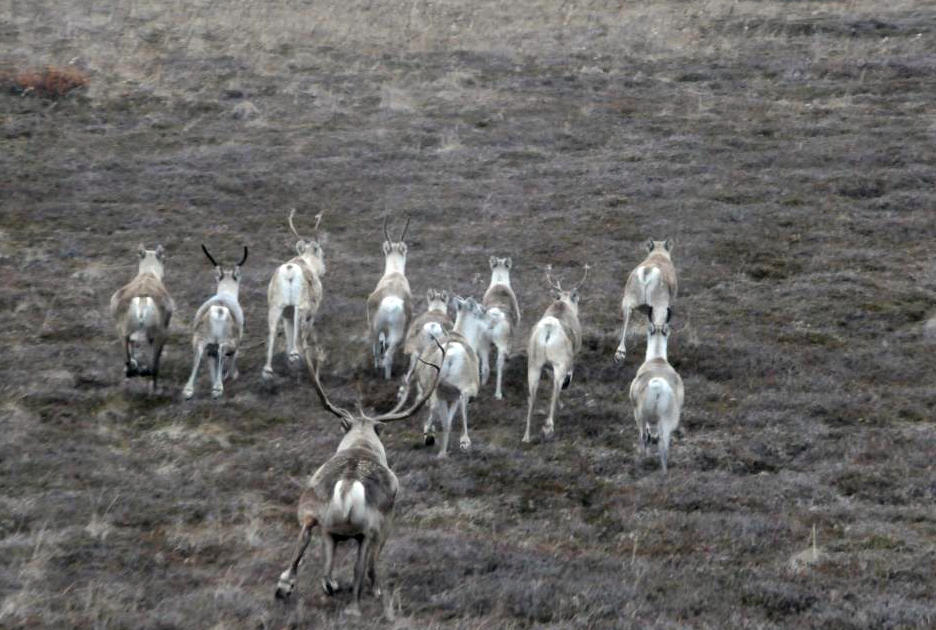
Togiak National Wildlife Refuge announced that refuge managers and wildlife biologists have determined that the herd cannot sustain a harvest of greater than 218 caribou.
Refuge biologist Andy Aderman said that the refuge made the determination by analyzing the summer caribou survey data and estimating the herd size.
“(The Nushagak Peninsula Caribou Management Plan) said we could harvest anything above 750 caribou and our estimate was 968,” Aderman said. “That would suggest 218 would be the appropriate amount to harvest from that herd. We just kind of re-looked at that 300 number and said, ‘That might be just a bit much.’”
The goal of the Nushagak Peninsula Caribou Management Plan is to keep the herd size large enough for hunting and small enough to avoid overgrazing the peninsula or a boom-bust population cycle.
Currently, only 23 Nushagak Peninsula caribou have been reported harvested.
If the limit of 218 caribou were taken, then it would be the second largest harvest of the herd.
Last year’s harvest of 378 caribou set the record. The next largest harvest was in 2001, when hunters took 127 caribou.
The federal hunt remains open to qualified subsistence users until March 31 or until the harvest limit is taken.
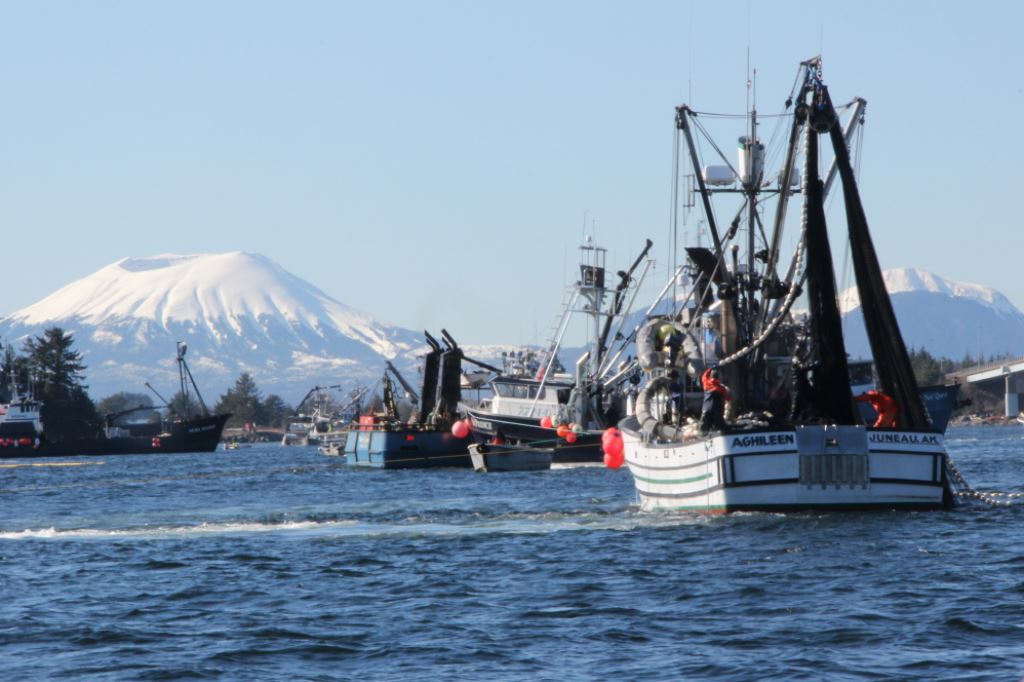
Purse seiners fish a commercial herring opening in Sitka Sound in 2014. (Photo by Rachel Waldholz/KCAW)
Despite three days of impassioned testimony before the Board of Fisheries in January, not much has changed for the Sitka Sound sac roe herring fishery, which will ramp up in about a month.
Local subsistence harvesters won an increase in the size of their exclusive use area, but failed to persuade the board to reduce the commercial catch.
Fishermen and processors from Petersburg joined with other commercial interests to remind the board of the economic importance of the annual springtime export.
Commercial fishing representatives at January’s meeting testified in oral and written comments about the economic importance of the annual fishery in Sitka Sound.
Icicle Seafoods processes some of the catch at its Petersburg plant and the company’s John Woodruff talked about the impact to the Petersburg economy.
“Last year, we spent roughly $450,000 just on Sitka herring labor,” Woodruff said. “Most of this stays in Petersburg and it comes at a time when there’s not much other economic activity in town and a half-million bucks might not seem like much but at that time of year for a town like Petersburg, I think it’s impactive.”
Woodruff said the work was important to other businesses in town as well.
In written comments, the Petersburg Chamber of Commerce noted that Icicle employs about 75 people for that processing, while there are seven permit holders homeporting boats in Petersburg along with 15 local tender boats taking part in the commercial fishery.
The chamber letter called that fishery important to the community as a whole.
The sac roe seine catch is worth millions of dollars to the commercial fleet every year.
Others involved in the fishery argued against reductions to the commercial catch or closing more area to the commercial fleet.
Angela Christensen said she packed herring from Sitka to Petersburg with her family every spring.
She said there was no biological basis to reduce the harvest rate and defended management by the Alaska Department of Fish and Game.
“The department’s long history of stock assessment and the care and consideration they put into their conservative guideline harvest level is reflected in the returning biomass each year,” Christensen said. “The Sitka herring fishery is a sustainable herring fishery for all, subsistence and commercial.”
Petersburg’s Julianne Curry has crewed in the commercial fishery, and now holds a permit.
“In the decade that I’ve been participating in the fishery I’ve heard arguments to close or curtail the commercial fishery shift every three years,” Curry said. “Every board cycle a different set of talking points are focused on with the goal of discrediting the department and reducing or eliminating commercial herring harvest. I urge you to look past the rhetoric and focus on the data.”
The Alaska Department of Fish and Game reported that herring populations have been stable, increased and decreased under the current commercial harvest rate.
Fish and Game statewide fisheries scientist Sherri Dressel noted opposing patterns for herring stocks in Alaska and British Columbia.
“When Alaska was low in the ’70s, British Columbia was high,” Dressel said. “When Alaska peaked in around 2010, British Columbia was at its lowest and now as British Columbia is starting to increase Alaska is starting to go down, suggesting that there are large scale environmental influences that are affecting these populations because we’re seeing similar trends regardless of what harvest rate has been applied. What this suggests to me is that large scale environmental influences are having an impact.”
The sac roe fishery in Sitka Sound along with a spawn on kelp fishery in Craig and a winter bait fishery in Craig were the only commercial fishing opened for herring in the region last year.
Other stocks were too low for managers to open fisheries.
Subsistence harvesters in Sitka Sound share their herring eggs with other communities around the region and they lobbied the board to reduce the commercial catch.
“We wanted these proposals to come forth and hopefully that you guys will see that the needs for conservation is very important,” said Harvey Kitka, chairman of the Sitka Tribe herring committee.
Subsistence harvesters reported a tougher time getting the herring eggs they needed in Sitka Sound.
Jeff Feldpausch, resource protection department director for the Sitka Tribe of Alaska, said the tribe and the state’s Division of Subsistence started surveying its members in 2002.
“The results of those surveys show that from 2002-2009 subsistence needs were met 62 percent of the time,” Feldpausch said. “From 2010-2016, subsistence needs were only met 29 percent of the time. The 2010-2016 data coincides with the implementation of the current accelerated harvest rate in 2010.”
The board was considering competing proposals.
Some sought to reduce the commercial harvest rate in the region or Sitka Sound specifically.
Others sought to close more area to the commercial fleet.
The Southeast Herring Conservation Alliance, a commercial industry group, had proposals in to reduce the herring spawn needed for subsistence and repeal closed commercial areas but ended up withdrawing those.
The board was somewhat split over the herring proposals. Orville Huntington of Huslia had conservation concerns.
“I’ve seen conservation plans fail time after time,” Huntington said. “We’re in a rock and a hard place with king salmon right now and I think this one is going to end up the same way. It’s like that last stronghold we’re hanging onto and if we let this herring fishery go, it’s just gonna keep going.”
But others, like Fritz Johnson of Dillingham thought the management was working.
“The stocks do fluctuate somewhat based on a number of factors but this is the same exploitation rate that’s been used in the Togiak sac roe fishery and it seems to work,” Johnson said. “I realize there are a lot of factors at play here but given all the stakeholders that are dependent on this fishery, I’d be reluctant to take this radical a change at this point as these proposals suggest.”
Reed Morisky of Fairbanks and Huntington were the only votes in support of reducing the commercial harvest rates.
The board did vote to expand the area closed to the commercial fishery by about 4 square miles. About 10 square miles was already closed to the commercial fleet in 2012.
This change adds closed area right in front and to the north of downtown Sitka.
But the board voted 5-2 against a separate proposal for an even larger commercial closure of an additional 14 square miles.
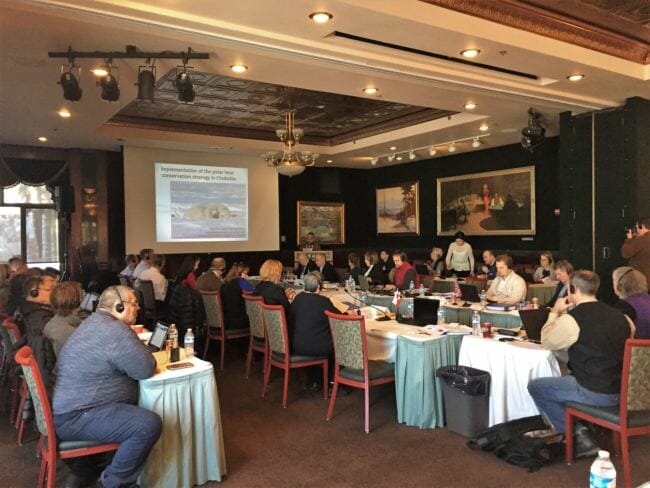
A presentation being given at the 2018 Polar Bear Range States Meeting in Fairbanks, AK. (Alaska’s Energy Desk/ Ravenna Koenig)
Representatives from Norway, Canada, Greenland, Russia and the United States met in Fairbanks Feb. 2 – 4, 2018, to talk about polar bears. Those countries are all part of a treaty signed in 1973 to coordinate protection of the species. And for about a decade now, those same countries have been holding meetings every two years to address the threats that polar bears are facing, especially from climate change.
At Pike’s Waterfront Lodge on the Chena River in Fairbanks, dozens of people mill about a cavernous meeting room, different languages echoing off the walls. A weekend-long meeting of what’s referred to as “the range states” — or the five nations where polar bears live — has just ended.
When the Agreement on the Conservation of Polar Bears was signed by these countries in 1973, the main issue they were trying to deal with was the dwindling numbers of polar bears in many areas, largely due to sport hunting. Not anymore.
“The number one challenge is loss of polar bear habitat, meaning sea ice,” said James Wilder, the polar bear program leader for the U.S. Fish and Wildlife Service. He’s one of several people representing the United States here.
A few years ago the range states finalized an initiative called the Circumpolar Action Plan, essentially a way for the different countries to coordinate their efforts to address things like human-bear conflicts, climate change and bear management with oil and gas development.
This meeting is, in part, a way for the group to catch up on the work they’ve done under that plan since they last met in 2015. One example: an update on an ongoing study on the effectiveness of bear spray on polar bears in Arctic temperatures. As sea ice disappears, polar bears are spending more time on land, leading to more conflicts with humans.
“It can range from polar bears raiding fishing camps on the coast, to getting into landfills in coastal villages, to traveling through and inhabiting oil and gas fields,” Wilder said. “It can also go to the other extreme of attacking people.”
The delegates for the U.S. include the State of Alaska, the North Slope Borough, the U.S. State Department and USGS, among others.
Nicole Kanayurak spoke for the North Slope Borough at the end of the meeting. She thanked the range states for recognizing that indigenous knowledge is an important part of managing and researching polar bears. But she also urged them to include native communities to a greater extent in that work.
“What we have drawn from the last two days is that there may be missing variables and a void that the intricacies of our indigenous knowledge on the ground may inform,” Kanayurak said. “It is important for our people that we are equitably involved in polar bear affairs.”
Other groups representing indigenous perspectives at the meeting echoed this push for more inclusion.
James Wilder says that this has been and will continue to be a point of focus for the range states.
“What we heard repeatedly during this meeting — and the range states are committed to doing a better job with — is working more closely with the native people,” Wilder said, “incorporating traditional ecological knowledge and subsistence users concerns and knowledge into the management and scientific processes that govern what we do.”
Wilder says that one example of how the U.S. is working towards more inclusion is a scientific working group they have with Russia. The group is designing studies on polar bears in the Chukchi Sea, and includes native hunters from both countries.
The range states will next convene in Norway in 2020.
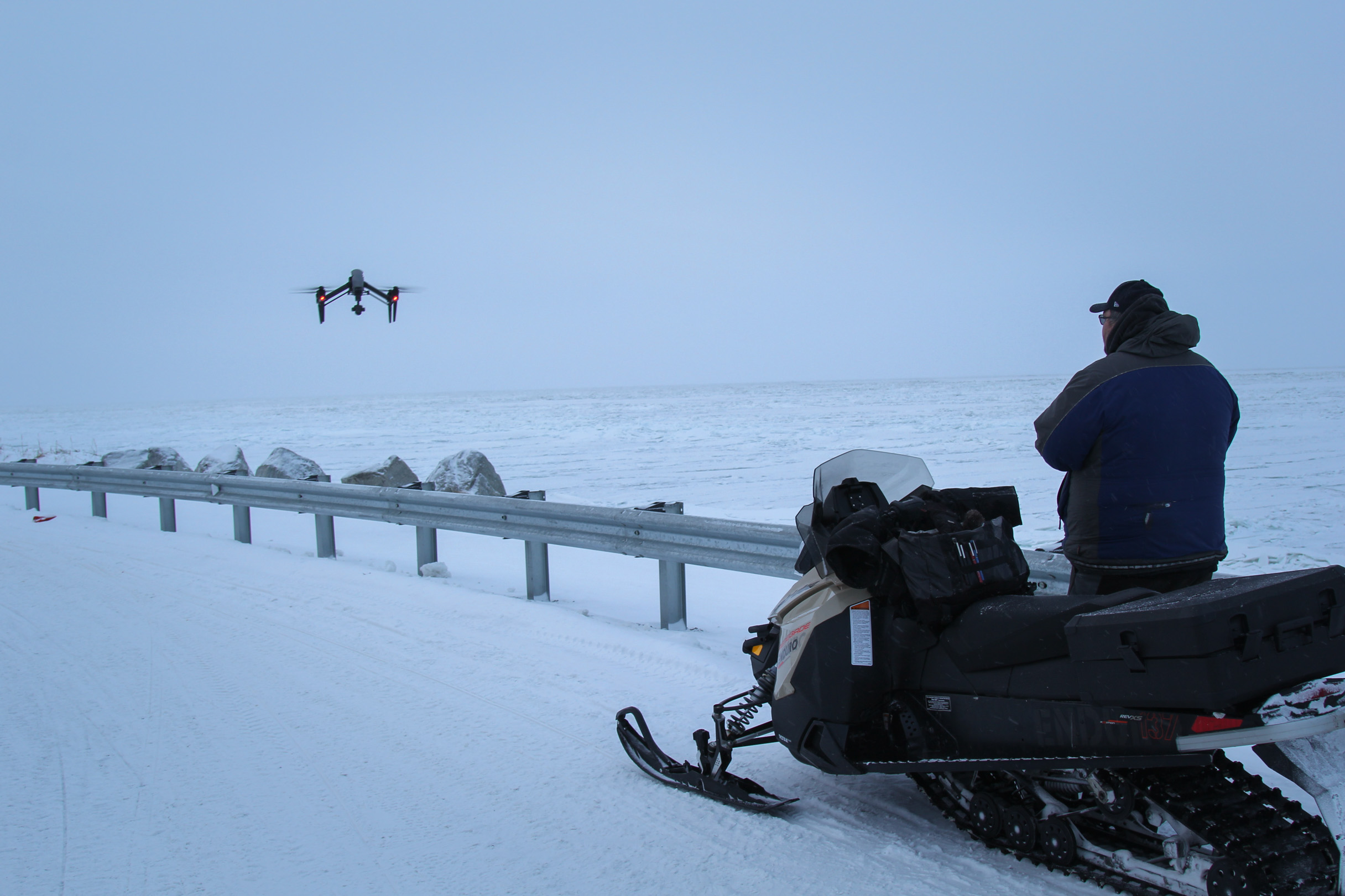
Dennis Davis flying his drone at the edge of Shishmaref a few days after a cold snap helped the sea ice freeze up late in January. (Photo by Zachariah Hughes/Alaska Public Media)
As the climate changes, subsistence hunters in Alaska are changing with it.
With warm temperatures this winter across the state, sea ice is forming exceptionally slowly in the Arctic and Bering Strait regions.
But subsistence hunters in small towns like Shishmaref, with a population of around 600 on a barrier island at the top of the Seward Peninsula, are finding ways to adapt.
On a recent afternoon in late January there was finally a patchwork of ice covering the Chukchi Sea at the edge of town. As snowmachines zoomed past, Dennis Davis set up his new drone.
“Some people think it’s a toy, but a lot of people know that it’s an actual tool,” Davis, 39, said as he attached propellers to the carbon-fiber frame.
It’s a serious drone, worth about $5,000, with a high-quality nice camera mounted on the bottom.
Davis plugged his iPhone into the controller and sent the microwave-sized device speeding out over the sea-ice.
Looking down at the bird’s-eye view beamed directly to his screen, Davis pointed out nuances in the varieties of ice.
“You can see the different colors in the ice,” Davis said. “What you want is more of the bluer ice.”
According to Davis, blue ice is more solid than white.
Those are areas hunters can travel across more safely as they search for marine mammal prey.
Subsistence hunters in such as Shishmaref and other coastal communities have always watched for these conditions.
But the drone can scout further and faster than the naked eye.
Davis crowd-funded for the machine to document the rapid erosion eating away at Shishmaref after storms, which has prompted a decades-long search for a new location to move the community.
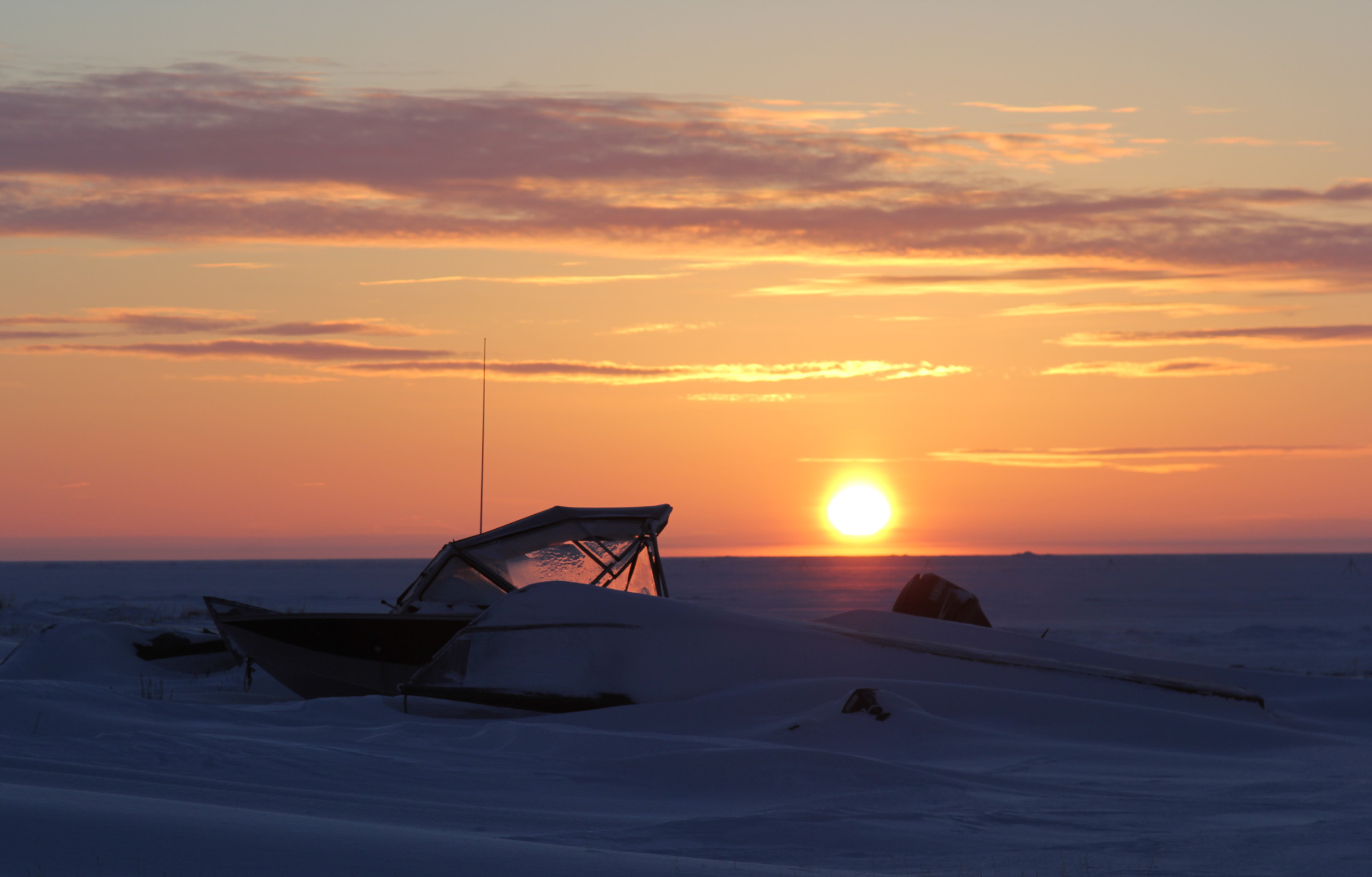
A boat buried under snow on the south side of Shishmaref near the lagoon (Photo by Zachariah Hughes/Alaska Public Media)
Journalists and environmental advocates have held up Shishmaref as a symbol for climate change’s looming threat of displacement.
But as the ocean encroaches on the town steadily from season to season, residents still need to eat, pay bills and support themselves.
Hunters like Davis are contending with diminishing predictable environmental conditions, using technological tools like this drone to try and regain an advantage understanding what’s happening on the land and sea.
Davis plans to use the drone to help “set a course for everybody when they go out hunting in the spring time.”
“I’d just send out the drone and find the best available trail that they can use, instead of having to go out and just mess around on the ice,” Davis said.
Davis doesn’t use the drone to spot prey – something he believes would be an unfair advantage and gets into murky, evolving regulations over Unmanned Aircraft Systems interacting with wildlife.
But he sees the machine as a new way to hunt animals more efficiently and safely, not unlike how satellite phones and GPS devices have become increasingly common in rural communities that rely on subsistence harvests.
New technologies are just one way hunters in Shishmaref are adapting to changing conditions.
There are others.
People are changing not just how they hunt, but what they hunt.
Traditionally, people in Shishmaref relied more heavily on marine mammals for food.
All around town, hides hang from porches and meat racks, ruby red haunches cure in the sun, and tangled piles of antlers rest on roofs.
Salmon returns in the part of Alaska are booming, creating not only expanded subsistence opportunities, but more lucrative commercial harvests.
And musk oxen, giant prehistoric goats, which were wiped out of Alaska in the 1800s, were reintroduced to the mainland just 50 years ago and are steadily working their way back into people’s diets.
Dennis Davis’s musk ox burgers, topped with Swiss cheese, sautéed onions and mushrooms, along with freshly sliced prosciutto and a home-made aioli. Or ketchup. (Photo by Zachariah Hughes/Alaska Public Media)
In fact, it’s one of Davis’s favorite sources of protein.
Back at his home, he fried up a house special: musk ox burgers.
“I compare musk ox to waygu beef, because it’s so marbled,” Davis said, referring to the highly prized variety of Japanese beef cattle.
Davis likes to cook about as much as he loves to eat.
But subsistence isn’t just a culinary hobby.
For him, like for most people in Shishmaref and indigenous communities across Alaska, it’s a necessity.
Davis and his wife have all seven of their kids living at home.
Dinner tonight is self-serve, with everyone grabbing burgers as they come off the stove.
By the time it’s done, all 8 pounds of meat that he mixed together is gone.
Buying this much frozen ground beef at the store would have cost up to $70, a per-meal cost that is out of reach for many in rural communities where jobs and cash are scarce, and everything costs several times as much as it would at a super-market in the Lower 48.
Even water.
Like many rural Alaska villages, Shishmaref lacks plumbing and easy access to potable water.
At the store, a gallon of it costs $11.
For those who can get a permit to hunt them, musk oxen have become a relatively reliable source of meat.
“You know where they’re at, you know how they behave,” Davis said. “They just stay in the same spot.”
That consistency is a relief, because environmental conditions are making ocean hunting less and less predictable.
In years like this, when the sea ice forms later, it doesn’t get as thick, and come springtime it disappears much faster.
That’s a problem for hunting ice seals, walrus, and bearded seals, which everyone in Shishmaref calls by their Inupiaq name, oogruk.
“Going oogruk hunting or walrus hunting, you can go like 30, 40, 50 miles without seeing something,” Davis said of the last few years.
It hasn’t always been that way.
In fact, it’s a pretty recent development. It isn’t that there are less animals; it’s just that as they follow retreating sea ice they are distributed further from the town – prompting hunters to travel greater distances searching for them.
In a study published last fall, state researchers interviewed 110 coastal residents over 10 years and concluded that marine mammals are still plentiful, but access to them is getting harder, with worse conditions during shorter windows of time.
As the sea ice retreats, the animals follow.
That’s a chase that’s not only more expensive for hunters, but creates more hazards as weather and sea conditions become more variable.
Davis went almost all the way to Kotzebue, about a hundred miles away, looking for oogruk last year.
On the way back the weather took an unexpected turn, nearly costing the hunting party all their equipment.
“Between boats and everybody’s snowmachines we had close to $150,000 on the ice that could have been lost,” Davis said. “That’d be a sad day in Shishmaref.”
Changing weather patterns are one of the biggest differences noted by some of the community’s elders.
“The way we hunt oogruk or seal hasn’t changed. The conditions have,” said Percy Nayokpuk, 65, who runs a store in town and is Davis’s father-in-law.
This year’s is the latest freeze-up of the ocean he ever remembers.
Nayokpuk has seen plenty of shifts in the animals around Shishmaref – some good, some bad.
The unpredictable weather worries him. But he’s encouraged that younger hunters are constantly adapting.
“We’ve always been hunters here, we hunt regardless of the situation,” Nayokpuk said from behind the counter as his store.
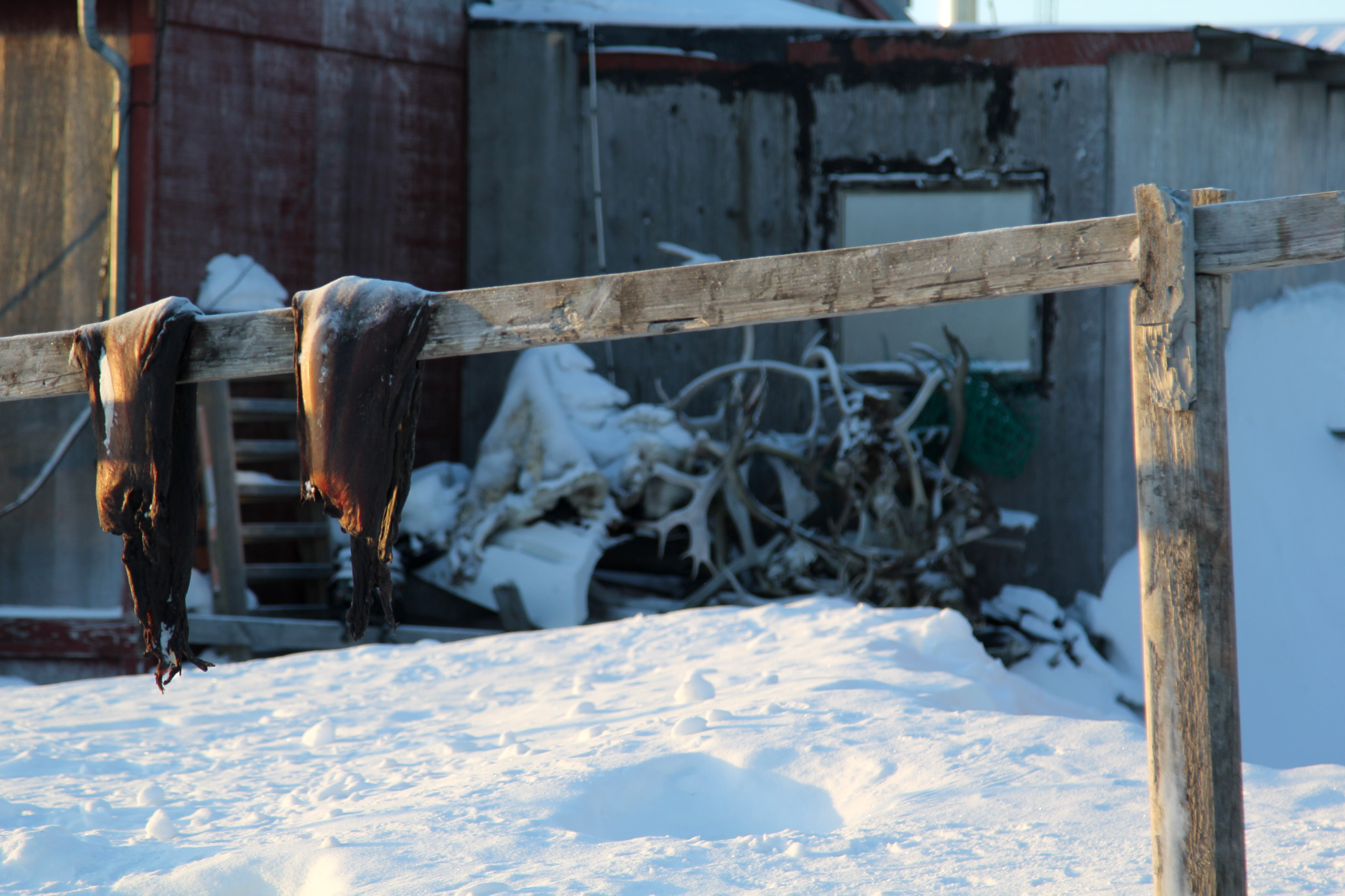
Seal meat hanging on a rack outside a home, with a pile of caribou antlers from past harvests in Shishmaref. (Photo by Zachariah Hughes/Alaska Public Media)
For those tracking subsistence across Alaska, the sense of uncertainty comes with a degree of optimism.
“It’s positive in my mind that our people are able to adapt. And they’re doing so,” said Brandon Ahmasuk, who manages subsistence resources for Kawerak, the regional non-profit in Nome that works with 15 smaller communities around the Bering Strait.
Some hunters are taking advantage of new opportunities created by environmental changes.
Open water later in the year around St. Lawrence Island, for example, has meant more bowhead whale harvests for the town of Savoonga.
The longer travel to reach hunting grounds requires more money for gas, leading communities to pool resources.
With healthy food basically unaffordable at local stores for many residents, hunters have no option but to adapt.
“They have to put food on the table,” Ahmasuk said. “In the villages they have to do something to offset whatever they can’t get from the store. They don’t have a choice: they have to. They have to go get it.”
Ahmasuk’s big worry is whether a changing climate could affect animal populations and their health in the coming years, a worry prompted by several unusual die-offs the past few years, as well as instances of avian cholera and toxic algal blooms.
But as long as the animals are healthy, Ahmasuk is confident people in the region will find ways to live off them.
This journalism project was made possible by a fellowship from Marguerite Casey Foundation, which supports low-income families in strengthening their voice and mobilizing their communities to achieve a more just and equitable society for all.
The Sitka sac roe herring fishery operates just beyond the windows where the Board of Fish is seated. The industry wants the current management plan to stay in place, while a local cohort calling themselves the “Herring Rock Water Protectors” has aligned with Sitka Tribe of Alaska for more conservative management. (Photo by Emily Kwong/KCAW)
Sitka is the center of gravity for fish politics — at least this week, as the Alaska Board of Fisheries is in town reviewing over 100 finfish proposals.
With its waters visible outside the window of Harrigan Centennial Hall, Sitka Sound, the site of the Sitka sac roe herring fishery, is one of the biggest battles this cycle.
The controversial Sitka herring fishery is relatively small with 48 permit holders.
Scientists, managers, fisherman, and subsistence harvesters are sipping coffee out of plastic cups and organizing their talking points in side rooms.
For lifelong Sitka fisherman Eric Jordan, who once sat on the board, the first day is a reunion.
“You visit with each other and bring up old things, old battles that you fought,” he said.
While the commercial industry harvests the eggs from inside the fish once caught, subsistence harvesters set out hemlock branches after the fleet leaves.
The herring spawn and lay their eggs.
But with thinning eggs on the branches, fear is escalating within Sitka Tribe of Alaska that the local stock is on the verge of collapse.
The tribe began voicing concern over the spawn in 1997.
Louise Brady and other members of the Kiks.ádi clan organized a koo.éex, or potlatch, on Jan. 14 to honor the herring.
“Last year, I think, made it clear that we are close to losing our herring eggs,” Brady said.
Before the koo.éex, Brady entered the kitchen at the Alaska Native Brotherhood Hall where Nina Vizcarrando was preparing food.
Opening the fridge, both were disgruntled there was only one bowl of herring eggs to go around.
“This is the amount for today,” Brady said.
“For 150, 200 people,” Vizcarrando added.
All seven members of the Board of Fisheries were invited to the koo.éex and four attended: Israel Payton of Wasilla, Robert Ruffner of Soldotna, Al Cain of Anchorage, and Fritz Johnson of Dillingham.
They were given gifts, such as herring-shaped chocolates and traditional headbands made of yellow and red cedar.
Johnson says the board likes when different interest groups find common ground.
“Come to compromise solutions where it seems there may be none readily available,” he said. “It really enhances the process because nobody really understands local issues better than local people.”
Right now, compromise is days away and there’s competing herring proposals on the table.
The proposal tells the board to cap the harvest rate at 10 percent.
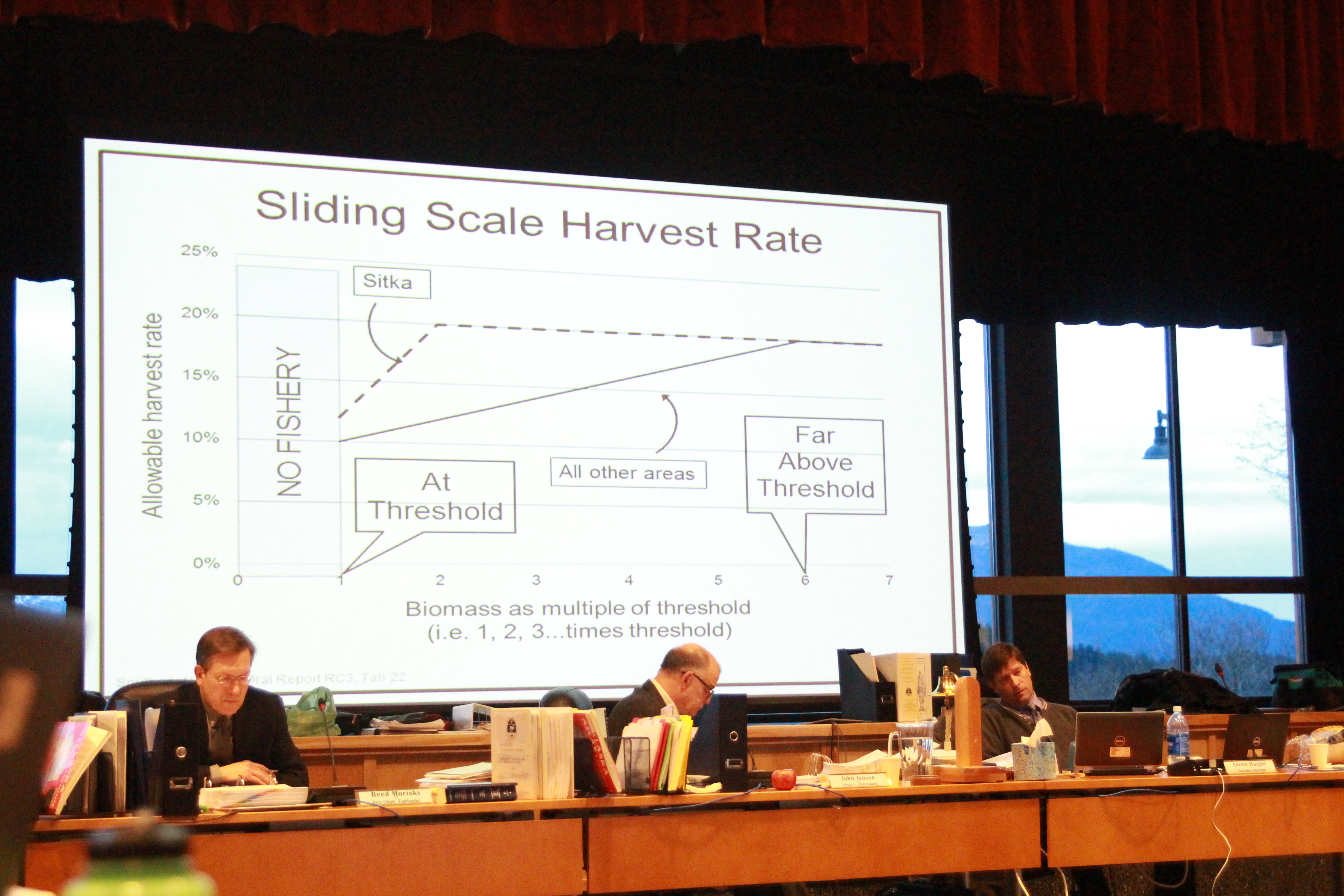
Sitka currently uses a more generous formula than anywhere in Southeast, a sliding scale between 12 and 20 percent.
Proposal 98 (Thoms_Proposal98), sponsored by Andrew Thoms, calls for reducing the sliding scale even further (between zero and 10 percent).
Another option he suggests is setting aside herring for the ecosystem.
“Leave a third for the birds,” he wrote in his proposal.
Sitka’s local advisory committee heard these cries for conservation.
Amending Proposal 99 during their Nov. 28 meeting, they advised the board to research what it would mean to adopt that more conservative formula used by the rest of Southeast in Sitka.
The amendment to Proposal 99 reads: The guideline harvest level for the herring sac roe fishery in Sections 13-A and 13-B shall be established by the department using a percentage that is not less than 10 percent, not more than 20 percent and within that range shall be determined by the following formula: Percentage Harvest Rate = 8 + 2 (Forecast Spawning Population Size / threshold level). The fishery will not be conducted when the spawning biomass is less than 25,000 tons.
The Sitka Assembly voted last week to support the conservation position of Sitka Tribe of Alaska and the local advisory committee (Res 2018-02).
The math is tricky, but the important thing to know is the Southeast formula would limit fishing opportunity in Sitka.
Within the 2018 forecasted mature biomass of 55,637 tons, Alaska Department of Fish and Game’s statewide fisheries scientist Sherri Dressel calculates the herring fleet’s quota would go down from 11,128 tons (20 percent) to 6,927 tons (12.45 percent).
That means more herring in the ocean, but also millions of dollars in losses for the industry.
There’s no official estimate, but commercial stakeholders often say that for every ton not fished, the industry loses $1,000.
Southeast Herring Conservation Alliance represents the fleet.
Executive director Steve Reifenstuhl told the Sitka Assembly last week that these losses extend to the local economy.
“(The means) over $100,000 in raw fish tax, bed tax, lost electrical receipts, and a huge multiplier effect to our economy,” Reifenstuhl said. “The worst thing is that this will not solve the stated issue: more herring eggs on the dock.”
He argued that the problem isn’t over-fishing, but that the annual subsistence need is too high. The annual subsistence need is currently 136,000 to 237,000 pounds.
Calling the ANS “artificially inflated,” the Southeast Herring Conservation Alliance has put forward proposal 94 (SHCA 94) to substantially lower the subsistence take.
They also are recommending the board re-open the “core spawning area” closest to town to commercial fishing (SHCA 104), while Sitka Tribe wants more waters sealed off (STA Proposal 105, STA Proposal 106).
These battling proposals, with their differing opinions on health of the local herring stock, will come to a head with two days of testimony.
For those planning to take the microphone, Jordan has one piece of advice: tell the board a story:
“A compelling, credible, short story from you is what resonates,” he said.
And even though it’s tempting to use all three minutes, he added, cut it down to two minutes.