Subsistence

Alaska Peninsula students and teachers get creative to meet requirements

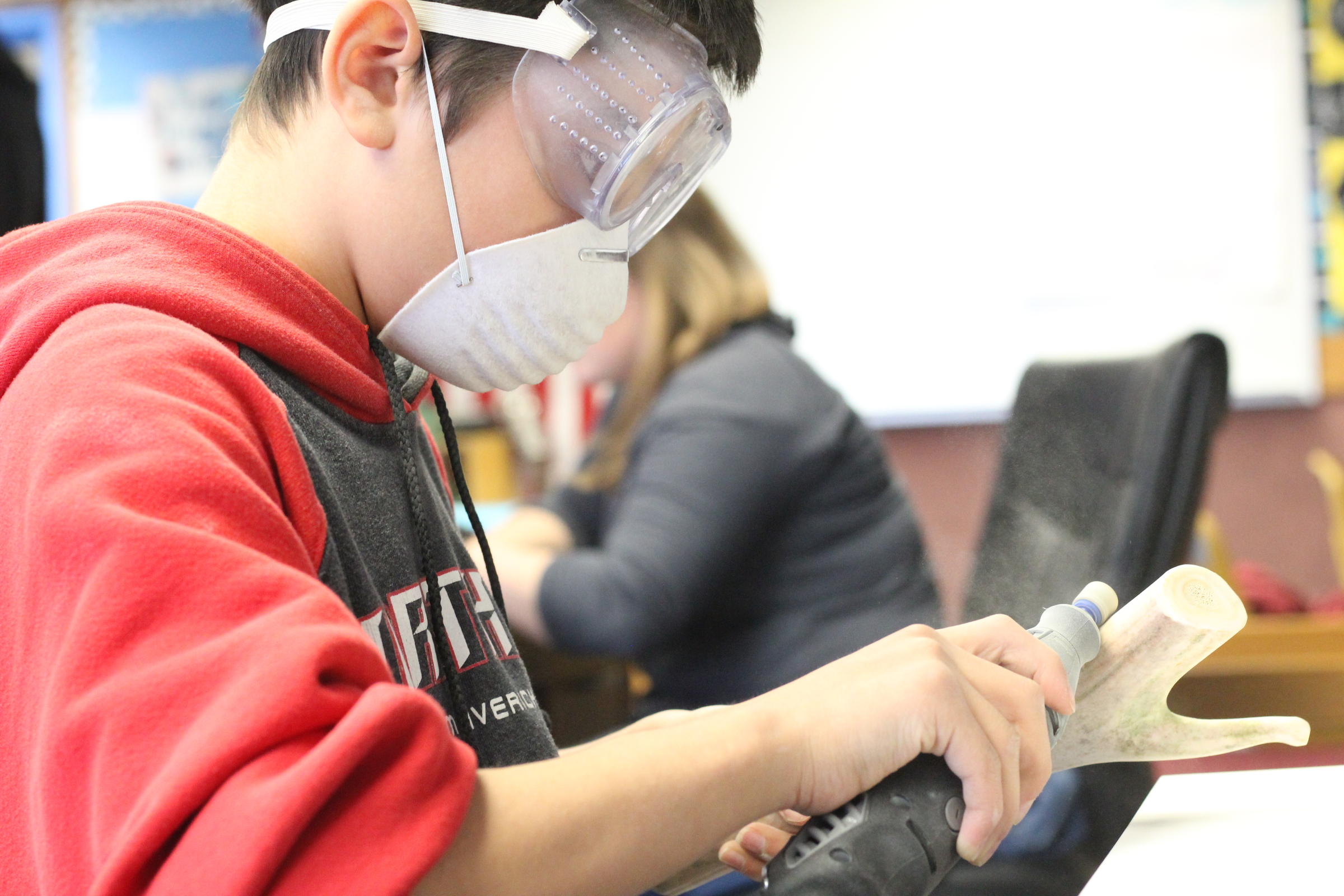
Tyler Croom polishes the caribou antler he is turning into a cribbage board. (Photo by Avery Lill/KDLG)

There was a sharp, burnt smell in the air as seventh-grader, Tyler Croom, guided an electric polishing tool along the surface of a caribou antler with steady hands.

A whirring, buzz filled his classroom at Meshik School in Port Heiden. The areas he had already polished gleamed bright and white.

“I’m making a cribbage board out of it,” said Croom, removing the surgical mask he wore to keep from breathing particles from the antler that he polished away. “I’m going to do scrimshaw in it, and we’re going to stain it brown. I’ve always wanted to make a cribbage board.”

The Lake and Peninsula School District is piloting a new calendar this year. They have dubbed it the “subsistence calendar.”

By starting later and ending earlier, the new calendar cuts 77.5 hours of instruction and saves more than $400,000.

The tricky part is students still have the same requirements they need to fulfill in a year, but they have less time to finish the standards.

That’s where project’s like Croom’s come become crucial.

“We were able to tie in lots of different standards,” said Kirsten Buckmaster, Croom’s teacher who is helping him with the project. “He’ll have a writing component. He has science, engineering, arts and his cultural side.”

In addition to completing projects during the school year that fulfill a variety of requirements concurrently, students can also document summer activities, like commercial fishing, to count toward school standards.

While fulfilling school standards efficiently and effectively may be challenge, Kasie Luke, principal of Meshik School and Chignik Bay School, said that it is one of the new calendar’s most positive aspects.

“I think the main strengths really show in our students having spent more time with their families and doing what they do in their summer,” Luke said. “It gives them the opportunity to experience more place-based education opportunities and to really take advantage of their experiences in the summer to count as some of our standards toward their graduation requirements.”

For the 12 schools in the Lake and Peninsula School District, classes started Sept. 5 this year. School lets out May 1.
Students connect with tradition and language at Hoonah culture camp

When young people face challenges in life, adults and educators can struggle with how to help.

Over the summer, students in Hoonah attended a culture camp that seeks to address some of these problems by connecting students with Alaska Native traditions.

The Haa Tóo Yéi Yatee culture camp is almost an hour drive from Hoonah.

Over the summer, about 35 students made the trip down a narrow, unpaved logging road to immerse themselves in Native art, food and language for four days.

The isolated location is intentional.

“We came out as far as we could to make sure that we didn’t have cell phone reception, and that the only connections that we had were with each other,” Heather Powell said.

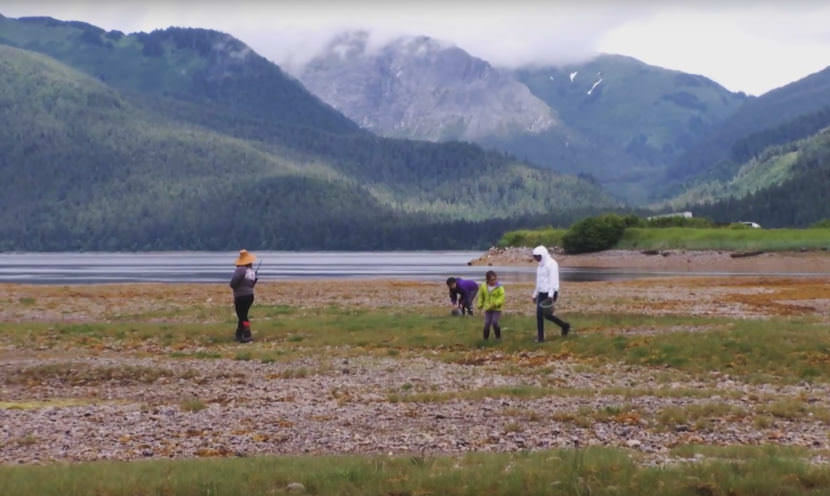
Students gather beach asparagus at the Haa Tóo Yéi Yatee culture camp near Hoonah (Photo by David Purdy/KTOO)

Powell works for Hoonah City Schools, and she created this camp with support from many others in the community, partly to help students confront some of the biggest challenges in their lives.

“We have young people in our community that are facing depression, addiction, suicide,” she said. “Things can ail not only your physical well-being, but your spirit.”

She hopes a traditional mindset will lead to a more holistic approach.

“In these non-Native ways of doing, we acknowledge and then we diagnose just that thing, and we deal with just that thing, she said. “But a long time ago we worked with the entire person, the entire family. Because none of us has the strength to do everything.”

The activities at the camp are deeply rooted in history.

Inside a cabin, students gathered around a table to cut, file and hammer copper sheets into small tináas. Almost everyone was wearing one of the traditional copper shields around their neck by the end of the camp.

Outside, a group of students spread out along the water to gather beach asparagus during low tide.

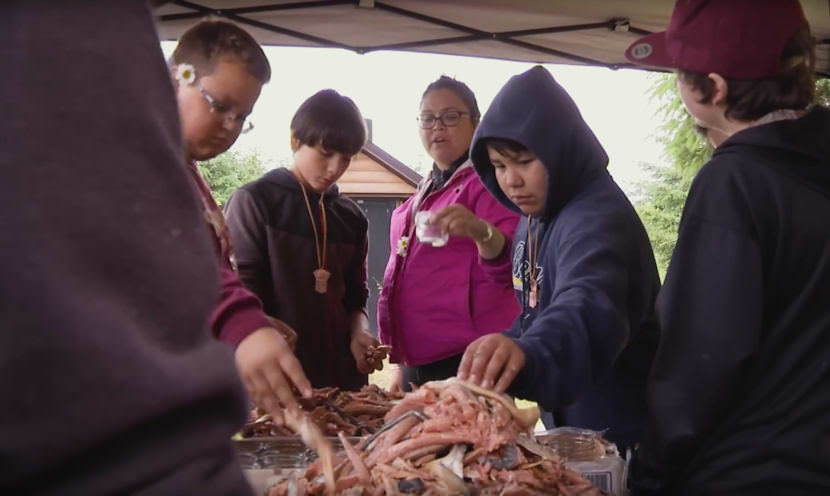
Later, they prepared it for canning, along with salmon fresh from the smoke house.

Heather Powell shows students the proper technique for canning smoked fish at the Haa Tóo Yéi Yatee culture camp near Hoonah (Photo by David Purdy/KTOO)

Powell hopes that this will be an opportunity for students to practice speaking Tlingit, and she moves seamlessly in and out of the language. She

believes that integrating Tlingit into everyday education will help revitalize the language and connect students to tradition.

The students also made their own cultural contribution together.

Besides playing music they already knew, Powell and others lead the students in creating their own original song.

Ultimately, her vision goes beyond specific skills and activities to something much more fundamental.

“Teaching traditional ecological knowledge and teaching place-based learning are all the … all the rage these days,” she said. “But for us, this is survival. This is who we are. We have done things for time immemorial because it calls to us. This is our food, this is our responsibility, this is our passion.”

Powell said she plans to offer more camps in the Hoonah area focusing on different cultural activities.

Quinton Chandler in Juneau contributed to this report.


This reporting was made possible by a grant from WNET’s American Graduate project. Television coverage of American Graduate Day 2017 begins at noon Saturday, Oct. 14, 2017 on 360 North.

Igiugig is set to embark on its Native foods challenge

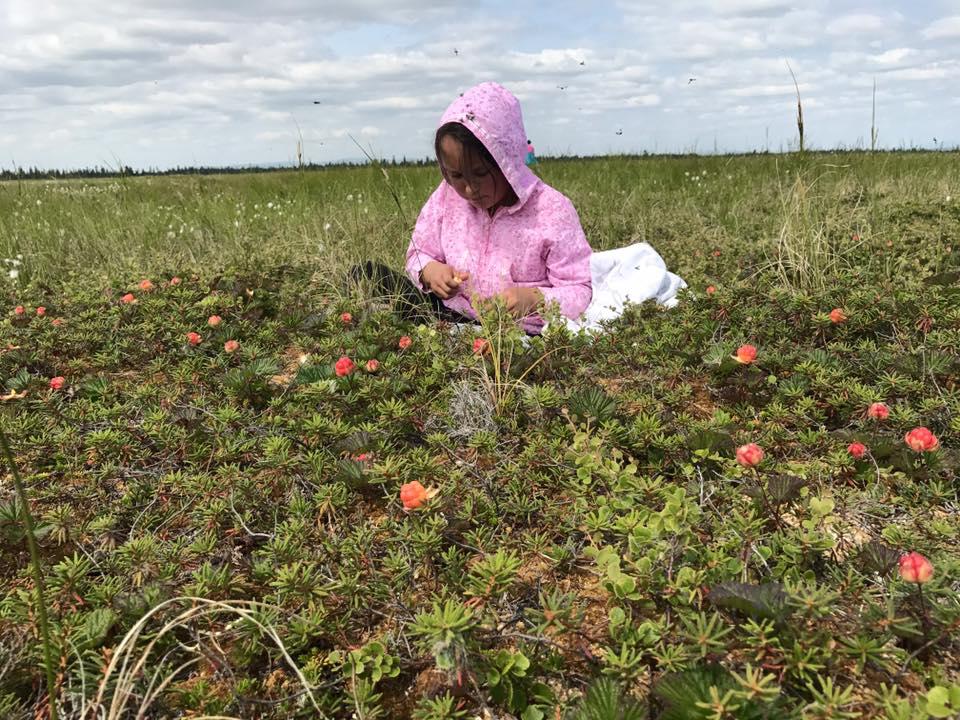
Dannika Wassillie harvests salmonberries. (Photo by Jeff Bringhurst)

Nutrition-related health concerns plague the U.S. as a whole, and rural Alaska is no exception.

People in village of Igiugig are aiming to improve their health this fall with a Native foods challenge.

Igiugig’s high school literature class read “In Defense of Food” by Michael Pollan last school year.

In the book, Pollan details a seven-week project in which a group of Aboriginal Australians who lived in the city and ate a Western diet moved to the outback and ate traditional food for seven weeks.

At the end of that period, all saw health improvements.

“The kids in the class thought that’d be a great idea if we were to do this,” said Tate Gooden, Igiugig School’s head teacher. “We pitched it to the community as a community idea, and the community members were very excited about it. Now here we are, we’ve been preparing for eight months now.”

For six weeks, starting Sept. 17, the adults and children in the village are challenging themselves to eat only traditional foods, locally raised foods and oatmeal.

The village has been putting away fish, berries, greens and game for the past eight months.

“It’s gotten people a lot closer together and talking about food and subsistence,” Gooden said. “I think a lot of people harvesting things they’ve never harvested before. We have people putting up sour dock and different greens. We’ve got people boiling down caribou bones and making fat cake.” 

The project is a health experiment, so residents have already begun regular health screenings.

Every month in 2017 they have taken their weight, blood pressure, blood sugar and heart rate. They will compare the results from before and after the challenge.

The final component of the challenge is a trek to Big Mountain, which lies 23 miles east of Igiugig. For four days in the last week of September, the village will hike to the mountain, which is a traditional meeting place between Igiugig and the village of Kokhanok.

At Big Mountain they will have a Native foods potluck, and then they will fly home.

The project’s focus is much broader than watching weight or blood sugar or even honing subsistence skills.

“This project focuses on the relationships and interdependence of food, culture, identity, community, subsistence and health,” said Gooden.

The challenge concludes Oct. 28.

Can a Southeast mine battle lead to a trade war?

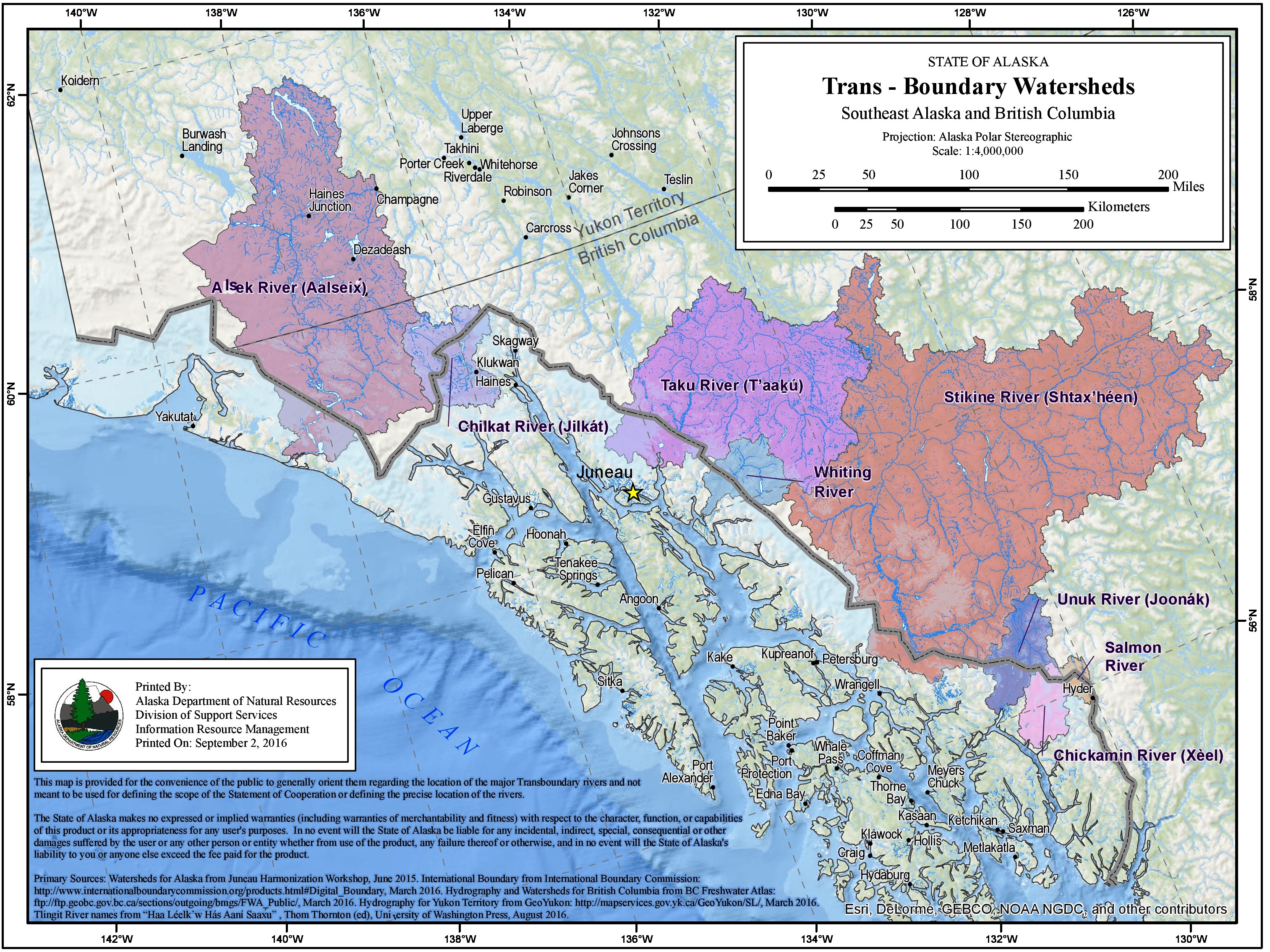
The state has identified eight transboundary watersheds feeding Southeast Alaska rivers. (Map by Alaska Department of natural Resources.)
The state has identified eight transboundary watersheds feeding Southeast Alaska rivers. A coalition of tribal governments is pushing the federal government to protect their fisheries.(Map by Alaska Department of Natural Resources.)

Could a cross-boundary mining battle lead to a trade war with Canada?

A Southeast Alaska tribal organization is using that possibility to push federal officials into providing stronger protections for regional fisheries.

A coalition of 16 Southeast tribal governments has filed paperwork that could lead to trade sanctions against British Columbia, which borders the region.

Southeast Alaska Indigenous Transboundary Commission chairman Frederick Olsen Jr. said about half the region’s tribal governments have signed a petition to the federal Department of the Interior.

“The goal is to get federal involvement in our transboundary mining issue,” he said. “So, we are getting some more of our member tribes to sign on.”

What’s called a Pelly Petition is allowed under a provision of the federal Fishermen’s Protective Act.

Southeast Alaska Conservation Council also opposes transboundary mining.

“If another country is found to be violating the tenets of the Fisherman’s Act, the other country can institute trade sanctions against that country,” council staff scientist Guy Archibald said.

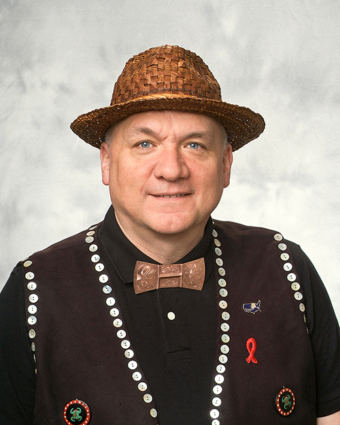
Frederick Olsen Jr. is chairman of the Southeast Alaska Indigenous Transboundary Commission. (Photo courtesy SAITC)

A number of advocacy groups and local governments are concerned about mines on or near British Columbia rivers that flow through Southeast. They said silt, minerals and acidic water from the mines will damage fish stocks on both sides of the border.

British Columbia’s mineral-extraction industry said it develops and operates its mines safely, with limited environmental impacts. But it’s had to defend itself after the Mount Polley Mine tailings dam collapse.

Archibald said trade sanctions are not the petition’s real goal.

Instead, the groups want federal officials to put their concerns before the International Joint Commission, which moderates disputes involving U.S.-Canada boundary waters.

“Nobody really wants to start a trade war with British Columbia,” Archibald said. “Basically, what they’re saying, is that if neither country wants to refer this matter to the International Joint Commission, we as the people on this side have another options. And that maybe the International Joint Commission would be the less onerous of the two options.”

Interior Department officials did not immediately respond to inquiries about the petition. Archibald said they’ve told petitioners they’re looking into it, but that’s all.

Earlier efforts trying to get the State Department to involve the joint commission were unsuccessful.

The Southeast Alaska Indigenous Transboundary Commission is the new name for the United Tribal Transboundary Mining Work Group.

Kasaan resident and commission chairman Olsen said the new name addresses the wider scope of the group’s work.

Tis Peterman is coodinator of the Southeast Alaska Indigenous Transboundary Commission, formerly the United Tribal Transboundary Mining Work Group. (Photo by KSTK-FM)

“Transboundary issues are far beyond mining alone,” he said. “There’s oil tankers, there’s radioactive debris, there’s fish farms breaking apart, there’s cruise ships dumping their bad water.”

Another change: The nonprofit organization hired its first employee in August.

“We’ve never had a staff person,” said new coordinator Tis Peterman, who is also a  Wrangell resident and activist. “Trying to get everybody coordinated and meeting and coordinating meetings with First Nations in B.C. is one of my tasks.”

The organization also is reaching out to Alaska Native groups facing similar issues. Olsen said that includes the United Tribes of Bristol Bay.

“We completely back them up in their fight against the Pebble Mine and to protect Bristol Bay and all the watersheds up there,” he said.

He said hiring a coordinator will help develop and formalize such relationships.

Hunters troll PETA in selfie campaign, but did it backfire?

David Nicolai posing with a caribou he took on a successful hunt in 2016, in PETA’s social media frame. (Photo courtesy of David Nicolai)

When People for the Ethical Treatment of Animals rolled out a new social media campaign, it caught on with an unexpected group – hunters.

All across the country, the slogan “shoot selfies, not animals” was co-opted by people putting up social media posts featuring trophy photos of game taken in the field. It’s a bit of social media mockery, but PETA is still counting it a success.

Last week, Anchorage resident David Nicolai spotted something funny online.

“I saw a friend post a PETA frame as he was butchering a moose,” Nicolai said by phone. “It was a pretty great photo for me.”

Beneath the eviscerated ungulate, written in a hip-looking curly font were the words “shoot selfies, not animals,” next to an illustration of a stoic deer.

“Being a hunter myself, I had to just copy it and put it up across all my social media,” Nicolai said.

In the picture he uploaded, Nicolai is posing proudly next to the spiky antlers of a caribou he shot last fall.

According to PETA, the frame has been downloaded more than 400,000 times. Many of the images generated feature camo clad hunters posing over dead deer, bears, squirrels, moose and a more than a few turkeys.

But if hunters thought they were making fun of the organization, PETA said it didn’t work.

“It totally backfired on them,” said Daniel Carron, an outreach coordinator for the organization at its Virginia headquarters. “It shot our frame to number one on Facebook, got us all kinds of attention, and is bringing the anti-hunting message to a whole new audience.”

With so many gory photos of dead animals flooding social media feeds, Carron said non-hunters may be put off, and people who might not have ever heard of PETA are getting funneled toward their messaging.

The campaign is not directed at people who may hunt out of necessity, which according to Carron is a tiny share of the people who shoot animals nationwide.

“The majority of people killing these animals are doing it for fun, and those are the types of people who are going to post a picture on Facebook in the frame to poke fun of us,” Carron said.

He doubts people who depend on subsistence hunting for food are spending time on Facebook.

But to Nicolai, that sounds out of touch.

“It’s definitely patronizing,” he said.

He sees a disconnect between PETA’s campaign and traditional cultural practices in Alaska.

Nicolai is Yup’ik and Athabascan, and while he could get by without filling the freezer with game, he still thinks there are plenty of worthwhile reasons to hunt. And post about it on social media.

“Subsistence is our way of life still, especially in rural Alaska,” Nicolai said. “The idea of not shooting animals means not eating.”

Selfies, after all, won’t feed the family.

St. Paul Island ramps up reindeer program to improve food security

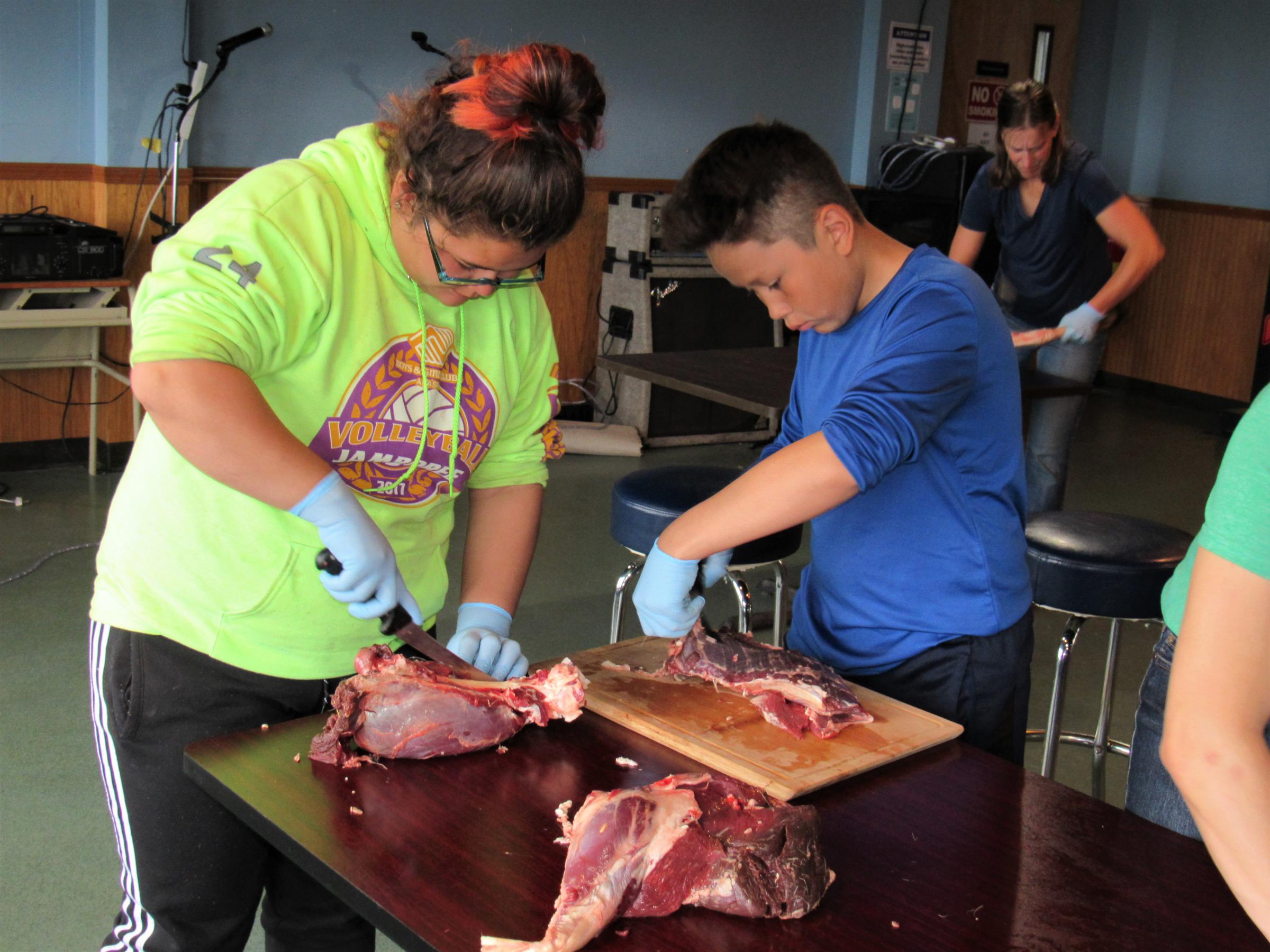
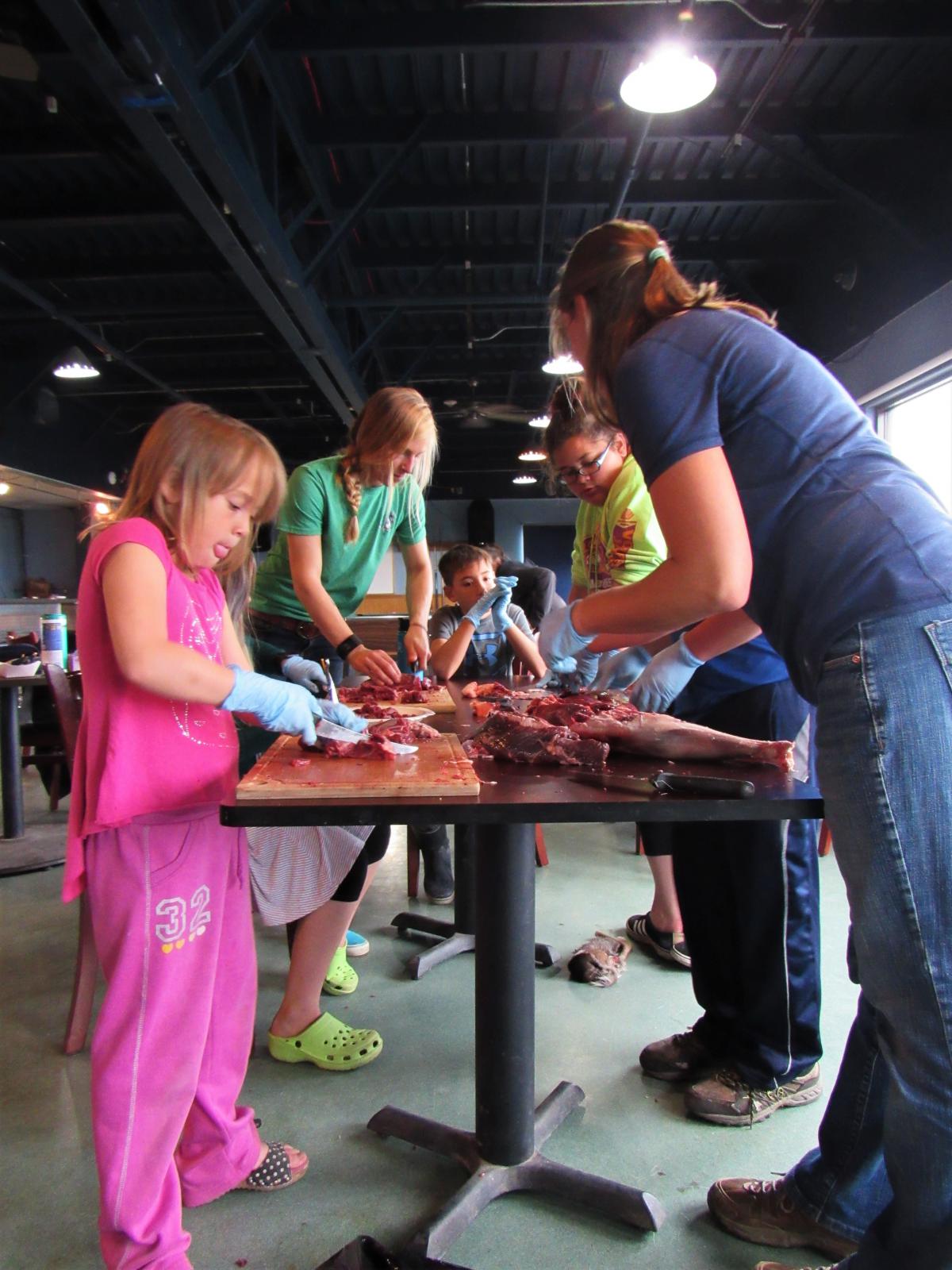
Students at St. Paul’s reindeer camp butcher a female from the island’s herd. This summer, the tribal government organized the camp as part of its effort to develop a more robust reindeer management program. (Photo by Laura Kraegel/KUCB)

For the last century, reindeer have roamed St. Paul Island without much oversight.

But now, the tribal government is stepping up its management style to boost subsistence options and the local economy.

Fleshy red reindeer quarters are spread across the tables of St. Paul’s tavern. Surrounding them are eager pre-teens, wielding knives and wearing plastic gloves.

“I don’t think we can cut through this bone,” said one student. “It’s like that thick.”

“No! You don’t want to cut through the bone,” a teacher responds.

The kids are learning how to butcher a hind shank — how to feel along the bone with their fingertips, slice through the tendons, and free the best cut of meat.

“Do you want to cut the joint right there?” the teacher asks. “There you go. Nice!”

Instructors Lauren Divine and Erin Carr demonstrate how to process a hind shank at St. Paul’s reindeer camp. (Photo by Laura Kraegel/KUCB)

Lauren Divine is one of the instructors at “reindeer camp” — a first for the small island of 500 people.

“Just having a first shot at reindeer camp out here is a really big step for us,” said Divine, the co-director of the tribe’s Ecosystem Conservation Office.

Specifically, she said it’s a step toward an active management program for the island’s herd.

Even though reindeer have lived on St. Paul for about 100 years, she said the tribe hasn’t done much more than distribute hunting permits. That’s slowly beginning to change, because the community needs another consistent source of meat.

“Especially in light of other resources that are declining,” Divine said. “The struggle becomes greater every year.”

Tribal leaders have started investigating ways to develop reindeer as a robust option for subsistence.

They’re experimenting with different hunting seasons and harvest strategies, in addition to offering community education, like this camp.

“We’re at the starting line,” Divine said. “Whereas a lot of other places in Alaska are more developed or have these champions who have been around for a long time in the reindeer world, we’re building our knowledge base from the ground up.”

That’s clear from the dozen or so kids at camp. Most are pretty new to the animal, including 9-year-old Riley Melvidov.

“My dad only hunted (them) one time,” he said.

His family liked the meat. They liked having a stash of it in the freezer, too, alongside their fur seal and other more established subsistence foods.

“Yeah! I was into it,” he said.

Riley’s family isn’t the only one interested.

Tribal leaders say more and more people are picking up permits, heading out on the tundra, and taking a shot at reindeer hunting.

Eventually, that participation could translate into something more profitable.

“They have an opportunity to be able to sell the reindeer meat in the store,” said Erin Carr of the Reindeer Research Program at the University of Alaska Fairbanks.

Carr is partnering with the tribe to expand St. Paul’s economy — and freezer section — through commercial sales at the local grocery store.

It’ll take a while, but she says the program would let people support the island’s hunters while avoiding the astronomical prices of other meat.

Back at reindeer camp, the kids finish their butchering lesson and shed their bloody gloves.

They gather around the grill in silent excitement.

“You want to sear it on medium-high on both sides,” Divine said.

Finally, the reindeer is served up, the taste test begins — and the reviews are positive.

“Really good!” says one camper. “You want to try?”

Site notifications
Update notification options
Subscribe to notifications