Students at St. Paul’s reindeer camp butcher a female from the island’s herd. This summer, the tribal government organized the camp as part of its effort to develop a more robust reindeer management program.(Photo by Laura Kraegel / KUCB)
For the last century, reindeer have roamed St. Paul Island without much oversight. But now, the tribal government is stepping up its management style — to boost subsistence options and the local economy.
Fleshy red reindeer quarters are spread across the tables of St. Paul’s tavern. Surrounding them are eager preteens, wielding knives and wearing plastic gloves.
“I don’t think we can cut through this bone!” says one student, “It’s like that thick.”
“No! You don’t want to cut through the bone,” the instructor replies.
The kids are learning how to butcher a hind shank — how to feel along the bone with their fingertips, slice through the tendons and free the best cut of meat.
Lauren Divine is one of the instructors at “reindeer camp” — the first of its kind for the small island of 500 people.
“Just having a first shot at reindeer camp out here is a really big step for us,” she says.
Specifically, it’s a step towards an active management program for the island’s herd. Even though reindeer have lived on St. Paul for about 100 years, the tribe hasn’t done much more than distribute hunting permits. That’s slowly beginning to change — because the community needs another consistent source of meat.
“Especially in light of other resources that are declining,” Divine says. “The struggle becomes greater every year.”
Instructors Lauren Divine and Erin Carr demonstrate how to process a hind shank at St. Paul’s reindeer camp. (Photo by Laura Kraegel / KUCB)
So, tribal leaders have started investigating ways to develop reindeer as a robust option for subsistence. They’re experimenting with different hunting seasons and harvest strategies in addition to offering community education, like this camp.
“We’re at the starting line, whereas a lot of other places in Alaska are more developed or have these champions who have been around for a long time in the reindeer world,” Divine says. “We’re building our knowledge base from the ground up.”
That’s clear from the dozen or so kids at camp. Most are pretty new to the animal, including 9-year-old Riley Melvidov, who says his dad only hunted reindeer once. His family liked the meat, he says, and they liked having a stash of it in the freezer, alongside their fur seal and other more established subsistence foods.
Riley’s family isn’t the only one interested. Tribal leaders say more and more people are picking up permits, heading out on the tundra and taking a shot at reindeer hunting.
Eventually that participation could translate into something more profitable, according to Erin Carr, who works for the Reindeer Research Program at the University of Alaska Fairbanks.
“They have an opportunity to be able to sell the reindeer meat in the store,” she says.
She’s partnering with the tribe to expand St. Paul’s economy — and freezer section — through commercial sales at the local grocery store. It’ll take a while, but Carr says the program would let people support the island’s hunters while avoiding the astronomical prices of other meat.
Back at reindeer camp, the kids finish their butchering lesson and shed their bloody gloves. They gather around the grill in silent excitement, while their cuts of meat are seared on both sides.
Finally, the reindeer is served up, the taste test begins — and the reviews are positive.
“Really good!” says one student. “You want to try?”
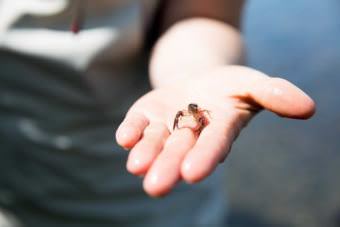
Signal crayfish are not native to Alaska. Discovered in the Buskin River in 2001, the population is now well established and breeding. (Photo courtesy Lisa Hupp/USFWS)
The Sun’aq Tribe won a grant to study the kind of threat that invasive crayfish in Alaska pose to subsistence resources. The award was announced Tuesday.
Tribal biologist Kelly Krueger saod Sun’aq applied for a Tribal Wildlife grant through the U.S. Fish and Wildlife Service about a year ago.
Now, the group will get almost $200,000 in funds as part of a continued effort to study crayfish in the Buskin River watershed.
Signal crayfish are from the Pacific Northwest, Krueger said, but they have been in the watershed for at least 20 years.
“We’re not sure how they got here or even how long they’ve been here, but the population is breeding, and we’re worried about the subsistence resources and the fish that we all rely on and how the crayfish are impacting those resources.”
Part of the two-year project includes diving down and collecting crayfish for study, Krueger said, and then coming back to the spot a month later to see how many of the animals have repopulated.
They’ll also follow the individual crustaceans remotely.
“We’re going to be attaching these little PIT tags. They use them for tracking salmon in other fish, but we’re going to be putting them in the crayfish to see where they’re moving so we can see if they’re going down to the bottom of the lake or if they’re moving out into the river.”
They also want to know what the crayfish feed on.
“Are they eating dead salmon carcasses? Are they eating salmon eggs? Are they just eating insects?” Krueger asked. “We don’t do know.”
The goal ultimately is to better understand what threat the relatively recent crawfish population poses to the species people have relied on for subsistence for thousands of years.
The other two Alaska-based Tribal Wildlife grant recipients are St. Paul Island for sustainable reindeer management and the Sitka Tribe of Alaska for shellfish population and habitat research in Southeast.
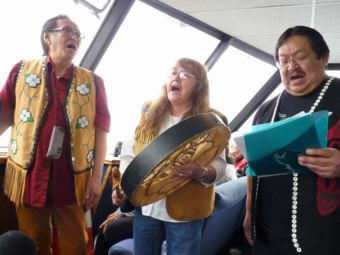
Members of the Yaaw Tei Yi Tlingit Dancers sing during a July 28, 2107, tour of the Taku Tlingits' traditional territory. (Photo by Ed Schoenfeld/CoastAlaska News)
The Douglas Indian Association organized the July 28, 2017, tour. (Photo by Ed Schoenfeld/CoastAlaska News)
Tribal government administrator Andrea Cadiente-Laiti speaks during a Taku Inlet stop. (Photo by Ed Schoenfeld/CoastAlaska News)
Traditional T’aaḵu Kwáan territory in Alaska is shown in this map posted for the tour. It continues into British Columbia and the Yukon.
Paul Marks. right, and David Katzeek speak in Tlingit and English during a recent tour of traditional T’aaḵu Kwáan lands. (Photo by Ed Schoenfeld/CoastAlaska News)
The Allen Marine catamaran St. Peter carried more than 100 tribal members and officials, plus government staffers and media members, on the Taku territory tour. (Photo by Ed Schoenfeld/CoastAlaska News)
Clouds and mist cover mountaintops in Taku Inlet. (Photo by Ed Schoenfeld, CoastAlaska News)
Elder Margaret Dutson speaks during the Taku territory tour. (Photo by Ed Schoenfeld/CoastAlaska News)
Flowers were left in Taku Inlet in memory of those who have passed on.
Andy Ebona speaks between songs during the Douglas Indian Association tour of traditional T’aaḵu Kwáan territory. (Photo by Ed Schoenfeld/CoastAlaska News)
Lyrics to the Wooshkeetaan Love Song.
Norman Sarabia, right, addresses the group during the Taku territory tour. (Photo by Ed Schoenfeld/CoastAlaska News)
An old cannery still stands in Taku Harbor. The area was home to a T’aaḵu Kwáan village. (Photo by Ed Schoenfeld/CoastAlaska News)
Children play on the back deck of the catamaran St. Peter during the tour of T’aaḵu Kwáan territory. (Photo by Ed Schoenfeld/CoastAlaska News)
It’s important to know where you come from. But when others make assumptions that are wrong, it’s hard to maintain your identity.
A Southeast Alaska Tlingit tribal government is letting its neighbors know its members come from a vast territory that still bears their names.
The tour boat St. Peter sails around Douglas Island, which is part of Juneau, headed to nearby Taku Inlet.
On board are local and state government officials and members of the Douglas Indian Association, which represents the T’aaḵu Kwáan, the area’s original residents.
At the front of the boat, elders Paul Marks and David Katzeek explain where they are, in Tlingit and English.
“You’re hearing the words and the voices of those who have gone before us on these waters. … And this is how we know today, and we’ve known for thousands of years, that this land belongs to us,” Katzeek translated.
The Douglas Indian Association organized the July 28, 2017, tour of traditional T’aaḵu Kwáan territory. (Photo by Ed Schoenfeld/CoastAlaska News)
Traditional T’aaḵu Kwáan territory includes the southeast part of Juneau, Taku Inlet, a smaller cove called Taku Harbor and up the Taku River into Canada.
Tribal members, some known as Inland Tlingits, also live in Atlin, British Columbia, almost 80 miles to the north, and Teslin, Yukon Territory, about 60 miles farther.
The association also includes some members of the A’akw Kwáan, whose traditional territory is to the north and west.
Westerners began exploring the area in the late 1800s, and built mines and cities. Taku people lived nearby, but weren’t treated as the original property owners.
They were shut out of traditional lands.
A Tlingit cemetery was later knocked down and paved, to make room for a road and a school. Later, local government burned down their village to build a boat harbor.
Tribal government administrator Andrea Cadiente-Laiti said colonization, disease, limits on fishing and other factors decimated the population.
“We lost everything that was precious to other … federally recognized tribes and that’s land, fishing rights, community, all the way down to sacred sites,” she said.
Some of that’s finally being addressed.
The Douglas Indian Association and Juneau’s Goldbelt Heritage Foundation are working with government officials to recognize and remember the area’s first peoples.
One totem has been carved and raised at the site of Douglas’ Gastineau School. A second pole and memorial are in the works.
University of Alaska Southeast anthropology professor Dan Monteith told the group that it’s important to reconcile, but never forget.
Douglas Indian Association Administrator Andrea Cadiente-Laiti speaks during a Taku Inlet stop. (Photo by Ed Schoenfeld/CoastAlaska News)
“Hopefully we can make this history a part of the history here that’s no longer repressed, no longer brushed over, no longer ignored,” he said.
The boat motors past Point Arden, where an inlet, a channel and a passage meet.
Katzeek said the competing currents weave the waters, giving them their Tlingit title.
“The name is Kanaasnoo. Everybody say, Kanaasnoo. That is a powerful, powerful word. When you look into hydrology, if there’s any kind of contamination going, this is the place where it would be mixing and it would be sending it out to the other places,” he said.
The Taku people are particularly worried about pollution from the long-closed Tulsequah Chief Mine, across the border in Canada. Acidic water drains from abandoned tunnels into the mine’s namesake river.
Some studies have shown it does not damage fisheries as it flows into the Taku River, but a recent British Columbia report points to unsafe pollutant levels in some areas.
The Indian association’s John Morris said it’s an issue for all the region’s tribes.
“The Taku, the Stikine, the Unuk, the Alsek, the Chilkoot,” he said. “All of our rivers are being threatened by these mining operations that are being proposed in British Columbia.”
Entering Taku Inlet, the boat stops at a steep cliff face for a memorial, and off a cove, for another. There, and in a harbor to the south, speakers point out where the T’aaḵu Kwáan once lived.
An old cannery still stands in Taku Harbor, south of Juneau. The area was home to a T’aaḵu Kwáan village. (Photo by Ed Schoenfeld/CoastAlaska News)
Michael Kell, a historical archaeologist for the state, gestures toward an old cannery and the site of a long-abandoned fort. It’s where the area’s Tlingits established one of their many communities.
“We know for a fact that there are summer and winter camps and these camps indicate that people were here and using the land,” he said. “That’s the important recognition here, is that the culture has been here and the culture’s still here.”
Old village sites are hard to spot, since most Taku people moved to town decades ago.
Tribal administrator Cadiente-Laiti said many are not part of the Douglas Indian Association. Leaders would like them to join.
“Part of the challenge is to have other government agencies, the powers that be that dictate where and when and how much funding comes to the tribe based on its membership, that it’s not just the tribal member numbers, it’s the area that was traditionally and historically the tribe’s,” she said.
She said more members would increase government grants that fund economic development, environmental protection and youth education.
Hear David Katzeek tell the Tlingit story of two giants, or mountains, by T’aaḵu Kwáan elder Elizabeth Nyman:
The gray whale killed in the Kuskokwim River on Thursday night may have been searching for new food sources, Oregon-based scientist Carrie Newell said. (Photo by Katie Basile/KYUK)
Climate change may be responsible for pushing Alaska’s gray whales up into estuaries and rivers.
Oregon-based whale biologist Dr. Carrie Newell said that gray whales spend six months of the year in Alaskan waters feeding.
The whales dig into the muddy bottoms of the North Pacific, the Bering Sea, and the Arctic Ocean looking for tiny shelled creatures known as amphipods.
“They are about a half-inch to an inch long,” she said. “The grays need to eat about a ton of those a day.”
Alaskan waters have warmed significantly with climate change, and one result is fewer of these cold-water loving crustaceans to feed gray whales, which sends the inquisitive whales into new habitats looking for food.
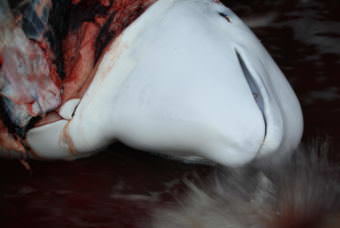
This could be the reason, Newell said, why the whale swam 60 miles up the Kuskokwim.
“I know that up in Alaska, the gray whales are not doing nearly as well as they are down here for food,” Newell said. “And so it was maybe trying to look for a new source of food because the food, the amphipods they primarily have fed on in Alaska, have not been doing as well as they have in the past.”
In other words, the whale may have been hungry. Newell said that it was probably a male and that at 37 feet, it probably weighed 37 tons.
Most of the East Pacific gray whales spend their summers in Alaska eating, and their winters in Mexico, breeding and calving off the Baja Peninsula.
A beluga whale is processed. (Photo by Avery Lill/KDLG)
A beluga whale was harvested Sunday evening near Dillingham.
The community showed up in force.
Lines of cars brought people with their totes and trash bags.
The successful hunters shared meat with everyone who came. Processing the animal took about two hours.
It was the whole hunting party’s first time to take a beluga. The three were commercial fishing for silver salmon when they saw a pod of belugas.
“We noticed one was nosing up to the beach and trying to get salmon, so we went up right to it and fired one shot, missed and got it with the next one,” Cade Woods said.
In Little Diomede, more than 500 miles away, Rebecca Ozenna’s family celebrated the catch with a traditional dance.
“Right after we landed the beluga, I called home,” Ozenna said. “I asked them to announce it so they could celebrate for us because usually when they land whales they have a really big Eskimo dance celebration and other people from different villages come in and Eskimo dance and celebrate and feast.”
In Bristol Bay, an average of 23 belugas are reported harvested each year.
According to the Alaska Department of Fish and Game, the population of belugas in the bay is stable and that number is well within a sustainable harvest size.
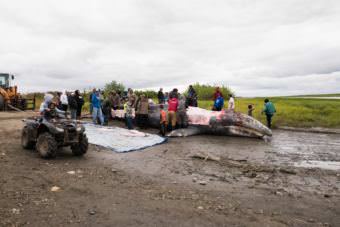
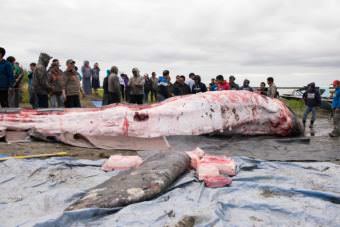
The whale killed in the Kuskokwim River on Thursday night is butchered and the meat and blubber distributed to people up and down the river. (Photo by Katie Basile / KYUK)
(Photo by Katie Basile / KYUK)
Willie John of Bethel, hauls a slice of whale blubber to his boat on July 29, 2017 in Napaskiak. People from up and down the river traveled to Napaskiak to help salvage and butcher the whale and collect blubber and meat. (Photo by Katie Basile / KYUK)
(Photo by Katie Basile / KYUK)
The whale killed in the Kuskokwim River on Thursday night is butchered and the meat and blubber distributed to people from up and down the river on Saturday, July 29, 2017. (Photo by Katie Basile/KYUK)
(Photo by Katie Basile / KYUK)
Meat and blubber from the whale killed Thursday evening in the Kuskokwim River is currently being distributed to surrounding villages. Six boats dragged the 37-foot long whale to shallow water between 6 p.m. and 7 p.m. on Saturday. A yellow front-end loader then carried the carcass to the Napaskiak shore.
As of 7:45 p.m. Saturday, about 40 people, including elders, adults, and children, surrounded the whale while several people worked to butcher the meat.
The meat was first distributed to elders, who were seen driving away on four wheelers, carrying pieces of white blubber in trash bags.
Around 9 p.m., sections of the whale had been given to community members from Napaskiak, Atmautluak, Bethel, Akiachak, Tuluksak, and Akiak. Meat and blubber from the whale is expected to travel throughout the region.
Bethel Fire Chief Bill Howell runs a meat cutting and processing business in Bethel called Bill’s Meats. A friend asked him to come to help with the butchering. He soon arrived with knives and began carving whale steaks.
Before the whale was cut, Napaskiak Honorary Chief Chris Larson said a prayer of thanks. Then the whale was given fresh water.
Larson says the whale will be enough to feed the village, especially after a summer of low king salmon. However, there was an abundance of red and chum salmon this season.
Even though the whale has been sitting dead at the bottom of the river for several days, bystanders are saying that the meat is edible.
One woman, when asked how she would prepare the meat, said, “I’m not sure. I’m gonna start with Crisco.”
Others are Googling how to prepare the meat, or saying that they will call their friends and family up north for advice.
Whales coming up the Kuskokwim are rare, and a whale of this kind has not been seen this far inland in living memory. The whale is grey and covered in barnacles. It is not a beluga, as some earlier claimed. It may be a gray whale, but that is unconfirmed. The legal ramifications of the incident are unknown. Whales are protected under federal law and international treaty.
The killing of the whale has drawn a broad controversy that has largely played out over Facebook. Opponents say that whales are not a traditional food for the area, and that the locals who spent 90 minutes using guns, seal harpoons, and whatever they had on hand were unequipped to kill an animal of this kind.
Others have supported killing the whale, saying whatever the river brings them is subsistence food.
To avoid negative attention, many people involved with killing and/or salvaging the whale are choosing to remain anonymous.
Many people have worked around the clock since Friday morning to bring the carcass ashore. The Napaskiak Tribal Council voted to donate $500 of gas to boaters who helped with the recovery. Welders fashioned custom, four-barbed hooks from scrap metal. Ropes broke and hooks were lost as the weight of the animal overwhelmed the homemade equipment.
When it was killed, an estimated 40 to 50 boats were seen chasing and surrounding the whale. Only six to eight boats at any given time were helping to salvage it.
Joe Evon with Napaskiak Search and Rescue led the recovery effort. Mid-day Saturday he said, “Everybody that participated in taking that animal’s life should be out there helping us.”
After two days of trying, innovating, developing tools, and trying again, hooks caught deep enough in the carcass lying under 30 feet of river water. It took a half dozen boats joining the strength of their motors to finally drag the giant animal from the bottom of the Kuskokwim.
Napaskiak Tribal Administrator Sharron Williams says that the recovery was a group effort and that she’s proud of those who helped.
Close
Update notification options
Subscribe to notifications
Subscribe
Get notifications about news related to the topics you care about. You can unsubscribe anytime.