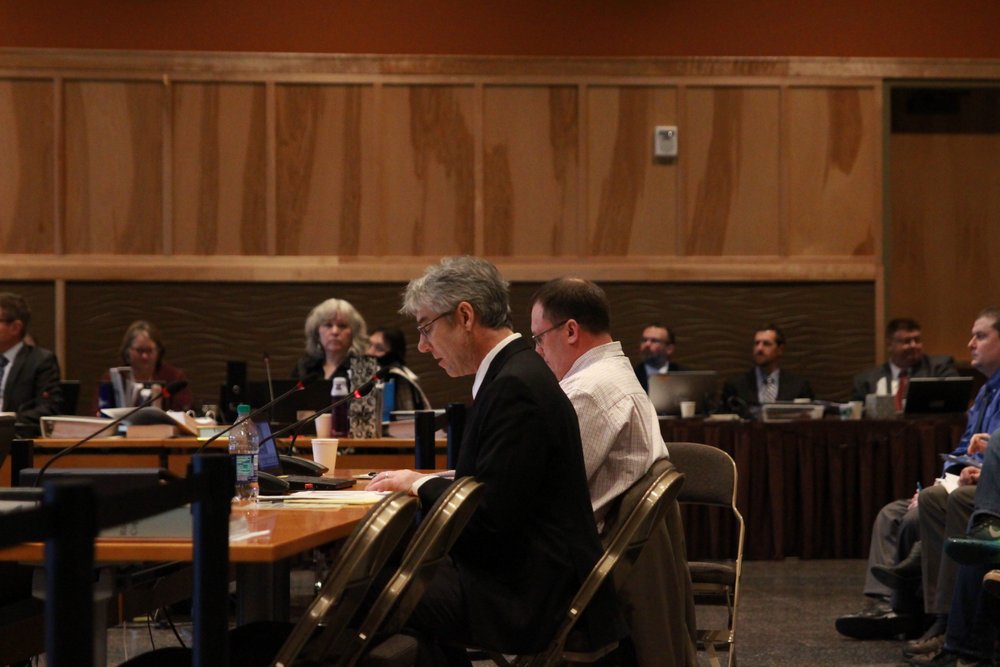
All eyes are on the Board of Fisheries as they deliberate conservation strategies for king salmon, which are returning in poor numbers across Southeast. Steve Heinl and Ed Jones presented Jan. 15 on the Alaska Department of Fish and Game’s draft action plans. (Emily Kwong/KCAW photo)
The board meets every three years to write and revise fishing rules and it holds great sway over the fortunes of the commercial fleet and fishing guides.
Subsistence users are acutely affected by the board’s decisions too.
For groups that traditionally find little common ground, there is consensus on this: king salmon are in trouble.
“I’m extremely concerned for the fate of the king salmon,” Haines-based fisherman Lindsay Johnson told the Board. “I’ll gladly do whatever the experts proscribe to bring them back.”
Alaska Department Fish and Game biologists presented a range of options, from maintaining the status quo to blanket restrictions and widespread closures.
ADF&G presented on escapement trends before the Board of Fish on Jan. 15, 2018. King Salmon river has been identified as a potential stock of concern, along with the Chilkat River, Unuk River, and McDonald Lake sockeye. (Emily Kwong/KCAW photo)
Dan Gray, the Southeast supervisor in charge of king salmon, said there’s a lot at stake for a lot of people.
“Certainly the fishermen are concerned about their futures — and rightfully so,” Gray said. “This is uncharted territory for king salmon.”
King, or chinook, salmon are valuable. Recently they’ve been fetching in excess of $10 a pound for fishermen.
Sitka troll fisherman Tad Fujioka said in an interview Wednesday that closing fishing from March to July would be devastating.
“Almost all of the fishermen are Alaska residents that time of year, many of them from small communities. The fishery is right in front of Hoonah, right in front of Angoon,” Fujioka said. “Sweeping, big closures like that will really hurt the smaller communities.”
Tourism also is at stake.
Sitka charter boat captain Mike Sullivan told the board that proposals forcing non-residents to release any king salmon they catch would harm businesses across Southeast.
“If the charter industry suffers it will be hard for the fleet and this place to regain its reputation as an unparalleled fishing destination,” he said.
Each action plan focuses on a king salmon system and most have failed to meet their escapement goals.
Those goals represent the number of salmon that successfully return from the ocean to freshwater to spawn.
Researchers don’t know exactly the reason for the decline, only that it appears to be happening in the open ocean rather than state waters where Alaska’s salmon fisheries are managed.
Gray said the rest of the week will be intense back-and-forth between the board and select stakeholders and interest groups.
“The board takes their charge very seriously on stocks of concern,” he said. “Your guess is as good as mine as to where they might go.”
The Porcupine caribou herd, whose range includes the Arctic National Wildlife Refuge, has grown to the highest number seen since monitoring started back in the 1970s. That’s according to the Alaska Department of Fish and Game, which just released the results of a photocensus they did this summer.
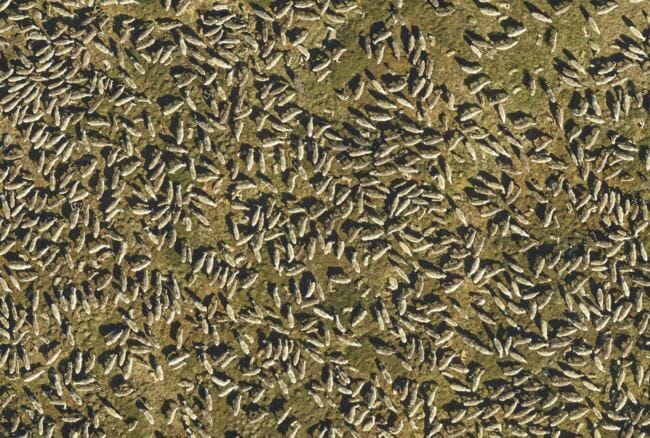
That census is done by mounting cameras to small aircraft, and taking aerial pictures of the herd during the short window they aggregate during the summer.
The new count puts the herd at an estimated 218,000 animals. For comparison, the low point was 123,000 – back in 2001.
The growth is part of an upward trend for the Porcupine herd; the surveys taken in 2010, 2013, and 2017 all show an increase.
“We’ve definitely had an improvement in calf production and adult female survival,” said Jason Caikoski, a wildlife biologist with the Alaska Department of Fish and Game. But he says that while they can identify things that explain how this caribou population is growing, they still don’t know the underlying causes that explain why.
“Predation, changes in weather, changes in habitat… all those types of things affect all those demographics,” Caikoski said. “And currently we don’t have any studies specifically looking at what factors are affecting those demographics.”
Photocensus counts are used by state and federal wildlife managers to help set hunting limits and seasons. Sometimes a finding will prompt a change in regulation, but in the case of the Porcupine caribou herd, which has a moderate population and low hunting pressure, no changes are anticipated.
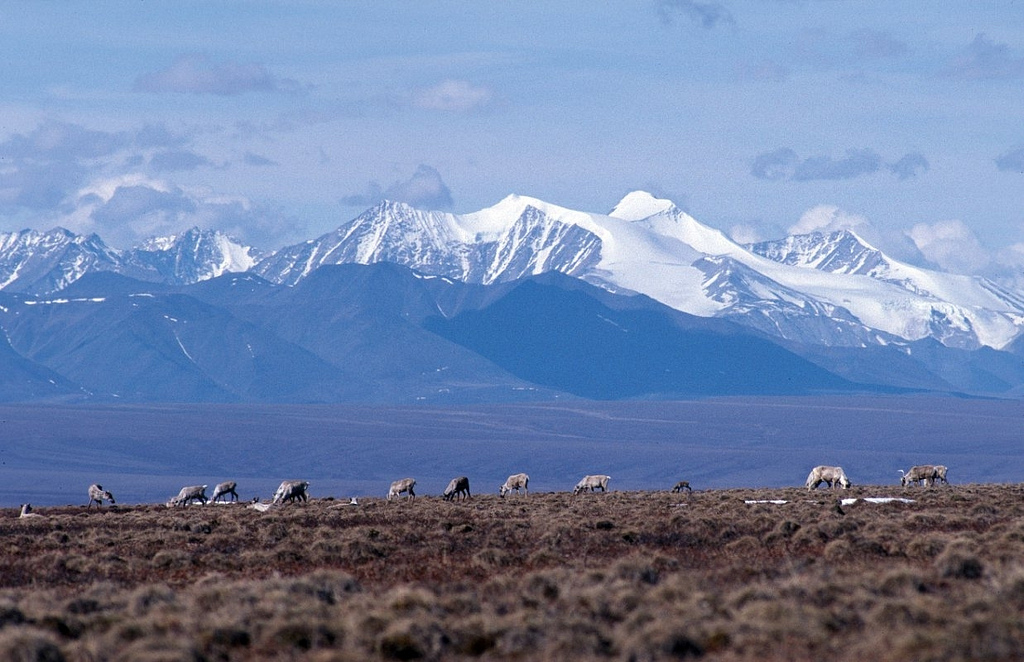
Caribou graze on the coastal plain of the Arctic National Wildlife Refuge, with the Brooks Range as a backdrop. (Creative Commons photo by USFWS)
Now that Congress has OK’d oil and gas exploration in the Arctic National Wildlife Refuge’s coastal plain, opponents are preparing for the next phase in their decades-long struggle to protect the environmentally sensitive area.
“This fight is not over. For the Gwich’in, it has just begun, on a whole new level,” Bernadette Demientieff, executive director of the Gwich-in Steering Committee.
She says members of the Fairbanks-based organization are taking a few days off before they resume their efforts to protect the coastal plain and its wildlife from oil-industry development.
“Right now, we just take the time to calm down, because there’s a lot of anger,” she said. “And we can’t act out in anger.”
The Gwich’in consider the lands that would be opened to oil and gas exploration as sacred. They also worry the industrial activity will harm the Porcupine caribou herd and other wildlife that’s essential to indigenous peoples’ subsistence.
“I would just say for every body just to enjoy their loved ones,” Demientieff said. “And in the new year, we will unite, get back on track, and work on ways that we are going to keep them out of the Arctic refuge.”
Local conservation groups also are preparing to launch campaigns to protect the coastal plain, in concert with their national counterparts and indigenous peoples organizations.
“You’ll see Northern Alaska Environmental Center and our partners here in Alaska continue to stand in solidarity with the Gwich’in nation,” Elizabeth Dabney, executive director of the Northern Alaska Environmental Center. “This is a huge blow to their way of life. And a lack of an acknowledgement of the time they spent in Washington, D.C., raising their voices.”
Fairbanks Climate Action Coalition spokeswoman Jessica Girard accuses Alaska’s congressional delegation of favoring industry over Alaskans who oppose opening the coastal plain to oil and gas development.
She said U.S. Sen. Lisa Murkowski sold out by voting in favor of the federal tax-reform bill that contained provisions to open ANWR, despite another part of the bill that will cripple the Affordable Care Act – which the senator said she opposed earlier this year.
“I think we saw a spike in support for the refuge, specifically here in Alaska, when people began to realize that Murkowski did sell out her health-care vote simply to get her pet project, which is the Arctic refuge,” Girard said.
Murkowski has denied those accusations, saying the bill’s provision to repeal the universal mandate from the health care act, quote, “restores to people the freedom to choose” because it eliminates the requirement that all Americans be covered by health insurance.
Dabney said Murkowski’s role in including ANWR in the final budget bill casts doubt on her explanation.
“It was an underhanded way to get the coastal plain in there. And it was also pretty dangerous and totally disregarded the Gwich’in,” she said.
Neither Dabney nor Girard would offer specifics on the new campaigns they say will be launched in the coming year to halt development of the Arctic Refuge.
Girard says conservation groups intend to take full advantage of the years-long federal process of identifying lands with oil and gas potential and then conducting lease sales, all of which must be done before drilling can begin.
“There’s many hurdles that are in the way of opening the refuge.”
Throughout that time, Girard says opponents will be waging political fights in Congress, filing lawsuits and staging protests here in Alaska and nationwide.
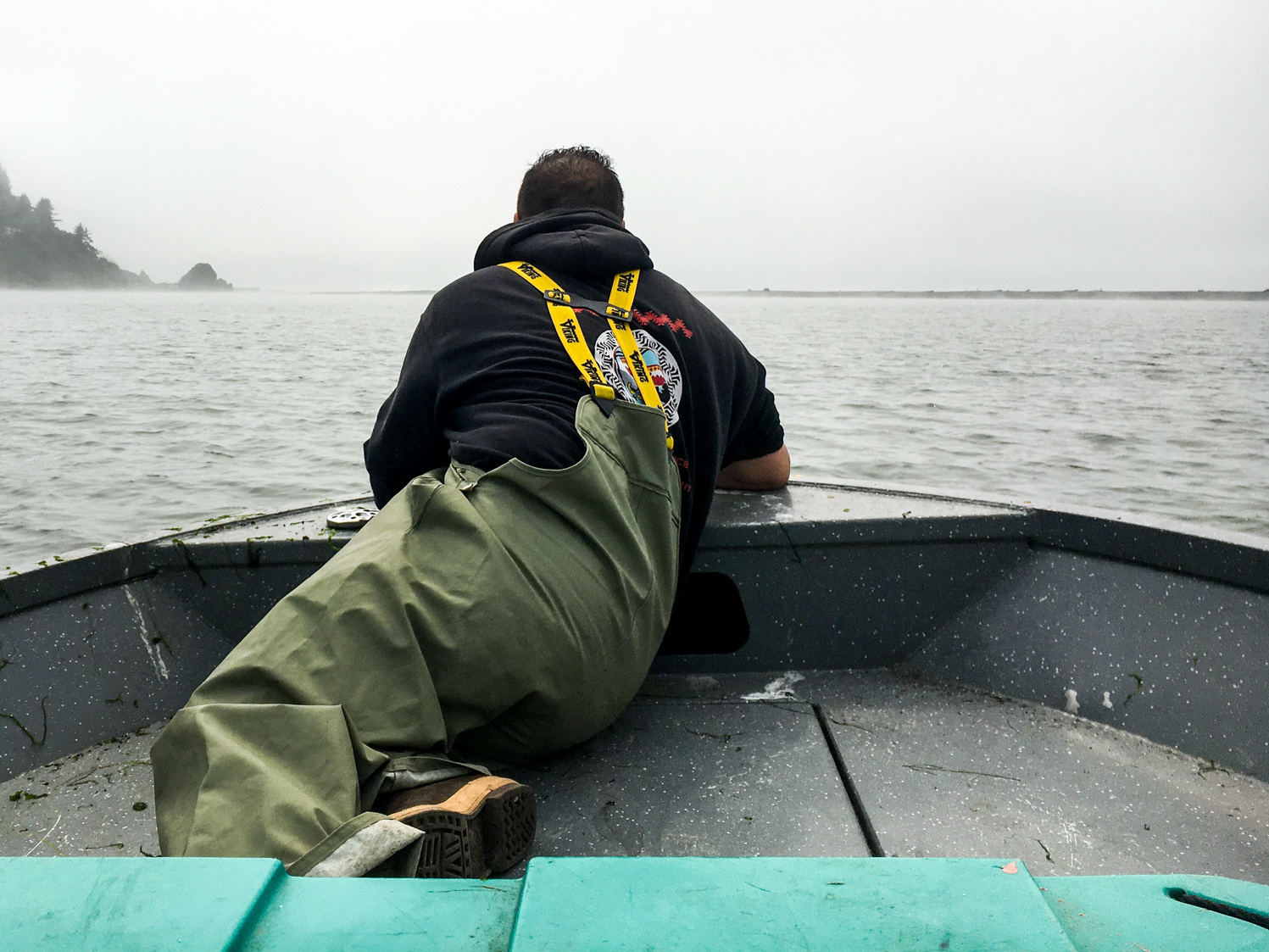
Jerome Nick Jr. perches in the front of the boat, checking to see if any Yurok tribal members are fishing. (Photo by Lisa Morehouse/KQED)
The Yurok Tribe in Calfornia has fished for salmon in the Klamath River for centuries. Salmon is essential to Yurok ceremonies, for food, and for income.
But this fall, the number of Chinook swimming up the Klamath, in the Pacific Northwest, was the lowest on record, threatening the tribe’s entire culture and way of life.
Erika Chavez and Jerome Nick Jr., cousins who work for the Yurok Tribal Fisheries Department, are patrolling the Klamath River in the far northwest corner of California. Nick perches in the front of the boat, with Chavez at the helm as they head to the mouth of the river.
“Just checking to see if there’s any tribal members fishing,” Chavez says. “Then we’re gonna head up to the bridge to see if anyone’s there.”
Today, the cousins are also are volunteering to catch salmon for tribal elders — the only fishing allowed this year.
Chavez slows the boat so Nick can pull up a net they set a couple hours ago. The verdict?
“No fish,” Nick says, shaking his head.
The cousins are alone on the water today. In a normal year during commercial fishing season, Nick says, “practically this whole area is nets, all the way up to the bridge. You just see corks on the water, the river’s so packed with nets.”
Without people on the river fishing, the salmon have a chance to travel up river to spawn. “At least that’s my hope,” Chavez says.
Unlike a lot of Yurok, Nick didn’t grow up fishing. He moved here six years ago to get away from family drama in Oregon. Now, when he’s not working the overnight shift at Wal-Mart, he’s on the water. “I work here with my cousin and she keeps me sane,” he says. “She’s my rock.”
Chavez grew up with her family camping right here for the summer. Her grandma would make fry bread, and she and her great-grandma would watch everyone fish. Chavez started fishing when she was nine.
“My partner was my auntie, she’s the one that taught me, and our whole bottom of our boat was filled with fish. Everyone was catching plenty for their families. It was beautiful.”
For the Yurok, a rich salmon harvest means covering the basics.
“It feeds our family,” Chavez says. “When commercial’s here we use that money to buy our kids school clothes.”
Chavez usually fishes for her grandma. “I get her 10 to 15 fish every year, so it’s in her freezer for the whole year,” she says. This year, “she’ll have to deal with deer meat or elk meat or something.”
About five minutes away in the town of Klamath, thousands of Yurok tribal members and friends gather every August for the tribe’s Salmon Festival. There’s a parade, and a stick game that looks to my untrained eye like a cross between wrestling and field hockey.
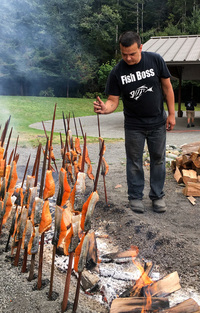
At the 55th Annual Yurok Salmon Festival, Oscar Gensaw cooks salmon the traditional way, on redwood skewers around a fire pit. This year, though, the tribe had to buy salmon from Alaska. (Photo by Lisa Morehouse/KQED)
True to the festival’s name, there’s salmon cooked in the traditional Yurok way. Around the edge of a long, narrow fire pit, salmon skewered on redwood sticks form a kind of crown. Oscar Gensaw monitors the scene, wearing a T-shirt that reads: Fish Boss.
“When you first start cooking, you get those fat rings around the fish like a ring on a tree,” Gensaw says. “When the fat starts dripping out of each of those rings you know that side is done.”
Gensaw grew up in Klamath and has three sons and a baby daughter.
“My main goal is to pass this onto my boys so one day I can be the ultimate fish boss, and be on the side when they cook,” he says with a laugh. But he wants to teach them with salmon caught in the Klamath — not the fish he’s cooking with today.
“These come from Alaska,” he says. The tribe had to buy this salmon, for the first time in the history of the festival.
The tribe works with federal agencies every year to estimate the fall run and to decide how many salmon can be caught. So few chinook were expected to return to spawn this year that commercial fishing was shut down to protect them. The Yurok were allowed to catch just over 600 salmon, in a tribe of 6,000.
Those low numbers are the end result of drought, disease and a long history of habitat destruction. The Yurok place much of the blame on upstream dams that have blocked salmon from ancient spawning grounds for over a century. After years of debate and struggle, four dams are set to be removed by 2020.
In the parade, Annelia Hillman commands the megaphone for the Klamath Justice Coalition, chanting, “Undam the Klamath, bring the salmon home.” She tell me that tribes along the Klamath have had to fight logging, gold mining, the dams and now a proposed natural gas pipeline.
“If we’re putting our water at risk like that, we’re putting life on earth at risk,” she says.
Hillman’s a youth social worker, and she says, when the balance with the river is off, the Yurok feel the effects.
“When we can’t be in our river, can’t eat our fish, it kind of takes our purpose away. We have one of the highest suicide rates … and I think that’s directly correlated to our lack of salmon and our inability to continue our way of life,” Hillman says.
The Yurok have fought for years to maintain their ties to the Klamath River and its salmon. In the 1960s, game wardens arrested many Yurok time and again for gillnet fishing on the river, a practice banned by the state. One young man, Raymond Mattz, challenged the arrests. His fight went to the U.S. Supreme Court, which reaffirmed the tribe’s fishing rights.
His nephew, Paul Mattz Van Mechelen, runs Paul’s Famous Smoked Salmon on Highway 101. Customers know he’s open if there’s smoke coming from the traditional fire pit in front. “That’s my Yurok Weber!” he jokes.
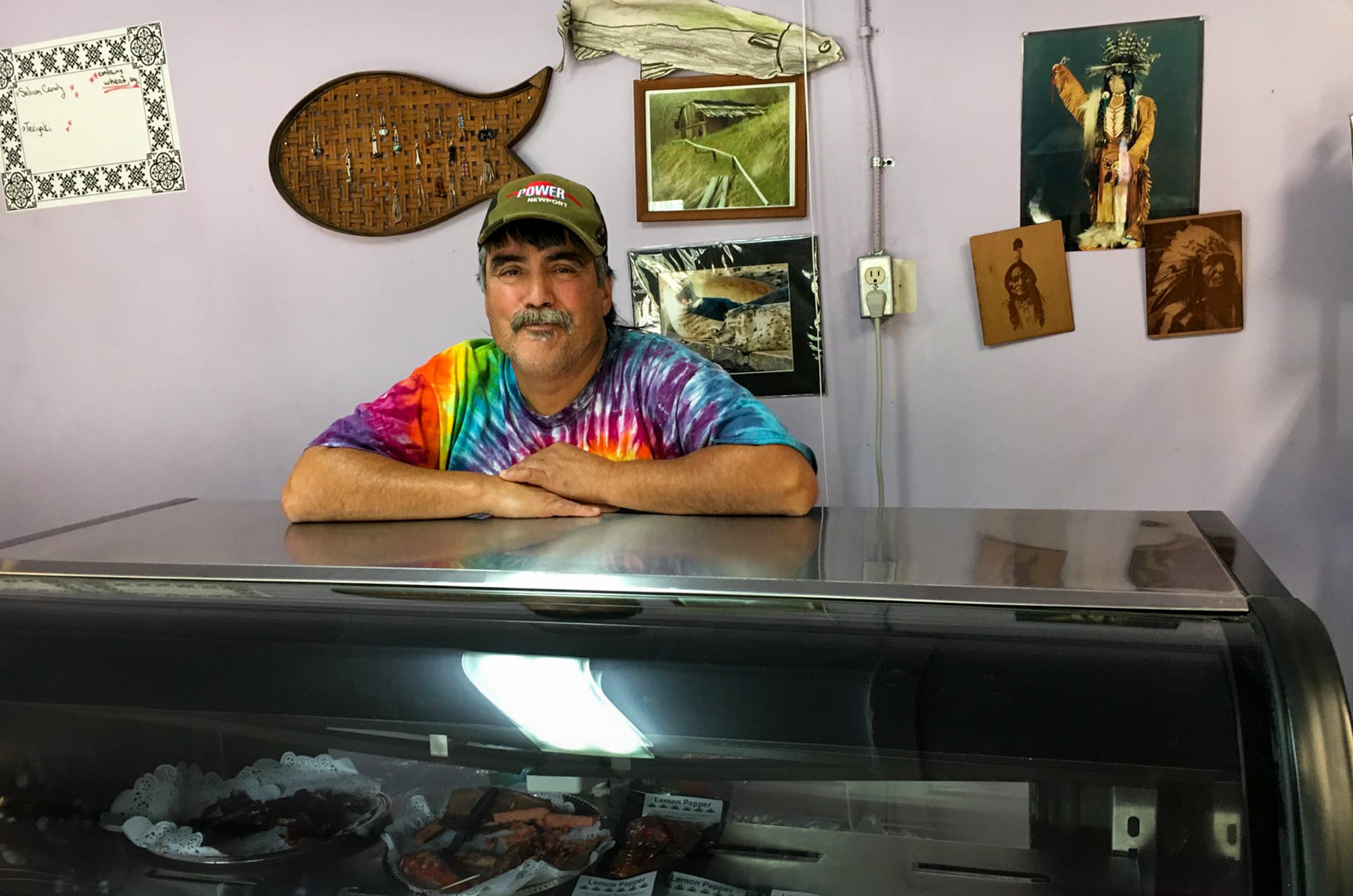
Paul Mattz Van Mechelen, who runs Paul’s Famous Smoked Salmon, has had to buy salmon from fishermen hundreds of miles away instead of fishing for Chinook in the Klamath River, just 50 feet from his California shop. (Photo by Lisa Morehouse/KQED)
Van Mechelen opened the shop 16 years ago after his grandmother came to him in a dream. A steady stream of customers comes to sample and buy the wild Chinook salmon he prepares with flavors like garlic, lemon pepper and teriyaki. Usually, he gets his stock from the Klamath River.
“Not the last two years, though,” he says. “I had to go to the Columbia River,” hundreds of miles away in Oregon, where he buys from native fishermen. Gas, and payment for fish, are big expenses for a business owner who usually fishes about 50 feet from his store.
The losses go deeper than just finances.
“I got a great niece — she’s only 2 — but she helped start up the boat and and smiled and did all that last year,” Van Mechelen says. “Her auntie was 5 when she pulled in a fish. So that whole part of learning and teaching them who they are and what this river gives to them is kind of life in one way.”
When I ask him to explain that, that fishing is who Yurok are, Van Mechelen gets emotional, even stepping out of the store for a minute.
“I had my grandma at a young age tell me I had fish blood. I didn’t understand it, I didn’t know why. But we’re all fishing people.”
And when you have fish blood but you have to stay away from fishing in hopes of keeping salmon here in the future? “It’s sad to stay next to a river and wake up and not see fish go by,” Van Mechelen says. “That’s the saddest part. It’s bad enough you dream about it.”
All he can do, he says, is pray the salmon come back.
This piece is part of the series California Foodways and was produced in collaboration with the Food & Environment Reporting Network, a non-profit, investigative news organization. Broadcast versions of this story aired on KQED’s The California Report and NPR’s Here & Now.
Copyright 2017 NPR. To see more, visit http://www.npr.org/.
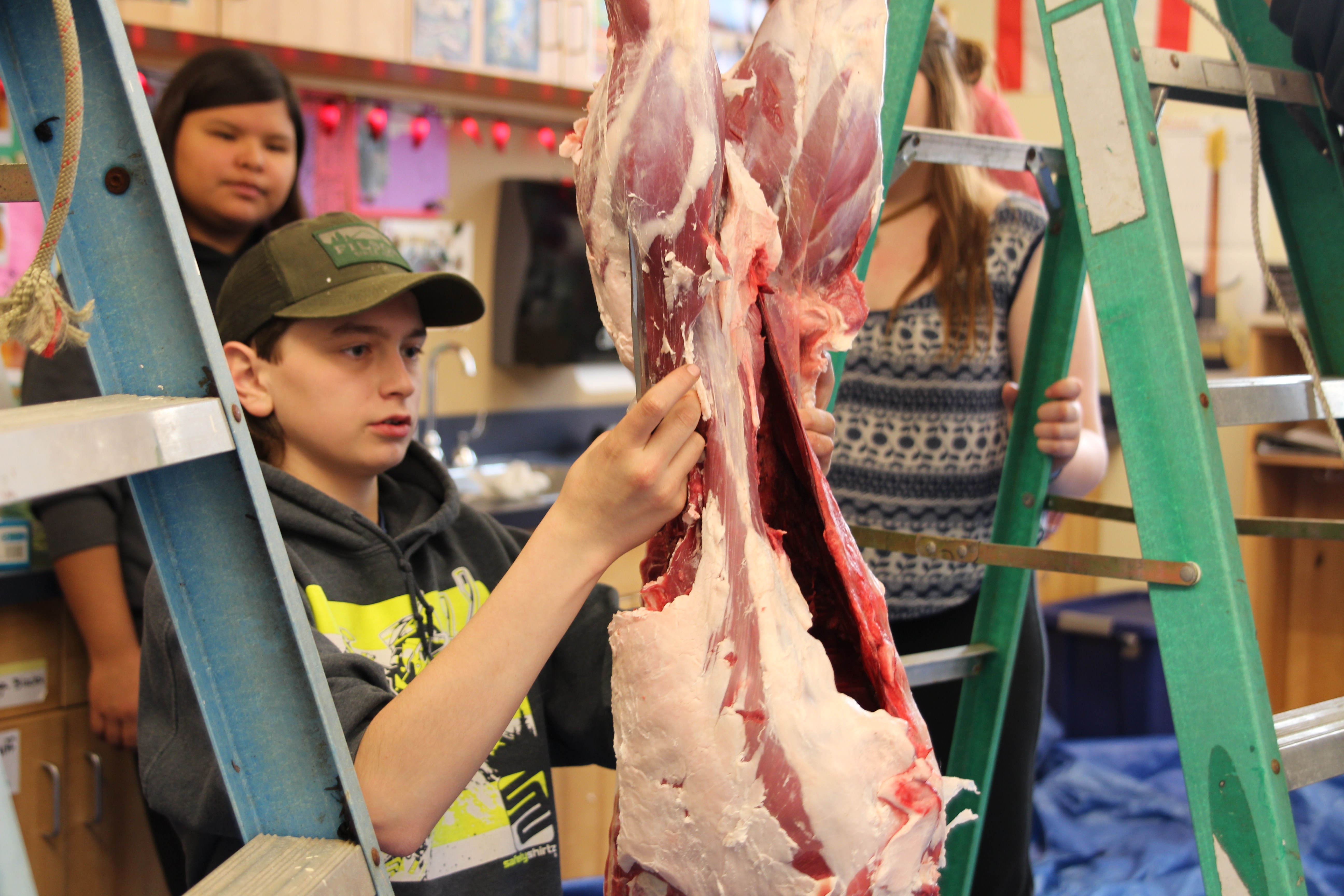
A student at Pacific High tries his hand at processing a locally harvested deer. (Photo by KCAW)
“Experiential learning” in high school takes on a whole new meaning when the subject is subsistence.
At Pacific High School in Sitka the students already understand that they’re going to experience a lot of hands-on activities.
Earlier this fall, they got their hands on — and inside of — some locally harvested deer.
In a high school classroom a saw is buzzing, but it’s not woodshop class.
“If you wanted to take a piece of meat off to just fry up like a steak, take slices off this backstrap. Does someone want to do the other side?” Tad Fujioka asks.
Students at Pacific High stand in a circle, watching intently as Fujioka shows them, step by step how to process a deer. He’s a bit out of breath, it’s a tough job.
“The ribs are really tasty, but they can be pretty tough, I usually like to boil ‘em or steam ‘em for a couple hours to make ‘em tender,” Fujioka said.
It’s a state history requirement that students learn about the importance of subsistence living.
These students are focusing on deer, but last month, they learned to fish for coho.
Freshman George Stevenson said that day, he and his classmates walked away empty handed.
“We didn’t catch anything. It’s not all about catching fish for fun. It’s about catching for food,” George said.
While nature didn’t provide that day, there was still something to be learned.
“Most of the time it would be just reading passively about the subject,” said Matt Groen, who teaches the subsistence course at Pacific High. “We are able to meet up with local experts like Tad and Chuck, put our hands on a salmon and engage in the process.”
After Fujioka shows students how to clean the deer, they spread the red chunks of meat out on the table.
Groen shows the students the final step: how to vacuum seal the meat into tidy packages.
“During this time of year, this is how my house sounds way too often,” Groen said. “How many of you have heard this sound during fall? Yes, it is the sound of modern subsistence.”
But they’re not just packaging venison without getting some historical context.
Chuck Miller arrives to teach students why deer is significant and should be respected.
“It’s not because you’re like the greatest hunter that you got this deer,” Miller said. “It’s not because you tracked it down and you were like oh, yeah I’m superior to the deer. The Tlingit people believe, and I know other cultures in Alaska believe, you are inferior to that animal. They allowed you to hunt it. They allowed you to harvest it.”
One story Miller tells about his grandfather really sticks with the students.
“I asked him, grandpa. What’s the biggest deer you ever got?’ He just kept playing. Then he put his cards down. Then he looked at me. ‘Chucky. You can’t eat the horns.’ He picked up his cards again and started playing.”
Miller’s story resonated with sophomore Angelei Young, who said the size of a rack doesn’t matter.
“It just matters how much you can provide to your family,” Young said. “That’s important to teach people. Usually a lot of people are like yeah, this is so big and so cool.”
The deer students processed is packed and frozen now, but soon they’ll give it away.
Sophomore Abraham Diaz explains why.
“When you kill your first deer you have to give it to your elders. They took care of you when you were a kid. They fed you, so that’s a sign of respect and appreciating what they did for you.”
“I’ve learned if you’re greedy with your food then nature doesn’t support you and doesn’t give you anything. My uncles make sure that every time I do go out, I pray about it and thank the land and thank the deer and thank everything I use in order to have a good season.”
The Pacific High students will distribute the best cuts at an upcoming luncheon honoring tribal elders.
Then hopefully, there will be a little left over for them so they can enjoy the fruits, or meats, of their labor.
Bear baiting on federal lands in Southeast may be allowed next year if a proposal by a regional subsistence advisory council is approved. The council also recommended ending a requirement that traps be marked with identifying numbers.
Both practices are already allowed by the state. Mike Bangs, chair of the Southeast Alaska Subsistence Regional Advisory Council, said the council felt it should match hunting and trapping rules with the Alaska Board of Game when those rules are less restrictive.
“It basically just aligned the state’s regulations for bear baiting and they’ve been doing it and it’s been an ongoing thing,” Bangs said. “So it really didn’t change anything except that subsistence hunters can now use bait for bears where it just wasn’t on the books in the federal register.”
In other action, the council rejected a proposal to reduce the number of deer that can be taken under the federal designated hunter program. The program allows a hunter to take deer on behalf of another eligible recipient. Advisory councils in Wrangell and Petersburg alleged that some hunters were abusing the program and taking too many deer.
But the council’s staff wrote that there are no conservation concerns for the deer population. It also said the proposal could add unnecessary restrictions to traditional hunting practices.
“There wasn’t any proof that there had been abuse,” said Bangs. “So we went along with the recommendation to oppose it until we find out more about what the abuse is. It sounded more like a law enforcement problem.”
The regional council’s recommendations are non-binding. They still need to be ratified in April by the statewide Federal Subsistence Board before going into force.
Close
Update notification options
Subscribe to notifications
Subscribe
Get notifications about news related to the topics you care about. You can unsubscribe anytime.


9(MDEwMjQ0ODM1MDEzNDk4MTEzNjU3NTRhYg004))