Subsistence

Summer tips: Save your chickens, stop feeding bears

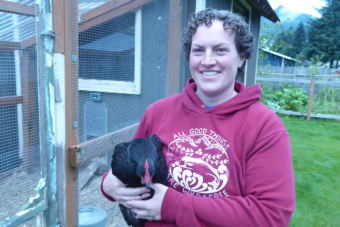
A chicken eats from a hanging feeder inside Sarah Dolan's chicken run in the Mendenhall Valley on Saturday, July 29, 2017.
A chicken eats from a hanging feeder inside Sarah Dolan’s chicken run in the Mendenhall Valley on Saturday. (Photo by Quinton Chandler/KTOO)

If a bear cornered Sarah Dolan’s chickens inside her chicken run, they would be sitting ducks.

Six birds are strolling aimlessly around the run surrounded by a mesh fencing called hardware cloth. It looks like chicken wire, but Dolan says it’s more solid.

“And I have that screwed into the 4-by-4s and then in the ground with cement pier blocks,” Dolan explained.

She has clear, plastic roofing at the top to protect from aerial hunters such eagles. She just lost two chickens to ravens earlier this summer. She let them free-range and didn’t watch for birds. It’s a mistake she doesn’t plan to make again.

Dolan’s recommendations for a chicken coop

  • Use electric fencing
  • Must be dry
  • Must be well ventilated
  • Needs roosting bars
  • Install a feeder
  • Add nesting boxes (secure them if they can be accessed from outside)
  • Build in 2 to 4 feet per bird
  • Use wood shavings, straw or shredded paper for bedding
  • Install a very secure human door and a small chicken door

Chickens are just one of the attractants Fish and Game is reminding people to protect from hungry bears. The agency recommends chicken owners put electric fencing around their birds.

Dolan said it’s a smart precaution but she doesn’t have any.

“I know that’s a gamble,” she said. “Because I know it’s a gamble, if I were to come out one day and a bear were actively trying to get into my run or coop, I would try to scare it off of course — that’s it. It’s my fault if it gets in.”

But, she’s confident the worst won’t happen because she has a fallback plan.

“It would take a bear a little bit to break (the run) down and in those seconds I would envision my chickens being able to run into the coop,” Dolan explained.

Her coop is overkill for such a small operation. Her husband calls it “Cluckingham Palace.”

It’s a strong wooden shed. You’d need a lot of force to break into it.

A chicken-sized sliding door, like a dog door, leads from the coop into the run. Dolan thinks if a bear attacked, her birds could hide on the other side and the bear would eventually give up.

She didn’t always have a palatial coop, but in the six years she’s been raising chickens, she’s still never lost any to bears.

The fence helps.

“A bear can scale that in a heartbeat if it wanted to, but it can’t see back here,” Dolan pointed out. “The sounds of a chicken isn’t really what’s going to draw it back here, it would be a smell and I don’t have a smell.”

Dolan keeps the chickens’ food in sealed containers inside her coop and she also feeds them inside. Her feeder doesn’t let the chickens spill food on the floor and she has what she calls a poop hammock that hangs underneath the chickens’ roosting bars.

The hammock catches poop and she composts it. She adds leaves and moss when she uses the compost to filter out lingering smells.

She’s not lying. The place really doesn’t stink.

Dolan’s recommendations for a chicken run

  • Use electric fencing
  • Use hardware cloth and sink it into the ground
  • Cover the top with roofing or netting
  • Make a dust bath for the chickens with wood ash or diatomaceous earth
  • Leave a waterer in the run instead of the coop (The coop must stay dry)

Dolan is part of a growing community of Juneau chicken farmers.

Teaching chicken owners how to keep bears out of their coops is one way Stephanie Sell is trying to minimize human-bear encounters.

Sell is the Fish and Game area biologist for northern Southeast Alaska. She is having a bear-crazy summer.

“We’re getting a lot of calls about bears in trash and sometimes we can address those and other times we have more aggressive behavior, like, the bear that we just dealt with, that we need to deal with immediately,” she said.

Biologist Stephanie Sell looks for electric fencing in a closet at the Fish and Game office on Douglas Island.
Biologist Stephanie Sell looks for electric fencing in a closet Friday at the Fish and Game office on Douglas Island. (Photo by Quinton Chandler/KTOO)

Sell and her co-workers recently put down a 470-pound black bear after it broke into a trailer home arctic entry. She said it was probably the biggest black bear she’s ever handled and was a known troublemaker.

She suspects the same bear broke into another home a few days before and she remembers that two years ago it pushed a window out of another home and climbed inside.

“You don’t get to be that big by being stupid so … I can guarantee that this bear has probably been eating trash for a long time,” she said. “(It) has found food sources within arctic entries before, so it basically recognizes that and will go back and try to find those locations again.”

This bear caught public attention because it was really big, but Sell said its misadventures are a symptom of the problem that is taking the steam out of her summer.

Some people in Juneau are breaking the rules for bear attractants.

“Trash, chicken coops, pet food, bird seed, stuff like that,” Sell said. “Food conditioning is a form of habituation. They find humans as being a normal part of their world. When people are saying, ‘Well it’s not afraid of me at all,’ that’s because we’ve been feeding it for years.”

Dolan’s advice for chicken first aid

  • Use black strap molasses to induce diarrhea
  • Add apple cider vinegar to water to reduce bacteria
  • Keep gauze pads, first aid tape, vet wrap, eye droppers and scissors
  • Add electrolytes to water if chickens are sick
  • Use Blu-Kote antibacterial/antifungal spray for wounds
  • Use Vetericyn spray to kill bacteria in cuts and to treat bumblefoot
  • Use coconut oil to prevent frostbite on chicken’s combs
  • Use Kocci Free to cure parasitic infestations like coccidiosis

Sell said don’t leave out pet food; don’t put out a bird feed in the summer. Juneau law says only put trash in bear resistant buildings or containers.

This is common knowledge. Fish and Game has been preaching it for years, but based on the reports she’s getting, Sell thinks too many people are getting complacent.

Sarah Dolan highly recommends new chicken farmers use electric fencing around their coops and runs. She also said to build everything before you get chickens. Otherwise, you might get busy with life and settle for a half-finished home for your birds.

Ekwok recovery program teaches subsistence skills to fight addiction

The Ekwok community arrives for a wellness camp graduation ceremony Friday. Ekwok Lodge, hosted the 30-day camp, where participants fought alcohol and drug addition with fishing and berry picking. (Photo by Avery Lill/KDLG)

Behind the Ekwok Lodge, the smell of soured salmon and pig muck hang in the air.

Despite the odor, Ben smiles shyly as he points out the nails in wooden boards that surround the pen, which stick out to deter bears.

“We feed them fish and other leftover foods. You hear their squeals because they’re being picked on,” he said as one pig lets out a shrill squeak when a bigger pig muscles it out of the way.

For the past month, this 22-year-old who grew up between Ekwok, Dillingham, Togiak and Anchorage participated in a substance use disorder recovery program.

The vision of the program was to teach subsistence skills as a part of the regimen. All the graduates are Alaska Native, and the idea is that cultural activities can be integral to recovery.

While raising pigs might not be a traditional subsistence activity in rural Alaska, these nine smelly animals gave the clients ample opportunity to practice one that is — fishing.

The program participants set nets every day to bring in enough fish to feed the pigs.

For two men, including Ben, this was their first time to be involved in subsistence fishing.

The three men graduating from the program helped daily with construction and maintenance on the lodge, which has been out of use.

They chopped wood and carried water up to the lodge from the river. They fished for salmon to feed to the pigs and to cut and smoke for themselves. They took a maqii every night, cleaning themselves in the steam bath.

“It’s fun picking berries, making akutaq from the berries that you picked, and taking a load off with cutting up fish. It was nice labor,” Ben said. “I’m slowly, slowly getting used to being clean and sober and looking forward to keeping it that way.”

The men in the program caught and smoked fish to take home with them after graduation. (Photo by Avery Lill/KDLG)

Friday was graduation day.

More than two dozen people, family members, the local priest and members of the Ekwok community gathered to celebrate the month the graduates have spent in recovery.

The mood was relaxed and celebratory in the main building of Ekwok Lodge.

It is a big room with large windows and wooden walls decorated with trophy fish. Children ran along the sides and between couches and wooden chairs as the graduates stood up to receive their diplomas.

The program’s leaders and community members congratulated and affirmed each one individually.

Several coordinators spoke of their own recovery from addiction. The graduates themselves spoke warmly about the program and about their commitment to sobriety.

Ekwok Natives Limited masterminded the program and put up the funds, which were substantial. ENL board president Jimmy Hurley Sr. estimates that the village corporation spent about $100,000 to cover the costs for all participants and to bring in Tutan Recovery Services, a private business from Anchorage, to run the program.

“Everybody used to put up fish, but the subsistence part, it brings pride in the people,” said Hurley, explaining ENL’s investment in the program. “If you’re a Native and you don’t know how to put away salmon, I think there’s a lot of embarrassment. That should be a part of every recovery, bringing culture into it.”

Getting this program off the ground was not without obstacles.

The power and water both went out to the lodge at points during the camp, and at least one person enrolled did not complete the program.

Overall, however, word from coordinators and the graduates was positive.

“At the end, they’re able to take some of their product home with them, and this will help sustain them when they’re looking for jobs,” Hurley said. “They’ll remember the camp, the sobriety they had here. They’ve got enough confidence in themselves right now that they could really go and take on a feat.”

This is Tutan Recovery Service’s first time operating outside Anchorage or incorporating subsistence as a component of their recovery program.

At a time when the governor has declared the epidemic of opioid use in Alaska a crisis, many are looking for more effective means of combating addiction. Relapse always is a concern in programs that address substance use disorder.

Tutan Recover Service program director Eydie Flygare anticipates that the subsistence component will be a help as the clients return home.

“When you find out where you came from and then you start doing some things you did when you were a kid. You’re just like, ‘Okay, yeah! I got it!’ The fact that a few of them are going back to do subsistence again, and that includes the spiritual aspect, I think absolutely it helps,” Flygare said.

As for Ekwok Natives Limited, Hurley said that the corporation board has been supportive of this year’s pilot run of the program.

However, the price tag is too large to continue without grants or outside funding. In the coming months, they will explore their options for continuing the wellness camp.

The graduates have all flown back to their homes in Anchorage and in Bristol Bay hopefully to continue their journey with sobriety.

They left with smoked fish in their bags for this winter and the skills to do it again next summer.

Where are Koliganek’s king salmon?

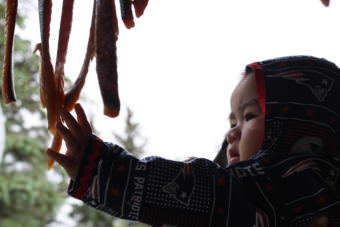
Christian Mulipola reaches for king salmon strips his grandmother, Diane Ishnook, has hung up to dry. Her king salmon were caught far downriver from Koliganek. (Photo by Avery Lill/KDLG)
Christian Mulipola reaches for king salmon strips his grandmother, Diane Ishnook, has hung up to dry. Her king salmon were caught far downriver from Koliganek.
(Photo by Avery Lill/KDLG)

More than 2.5 million sockeye have returned to spawn in the Nushagak River this year, one of the highest counts on record.

They have filled pools and creeks, jumping and swimming their way to their spawning grounds.

“I’ve seen a lot of red salmon this year. There was so much salmon in the river,” said Frances Nelson of Koliganek, the uppermost village on the Nushagak River. Koliganek is about 61 miles northeast of Dillingham. “Usually we get our kings first, but my dad brought home over a hundred reds the first time I cut fish.”

King salmon are conspicuously missing from the nets in the village.

Local families have had to travel to places like New Stuyahok and Lewis Point to catch them.

While many in Koliganek do that every year to get an earlier start on processing fish, this year even families who usually get their kings near their village went downriver.

George Nelson usually catches 100 to 150 kings in a season at Koliganek. This year he has caught six or seven. (Photo by Avery Lill/KDLG)

Local elder George Nelson usually catches 100 to 150 kings at Koliganek in a season. After setting his net for a month, he has only caught six or seven.

Diane Ishnook has lived in Koliganek since she was a child. She and her family set their nets off Tuumartuli, Cranberry Creek.

In three weeks, she caught one king. Her sister got two in two weeks.

“Normally we could catch up to 30 or 40 a day, like 18 in the morning or 15 at night. We’d have to check it twice a day,” Ishnook said.

Ishnook said that people are puzzled as to why the kings have not arrived yet. She also has another theory.

“We were thinking that maybe there are so many reds that they’re pushing the kings out the middle of the river,” she said.

If that is the case, king salmon may simply be escaping the nets set for them.

Diane Ishnook dries her fish briefly in the open air before smoking it. (Photo by Avery Lill/KDLG)

Frances Nelson also is from Koliganek. She stands in the doorway of her smokehouse.

It smells sharply of cottonwood smoke and salmon, which hangs in from wooden racks.

The small wooden structure is full of both kings and reds.

The kings she has cut into long strips. The sockeye are split in half with only the base of the tail joined so that each fish can be hung over the rack to dry.

Her kings were caught downriver, but she is sure that there are king salmon near Koliganek as well.

“I think there were lots of kings in the river. I don’t ever want to say there’s a shortage of kings in this river. That’s just talk,” Frances Nelson said. “If those downriver people harvested all their kings that they did down at the mouth of the Nushagak River in Dillingham and Clark’s Point, you know there were a lot of kings coming up this river.”

Sport fishing provides another perspective on the unusually low king catches in set nets.

Katrina Merlino, the village Indian Environmental General Assistance Program coordinator, said that people who sport fish for a full day are catching upwards of six kings.

“Usually the nets catch a lot more than we do rod and reel,” Merlino said. “I really think that the kings are coming up in the middle channel and riding along the banks because right where all the rod and reel fishers are, they go right where there’s still water and right in the current and they leave their line right there, it seems like that’s where they’re catching the most kings.”

While no one in Koliganek can do more than hypothesize about why the kings are hitting the nets so sparsely, there seems to be little concern.

Freezers are full, and most people have already smoked as many fish as they will need for the year.

Nelson takes a no nonsense attitude toward the whole situation.

“People all along this river have gotten their king salmon. It’s just a different year, a different season,” she said. “As Alaska Natives we always know how to adjust to change. There’s always different changes in our ecosystem, and we learn to adjust to those changes.”

The coming years will tell whether this year’s run is an anomaly or whether it is indicative of a long term shift in the way salmon run up the Nushagak.

Frances Nelson's smokehouse is full of kings and reds. (Photo by Avery Lill/KDLG)
Frances Nelson’s smokehouse is full of kings and reds. (Photo by Avery Lill/KDLG)

No answers for low Kuskokwim king run

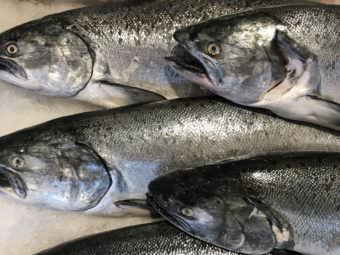
King salmon at a market in Seattle.
King salmon at a market in Seattle. (Creative Commons photo by Jill /Blue Moonbeam Studio)

The driving question over the last several years, and the one that’s being asked again as biologists warn that 2017 could be the lowest king salmon run on record, is: why is the king run on the Kuskokwim River so low?

“The simple answer is we really don’t know,” said Zach Liller, leading Kuskokwim researcher for the Alaska Department of Fish and Game. “We expected the return to be very similar to last year.”

That’s when an estimated 177,000 kings swam up the river.

But instead, half-way through this season’s run, we’re seeing numbers similar to 2013, the year the king salmon stock crashed and about 94, 000 of the fish ran the Kuskokwim.

Why was the predicted run so much higher than the return?

Locals were concerned that state fish biologists were being too optimistic months before the first kings showed up on the river.

The models that predicted this season’s forecast are currently under review by third parties.

Fish and Game Commissioner Sam Cotten said the state is discussing with federal managers how to provide fishing options for subsistence users while protecting the collapsing kings.

“We are considering an opportunity to allow drift gillnets to target sockeye and chum salmon,” Cotten said. “We recognize that’ll be some incidental catch involved with that. That if you’re using gillnets, that that’s just going to allow for some chinook take as well.”

Managers are seeing strong numbers for both sockeye and chum so far this season.

Another option the state will consider is an elder opening, Cotten said. That’s when an elder goes fishing with a family member during a designated time to give elders a taste of fresh fish.

As to concerns that conservation efforts to avoid harvesting salmon could be depleting whitefish, Fish and Game fishery manager Aaron Poetter said that the state cannot measure those numbers.

It has no data on whitefish populations in the Kuskokwim. The best indicator they have to determine changes in these stocks is fishermen’s observations.

The U.S. Fish and Wildlife Service is meeting with the Kuskokwim Inter-Tribal Fish Commission today to consider opening a gillnet opportunity.

After nearly 20 Years, NOAA surveys Norton Sound beluga whale population

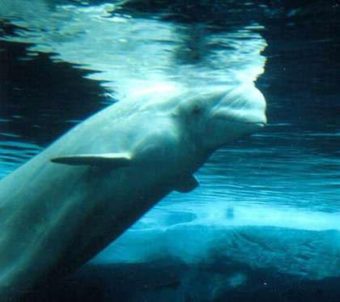
Beluga coming to the surface to breathe.
Beluga coming to the surface to breathe. (Creative Commons photo by Eva Hejda)

National Oceanic and Atmospheric Administration Fisheries, or NOAA Fisheries, in conjunction with two other Alaska entities, is conducting a survey of beluga whales in Norton Sound.
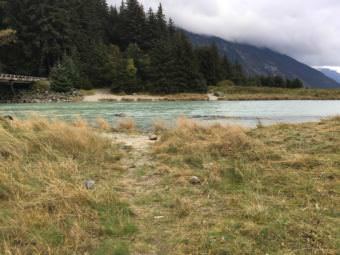
Surveys of this area’s beluga whale population have not been taken since the year 2000.

The Alaska Beluga Whale Committee, the North Slope Borough, and NOAA Fisheries’ Alaska Fisheries Science Center are doing aerial surveys of the Eastern Bering Sea as well as near the Yukon River Delta until June 29.

Updated population information on beluga whales will help managers and subsistence users recognize trends to help maintain a “healthy beluga whale population,” according to a news release from NOAA.

Pilots and the team of surveyors began by flying out of Nome on Friday with aircraft from Clearwater Air.

Judge orders landowners to pay $52,000 in Chilkoot land use case

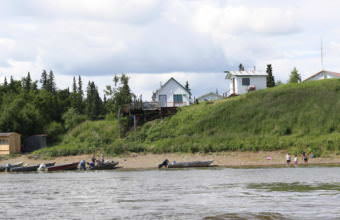
Fishermen will still be able to drive vehicles to the spot on the Chilkoot River during the hooligan run. (Photo by Abbey Collins/KHNS)

A dispute in Haines between private landowners and several Native organizations has come to a close.

The disagreement over drive-down access for hooligan fishing on the Chilkoot River was resolved by a judge last year.

But that wasn’t the end of the legal battle.

Now, the landowners in the case have been ordered to pay a significant amount of money to the other side.

“As a family for us it’s kind of just shocking and devastating,” said Rosalie Loewen, who, with her husband Reuben, owns property along the Chilkoot River.

In 2013, they sought to protect a couple pieces of their land from anyone else claiming ownership through a process called “quiet title.”

Their land includes a path that local subsistence fishermen use to drive down to the river and fish for hooligan.

The Chilkoot Indian Association, Alaska Native Brotherhood Camp 5 and Sealaska Corporation intervened in the case.

They wanted to fight for continued drive-down access.

The path has historically been used to access the hooligan fishery, including the use of vehicles for many years.

Fishermen said they need to drive down to the river to accommodate the elderly and to help haul fish back up.

There has been a conflict at the spot for several years.

In September, a judge decided that right should be preserved.

Superior Court Judge Phillip Pallenberg ruled that although the land still belongs to the Loewens, they cannot block access during the few weeks of the hooligan run.

He said that is not the case for the other piece of land in question that belongs to the Loewens and there is no public easement.

Lee Heinmiller, secretary of the Alaska Native Brotherhood Camp 5, said this case established a precedent for subsistence rights, and preserving access to traditional fishing sites.

At that point, the Loewens said in some ways the decision represented a good balance between their rights as private landowners and what’s important to the community. They were never opposed to fishing at the spot, just the use of vehicles, they said.

But the case was not over.

“There have been several points where we thought, this can’t get any worse,” Reuben Loewen said. “This is it, it’s done, let’s move forward. And then they come back.”

“And it gets worse,” Rosalie Loewen said.

Last month, the judge ordered the Loewens to pay just more than $52,000 in attorneys’ fees and costs.

Reimbursement will be distributed between the Chilkoot Indian Association and Sealaska, which footed most of the legal bill.

“I’m satisfied that the judge awarded some of the money that we expended to fight this fight,” said Kristen Miller, the lawyer who represented Sealaska in the case. “It would have been nice if we were to receive more. But I think it was reasonably under the circumstances.”

In a civil case such as this one, Alaska law allows the prevailing party to receive financial compensation from the losing side.

But the Native corporations didn’t prevail on all fronts.

The judge only awarded $52,000 of the about $240,000 Sealaska and the other parties requested. Pallenberg granted that amount because he said they did succeed on the main issue: the right to preserve drive-down access to the river.

The Loewens were not expecting this outcome.

“It will definitely mean some big changes for us as a family,” Rosalie said. “I think we’ll be able to pay it without losing our land. And just even saying that makes me kind of want to cry – how did it get to that point?”

Money aside, Rosalie said they feel there is “ill-will” toward their family and it’s difficult to see where they fit in the community now.

“We’ve been good neighbors, good citizens. We’ve tried to be good people as we’ve become embroiled in this situation and tried to handle it in a way that was in everybody’s interests,” Rosalie said. “To have this be the outcome, it’s shocking and pretty devastating for us.”

Miller said her clients sought compensation because it was their right by Alaska law after the outcome of the case.

She says they are glad they were able to protect subsistence rights to fish in that spot on the river in the same way local fishermen have for many years.

“We are satisfied,” Miller said. “Our goal in this litigation was to preserve the access that we’ve always had for generations. Unfortunately the Loewens tried to block that access and that’s why we had to fight.”

The Loewens say they are not going to appeal the judge’s decision.

Site notifications
Update notification options
Subscribe to notifications