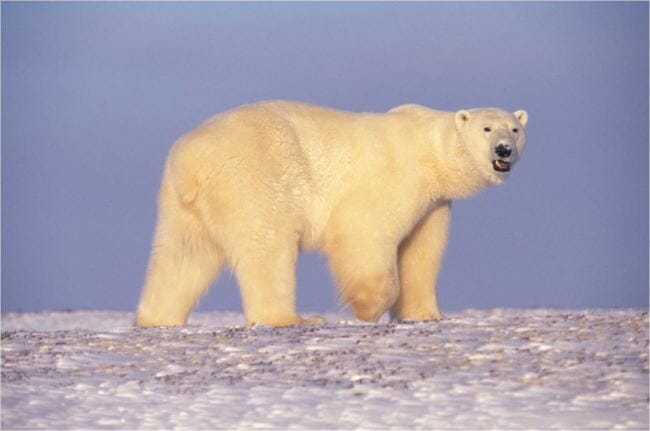
A polar bear in Arctic Alaska. Subsistence harvest levels of Chukchi Sea polar bears have just been raised, based on new data about the population’s health. (Photo Credit: Terry Debruyne/U.S. Fish and Wildlife Service)
Native hunters in Alaska are about to see an increase in the number of polar bears they can harvest from the Chukchi Sea bear population.
The commission responsible for setting that limit recently raised the quota from 58 to 85 bears per year, shared equally between Alaska and Russian hunters.
The quota increase was based on new science and traditional ecological knowledge indicating that the polar bear population is doing well.
Eric Regehr is a polar bear biologist at the University of Washington’s Polar Science Center and one of the scientists who advised the commission.
“Currently the nutritional condition, or the fatness, of the bears in the Chukchi Sea is on par with what it was 20, 30 years ago,” Regehr said.
In 2010 the U.S. and Russia put a limit on the number of polar bears Native hunters were allowed to harvest from the Chukchi Sea population. It was part of an effort to conserve the animals in the face of uncertainty about how they would respond to sea ice loss.
Regehr says the new research indicates that the population numbers and reproductive rates of the Chukchi Sea polar bears are good, but that doesn’t mean there aren’t concerns for the future.
“Sea ice loss associated with climate change is the primary threat to the species,” Regehr said. “And we don’t know when or how it may affect Chukchi Sea polar bears, but we would expect, from a scientific perspective, that at some point in the future there will be some negative effects.”
Regehr says that in contrast to the Chukchi Sea bears, evidence suggests that Alaska’s other group of polar bears in the Southern Beaufort Sea is already experiencing negative impacts from the decline of sea ice, including weight loss and a reduction in both reproductive and survival rates.
On average, Alaska Native hunters take about 30 Chukchi Sea polar bears a year.
Katya Wassillie is executive director of the Alaska Nannut Co-Management Council, or ANCC, the group that represents Alaska Native polar bear hunters. She says that the good health of the Chukchi Sea bears is cause for celebration.
But while ANCC is pleased that the harvest number has increased, Wassillie says the group was advocating for an even larger quota.
“When you introduce something like a quota, that creates a different atmosphere, one with more anxiety, with competition,” said Wassillie. “And our hunters were concerned about that. So they wanted just a cushion; the freedom to be able to manage through our own traditional values, our own traditional practices.”
The commission that sets the harvest limit reviews the quota annually. A quota has been in place since 2010, but as of yet is not enforced.
Generator problems caused ongoing power outages for Tuluksak over the past month.
Tuluksak, Alaska. (Photo courtesy National Oceanic and Atmospheric Administration)
Many people lost their summer subsistence harvest because of the lack of electricity to operate freezers, and the problem is expected to continue into early next week.
Living in the lower Kuskokwim River community is like living at a giant fish camp, Tuluksak resident Angela Alexie said.
“When you’re living out at fish camp you have to have a generator, or some people have a generator,” she said.
The power has been out for about a week. The generator motors run day and night.
Alexie’s small generator can only run a few appliances at a time.
She buys diesel every day to fuel it, and it’s not big enough to run her stove or her freezer.
“I had to take some of my fish out and take it over to my parents’ freezer before I lost everything,” she said.
Alexie has lost about a quarter of her subsistence fish.
Her dry fish should be fine. She whipped her salmonberries into akutaq to prolong them, but Alexie has not been able to save everything.
“All my half-dry fish, gaamaarrluk, that I had to feed to the dogs,” Alexie said.
She shares her subsistence fish among four families: Alexie’s, her parents, and her two sisters.
She hopes for a strong silver salmon run to help replace what was lost, but the drying weather in August is not expected to be as good as it was earlier in the summer.
In Tuluksak, not every home has a generator.
Alexie’s parents bought hers two years ago after another weeklong power outage wiped out her fall and winter subsistence catch.
Multi-day power outages are a frequent problem in the community, and residents have become frustrated with the inconvenience and cost of the situation.
“Here and there, there’s more generators every year in the village,” Alexie said.
The Tuluksak Native Community operates the power plant. Parts for the broken generator are expected to arrive Monday in Anchorage.
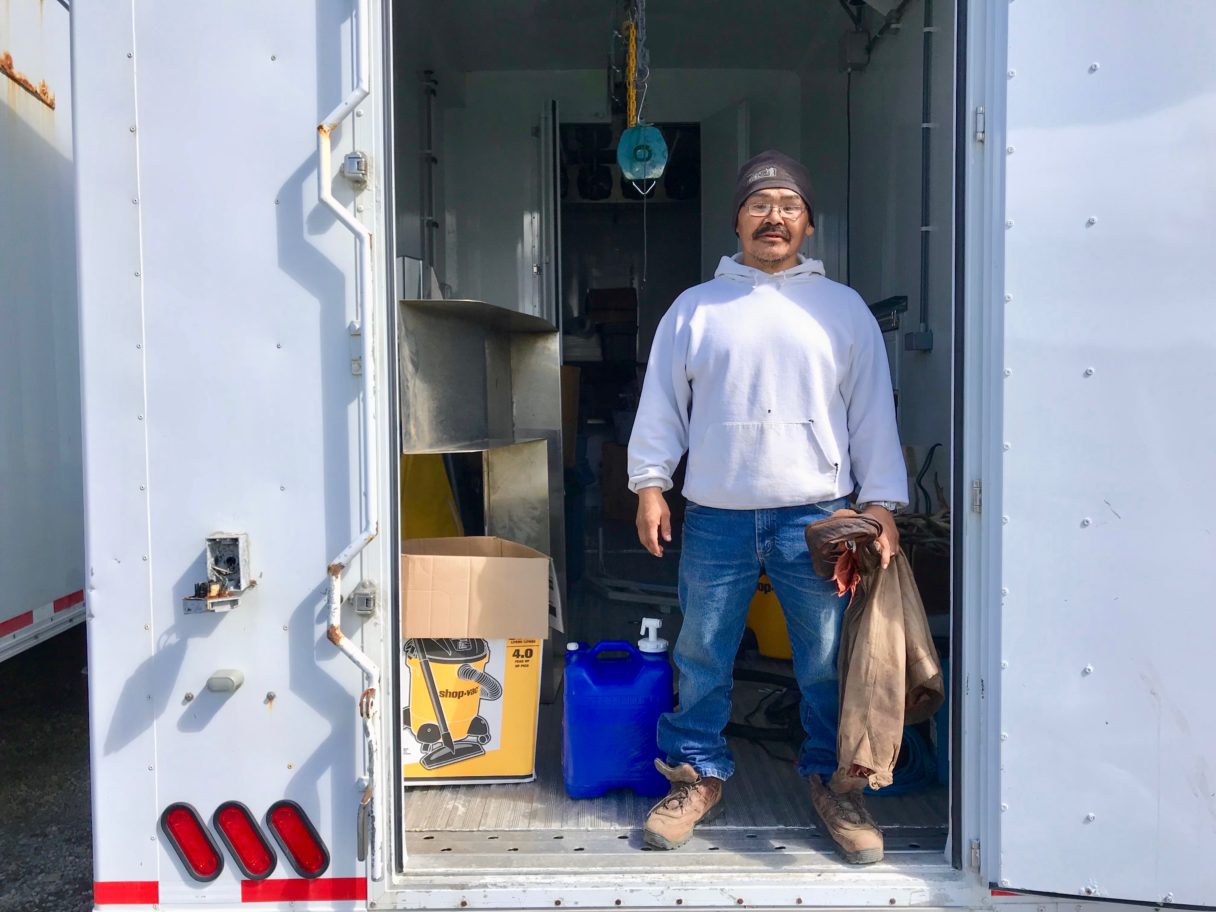
Savoonga’s chief reindeer herder Richmond Toolie, at the mobile reindeer processing plant (Photo by Gabe Colombo/KNOM)
Reindeer herding is an increasingly attractive economic option for communities in the Norton Sound region.
As winter sea-ice cover becomes more unreliable, the traditional practice of hunting for marine mammals is more dangerous.
Some community leaders hope reindeer herds, originally imported from Scandinavia in the late 19th century, could now fill a growing gap in ensuring economic security.
Several Norton Sound communities want to expand their operations.
Richmond Toolie is the chief herder of St. Lawrence Island’s 4,000 to 5,000 reindeer.
“My uncle Herman — I followed him when I was a teenager, and he taught me everything, while he was the chief herder,” Toolie said. “I enjoy doing it. I love it. I just go out there and drive all around the island.”
Toolie works at a mobile reindeer processing plant in Savoonga.
The plant is owned by the University of Alaska–Fairbanks and has been here for four years.
Greg Finstad with UAF’s range management program has trained 22 Savoonga community members on how to use it.
Two big trailers with equipment inside to store, cool, hang and butcher 16 reindeer at a time.
“Before we band-saw them, we cut them in half right here, with a chainsaw. Hang them up and cut them right in the middle,” Toolie said. “We have orders from all over Alaska and Washington.”
Those orders, and others from as far away as Australia, have convinced Savoonga tribal chief Delbert Pungowiyi that the demand for commercial meat is there.
“To us, that’s the only real promise that can really bring a huge difference to our people on the island: where we can sustain ourselves and take care of ourselves as our ancestors have, without pleading to Washington or anyone for any funding,” Pungowiyi said.
Right now, they’re limited to field slaughtering, which Pungowiyi estimates brings about $1,000 per whole carcass.
He thinks professionally butchering it could get at least $1,600 per reindeer.
To do that, though, they need to pay for a U.S. Department of Agriculture representative to come inspect the processing facility.
They also want to build a permanent processing plant, a new corral and new roads to make herding the reindeer more efficient.
Pungowiyi says the Native villages of Savoonga and Gambell want funding from the federal government and elsewhere for the projects.
They’re also working with Kawerak, the regional nonprofit corporation, to develop a business plan, and lobbying Senator Lisa Murkowski to come visit and discuss the project.
“Really need to get that in motion because of the food security that we’re losing from the Bering Sea itself,” Pungowiyi said.
Across Norton Sound, Thomas Kirk in Stebbins feels the same way. He’s the clerk for the community’s tribal association.
“Climate change has affected our sea-ice hunting and our marine mammal gathering,” Kirk said. “The ice is a lot thinner. And having our reindeer is a blessing.”
The herd here is estimated to be more than 5,000 head, the largest in the Norton Sound region, and it’s jointly owned by the Native villages of Stebbins and St. Michael and the chief reindeer herder, Theodore Katcheak.
The group already sells antlers commercially to a buyer from California, who resells it at $25 a pound to Asian-Americans for traditional medicinal purposes.
“I also have other interests in the Asian market that would like to purchase the horns and the meat: Eastern Asia, China, Singapore, Hong Kong, Japan,” Kirk said.
Kirk said the tri-party group wants to work with the U.S. Fish and Wildlife Service to do an aerial survey of the reindeer, to figure out exactly how many are out there and how healthy they are.
They’re also hoping to have the mobile processing plant transferred from Savoonga to Stebbins and St. Michael.
Theodore Katcheak said the free-range meat is healthier than the reindeer in the freezer at the St. Michael grocery store.
“The color of this meat is dark, because they’re probably feeding in the over-grazed areas,” Katcheak said.
The meat also is a reliable food source for the communities’ residents as marine mammals become less easily obtainable.
In terms of commercial sales, Katcheak said there’s still a long way to go, for the region and for him, personally.
“I see that Sami people — they know how to handle reindeer. They’ve been doing it for many centuries,” Katcheak said. “My age, I’m 70 years old, I’m just like a little baby just waking up; I don’t know what to do. You don’t see no 20 or 30 herders in Alaska. You only see like five or six, maybe seven herds.”
Pungowiyi in Savoonga hopes to change that by taking reindeer from St. Lawrence Island and reintroducing them to communities like White Mountain, which lost its herds to encroaching caribou.
Pungowiyi envisions a coalition of reindeer-herding tribes around Norton Sound that could sell meat collectively, with a central processing plant and freezer in Nome, something the regional Reindeer Herders Association has discussed.
“If we did it right, we could become Alaska’s reindeer capital: the Bering Straits region,” Pungowiyi said.
From Savoonga’s shoreline, the bright-blue water stretches as far as the eye can see on a sunny July day.
As late as 1975, though, you might have seen some sea ice here at this time of year.
Now, solid sea ice isn’t a guarantee even in March.
But if Toolie, Kirk, Katcheak and Pungowiyi see their vision of a reindeer economy made real, a more solid guarantee of self-sustenance might be on the horizon.
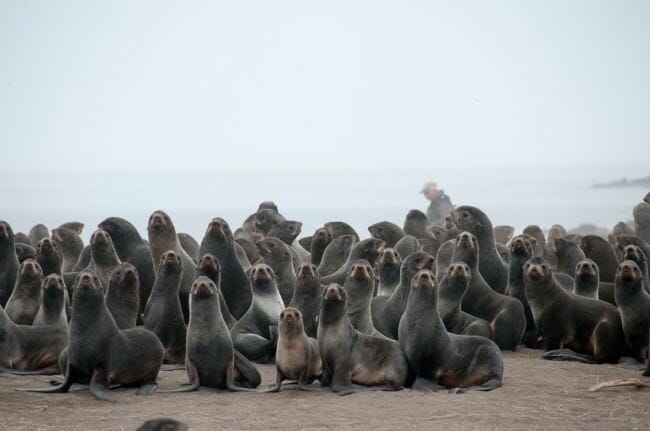
Northern fur seals gather at a resting area in the Pribilof Islands, where non-breeding seals congregate while they’re not out at sea feeding. (Dave Withrow/NOAA)
Federal managers in June agreed to the early harvest on St. George, which is more than 200 miles from the mainland.
The decision came after a request by the tribal government, which said members needed the meat because the island’s store was running out of food, according to the National Marine Fisheries Service. Flights to the island are often canceled amid bad weather and because of what airlines say is a poorly-positioned runway.
“I don’t know how many times I’ve called ACE to say, ‘Hey, where are our groceries? Why can’t we get them?'” said Mayor Pat Pletnikoff, referring to the cargo airline that serves the island. “It happens on a regular basis.”
About 60 people live on St. George, Pletnikoff said. Passenger planes only come twice a week, and frequent flight cancellations can make it hard for residents to keep fresh food around.
One thing that’s not in short supply on the island? Meat.
St. George and nearby St. Paul both host massive populations of northern fur seals in summer and fall — about 500,000 between the two. It’s about half the world’s population, said Mike Williams, who works with the fisheries service.
But the seals’ harvest is strictly regulated by the federal Fur Seal Act.
While the St. George store was starting to run short on food last month, the harvest season wasn’t scheduled to open until June 23. So the tribal government asked the fisheries service to allow it to start earlier. (Tribal leaders did not respond to requests for comment.)
The fisheries service, which co-manages the harvest with the tribe, responded by issuing a special, temporary rule allowing the harvest to start three days early.
“The community needed food. And this was the way that the government could help with that,” Williams said in a phone interview from a federal bunkhouse on St. George.
Typically no more than 150 seals are taken in a year, and each one has about 30 pounds of edible meat, Williams said.
Those harvest numbers are down substantially from when the seals were hunted commercially for their fur. That’s how St. George and St. Paul were originally settled two centuries ago, when Russians forcibly moved Alaska Natives from the Aleutian Islands to help with the harvest.
Even after the U.S. bought Alaska from Russia, the government continued relying on the Pribilofs’ residents to hunt and process fur seals. But since the hunt ended in the 1980s, Pletnikoff, St. George’s mayor, said his island hasn’t received enough government support to transition to a more diverse economy.
St. George faces continuing uncertainty about its flight schedule amid the bankruptcy of PenAir, the passenger airline that serves the island. And without better, federally subsidized air service, Pletnikoff said St. George will continue to face problems like the food shortage that led to the early seal harvest.
Residents are also pushing Congress and federal agencies for improvements to their boat harbor to allow better access for barges.
“This early start on fur sealing — while a good gesture on the part of the United States government and the tribe — doesn’t begin to address the serious issues that we need to deal with and we need to get a handle on,” he said.
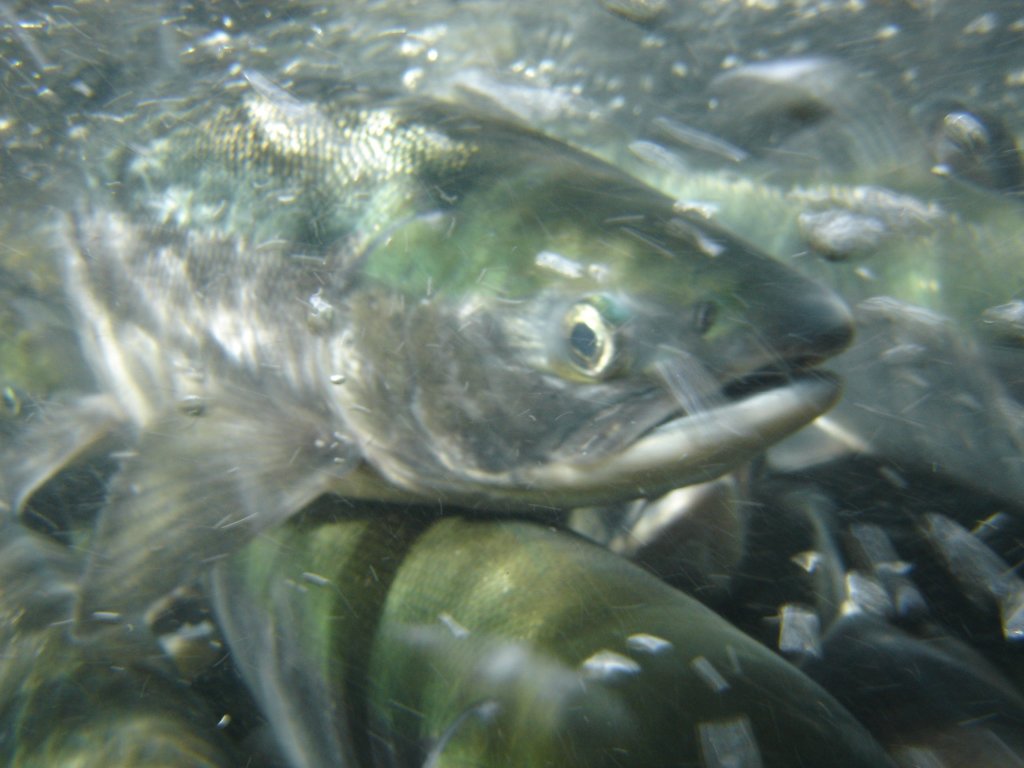
Sockeye swim upstream in Yakutat in 2014. A good “parent year” for sockeye in freshwater systems, Alaska Department of Fish and Game biologist Nicole Zeiser says something “out of our control” killed sockeye in the ocean. (Photo by Nate Catterson/U.S. Forest Service)
Commercial sockeye fishing in Yakutat has been closed due to historic low returns, leaving set-netters in a bind until coho and chum season later in the summer.
Unlike other salmon fisheries around the Southeast, biologists never saw this coming.
The forecast for the sockeye return on the Situk river was good this year. Managers expected to see around 21,000 fish through the weir by this time, and between 30,000-70,000 by the end of the season.
Only 2,300 fish — had made it back to the river — as of Monday.
Alaska Department of Fish and Game biologist Nicole Zeiser says the low return is “shocking.”
“This is by far the worst on record that we’ve ever seen as far as Situk River weir count,” Zeiser said.
Zeiser shut down the commercial set net fishery by emergency order June 28, and Yakutat will feel the effects.
Fish and Game closed subsistence fishing for sockeye on the Situk — one of the few unlimited subsistence fisheries in the state — Tuesday.
Although Fish and Game has been forecasting low returns for other species in Southeast this year — especially king salmon — no one saw this coming.
Zeiser has her suspicions, but no conclusive answers.
“Most of the data suggests that the problem’s in the marine environment,” she said. “Freshwater systems are healthy, producing plenty of smolt and fry going out. It’s just that something’s going on in the ocean that we can’t control.”
Zeiser said that no connection has been established yet between this year’s mysterious sockeye decline in the Situk, and weak runs of king salmon elsewhere in Southeast.
Unlike it’s predator cousin the chinook, sockeye eat plankton almost exclusively.
Nevertheless, a bad year for plankton can ripple through the food web.
“When they went out to sea that was when the Blob formed, and we had the highest sea-surface temperatures on record, during those years,” Zeiser said. “That could play a factor into what’s going on with these species, but it’s just hard to say.”
Zeiser is encouraged by recent improvements in the Copper River returns, but she’d want to see 2,000-3,000 sockeye per day moving through the Situk weir before she’d consider reopening the commercial fishery.
Otherwise, Yakutat set-netters — like other Southeast salmon fishermen — will look to chum and coho to save the season.
That the average five-year commercial harvest for silver salmon in the Situk has been about 100,000 fish, Zeiser said.
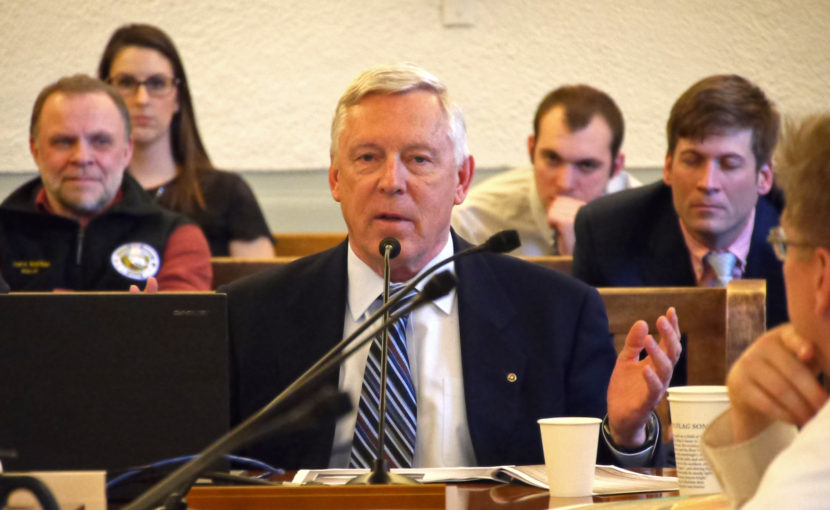
John Sturgeon discusses his U.S. Supreme Court case with the Alaska Senate Resources Committee on Feb. 17, 2016. Sturgeon is the plaintiff in in Sturgeon v. Frost, a case involving a dispute over federal control over navigable waters. (Photo by Skip Gray/360 North)
The U.S. Supreme Court has agreed to hear an Alaska water rights case for the second time.
On Monday, the court agreed to review Alaska hunter John Sturgeon’s case. That case grew from a 2007 incident when National Park Service rangers confronted Sturgeon and said he couldn’t operate his hovercraft in the Yukon-Charley Rivers National Preserve.
The issue at the core of the Sturgeon case is a fight over control of rivers in Alaska. Specifically, who has the authority to regulate state navigable waters within conservation units in the state.
Those conservation units are things like national parks and preserves, wildlife refuges, wilderness areas and wild and scenic rivers.