Subsistence

Science and traditional knowledge converge in North Slope Borough’s bowhead whale program

Craig George, a wildlife biologist for the North Slope Borough’s Wildlife Department, weighs, measures, and catalogs samples from a recently-landed bowhead whale on Oct. 24, 2018. (Photo by Ravenna Koenig/Alaska’s Energy Desk).

When hunters in Utqiaġvik haul whales to shore in the fall, many members of the community flock to the beach to help butcher them.

Among them are North Slope Borough scientists, who for almost 40 years now have been collecting samples of those whales as part of a singular whale study program that has been built in concert with whalers.

On the snowy beach north of town during the last week of October, portable floodlights illuminate the work of over a dozen whalers as they cut the blubber and meat from a recently-landed whale. There’s heavy machinery out there helping, since this whale is particularly large, but it’s still hard work and they’ve been doing it for hours. When a whale is brought ashore, it’s something of a race to harvest it before the meat spoils.

That time crunch also applies to Craig George, a biologist with the North Slope Borough’s Department of Wildlife Management who’s lived in Utqiaġvik since the 1970s and has been with the bowhead program since its early days. He’s been awake until the early hours of the morning several days this week to take samples of whales.

George and his colleagues, with the permission of whaling captains, collect muscle, eyes, kidney, spleen — their collection checklist is a page long. Before butchering starts they also examine the whale for any outward harm like signs of net entanglement, orca attacks or ship strikes.

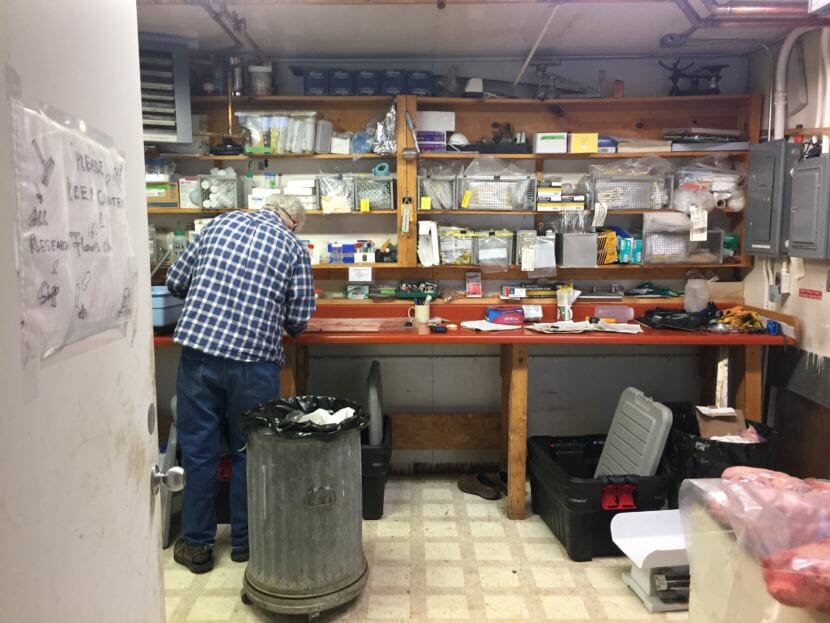
Their work then continues about a mile away in a small lab that’s part of the old Navy research complex on the outskirts of town.

George and his colleague, Raphaela Stimmelmayr, a wildlife veterinarian and research biologist for the department, work around each other in the narrow field lab to weigh, measure, and catalog the whale parts.

The purpose of this program is to look at the health and numbers of the bowhead whale population, in part for setting an appropriate hunting quota.

It was started back in the ‘80s because the International Whaling Commission had concerns that the bowhead whale population was too depleted to support a hunt the size of which Alaska whaling communities had traditionally practiced.

But through years of study, including a whale census that’s done periodically in the spring, North Slope Borough scientists were able to show that the population was doing well, which backed up what whalers had been saying.
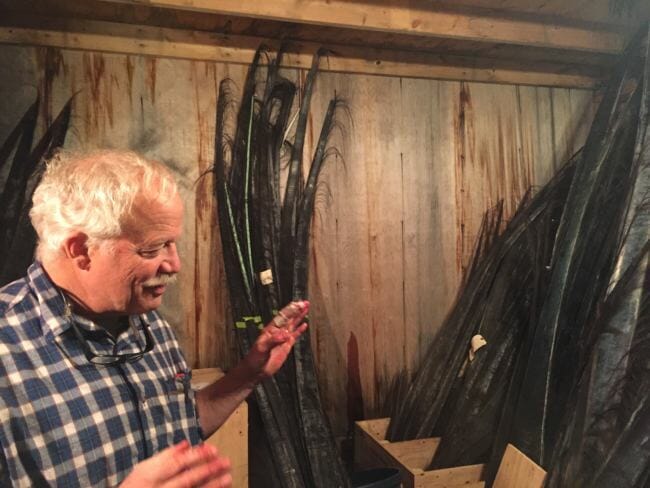
Craig George gestures to a collection of baleen plates that have been archived by the North Slope Borough’s Department of Wildlife Management. Those plates can provide a wealth of information about the bowhead whale, including reproductive history and information about feeding. Oct. 24, 2018. (Photo by Ravenna Koenig/Alaska’s Energy Desk).

The research also provides an important check that there’s nothing in the whales that could be harmful to the people who eat them, like parasites or contaminants.

Stimmelmayr said that new questions are coming up about how bowhead health — and consequently, human health — may be affected by rapidly warming oceans.

“Emerging diseases can occur. You know, we’re dealing with harmful algae (sic) blooms,” said Stimmelmayr. “So there are things now that are kind of coming towards the Arctic that maybe weren’t an issue 20 years ago.”

Borough scientists don’t have any evidence that the whales are being affected by harmful algal blooms at this point. In fact, they see evidence that the bowheads are actually benefiting from warmer waters because their food source is growing.

But no one knows what the future holds. So they’re watching closely.

While all this science has been done for a practical end, it’s also contributed a huge amount to what the scientific community understands about bowheads, and whales in general. Hundreds of peer-reviewed papers have come out of the borough’s Department of Wildlife Management over the years.

George said they cover all aspects of cetacean biology, from population work to genetics.

The involvement of whalers has been critical to that. It’s only with the permission of whaling captains that these scientists get access to fresh samples, which they can’t get any other way since it’s against federal law to intentionally kill whales except for traditional subsistence use.

But equally important is the expert knowledge of whale behavior and attributes that hunters have shared over the years.

“Migratory behavior, ice-breaking behavior, when they calve, where they calve, their feeding habits,” said George. “Just endless. And slowly… we were pretty clueless, but we listened.”

The way North Slope Borough scientists put it, the science has spent the past few decades catching up to traditional knowledge — documenting scientifically what hunters already knew. Like the fact that the whales can smell, and that they can travel under the sea ice.

George said that as scientists continue to learn about the bowhead, getting information from hunters who closely observe the species is invaluable.

“When you have 500 or more whale hunters from St. Lawrence Island to Kaktovik sharing observations, we learn a lot about things that we could never possibly capture in a study,” said George.

The samples that were collected this year will be sent out to institutions around the world and will form the basis of dozens of new studies, adding to the data that scientists on the North Slope — and worldwide — now have about the bowhead whale.
Fall whaling in Utqiaġvik: joy, excitement and this year, mourning too

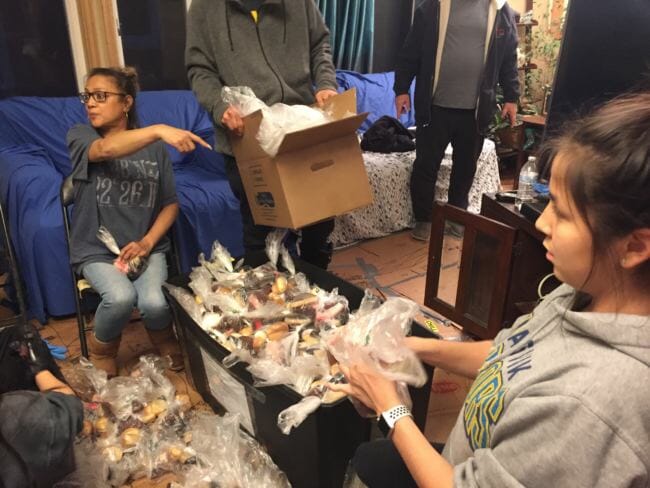
Friends and relatives including Rosanna Lemen, the captain’s mother-in-law, help to bag up portions of the whale to give to the community. October 25, 2018. (Ravenna Koenig/ Alaska’s Energy Desk).

Fall whaling concluded in Utqiaġvik in late October, and was characterized this year by events that brought additional excitement, but also sorrow to a usually celebratory time for the community.

In early evening a few days after the last whale has been brought onshore in Utqiaġvik, Ross and Justina Wilhelm’s house is crowded with about 20 friends and relatives. They’re setting out doughnuts and pineapple cake, arranging plates of whale meat and unaalik — which is boiled whale blubber and skin — and bagging up servings of whale for people to take home.

Ross Wilhelm is a whaling captain and his crew, with help from others, brought in the final whale of the season. His wife Justina is responsible for organizing tonight’s “crew’s serving,” an event where anyone in the community can come get a portion of the whale.

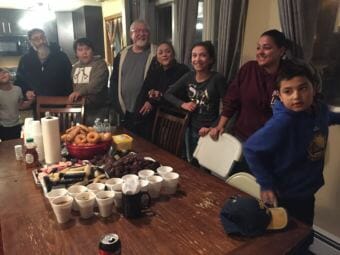
The group circles up to pray before the serving starts. As the captain’s wife, Justina Wilhelm, second from right, is responsible for organizing the event. October 25, 2018. (Ravenna Koenig/ Alaska’s Energy Desk).

When everything is ready, the group joins hands. Ross’ mother Lagoo Kunaknana says a prayer in Iñupiaq, expressing gratitude for the whale they’re about to serve.

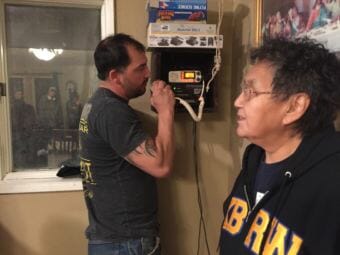
The prayer is broadcast over VHF radio, along with the family’s house number and an announcement that they’re ready to serve. Soon there’s a steady stream of people revolving through the house, yelling congratulations and trading hugs in the Wilhelm’s living room.

Ross Wilhelm spends the evening shaking hands and greeting visitors.

“It’s just what puts us together is the whale, the bowhead whale. Just gets us all together,” he says, before breaking off to say hello to an approaching friend.  

Wilhelm says that the usual energy around fall whaling was boosted this year, coming off a big success at the meeting of the International Whaling Commission in September. At that meeting, the IWC made some key changes to the bowhead whale quota that Alaska subsistence hunters had been pushing for.

But on the other end of the emotional spectrum, the community just experienced a profound loss. About a month ago Captain Roxy Oyagak Jr. and crew member Ron Kanayurak were killed in a whaling accident off the coast of Utqiaġvik when their boat capsized while towing a whale to shore.

Ross Wilhelm says that the crew’s serving is a time of joy, and that seems to be the main emotion in the room during the event. But in conversations around town it’s clear there’s still a lot of pain related to the accident. It’s also an important reminder of something that whalers already know well: that whaling can be dangerous.

Wilhelm says that he was shaken by what happened.

“I’d make myself look bad if I said it doesn’t scare me,” he said. “I’d be stupid if I didn’t say that of course it does.”

Captain Ross Wilhelm, using the VHF radio to notify the community that they’re about to broadcast a prayer. His mother Lagoo Kunaknana, to his right, says the prayer in Iñupiaq. October 25, 2018. (Ravenna Koenig, Alaska’s Energy Desk).

Despite what happened this season, and a close call he himself had in the past, Wilhelm isn’t deterred from the hunt. He says sometimes things happen that are outside your control, but the only thing you can do is renew your vigilance when it comes to basic safety.

He’s not the only one thinking along these lines. The Barrow Whaling Captains Association is reviewing what happened, and will be discussing what safety lessons may be drawn from the accident at upcoming meetings. That’s according to Crawford Patkotak, a whaling captain and board member. He says that many in the community are still mourning the loss of the two men, but the overarching dedication to continuing the tradition of whaling remains strong.

“For the most part our people are able to rebound and continue our life, our culture,” said Patkotak. “And knowing that Roxy and Ron would have it no other way, they would want us to continue our culture.”

Fall whaling concluded in Utqiaġvik with hunters bringing in a total of 19 whales, the full number of whales permitted by their quota.

Two Utqiaġvik whaling crew members die in apparent whaling accident

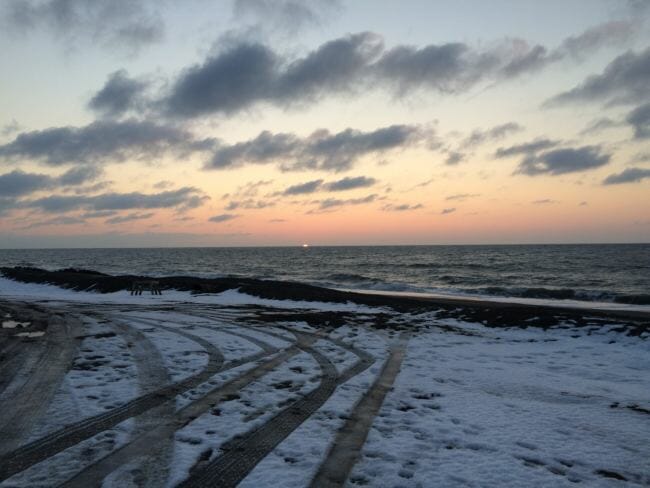
The coastline off of Utqiaġvik. September 25, 2014. (Andrew Petersen).

Two members of an Utqiaġvik whaling crew have died, reportedly after a boat capsized during fall whaling.

In a statement Monday, Oct. 8, North Slope Borough Mayor Harry K. Brower Jr. confirmed that two lives were lost and said that the Borough is not releasing details about the incident until all the facts are gathered and all family members have been notified.

On Facebook Monday, members of the Utqiaġvik community and others from around the state posted condolences, remembrances and prayers for the whalers and their families.

The man who translates climate change data for Alaskans is retiring. Here’s a Q+A.

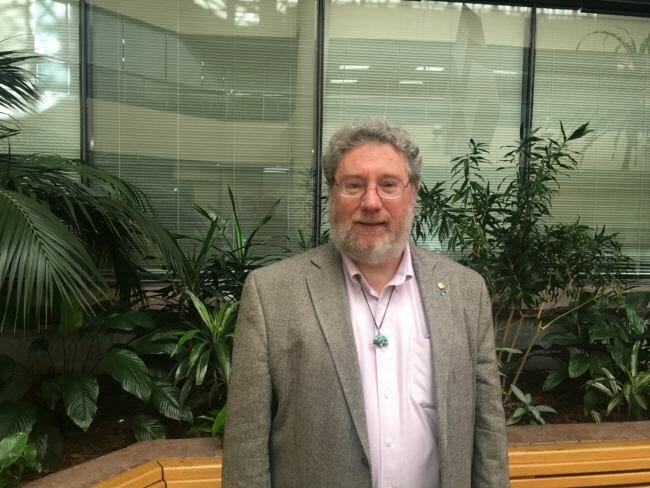
Climatologist Rick Thoman is retiring this week after more than three decades working at the National Weather Service. (Photo by Nathaniel Herz / Alaska’s Energy Desk)

If you’re looking for concrete evidence of climate change in Alaska, here’s some: Fairbanks’ typical time between the last spring freeze and the first autumn one has increased by a full month in the past century.

That fact is courtesy of Rick Thoman, a federal climatologist based in Fairbanks. For the past five years, Thoman has been something like the voice of climate change in Alaska, measuring new trends against old baselines.

He retires this week after spending more than three decades with the National Weather Service, and next week he starts a new job with the Alaska Center for Climate Assessment and Policy, based at the University of Alaska Fairbanks. Some of his work will be similar to his old job, and he said he plans to keep his Twitter account as active as ever.

Thoman sat down Monday for an interview with Alaska’s Energy Desk. He started by talking about how personal memories of climate and weather don’t always align with the data, making it important to keep broader context in mind.

The interview has been edited and condensed.

Rick Thoman: We are seeing changes in parts of Alaska and in some seasons that are beyond anything that’s occurred not just in living memory, but now we can push that past living memory. And I think going forward, as Alaskans make decisions about our future, that context is very important. It’s more than just, ‘What I happened to remember except for those two years when I was gone to Hawaii.’

Nat Herz: Can you talk to me a little bit more about people’s memories aligning with what the data tells us happened? Is there anything specific you can point to that helps illustrate that?

RT: People base their expectations on a relatively short time frame. The classic example is this summer in Anchorage. Many people thought it was unusually cool and rainy, and in fact it was significantly warmer than the multi-decade average. But it was cooler than some of our recent summers. So it’s pretty clear that people aren’t judging what’s happened this summer from the World Meteorological Organization’s 1981 to 2010 normals, which is the standard. They’re basing it on the last few years. That’s perfectly valid. The problem becomes when the last few years get projected back into, ‘Oh, that’s the way it was so this year was, in fact, cool.’ Well, in fact, in the longer term we can see that this was actually quite a mild summer, but not as mild as some of the recent years.

NH: Are there any other interesting things you take away about how Alaskans are seeing and experiencing climate change?

RT: I think it would be fair to generalize and say that there are quite different perceptions of what’s happening with Alaska’s environment and climate between rural Alaska and urban Alaska.

NH: Talk to me more about that.

RT: So, I think that in rural Alaska, where most of the communities are fairly strongly subsistence dependent and people are out on the land, there’s a general recognition that things are changing. And of course, when you’re doing subsistence hunting or gathering, weather and climate is just one part of the equation. How are the times that animals are available? How’s that changed? When are plants, if you’re berry picking, when are they coming ripe? Those are all part of the equation. When is the snow melting? When are rivers and lakes freezing, so you can get out in the winter time? That’s a very different experience than if you’re living in urban Anchorage or Fairbanks and your experience of the changes is driving to work.

NH: Or skiing at Alyeska?

RT: Or skiing at Alyeska. Those are very different experiences. They’re equally valid but they’re quite different perceptions, potentially, than a rural subsistence-based community.

NH: What are the things you’re most curious about, as far as trends that might continue or things that might develop in the next five, 10, 15 years?

RT: Particularly, changes in the seasonality of things: When does snow cover come? When does it melt off? Potentially, precipitation trends. I think those are going to become more clear over the next decade or so. Things like seasonality have big impacts beyond just mere dates. For instance, the Alaska Fire Service is spinning up operations weeks earlier now than they used to, because of a run of early snow melt. Before greenup. So, very flammable fuels. It’s already starting and will likely accelerate.

International Whaling Commission votes to change subsistence quota renewal process

Subsistence hunt quotas for bowhead whales are set by the International Whaling Commission, which has just voted to change the way it renews those quotas. (Anne-Line Brink). 

At a meeting of the International Whaling Commission (IWC) in Brazil on Wednesday, Sept. 12, Alaska bowhead whale hunters celebrated a big victory.

The organization — which manages international whaling, including for indigenous hunters — voted to change the way that subsistence hunt quotas are set.

Instead of quotas that expire and have to be renewed by the full IWC every six years, the quotas will now be renewed automatically, provided they have approval from the scientific committee that reviews the health of different whale populations.

It will also enable hunters to carry over more of their unused allowance from past years to another year.

Members of the Alaska Eskimo Whaling Commission are attending the meeting in Brazil as part of the U.S. delegation. The meeting ends Friday, Sept. 14.

The IWC began setting quotas for the Alaska bowhead whale subsistence hunt back in 1977.

Kunniak’s Spices brings new flavors to Native dishes

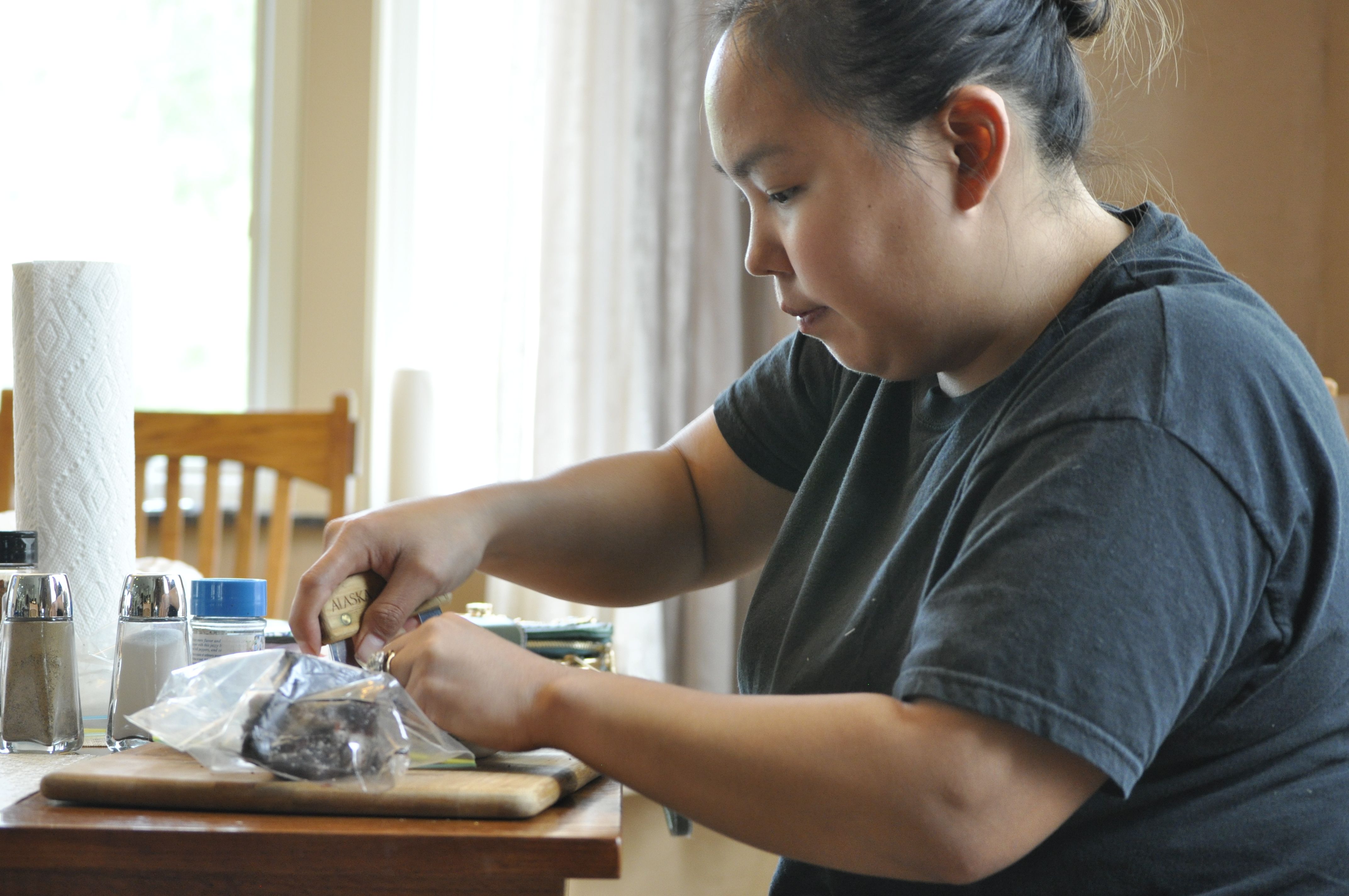
Alesha Tangman uses an ulu to cut up pieces of bowhead whale meat at her aunt and uncle’s kitchen table in Wasilla. She uses Kunniak’s spice mixtures on everything from salads to Maktak. (Photo by Erin McKinstry/Alaska Public Media)

Alesha Tangman uses an ulu to cut a dark red piece of bowhead whale meat into small cubes at her aunt and uncle’s kitchen table in Wasilla. It’s a marine mammal, but it smells like fresh fish.

She snacks on a plate of light pink tail meat – known as aqikkaq or the flukes – and then passes it around the table to her family members. It tastes like sushi.

“I grew up on Native food because coming from the village everything at the store was so expensive, so we relied on caribou and whale and geese,” she said.

Tangman moved to Big Lake about five years ago from Nuiqsut, but her relatives and friends bring her Native foods when they visit from the North Slope.

She wants her 3-year-old daughter to grow up loving the foods, unlike her nephews.

“They’re older, they haven’t had it since they were babies, and now they don’t like it,” she said.

Hopefully, that won’t happen with her daughter, thanks in part to a local spice blend company run by a woman from the North Slope.


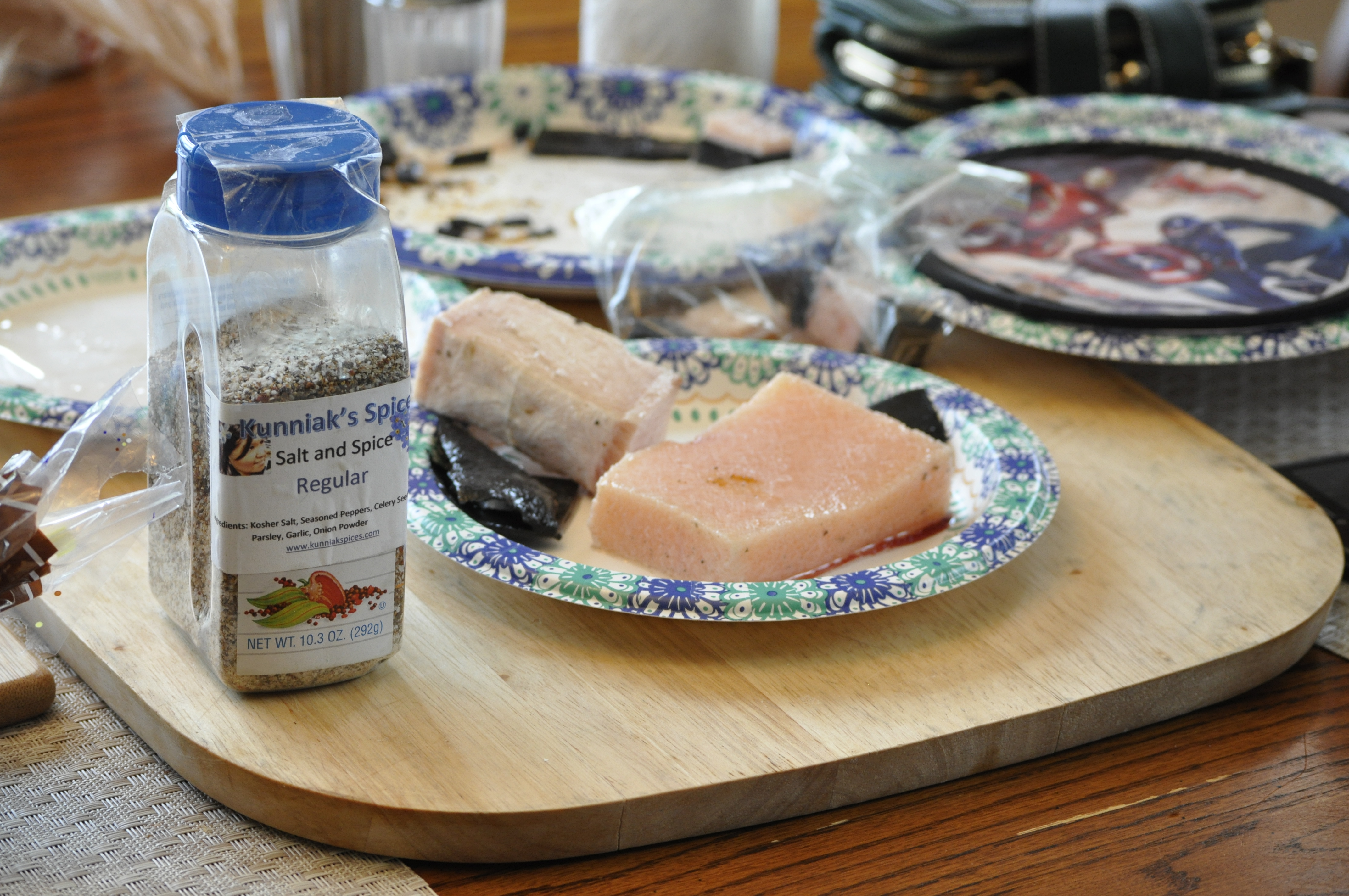
Kunniak’s original Salt and Spice mixture next to a plate of bowhead whale. She now carries 11 different flavors, including “Black Lava” and “Ghost Blend.” (Photo by Erin McKinstry/Alaska Public Media)

Kunniak’s Spices is doing more than building bank accounts – it’s also connecting people with Native dishes in new ways.


Tangman used to eat many of the dishes she grew up with plain or with salt.

When she saw her friends talking about the company on Facebook, Tangman added herself to the company’s group page and then she won a sample.

“I used it on everything up there, even on salads and then in soups and then with eating Native food, it tasted even better,” she said.

She shares pictures on the page to show how much she enjoys the dishes and is happy that she can support a Native-owned business owned by someone from the same region.

The company’s owner, Kunniak Hopson, moved to Chugiak 11 years ago from Utqiaġvik, which she calls Barrow.

When she was growing up, her family always put McCormick’s Salt ‘n Spice on maktak, which is frozen whale blubber and skin.

But McCormick’s stopped making it and she had to find an alternative.

“They kind of put their recipe online,” Hopson said. “I took it from there and altered it just a little bit, you know, just to make it mine, so I don’t get in trouble.”

She was just making it for herself at first, but then her sister shared some with friends.

Before Hopson knew it, people from other parts of the state were asking for the blend. She didn’t have any business experience, but she taught herself Quickbooks and got a food workers card.

“From there, I started my own whole line of spices, which I now have 11 different flavors,” she said.

Metal shelves stuffed with bulk spices line the walls of Hopson’s kitchen.

Flavors range from lemon to garlic to ghost pepper. Hopson stands at the head of a sturdy wooden table, where she mixes spices and fills clear plastic containers decorated with forget-me-nots.

She ships 300 to 500 bottles of spices a month to customers across rural Alaska and to Canada. She fills them all with help from her daughters.

Hopson’s Facebook group has more than 1,300 followers.

People post pictures daily, mostly of Alaska Native dishes that they’ve paired with her spice blends.

Business has nearly quadrupled in the last six months, she said, mostly because people share the page with friends and family, and she hosts giveaways.

For now, the business primarily lives on Facebook. She doesn’t have any plans yet to sell to restaurants or in stores, though she’s open to the idea if the business keeps growing.

Hopson works a full-time job but sometimes spends five hours a day on the side business. The hard work has paid off.

The business has funded trips back home, most recently to sell her spices at the Inuit Circumpolar Council general assembly meeting.

“There’s a lot of people that I have no idea who they are, they come up to me and say ‘hi’ and tell me that they’re one of my customers, and so it feels really good. It feels almost like a celebrity, almost,” she said.

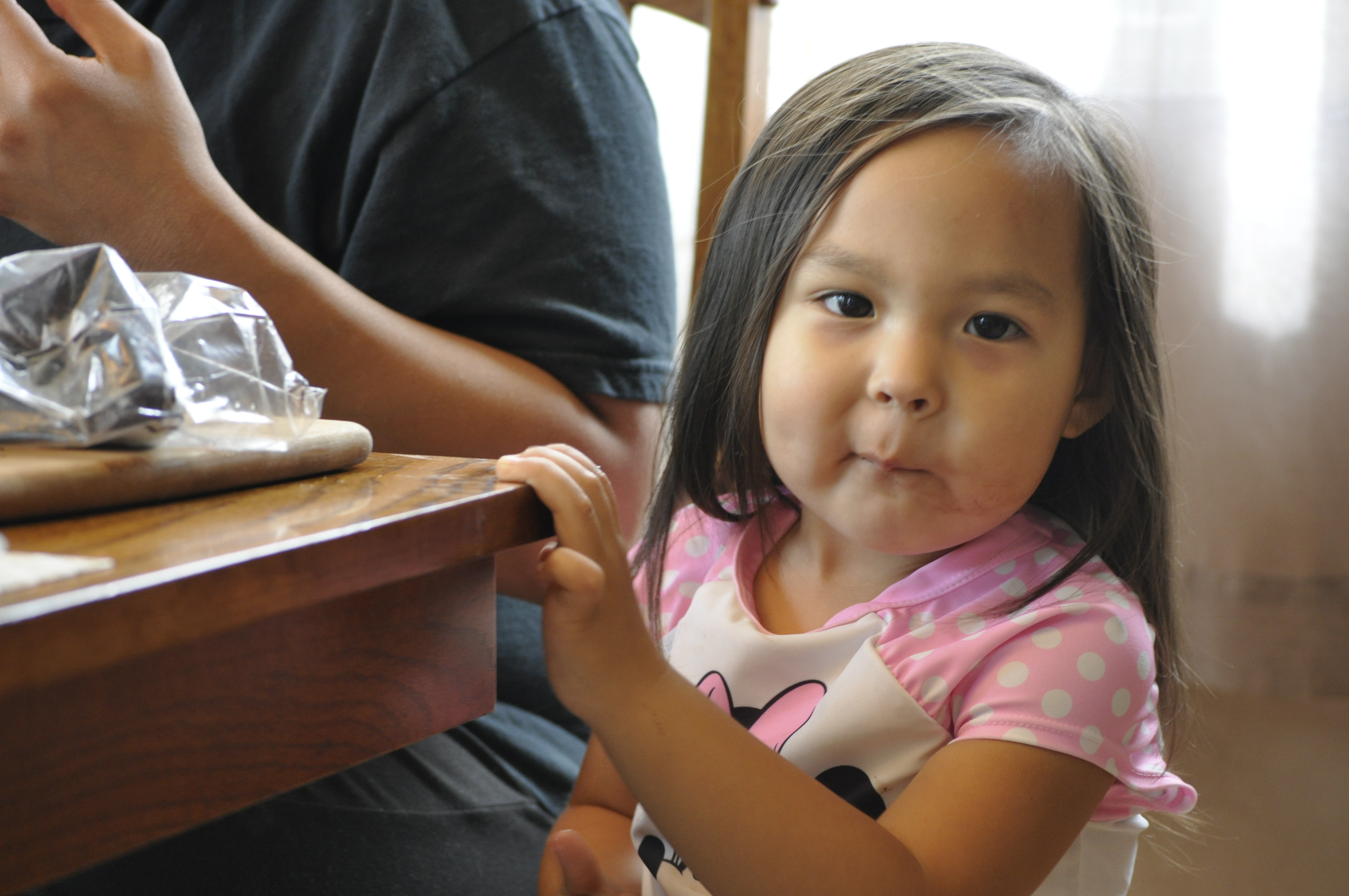
Alesha Tangman’s daughter Lucy steals bites of Maktak from her mother’s plate. She loves eating the dish with Kunniak’s Salt and Spice mixture. (Photo by Erin McKinstry/Alaska Public Media)

The best part, she said, is hearing how much people enjoy them, especially their kids.

Like Tangman’s daughter, Lucy. She darts in and out of the kitchen, stealing bites of Maktak dipped in Kunniak’s Salt and Spice blend, her favorite.

“We eat it together,” Tangman said. “She’ll choose this over chips or junk food.”

Finally, Lucy grabs an entire plate full of ruby chunks and takes it in front of the television, licking the salt and spice off her fingers after each bite.

Site notifications
Update notification options
Subscribe to notifications