Subsistence

Hunters sleep in Bethel parking lot to get muskox permits

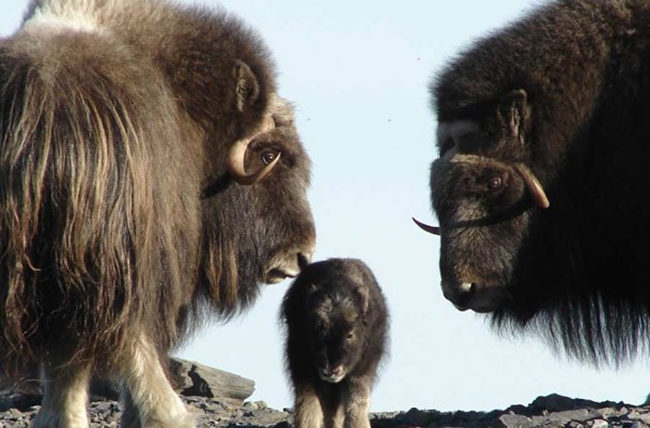
Muskox photographed near Nome. (Photo by Jason Gablaski, Bering Landbridge National Preserve, National Park Service)

One of the most exclusive animal hunts in the United States happens on a small corner of Alaska on the Bering Sea. On two subarctic islands live herds of a large, prehistoric mammal that roamed the tundra during the last Ice Age. Muskoxen are prized for their fatty, flavorful meat and soft, warm fur. Every year, thousands of people apply online for less than 200 winter permits to hunt them in Alaska. Or, for the truly devoted, you can travel to Bethel to sign up in person.

It’s 7:30 a.m. outside the Alaska Department of Fish and Game office in Bethel. It’s dark, above freezing, and a line of vehicles, each holding a couple of men, wait outside. A white jeep has its window down.

“I’m Adam London,” says the man sitting in the driver’s seat, holding a paper coffee cup. “This is my first winter here in Bethel. My buddy Kent over here convinced me that it’d be a good idea to come camp out and try to get a muskox permit.”

Kent Wong is sitting in the passenger seat. He’s from Anchorage, and for more than 20 years he has applied annually for a muskox permit in the state lottery. He has never gotten one. So when London moved to Bethel, he saw his chance. The two men had been in the parking lot since the prior afternoon, leaving only, as London said, “for a quick potty break and getting some coffee.”

In a large, blue van next to them lounge two hunters from Fairbanks. The van belongs to the Bethel Evangelical Covenant Church, where London works as a pastor. He offered the van to the hunters to sleep in so they wouldn’t have to pitch a tent in the parking lot.

“It’s an outreach [ministry],” London joked.

At 7:45 a.m. an ADF&G biologist shows up; the permits open at 8 a.m. Unlocking the door, the biologist announces that the hunters can start chasing him inside. But there’s no need to chase him. The men have already agreed on their order and written it on a ripped-out sheet of notebook paper taped to the door. The paper is referred to as both an “honor system” and “a gentlemen’s agreement.” According to the long-time hunters, this agreement has never been broken.

At the Bethel office are two muskox permits for Nelson Island and 10 permits for Nunivak Island.

The name on the top of the list, for the only bull permit, is 18-year-old Avery Hoffman of Bethel, who had not left the parking lot in 24 hours.

“I have done this before,” Hoffman explained, wearing glasses instead of his usual contacts after a night of sleeping in his 1997 Ford Explorer. “The last time I waited in line, I was in line for about three days. My teacher would come and bring me my school work, and he would pick it up at the end of the day and bring it back to the school.”

Hoffman has hunted muskox on Nelson Island for years. The young, though experienced, hunter shared pointers with the out-of-towners from Anchorage and Fairbanks as they waited.

“When you’re out there you mainly look for black, because they’re black. You look for black things on the white ground,” Hoffman described. “Look on the hills. Sometimes they’re on the peaks up there where the wind is, and we take our binoculars and we glass across. And we ask the locals around there to have a general idea where the muskox are.”

A few minutes before 8 a.m., another experienced hunter walks in. Tim Bee of Bethel says that he has hunted muskox on Nunivak Island at least 24 times. And for the first time, Bee didn’t need to camp overnight to get his permit. Competition has gone down, and no one from outside Alaska even came this year. Last year, a hunter from New Jersey camped in the parking lot for a week. Of the 12 open slots, five are still available when Bee arrives.

“The cost of going out to Nunivak is pretty expensive,” Bee explained. “It’s a $500 to $600 ticket. And just the logistics of getting across the island on a snowmachine; you have to rent a snowmachine. You can’t bring your own out there.”

Then, without any announcement, ADF&G biologist Patrick Jones begins to hand out the permits. Jones knows all the names by sight. Either he knows them from Bethel, or he met them in the parking lot the day before, so calling out names isn’t necessary.

Jones says that the Yukon-Kuskokwim Delta mainland could open a muskox hunt in as little as 10 years if the current population of the animals continues to grow.

The Nelson and Nunivak Island muskox permits became available in Bethel on January 15, 2019.

A total of 133 Nunivak Island muskox permits were given out this year: 63 draw bull permits online; 10 registration cow permits in Bethel; 60 registration cow permits in Mekoryuk.

A total of 50 Nelson Island muskox permits were given out: two bull and two cow draw permits online. One bull and one cow registration permits in Bethel. Twenty-two cows and 22 bull registration permits in Newtok.
Winter salmon trolling starts slow in Southeast Alaska

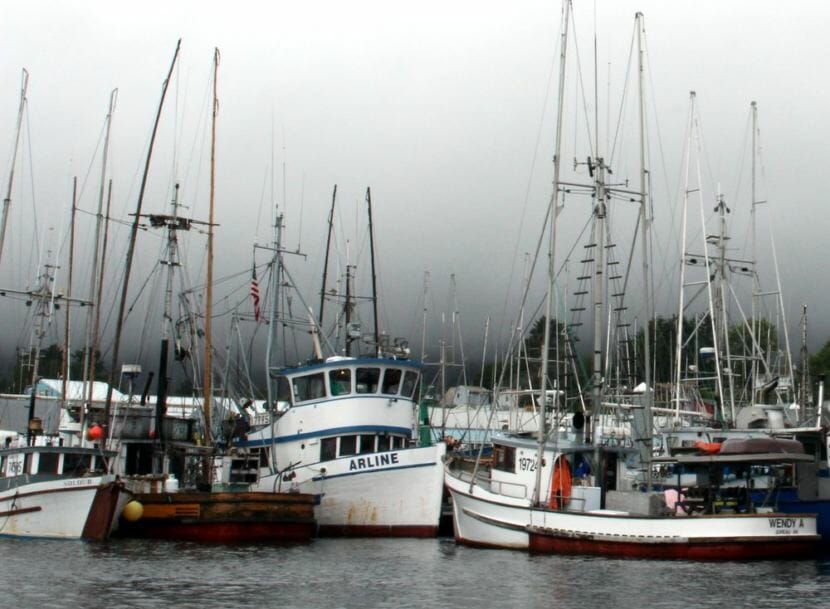
Trollers in Sitka’s Eliason Harbor. Extended king closures worry many. “There’s so much down time that a guy’s got to get another job,” troller Caven Pfeiffer told the Sitka Advisory Committee. (KCAW file photo)
Trollers in Sitka’s Eliason Harbor. (Photo by KCAW)

Commercial salmon trolling in Southeast Alaska had a slow start to the winter season. That’s likely to mean another year of restrictions for both commercial and sport fishing for king salmon in 2019. Recently-adopted guidelines in the Pacific Salmon Treaty link the success or failure of winter fishing to the numbers of salmon available for harvest the rest of the year.

The winter troll season opens in Southeast Alaska in October. Through the end of December, trollers had caught only around 5,500 kings.

Grant Hagerman, the Alaska Department of Fish and Game’s troll fishery biologist for Southeast, said that catch is down quite a bit from last year.

“Last year through the same time period we had over seven thousand, we were about 7,400, so we’re almost a couple thousand fish below where we were last year,” he said. “And that’s quite a bit below a five- or ten-year average. The early winter fishery, basically October through December, the five-year average is just about 16,000, and a ten-year or longer average is about 12 and a half thousand (12,500), so we’re down substantially from that.”

Normally, catches in the outside waters near Sitka make up a big portion of the winter catch. Those catches were low this year. And there was some stronger early-season fishing in Frederick Sound near Petersburg. Hagerman said that led to some of the fleet heading inside to fish.

“It was interesting to see some of the Sitka fleet actually fishing in Frederick Sound,” Hagerman said. “You know, we get fish tickets in, and seeing some of the Sitka boats where normally we have 100 boats here fishing and catching — you know, like I mentioned 40 to 50 percent of that early-winter harvest — we had a fair amount of permits who ran into the inside to fish. Very different.”

Last year’s total winter catch season was shortened by six weeks to conserve the fish returning to Southeast rivers. This year’s winter season is also expected to end March 15.

The troll catch takes on added significance this year. That’s because the Pacific Salmon Treaty signed in 2018 links management measures for all fisheries to the winter season catch rates. Specifically, estimates of king salmon abundance will be based on power troll catch rates in waters near Sitka for the first month and a half of the season.

The numbers are still preliminary, and harvest restrictions and fishery closures are not yet finalized. But Hagerman does expect more restrictions to commercial and sport fishing.

“Following the 2018 Alaska Board of Fisheries meeting, we had a number of restrictions that were implemented in troll fisheries, gillnet — well, all commercial fisheries, really, and the sport fisheries — and I believe those would continue,” Hagerman said.

King stocks in the western U.S. are listed under the Endangered Species Act, and some in Canada are thought to be at an increasing risk of extinction. In Alaska, some runs are at historically low levels. The fishery restrictions are aimed at helping stocks recover.

Japan whaling decision may have consequences for Alaska subsistence whalers

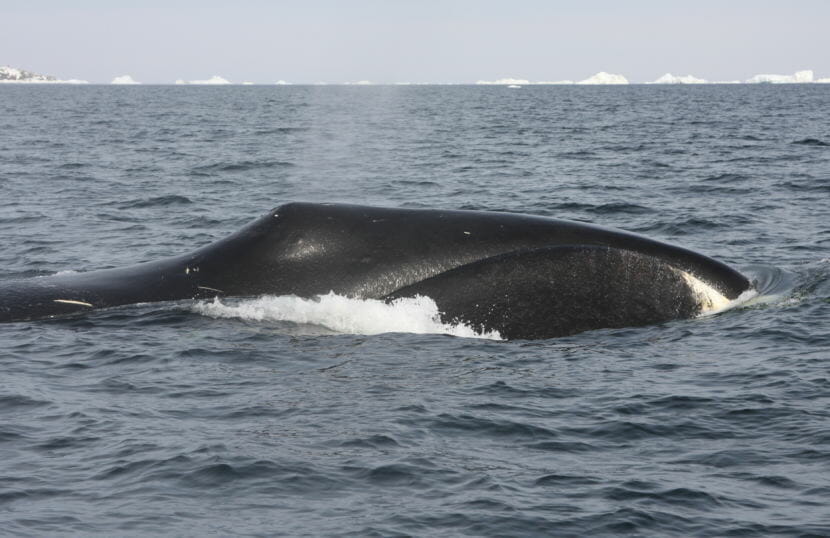
The International Whaling Commission recently voted to grant Alaska subsistence hunters a conditional automatic renewal for their bowhead whale quota. Japan’s departure from the IWC could make that automatic renewal less secure in the future. (Creative Commons photo by Kristin Laidre/University of Washington)

Last month Japan announced that it is leaving the international group that regulates whaling and will resume commercial whaling in its own coastal waters.

That move provoked some criticism. Commercial whaling has been banned by the International Whaling Commission since the 1980s.

But separate from that, Japan’s decision may have consequences for Alaska’s legal aboriginal subsistence whaling.

Japan’s departure means it will no longer conduct what it calls scientific whaling outside its waters — which was criticized by some as a loophole. Instead, it will hunt commercially in its own territorial waters and 200-mile exclusive economic zone.

The announcement comes on the heels of a proposal Japan made to resume commercial whaling at a recent meeting of the IWC — a proposal that failed.

Japan’s leaving the commission has potential consequences for Alaska whalers, whose quota for subsistence whaling is set by the IWC.

“It would be in our best interest to have Japan remain with the IWC,” said John Hopson Jr., chairman of the Alaska Eskimo Whaling Commission and a whaling captain in Wainwright. “They were a strong ally of ours in obtaining our quota.”

It’s too soon to know the ultimate impact of Japan’s decision. But the country does play an important role at the IWC, according to Jessica Lefevre, a lawyer for AEWC.

“Japan is a key member of the group within the body that refers to themselves as the ‘sustainable use group,'” said Lefevre. Others include Norway and Iceland, as well as some African, Caribbean and Pacific Island countries.

She said it’s possible that other countries in the sustainable use group could follow Japan’s example and leave the IWC as well — diminishing support for Alaska whalers.

That could make a critical rule change that passed last year less secure. The rule change made the renewal of aboriginal subsistence whaling quotas — including Alaska’s — automatic, provided certain conditions are met.

“The main vulnerability for us is that automatic renewal could be challenged at some point in the future if the … balance of power within the IWC, given Japan’s departure, shifts more in the direction of the anti-whaling coalition,” said Lefevre.

It would take a three-fourths majority vote of the IWC to change the current quota rule.

Hopson said AEWC will work with the United States and other IWC countries to try to find a path forward that preserves Japan’s membership.

He said his group will have a better sense of their next steps after AEWC’s next board meeting later this month.

New Alaska wildlife managers could revive old fights over federal protections, bear- and wolf-killing

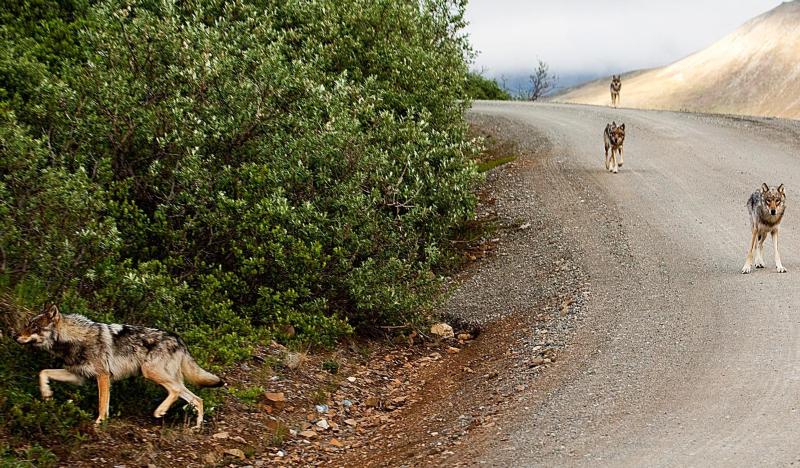
Wolves on the Denali Park Road. (Photo by NPS Photo / Nathan Kostegian)
Wolves travel along the Denali Park Road. The new administration of Alaska Gov. Mike Dunleavy is likely to revive old conflicts like one over a state program that kills wolves and bears to boost caribou and moose populations. (Photo by Nathan Kostegian/National Park Service)

Alaska Governor Mike Dunleavy is shaking up the Department of Fish and Game.

His acting commissioner, Doug Vincent-Lang, has made a pair of unconventional, high-level appointments. Rick Green — the right-wing talk show host known as Rick Rydell — is Vincent-Lang’s new special assistant.

And Eddie Grasser, who earlier this year worked as a lobbyist for a hunters’ advocacy group, Safari Club International, will lead the department’s wildlife conservation division.

The administration of Dunleavy, a Republican, has not released its proposed budget for the department, and it also hasn’t announced any major policy changes.

Doug Vincent Lang (Photo courtesy Alaska Department of Fish and Game)

But Vincent-Lang, who served as a top fish and game official under the previous Republican governor, Sean Parnell, said he won’t shrink from some of the more contentious policies he promoted in his past stint at the department. And that’s likely to shift the complex dynamics between the different entities and interests involved in Alaska’s fish and wildlife politics – from the state and federal governments to tribes, hunting organizations and fishing groups.

Under Parnell, Vincent-Lang fought the federal government on several fronts. One of them was over federal protections for endangered species like humpback whales and Steller sea lions, with the state arguing that such protections unnecessarily restricted activity like fishing and oil and gas development.

“Increasingly, I think we’re seeing an intrusion by the federal government into states’ rights to manage,” Vincent-Lang said in a phone interview Friday. “We’re going to fight hard to protect those — and where we can, cooperate with our federal agencies on research and other things.”

Vincent-Lang was also an advocate for predator control, a controversial state program that kills wolves and bears in an effort to leave more moose and caribou for hunters.

“I’m not going to shy away from doing predation control to increase productivity,” he said. “To the extent that we’re going to manage to ecosystems to maximize the number of moose and caribou coming out there for putting food on Alaskans’ plates, I’m willing to do that.”

Green, the special assistant, will earn $87,000 annually to work with Vincent-Lang on outreach and communication.

Two weeks ago, Green was still broadcasting his drive-time Anchorage talk radio show under the name Rick Rydell.

Rydell once referred to himself as a “flame-throwing conservative” who skewered “wacko” liberals on the radio. But in a Thursday phone interview, he was back to his given name, Rick Green, and sitting at a desk as a state employee.

Rick Rydell, the new special assistant to the Alaska fish and game commissioner. (Photo courtesy Rick Rydell)

Green, in a phone interview, described one of his main tasks as “rebuilding trust” with different groups frustrated with the way Alaska’s fish and game have been divided up. He cited dipnetters as one example, saying they were frustrated by the lack of available fish on the Kenai River in the summer.

That echoes one of Dunleavy’s criticisms on the campaign trail of the previous governor, independent Bill Walker, who Dunleavy described as overly sympathetic to commercial fishermen.

Vincent-Lang said that as he started as commissioner, he talked with Bob Penney, a longtime advocate for Kenai River recreational fishermen and a major financial supporter of Dunleavy’s gubernatorial bid.

Vincent-Lang also said he plans to meet with commercial fishermen from the same area in the next week. He hasn’t yet named his department’s new top fisheries managers – Vincent-Lang said that will likely happen in early January.

While those high-level jobs remain unfilled, some conservation-minded Alaskans said they’re worried that the fish and game department under Dunleavy will focus on hunting to the detriment of wildlife viewing and tourism.

“If I were a wolf or a bear in Alaska right now, I would be headed for the Canadian border, ASAP,” said Rick Steiner, an environmental advocate and former marine conservation professor in Anchorage.

Among Steiner’s concerns was the hiring of Grasser as the department official in charge of wildlife conservation.

Grasser grew up in a family of hunting guides, and once rode horses as they swam across the Copper River in the Wrangell Mountains. Later, he became a lobbyist and advocate for sportsmen’s groups like the Alaska Outdoor Council and the National Rifle Association.

In the 1990s, Grasser pushed the fish and game department to cut spending on programs like bear- and bird-viewing. At the time, he was representing the Alaska Outdoor Council, and argued that those non-hunting programs sucked up revenue from taxes on guns, bullets and hunting and fishing licenses.

More recently, Grasser has lobbied for another hunters’ advocacy group, Safari Club International.

Steiner said appointees like Grasser, Green and Vincent-Lang are too narrowly focused on the interests of recreational hunters from Alaska’s more urban regions, and Outside.

“I think the out-of-state trophy hunters and trappers will fare well,” Steiner said. “The major stakeholders that should be very concerned are the commercial fishing industry, the tourism industry and even the subsistence community.”

Steiner’s comments hinted at long-running conflicts over subsistence between rural Alaskans, particularly Alaska Natives, and urban hunters — groups that sometimes vie for the same fish and game.

But a top official at the Alaska Federation of Natives — one of the most powerful advocacy groups that backs subsistence users — said it’s way too early to judge the direction of Dunleavy’s administration.

“We’re looking forward to meeting them and sitting down and talking to them about the pressing issues, and seeing where our common ground is,” said President Julia Kitka.

Sitka Tribe of Alaska sues state, claiming mismanagement of herring fishery

Jeff Feldpausch stands in front of bags of hemlock branches, ready for distribution to elders. He noted the bare spots on the branches, illustrating the annual need for subsistence coming up short.
Jeff Feldpausch stands in front of bags of hemlock branches, ready for distribution to elders. He noted the bare spots on the branches, illustrating the annual need for subsistence coming up short. (Photo by Emily Kwong/KCAW)

A tribal government is filing suit against the state of Alaska, alleging mismanagement of the Sitka sac roe herring fishery. The Sitka Tribe of Alaska has retained a major Anchorage law firm that specializes in tribal advocacy and subsistence issues.

For 20 years, tribal leaders have been worried about the health of Sitka’s herring. The silvery fish return every spring to spawn and are pursued by commercial fisherman, subsistence harvesters and marine mammals alike. As a forage fish, they’re a cornerstone of the ecosystem.

Jessie Johnnie told the story of Herring Rock to the Alaska Board of Fisheries in 1997 — one of a young Tlingit woman sitting on the rock and lowering her hair into the ocean for the herring to lay their eggs. “All the herring would come to the rock and swim around,” she said, “and she would sing lullabies to them.”

Herring have cultural, ecological, and economic significance for Sitka. But the message to the Board of Fisheries back then was that the herring weren’t spawning the same way in the same places, and subsistence harvesters were struggling to gather enough roe.

Herman Kitka, testifying at that 1997 meeting, feared for the worst.

“If nothing is done,” he said, “we will lose the herring stock that is left in Sitka Sound.”

In 2018, his son Harvey Kitka went before the Board of Fisheries to say the same thing: Act now, or potentially lose our herring. STA proposed capping the commercial harvest of herring at 10 percent. But the board took no action, maintaining a formula that calculates a sliding scale of 12-to-20 percent depending on the size of the biomass.

KCAW’s Emily Kwong spoke with Kitka afterwards. He said he wasn’t surprised by the board’s decision, but he wondered if his father’s forecast was coming true.

“It’s happening right now, what we were concerned about back then,” Kitka said back in January.

In March, the herring fishery opened and ran into trouble. Because the commercial herring fishery is driven by processors, they need fish of a certain quality to market their product, largely to Japan and other Asian countries.

Eric Coonradt, the Sitka area management biologist for the state, said the fish this year  — most of which were four-year-olds — were simply too small.

“The quality with which processors needed to market these fish was 125 grams or better and 11 percent roe or better, and if you look at our forecast, 92 percent of the fish didn’t meet that demand,” said Coonradt.

In other words, they were looking for the biggest and best fish out there but didn’t find enough. The fleet fell over 8,000 tons short of their quota, and the commercial fishery closed early for the fourth time in six years. The fishery is driven by the formula, and Coonradt noted it’s up to the Board of Fisheries to change it.

“Unless we had a biological concern, we couldn’t close this fishery ourselves. What they’d have to do is bring it to the Board of Fish as an emergency petition. That’s their option,” Coonradt said.

Subsistence harvesters didn’t have much luck either.

Jeff Feldpausch is the resource protection director for STA. While his team bagged hemlock branches covered with herring eggs for distribution to elders, he pointed to bare spots on the branches.

“People don’t want trees in their freezer. It’s all about putting eggs in their freezers, not branches,” said Feldpausch. “This is looking grim. This is really grim.”

Although the harvest was insufficient for both commercial and subsistence purposes, the state is preparing for next season’s fishery under the same model. In December, the Alaska Department of Fish and Game announced they anticipate a spawning mass of 64,000 tons of herring in Sitka Sound, around 9,000 more pounds than was originally predicted — and set a commercial quota at 20 percent of that forecast.

This infuriates the Sitka Tribe of Alaska. On Dec. 11, STA filed a lawsuit against Fish and Game and the Board of Fisheries in Superior Court. They’re not calling for an all-out closure of the fishery; they’re asking for an injunction against Fish and Game, requiring them to develop a new management plan for the fishery prior to the start of the season next March. STA also wants the court to find that the actions of the Board of Fisheries and the Department of Fish and Game are illegal under Alaska law.

In a press release on Friday, STA chair Kathy Hope Erickson called for protection of the subsistence way of life. “The time is now,” she says, “to ensure our people have the chance to fulfill their cultural responsibilities which have been interwoven with the herring since time immemorial, and to fill their freezers. We cannot sit by while the State of Alaska shirks its statutory and constitutional duties to citizens. We demand action by the state.”

STA has retained the Anchorage law firm of Landye Bennett Blumstein LLP as legal counsel. The state of Alaska has 30 days to reply to the suit.

Reactions from Utqiaġvik on a whaling quota rule change: ‘We don’t have to beg anymore’

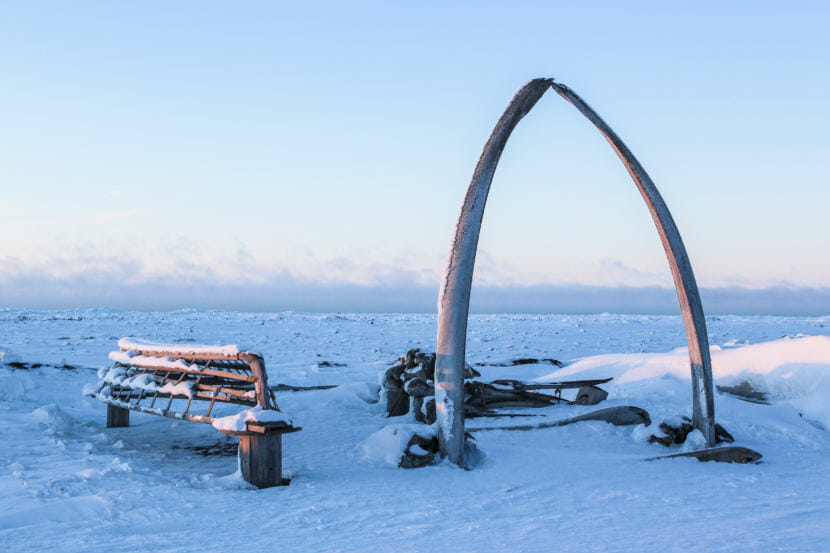
The bone arch in Utqiaġvik, made from bones of the bowhead whale. This year, Alaska whalers succeeded in getting the rules changed for how their whaling quota is renewed. (Photo courtesy of Arctic Council Secretariat / Kseniia Iartceva)

Back in September, a group of whaling captains made the long trip from Alaska to Florianópolis, Brazil.

They went to do something they’ve done dozens of times since the late 1970s: Ask an international commission to let them keep whaling.

But this time they had a new request, and it was a big one. They wanted to change the rules of the commission so they wouldn’t have to keep asking for that permission every few years. And they succeeded.

For context: Back in 1977, whaling communities in northern Alaska got some devastating news. The International Whaling Commission was concerned that the bowhead whale population was too low to support a subsistence hunt, and they put a moratorium on hunting bowheads.

“At the beginning of the battle in ‘77, through those early years, it was a real struggle to get the world to understand what our world was like up here,” said Marie Adams Carroll, who was the executive director of the Alaska Eskimo Whaling Commission in its early years. The group formed in response to the IWC moratorium to advocate for the right of Iñupiat and Yup’ik hunters to whale.

The IWC moratorium was only in place for a few months. After that, the whalers managed to get a small quota. But it was only half of what they said they needed.

Through a lot of hard work in the years that followed, the Alaska Eskimo Whaling Commission became a co-manager of the hunt. Whalers brought in scientists who used traditional knowledge to improve the technique for counting whales. The population estimates increased, and the quota grew.

But every few years, whalers had to show up to a meeting of IWC member countries and get 75 percent of them to say, yes, you can keep whaling.

If they didn’t succeed, their quota would expire.

“Seems like we had to go back and beg,” said Eugene Brower, former president of the Barrow Whaling Captains Association. Brower said he attended more IWC meetings than he cares to remember, and that feeling of having to beg — that’s not a good feeling. But additionally, there was always concern about the outcome of the vote.

“It wasn’t easy trying to get that quota,” said Brower. “Sometimes (the) United States failed to get that three-quarter vote needed to keep our way of life going.”

That happened in 2002. Eventually another vote was held at a special meeting, and the whalers got their quota.

But for several months before that, whaling communities in Alaska were in limbo, thinking they might not be able to hunt the bowhead whale without breaking the law.

So this year, the Alaska Eskimo Whaling Commission and the U.S. government put forward a new proposal that would change how the IWC renews the quota. Something called a “limited automatic renewal.”

The idea is that as long as certain conditions are met, including that the science says the bowhead whale population is doing well, every six years the quota will automatically renew. The limited automatic renewal won’t just apply to the bowhead quota, but to all aboriginal subsistence whale hunts conducted by IWC member countries.

The proposal also included an increase in the number of unused “strikes” that whalers could carry over from previous years. (“Strikes” are counted whenever a whale is hit, even if it’s subsequently lost.) With the new proposed carryover, the annual quota going forward would be 93 strikes per year for Alaska hunters. AEWC says that Alaska whalers usually take an average of 40 whales a year.

And the proposal passed.

“To me, that was a miracle,” said Crawford Patkotak, vice chair of the Alaska Eskimo Whaling Commission and one of the whaling captains who traveled to Brazil as part of the U.S. delegation. He described the rule change as both a surprise and a victory for Alaska whalers.

“It changes the way you think, the way you hunt, and it is a real pressure relief as far as not having to go back and questioning whether (the quota’s) going to be approved or not,” he said.

Patkotak said when they got back to Utqiaġvik, the atmosphere was pure excitement.

For people like Marie Adams Carroll and Eugene Brower, it felt like after years of struggle, a weight had been lifted from their shoulders.

“I had hoped to see that happen during my lifeterm,” said Brower. “Because my father, my uncles said, ‘Go out and educate. Fight for our people.’ It’s finally here … I’m happy that we don’t have to beg anymore.”

The automatic quota renewal could be revoked. But just as it took a large percentage of the IWC to make this new rule, it would take that same percentage to change it again. People familiar with the workings of the IWC say that’s unlikely.

Site notifications
Update notification options
Subscribe to notifications