Southwest

Dillingham students celebrate name change for local creek

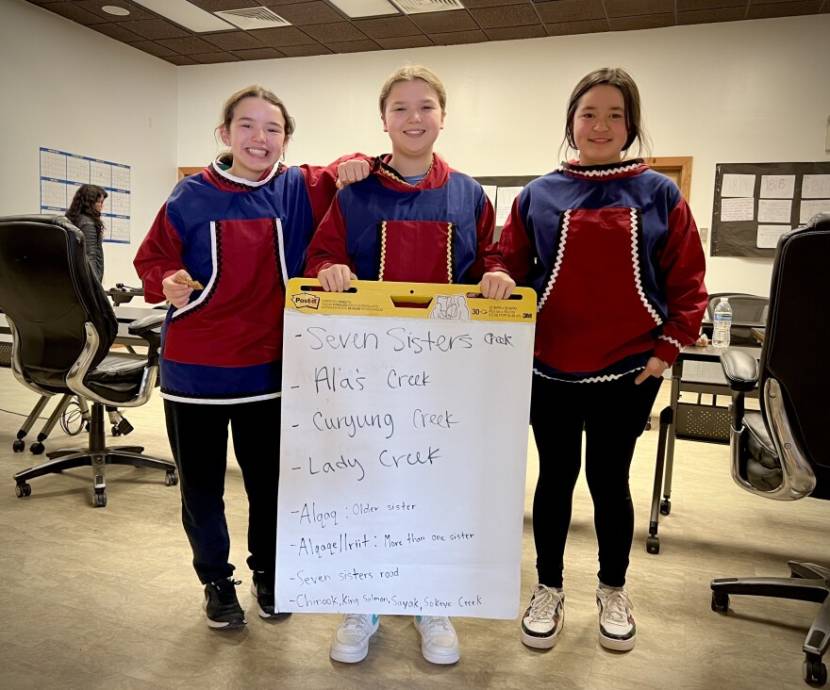
Alora Wassily, Harmony Larson, and Trista Wassily with names community members suggested for the creek in Dillingham. (Photo by Avery Lill/KDLG)

One year ago, Interior Secretary Deb Haaland issued a declaration to remove a slur against Indigenous women from place names on federal lands. Nearly 650 new names were finalized this fall, including one for a Dillingham creek that bore the slur.

But three elementary students in Dillingham — Alora Wassily, Trista Wassily and Harmony Larson — had worked to change the creek’s name since 2021, long before the federal government started its process.

In an interview shortly after the announcement, Alora said they put a lot of effort into reaching that goal.

“It feels good because we worked on it for so long, and it finally got changed, and we just feel relieved,” she said. “We felt accomplished.”

They began advocating for the change when they were in fifth grade, after they heard a local story about seven sisters who had lived along the creek and how both the creek and a road of the same name were marked with the derogatory word.

“We thought about it, and then we decided to change it, and then we talked to our teacher, Ms. Jensen,” she said. “Then we talked with [Curyung Tribal Council Administrator] Courtenay Carty and Robyn [Chaney], and then we just started researching about other places.”

Now the students are in seventh grade, and they have presented their research many times. They started with the Dillingham Parent Advisory Committee and the school board.

“We were all really nervous our first time. And after a while we got used to it, and we just got normal about it,” Alora said.

Since then, they have presented their research to the Curyung Tribal Council, the Alaska Federation of Natives Elders and Youth Conference, and the Bristol Bay Native Corporation. Robyn Chaney helped the students prepare. She is the Federal Programs Coordinator for Dillingham city schools and has been an adult advisor for the students.

“I think them standing behind their information was really powerful,” Chaney said. “They were part of educating people here, including myself. They received mostly positive feedback and support. And really their confidence grew because their facts are accurate. And it was an issue that obviously became really important, not just to us, but on a federal level that Secretary Haaland would take that up.”

When U.S. Interior Secretary Deb Haaland announced last year that the word would be removed from geographic features across the country, the students’ work got more attention. And they had to shift their approach, taking their grassroots advocacy and fitting it into a political process.

“Our process went from slow and steady to very, very rapid,” Chaney said. “It shifted from us educating and garnering local support for change to a government-to-government relationship, following a tribal process and doing tribal consultation between our local Curyung Tribe and the federal government.”

The students recommended renaming the creek Al’a Creek, and they received broad support from the community during a listening session last spring. But at the last minute, a Curyung Tribal Council member suggested a different name: Amau Creek. Chaney said that was difficult.

“It was just a hard pill to swallow because that name hadn’t gone through the public process. It was in their regular meeting. But it wasn’t a name that had been carried forward in the public process that they set forth. And so it was surprising and upsetting,” Chaney said. “But they still achieved the goal, which was to remove a derogatory place name and replace it.”

The students are the latest in a long legacy of work to re-center Native place names in Bristol Bay. Francisca Demoski is the land manager for the Bristol Bay Native Corporation.

Originally from Togiak, she now lives in Anchorage and oversees the land department’s cultural heritage efforts, including the Bristol Bay Native Place Names project. She said it’s one way the corporation celebrates and preserves that heritage.

“Amau Creek translates to ‘great-grandparent’ and is a Yugtun word. And in this case it references a group of sisters, or great-grandmothers, who according to traditional stories traveled to the area and settled near the creek,” Demoski said. “So the community recognized the role of the great-grandmothers in their families and chose the name to honor their ancestors.”

Demoski said BBNC supports the federal efforts to change the derogatory names of places across the country, including in Dillingham.

“BBNC is pleased with the outcome, and I applaud the young students for taking leadership in making this change happen for their community,” she said.

Demoski helped start the Native corporation’s project almost 20 years ago, in 2003. It now has over 1,400 place names on the website. Many are from the areas around Togiak, Manokotak, Dillingham and along the Nushagak River. There are also many Dena’ina and Yup’ik contributions from around Iliamna Lake.

“I am working with the Bristol Bay Native Education Foundation to gather place names along the Alaska Peninsula, including the Naknek area. So that’s where we’re focusing right now, because there’s very limited data in that area,” she said.

Demoski said its purpose is to “capture and preserve important knowledge and safely archive it before it’s lost.”

Demoski hopes this year’s push to change derogatory names around the country inspires communities to consider changing their own names. She says it’s been done before, pointing to the example of Utqiaġvik, which used to be named Barrow. This is a critical effort, she said.

“And ensuring the survival of our people’s cultural history is of the utmost importance to us, and place names is one way that we ensure that our history is being preserved for a future generation,” she said.

The students’ work isn’t over. They are still working on the next steps to change the community’s signs and replace them with the new name: Amau Creek.
More than 2 years after fatal naval base shooting, a Kodiak family is still looking for answers

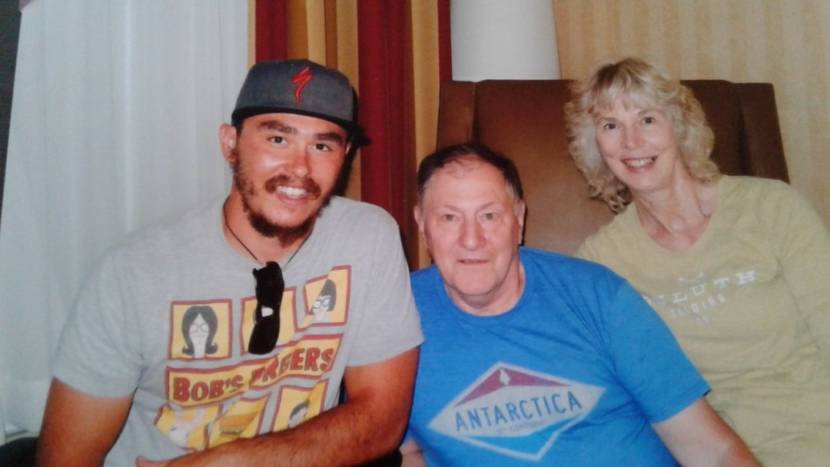
Jayson Vinberg with his father and stepmother Tony and Esther Furio in 2018. (Photo courtesy of Furio family)

The family of a man killed by a guard on a military base in Kodiak is still looking for answers more than two years after his death. The Navy SEALs have a video of the shooting, but they have stonewalled the family’s requests to see it. So now, the family says, its only hope is a federal lawsuit.

In the spring of 2020, Tony Furio was driving out to gather firewood in Chiniak, near where the road ends on Kodiak Island. Furio and his son, Jayson Vinberg, loaded up the truck with sandwiches and a big bag of potato chips in case they got hungry on the way.

“I can remember on the way back he started laughing, and I’m going, ‘What are you laughing about?’ And he said, ‘Well, here, Dad, you better have some of these before I finish the whole bag.’ It was just a fun time,” said Furio.

A few months later, Vinberg was dead.

On a warm June night, the 30-year-old man wandered onto Kodiak’s Naval Special Warfare Detachment — it’s known as the SEAL base to locals.

According to investigators, Vinberg was carrying a pair of kitchen knives. He tapped them on the glass of the guard house, where a lone watchman was stationed. The report says the guard repeatedly ordered Vinberg to leave. Vinberg started to walk away. Then, still carrying the knives, he turned around and walked toward the guard, who opened fire, killing him. A blood test later showed Vinberg had been drinking — he had a blood alcohol level of .11 — and also had marijuana in his system.

Back in January of this year, a joint state and federal criminal investigation concluded that Vinberg’s killing was justifiable, because the guard acted in self-defense.

But Vinberg’s family still has questions. The military has told them almost nothing. It made them file a Freedom of Information Act request just to see the results of the investigation. And even then, it has refused to show them the surveillance video that captured the final moments of their son’s life.

“I mean we have a peace in many ways, but not necessarily a peace about the circumstances that happened,” said Esther Furio, Vinberg’s stepmother.

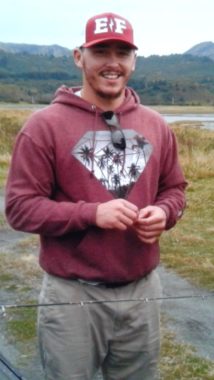
A man in a red sweatshirt stands smiling with a fishing rod
Jayson Vinberg on a fishing trip in Kodiak in 2018 (Photo courtesy Esther and Tony Furio)

What happened that night in June is at the center of a lawsuit Vinberg’s widow, Becky Vinberg, filed this summer against the U.S. government. She declined to be interviewed. The Furios are not listed plaintiffs, but say they support the suit.

Attorneys Jeffrey Robinson and Ashley Sundquist of the Anchorage law firm Ashburn & Mason are representing Jayson Vinberg’s family.

The original complaint named the United States, U.S. Navy and the petty officer who shot Vinberg, Bradley Udell, for wrongful death and negligence in his killing. The latter two were dismissed as defendants, but a judge ruled last month that the lawsuit against the U.S. could proceed, noting that the United States “has not been forthcoming with what only it knows about the circumstances surrounding the shooting.”

The U.S. Attorney’s office declined to comment on the lawsuit.

Tony Furio said the lack of transparency has been painful.

“When you think that you’ve almost got it, it’s not true because that finality is not there,” he said. “It’s just hard, that’s all.”

In July, Naval Criminal Investigative Service, or NCIS, released hundreds of pages of material in response to FOIAs filed by KMXT, CoastAlaska and Vinberg’s family.

But the report is heavily redacted — all the names are blacked out, and in some places, it’s hard to understand what it even says. And while surveillance video footage of the incident is repeatedly referenced in NCIS’s report, the military so far has refused to release it to KMXT or the family. It says after 9 months, the video remains under review.

KMXT filed another FOIA request for the video in September, this time with Naval Special Warfare Command. Alaska State Troopers have also declined to release the tape or additional material regarding the case, deferring to the level of redactions placed on the full report by federal investigators.

That’s not normal. These days, when a government employee kills someone in the line of duty — and it’s captured on video — the authorities almost always release it.

Rich Curtner is a longtime public defense attorney in Alaska with experience representing people who have been shot by police officers. He’s not involved with Vinberg’s case, but he said releasing body camera footage or surveillance video when it’s available has become an important protocol for departments across the country.

“And when an incident is recorded, that it can be made public in a timely fashion — not two years, three years, or a whole process of going through the records,” said Curtner. “It should be publicly released as soon as possible.”

Curtner points to cases like the 2019 fatal shooting of Bishar Hassan by Anchorage police officers as one instance where seeing what happened changed the perspective of the shooting.

In Hassan’s case, dashcam video showed officers almost immediately opening fire after he pulled what was later determined to be a BB gun from his waistband. And minutes went by before anyone applied first aid after he was struck by multiple rounds. The footage also was not made immediately available to the family or the public.

Curtner said making information accessible to the public can also corroborate a department’s telling of events and whether an officer’s action were warranted.

“You can’t distinguish between an overreaction or a belligerent, dangerous person unless you see the video,” he said. “Then you know what that person was acting like.”

Page after page of NCIS’s report into Vinberg’s death includes interviews with his family, friends, coworkers — even some people who didn’t like him. There’s information about past legal dust-ups and drug use, mostly from when he was younger.

Tony Furio said his son wasn’t perfect, but in all the questions investigators have asked about him, the family hasn’t been able to ask their own questions about what happened to him.

Esther Furio said the process is one that no family should have to go through.

“Anytime you lose someone really close to you it’s not like, ‘Okay, finally it’s over,’” she said. “It’s always there, there’s always the memories, the pain and those things too. But when it goes on for this long, it’s like you couldn’t really grieve because there’s no ending to it.”

This year, on the second anniversary of the shooting, the Furios went to Kodiak’s Fort Abercrombie State Park. Esther Furio had made a floating flower arrangement, and together they placed it in the water at the bottom of the park’s rocky cliffs.

Tony Furio said he likes to talk to his son at Abercrombie, and he’s tried to find peace where he can. He’s said two prayers since the night he learned his son had died — one for forgiveness for the guard who shot his son and the guard’s family.

“Not that they had any part of it, but that their lives, our lives, everyone who’s connected to Jayson is changed,” said Furio. “And for God’s truth to be known in the end.”

More than two years later he said he’s still waiting for that prayer to be answered.

Editor’s note: This story was produced as a collaboration between American Public Media and KMXT.

Long-running dispute over Izembek road to get another review in court-ordered rehearing

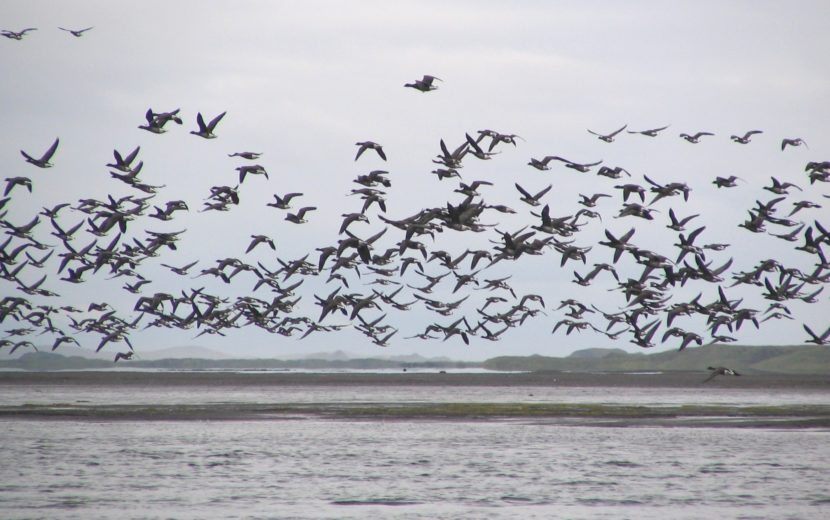
A flock of seabirds flying over a lagoon
Pacific black brant fly above Izembek Lagoon at Izembek National Wildlife Refuge on Dec. 27, 2013. The refuge is used as a migratory stop for nearly the entire global population of Pacific black brant. For decades, a debate has raged over a plan to put a road through a portion of the refuge. Izembek’s importance to migratory birds is invoked by road opponents, while road supporters say the project is needed to help residents of the nearby village of King Cove. (Photo by Kristine Sowl/U.S. Fish and Wildlfie Service)

A back-and-forth legal saga over a proposed road through a national wildlife refuge in Alaska took another turn on Thursday when the 9th U.S. Circuit Court of Appeals ordered a rehearing of the issue, a move that could possibly squash the project.

The case involves a land trade that would enable construction of a gravel road through a section of designated wilderness in the Izembek National Wildlife Refuge in southwestern Alaska. Thursday’s three-sentence order from the full panel of the circuit court vacated a March ruling by a three-judge appeals panel that would have helped clear the way for road construction.

The 2-1 ruling found that the Trump administration’s Department of the Interior was acting lawfully when it approved a swap of land between the U.S. Fish and Wildlife Service and the local village Native corporation, the King Cove Corp. Under the deal, which is currently in limbo, corporate-owned coastal land would be added to the refuge in exchange for a stretch of land within the refuge that would be used for the approximately 12-mile road.

Residents of King Cove, an Aleut village of about 850 people, have argued for decades that they need a road across the refuge to reach a jetliner-capable airport in Cold Bay, an even smaller community to the west. The Cold Bay airport, now operated by the state, is a World War II legacy; its 10,000-foot runway is one of the longest in Alaska and is sometimes used by jetliners that divert for emergency landings.

Opponents of the road and the land trade that would enable its construction argue that the road would damage globally important bird and wildlife habitat. They say the deal would set a bad precedent for all national wildlife refuges. They also argue that emergency evacuation services can be provided in alternative ways. Additionally, many have said they believe the road’s true purpose is commercial, to benefit segments of the seafood industry.

The debate over the land trade and the road it would enable has ricocheted for years through the administrative processes and the federal courts.

The Alaska congressional delegation pushed for legislation in the 1990s that would enable a land exchange. A 2009 appropriations bill launched a full environmental review of the project. In 2013, Sally Jewell, the Obama administration’s Interior secretary, issued a decision rejecting the land swap, concluding that process. In 2018, the Trump administration reversed Jewell’s decision and approved the trade. In 2019, U.S. District Court Judge Sharon Gleason struck down that approval, finding that Trump administration’s Interior secretaries, Ryan Zinke and David Bernhardt, exceeded their legal authority.

The March 16 appeals ruling reversed Gleason’s decision, finding that Bernhardt had acted within his authority. The Biden administration, so far, has supported the Trump administration’s approval of the land trade.

This article originally appeared in the Alaska Beacon and is republished here with permission.

In Bethel, a homegrown solution to the state’s nursing shortage

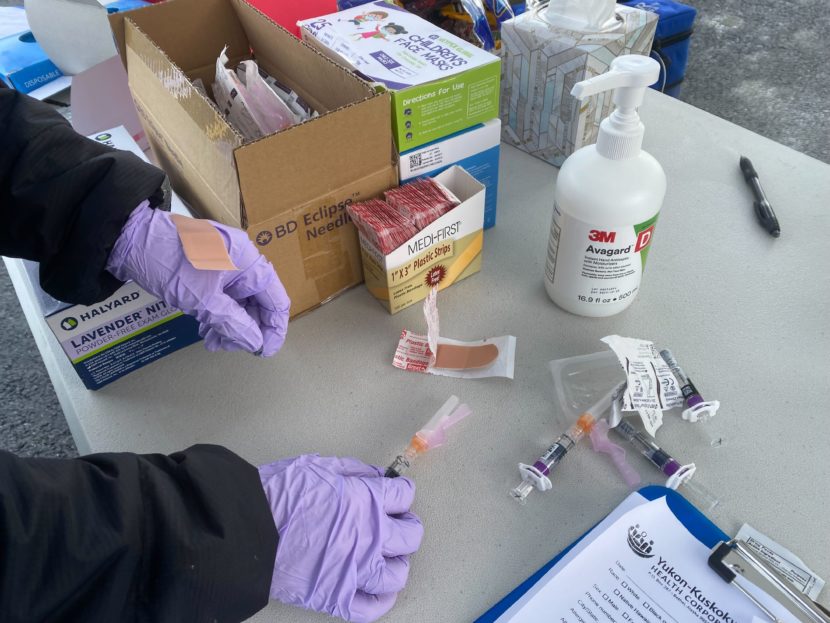
Amber Bukowski leans into Melanie McIntyre’s car to give her a flu shot. She’s wearing lavender gloves and has a small bandage ready.

Bukowski counts down and quickly empties the syringe in McIntyre’s arm while a Yukon Kuskokwim Health Center employee observes.

“It’s like a mosquito bite or like a little pinch, that’s all,” McIntyre said, leaning back to let her kids know how it went—they’re next.

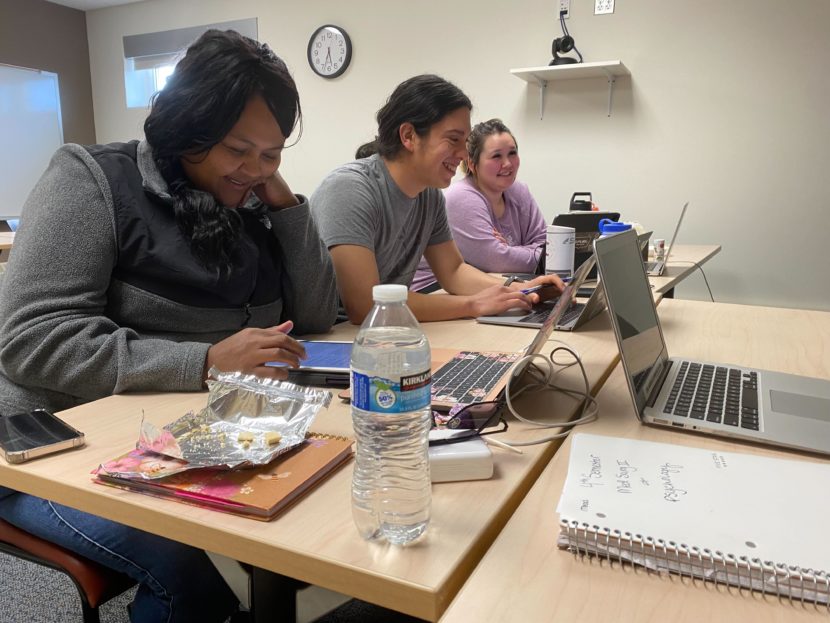
This is one of many flu shots Bukowski will give today. She’s working the drive-through clinic on a frosty Saturday morning as part of the clinical hours towards her nursing degree from the Kuskokwim campus of the University of Alaska Fairbanks.

She and the three other students in her cohort are part of the long-term solution to the state’s dire need for nurses – specifically, Alaska-trained nurses who intend to work in the state. Alaska is increasingly reliant on out-of-state healthcare workers — an expensive, short term fix to a longstanding problem. The nursing program at the Kuskokwim campus isn’t huge, but it is putting four new nurses directly into the Bethel community this year.

Bukowski isn’t new to patient care, though. She got her start in Chevak, where she’s from originally.

“I started out as a health aide in the village clinics and transferred over to be a supervisor and took classes part time and then ended up in the nursing program,” she said.

Previous experience in health care isn’t required to start the degree program. The campus in Bethel offers pre-nursing courses, too.

Bukowski and the other three students in her cohort will take the test to become fully certified nurses after they pass their exams this December.

“It’s a lot of info,” Bukowski said. “A lot of hard work and dedication. But anybody can do it.”

Her classmate Michael Vicente worked as a public health official for the hospital in Bethel until he started the nursing program two years ago.

“I just felt like I’d been called to nursing,” he said. “This is the next step into working closer with the community on a one-on-one basis instead of community wide.”

Twyla Elhardt teaches the nurses-to-be.

“We have a huge shortage of healthcare workers here,” she said.

Elhardt came to Bethel as a nurse in 2015, then became a nursing instructor a couple of years ago. She said that’s because she has a passion for seeing students from the region learn to take care of its residents.

“I get to see elders cared for by nursing students who are from the same village. And it’s a beautiful thing,” Elhardt said. “I’d love to see that increase.”

She said local nurses break down barriers to care because they understand where their patients are coming from.

“If they want to be here for the long haul, I think you just have an amazing investment, not just in direct patient care, but into the whole healthcare system,” she said.

Bethel students will name a local park as part of a city-wide civics lesson

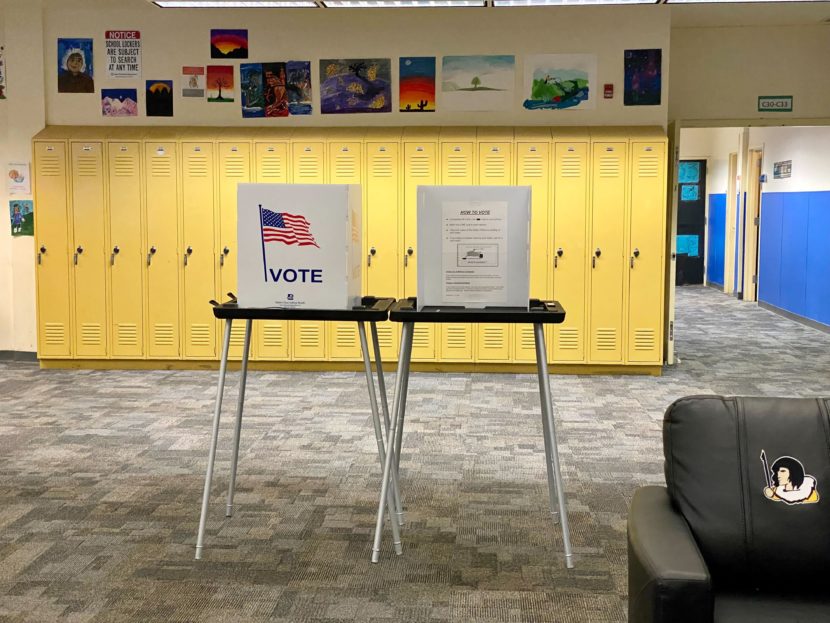
Voting booths at Bethel High School on October 25, 2022. (Claire Stremple/KYUK)

Bethel students are going to the polls this week. They’re voting with Sharpies, and there’s only one question on the ballot — it’s up to them to pick the sign that will mark a local playground.

It’s part of a city-wide effort to raise community-minded citizens. City leaders also hope it will interest parents and families in the upcoming general elections.

“If the community isn’t voting, they’re not sharing their voice,” said Lori Strickler, Bethel’s city clerk.

This election may not seem as consequential as the upcoming general elections, but Strickler said they’re actually related.

She said kids can also bring a little voter awareness home to their families — and maybe even spur adults to vote.

“Having conversations about elections within the household will help encourage the adult voters to look into what’s going to be on the ballot,” she said.

She brought voter information for this year’s state elections for students to take home.

Less than 19% of Bethel voters turned out in this year’s local elections. In 2018 and 2019, more than a third of the population voted in municipal elections.

Strickler set up voting booths and the city’s ballot counting machines at Bethel High School earlier this week. It looked like the real deal, except the backdrop was yellow lockers and classroom doors.

She explained how the student vote would work to a couple dozen middle schoolers at a time. There was some gum snapping from the crowd, but everyone paid attention.

Hannah Japhet and Andrea Simon head back to class after a student vote. October 25, 2022. (Claire Stremple/KYUK)

The students took turns in the polling booths and then fed their ballots into the machines. Everyone voted, and the stickers were popular.

Hannah Japhet and Angela Simon still have five years before they can vote in a general election, but they both said they might vote when they’re eligible.

A few students even grabbed the grownup election materials to take home. They’ll find out the results on Monday.

Adult elections are Tuesday, Nov. 8 this year. Early voting for most Alaska precincts started Oct. 24.

Dunleavy, Peltola request disaster funds for Bering Sea crab fisheries

""
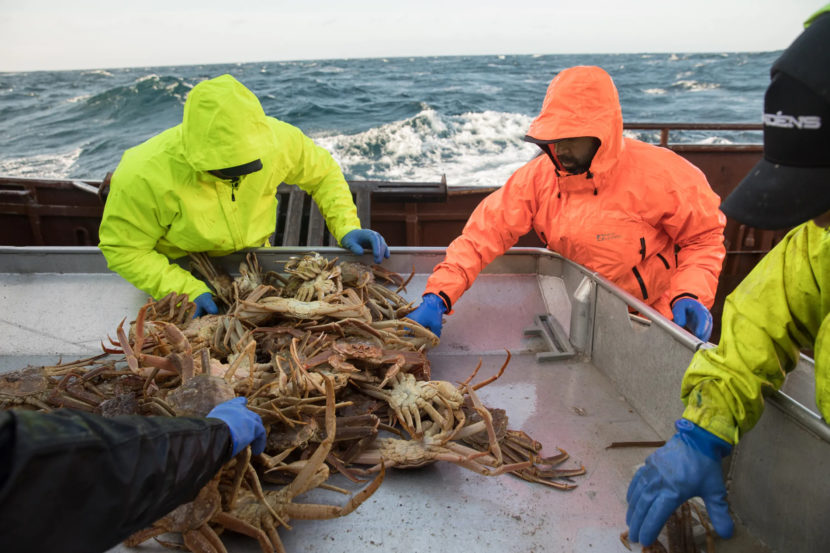
Gov. Dunleavy requested disaster declarations for the Bering Sea snow crab and Bristol Bay red king crab fisheries, citing the closure of both this year. (Photo courtesy Corey Arnold/Alaska Bering Sea Crabbers)

Gov. Mike Dunleavy has requested federal disaster declarations for two Alaska crab fisheries after their populations crashed. The Alaska Department of Fish and Game announced earlier this month that the Bering Sea snow crab fishery will not open, for the first time in its history.

The governor requested expedited disaster designations to jump-start the process of sending money to fishermen in both the 2022 Bering Sea snow crab and Bristol Bay red king crab fisheries, citing the complete closure of both this season.

Dunleavy also requested a disaster declaration for last year’s Bristol Bay red king crab fishery, which will remain closed for the second year in a row this season.

Rep. Mary Peltola has also requested emergency relief funding in a letter addressed to U.S. House Speaker Nancy Pelosi and the chair of the House Appropriations Committee.

In a letter to U.S. Secretary of Commerce Gina Raimondo dated Oct. 21, Dunleavy blamed “warming ocean temperatures” for the collapse of both Bering Sea crab stocks — and said the closures would be a $287 million hit to Alaska’s economy in seafood landings alone.

In a press release Wednesday, Alaska Bering Sea Crabbers Executive Director Jamie Goen said that total economic losses to supporting industries, workers and coastal communities would likely be hundreds of millions of dollars more than that. Alaska Bering Sea Crabbers is a trade organization that advocates for Bering Sea fishermen.

Goen also said the closures represent a “defining moment in U.S. fisheries management” and that financial relief will likely take years to reach fishermen, even with the expedited disaster requests.

King crab numbers have been on the decline for years, and snow crab stocks in the Bering Sea crashed between the years 2018 and 2021. Researchers don’t know exactly what happened, but they believe warmer ocean conditions caused by climate change is a main driver of the snow crab’s population decline.

Site notifications
Update notification options
Subscribe to notifications