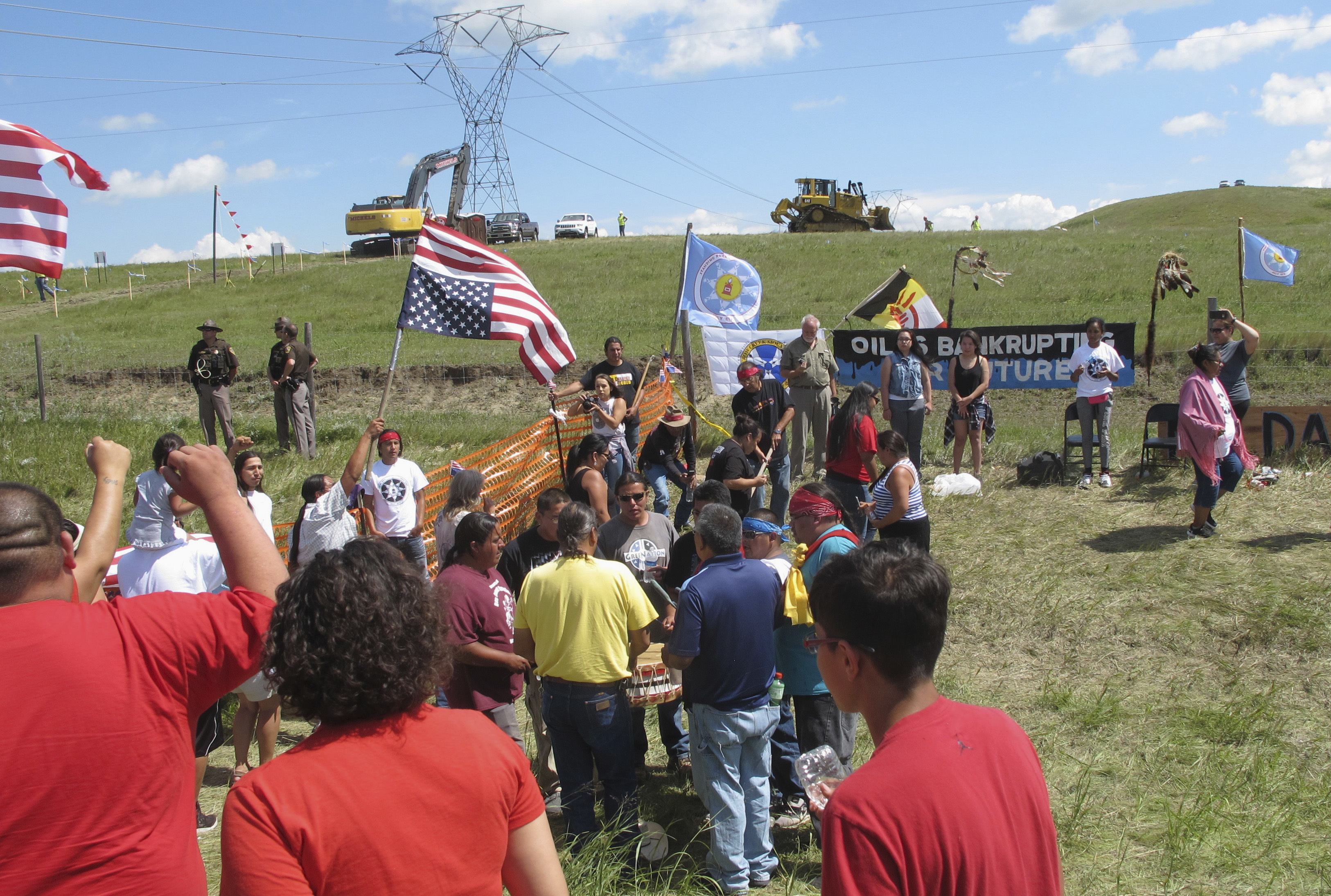
Native Americans protest the Dakota Access oil pipeline near the Standing Rock Sioux reservation in southern North Dakota. (Photo by James MacPherson/Associated Press)
The U.S. Army Corps of Engineers says it does not oppose the temporary halt of construction on the Dakota Access Pipeline, a $3.8 billion oil pipeline slated to run through four states, including North Dakota.
As we’ve reported, the Standing Rock Sioux Tribe opposes the pipeline because it fears it could disturb sacred sites and affect the drinking water.
Earlier this summer, the tribe filed a complaint with the United States District Court for the District of Columbia, arguing that the Army Corps did not follow proper procedure when it gave Dallas-based Energy Transfer Partners the go ahead to build the pipeline.
Over the weekend, the tribe filed an emergency motion asking the court to halt construction of the pipeline. In one filing, Tim Mentz Sr., who helped start the Standing Rock Sioux Tribe Tribal Historic Preservation Office, said bulldozers had likely dug through burial grounds with little regard and without allowing members of the tribe a chance to look for human remains.
The Army Corps replied saying it did not oppose a temporary halt to construction.
The Corps said it was comfortable with the process it followed when it permitted the project in first place and that the tribe was unlikely to succeed with its lawsuit.
Still, it acknowledged the confrontations that have occurred between private security officers at the construction site and protesters. (As we reported, one demonstration over the weekend turned violent. Some protesters ended up bloodied and the local sheriff said three private security officers had been hurt.)
“The Corps acknowledges that the public interest would be served by preserving peace near Lake Oahe until the Court can render its well-considered opinion on Plaintiff’s Motion for Preliminary Injunction,” the Corps said. “The Corps therefore does not oppose this short and discrete temporary restraining order.”
Copyright 2016 NPR. To see more, visit http://www.npr.org/.
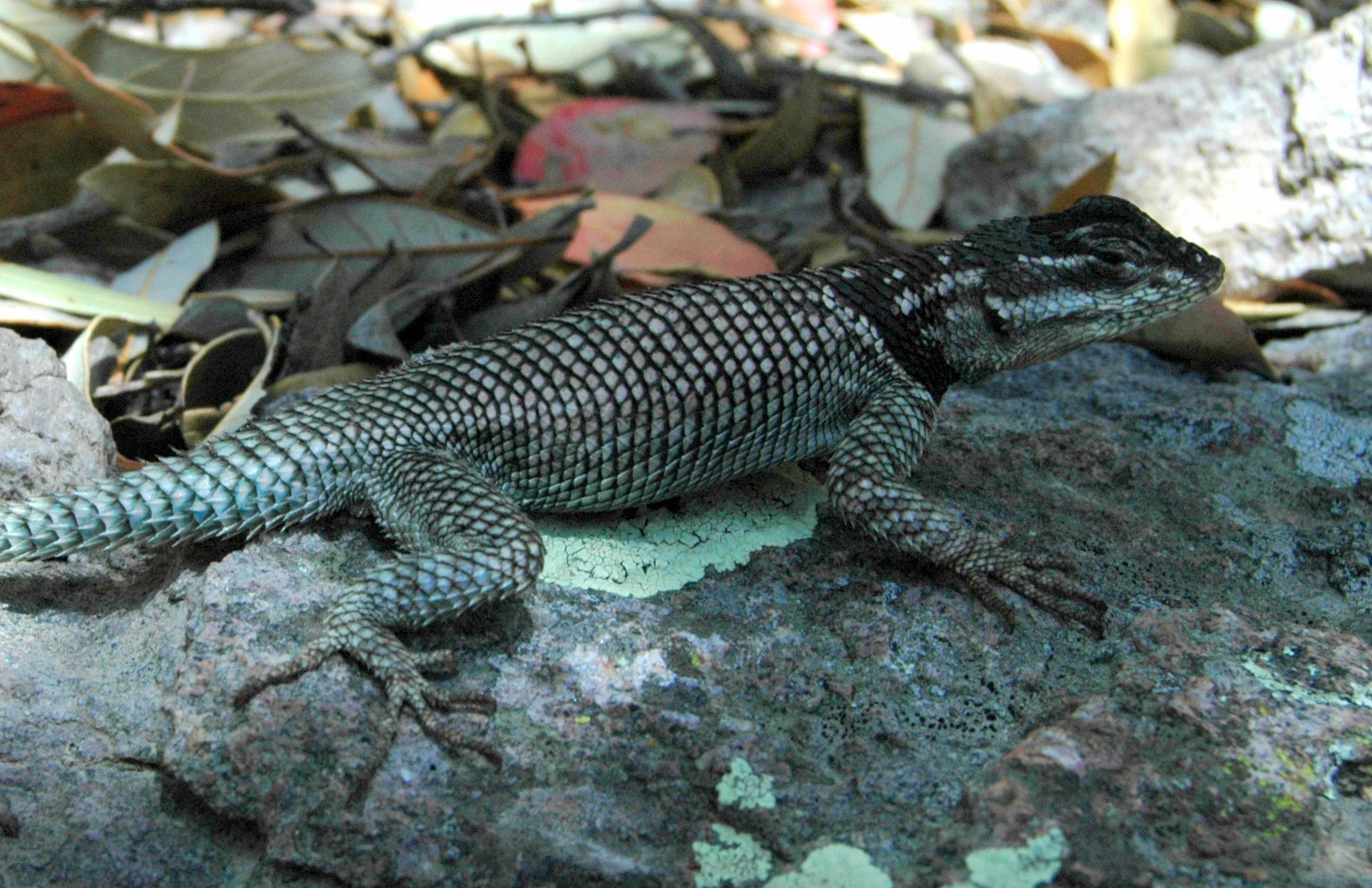
The spiny lizard, like other lizards, relies on sunshine and shade to regulate its body temperature. That makes the animals particularly vulnerable to climate change. (Photo by Michael Angilletta, Arizona State University, Michael Sears, Clemson University)
Lizards are expected to be hard-hit by climate change — and a new study suggests it might be even worse for some the creatures than scientists thought.
Lizards and other reptiles are sensitive to global warming because they regulate their body temperature using the environment — basking in the sun, cooling off in the shade. It’s been predicted that about 20 percent of lizard species will go extinct by the year 2080.
That prediction was based on certain assumptions about how easy it is for lizards to find shade, says Michael Sears, a biologist at Clemson University who was the study’s lead author.
“The thing that those models assumed is that the lizard can find a piece of shade anywhere in the environment instantly if it needed it,” says Sears. In reality, of course, it takes lizards energy and time to find shade, which means those past predictions of extinction risk could be too low.
He and his colleagues recently did a study using computer modeling and real-world experiments to see how the kind of shade available affects a lizard’s ability to keep its body temperature in the optimal range.
The team surgically implanted tiny temperature sensors into dozens of spiny lizards, and then did experiments in special enclosures constructed in the New Mexico desert.
“We use these pieces of shade cloth to cool down temperatures in spots to see how the animals react to it,” Sears says.
What they found is that the lizards did much better when they had access to lots of small patches of shade, compared to just a few big patches, according to a report of their work in the Proceedings of the National Academy of Sciences.
“It’s sort of like, if you were out jogging, and there was only one tree and it was a long way to the next one, and it was a hot day — that’s a bad environment,” says Sears. “But if there were a bunch of trees along the way providing little bits of shade, you’d feel a lot better.”
That means predicting the future for lizards as the climate changes will be more complicated than people thought, as each population may be significantly affected by its local distribution of shade-providing plants and rocky outcrops.
In general, lizards that live in already-warm places probably will suffer from increased temperatures, while lizards that live in cool places might actually benefit to some extent, says Sears.
“Everything in between, all bets are kind of off now,” he says, “because what our study suggests is that how bushes are placed in an environment might really impact the lizards just as much as the temperature itself.”
Copyright 2016 NPR. To see more, visit http://www.npr.org/.
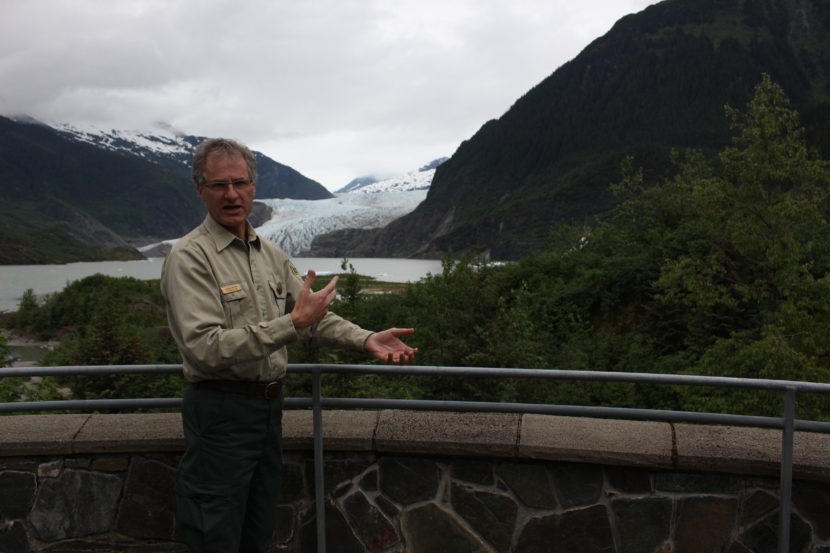
John Neary, the director of the Mendenhall Glacier Visitor Center, in front of the actual glacier. (Photo by Elizabeth Jenkins/KTOO)
The magazine Marie Claire sent a team of journalists and fashionistas to the Mendenhall Glacier in the summer. The story that appeared in its September issue is called On Thin Ice: Can the Fashion Industry Help Save the Planet? But as first reported in the Juneau Empire, the magazine got a couple of key things wrong.
“It felt like I was in Frozen, that’s the only way I can describe it!” said Nina Garcia in a video on Marie Claire’s website. She was describing what it’s like to enter the ice caves at the Mendenhall glacier.
Garcia is the creative director of the magazine. You’ve probably spotted it when you wait in line at the supermarket. This month’s cover featured Sarah Jessica Parker.
And inside, there was an article about the effects of climate change on glacier ice and how the fashion industry can help by reducing wasteful packaging. But some of the photos’ captions are pretty off. Or, as Nina Garcia would say as a judge on Project Runway:
“I think you made a real big effort. However …”
However, one of the pictures looked like it’d been put through an Instagram filter. It was supposed to depict the Mendenhall glacier in 1970.
“And we know, that at that time, nugget falls was falling — well, in the 70s — it was falling onto the glacier,” said John Neary, the director at the Mendenhall Glacier Visitor Center.
He thinks the photo was actually taken some time in the 1990s.
Then there was another photograph in the magazine spread — captioned “The Mendenhall Glacier today.”
“The other photo was more strange. It was — from what I can tell — a picture from the top of Thunder Mountain looking at that Thunder Mountain Basin with the airport behind it and then North Douglas,” he said.
You can see a rolling mountain with grass and only a little bit of snow. No glacier anywhere in sight.
When the article came out, Neary says he was in Denali National Park on vacation and initially he was disappointed. But he recognizes everyone makes mistakes.
“And I don’t fault them for it because it’s a long ways away from where they are,” Neary said. “And they did a really good job of fact checking. I got follows ups about this fact and that fact but they just missed this one.”
No doubt, the Mendenhall Glacier is shrinking. In the past 30 years, Neary’s noticed extreme change. And scientists say the glacier won’t be visible from the visitor center by the end of this century.
Neary says even though Marie Claire got the photos very wrong, he found the overall message of the story interesting.
“It’s from a different take than I would write an article on but at the same time people are coming from really different places than I am, too,” Neary said. “And if they’re coming from the New York fashion scene, then maybe that article really appeals to their sensibilities.”
As the Marie Claire article concluded, you shouldn’t have to choose between fashion and the glacier
Coastal erosion reveals the extent of ice-rich permafrost underlying the active layer in the Teshekpuk Lake special area of Alaska’s National Petroleum Reserve. (Photo: Brandt Meixell/USGS)
Russian officials say warming permafrost could be linked to a deadly anthrax outbreak in Siberia this month.
Permafrost can be found almost everywhere in Alaska — from the Arctic coast to Anchorage.
But at least one expert isn’t alarmed about the potential for thawing ground to bring old diseases back to life.
After a Siberian heat wave, anthrax hit the Yamal Peninsula in early August.
The bacterial disease has claimed the life of a child and thousands of reindeer.
Permafrost expert Vladimir Romanovsky of the University of Alaska Fairbanks said melting permafrost and erosion may have worked together to spread anthrax into the water supply.
“Thawing of permafrost can release microorganisms first into the active layer, then into water and air,” Romanovsky said. “They were sequestered there for many, many years — tens of years, even thousands and tens of thousands of years.”
Scientists have talked about the possibility of epidemics caused by thawing permafrost, but until now, it’s only been a theory, Romanovsky said.
If the Siberian anthrax outbreak is traced back to spores in the permafrost, then it would be a troubling development.
“This release of these dangerous microorganisms could actually be spread very easily from the north, because we have lots of birds who are migrating all kind of places in the world,” he said. “So this problem could be not just local problem. It could be global problem.”
More research is needed to tie this anthrax outbreak to warming permafrost, Romanovsky said.
Infectious disease specialist Dr. David Morens, with the National Institutes of Health, isn’t worried about anthrax — or any other disease — surfacing from the ground.
Anthrax is hardy and virtually everywhere, he said.
“Anthrax is sitting in the grass in farms in Texas,” Morens said. “It’s in Asia. It’s in Africa. It’s everywhere. And so the fact that some might be in the permafrost doesn’t really add to whatever the risk is.”
Although anthrax is widespread, the chance of getting sick from it is really small.
The likelihood of contracting anthrax from spores exhumed from the permafrost, is even tinier.
Morens has studied the 1918 Spanish influenza pandemic that decimated rural villages in Alaska. Brevig Mission was hit especially hard.
Spanish flu killed 90 percent of the village over the course of six days.
The remains of victims were buried together.
Researchers have used samples from that mass grave to reconstruct the genetic code of the virus.
But Alaskans shouldn’t be afraid of getting sick as the ground in Brevig Mission thaws, Morens said. Unlike anthrax, Spanish flu is very fragile.
“What came out of the so-called permafrost was just broken pieces of RNA,” Morens said. “Nucleic acid. There was nothing infectious. A ton of it swallowed would have been harmless.”
Freezing and thawing breaks up viruses like Spanish flu, killing them.
“So if we are talking about viruses and deadly things, I would say whatever might be there in the permafrost is not going to be contagious,” he said.
Morens doesn’t fear viruses or bacteria emerging from their cryogenic slumber, but he is concerned about the threat of new diseases.
“All these emerging viruses that are coming on — Zika, chikungunya, severe acute respiratory syndrome (SARS), and all that,” Morens said. “It’s not that they’re being created. It’s not that they’re being dug up from the permafrost. They’re already there. And we human beings do things that invite them to come in, infect us, and cause epidemics.”
Officials in Russia are trying to stop the anthrax outbreak from spreading further. They are incinerating all infected reindeer carcasses and have banned hunting in the region.
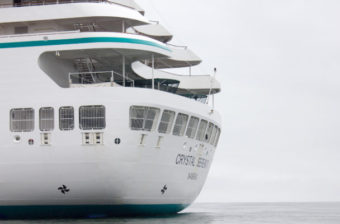
The luxury cruise liner Crystal Serenity arrived off the coast of Nome on Sunday. (Photo by Lauren Frost/KNOM)
The Crystal Serenity cruise ship is making a 32-day voyage from Anchorage to New York City.
The ship is the largest vessel ever to travel the Northwest Passage with about 1,000 passengers aboard.
Meanwhile, the potential environmental impact of a journey of that scope has some worried.
Austin Ahmasuk, a marine advocate at the Kawerak regional non-profit corporation, is nervous about what happens when a floating city moves through a delicate region like the Arctic.
Ahmasuk refers to the Crystal Serenity as “a floating city.”
It certainly contains enough people, and produces enough waste.
“We have some very deep-felt and heartfelt concerns about what is happening in the Arctic,” he said.
Alaska Native communities rely on fish and marine mammals for subsistence.
Ahmasuk worries that cruise ships could damage the ecosystem and threaten that subsistence lifestyle.
What’s more, he does not think the cruise industry is listening.
“Honestly, I don’t know that our concerns are being fully heard,” he said. “I honestly cannot say that with a straight face.”
He’s not alone in his misgivings.
Marcie Keever, who directs the oceans and vessels program at an environmental group called Friends of the Earth, also is worried.
“When a ship like Crystal is going, because of its size, because of the length of time, there’s lots of reasons why a ship like that is a big concern,” Keever said.
In June, Friends of the Earth released their latest cruise ship report card, which grades cruise lines on their commitment to protecting the environment.
What grades did Crystal Cruises get?
Sewage treatment: F. Air pollution reduction: F. Transparency: F. It ranked 17 th out of 17 cruise lines.
Crystal Cruises has spoken out against the report card, and so has the Cruise Lines International Association.
Alaska branch president John Binkley said that people should look to the Coast Guard to regulate the industry, not to environmental groups.
“And similar to our political parties today, I believe that the Friends of the Earth are trying to divide people, really, with radical and unfounded claims,” Binkley said.
While the Crystal Serenity does not meet the standards set by Friends of the Earth, it does comply with all federal regulations.
The ship also has pledged to use cleaner fuel while it’s in Alaskan waters.
Even Keever admits that the Crystal Serenity is not at the heart of the problem.
“Our concern is not necessarily just the Serenity,” she said. “It’s the number and size of cruise ships and other ocean-going vessels that are going up over the top of the world.”
If the Crystal Serenity successfully completes its voyage, then other large ships likely will follow.
The Serenity already plans to return in 2017.
Keever points out that if those ships contribute to climate change in the Arctic, then they are making their own passage just a little bit easier — melted ice means a smoother trip.
“The only reason that this cruise is even possible is due, in small part, to the cruise industry,” Keever said.
The Crystal Serenity is expected to arrive Sunday in Pond Inlet.
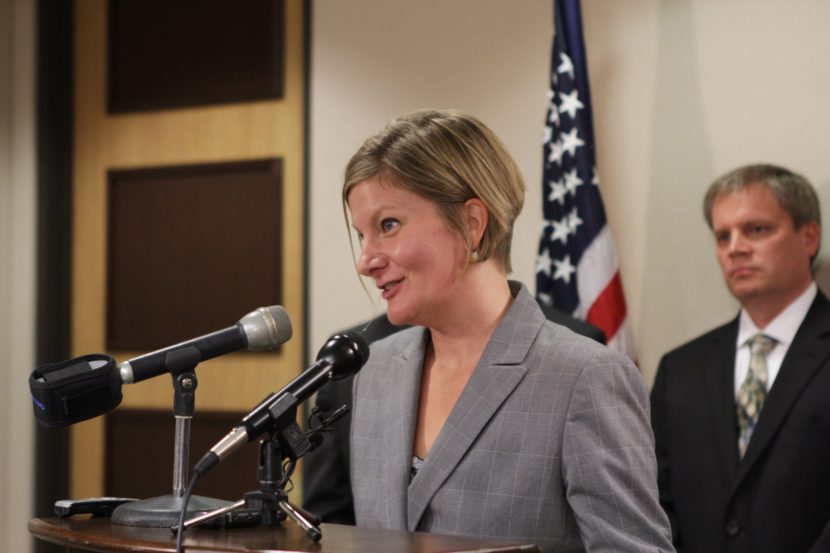
Jahna Lindemuth, Alaska’s new attorney general, has waded into a fight over ExxonMobil and how the company fights subpoenas for information about what the company knew about climate change. (Photo by Graelyn Brashear/Alaska Public Media)
ExxonMobil has been the target of a growing number of state attorneys general investigating whether the company lied about its climate change research since last November.
Alaska’s new Attorney General Jahna Lindemuth has jumped into that fight. Some lawmakers say it’s a flip-flop from the state’s original decision not to investigate the company.
Some also say the state shouldn’t waste money getting tangled up in a lawsuit.
While Alaska’s attorney general isn’t yet willing to weigh in on whether ExxonMobil lied about its climate change research, she is ready to battle the company in regards to its tactics in fighting the investigation.
Some states have subpoenaed financial and research records from the company. Exxon has fought back in court by suing to block those subpoenas.
Former Attorney General Craig Richards signed a memo in June cautioning attorneys general nationwide against aligning themselves with environmentalists and investigating the company.
Lindemuth, who took the top lawyer’s job earlier this month, signed onto a amici curiae, or friend of the court, brief arguing against Exxon’s move to blockone such investigation.
Exxon is asking a federal court in Texas to block a Massachusetts state subpoena and Lindemuth said this is an issue of federal overreach.
“The issue in that case is whether a large corporation — and it could be Exxon, it could be any large corporation — can go to a jurisdiction outside of the state where those investigations are happening and try to quash the investigation from a federal court in a different state,” she said.
States should have the right to protect consumers and investigate fraud cases in state courts rather than battling them out in federal courts, Lindemuth said.
Two House Republicans are criticizing her for what they say is a reversal of course for the state: House Speaker Mike Chenault and Judiciary Committee Chair Gabrielle LeDoux say the state shouldn’t have a role in the lawsuit.
LeDoux, a former attorney, said she has not read the brief Lindemuth’s signed, but she doesn’t think the state should get involved.
“I just don’t think that in our time of limited resources that we should be spending money going to war with our major industry,” LeDoux said.
The attorney general’s office said just because Lindemuth signed the brief, doesn’t mean state will be compelled to appear in court as the lawsuit plays out in other states.
No one from Exxon returned a phone call seeking comment.
Close
Update notification options
Subscribe to notifications
Subscribe
Get notifications about news related to the topics you care about. You can unsubscribe anytime.

9(MDEwMjQ0ODM1MDEzNDk4MTEzNjU3NTRhYg004))
9(MDEwMjQ0ODM1MDEzNDk4MTEzNjU3NTRhYg004))