Oceans

Charting new courses: student mariners prepare to navigate a warmer Arctic

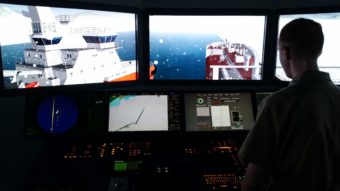
Glenn Burleigh practices piloting a tanker with a damaged rudder. (Photo by Zoë Sobel/KUCB)

In a windowless room at Maine Maritime Academy, Glenn Burleigh is standing calmly at the controls of a massive tanker. He is stuck, encased in a sea of ice, waiting for an icebreaker to break him free.

When help arrives, the rescue doesn’t go as planned.

“I think this is one of the situations where things do go wrong,” Burleigh said. “I seem to have lost my rudder.”

Burleigh is one of nearly 1,000 students studying at Maine Maritime Academy. He hopes to one day captain a ship. Today is a preview of what that job might look like in the Arctic Ocean.

The software is so detailed; you can hear the birds circling overhead. Just like a real ship. But without the danger.

“I mean you can ask the people who ran the Titanic what the risks are associated with ice transit and you would have a pretty good understanding what that’s all about,” said Capt. Ralph Pundt.

He designed this polar navigation course with help from a Department of Homeland Security grant.  The $450,000 grant was awarded to Maine Maritime Academy and the University of Alaska Anchorage’s Arctic Domain Awareness Center.

Before teaching, Pundt served as a merchant marine captain and spent time working at both poles. His time sailing taught him how much he didn’t know. That lack of knowledge was dangerous.

He says practicing in the simulator is a chance for real world experience, kind of.

“There’s nothing like the real thing,” Pundt said. “It’s as close as you can get without being in the real thing. The nice thing is that stop gap between basic book learning and having the responsibility of a multi-billion-dollar vessel. If they make mistakes, let them make the mistakes here.”

This class isn’t the only way to learn arctic navigation. Pundt’s working on a more advanced version and AVTEC, the technical college in Seward, has one, too. These classes will get mariners up to speed for the Polar Code, which goes into effect in January. That international code requires additional training for mariners to protect ships, passengers, and crews operating in the harsh Arctic and Antarctic environments.

Pundt says the Arctic Ocean today is a dramatically different place than when he was there 30 years ago.

“We could not go through most of the ice up there without an icebreaker escort at that time. I talk to my students who transit up there and I say, ‘how is the ice this year?’ They say to me, ‘what ice?’ It’s that open now.”

With less ice, Pundt says there’s a new set of risks. Mariners have to know what they’re up against.

The Northwest passage connects the Pacific and Atlantic Oceans. (NASA)
The Northwest passage connects the Pacific and Atlantic Oceans. (Image courtesy NASA)

That’s what’s great about practicing in the simulator. With the click of a mouse, almost any situation becomes reality.

“From here I can control weather,” Pundt said. “I can make things very nasty, very quickly here. How about some blowing snow? That’s Alaska weather right?”

That’s part of why Burleigh signed up for Pundt’s class. With Arctic ice decreasing, more ships will transit the Northwest Passage. That could mean a growing job market, which Burleigh has his eyes on.

“When that industry does open up more, I can walk in and say I’m already certified for this. You don’t have to send me back to school for it,” Burleigh said. “I’m ready to go right now. I’ve had experience doing simulations with ice and whatnot, so that puts me ahead of a normal third mate who hasn’t done anything with this.”

Right now, the market is small and it’s unclear what the future holds for icebreakers. This summer, the cruise ship Crystal Serenity made a historic transit of the Northwest Passage with a personal icebreaker escort.

Back on the bridge, success. Both ships have broken through the ice.

Burleigh completed the course earlier this year and is one step closer to a future as an Arctic mariner. But his teacher, Pundt, questions if those jobs should even exist.

“I’m not a fan of all this happening in the Arctic or in the Antarctic,” Pundt said. “I think it needs to remain pristine. If we do have to go up into the Arctic, we need to understand it and respect it for what it is.”

With the class, Pundt wants to cultivate a new crop of mariners trained to navigate polar waters with minimal impact, even if he’s hoping they don’t have to go there at all.

State commission approves Dillingham, Manokotak annexations with ammendments

Commissioners Darroll Hargraves, Lynn Chrystal, and Lavell Wilson were present for three days of public hearings in the Bristol Bay region. Pictured here in Dillingham Tuesday.
(Photo by the KDLG News Department)

In a rare move, the five members of Alaska’s Local Boundary Commission voted directly against staff recommendations and approved two competing annexation petitions. Both Dillingham and Manokotak cleared a big hurdle Thursday and were granted the LBC’s blessing to take large tracts of the Nushagak commercial fishing district within their city boundaries to collect a tax on the salmon harvest. Beaches along the eastern shore north and south of Clark’s Point were excluded.

Following three long days of public testimony, the LBC returned to Anchorage to make up their minds on the best way to divide the waters of the Nushagak Bay, if at all.

Though the commissioners had seemed open to arguments offered by the public and witnesses for the interested parties, it was never clear they would reject entirely a staff report that had recommended strongly against both annexation petitions.

The commissioners first took up the Manokotak petition, voting three-to-two to approve it as written. They then turned to Dillingham’s petition, voting unanimously to approve it with amendments. Though Dillingham had sought to annex all the waters of the Nushagak district, the boundaries were cut back to exclude the Igushik section and the eastern set net beaches from Nushagak Point through Ekuk Beach.

The amendments reflected the LBC’s attempt to please both petitioners and the leading opposition. Manokotak and Dillingham both sought to lay claim to the waters of the Igushik section, but the LBC ruled in Manokotak’s favor in order to keep the new tracts at the mouths of the Weary and Igushik Rivers “contiguous.” Opposition to any annexation of the Nushagak Bay was led by the Ekuk tribal council. This week Ekuk asked the LBC that if it approved the annexation, to at least exempt the beaches from Nushagak Point through Ekuk from the plan, which the LBC agreed to do.

Not all commissioners were pleased with the end result of Thursday’s votes.

“I think we made serious mistakes today,” Commissioner John Harrington of Ketchikan said at the end of the hearing. “First of all we dealt with a regional resource, in fact in my sense it’s a state resource, and we delegated it to several individual places, which I have some problems with. And ever since we did this initially I have come around to believe that this whole annexation of huge sections of water is best left to boroughs.”

The idea that the Dillingham Census Area should be, or could operate better, as a borough was argued at length this week. A task force under the Bristol Bay Native Association is studying the matter again presently, though all past studies have failed to show a workable feasibility or sufficient local interest. The city of Dillingham has argued that annexation and borough formation need not be mutually exclusive, an idea some on the LBC agreed with.

“Even though we allocated resources, or bodies of water that contain resources, those actions do not preclude the formation of a borough sometime in the probably distant future,” said Commissioner Robert Harcharek of Barrow.

Commissioner Darroll Hargraves from Wasilla had been the most vocal and inquisitive through the three days of public hearings. He said on numerous occasions that he would prefer to see the area form a borough to collect and share the tax on salmon, but voted to pass both petitions. He was not pleased about voting on the amended boundaries that exempted the eastern beaches without vetting the specific coordinates, which staff were directed to fill in later.

“We passed a motion here today that turns over without exact numbers and places and so forth, where those bounds are. It’s not clear to me that those bounds are going to come back to us the way we visualized it. We didn’t put the parameters into place, which is what we’re supposed to do,” Hargraves said.

Commissioner Darroll Hargraves seemed disappointed by the outcome of the LBC vote. Hargraves said he would prefer to see a borough formed, and did not like new boundary lines from exempted beaches left unclear.
(Photo by KDLG News)

Commissioner Lavell Wilson was supportive of the concepts behind the annexation requests, but voted against Manokotak’s due to the large territory contained in “tract B.” Otherwise, he said he disagreed with Hargraves and Harrington on a couple of points.

“One is that this is setting a precedent. I don’t see that at all,” Wilson said. “You look at other towns and cities that have annexed water for a fish tax, so I think that’s a moot argument. As far as the boundaries, looks like they’re pretty well described to me. That’s my opinion.”

The chairman, Lynn Chrystal of Wasilla, was generally supportive of both proposals, steering them through the lengthy checklists of criteria that at times other commissioners disagreed with. In his comments, Chrystal made clear he felt the proposals were in the best interests of the state, and would allow the cities to provide more services to their residents and the fishery.

Dillingham Mayor Alice Ruby offered a measured reaction Thursday, calling it a positive outcome after a lengthy process.

“I think the LBC did what they could to try and give both communities something for the future,” she said. “I think the fact that they approved our petition, even with amendments, demonstrated that they saw the merits of Dillingham’s need to grow and the fact that we’re providing services, and so on.”

Dillingham Mayor Alice Ruby, seated next to attorney Brooks Chandler, made the case to the LBC that the city provides services to the region and the Nushagak district fishery. The city asked again to annex the Nushagak waters to levy a tax on the fish harvest, which the LBC granted in part. (Photo by KDLG News)
Dillingham Mayor Alice Ruby, seated next to attorney Brooks Chandler, made the case to the LBC that the city provides services to the region and the Nushagak district fishery. The city asked again to annex the Nushagak waters to levy a tax on the fish harvest, which the LBC granted in part.
(Photo by KDLG News)

Based on recent averages, the city said its annexation plan would raise around $750,000 annually if the entire district was subject to the 2.5 percent raw fish tax. Back-of-the-envelope calculations led Dillingham officials to estimate the LBC’s amendments would result in upwards of $100,000 less revenue, maybe twice that.

Still unsettled are the boundary lines for the exceptions around Clarks Point, and how Dillingham and Manokotak will sort out where some drift net fish are caught when the entire district is open to fishing.

“We’ll have to work with Manokotak on how we’ll implement the tax with that boundary line running down the district. But, we’ve worked with Manokotak on other issues and we certainly will be able to do it in this case,” said Ruby. “I haven’t had as much time to think about that set net exclusion because that just came up during this LBC hearing, so I think it’s just all a matter of implementation, we’ll just have to figure out how it works.”

The commissioners have tasked staff with filling in the blanks on the new boundaries, including the carve out for all of the set net beaches around Clarks Point and Ekuk. A final written version will still need to be voted on again later this month before the petitions are submitted to the Legislature for review.

If the Legislature does not disapprove the petitions next session, each city could begin, or in Dillingham’s case resume, collecting raw fish tax by next season. They will also become two of the biggest little cities in the state of Alaska.

Snagging Savings: Energy audit designed to cut costs for fishermen

The seiner Infinite Grace pursing up during the third opening in the Sitka Sound sac roe herring fishery, on Wednesday, March 26, 2014 (Photo by Rachel Waldholz/KCAW)
The seiner Infinite Grace pursing up during the third opening in the Sitka Sound sac roe herring fishery, on Wednesday, March 26, 2014. (Photo by Rachel Waldholz/KCAW)

Commercial fishermen are largely at the whim of the seafood market. Prices can vary wildly, while operation costs stays the same — That is, until now. An energy audit aims to help Sitka’s fishermen increase their profit margins.

It’s a sunny morning in Sitka. Usually Steve Fish — yes, that is his real name — would be out on his boat the Kariel, trolling for salmon or longlining for black cod or halibut. But today, the 66-foot fishing vessel and its captain are parked in the harbor.

Fish has surrendered the Kariel to a swarm of engineers, who can’t help but ask about how his gear works. Fish explains.

“The fish hits the cruise fire and then the winch, as it’s hauling the gear, pulls the hook out of the fish’s mouth.”

They’re all aboard the Kariel to conduct an energy audit of the vessel. Fish, along with 17 other fishermen in Sitka, volunteered for the audit.

“It’s dollars and cents,” Fish says.

For Fish and most others in the industry, each year those dollars and cents are spent at the pump.

“We might use somewhere in the neighborhood of 10,000 gallons,” Fish says, which costs between $20,000 and $50,000, depending on the price of diesel.

One obvious way to cut costs is with a more efficient engine, but Mike Gaffney says there are other, less expensive avenues as well. He’s an engineer based in Norfolk, Virginia and usually works on larger ships like cruise liners and Coast Guard cutters.

“But this is my first episode with fishing vessels, so that’s why I keep asking how the operations work,” explains Gaffney.

Gaffney was brought up to help with the Fishing Vessel Energy Efficiency Project. That’s a joint effort by the Alaska Longline Fishermen’s Association and the Alaska Fisheries Development Foundation aimed at energy and cost savings.

But to do that, Gaffney says they need a baseline of data: How much, say, a vessel like the Karieluses without the upgrades.

Gaffney climbs down the narrow ladder into the Kariels engine room

“And of course there’s lots of room here to move around,” Gaffney jokes.

The space is tiny. Gaffney tucks himself up against the electric panel and runs wires between it and his power quality analyzer, or PQA, which resembles a clunky, oversized calculator.

“It is the Hioki 3197 model,” Gaffney explains of his PQA. “That one is sexy.”

Engineer Mike Gaffney uses a power quality analyzer to measure the energy use of the vessel’s lighting. (Emily Russell/KCAW).

He starts with the vessel’s lighting. It’s measuring amperage, voltage, and power factor, which together determine how much energy the lights actually use.

“So we’re going to measure what he’s currently drawing and see how long he actually keeps them on,” Gaffney says. “We’ll figure out what his annual cost is to operate these lights and see if it’s cost effective to switch to LEDs.”

Right now the vessel uses high pressure sodium lights, which Gaffney says have a long warm up period, so fishermen tend to just turn them on and leave them on.

Also every time you cycle them on and off, it shortens the life of the bulb,” Gaffney adds.

That’s not the case for LEDs. There’s no warm up time and it doesn’t hurt to turn them on and off. And they’re brighter.

“If you put an LED lighting in this engine room, it’ll brighten it way up,” Gaffney says.

For fishermen, though, that’s not always a good thing. Some complain about the light being too blue, too harsh on the eyes. Another problem unique to fishermen especially in Alaska: LEDs don’t heat up the way other bulbs do, which means more ice buildup on outside lighting.

It’s the data but also these insights that make the project unique.

Chandler Kemp is an engineer based in Sitka. “I don’t know of anybody who is doing this type of work on fishing boats,” Kemp says.

He’s compiling all of Gaffney’s data and writing up reports for the 18 vessels that volunteered for the audit. Kemp says the end goal is an online tool for fishermen.

“It would be an online interface that people can go on to easily access the information we have collected and enter in a little bit of information about their boats, say the fisheries they participate in, the length, the engine size,” Kemp explains.

The tool, which Kemp expects will be released in 2017, will then generate ways to make the vessel more energy efficient, and for fishermen, that means more profitable.

Princess Cruises hit with largest-ever criminal penalty for ‘deliberate pollution’

Princess Cruise Lines will pay a $40 million fine for “deliberate pollution of the seas and intentional acts to cover it up,” according to the Department of Justice, which calls it “the largest-ever criminal penalty involving deliberate vessel pollution.”

The California-based cruise operator also agreed to plead guilty to seven felony charges over illegal practices on five ships dating back, in at least one case, to 2005.

The Justice Department said in a statement that Princess illegally dumped contaminated waste and oil from its Caribbean Princess ship for eight years — a practice that was exposed by a whistleblowing engineer in 2013.

The engineer quit his job over the dumping when the ship docked in the U.K. and alerted British authorities, who notified the U.S. Coast Guard. He said other engineers were using a device called a “magic pipe” to bypass the ship’s water treatment system and unload oily waste into the ocean.

Then, other engineers attempted to hide the evidence of illegal dumping before British investigators could board the ship, according to the Justice Department. The statement read: “The chief engineer and senior first engineer ordered a cover-up, including removal of the magic pipe and directing subordinates to lie.” This continued during a subsequent investigation led by the U.S. Coast Guard.

The Justice Department said the deliberate pollution was likely an attempt to cut costs: “The chief engineer that ordered the dumping off the coast of England told subordinate engineers that it cost too much to properly offload the waste in ports and that the shore-side superintendent who he reported to would not want to pay the expense.”

In addition to the illegal waste dumping from the Caribbean Princess, the Department of Justice says it uncovered illegal practices on four other Princess ships:

  • “One practice was to open a salt water valve when bilge waste was being processed by the oily water separator and oil content monitor. The purpose was to prevent the oil content monitor from otherwise alarming and stopping the overboard discharge.”
  • “The second practice involved discharges of oily bilge water originating from the overflow of graywater tanks into the machinery space bilges. This waste was pumped back into the graywater system rather than being processed as oily bilge waste.”

Some discharges likely took place within U.S. waters, the Justice Department says.

“The pollution in this case was the result of more than just bad actors on one ship,” Assistant Attorney General John C. Cruden says. “It reflects very poorly on Princess’s culture and management.”

In a statement to NPR, Princess Cruises says it is “extremely disappointed about the inexcusable actions of our employees.” It says it launched an internal investigation in 2013. And “although we had policies and procedures in place, it became apparent they were not fully effective,” the statement reads. “We are very sorry that this happened and have taken additional steps to ensure we meet or exceed all environmental requirements.

Princess Cruises is a subsidiary of Miami-based Carnival Corp., and the plea agreement requires ships from eight of Carnival’s companies to submit to court-supervised monitoring of environmental compliance for the next five years.

Copyright 2016 NPR. To see more, visit http://www.npr.org/.

Workshop to discuss threats of ocean acidification on Alaska waters

The world’s oceans are becoming more acidic and, like climate change, it’s happening at a faster rate in the far north waters of Alaska.

A workshop to be held Wednesday in Anchorage aims to bring together scientists and stakeholders to better understand the threat ocean acidification poses to the state.

The workshop is being streamed in nine other communities around the state, including Sitka and Juneau.

Not only are the world’s oceans about 30 percent more acidic today than they were 300 years ago, the rate at which they’re acidifying is faster than at any other time on record.

Chris Whitehead is the environmental program manager for the Sitka Tribe of Alaska.

“So, more carbon in the air getting absorbed by seawater makes it more acidic,” Whitehead said of ocean acidification.

The tribe has been testing toxins in shellfish for years, but soon it will start testing the waters for levels of acidity.

Ocean acidification poses a particular threat to marine animals at the bottom of the food chain, according to Whitehead.

“Like if you’re a little tiny clam or a terapod, which are these little tiny plankton that form really delicate shells,” Whitehead said, “your shell can’t form.”

That’s because the more acidic ocean water is, the more corrosive it is.

That worries people like Hannah Heimbuch, who’s planning on attending the ocean acidification workshop.

“A lot of my questions are around the food web and predator-prey dynamics,” Heimbuch said.

Heimbuch lives in Homer, where she fishes commercially.

“There are so many unanswered questions about how (ocean acidification) will affect the ecology of the marine environment,” Heimbuch said. “As a salmon fisherman, I would like to know how it will affect what the fish I catch eat.”

Along with catching fish, Heimbuch also works for the Alaska Marine Conservation Council as a community fisheries organizer.

She’s been focused recently on ocean acidification, trying to inform people about the effects it may have on Alaska’s waters.

“And one of the ways that we have been doing that is by working with the Alaska Ocean Observing System, AOOS, on the Alaska Ocean Acidification Network,” Heimbuch said.

It’s that network that organized the workshop on the “State of the Science” of ocean acidification.

There will be remarks from researchers and policymakers, panel discussions with scientists from around the state, and presentations on lessons learned from the Pacific Northwest.

The workshop is free online, and will stream directly to some of the state’s major fishing communities like Unalaska, Kodiak and Sitka. Hannah Heimbuch said ocean acidification poses a direct threat to their local economies for those communities.

“I think that folks that are based in coastal Alaska understand that we need to take that long term view and really try to better understand these big-picture changes happening out in the ocean,” she said.

Because, Heimbuch said, at the current rate of ocean acidification, it won’t be long before those changes will be felt on shore.

In Sitka, a remote viewing of the workshop is being held at the Island Institute from 8 a.m. to 5 p.m. Wednesday.

You can find a link to stream the workshop online. The presentation is also being streamed in Cordova, Fairbanks, Homer, Seward, Kodiak, Nome and Unalaska.

Before contamination in Skagway harbor is cleaned up, some want another study

Skagway Ore Terminal/AIDEA photo
The Alaska Department of Environmental Conservation is taking a more proactive approach to motivate cleanup of the ore basin in Skagway. It brought together harbor owners and users to meet in-person and work toward a solution to long-standing lead contamination in the harbor. (Photo by AIDEA)

Skagway is getting closer to addressing long-standing lead contamination in the harbor.

The Alaska Department of Environmental Conservation is taking a more proactive approach to motivate cleanup of the ore basin.

The department brought together the complicated web of harbor owners and users to meet in-person and work toward a solution.

The most recent meeting happened the week of Thanksgiving.

Representatives from DEC, the Skagway Borough, White Pass and Yukon Route Railroad, and other stakeholders sat down together on Nov. 21 in Anchorage.

The meeting lasted about an hour and consisted mostly of a presentation from Golder Associates, an environmental engineering company.

“We reviewed 13 reports that covered a span of almost 30 years that were previously done for the ore basin,” said Golder hydrologist Tamra Reynolds.

Golder was hired by White Pass to analyze previous studies and make a recommendation on the best course of action.

“It’s been a highly studied site, but there hadn’t been a consolidation of all the work,” said White Pass executive Tyler Rose.

His company is involved because they lease the ore terminal land from the municipality, which owns it.

White Pass and the municipality are just two of several ore terminal stakeholders.

Others include the Alaska Industrial Development and Export Authority, Mineral Services Inc., and the Yukon’s Capstone Mining.

So, Golder reviewed the existing information.

“Their conclusion was that they needed to do more analysis,” said Steve Burnham Jr., a Skagway Borough Assembly member who attended the meeting.

Golder recommends more research before doing anything with the contamination. Reynolds said they want to do a risk assessment.

“In order to clean it up, you need to know where the areas of high risk are,” she said. “And then you can identify the best way to clean it up.”

Reynolds says there isn’t just one way to clean up a contaminated site.

“The way that’s been proposed to date is dredging,” Reynolds said. “Dredging is often worse for the ecosystem because you’re then suspending it into the water as you’re pulling it out. So what we want to make sure is we don’t cause more harm to the environment than potentially other solutions.”

The risk assessment would involve studying the mussels, crabs and fish in the area for toxicity.

“We want to take away those question marks,” Reynolds said. “We want to see if there are potential health affects, rather than just speculation about it.”

If the risk assessment finds there is only danger in certain “hot spots,” then remediation might be limited to those sections. Or, if it finds no risk, then there might not be any clean up needed.

But Burnham said the question of risk has already been answered.

“We have done enough testing on the waterfront and we’ve gotten the result showing us that there is a risk to leaving the contamination there,” Burnham said.

DEC site project manager Kara Kusche realized that some in Skagway want the cleanup to happen as soon as possible. The risk assessment plan is progress compared with the stalemate that’s lasted for much of the past year, she said.

“We are actually very happy,” Kusche said.

She said this is what DEC wanted when they gathered the various parties involved in the ore terminal in August. DEC directed them to come up with a solution. White Pass taking the initiative and paying for Golder to evaluate the current data and prepare for a risk assessment is a good step forward, Kusche said.

“We would be able to make some decisions about whether it’s best to leave contamination in place or treat or remove contamination,” Kusche said.

In the past, progress has stalled because there are different ideas about who is culpable for the clean-up. But DEC told the municipality, White Pass, and other groups that all of them are “potentially responsible parties.”

The next step is for Golder to draw up and present a work plan to DEC and the other parties in early 2017.

The company said it could complete its testing and finalize the data by the end of 2017.

That timeline doesn’t sound acceptable to everyone.

Burnham said if a risk assessment does happen, then it needs to be faster than that.

He doesn’t want to kick the can down the road another year.

Site notifications
Update notification options
Subscribe to notifications