Alaska Native Government & Policy

Tlingit and Haida holds its 86th Tribal Assembly

Tribal Assembly delegates at the 82nd Annual Tribal Assembly. (Photo courtesy of Central Council of Tlingit and Haida Indian Tribes of Alaska)

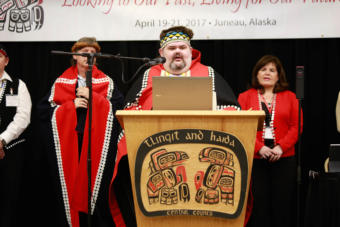
Tribal citizens and delegates gathered Friday for the Central Council of Tlingit and Haida Indian Tribes of Alaska’s annual Tribal Assembly.

It is the 86th year of the assembly. The time is used to update tribal delegates and citizens on the past year. It is also when the tribe adopts resolutions and holds elections for its delegates.

Right now, there are 119 delegates in the tribe’s assembly. They represent tribal citizens in 19 communities throughout Southeast Alaska, Anchorage, Seattle and San Francisco.

Chalyee Éesh Richard Peterson is Tlingit and Haida’s president. During his tribal address, he talked about the tribe’s advocacy efforts, tribal businesses, expanding the Tlingit and Haida campus and how the tribe has responded to the pandemic.

The tribe is retiring the term “service area” and is bringing back tribal liaisons to meet tribal citizens where they are, according to Peterson.

“We hope to work with the local tribe to establish and place them there so that not only can they help our citizens navigate our programs, but they can help them to navigate local programs,” he said.

A lot of people wanted to know more about the tribe’s broadband project. Its focus is to provide reliable Internet connections to help with education, health care and economic development.

Internet access was also a central issue in the U.S. Secretary of the Interior Deb Haaland’s keynote address.

She said Native communities were left behind long before the pandemic.

“The pandemic put a spotlight on the disparities that already existed, including a lack of basic resources like running water, adequate health care and functional broadband,” Haaland said.

The American Rescue Plan, the federal COVID-19 stimulus law passed in March this year, tries to make up for those disparities, according to Haaland. She said the law is the biggest investment in Native communities the U.S. has ever made.

Haaland also said the Biden administration wants to include Indigenous people in discussions on climate change and clean energy.

Haaland is the first Indigenous person to hold the U.S. Secretary of the Interior position. Delegates said it was momentous that she came to Tlingit and Haida’s tribal assembly and that no one of that position has come to their assembly before.

Yukon-Kuskokwim Delta tribes receive funding to address environmental threats linked to climate change

Nunapitchuk was one of nine YK Delta tribes that received funding from the BIA’s Tribal Climate Resilience Program. The community experienced its worst flooding in a decade, pictured here on May 8, 2020. (Photo courtesy of Jacob Tobeluk)

Nine Yukon-Kuskokwim Delta tribes got a boost in funding in September to respond to environmental threats like erosion, flooding and permafrost degradation. The money comes from the Bureau of Indian Affairs’ Tribal Climate Resilience Program. BIA announced awards of more than $1 million to YK Delta tribes.

The tribes that were awarded funding are Chefornak, Chevak, Eek, Kasigluk, Kongiganak, Kotlik, Kwigilingok, Napakiak, and Nunapitchuk. They each received between $110,000 and $150,000.

This is the second year that the federal program has focused on supporting Alaska Native communities that are facing existential environmental threats.

For most of them, the funding will pay for studies to assess these threats. These studies will look at how severe erosion or permafrost degradation could become over time. They will also predict how much community infrastructure could be impacted. Those communities can then take the results of those assessments to make a long-term plan. For example, tribes may use the results to decide whether to relocate, move back from an eroding coastline, or take other actions without moving their community.

For three villages, Napakiak, Nunapitchuk, and Chefornak, the funding will pay for an environmental threat coordinator. Each community has its own name for the position, but it’s a person who manages all the grants and projects related to environmental threats. More and more communities in the YK Delta are finding that such a position is necessary.

The BIA’s Tribal Climate Resilience Program is not funded by the infrastructure bill currently being considered by Congress. If passed, that bill would make another several hundred million dollars available to tribes facing environmental threats.

Judge deals blow to Eklutna’s bid for tribal gaming

Bingo cards
The state allows charitable gaming, including bingo. A tribe could make more money under Indian Gaming rules, because such operations usually aren’t subject to state taxes. (Photo by Alexandra Gutierrez/KUCB)

A federal judge in Washington, D.C. has decided against the Eklutna Tribe in its effort to build an Indian gaming parlor on land owned by tribal members.

U.S. District Court Judge Dabney Friedrich ruled Wednesday that the Interior department was justified in concluding the tribe does not have governmental authority over a particular land parcel near Eklutna village. If the eight acres in Chugiak are not legally considered “Indian land” Eklutna can’t use Indian gaming rules to build a gambling facility there.

Eklutna’s plan to lease the land alarmed opponents of Indian casinos in Alaska. The case was also closely watched by advocates who want Alaska tribes to have territorial jurisdiction like Lower 48 tribes have.

Alaska tribes have authority over their members, but where they might have jurisdiction over land is more complicated because, with the exception of Metlakatla in Southeast, Alaska has no Indian reservations.

Eklutna wanted a class I & II gaming facility, which would allow pull-tabs, lotto and bingo, as well as electronic bingo that looks a lot like slot machines.

The state of Alaska allows pull-tabs and bingo parlors that benefit nonprofits, including tribes. But if tribes can establish gambling parlors under Indian gaming rules, their revenues are potentially higher, because the state couldn’t impose taxes on those games.

Eklutna could appeal the court decision. Tribal President Aaron Leggett did not respond to an email Thursday. The Interior Department declined to comment.

Boatbuilder sentenced for defrauding 22 customers, including Village of Igiugig

Igiugig’s barge landing in March, 2019. (Izzy Ross/KDLG)

In 2015, the Village of Igiugig paid Michael Dismer to build a tugboat.

The village had received a federal economic development grant for the vessel, and hired Lakeland Marine Builders, the company owned by Dismer, to construct it. The Igiugig Tribal Council would go on to pay a total of $242,375 for the tugboat.

But Igiugig never received it.

According to a news release Friday from the Department of Justice, the village was one of 22 customers defrauded by Dismer between 2013 and 2018.

Last April, Dismer admitted to the fraud and pleaded guilty to tax evasion.

The Justice Department says that to avoid taxes, Dismer stopped operating under business names that owed taxes but continued to make money through newly created businesses. Since 1993, he operated at least eight different businesses that built a range of vessels.

In December 2015, the Village of Igiugig paid Dismer $96,0000. Dismer immediately used $70,000 of that money to purchase a construction facility in Stockton, Missouri. He then transferred the title of that property to another company, Cardgames on Motorcycles, Inc. The sole shareholder was a 21-year-old — an effort to keep the real estate beyond the reach of the IRS and other creditors.

In all, Dismer received more than $4 million from customers for the construction of vessels. But he never fully delivered on his promises, instead spending much of the money on personal expenses.

He claimed that construction was on schedule and provided misleading documentation, like photographs, to his customers to convince them to make their next payments.

Fourteen customers received vessels that the Justice Department called “incomplete, inoperable, or unseaworthy” after they paid Dismer more than $2.9 million. At least seven customers paid a total of more than $1.3 million but saw no vessels at all.

Dismer did not file business or personal income tax returns for 2009 through 2017. To evade paying taxes, he used 28 different bank accounts at six banks and transferred funds between those accounts. Between 1996 and 2007, he also collected payroll tax from his employees but withheld $430,000 of federal income and payroll taxes from the government.

A federal judge sentenced Dismer Friday to five years in federal prison without parole for failing to pay more than $768,000 in state and federal taxes, which he now has to repay.

The court also ordered him to pay $4.3 million in restitution to the fraud victims.

As part of his plea agreement, Dismer had to sell the property he bought with Igiugig’s money and liquidate all other assets.

New Seacoast Trust endowment will support Indigenous-led conservation and development projects

Sgwaayaans Young leans against a wasgo, or sea wolf pole, he carved in the community carving shed in Hydaburg. Photo courtesy Bethany Goodrich/Sustainable Southeast Partnership)

coalition of Southeast tribes and the region’s largest Native corporation announced on Thursday the creation of an endowment designed to support conservation and economic development. They’re calling it the Seacoast Trust.

Sealaska Corporation and The Nature Conservancy have set aside $10 and $7 million respectively in seed money to help support the fund that they say they’d like to eventually grow to $100 million.

Its work will be coordinated by Southeast Sustainable Partnership, a decade-old effort that runs projects in towns and villages across Southeast Alaska. That partnership will run the programs funded by the new trust.

Sealaska CEO Anthony Mallott told reporters that some projects are already running across Southeast. But the growth of the new fund could help them expand in new places and on a larger scale.

This just gives us the pathway to increase the number of projects and bring on more partners and more communities,” he said.

Southeast tribes including the Organized Village of Kasaan, Organized Village of Kake and Central Council of the Tlingit and Haida Indian Tribes of Alaska are helping lead the effort on the ground.

Our people watched the Tongass grow,” Tlingit & Haida President Richard Peterson said Thursday. “And this forest has taken care of us for generations. And who better than us to lead efforts to care for our forests and our resources.”

The Keex’Kwaan Community Forest Partnership (pictured) and the Hoonah Native Forest Partnership are collaborative land management programs that were catalyzed by the Sustainable Southeast Partnership and are helping to define what community land management can look like for Southeast Alaska. (Courtesy Bethany Goodrich/SSP)

Fran Ulmer, a former Alaska lieutenant governor and Juneau mayor who now works for The Nature Conservancy, says her conservation group is pleased to offer $7 million towards getting the Seacoast Trust off the ground.

It is an exciting opportunity to really make something happen that has durability and sustainability,” she said. “And that recognizes how important it is that collaborative land and resource management with Indigenous people leading the way is what really makes sense in Alaska and in many other places in the world.”

Financial oversight of the Seacoast Trust will be done by Spruceroot, a nonprofit originally founded by Sealaska that is now organizationally independent. The Juneau-based nonprofit offers seed money and expertise for new businesses.

Advocates say the legal system needs more Indigenous representation

Natasha Singh (seated, right) said Tanana Chiefs Conference supports an income tax. She spoke to the House Finance Committee, with her sister Grace Singh (left), May 2, 2017. (Photo by Andrew Kitchenman/KTOO and Alaska Public Media)
Natasha Singh (center) represents the Tanana Chiefs Conference. (Photo by Andrew Kitchenman/KTOO and Alaska Public Media)

According to incarceration data from the 2010 Census, Native American people accounted for more than one-third of adults incarcerated in Alaska. Legal experts say that unless the justice system includes more Indigenous people as lawyers and judges — inequities in incarceration will continue.

Natasha Singh, general counsel for the Tanana Chiefs Conference, says the justice system needs to see significant change. The conference is a Tribal consortium that includes 42 Interior Alaska Native villages.

“We represent a huge part of defendants, right, so then you’d want your lawyers, your public defenders, your prosecutors and your judges and the criminal sector to represent those people who are defendants,” she said.

In 2020, the Law School Admission Council reported that less than 0.3% of students admitted to U.S. colleges of law were Native American, and yet Native American people account for 1.6% of the total U.S. population.

According to the U.S. News & World Report, only 12% of the nation’s nearly 200 accredited law schools offer a certificate, program or legal clinic that specializes in Native American issues.

Alex Cleghorn is the legal and policy director at the Alaska Native Justice Center. He agrees on the importance of diversity, and showing youth that law is a career they can — and should pursue.

“I don’t think that we have been as deliberate throughout the state in talking about justice and talking about public safety and talking about having the same coordinated Native statewide response to those issues,” he said.

When he was in school, Cleghorn said a law career didn’t seem feasible.

“Perhaps disproportionately, Native people experience a lot of interaction with laws and policies that may not be reflective of our values or may not be responsive to our needs,” he said. “So having Indigenous people trained in the law I think can help navigate those sometimes complicated systems.”

Tanana Chiefs general counsel Singh also says that it’s crucial to educate children about their Indigenous heritage, as well as other children state-wide about Indigenous people. She says that educating the current lawyers and judges on Tribal laws could be a massive step toward a more balanced justice system.

“It would probably be restorative and healing because our people who are committing crimes are not actually bad people,” she said. “What’s happening is they’re suffering from historical trauma, they are substance abusers and they are not given the tools to get out of the cycle.”

Cleghorn says encouraging youth and law students to broaden their understanding of justice is an important step toward a better Alaska.

“To be having those statewide conversations about public safety and justice and what an Indigenous or Native or Tribal response to that looks like, and talking about how to engage our young people and seeing themselves as part of the solution,” he said.

The Alaska Bar Association plans to launch a diversity initiative committee within the next year or so. The goal of the committee is to identify systemic issues that impact lawyers of color; issues with attracting lawyers of color to the bar association; and to better support diverse members of the bar association.

Ben Hofmeister is the president of the Board of Governors for the Alaska Bar, and has been a board member since 2018.

He says Alaska is far behind — compared with some states that already have a diversity committee.

“I think we need leadership from diverse numbers so that we can get a diversity of opinions that are going to help us fix our state in the long run,” he said.

The diversity initiative was proposed in January 2021, and passed this May. Now, the Alaska Bar will work on putting the committee together.

For young people, the Alaska Native Justice Center holds a two-day event called Color of Justice, which highlights different career paths in the justice field for students. The location of the program rotates each year between Southcentral Alaska and Sitka. The next program is scheduled for 2022 in Southcentral Alaska.

Site notifications
Update notification options
Subscribe to notifications