Alaska Native Government & Policy

Pandemic slows relocation of rapidly eroding village

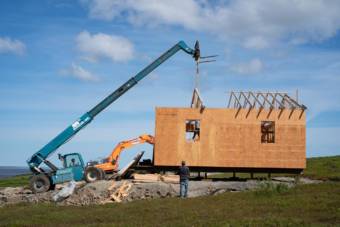
Many of the men and women working construction in Mertarvik this summer are from Newtok or nearby villages. Keeping the crew local is one way the Newtok Village Council is saving money on home construction. A roof truss is placed on a home in Mertarvik on July 14, 2020. (Katie Basile/KYUK)

With Newtok continuing to erode at alarming rates, the urgency to move grows by the day. But construction in Mertarvik, the new village that will replace the eroding one, has been slow the past two summers. COVID-19 is a big reason why.

Nine homes in Mertarvik remain unfinished and unoccupied since they were started last summer. Nobody has moved from Newtok to Mertarvik since 2019, when about a third of the community’s approximately 350 residents migrated over.

Newtok Acting Tribal Administrator Phillip Carl explained that part of the reason for last year’s slow progress was the pandemic.

“We couldn’t get any cabinets because of this COVID thing,” Carl said.

Many manufacturers for cabinets, stoves, and other household items had either shut down or drastically cut production due to the pandemic. Patrick LeMay, who is leading the building effort in Mertarvik, said that those material shortages have continued into this year.

“We got 48 lights that are trapped somewhere in Tennessee floods, to finish the lighting. There’s a shortage of fire extinguishers in the nation,” LeMay said. “The supply chain has been a disaster.”

But the materials shortage is just one way that COVID-19 has slowed construction in Mertarvik. LeMay said that the other reason is the virus itself.

“Three of my guys went home for the weekend, and they all got together on a Friday night just to relax. And they all called me on Monday and said ‘we all have COVID,’” LeMay said.

Many of the workers building homes in Mertarvik are Newtok residents. LeMay said that three local workers from Newtok were infected with the virus in August. Then, nearly all the remaining laborers chose to stop working due to concern over a COVID-19 outbreak in the community.

“They were just seeing so much COVID going around they all just decided to go home, stop work until they can get tested,” LeMay said.

The outbreak was the biggest Newtok had experienced since the pandemic began. Thirty-two Newtok residents tested positive for COVID-19 in August; Newtok had only seen a few cases before that. The community’s vaccination rates are lower than the regional average. About 42% of Newtok’s entire population is vaccinated, compared to about 50% for the entire Y-K Delta.

Carl, the acting tribal administrator, said that he doesn’t know why people in Newtok aren’t getting vaccinated. He said that he encourages people on VHF to get the shot, but he himself hasn’t received one.

“Cause I might get sick or something,” Carl said.

Side effects from the COVID-19 vaccine can include tiredness, headache, chills, and fever. However, the Centers for Disease Control and Prevention says that these should go away within a few days and that serious side effects are extremely unlikely. People are more likely to get seriously sick if they’re unvaccinated and exposed to COVID-19. A recent CDC study showed that unvaccinated people are over 29 times more likely to be hospitalized with COVID-19 than vaccinated people.

The decline in construction in Mertarvik since 2019 isn’t just because of COVID-19, though. The project’s funding has also declined. In 2019, Newtok was flush with cash, infused by $15 million in federal funding. And while Newtok has continued to receive smaller grants since then, large grants of more than $1 million are rare. The entire cost of relocation has been estimated at over $100 million.

While construction of the new village has slowed, the need to move there hasn’t. Carl said that Newtok lost over 100 feet of its coast since April.

“When spring came, we started eroding after it warmed up,” Carl said. “After the storm, we lost more.”

Carl said that the community demolished several teacher housing units that were near the water’s edge. On the other side of the river in Mertarvik, the community is finishing up a new duplex for teachers. It’s also finishing the nine homes that were started last year, and AVCP Regional Housing Authority is adding two more.

While not as fast as it would like, Newtok is making progress towards a new future in its new home.

Land acknowledgment coming to Juneau School Board meetings soon

Students head upstairs during a break between classes at Thunder Mountain High School on Monday, August 16, 2021, in Juneau, Alaska. The school district reported about 300 more students on the first day of classes this year than it had last year. (Photo by Rashah McChesney/KTOO)

Juneau Board of Education meetings could begin like this, soon:

“The Juneau School District is on Lingít land and the Board of Education honors the people of this land. For more than 10,000 years, Alaska Native people have been and continue to be integral to the well-being of our community. We are grateful to have been welcomed to this place, to be a part of this community supporting the education of all children, including future elders. We honor the culture, traditions, language and resilience of the Tlingit people. Gunalchéesh!”

Board member Paul Kelly recited the language during a Policy Committee meeting on Wednesday. The committee recommends that the Lingít land acknowledgment be read at the beginning of full board meetings. The full school board is slated to adopt the language at its Sept. 14 meeting.

The board began working on a land acknowledgment back in January.

The acknowledgment doesn’t mention specific clans. Committee members said they wanted to err toward inclusivity, and avoid a misstep the Juneau Assembly made with its initial land acknowledgment language.

There’s been a trend locally and statewide of institutionalizing indigenous land acknowledgments at events and civic meetings.

Alaska Federation of Natives postpones convention until December, citing COVID-19 spread

Alaska Federation of Natives President Julie Kitka on Aug. 26, 2020. Kitka said in a statement Tuesday, “the high-risk factors of holding a 5,000-person indoor meeting, with delegates coming in from across Alaska, make an in-person October gathering out of the question.” (Jeff Chen/Alaska Public Media)

The Alaska Federation of Natives, the state’s largest organization of Alaska Native people, has postponed their annual convention to December, citing concerns over the high rates of COVID-19 cases and hospitalizations.

The three-day event had been scheduled for Oct. 21-23 in Anchorage. However, AFN President Julie Kitka said in a statement Tuesday, “the high-risk factors of holding a 5,000-person indoor meeting, with delegates coming in from across Alaska, make an in-person October gathering out of the question.”

Cases of COVID-19 have risen steadily over the past month in Anchorage, with the convention’s host city reporting its highest number of hospitalizations from the virus since December.

The pandemic already pushed the annual Elder’s and Youth Conference to be held virtually this year. That conference is an Alaska Native gathering that typically occurs the same week as AFN.

AFN officials continue to opt for an in-person convention with a virtual option.

They say the exact dates, times and agenda for the AFN convention will be announced in the coming weeks. After reviewing data and guidance from federal, state and tribal health leaders, the AFN board will also make a final decision in October on whether the convention will be in-person or not.

The theme of this year’s convention is “ANCSA at 50: Empowering Our Future”, commemorating the Alaska Native Claims Settlement Act, a landmark land claims law that established the 12 regional Alaska Native Corporations and more than 200 village corporations. AFN co-chair Joe Nelson said in a statement that postponing the convention will allow the attendees to properly celebrate ANCSA, but “it all hinges on everyone’s willingness to get vaccinated.”

AFN represents members from 11 of the 12 regional Native corporations and more than 191 federally recognized tribes.

Up to $3,600 available to Tlingit and Haida members, Goldbelt shareholders

Nathan Johnson
Nathan Johnson poses for a portrait at the Glory Hall in Juneau on Aug. 20, 2021. Johnson is from Angoon but says he moved to Juneau during the pandemic in 2020 to find better work opportunities. (Photo by Jeremy Hsieh/KTOO)

Two more pandemic relief programs opened this week that thousands of Tlingit and Haida tribal members and Goldbelt shareholders are eligible for. People who fall into both categories can get up to $3,600 in one-time payments.

Nathan Johnson recently applied for a $1,000 grant available to enrolled members of the Central Council of Tlingit and Haida Indian Tribes of Alaska. Johnson is from Angoon, where he used to work seasonal jobs. The pandemic shut down most travel and made life a lot tougher there.

“Our store was running low on food,” Johnson said. “And that’s the main reason why I moved to Juneau, so I can try to work more.”

Grandparents are looking after his three young children in Angoon. He wants to bring them over and be a father to them. About three months ago, he started working at a pizza restaurant and is saving up for an apartment his family can live in.

“An extra $1,000 means, at least, a couple weeks to at least a month closer to my kids,” he said. “It means that I get to be fed well, I could have more energy for my job. I could prep for the winter. I could pay off my phone. It’s a big help.”

He said getting his application in was like “a big mountain off his shoulders.”

Tlingit and Haida’s program is funded by the American Rescue Plan Act, which federal lawmakers passed in March.

Another relief program opened recently that’s available to shareholders in Goldbelt Inc., the urban Alaska Native corporation for the Juneau area. Each shareholder can get up to $2,600. To be eligible, shareholders must be U.S. citizens and be able to show how the COVID-19 pandemic impacted them financially.

Goldbelt has more than $11 million available for this program. That’s more than enough to make the maximum payment to every single one of the corporation’s nearly 4,000 shareholders.

“If you don’t file an application, it’s not going to help somebody else,” said Goldbelt CEO McHugh Pierre. “We have enough money for everybody to get the full amount if they can demonstrate the need. So I want everyone to apply, justify your amount, and we will reimburse you for those costs up to $2,600.”

The application period closes at the end of September. Pierre said the leftover money will go to another relief program to be determined in October. It must be spent by the end of the calendar year.

As of Thursday afternoon, Pierre said Goldbelt had gotten more than 1,400 applications, and certified about 800. Payments will start going out next week.

Pierre said Goldbelt’s leadership made plans for the program early on in the pandemic last year but shelved them after court cases came up affecting the funding. The money comes from last year’s federal CARES Act.

“I mean, they should’ve had it last year and they didn’t,” Pierre said. “They weren’t allowed to have it, you know, due to the legal complications. But now that those are resolved, we want to get it into our shareholders’ hands and help them out in this difficult time.”

The CARES Act quickly sent relief money out to individuals, businesses, nonprofits, as well as state, local and tribal governments. But not to Alaska Native corporations because several Lower 48 tribes challenged the corporations’ eligibility for these funds.

The U.S. Supreme Court decided in June that Alaska Native corporations are eligible for a share of the $8 billion in CARES Act money set aside for tribes. Alaska Native corporations are specifically mentioned in the eligibility definition that the CARES Act uses.

While the lawsuits pit Alaska Native corporations against tribes in the Lower 48, Pierre said Goldbelt has a strong relationship with Tlingit and Haida. Pierre said everyone in the community benefits from that.

When Yukon River chum stocks collapsed, donated fish came in from Bristol Bay

Daren Jennings loads up his skiff to deliver Bristol Bay salmon to Lower Yukon River communities. (Olivia Ebertz/KYUK)

For eight years, Tanya Ives has been traveling up from Washington each summer to work at the Yukon River’s only fish processing plant: Kwik’Pak Fisheries. The plant sits outside of Emmonak, at the river’s mouth. Normally at this time of year, Ives would be packing up chum salmon harvested by commercial fishermen along the Yukon River to sell around the world. But this summer, she’s doing the opposite.

Ives is packing up salmon, caught hundreds of miles away, to send to Yukon River villages. She wears a red sweatshirt and gloves to keep warm while working with the frozen fish.

The Yukon River has seen its worst summer chum salmon run on record, and its third-worst chinook run. The commercial fishery is closed, and Kwik’Pak can’t sell salmon. Subsistence fishing for chum and chinook is also closed, and many people along the river have not had a taste of the fish this season.

Normally at this time of year, Ives would be packing up chum salmon to sell around the world. (Olivia Ebertz/KYUK)

Meanwhile, on the southern end of the peninsula, Bristol Bay has been enjoying its best salmon run on record. To share the bounty, processors there donated 22,000 pounds of chinook and chum salmon to Yukon River villages. The Bristol Bay processors sent some of that salmon to Kwik’Pak to distribute to lower river communities.

Inside the Kwik’Pak plant, workers divide about 12,000 pounds of salmon into boxes. Ives gives instructions for how to label them.

“You’re going to write the number of fish and the pounds on this label, and then you’re going to put this donation label on the right top corner,” Ives says.

The fish are whole and frozen, so villagers can use them how they wish. Kwik’Pak is splitting the fish between 10 Lower Yukon River villages: Emmonak, Alakanuk, Nunam Iqua, Kotlik, Pilot Station, St. Mary’s, Marshall, Russian Mission and Pitkas Point.

Kwik’Pak is splitting the fish between 10 Lower Yukon River villages: Emmonak, Alakanuk, Nunam Iqua, Kotlik, Pilot Station, St. Mary’s, Marshall, Russian Mission, and Pitkas Point. (Olivia Ebertz/KYUK)

Dividing the salmon by village population, regional tribal nonprofits determined how many fish would go to each village. Tanana Chiefs Conference directed distributions upriver, and the Association of Village Council Presidents directed distributions along the lower river.

Kwik’Pak boated the salmon from community to community. Weighed down by thousands of pounds of frozen fish, a tender boat slowly motored up the cold, rainy Yukon. At the helm stood captain Daren Jennings, bundled up in a Rick and Morty sweatshirt with thick layers of raingear on top. As the skiff wound further upriver, willows more densely crowded the banks. Then spruce forests appeared.

According to local Elders, the area used to be pure tundra. The flora is changing, and sandbars claim more territory each year. They’re getting harder to avoid, even for someone who knows the river as well as Jennings.

Delivering salmon to the villages is new to him. In previous years he’d be doing the opposite: picking up commercial fishermen’s fresh catches and taking them back to Kwik’Pak to be processed. With the commercial fishery closed, he’s one of the few dozen employees that Kwik’pak has been able to hire back this year.

“Usually we’d be running way more and had way more people here, but since there’s no fishing you can only have so many workers that are doing so many things,” Jennings said.

A Kwik’pak worker unloads salmon in St. Mary’s. (Olivia Ebertz/KYUK)

The boat makes a gentle left turn onto the Andreafsky River. The river, fed by the Kusilvak Mountains, runs cold and black, a stark contrast to the muddy lower Yukon. The tender docks in St. Mary’s. Workers from the Algaaciq and Andreafsky tribes meet the tender at the bank.

“I’m droppin’ off big boxes of fish,” Jennings says, while calling the tribes to announce his arrival.

The tribal workers meet him at the shore. They load the fish into their pickups and drive them to households, until late evening. Bay Johnson from St. Mary’s is grateful to have at least a bit of fish.

The tribal workers from the Algaaciq and Andreafsky tribes load the fish into their pickups, and then drive them to households until late evening. (Olivia Ebertz/KYUK)

“We got two, and we were so happy for them,” she said. “Right now I have them thawing out so I can can them. They can last longer throughout the winter for us.”

But she said that the fish isn’t enough food for her family for the months ahead. With little opportunity for subsistence salmon fishing, her grocery bill has gone up. Her husband, Walky, said that they’ll have to try for other species of fish to get them through the winter.

A spokesperson for Gov. Dunleavy’s office also said that the Alaska Department of Fish and Game has purchased an additional 25,000 pounds of fish. Half of that arrived in Emmonak on Aug. 10 for distribution to Yukon-Kuskokwim Delta communities.

Dunleavy won’t appeal judge’s ruling that state must fund program for lower energy costs

Unalakleet on July 13, 2019, when an earlier threat of lost funds to the state’s Power Cost Equalization program meant residents and the city were bracing for power costs to go up. (Rashah McChesney/Alaska’s Energy Desk)

Gov. Mike Dunleavy announced Thursday that his administration will not appeal a ruling earlier this week that the state must maintain a more than $1 billion endowment to lower electricity costs in high-cost areas.

Dunleavy said in a statement that the ruling provided clarity and that the Power Cost Equalization program provides an essential service.

His administration previously took the position that the money in the Power Cost Equalization Endowment Fund could only stay there if three-quarters of both legislative chambers voted in favor of it. Since that failed to happen this year, the administration planned to sweep money in the fund into the Constitutional Budget Reserve.

The Alaska Federation of Natives and others sued Dunleavy to stop that from happening. And Superior Court Judge Josie Garton ruled in favor of the plaintiffs on Wednesday.

Dunleavy said the court did not address an important political challenge that “at any point, the PCE fund can be raided by the Legislature with a simple majority vote.”

Dunleavy has proposed requiring funding for the program as part of an amendment to the state constitution that would also enshrine Permanent Fund dividends in the constitution. Dunleavy said the possibility that the PCE could be raided in the future is a reason why the Legislature should pass his proposed amendment this year.

Site notifications
Update notification options
Subscribe to notifications