Science & Tech

Most of Anchorage safe from tsunami, but new report notes threat from worst-case scenario

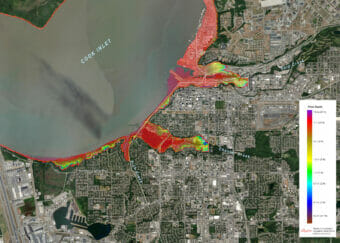
A tsunami inundation map shows the maximum extent of high water from a worst-case scenario, were a tsunami to hit Anchorage. (Alaska Earthquake Center)

Alaska researchers say most of Anchorage is safe from the threat of a tsunami, but they warn that such a wave could affect Girdwood, Hope and some other coastal areas, including the Port of Alaska, under certain conditions.

That’s according to first-of-its-kind tsunami hazard modeling of Upper Cook Inlet in a report out Wednesday from the Alaska Earthquake Center, the state Division of Geological and Geophysical Surveys and the state Division of Homeland Security and Emergency Management.

The risk of a tsunami hitting Anchorage – Alaska’s largest city, at the head of Cook Inlet – has been the subject of debate for years. After several nearby earthquakes in the past decade, there’s been uncertainty around alerts warning residents that they are in danger. In the past, geologists have said the majority of Anchorage residents are safe from a tsunami, but there had never been a thorough study until the one released Wednesday, which includes detailed and updated inundation maps.

“One major thing that this report does is dispel the myth that there is zero chance a tsunami could reach Anchorage. We know that that’s not true,” state Earthquake and Tsunami Hazards Program Manager Barrett Salisbury said. “There are low-lying coastal areas that will potentially be inundated above high tide. But thankfully the majority of homeowners in Anchorage and people will not need to worry about their homes or their properties.”

According to the report, if a big enough earthquake hit in the right location at the right time – specifically, when there is a high tide in Upper Cook Inlet – a tsunami could overrun parts of the coast in the Anchorage area, including at the Port of Alaska and along Ship, Chester and Fish creeks. And the report notes that an earthquake could trigger a localized landslide in Cook Inlet, which itself could cause a fast-moving tsunami.

The study authors said in a press conference Wednesday that the potential tsunami impacts to the port are unclear and would require more research. About 75% of all water-bourne freight to Alaska enters the state through the Port of Alaska, in Anchorage.

People near any coastline when a big earthquake hits should always be concerned about a potential tsunami, the researchers said.

Still, in Anchorage, there would likely be plenty of time to warn people about an earthquake-generated tsunami, because, according to the report, Cook Inlet’s shallow water would make for a slow-moving wave.

The report authors modeled Alaska’s magnitude 9.2 1964 Good Friday Earthquake – the second-largest earthquake ever recorded – and found that a 10-foot wave likely hit the city’s coastline more than eight hours after the earthquake. But that tsunami went undetected, the report says, because it came in the middle of the night and coincided with an outgoing tide, which lessened the tsunami’s effect.

In a hypothetical, worst-case scenario described in the report, a large earthquake could strike at the entrance to Cook Inlet as the tide is coming in, causing strong currents and high water. The new inundation maps show the most acute impacts would be flooding in the Turnagain Arm communities of Girdwood and Hope and across the Knik Arm from Anchorage in the Point MacKenzie area.

Despite ongoing and widespread confusion from tsunami warnings buzzing residents’ phones – caused by “overalerting,” as one researcher put it – large earthquakes in the region will continue to trigger alerts for the entire Anchorage area, for the time being.

Dave Snider, warning coordinator with the National Tsunami Warning Center in Alaska, said his agency is working to solve that problem.

“So today, we’re limited by the ability to specifically warn very targeted parts of our geography,” Snider said. “And in the future, we’ll be able to warn very specific parts of our coastline, including the Anchorage coastline. But right now, the limitations that we have will likely alert a lot more people than actually need to move away from the coast.”

Scientists find a ‘dinosaur bonanza’ during Yukon River trip


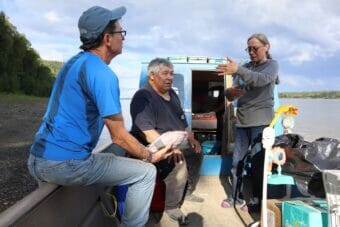
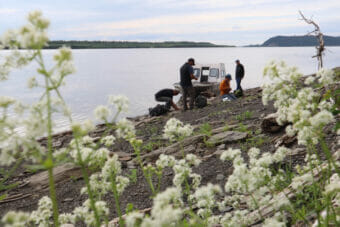
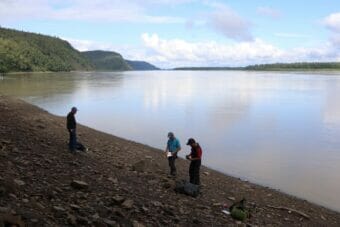
A three-man team of scientists are traveling the middle section of the Yukon River by boat with a local guide this summer. They’re looking for signs of dinosaurs that once roamed here during the early Cretaceous Period, which was around 100 million years ago. (Emily Schwing/KYUK)

A small team of researchers is on the Yukon River this month to learn more about an area where dinosaur footprints were discovered 10 years ago. And in a single week, they’ve turned up at least two dozen footprints left by at least five different ancient species

Halfway into the second day along the Yukon River, the team is more than 300 miles west of Fairbanks, near Nulato. Paleontologist Tony Fiorillo points to two small blobs protruding out of a large block of yellow sandstone. They look like flattened tennis balls, except there are three distinct toes. These are 100-million-year-old dinosaur footprints.

“So it’s either another body size of a dinosaur that lived here or it’s a baby,” Fiorillo said.

Fiorillo is the Executive Director of the New Mexico Museum of Natural History and Science. He said that this print was made by an ornithopod, a group of bipedal herbivores. This is the smallest ornithopod print he that said he’s ever found.

The leader of a three man team, Fiorillo also discovered signs of an ancient fish species. He pointed to a gray block of sandstone with marks that look like someone scraped their fingernails across it. There are a series of three evenly spaced, raised lines.

“What this surface is is an ichnogenus called undichna, a trace fossil of a fish, a bony fish,” Fiorillo said. “As the fish is swimming and it’s fins are hitting the bottom, the rays of the fin will do that.”

Between 2000 and 2013, Fiorillo, who is an expert on the dinosaurs that once roamed Alaska, visited the upper reaches of the Yukon River six times. During those years he only ever found two dinosaur footprints.

“That’s the hardest I ever worked for two footprints,” Fiorillo said.

But now, on the middle section of the river, Fiorillo said that it’s something of a “dinosaur bonanza.”

“I think it might have taken an hour to find the first footprint. I wouldn’t say the floodgates are open yet, but I think we’re gonna feel like that at the rate we’re finding stuff,” Fiorillo said.

By the end of the second day of field work, the three-man team had recorded nearly a dozen fossil footprints. In the following few days, that number has more than doubled and the team plans to continue their search through the middle of August.

Scientists embark on a Yukon River expedition to track down a trove of dinosaur footprints

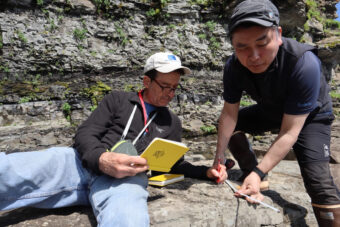
Tony Fiorillo and Yoshitsugu Kobayashi measure and record a dinosaur track at Aniakchak Bay in the Aleutians in 2022. This year, the two paleontologists are focusing their attention on the Interior, where scientists reported a trove of dinosaur tracks in 2013 somewhere along the Yukon River. (Emily Schwing/KYUK)

A team of scientists was in Fairbanks this week making final preparations for a three-week expedition. The goal of the trip is to locate and document a treasure trove of dinosaur tracks discovered along the banks of the Yukon River a decade ago.

“When I started this project 24 years ago, I think the number of dinosaur sites known from Alaska you could count on one hand, maybe with a couple of extra fingers,” said New Mexico Museum of Natural History and Science Executive Director Tony Fiorillo. He’s an expert on dinosaurs in Alaska’s arctic and subarctic.

After dozens of field seasons along the Aleutian chain and on the North Slope, Fiorillo will explore new territory along the middle section of the Yukon River.

“We’ve got a geologic map. We know where the rocks of interest intersect with the river, and that’s what we’re going to do: we’re going to let the geology and paleontology determine what happens while we’re on the river,” Fiorillo said.

Back in 2013, a team from the University of Alaska Fairbanks reported finding thousands of tracks from at least two dinosaur species somewhere along the Yukon River between the villages of Ruby and Kaltag. It’s unclear if anyone has been back since, and it’s also unclear what the people who live along the river know about them, which is a question Fiorillo also wants to answer.

“These communities may actually have something just because they’re up and down that river. And those people see stuff, and they’ve had to have seen stuff, and maybe they have an explanation. What does that mean to them?” Fiorillo said. “And so if these communities have those stories, and if they’re willing to share them, I would love to hear them.”

Fiorillo is joined by Yoshitsugu Kobayashi, a paleontologist with Japan’s Hokkaido University. Paul McCarthy, a paleopedologist, or expert in ancient soils, from the University of Alaska Fairbanks is also on the team.

The rocky outcrops the team will target are from the Cretaceous Period and are up to 100 million years old. They also hold fossilized plant material, small clues that can help the team piece together the story of the dinosaurs that once roamed the Interior. The expedition will cover up to 250 miles of the middle Yukon over the next three weeks.

Editor’s note: Emily Schwing is traveling with this group of researchers for the duration of the project. Her flight from Fairbanks to Galena was covered by funding for the project. 

Craig George, renowned Arctic wildlife biologist and whale expert, missing in rafting accident

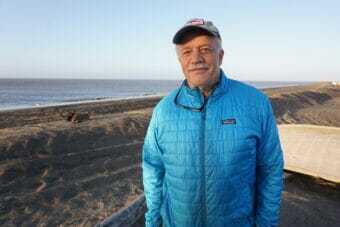
Biologist Craig George stands on Utqiagvik’s beach on Oct. 4, 2018. George, who went missing while rafting the Chulitna River last week, devoted much of his research to the effects of sea-ice loss. In past decades, the waters here would have been frozen over by October; in 2018, there was no ice within sight. (Photo by Yereth Rosen/Alaska Beacon)

A veteran Arctic scientist who was one of the world’s most distinguished whale experts was missing after a rafting accident in Interior Alaska last week.

Craig George, a retired senior biologist with the North Slope Borough Department of Wildlife Management, went missing on Wednesday while rafting the Chulitna River with companions south of Cantwell near Denali National Park, the Alaska State Troopers reported. His body had not been found as of Monday, a trooper spokesperson said.

George, 70, spent decades studying bowhead whales and documenting their long-term increases. He also studied the myriad ways that reduced sea ice and other climate-change impacts have affected Utqiagvik and the rest of coastal Arctic Alaska.

He published studies on such subjects as increased predation on bowheads by killer whales that can now swim farther north, the way changes in shore ice have affected Inupiat hunting practices, and ways to preserve traditional food cellars that are dug in the warming permafrost.

He moved to the town then known as Barrow in the 1970s. He was an animal caretaker at the Naval Arctic Research Laboratory before embarking on his long career with the North Slope Borough. He became known for his collaborative work with Inupiat experts.

George had talents and accomplishments beyond his scientific work. He was a pillar of the Utqiagvik community. He was a musician, and often performed a song he wrote called “Keep on Whaling.” The son of Newbery Award-winning author Jean Craighead George, he and his sister collaborated to complete one of his late mother’s unfinished books after she died. The book is titled “Ice Whale”; like many of Jean Craighead George’s books, it was partly inspired by her son’s scientific work in Arctic Alaska.

Tributes to George poured in over social media once news of his accident was released.

D.J. Fauske, director of external affairs for the North Slope Borough, wrote on his personal Facebook page about memories from first grade, when he was a student at Ipalook Elementary School and first met George.

“He was kind, gentle, humble, funny, and could teach you something without you even knowing you were in the middle of an academic lesson. No such thing as a dumb question to him. . . . It’s been a pleasure working for my hometown borough, and people like Craig were a big part of the reason. He helped so many people and helped preserve and protect an Inupiat culture that was judged and stereotyped for years by outsiders. He helped combine thousands of years of traditional local Inupiat knowledge with world class technology and data.”

Suzanne Little, who oversees Alaska land conservation for the Pew Charitable Trusts, played in a band with George, and performances included a mid-1980s event in what was then the new Barrow High School.

“Dr. Craig George, aside from being an amazing friend, musician, songwriter, father, spouse and stellar community member, was one of the first western science biologists, along with Dr. Tom Albert, who listened to the Indigenous Knowledge of the Inupiat People and instated a Bowhead Whale census program to prove the Indigenous people were correct about the Bowhead whale population NOT being endangered. . .Craig’s work provides us all a roadmap,” she posted on Facebook.

Cheryl Rosa, deputy director of the U.S. Arctic Research Commission, commented: “Dr. Craig George was a remarkable Arctic research scientist with a unique scientific curiosity that drove his work, his results often endearingly delivered with softspoken humor and humility. He was a great proponent of co-production in research—far before it became a buzzword—and was fair and empathetic, in both science and life. The respect he showed the communities he worked with earned him a place as a trusted partner and showed the rest of the scientific community how research could be improved with local input. Craig was a mentor to many and a friend to even more. Many scientists entered and remained in the field of Arctic research because of him. He was a wonderful person and will be deeply missed.”

The search for George has been hampered by high water in the river, said Austin McDaniel, a spokesman for the Alaska State Troopers. A dive team is waiting for water levels to fall so that specialized equipment can be deployed in the river, McDaniel said.

This story originally appeared in the Alaska Beacon and is republished here with permission.

Men are hunters, women are gatherers. That was the assumption. A new study upends it.

A group of young women from the Awa people in Brazil hold their bows and arrows as they return from a hunt. A new reexamination of ethnographic studies finds female hunters are common in hunter-gatherer societies. (Scott Wallace/Getty Images)

For decades, scientists have believed that early humans had a division of labor: Men generally did the hunting and women did the gathering. And this view hasn’t been limited to academics. It’s often been used to make the case that men and women today should stick to the supposedly “natural” roles that early human society reveals.

Now a new study suggests the vision of early men as the exclusive hunters is simply wrong – and that evidence that early women were also hunting has been there all along.

Specifically, the new research upends one of the key strands of evidence that scientists have relied on to infer what life was probably like during the period that started roughly 200,000 years ago, when homo sapiens first emerged as a species.

Direct evidence is limited because that phase ended about 9,000 years ago, as people slowly began to develop agriculture and settlements. But all over the world, there have been groups, often in remote areas of low- and middle-income countries, who still live a hunting and foraging life. So scholars look to them as a sort of window into humanity’s past. Anthropologists and other specialists have gained these groups’ permission to live alongside them and have produced detailed observational reports.

Until now, the general sense among scientists has been that these accounts overwhelmingly pointed to men mainly hunting and women mainly gathering, with only occasional exceptions, says Robert Kelly, professor of anthropology at the University of Wyoming and the author of influential books and articles on hunter-gatherer societies.

But Kelly says that the views he and others held of the typical gender divisions around hunting were based on anecdotal impressions of the reports they’d been reading, combined with the field work many had engaged in personally. “No one,” says Kelly, had done a systematic “tally” of what the observational reports said about women hunting.

Enter the researchers behind the new study: a team from University of Washington and Seattle Pacific University. “We decided to see what was actually out there” on hunting, says the lead researcher Cara Wall-Scheffler, a biological anthropologist.

A fresh look at old evidence

Wall-Scheffler and her collaborators combed through accounts from as far back as the 1800s through to present day. And rather than relying on summaries of those accounts – as scientists often do when analyzing large numbers of them – Wall-Scheffler notes “our goal was to go back to the original ethnographic reports of those populations and see what had actually been written about the hunting strategies.”

Their findings — published in the journal PLOS One this week — is that in 79% of the societies for which there is data, women were hunting.

Moreover, says Wall-Scheffler, this wasn’t just opportunistic killing of animals that the women happened upon. The vast majority of the time, she says, “the hunting was purposeful. Women had their own toolkit. They had favorite weapons. Grandmas were the best hunters of the village.”

In other words, “the majority of cultures for whom hunting is important train their girls and their women to make their tools and go hunting,” she says. Wall-Scheffler says she was expecting to find evidence of women hunting – but not to this extent. “That piece has just been really underappreciated,” she says, “even though it’s right there in literature.”

The implications of these results are potentially enormous, says Kimberly Hamlin, a professor of history at Miami University in Oxford, Ohio who specializes in ways that evolutionary science has figured in the wider culture.

“I think that next to the myth that God made a woman from man’s rib to be his helper, the myth that man is the hunter and woman is the gatherer is probably the second most enduring myth that naturalizes the inferiority of women,” says Hamlin.

It has fueled the idea, she says, that “men are supposed to be violent, they’re supposed to be aggressive – one of the core elements in the soup of toxic masculinity” used to excuse damaging male behaviors, including rape.

The popular narrative of man as the sole – or at least almost exclusive – hunter has also been used implicitly and even explicitly to argue for policies that prioritize men’s role as the “natural breadwinner” – and that also limit them to that role by, for instance, denying them paternity leave, adds Hamlin.

By the same token, she maintains, “this idea that somehow women are naturally preordained to be caretakers and maternal figures, whether they like it or not,” often underlies policies that effectively “force motherhood on women” – including policies that restrict access to abortion and contraception.

So the new study’s findings are “thrilling,” concludes Hamlin. “It’s really going to encourage us to call into question a lot of these ideas about what men and women are supposedly naturally like.”

For scientists, a shifting narrative about hunters

As to how consequential the study’s findings are for science, scholars say they add to a body of evidence that has been building for years.

Kelly says that notwithstanding the endurance of stereotypes around early human hunting in popular culture, scientists had already moved to a more nuanced picture.

As far back as the mid-1960s, says Kelly, scientists were coalescing around evidence that most of the diet in hunter-gatherer societies has come from plant food gathered by women. “People were saying, ‘We should call them ‘gatherer-hunters’ to emphasize that.’ ”

By the 1980s, adds Kelly, many more women had entered the field of anthropology. Compared to their male predecessors, these women scientists were often able to gain more access to women in foraging societies. The result was a slew of new descriptions of women’s activities – including more accounts of women hunting.

So Kelly’s initial reaction to Wall-Scheffler’s study is that, while its organization and tabulation of the data is “genuinely new and useful,” when it comes to the picture it paints of the hunting practices of women, “there wasn’t anything that struck me as eye-opening. I sort of knew all of this.”

Yet one finding did stick out to Kelly. He says that the current consensus view holds that even when women do some hunting, they engage in a very different form of hunting than the kind done by men.

“The general pattern is that men intentionally go out to hunt large game,” says Kelly. “And women intentionally go out to gather plant food and also intentionally or opportunistically will hunt the smaller, more reliably-gathered game” – meaning animals like lizards and rabbits.

By contrast, the new study found that in a third of societies for which there is data, the women hunt large game. In other words, they do go after the kind of big mammals associated with the stereotype of male hunters.

“I would consider that something new,” Kelly concedes, adding “I’d really like to go look at those ethnographies” that were the source.

Vivek Venkataraman of the University of Calgary is another anthropologist expressing doubts.

He notes that Wall-Scheffler and her colleagues had to limit themselves to societies for which there were explicit accounts of not just hunting practices, but precisely who was doing the hunting. The result is that the study is based on observations of 63 groups.

“But of course there are several hundred foraging societies,” says Venkataraman. “We need to know what’s going on there before we can draw any sweeping conclusions.”

Key clues that were overlooked

Randy Haas disagrees with the critics of the study. An anthropologist at Wayne State University, Haas notes that the societies Wall-Scheffler’s study analyzes are well distributed across the globe. Furthermore, says Haas, “more data is not always better. My sense is that [the evidence used in the study] is a well-structured, high quality sample that is actually more likely to yield a reliable result than a larger sample of lower quality observations.”

What’s more, Haas says, his own experience illustrates how the “near universal” view of men as the sole big-game-hunters may be warping researchers’ ability to recognize data to the contrary. In addition to creating blind spots in the understanding of modern hunter-gatherer societies, Hass says it also appears to have led scientists to overlook key clues from the other main source of evidence on early humans: ancient burial sites and the human remains and artifacts found there.

In 2018 Haas was part of a team in Peru that found a 9,000-year-old person buried with an unusually large number of hunting tools. “We all just assumed this individual was a male,” he recalls. “Everybody is sitting around, saying things like, ‘Wow! This is amazing. He must have been a great hunter, a great warrior. Maybe he was a chief!’ ”

Haas didn’t even think to question the person’s gender until about a week later, when a colleague who specialized in analyzing bone structure arrived and delivered a bombshell assessment: The remains seemed to be female.

The team then used a technology newly available to the field. Scraping the enamel from the teeth found in the grave, they found proteins that confirmed it unequivocally: This apparent master hunter was female.

Stunned, Haas and his collaborators decided to review the records of similar finds across the Americas over the previous 70 years. In 27 gravesites of individuals found with hunting tools, they found 11 cases in which the person was female.

They ran a statistical analysis that finds that this ratio is associated with the probability that between 30-to-50% of individuals buried with hunting tools in ancient American gravesites are female. In other words, says Haas, “Large mammal hunting during this time in the Americas was a gender neutral activity, or at least nearly so.”

Why did this take so long?

Why hadn’t these findings commanded the world’s attention sooner?

Haas says in one of the excavation records he and his collaborators re-analyzed – the 11,000-year-old remains of a female found in the 1970s with a pointy stone tip laid under her head – the scientists who had originally uncovered the grave had effectively ignored their own discovery.

Says Haas, “They had written something to the effect of, ‘Had this [pointy stone] been associated with a male we would have assumed this to be a hunting weapon. But given its association with a female, its use as a kitchen tool would make more sense.” Haas and his co-authors decided it should be reclassified as a hunting tool.

Yet what’s even more notable, says Haas, is that in all but one other case, his team did not need to revise the conclusions of the original excavators: Those scientists had already determined that the individuals they’d found were females buried with hunting weapons. Just as with the findings in Wall-Scheffler’s study, the archaeological evidence had been available the whole time – hiding in plain sight.

“Everybody had just taken this man-the-hunter hypothesis for granted. So no one really decided to evaluate it,” says Haas. “It wasn’t really a question on a lot of people’s minds.”

But Cara Wall-Scheffler had seen Haas’s findings, and they were precisely what prompted her to launch her review of the modern-day accounts.

Wall-Scheffler says the episode offers a reminder of why it’s so important to ensure the scientific community includes people of diverse backgrounds.

“The preconceptions that we all have when we look at a data set really shape the outcome,” she says. “I’m really hoping that people take second looks at some of the data that they already have to see what new questions we can ask.”

Copyright 2023 NPR. To see more, visit https://www.npr.org.

Scientists look for clues to Mt. Edgecumbe’s next eruption

Geophysical Institute research assistant professor Társilo Girona takes video footage while graduate student assistant, Claire Puleio, takes a forward-looking infrared camera video during a reconnaissance flight around Mt. Edgecumbe volcano on Kruzof Island. (UAF/GI photo by JR Ancheta)

While no eruption is imminent, scientists from the Alaska Geophysical Institute in Fairbanks recently spent a few days on the flanks of Mt. Edgecumbe — and on surrounding beaches — collecting information on surface temperatures and gasses they hope will shed light on what’s brewing beneath the surface.

Carbon dioxide can’t be seen or smelled, but a team of scientists from the Alaska Geophysical Institute knows how to detect it. Six of them spent a few days helicoptering between Sitka and Mt. Edgecumbe in early June, testing the soil of Kruzof Island for CO2.

Claire Puleio is a doctoral student at the University of Alaska Fairbanks. Her team was at the Sitka airport, waiting for a break in the weather.

“We’re hoping to measure diffuse CO2 – those same CO2 measurements we’ve been taking along the flanks of the volcano,” she said. “Then, if we could get inside the crater, we’d like to take some measurements there. However, it’s unclear if it’s snow-free right now.”

Puleio studies under Research Assistant Professor Társilo Girona, who thinks that thermal anomalies on Mt. Edgecumbe detected by satellite data might suggest increased magma activity  that could be a precursor to an eruption.

“One of the hypotheses we have to understand those signals,” said Girona, “is that the gas that is moving from the magma source to the surface is producing this warming in the surface.”

The project is funded by NASA as part of a program for early career scientists. The team is tackling the problem on two fronts: in the air and on land.

Carlo Cardellini is from the University Perugia in Italy. He’s helped develop a method for collecting gas from the soil using a device called an accumulation chamber.

“We place a chamber on the top of the soil — it’s like a cooking pot,” said Cardellini. “And we leave  the concentration of carbon dioxide to increase inside the chamber. And the rate of increasing is something that is linked to the amount of gas that is passing from the soil to the atmosphere. So we are catching this increase, and we can compute how much gas is escaping from the soil.”

Graduate student researchers Claire Puleio, left, and Valerie Wasser walk to another location to test for CO2 gas along Mt. Edgecumbe’s summit on Kruzof Island. (UAF/GI photo by JR Ancheta)

Cardellini uses an infrared sensor that continuously measures the concentration of CO2 in the cooking pot. But he also collects samples to take back and study in the lab. CO2 produced by magma will have a different isotopic signature than CO2 produced by organic decomposition — and there is a lot of organic decomposition on the slopes of Mt. Edgecumbe, which are primarily wetlands.

For the bigger picture, you’ve got to be airborne. Taryn Lopez is a volcanologist with the Alaska Volcano Observatory. While the others are sampling the slopes of the crater, she’ll be overhead doing what is called a “gas flight.”

“Some gasses exsolve, which means they form bubbles really deep, such as CO2,” Lopez said. “Where things like water and SO2 (sulfur dioxide), which are common volcanic gasses, exsolve very shallow. So what we’re looking for is the composition of the gasses. If we see gasses, and if we see the composition, we can tell if the magma is deep or shallow.”

Girona says all the data and information collected by the Geophysical Institute team will be published in several papers and shared with the Alaska Volcano Observatory, which is sending its own team to Mt. Edgecumbe later this summer. And hopefully, Girona said, “We can better understand how the volcano works.”

Site notifications
Update notification options
Subscribe to notifications