Science & Tech

Revenge of the killer whales? Recent boat attacks might be driven by trauma

Killer whales are pictured during a storm in the fjord of Skjervoy in 2021 off the coast of northern Norway. Researchers say orcas are stepping up “attacks” on yachts along Europe’s Iberian coast. (Olivier Morin/AFP via Getty Images)

Scientists and sailors say orcas, also known as killer whales, are stepping up “attacks” on yachts along Europe’s Iberian coast, with one skipper who’s been pursued by the marine mammals on two separate occasions suggesting that their tactics are becoming more stealthy.

Delivery skipper Dan Kriz, who had to be towed into port after orcas destroyed the rudder on a boat he was on in 2020, had an almost identical experience in April.

“My first reaction was, ‘Please! Not again,'” Kriz told Newsweek.

Unlike last time, the orcas made a stealthier approach without the characteristic squeaks they normally use to communicate, he says. They made quick work of the two rudders on the catamaran Kriz was delivering. “Looks like they knew exactly what they are doing. They didn’t touch anything else,” he said.


View this post on Instagram


A post shared by Catamaran Guru (@catamaranguru)

Most marine scientists have characterized hundreds of encounters between boats and orcas that have sunk at least three vessels and damaged dozens of others over the years as a “fad,” implying that the animals will eventually lose interest and resort to more typical behavior.

But if that’s the case, there are few signs this behavior is going out of style anytime soon. According to a June 2022 study published in the journal Marine Mammal Science, orcas have stepped up the frequency of their interactions with sailing vessels in and around the Strait of Gibraltar, the busy waterway that links the Mediterranean Sea with the Atlantic Ocean.

Some researchers think it’s merely playful behavior

As NPR first reported last August, many scientists who study orca behavior believe these incidents — in which often one or more of the marine mammals knock off large chunks of a sailboat’s rudder — are not meant as attacks, but merely represent playful behavior.

One hypothesis put forward by Renaud de Stephanis, president and coordinator at CIRCE Conservación Information and Research, a research group based in Spain, is that orcas like the feel of a boat’s rudder.

“What we think is that they’re asking to have the propeller in the face,” de Stephanis told NPR last year. “So, when they encounter a sailboat that isn’t running its engine, they get kind of frustrated and that’s why they break the rudder.”

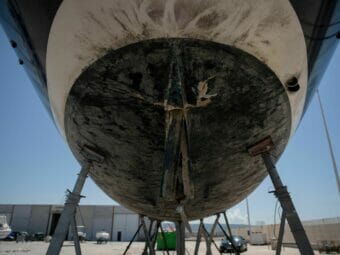
A picture taken on May 31 shows the rudder of a vessel damaged by killer whales (Orcinus orca) while sailing in the Strait of Gibraltar and taken for repairs at the Pecci Shipyards in Barbate, near Cadiz, southern Spain. (Jorge Guerrero/AFP via Getty Images)

In another recent encounter, Werner Schaufelberger told the German publication Yacht that his vessel, Champagne, was approached by “two smaller and one larger orca” off Gibraltar.

“The little ones shook the rudder at the back while the big one repeatedly backed up and rammed the ship with full force from the side,” he said.

The Spanish coast guard rescued Schaufelberger and his crew, towing Champagne to the Spanish port of Barbate, but the vessel sank before reaching safety.

The encounters could be a response to past trauma

Since 2020, there have been more than 500 encounters between yachts and orcas in the area, according to one of the study’s co-authors, Alfredo López Fernandez, a biologist at the University of Aveiro in Portugal and a representative of the Grupo de Trabajo Orca Atlántica, or Atlantic Orca Working Group.

López Fernandez believes that a female known as White Gladis, who leads the group of around 40 animals, may have had a traumatizing encounter with a boat or a fishing net. In an act of revenge, she is teaching her pod-mates how to carry out revenge attacks with her encouragement, researchers believe.

A worker cleans Champagne, a vessel that sank after an attack by orcas in the Strait of Gibraltar and was taken for repairs at the Pecci Shipyards in Barbate, near Cadiz, southern Spain, on May 31. (Jorge Guerrero/AFP via Getty Images)

“The orcas are doing this on purpose, of course, we don’t know the origin or the motivation, but defensive behavior based on trauma, as the origin of all this, gains more strength for us every day,” López Fernandez told Live Science.

It’s an intriguing possibility, says Monika Wieland Shields, director of the Orca Behavior Institute.

“I definitely think orcas are capable of complex emotions like revenge,” she says. “I don’t think we can completely rule it out.”

However, Shields is not ready to sign on to the “revenge” hypothesis just yet. She says that despite humans having “given a lot of opportunities for orcas to respond to us in an aggressive manner,” there are no other examples of them doing so.

Deborah Giles, the science and research director at Wild Orca, a conservation group based in Washington state, is also skeptical of the hypothesis. She points out that killer whale populations in waters off Washington “were highly targeted” in the past as a source for aquariums. She says seal bombs, small charges that fishers throw into the water in an effort to scare sea lions away from their nets, were dropped in their path while helicopters and boats herded them into coves.

“The pod never attacked boats after that,” she says. “It just doesn’t ring true to me.”

Shields says it’s important to remember that whatever the motive is for the behavior of the orcas off the Iberian coast, it isn’t being transmitted to pods in other parts of the world.

“We’ve had folks here in Washington [asking] ‘is it safe to go out in the water here with these orcas?'” she says. “While this is kind of an ongoing situation in that specific place, I don’t think there’s any reason to think it’s going to start spreading to other populations of orcas.”

Copyright 2023 NPR. To see more, visit https://www.npr.org.

Researchers are searching underwater for more ancient evidence of Indigenous life near Prince of Wales Island

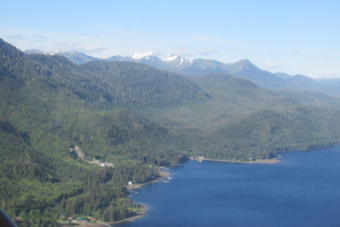
An aerial shot of Prince of Wales Island. (Photo courtesy KRBD)
An aerial shot of Prince of Wales Island. (KRBD photo)

A team of researchers have been combing the waters around Prince of Wales Island, looking for evidence that could shed more light on how long Indigenous people have lived on this land. An underwater robot has a key role.

After the discovery of an ancient fish trap last year, scientists were able to place Indigenous people near Prince of Wales Island around 11,000 years ago.

Now, more research is being done to see if they can push that time back even further.

Kelly Monteleone is a lead researcher with the crew. The crew includes people from the University of Calgary, Sealaska Heritage Institute and SUNFISH.

“We’re really hoping that we can find evidence going back, you know, thousands and thousands of years more — to get people on this continental shelf 16, maybe even 20,000 years ago,” Monteleone said.

She explained that the people who lived along that shelf tens of thousands of years ago are likely ancestors to modern-day residents.

We’re hoping to find caves,” Monteleone said. “And then we know that because of changing in sediments, we’re not necessarily going to find things on the surface in caves. So we’re trying to take a number of sediment samples.”

The samples will then be searched for something called microdebitage. It’s a big word for something that’s actually really small.

“So every time somebody sharpens or uses a stone tool, little, itsy-bitsy flakes come off — sometimes, you know, less than one millimeter in size,” Monteleone explained. “And we can find those in the sediment samples if people were using tools in the cave.”

That sediment will undergo a variety of tests.

“We’re also going to be analyzing the sediments for environmental factors,” she said. “And so we’ll radiocarbon date and we’re gonna get pollen and something called dinoflagellates cysts, which are little microscopic organisms that tell us about the waterfall at the time that sedimentation happened.”

But there’s one catch: the caves are now underwater. Monteleone said they would’ve been above water around 10,000 years ago, when sea levels were about 165 meters lower than what they are now.

So the team is using an underwater robot called SUNFISH. Kristof Richmond is the co-principal investigator involved on the robotics side of the project. He said the robot is going to explore areas that humans pointed out last year.

“And it does very precise mapping using sonar and cameras, and can actually navigate into caves autonomously,” he explained. “So it’s able to explore really complex underwater features and map them out. And so we’re using that tool to help us really identify with precision what kind of features we saw in this high level overview.”

The team also held public events with the robot over the weekend in Craig and Klawock.

“This is just, for us, a real exciting opportunity to demonstrate AI and autonomous functions, you know, to get to places where people can’t and learn lots about our environments, where we come from, and, you know, get into unexplored territory and just push the boundaries of human knowledge,” Richmond explained.

It will take another year or so to comb through what the team finds. But they hope it will lead to even more research about the history of people living in Southeast Alaska.

Deepwater mapping reveals gas seeps in Aleutian Trench

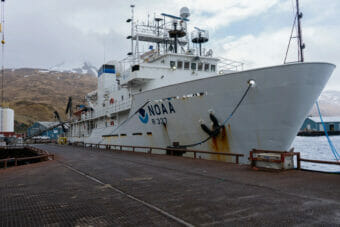
Deepwater mapping reveals gas seeps in Aleutian Trench. (Ellis Berry)

The Okeanos Explorer docked in Unalaska last month after finishing its first of six expeditions mapping out the deep seafloor around the Aleutian Islands. It was almost June, and the weather was starting to calm down from the winter season — making it safer for research boats to head out to the Bering Sea.

Sam Cuellar is with the National Oceanic and Atmospheric Administration and works as the expedition coordinator on the 224-foot research vessel. While on the Okeanos Explorer in May, Cuellar and his crew discovered three seeps bubbling gas through the seafloor in the Aleutian Trench.

According to NOAA, the discovery is crucial because these gas seeps can create unique surrounding habitats and provide potential sources of alternative energy and biopharmaceuticals. But to Cuellar and his crew, it was just another day at work.
“You’re in that kind of routine,” he said. “It’s not exciting because it’s not important — it’s just part of your job. And it’s really cool to note, but you just keep going on with your job and keep looking for more.”

According to Cuellar, finding these gas seeps wasn’t a total surprise. That’s because there’s research from the U.S. Geological Survey that predicts where gas seeps could be in Alaskan waters. And now, with more advanced machinery, there can be more advanced data collection from the seafloor.

“Now that you’re seeing the different technologies catch up with being able to more properly and economically extract resources from the deep seafloor,” said Cuellar. “We need to better understand [resources] for protection, but also to understand what kind of resources are here.”

Alaska’s waters are predominantly unexplored. Cuellar said it’s partially due to the state’s remoteness from the rest of the country and the environmental difficulties that come with being so far north.

But, he said, retracting ice sheets make areas more accessible than ever before.

“And so, there’s a renewed push by the U.S. government to better understand what is in those types of waters now that they’re accessible,” Cuellar said.

The Okeanos Explorer is out at sea until mid-October, mapping the deep waters around the Aleutian Islands, in the Aleutian Trench, and in the Gulf of Alaska. You can track the ship live online on NOAA’s website and the collected data will be accessible to the public during and after expeditions.

A high-stakes egg drop onto the Juneau Icefield could lead to better monitoring of Antarctic ice

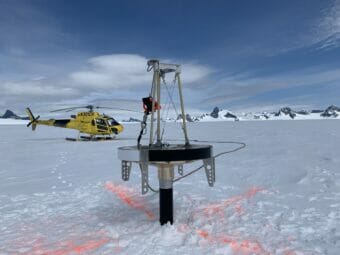
The “ice penetrator,” developed by researchers at MIT”s Haystack Observatory, was dropped from 5,000 feet above the Juneau Ice Field (Photo courtesy of Chester Ruszczyk, Jeff Hoffman, and Parker Steen of MIT)

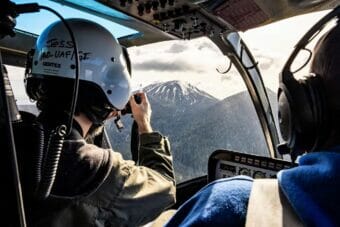
Earlier this month, engineers from MIT teamed up with Coastal Helicopter and the Juneau Ice Research Program to pull off a high-stakes egg drop. It’s just like the ones you did in school, except the egg is a very fragile, very expensive seismometer. And the drop point is 5,000 feet above the Juneau Ice Field. 

The dropping device looks like a six-foot lawn dart, and it’s called the “ice penetrator.” Eventually, they’ll be used to place seismometers in the ice sheets of Antarctica to help scientists understand climate change. But before that, MIT’s team will have to figure out if their design can keep the metaphorical egg from breaking. 

Dr. Chester Ruszczyk leads the project, and he joined KTOO’s Anna Canny to talk about how it went.

Listen:

This interview has been edited for length and clarity.

Chet Rusczyk: It looks like a, basically, a six foot lawn dart with an antenna on top — a mast. The top part is much wider — it’s like a disc. It stays on the top because the mast has to be up above the ice and snow for communications. But the piece that holds the sensors and the batteries to provide power continues going into the ice shelf itself. 

Really, the main thing is, it has to have enough speed so the two pieces can separate. But it also has with it the electronic cables to provide connection between your antennas and the actual receivers that need to get data to and from it. 

Anna Canny: And the goal eventually will be to drop the ice penetrator from a helicopter to deposit seismometers in Antarctica to measure changing ice. Can you explain to me why that is such a difficult feat?

Chet Rusczyk: Because the seismometer is so sensitive. Usually they’re only meant to be dropped out of the back of a pickup truck. So when you tell them, yeah, we’re going to drop it from 5,000 feet above the ice shelf, they tend to freak out. So the goal of this was to get accelerometers inside the system, do a few drops. And then from the drops, we would be able to go to the seismometer people and say, this is what we expect that you have to survive. 


Anna Canny: And the reason for putting accelerometers in there is to measure force, basically? Like the amount of force that these seismometers will eventually have to endure?

Chet Rusczyk: Correct. 

Anna Canny: This prototype is sort of a dummy version. It doesn’t have those really fragile seismometers in it yet. But when it does, they’ll measure motion in the ice shelf in Antarctica. Why is that so important?

Dr. Chet Rusczyk retrieves the “ice penetrator” prototype after it’s inaugural drop (Photo courtesy of Chester Ruszczyk, Jeff Hoffman, and Parker Steen of MIT.)

Chet Rusczyk: Well, it’s climate change. Because if large chunks of the ice shelf break off, you get seawater rise, sea level rise. So part of this is really to look at, how do you predict this a little better? So think of the Ross Ice Shelf as suspended on a layer of water. So you’re gonna have impacts from the water underneath it, but you’re gonna have waves coming in at the front of it, and then you’re gonna have atmospheric conditions pushing down on it. So what the seismometer is really looking for is, how is the ice responding to all three of these different type of waves? 

Anna Canny: Are there any other factors you’re considering, in terms of successfully deploying the ice penetrator?

Chet Rusczyk:  So it really wants to go straight in. Because what happens is, with the seismometer, there’s a gyroscope that can only straighten it out if the tilt is so many degrees. So, um, there was a whole slew of things that could have gone wrong, but it actually worked out okay. 

Anna Canny: And why is remote deployment so important? Why is the ability to be able to drop the sensors from a helicopter like this useful? 

Chet Rusczyk: So one of the things is, a few of my colleagues have worked with people in the Arctic and Antarctica, and people’s lives — scientists’ lives — have been lost there. So this kind of mitigates that problem by removing that from the equation and making it a little bit simple. And they do have sensors out there that were manually placed. But it’s not enough. So being able to just throw a bunch out of the back of a helicopter or the back of a plane is a lot easier.

Anna Canny: Well, thanks for joining me, and it’s pretty exciting that Juneau got to play a little role in this really cool science.

Chet Rusczyk: Juneau was very important to us having success in Antarctica. So that was good.

Turning weather data into music could help Southeast Alaska students hear their changing environment

Rainbow near the Wrangell Narrows. (Photo by Angela Denning/CoastAlaska)

Imagine the sound of wind chimes. It’s pretty — but it’s more than that.

“The wind chime is a really interesting translation, and musicification or a sonification of an unseen environmental phenomenon,” said Oregon State University researcher Chet Udell. “It’s giving me information that could be useful if I’m curious about how windy it is outside. And it also is aesthetically pleasing.”

Udell’s lab unites engineers and environmental researchers to design environmental sensors. Wind chimes were the inspiration for one of the newest instruments, called WeatherChimes, which collects weather data and turns it into music. Now the technology will get used for projects across Southeast Alaska, starting in Sitka and Hoonah.

Scientists often express changes in the environment with things like graphs and charts — but what does that mean to a non-scientist?

“They show you the data and wiggles on a graph, but they don’t usually go too deep into having the person, like, translate that into meaning,” Udell said. “How do you get those people to empathize with environmental data?”

The WeatherChimes sensor collects real-time environmental data and transmits it via Wi-Fi. That data can then be used to compose music (Photo courtesy of the OPEnS Lab at University of Oregon).

Udell and his team tried to build an environmental sensor that would be intuitive, emotional and creative. Like wind chimes, the WeatherChimes hardware is installed outside. It gathers data on things like light, temperature, humidity and soil moisture. Then it uses Wi-Fi to send that data into a program where it can be set to different keys, scales and instruments.

Humidity, for instance, could be a marimba playing a C major scale. By listening to those musical translations, you can hear weather patterns. Around sunrise and sunset, there’s a symphony of the world warming up and drying out. And throughout the day, there are melodies and countermelodies.

“There’s this thing in composition — Beethoven uses a lot, Bach uses a lot — called contrary motion,” Udell said. “Like, when one voice goes in one direction and another voice goes in a different direction.”

The WeatherChimes show the same thing happening in nature. Temperature and humidity, for instance, have an inverse relationship.

“And there’s a certain satisfaction in putting those kinds of natural things together, and seeing how patterns that exist naturally are the same ones that make this music fun,” Udell said.

Fun is one of the major goals. But as an educational tool, WeatherChimes could also help students think more deeply and personally about weather.

When there’s a particularly rainy period, is that good news or bad news? Udell hopes students can ponder questions like that through music.

“Should I make a happy melody or a sad melody? Should I make something that goes fast or slow?” he said. “Like, what does this mean to me?”

Educators at the Sitka Sound Science Center and Sitka High School’s Traditional Ecological Knowledge program will use WeatherChimes in classrooms and educational workshops over the coming year.

And Udell and his lab will work with the Sitka Sound Science Center, the Hoonah Indian Association and Alaska Youth Stewards to install more WeatherChimes for community-designed projects, including yellow cedar monitoring in Sitka and salmon stream monitoring in Hoonah.

Leading experts warn of a risk of extinction from AI

The welcome screen for the OpenAI ChatGPT app is displayed on a laptop screen in February in London. (Leon Neal/Getty Images)

AI experts issued a dire warning on Tuesday: Artificial intelligence models could soon be smarter and more powerful than us and it is time to impose limits to ensure they don’t take control over humans or destroy the world.

“Mitigating the risk of extinction from AI should be a global priority alongside other societal-scale risks such as pandemics and nuclear war,” a group of scientists and tech industry leaders said in a statement that was posted on the Center for AI Safety’s website.

Sam Altman, CEO of OpenAI, the Microsoft-backed AI research lab that is behind ChatGPT, and the so-called godfather of AI who recently left Google, Geoffrey Hinton, were among the hundreds of leading figures who signed the we’re-on-the-brink-of-crisis statement.

The call for guardrails on AI systems has intensified in recent months as public and profit-driven enterprises are embracing new generations of programs.

In a separate statement published in March and now signed by more than 30,000 people, tech executives and researchers called for a six-month pause on training of AI systems more powerful than GPT-4, the latest version of the ChatGPT chatbot.

An open letter warned: “Advanced AI could represent a profound change in the history of life on Earth, and should be planned for and managed with commensurate care and resources.”

In a recent interview with NPR, Hinton, who was instrumental in AI’s development, said AI programs are on track to outperform their creators sooner than anyone anticipated.

“I thought for a long time that we were, like, 30 to 50 years away from that. … Now, I think we may be much closer, maybe only five years away from that,” he estimated.

Dan Hendrycks, director of the Center for AI Safety, noted in a Twitter thread that in the immediate future, AI poses urgent risks of “systemic bias, misinformation, malicious use, cyberattacks, and weaponization.”

He added that society should endeavor to address all of the risks posed by AI simultaneously. “Societies can manage multiple risks at once; it’s not ‘either/or’ but ‘yes/and.’ ” he said. “From a risk management perspective, just as it would be reckless to exclusively prioritize present harms, it would also be reckless to ignore them as well.”

NPR’s Bobby Allyn contributed to this story.

Copyright 2023 NPR. To see more, visit https://www.npr.org.

Site notifications
Update notification options
Subscribe to notifications