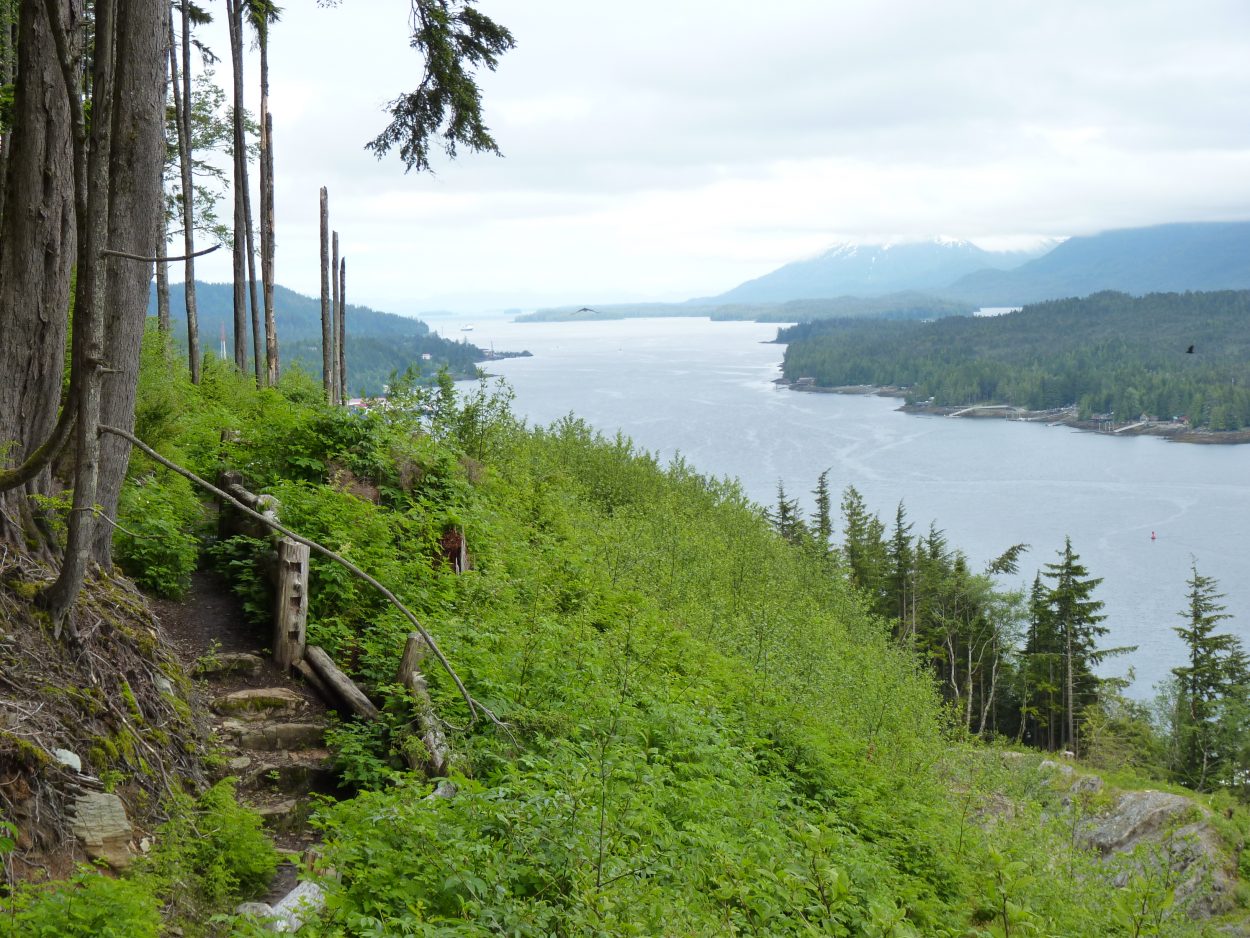
Portions of the Tongass National Forest can be seen from Ketchikan’s Rainbird Trail. (KRBD file photo)
On Thursday, the U.S. Department of Agriculture announced that it is forging ahead with a proposal to make the Tongass National Forest fully exempt from a Clinton-era rule designed to limit road development on federal lands.
It’s known as the Roadless Rule, and successive Alaska governors and the state’s congressional delegation have pushed to make it not apply in the Tongass.
Proponents say exempting the Tongass would allow for more mining, communications and renewable energy projects on federal land. It could also open up more areas for logging, though advocates and opponents seem to agree that the impact on the timber industry would likely be minimal.
But many Alaska Natives worry that rolling back the rule would damage areas tribal members use for hunting, fishing and foraging. Nearly 200 people testified at 18 hearings last year specifically geared towards people who rely on the forest for their way of life — and large majorities supported keeping the rule in place, according to the U.S. Forest Service.
An internal Forest Service report notes that 96% of public comments received on the issue last fall supported leaving the rule in place. Approximately 1% supported a full exemption.
The final environmental impact statement was released late on Thursday. That starts a 30-day waiting period before the USDA can issue a final decision on the Roadless Rule for the Tongass National Forest.
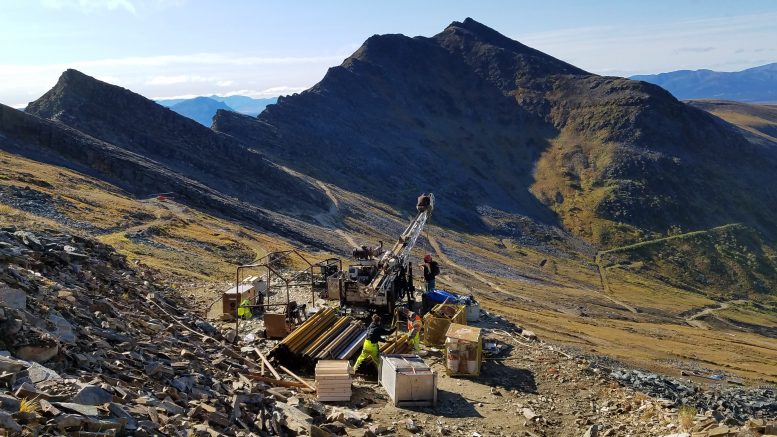
Drilling at the Trilogy Metals Inc. copper-rich Arctic polymetallic deposit in Alaska’s Ambler Mining District. (Photo courtesy of Trilogy Metals Inc.)
Ambler Metals is a company dedicated to the development of the copper-rich Ambler Mining District in Northwest Alaska. But it can’t move forward without the blessing of NANA Regional Native Corporation and permits from local governments.
Ambler Metals is a joint effort formed by two multinational corporations: Trilogy Metals and South32. President and CEO Ramzi Fawaz started at the beginning of September, relocating to Anchorage from Colorado. During a Northwest Arctic Borough Assembly meeting, Fawaz highlighted his hopes for the Northwest Arctic region.
“A lot of opportunities for us to work together and to invest in the region in Alaska and make something wonderful and profitable and sustainable for the long duration,” Fawaz said.
The company’s plans for resource development in the region are still several years away. Most of the work right now is in preliminary surveys and drilling. Trilogy CEO Tony Giardini says getting approval from the Alaska Industrial Development and Export Authority on the controversial Ambler Road project is the first major step in the region.
“We’re working with them right now to sign a memorandum of understanding to effectively start the finely detailed engineering of the road,” Giardini said.
Environmentalists have criticized the 211-mile private road, which would cut through Gates of the Arctic National Park and Preserve. Subsistence hunting advocates are also concerned with potential effects to caribou migration in the region.
However, regional leaders are also concerned over another topic — jobs.
For these multinational companies to come in and extract resources from their lands, local officials want to ensure that their communities — which are overwhelmingly made up of Inupiaq people — have employment options.
“You’re going into the region to the land where people own,” said assembly member Walter Sampson. “And we expect companies to make sure that they take their word to make sure that regional employees are the number one in this region to be hired.”
Sampson says that is a similar model to how Teck, the operators of the Red Dog Mine, said that they would hire employees for their mine. The mine is the largest producer of zinc in the world.
“Red Dog said 100% 30 years ago,” Sampson said. “They’re still at 55-60% today.”
Fawaz with Ambler Metals says the company has worked with local hires for the preliminary work, and he hopes to increase that amount as the project gets rolling.
“I would love that,” Fawaz said. “And we will try our utmost in allowing opportunities in the region to apply for the jobs once we start creating them.”
Hannah Paniyavluk Loon echoed Sampson’s sentiments. She expressed concern that Ambler Metals only has offices in Anchorage and Fairbanks, and pushed for a more local presence to keep with regional and cultural ties.
“I believe that in doing so, you may need to have an office up in the Kobuk region or in Kotzebue where you could train and recruit local hire,” Loon said.
Loon and other assembly members say doing work in advance could help guide the region’s youngest to careers in the mining district.
Fawaz agreed with the need for community engagement, though he didn’t make any promises about a permanent presence in Kotzebue or any other local community.
On Sept. 21, an environmental group leaked footage of top mining executives discussing the proposed Donlin Gold mine. ( Environmental Investigation Agency)
On Sept. 21, an environmental group released secretly recorded video clips of Pebble Mine executives who thought they were talking to potential investors but instead were speaking to people pretending to be interested in investing in the controversial mine.
Among the things the Pebble executives said: Donlin Gold can’t afford to build its gold mine in the Yukon-Kuskokwim Delta.
The executives said there might be a way for Donlin to reduce its costs if the companies work together to connect the two Southwest Alaska mining projects by building a road through the tundra.
The United States-based nonprofit Environmental Investigation Agency released several video clips Thursday that show executives from the two companies that are developing the Pebble mine discussing plans about the mine’s development.
In one video, Tom Collier, CEO of Pebble Limited Partnership, and Ronald Thiessen, CEO of Northern Dynasty Minerals, talked about the future of the proposed Donlin Gold mine. On the recording, Collier said that the Donlin mine was too expensive to build even with the gold prices set at $1,934 per ounce on Sept. 21.
“The cost of the royalties and the cost of the capital that has to be invested in the project makes it difficult for the project to go forward at the time,” Collier said.
The royalties Collier is talking about refer to the money Donlin Gold has to pay the two Native corporations that own the land and mineral rights. Donlin also needs to build a lot of infrastructure just to operate the mine: an airstrip, a road, a port, a 315-mile gas pipeline and a power plant. All of that could cost Donlin nearly $7 billion.
Collier’s comments echo a report from a short-selling financial research firm that claims the Donlin Gold mine is overvalued and will never be developed because of its hefty price tag. The firm makes money when a company’s stock price declines.
Collier said one way for Donlin to cut costs would be to build a nearly 180-mile road from the Donlin mine site to the Pebble mine site in order to ship Donlin’s ore to a port in in the Bristol Bay region. Collier said that the state could finance the road and port, which Collier said would be a big win for both companies.
“Because when you flip the Pebble switch on, that means you could flip the Donlin switch,” Collier said.
In the secret recordings, Northern Dynasty Minerals’s Thiessen said they haven’t formally approached Donlin Gold with the idea.
“We’ve had a couple of discussions, but really we need to get to the point where we have our ROD in place,” Thiessen said.
ROD refers to the final record of decision from the Army Corps of Engineers, which is expected soon.
Donlin Gold declined an interview and sent a written statement instead.
“Donlin Gold continues to advance on a stand-alone basis and is not engaged with any other projects. We remain completely confident in our proposal and its economics, which has advanced through the federal and state permitting process, and are not proposing any modifications at this time,” it said.
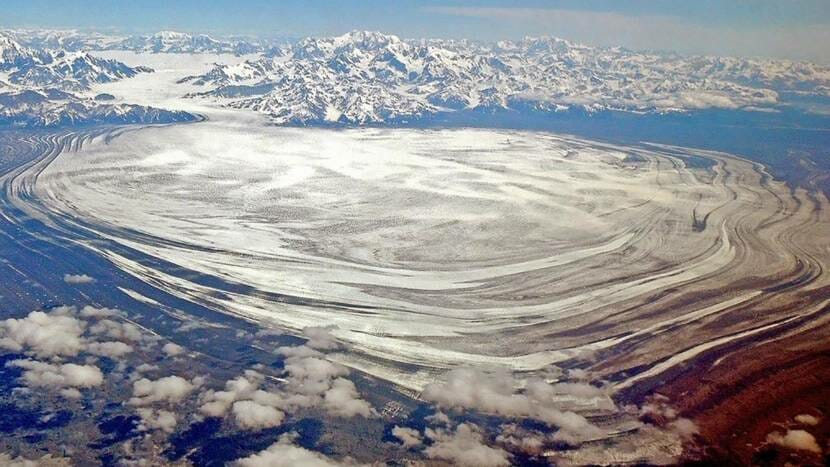
The Malaspina Glacier is located in the Wrangell-St. Elias National Park. University of Alaska Fairbanks researchers are looking at how the glacier is melting and what impacts it could have north of Yakutat. (U.S. National Park Service)
Researchers from the University of Alaska Fairbanks began looking at big changes to one of the state’s biggest glaciers on Monday. It’s melting so rapidly that it could create a new bay north of Yakutat.
What’s happening at the Malaspina Glacier may be the largest landscape transformation underway in the United States.
“You’re looking at something becoming a big ocean bay, essentially, that’s the size of a small state,” said Martin Truffer, a glaciologist with the Geophysical Institute and a physics professor at UAF. He said he doesn’t like to pick on Rhode Island, but the Malaspina is bigger. Truffer has studied big ice from Greenland to Antarctica.
“The Malaspina is kind of a hard glacier not to pay attention to if you’re a glaciologist. It’s a really big glacier,” he said.
It sits in Wrangell-St. Elias National Park and flows onto lowland plains on the north side of Yakutat Bay. As it retreats, it’s opening up lakes that connect to the ocean. The National Science Foundation recently awarded Truffer’s team $1.3 million dollars to study the Malaspina’s retreat.
“The goal of the project is really to suss out a bit more how likely that is, and what rates are we talking about. You know, where are we going to be in fifty years, are you going to be in one hundred years,” he explained.
His team will measure how fast the glacier moves and how fast it’s melting in different places. They’ll pay special attention to the front of the glacier, where ice is turning into those lakes.
They plan to find out whether the Malaspina Glacier will disappear completely based on different climate models. Truffer said meltwater from the Malaspina Glacier makes Alaska a big contributor to global sea-level rise.
“Some of these changes that we’re seeing are really, actually hard to kind of wrap your head around what’s actually going on. And this is really one of those places,” Truffer said.
Truffer said it’s too soon to tell what the impacts on Yakutat hunters and fishers may be, but he plans to make community connections and find out.
This isn’t the first time a big glacier has melted in Alaska. Yakutat Bay used to be full of ice from the Hubbard Glacier — about a thousand years ago.
Kerry Williams and Ceal Smith are climate activists who were among the 50,000 Alaskans to sign the application to recall the governor.
Nonetheless, all three found themselves on the phone in January. Dunleavy initiated the call after reading about Williams’ idea for a hydroelectric megaproject at Eklutna Lake, outside Anchorage, which would tie in with a huge expansion of wind energy across the state.
“We were quite surprised by how enthusiastic he was,” said Smith. “He said he even drove out to Eklutna to conceptualize it.”
Alaska is warming twice as fast as fast as the global average, and even as climate change threatens to impose steep costs here, Dunleavy and other elected officials have continued promoting the oil industry, which underpins the state’s entire economy.
But the plummeting costs and increasing availability of renewable power sources are making their adoption increasingly inescapable, and even major oil companies like BP have expanded into the industry.
Renewables make an especially compelling case in Alaska, where electricity costs nearly twice the national average. And the Eklutna hydroelectric concept isn’t the only renewable power idea to draw Dunleavy’s interest.
The governor has also quietly pitched Warren Buffett, the billionaire investor, on Alaska’s wind power potential, with Buffett responding in a letter that he hopes he can “join forces” with Dunleavy. Executives from one of Buffett’s companies, Berkshire Hathaway Energy, have held a series of meetings with the governor and senior administration officials.
“I know there’s a view, on the part of some, that a Republican governor that is supportive of Alaska’s resource extraction industries, including those around fossil fuels, would not want anything to do with renewables,” Dunleavy said in an interview Friday. “That’s not the case.”
Improvements in technology and decreasing costs of renewable power, he added, “open up some new and tremendous possibilities for Alaska.”
The Eklutna project is still more of a concept than a formal proposal, and neither the governor nor Berkshire Hathaway is talking about what could come out of their discussions. But alternative energy boosters say the governor’s interest reflects a growing political consensus around the benefits of renewable power.
“Things are shifting,” said Smith. “And this is a new place we’re in, that we haven’t been in before.”
The Eklutna hydroelectric project and accompanying wind power investments could cost $5 billion or more. But boosters say the project could supply most of Alaska’s road system communities with 100% renewable power and cut electric costs by a third over time.
The concept stems from an inherent problem with wind power: It isn’t consistent, because it rises and falls with the wind itself.
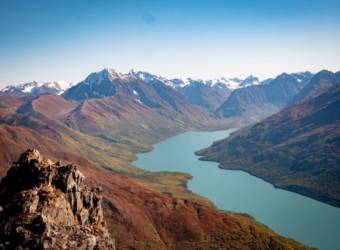
Eklutna Lake is tucked into the Chugach Mountains not far from Anchorage. (Abbey Collins/Alaska Public Media)
Williams and Smith want to use the project at Eklutna Lake, tucked in the mountains outside of Anchorage, as a kind of battery: When winds create more energy than Alaskans need, the extra power would pump water uphill to the lake and to two new reservoirs built even higher in the mountains.
Then, in times when more power is needed, the water would be drained downhill out of the reservoirs and through an existing hydroelectric plant that connects to the lake. It’s a system known in the energy industry as “pumped hydro.”
Supporters say extra water flowing out of Eklutna Lake could actually boost salmon runs in the Eklutna River downstream — a major difference from another major hydroelectric project that Alaska elected officials advanced in the past, in the Susitna River watershed.
And the Eklutna project faces no opposition from the region’s Indigenous people, according to Aaron Leggett, the president of Eklutna’s tribal government.
Dunleavy said he stumbled on the idea doing some late-night internet research and felt like “the concept had potential.”
“It makes total sense to explore pumped hydro, using wind as a main source of energy and the reservoir as the batteries,” Dunleavy said. “We have the topography to make this work.”
Alaska’s electricity costs are the second-highest of all 50 states. Dunleavy said he’d like to install more predictable energy sources, like renewables, as a means to recruit businesses to the state. He said Alaska could tap into not just wind and hydroelectric energy, but also tidal power, given the massive tides in Cook Inlet near Anchorage.
After discussing the Eklutna project with Williams and Smith, Dunleavy asked them to write a memo on their idea, which has since been published.
Dunleavy asked the Alaska Energy Authority, a state agency charged with reducing power costs, to review the proposal.
The authority has not published any of its own findings, but its preliminary analysis suggests that a pumped hydro project may have more potential near an existing state-owned hydroelectric dam at Bradley Lake, on the Kenai Peninsula, said Executive Director Curtis Thayer. He said the authority aims to produce more detailed recommendations within six months to a year.
The Eklutna project was what sparked Berkshire Hathaway Energy’s interest in Alaska, Thayer said. The authority hasn’t had detailed conversations with the company, but Berkshire Hathaway does have a copy of the memo about the project, Thayer said.
The company’s executives have held at least four phone calls with Dunleavy since he wrote to Buffett in May, according to copies of the governor’s schedules obtained through a public records request. A Berkshire Hathaway Energy spokeswoman, Jessi Strawn, declined to comment.
“I believe Alaska presents similar opportunities and would welcome the opportunity to discuss them with you,” Dunleavy wrote. “Transitioning Alaska to clean, reliable, inexpensive electricity is one of the greatest things we could do to attract additional investment, diversify and grow our economy and lower the economic burden on Alaskans in powering their homes and businesses.”
Chris Rose, who leads an advocacy organization called the Renewable Energy Alaska Project, said his group welcomes Dunleavy’s interest in efforts to make the state’s power grid more efficient.
But Rose said he wants to make sure that planning for renewable power projects is careful and strategic, not driven by political interest in megaprojects. That’s because many of Alaska’s road system utilities use relatively new power plants fueled by natural gas, and displacing them with projects that are too big could actually drive costs up, Rose said.
“We have to, I think, look at this a little bit more surgically and say, ‘We’re going to be displacing this much natural gas by putting in energy storage here, or by putting in a smaller wind farm over there,’ rather than thinking about much larger projects,” Rose said.
Rose said he’d also like to see the governor focus on efficiency efforts that might be “less sexy” than megaprojects but are already underway, like an initiative to better coordinate power generation and transmission between Alaska’s many different road system utilities.
Dunleavy said his administration is planning “a lot more” action on renewable power. And he cited his State of the State speech earlier this year, when he said he was pushing his departments to hit a 2025 goal for Alaska to produce half of its energy from renewable sources.
“I think Alaska has tremendous opportunity in this,” Dunleavy said. “Alaska is open to business, and the governor is trying to reduce energy dependence — and we’ll use any and all methods to get to that.”
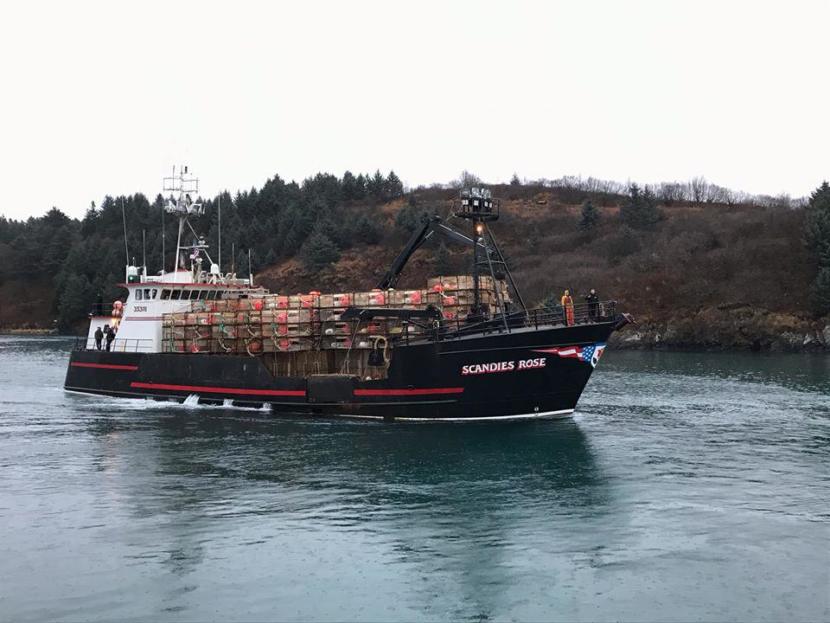
The F/V Scandies Rose, a 130-foot crab fishing vessel based in Dutch Harbor, sank on Dec. 31, 2019 with seven crew members aboard. (Photo by Gerry Cobban Knagin)
The U.S. Coast Guard is seeking help from the public in its investigation of a Dutch Harbor-based fishing vessel that was lost off the Alaska Peninsula along with five crew members.
The F/V Scandies Rose sank on New Year’s Eve about 170 miles west of Kodiak Island while en route to fish for Pacific cod. Two fishermen were rescued wearing gumby survival suits in a life raft. The other five crew members and their 130-foot crab boat were never found.
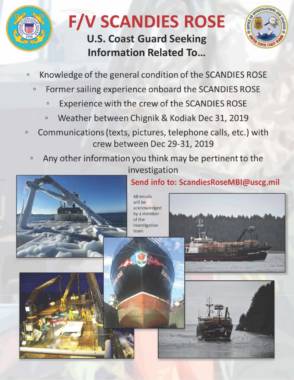
A Coast Guard flyer asks for information about the sinking of the Scandies Rose.
Coast Guard investigators would appreciate anyone with information about the vessel or conditions around the time the ship was lost to come forward, according to Petty Officer Janessa Warschkow.
“Whether that is former sailing experience on board the Scandies Rose, experience with the crew of the Scandies Rose, if you know the weather between Chiniak and Kodiak on December 31 of 2019,” she said. “Any information is helpful for the ongoing investigation.”
Warschkow said the intent of crowdsourcing information from the public is to gather facts to determine what happened, why it happened and identify any corrective measures which can be taken to prevent future tragedies.
“In this day and age, with social media being a very big platform to use for information, we do use social media and this type of thing to try and gather information from the public,” Warschkow said.
The Coast Guard has released very little information about its findings so far. And according to Warschkow, the investigation could take months or even more than a year to conclude. Eventually, she said, the agency will release its findings.
Anyone who has information on the sinking of the Scandies Rose last New Year’s Eve is asked to email ScandiesRoseMBI@uscg.mil.
Correction: A photo caption has been updated to reflect the correct date that the Scandies Rose sank. It was December 31.
Close
Update notification options
Subscribe to notifications
Subscribe
Get notifications about news related to the topics you care about. You can unsubscribe anytime.