Alaska's Energy Desk

Pandemic creates turbulent waters for Alaska’s growing oyster industry

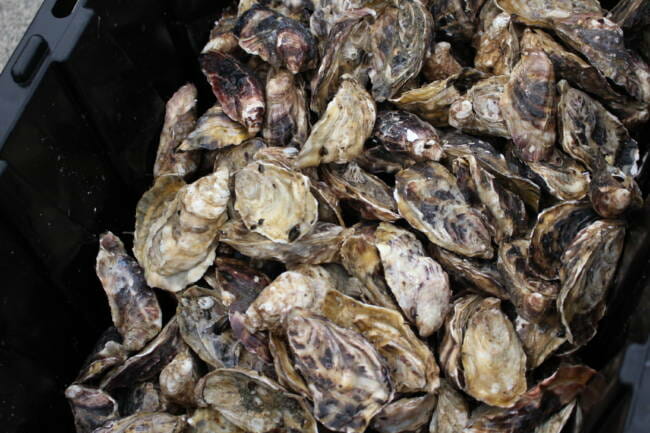
Salty Lady Seafood Company oysters. (Photo by Elizabeth Jenkins/Alaska’s Energy Desk)

Mariculture, which includes seaweed and oyster farming, has been touted as an up-and-coming industry in Alaska. A few years ago, former Gov. Bill Walker poured resources into promoting it, but the declining price of oil and a surprise pandemic has some farmers worried about the future.

Salty Lady Seafood Company is a family operation. This becomes apparent when a small skiff picks me up beachside, just a few steps off of a hiking trail in Juneau. The captain is owner Meta Mesdag’s 13-year old son. 

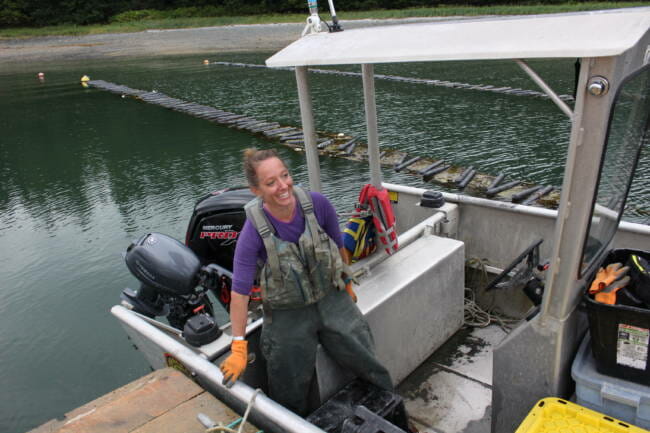
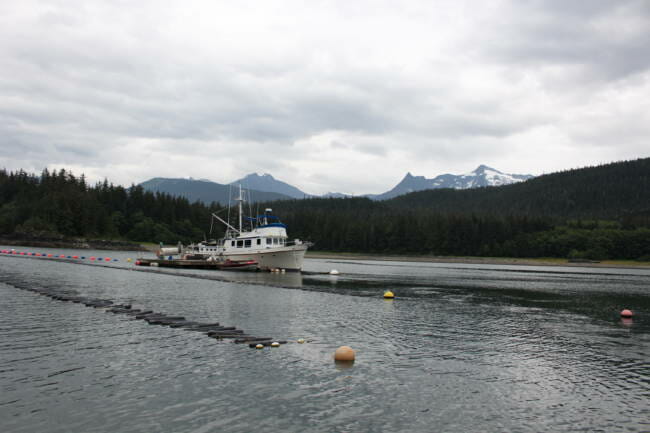
The oyster farm is located close to shore and is mostly underwater. There’s a floating dock and a large boat making up the business’s hub. When I arrive, Mesdag is just finishing up an afternoon of gathering Pacific oysters to sell in town and returning smaller ones that need more time to grow back into the water in a large square mesh container. 

Mesdag started this business two years ago as a way to get her family working outside. She wanted a new career and farming seemed like a good fit.  

“We kind of went through all our options and the cost of equipment,” Mesdag said. “And we felt like oysters were a safe thing. People generally love oysters.”
xx
Meta Mesdag is also the President of Alaska Shellfish Growers Association. (Photo by Elizabeth Jenkins/Alaska’s Energy Desk)

Other states already have a foothold on this industry. By comparison, Alaska’s mariculture startups are relatively new, and they’re being confronted by some formidable challenges. 

“I think some of the challenges that we’ve really faced that we didn’t foresee was the instability in the industry,” Mesdag said. “A lot of that is based on … state funding.”

To make sure her oysters are safe to eat, Mesdag has to get them tested by a state lab. Paralytic shellfish poisoning is a serious threat in the region. It usually takes a week or so for the bivalves to filter the toxins out, so they have to be tested weekly.

Right now, the state pays for that testing, which would cost up to $800 each week. But there are concerns the funding could go away next year. Oil prices have hit record lows in recent months and the coronavirus pandemic is compounding everything. 

Mesdag says navigating that uncertainty has made it extremely difficult to plan ahead. 

“It’s not just our farm,” Mesdag said. “I don’t think there’s any way that any farm in the state can afford up to $20 to 30 thousand dollars a year in testing fees for these small ‘ma and ‘pa farms that we have in the state.”

Before the coronavirus hit, Alaska’s Department of Environmental Conservation Commissioner proposed shifting half of the testing costs back to the mariculture industry — with the intent farmer’s would eventually pay the full price. That proposal wasn’t passed in the last legislative session. But the added strain of the pandemic on the state’s budget means that cut is likely to be taken up again in another session.

Melissa Good of Alaska Sea Grant says farmers across the state are concerned. 

“You know it could have devastating effects to the growing mariculture industry,” Good said.

Rather than pay the full testing fees, Good says there are other cost structures to be considered. She thinks it’d be beneficial to have an assessment done to see what other states are doing. 

“How do we look at these examples and help support a competitive industry?” Good said. “Because also if we nudge out our competitiveness in a broader market, that’s going to prohibit a lot of growth.”

Still, Good says the pandemic has created other issues for the mariculture industry in Alaska as a whole. A survey commissioned by Sea Grant at the beginning of the coronavirus outbreak found 43% of respondents had losses of more than half of their revenue. Good says the loss of tourism and restaurant capacity definitely affected things. 
xx
Salty Lady Seafood Company oyster farm in Juneau. (Photo by Elizabeth Jenkins/Alaska’s Energy Desk)

Mesdag says the pandemic did change some of her plans for the summer. It’s delayed her business from being able to sell oysters outside of Alaska. And she was hoping to have more wholesale buyers. For now, she’s shifting her focus to establishing winter operations. She says it’s hard to envision what next summer will look like. She’s considering opening what she calls a pop-up oyster shack. 

“It just kind of all depends on where we’re at. Everything is so unknown,” Mesdag said. “I feel like for now my main focus has to just be on my kids and getting them through school and getting the product I do have to market.”
‘A Swiss cheese moment’: how a communication breakdown stopped flights to Aniak

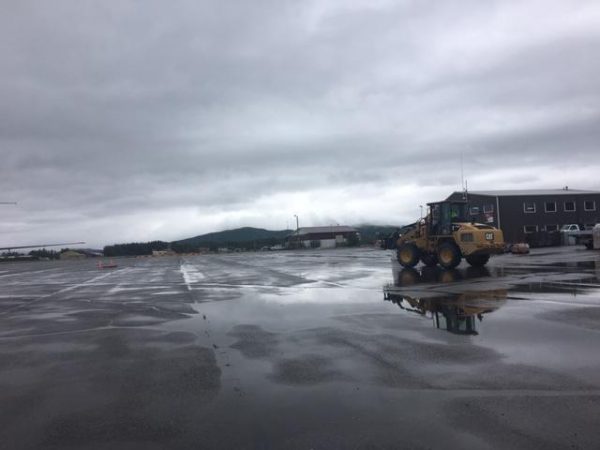
The Aniak runway is being moved 261 feet. (Krysti Shallenberger/KYUK)

Earlier in August, pilots trying to land at the Aniak airport got a last-minute notice that they were not allowed to land, disrupting cargo and passenger service into the small Yukon-Kuskokwim Delta hub. The Alaska Department of Transportation said the cause of the incident was a failure to communicate about a runway project.

According to Troy LaRue of the DOT, the Aniak runway was under construction for about three years after federal and state officials said it was too close to some homes and decided to move it 200 feet.

“So we worked for a very long time to put together a project to shift the runway in order to come into safety standards and federal compliance and shifting the runway. Eventually, you have to open one, and you have to close the other one, right?” LaRue said.

That’s what happened in August. To continue construction, DOT and the Federal Aviation Administration closed down the runway that housed the vital landing equipment. When the DOT and the FAA make a decision like that, they normally notify pilots and airlines over the radio, called a notice to airmen, or NOTAM. But this time, the radio notice was issued the day they closed the old runway instead of a few days before. And the new runway doesn’t have all the equipment pilots need to land safely.

Northern Air Cargo station manager Gideon Garcia said that it boiled down to a failure to communicate between the state and federal agencies involved in the project.

“Sort of a Swiss cheese moment when all the holes lined up in the swiss cheese and fell through the cracks, literally, and the right information wasn’t published in a timely manner to alert people that there was going to be an update from the old runway to a new runway,” Garcia said.

Garcia said that NAC couldn’t deliver bypass mail and freight for about a week. The DOT and FAA have since changed the approach to the runway so planes can land safely again.

“And gosh, I don’t think it took more than two days. And we had figured out that, ‘wait a minute, we can still use, it’s called an RNAV approach. And basically, it’s a circling approach that is designed for the old runway. We were able to modify the NOTAM to be able to put some approach procedures in place,” LaRue said.

LaRue said the RNAV approach, while not ideal, will work until they install new landing equipment, and that the department is currently investigating where they went wrong.

“If we would have started those conversations earlier, they would have been resolved earlier on, I’m pretty sure,” LaRue said.

LaRue said that they hope to have the new runway and all the landing equipment up and running by Sept. 20.

Amidst concerns about profitability, companies tout Donlin Gold test results

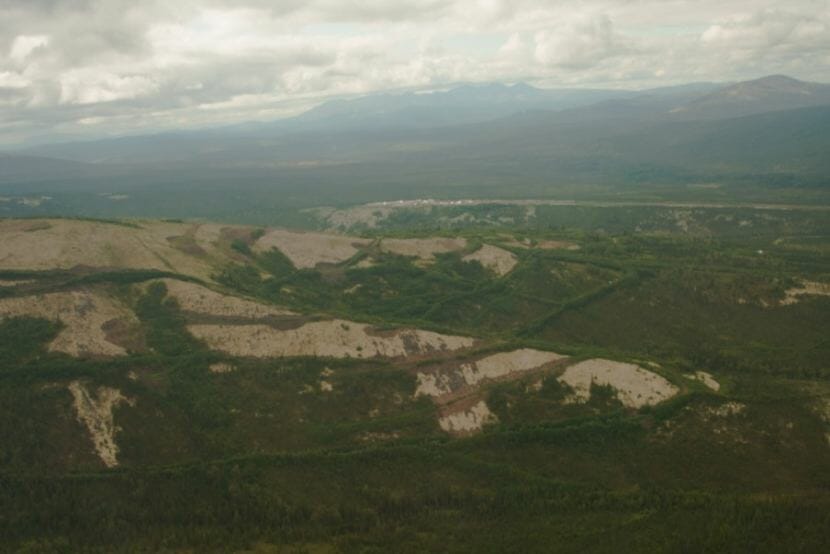
Donlin says it will get most of its major permits out of the way this year. But it still needs 100 before it can begin mining. (Photo By KYUK)

Donlin Gold is touting the results from its most ambitious drilling program yet. This news follows a recent financial report saying the mining prospect in the Yukon-Kuskokwim Delta was too expensive to build and likely not going to happen.

NovaGold and Barrick, the Canadian companies developing the Donlin mine, praised the drilling results in recent earnings calls. Melanie Hennessy, NovaGold’s vice president of corporate communications, said it shows both companies are serious about the mine’s potential.

“There is alignment between both companies on the direction and continuing focus on advancement of Donlin Gold,” said Hennessy.

Back in March, Barrick Gold CEO Mark Bristow said in an earnings call that the mine did not meet its criteria to build in its 10-year plan. Then in May, a short-selling financial research firm cited Barrick’s hesitation in a report that shed doubt on the future of the mine.

But now Barrick and Novagold appear pleased with the results from the drilling program so far, according to a transcript from Barrick Gold’s latest earnings call.

Barrick Gold CEO Mark Bristow told investors, “It’s a key project for Barrick, and very valuable today.”

Still, a financial analyst pointed out in the earnings call that comments from Barrick suggested that the company is more likely to sell the prospect before it’s actually built.

Greg Barnes, from TD Securities, told Bristow: “From your comments earlier on about Donlin and some of the other big projects, it sounds like you’re more of a seller of those projects than a builder in this kind of environment.”

Barrick CEO Bristow responded to Barnes: “You know that famous saying, everything’s got a price? We will sell anything as long as we feel that we’re getting more than what it’s worth or more. As I said earlier, our view is that whereas our activities in Donlin are still adding value, it’s a very substantial gold resource.”

Bristow said the biggest challenge is still how expensive it would be to build the mine. The proposed site is in a remote part of the Yukon-Kuskokwim Delta that is only accessible by plane. Developing the mine would require building a power plant, a 315-mile gas pipeline and a road, at a total cost of nearly $7 billion.

But Hennessy said the drilling results and Barrick Gold’s comments in the earrings call prove that they are serious about developing the mine.

“All that drilling that’s been done to date has been, has been quite positive,” Hennessy said.

Meanwhile, the coronavirus pandemic has slowed down Donlin’s permitting. Hennessy said the company has delayed work on the dam safety certifications. But back at the camp, none of the workers have tested positive for the virus so far.

Donlin’s COVID-19 protocols include requiring all employees have a negative test before coming into or leaving the camp. Village residents who work at the camp must test negative twice before entering the camp and before heading back to their village. Out-of-state employees also have to test twice before coming into the camp and leaving it.

“We’re using charter [planes] to deliver, to safely deliver employees to and from camp to minimize in-region travel. And we’re also doing frequent sanitization practices. We’re increasing communication onsite around hygiene and sanitization, and also looking to identify any symptoms,” Hennessy said.

Meanwhile, Donlin opponents have challenged the Alaska Department of Natural Resources’ decision to lease Donlin a right of way for its pipeline, and that challenge is still working its way through the procedural process at the agency.

Yukon mining industry sees opportunity in Port of Skagway

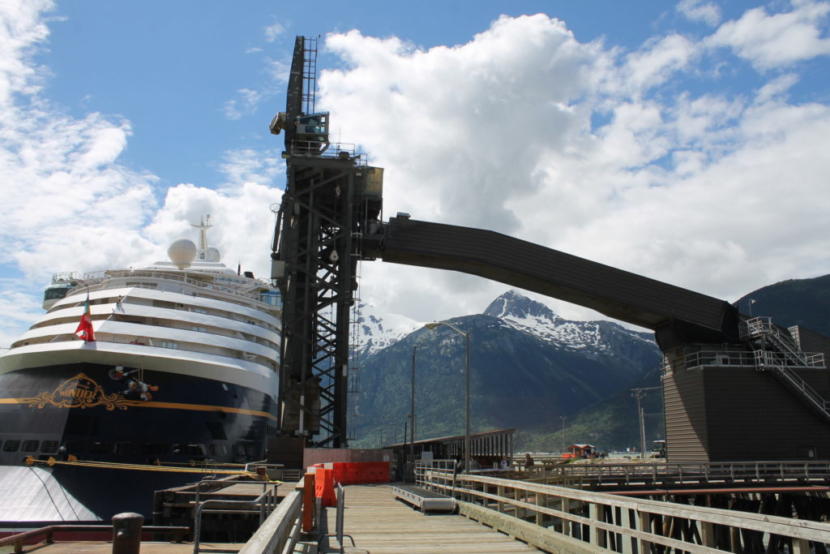
The Disney Wonder cruise ship docks near the ship loader at Skagway’s ore terminal. (Henry Leasia, KHNS – Haines)

As Skagway’s long-standing waterfront lease with tourist attraction White Pass and Yukon Route Railroad draws to a close, the municipality plans to diversify its port traffic. Yukon mining interests are paying close attention.

Jonas Smith, co-project manager for the Yukon Producers’ Group — an industry group for mining and mineral exploration companies — says Skagway is essential to mining in the Yukon.

“Skagway is a considerably shorter sailing from Asian markets than other Western North American ports,” he said. “So it’s very strategic and useful for accessing those international markets.”

Skagway’s port has been dominated by tourism interests in the last few decades, but this blossoming commercial relationship is in line with Skagway’s less recent history. Skagway was founded as the railhead for Yukon mines. The tiny Alaska port town was a gateway to the Klondike — and a gateway to the rest of the world for the Yukon.

Smith said there’s considerable mineral development moving toward actual producing mines in the Yukon. He said most of the mine projects are five to ten years out, but building the relationship is important now. And the municipality is poised to regain control over its waterfront when its lease with White Pass ends in 2023.

“We saw this as a key time to get in on the ground floor, so to speak, make sure that we were speaking to everyone involved and let them know our perspectives and our projected needs for the port, so that could be considered as this begins to take shape and the moves toward the Municipality of Skagway taking over control in 2023,” Smith said.

Smith said that as more mining projects come online in the coming decade, ore shipping could open up year-round jobs for Skagway residents.

Skagway Mayor Andrew Cremata said year-round work that’s not tied to the tourist industry is especially attractive in light of the pandemic, as he and the municipal assembly work to manage a summer without tourism.

“I see that as a really promising way to diversify our portfolio moving forward which, obviously, we’re seeing more and more as a necessity because if tourism is impacted like it is during COVID, having something to fall back on if this ever happens again, it’s paramount,” Cremata said.

In January, assembly member Orion Hansen and Mayor Cremata attended the Mineral Roundup convention — an annual regional mining conference — to learn more about industrial possibilities for the port.

Then in June, the Yukon Producers’ Group gave a presentation to the community at an assembly meeting. Smith joins Skagway’s port commission meetings via Zoom.

Cremata says the municipality plans to dedicate a portion of the port solely to commercial users, to eliminate conflict between cruise ships and industry. He wants to get feedback from future partners now.

“We want to know, when it comes time to build out that part of the port, what types of modern equipment will be used, what we want to include in that design, so that when we build it out, we have a facility that prepares us for the next 30 to 50 years of doing commerce with our partners in the Yukon,” he said.

When the waterfront lease expires in 2023, the municipality will control its deep water port for the first time in over half a century. Last fall, White Pass and Yukon Route Railroad lawyers staked claim to the waterfront, but backed off after the municipal attorney rejected its bid to renew the lease. A recent letter from White Pass and Yukon Route Railroad President Bob Berto expressed willingness to cede the tidelands to the municipality.

Indigenous leaders are reimagining Vogue covers to get the word out on Tongass

xx
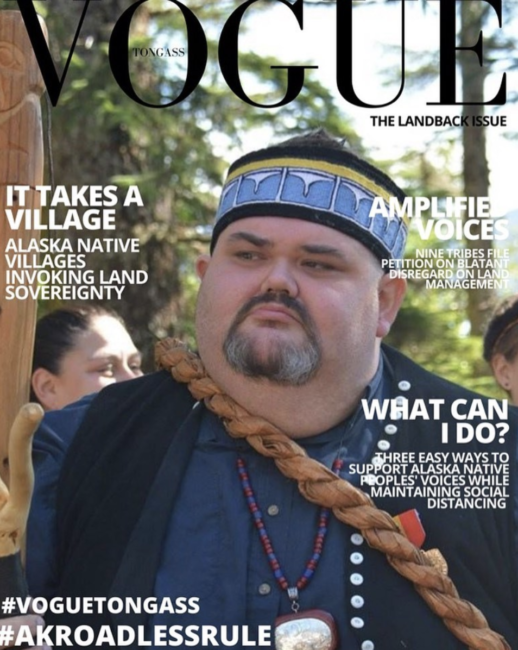
Marina Anderson on the Landback Issue of  Vogue Tongass. Tristan Douville helped put the covers together. (Photo by Bethany Goodrich)

The Roadless Rule debate for the Tongass National Forest has been going on since before social media websites even existed. But today, it’s not uncommon to scroll past conversations about the sweeping policy changes on Facebook or Instagram. In a push to get the word out before the Trump Administration makes a final decision, young, Indigenous leaders in Alaska and elsewhere are making that content extremely sharable.

Even if you’re not aware of the contentious, ongoing Roadless Rule debate, you’ve probably heard of Vogue, the high-end fashion magazine. Now, imagine combining the two: a Vogue cover with dense federal policy. 

Marina Anderson is the Tribal Administrator at the Organized Village of Kasaan, and she’s on that reimagined cover of Vogue, which includes headlines about real ordeals tribal governments have faced. It’s posted to her Instagram page. 

“Right Across the top in capital letters it says, ‘Vogue,’” she said. “And we have Vogue Tongass, and it’s called the Landback Issue.” 

Anderson isn’t the first person to use a mockup of a Vogue cover to make a point. A black, Oslo-based student started the #VogueChallenge over the summer to promote more diversity on the magazine’s covers, which have been photographed mostly by white males. Anderson says she’s been meaning to write a thank you note for the inspiration. 

She thought this approach could also be used to educate people about problems at home. 

“So immediately it’s able to draw somebody in because it’s something we’re familiar with, which is Vogue,” Anderson said.

Depending on how closely you keep up with the news, you might be aware of the major management changes underway in the Tongass National Forest. 

In 2018, the State of Alaska petitioned the United States Department of Agriculture for an exemption to the Roadless Rule. That would mean the rule that prohibits road building elsewhere on national forest land wouldn’t apply to the Tongass. Proponents say the exemption could open up access to logging and other activities. 

But lots of people, from commercial fishermen to tribal governments, have voiced strong opposition. There are concerns about what this could mean for deer and salmon habit and climate change mitigation. Recently, nine tribal governments requested another federal process to establish a Traditional Homelands Conservation Rule. The idea is to protect important areas for Tlingit, Haida and Tsimshian peoples. 

All of this is complicated, and that’s where the Vogue cover fits in. 

“I’ve been hearing that because it was catchy and easy to follow along with the Vogue covers on social media, they were finally ready to learn about it,” Anderson said.

Several Indigenous leaders and social media influencers have joined the cause, sharing their own Vogue Tongass covers. The posts are linked to a website that helps people generate letters to their local elected officials and the Secretary of the USDA. 

“A priority of the campaign was to be able to reach young people to keep the momentum up,” Anderson said. “A lot of us have a big large web, and we have the know-how to click fast on these little phones and make things happen.”

xx
(Photo courtesy of Richard Peterson)

Richard Peterson, the President of the Tlingit and Haida Indian Tribes of Alaska, has been following the proposed changes to the Roadless Rule closely for a long time, but he only recently learned about a Tongass edition of Vogue. 

“I had many people reach out and say, ‘hey, where’s your Vogue cover?’ And I was like what?”

Peterson now has his own Vogue Tongass cover, which he posted on Instagram. He says he was delighted to see this innovative way of getting the message across.

“I think a lot of people really don’t understand what the tribes’ concerns are right now,” Peterson said. “I think that’s how we can start the conversation.”

Marina Anderson thinks that’s a conversation young people should be prepared to have. The Roadless Rule has been an ongoing topic in Alaska for decades, and the debate doesn’t seem to be going away. 

“If we’re going to have to fight this fight in another 10 years, we’re going to need these people ready,” she said.

So far, she says 500 people have submitted letters supporting tribal governments. 

‘We will give you one heck of a fight’: Lawsuits filed against drilling plan for Alaska’s Arctic Refuge

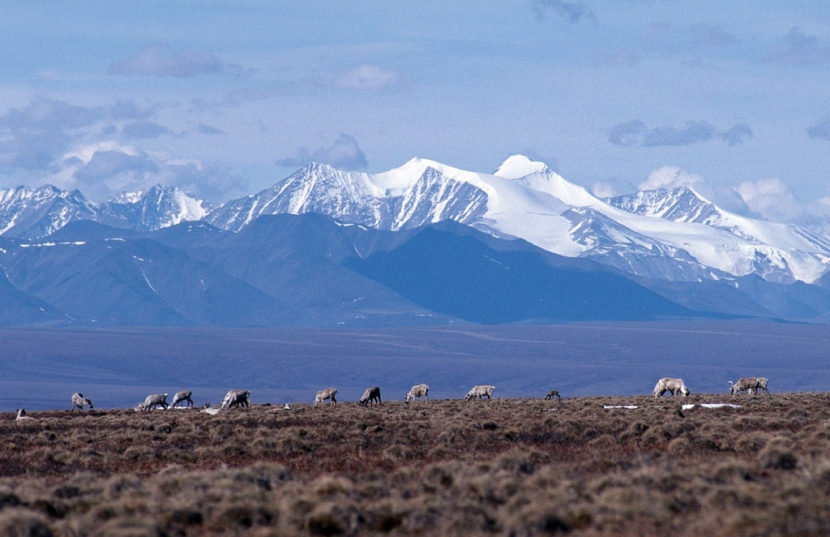
Caribou graze on the coastal plain of the Arctic National Wildlife Refuge, with the Brooks Range as a backdrop. (USFWS)

The Gwich’in Steering Committee and more than a dozen environmental groups are suing the Trump administration over its controversial plan to open up part of the Arctic National Wildlife Refuge to oil and gas development.

The two lawsuits filed Monday argue that the Bureau of Land Management’s environmental review process failed to follow numerous laws meant to protect wildlife, land, water and people.

“The remedy that we’re seeking is to throw out this illegal decision as well as any lease sale or leases that rely on it,” said Victoria Clark, executive director of Trustees for Alaska, the Anchorage-based firm representing the Gwich’in Steering Committee and other groups.

The lawsuits come a week after the BLM finalized its plans for development in the Arctic Refuge’s 1.6-million-acre coastal plain — an area roughly the size of Delaware that makes up about 8% of the vast refuge. It’s a place where caribou migrate, polar bears den and migratory birds feed. It’s also an area believed to hold billions of barrels of untapped oil.

Interior Secretary David Bernhardt has said the federal government could auction off drilling rights in the coastal plain by the end of the year.

That’s why the groups had to quickly move forward with their lawsuits, Clark said. Once leases are issued, it could be more difficult to reverse course.

“We have an administration that is just steamrolling along trying to get these decisions made,” she said.

The BLM’s development plan stems from legislation approved by Congress in 2017 that called for two lease sales in a coastal section of the Arctic Refuge within seven years.

In response to the lawsuits, the BLM released a statement Monday saying that its plan for where and when development can take place “includes extensive protections for wildlife, including caribou and polar bears.”

“This is a congressionally mandated energy development program that leaves 92% of the refuge completely off-limits to development,” it said.

But the lawsuits argue that the BLM is downplaying the impacts of drilling and that oil and gas development will cause irreparable harm to wildlife, the tundra and the climate.

“Developing Alaska’s last wild places would be a death sentence for polar bears and other threatened Arctic species. The oil industry just doesn’t belong in the Arctic National Wildlife Refuge,” said a statement from Kristen Monsell, a senior attorney at the Center for Biological Diversity, a group behind the second lawsuit.

On a call with reporters Monday, Gwich’in Steering Committee’s executive director Bernadette Demientieff said the Gwich’in people feel attacked by the government.

“We are not asking for anything but the ability to continue to live and thrive off the land that has sustained us for thousands and thousands of years,” she said.

Demientieff is from the Yukon River community of Fort Yukon, and she’s one of the highest profile leaders among the Gwich’in, an indigenous group spread between Alaska and Canada whose members harvest caribou that give birth in the Arctic Refuge.

Demientieff described the coastal plain as pristine and sacred and vowed to protect it.

“We will give you one heck of a fight,” she said.

Site notifications
Update notification options
Subscribe to notifications