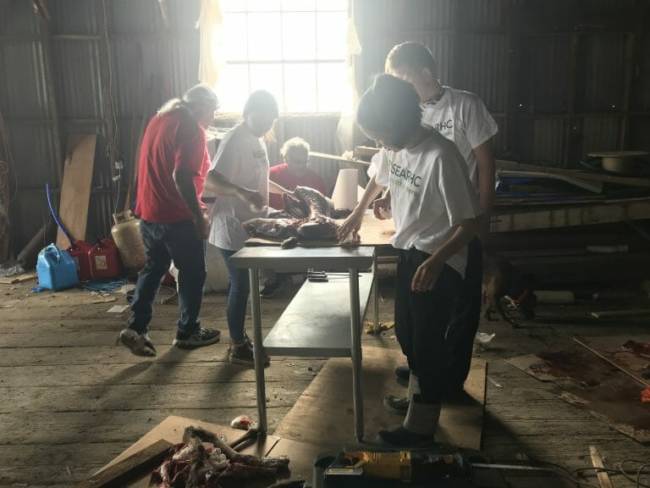
Kake Youth Conservation Corps help butcher one of five deer obtained under the emergency season. (Photo courtesy of the Organized Village of Kake)
Alaska tribal governments and organizations are asking the State of Alaska to withdraw a lawsuit filed recently in federal court. The lawsuit alleges the federal Office of Subsistence Management overstepped its authority when it granted the Organized Village of Kake a special hunting action during the pandemic.
Richard Peterson, the President of Central Council Tlingit and Haida Indian Tribes of Alaska, says he wasn’t surprised by the state’s lawsuit, but he was disappointed.
“I think our state should have better things to do right now than sue its own people and communities during a time of the pandemic,” he said.
Over the summer, the federal Office of Subsistence Management granted Kake’s request. The community was able to harvest up to two moose and five male Sitka black-tailed deer. But the Alaska Department of Fish & Game Commissioner didn’t think that was warranted. A state emergency command unit deemed there wasn’t a food security issue. However, Kake’s Tribal President maintained it wasn’t just about food scarcity. It was about the health of village Elders and having access to culturally nourishing food during the pandemic.
The joint-statement issued by President Peterson and other tribal leaders calls the state’s lawsuit “a disgraceful continuation of outdated, exclusionary, racist management practices.”
“They should be working with us,” Peterson said. “They should’ve been applauding a community, a tribe providing for a community during this time.”
In an emailed statement, the Alaska Fish & Game Commissioner Doug Vincent-Lang said, “The State of Alaska is not opposed to the indigenous way of life of native Alaskans.” The agency will continue to pursue the lawsuit because they believe recent decisions are illegal under federal policy.
According to the federal Office of Subsistence Management, 12 special action hunting or fishing requests have been made across Alaska since the start of the pandemic.
“A couple of our staff reached out to Donlin to use a picture from their website,” said Dan Walker, then-superintendent of the Lower Kuskokwim School District, in February. He retired at the end of July.
For nearly a decade, LKSD, the biggest school district in the Yukon-Kuskokwim Delta, has been developing a place-based curriculum for its students. Typically, textbooks used in other parts of the country are not applicable to students in rural Alaska.
“In textbooks you see things like sidewalks and paved streets and stoplights,” Walker said. “And most of our kids don’t have any experience with sidewalks.”
LKSD wanted to create its own curriculum that would use the region’s resources and its history to teach kids about social sciences, health and ecology. Then that textbook would be translated into Yugtun, the Yup’ik language.
This is where it gets back to the proposed Donlin Gold mine.
The mining prospect has been around for decades, since the regional Native corporation, Calista, leased the mineral rights in 1980s. In the Yukon-Kuskokwim Delta, nearly everyone has heard of Donlin Gold.
A team of teachers began drafting a curriculum for fifth graders that focused on human impact to the environment. That included the impact of the proposed Donlin Gold mine. A draft of the curriculum obtained by Alaska’s Energy Desk showed that it featured Alaskans from the community voicing their opinions about the mine. For example, Bethel resident and tribal member of the Orutsararmiut Native Council, Bev Hoffman, speaks out against the mine in the curriculum. Thom Leonard, spokesperson for the Calista Corporation, speaks out in support.
The curriculum was almost ready in early January of this year — all that was missing was a few photos. So an LKSD employee, Mike Gehman, emailed Donlin Gold to request a photo. He included part of the curriculum, according to records obtained by Alaska’s Energy Desk.
Donlin Gold’s Kristina Woolston emailed back:
“I would like to work with you on the information you include in your class curriculum. This piece contains a number of things that are factually incorrect. We would like the opportunity to correct them, at the very least perhaps we can give a presentation to the class. It’s important to everyone that the information be correct. Thank you.”
Gehman agreed, and worked to set up a time to meet. Another Donlin employee, Vernon Chimegalrea, looped in Calista Corporation, which owns the mineral rights, and suggested that LKSD use Yugtun linguists recommended by Calista and Donlin’s Bethel-based community engagement team.
Gehman replied that the school district already had Yugtun linguists working on the curriculum, but was willing to go over any factual errors. Gehman again expressed the district’s interest in using photos of the mine site.
“I hope that will be discussed,” he wrote.
Woolston emailed back: “Apologies for not clarifying, but you have our approval to use the photos once the content is revised.”
In late January, Calista Vice President of Land and Natural Resources Tisha Kuhns, who used to work for Donlin and grew up in Bethel, sent a letter to the LKSD school board outlining Calista and Donlin’s concerns about the curriculum. But it did not list any specific errors.
A few days later, Kuhns emailed Gehman with their suggested edits.
In an interview with KYUK, Woolston said that Donlin’s main issue with the curriculum was the tone.
“The tone created fear,” Woolston said.
She said the curriculum didn’t focus on the nuances of the mining operations, and it implied that mining pollution from its waste was inevitable.
“We did not feel like it was objective to say that this would happen, so that was part of our concern as we wanted to have a more neutral tone about that,” Woolston said.
LKSD did not want to be caught up in the controversy over the mining project.
A few days after Calista sent the letter to the board, LKSD made its final decision: The district erased all mention of the proposed Donlin Gold mine.
“We’re moving forward,” Walker said. “I think there are ways for us as educators to capture the issue of humans and our impact on the environment without specifically relating it to Donlin Gold.”
Donlin wouldn’t say whether it supported Walker’s decision to remove the mine from the curriculum.
Woolston said that Donlin Gold is forging ahead with its investment into the region. The company has about $1 million each year that it puts into various projects and organizations.
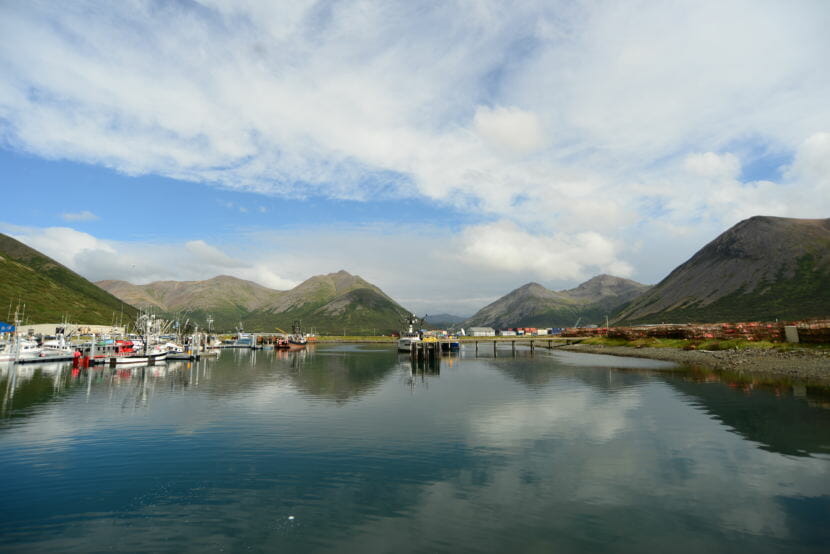
The Alaska Peninsula fishing village of King Cove has pushed for construction of a road through the Izembek National Wildlife Refuge, which residents say would allow more consistent access to a jet runway in neighboring Cold Bay for medical evacuations. (Photo by Berett Wilber/KUCB)
President Donald Trump’s administration has appealed a federal judge’s rejection of a plan aimed at building a road through the Izembek National Wildlife Refuge on the Alaska Peninsula.
Two months ago, Judge John Sedwick threw out a land trade between the federal government and an Alaska Native village corporation aimed at advancing the road project. He said the trade was illegal because it violated two separate federal laws, the Administrative Procedure Act and the Alaska National Interest Lands Conservation Act.
The Trump administration issued a notice Friday saying it would appeal the ruling.
Residents of the isolated Alaska Peninsula village of King Cove, with support from Alaska elected leaders, have pushed for construction of the road for decades. They say a road would make it easier to reach the nearby airport in the town of Cold Bay for lifesaving medical evacuations.
Environmental groups argue that the road could still be impassable during the winter and foul weather and that construction and traffic could harm Izembek’s birds and wildlife.
This is the second time the Trump administration’s land exchange has been challenged in federal court. An earlier version was also thrown out by a different federal judge last year.
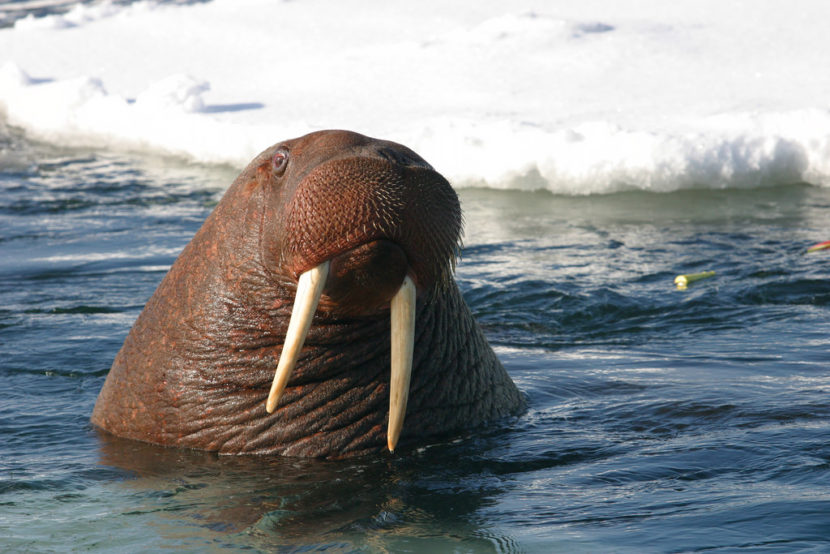
A young Pacific Walrus bull in coastal Alaska waters. (Photo by Joel Garlich-Miller/USFWS)
Point Lay and the nearby beaches of Cape Lisburne might seem like popular spots for walruses, but the haulouts there are a recent phenomenon.
“We had a few times that they gathered,” Point Lay resident Allen Upicksoun told U.S. Fish and Wildlife workers in 2018. “They’d say, ‘lots of walrus up north.’ But there were 10 to 12, not 40,000.”
Since 2007, walruses have been hauling out on land between their hunts. Before then, they’d populate sea ice patches throughout the Arctic. Fish and Wildlife spokeswoman Andrea Medeiros says that sea ice hasn’t been as reliable in recent years.
“As the ice has retreated further north in the summer times, the walruses have been hauling out on land in larger numbers and for longer periods of time,” Medeiros said.
And Upicksoun of Point Lay wasn’t exaggerating about the numbers. Medeiros says that upwards of 50,000 walruses have been hauling out on Arctic shores since the decline in sea ice.
And that’s led to myriad new issues, especially due to the walruses’ temperaments. Medeiros says in the past, the ice allowed for safe respite for the marine mammals.
“They can just, if something disturbs them, drop off into the water,” Medeiros said. “So when they’re on land, they tend to be skittish.”
If 10 or 12 walruses were hauling out on shores, being skittish wouldn’t be that big of a deal. But the average pacific walrus weighs more than a ton, and when 50,000 of those heavy animals panic in a tight space, Medeiros says there’s a high risk for mortality among the smaller ones.
“They’ll stampede into the water, and in that process, any weak animals — any animals that are young and small — can get trampled and severely injured and sometimes are killed,” Medeiros said.
For Point Lay locals like Julie Itta, this is a risk to those who rely on the walrus as part of their subsistence diet. She told Fish and Wildlife interviewers in 2018 that the people of Point Lay have a traditional connection with the animals that spans generations.
“That’s something that this village has always been strong in, is that spirituality we have with our animals. Because they provide for us,” Itta said. “So if you’re not taking care and respecting them in the way that you’re supposed to, they won’t give themselves to you.”
Point Lay residents sometimes are able to harvest the animals that are trampled due to stampedes, but only if they’re able to get to them in time. For them, a better solution is to prevent disturbances in the first place. That means constantly monitoring the walruses to make sure they’re alright and penalizing those who get too close.
Last year, two pilots were fined $3,000 for disrupting a haul out in 2017. It was deemed a violation of the Marine Mammal Protection Act.
Upicksoun says it’s all a way to make sure that the life cycle for both the residents in the village and their marine mammal neighbors can remain fruitful.
“Walrus are important because of the animal chain,” Upicksoun said. “They go down and harvest small animals, and the small animals depend on them. We depend on them. It’s all part of the animal chain.”
Fish and Wildlife officials expect the walruses to haul out on the shores near Point Lay through October.
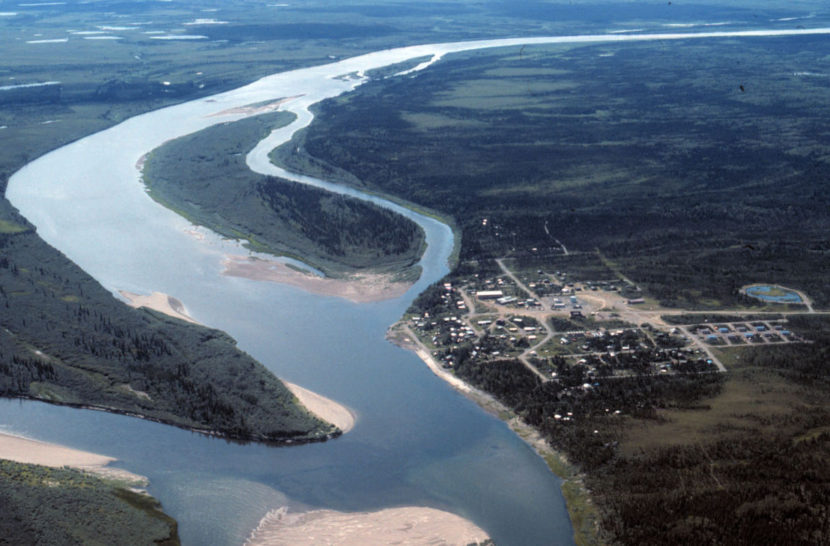
Aerial view of Ambler and the Kobuk River in the summer. (Photo courtesy of the National Park Service via UAF Gates of the Arctic Research Portal)
Nine environmental groups are suing the Trump administration for approving the 211-mile Ambler Road project.
“The agencies don’t have enough information to be issuing these permits in the first place,” said Bridget Psarianos, an attorney representing the plaintiffs. “And this environmental review process should never have even been allowed to move forward.”
On July 23rd, the Bureau of Land Management approved a route for the controversial project, a private-access gravel road that would extend from the Dalton Highway to the Ambler Mining District in Northwest Alaska, through Gates of the Arctic National Preserve.
In a lawsuit filed in the U.S. District Court for Alaska Tuesday, plaintiffs wrote that federal agencies failed to comply with several acts — including the Alaska National Interest Lands Conservation Act, the Clean Water Act and the National Environmental Policy Act — when pushing the project forward.
The nine plaintiffs in the case are the Northern Alaska Environmental Center, Alaska Wildlife Alliance, the Center for Biological Diversity, Earthworks, the National Audubon Society, the National Parks Conservation Association, the Sierra Club, the Wilderness Society and Winter Wildlands Alliance.
The Alaska Industrial Development and Export Authority (AIDEA) has been pushing the project along with federal agencies for several years. The state agency is in charge of making investments and providing loans to various business interests across the state.
Psarianos says permits were issued for the project at different stages of the road’s design, and should be voided.
“We’re asking the court to completely vacate and set aside these permits and pretty much wipe the slate clean and send AIDEA and the agencies back to the drawing board,” Psarianos said.
Mining companies hope to use the road to access deposits of copper and other metals in the Ambler mining district, then to truck ore out. The road has drawn concerns from environmentalists and tribal governments over impacts to wetlands and subsistence hunting in the region.
In a brief email statement, AIDEA spokesman Karsten Rodvik wrote that the state agency is aware of the lawsuit and “the matter is under review and consideration.”
The U.S. Army Corps of Engineers’ final environmental review of Pebble says that under normal operations, it does not expect the mine to have a significant effect on fish populations in Bristol Bay. But the Corps does say the mine would harm fish around the mine site. Some scientists say the project could also put a specific salmon population in the Koktuli River at risk and remove genetic diversity from the region.
The mine would be built at the headwaters of the Koktuli River drainage, and it would eliminate about 20% of available habitat there, though the Corps says that does not necessarily represent fish habitat.
Daniel Schindler has spent decades studying salmon in the Bristol Bay watershed. He’s a professor of fisheries sciences at the University of Washington
“If you looked at the Koktuli all by itself, and you assumed that all sockeye salmon are interchangeable across all of Bristol Bay, then you would say that the Koktuli River is a very small piece of habitat, and it’s not that important,” he said.
According to Schindler, the variety of different life strategies and genetic identities of sockeye throughout Bristol Bay ultimately stabilizes the returns of fish back to the rivers every year.
“When you realize that the fish that breed and succeed in the Koktuli River are adapted to that specific place, then you realize that the fish are not interchangeable from place to place and in terms of impacts of development, that specific population is distinctly at risk, because the whole population is downstream of where a mine would be,” he says.
In its analysis of the Pebble mine proposal, the Army Corps says the project would eliminate almost 100 miles of streambed habitat; it would permanently destroy around 22 miles of aquatic habitat in the North and South Fork Koktuli drainages. That includes 8.5 miles of salmon habitat in the north. The Corps says constructing the mine would result in some decline in productivity, but it says that loss of habitat is not expected to have a “measurable impact” on fish populations in the area.
The Environmental Protection Agency is concerned. In late May, the EPA wrote a letter to the Army Corps, citing data suggesting that fish in different tributaries of the Nushagak are genetically distinct from one another — including the Koktuli sockeye population.
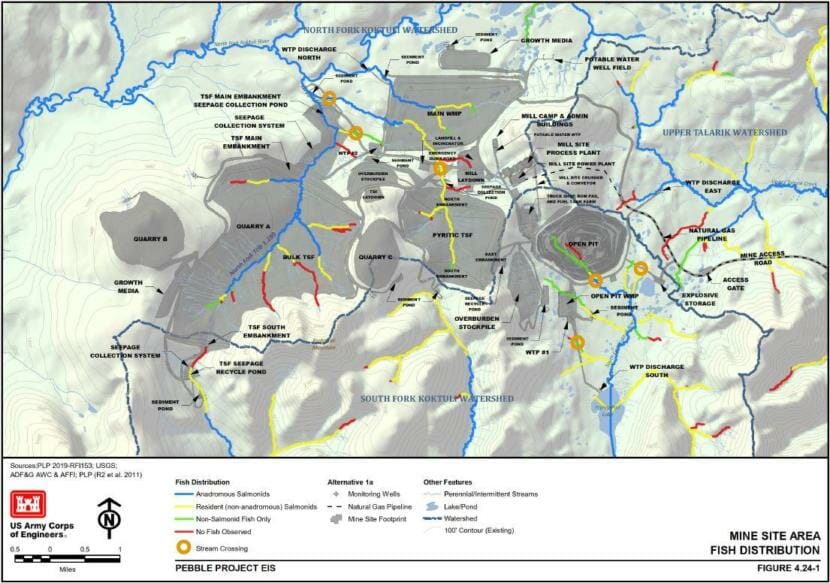
A map of fish streams around the proposed mine site. (U.S. Army Corps of Engineers)
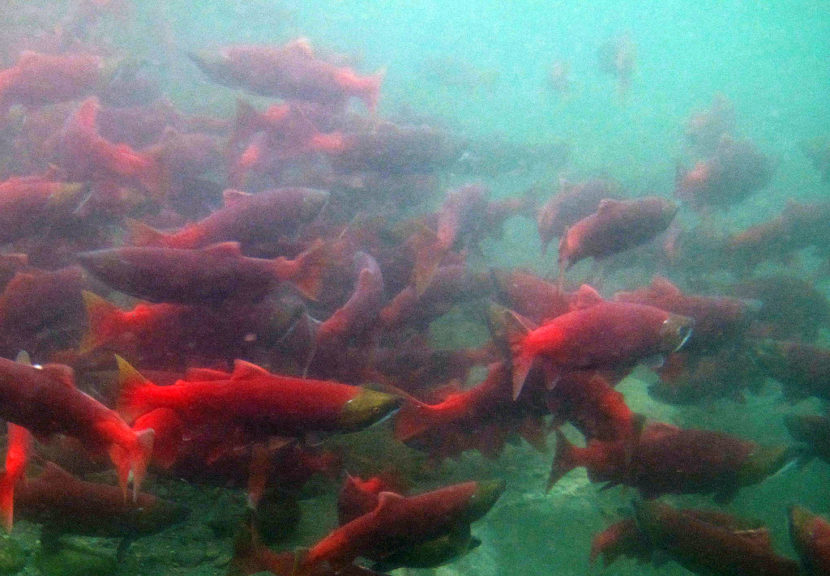
Koktuli sockeye are river-type salmon that migrate to the ocean during their first summer of life. The more common lake-type sockeye typically spend one or two summers in lakes before migrating to the ocean Biologists estimate that a good proportion — probably about half — of the sockeye in the entire Nushagak River are river-type fish. The rest are the more common lake-type sockeye, which typically spend one or two summers in lakes before migrating to the ocean. The amount of river-type and lake-type sockeye varies from year to year.
“Sockeye salmon return to the place that they were born to spawn themselves,” Schindler explains. “And because of this tendency for them to return to their home stream, you get genetically distinct populations that develop in different parts of the watershed.”
Schindler says it’s not clear whether Koktuli sockeye are genetically distinct, but they are unusual. If the mine is built, Schindler says, a dam failure could mean the end of the Koktuli sockeye population.
“Pebble sits on the saddle between two drainages. If there was a spill into the Koktuli drainage, we know that spill would move quickly downstream, and if it happened at a time of the year when there were fish spawning in that river, or when there were embryos incubating in that river, or when there were juveniles feeding and growing in that river, a spill could potentially wipe out the entire population.”
The Army Corps says in the final EIS that the chance of a dam failure at the Pebble site is so small that it doesn’t warrant an evaluation, a claim critics dispute.
As Pebble tells it, there’s no danger. Company spokesperson Mike Heatwole said in an email the mine “will not result in a population-level effect on Koktuli River salmon or any other fish population in the region.”
Schindler says development elsewhere demonstrates the delicate relationship between salmon populations and their habitats.
“One interesting thing to consider is that when we look at rivers that we have developed heavily, like we have in the Pacific Northwest, we have moved ahead with development assuming that different populations are interchangeable with one another. And what we realized after a century of messing up rivers in the Lower 48 is that they’re not interchangeable.”
Once you lose genetic diversity, he says, it’s nearly impossible to get it back.
Close
Update notification options
Subscribe to notifications
Subscribe
Get notifications about news related to the topics you care about. You can unsubscribe anytime.