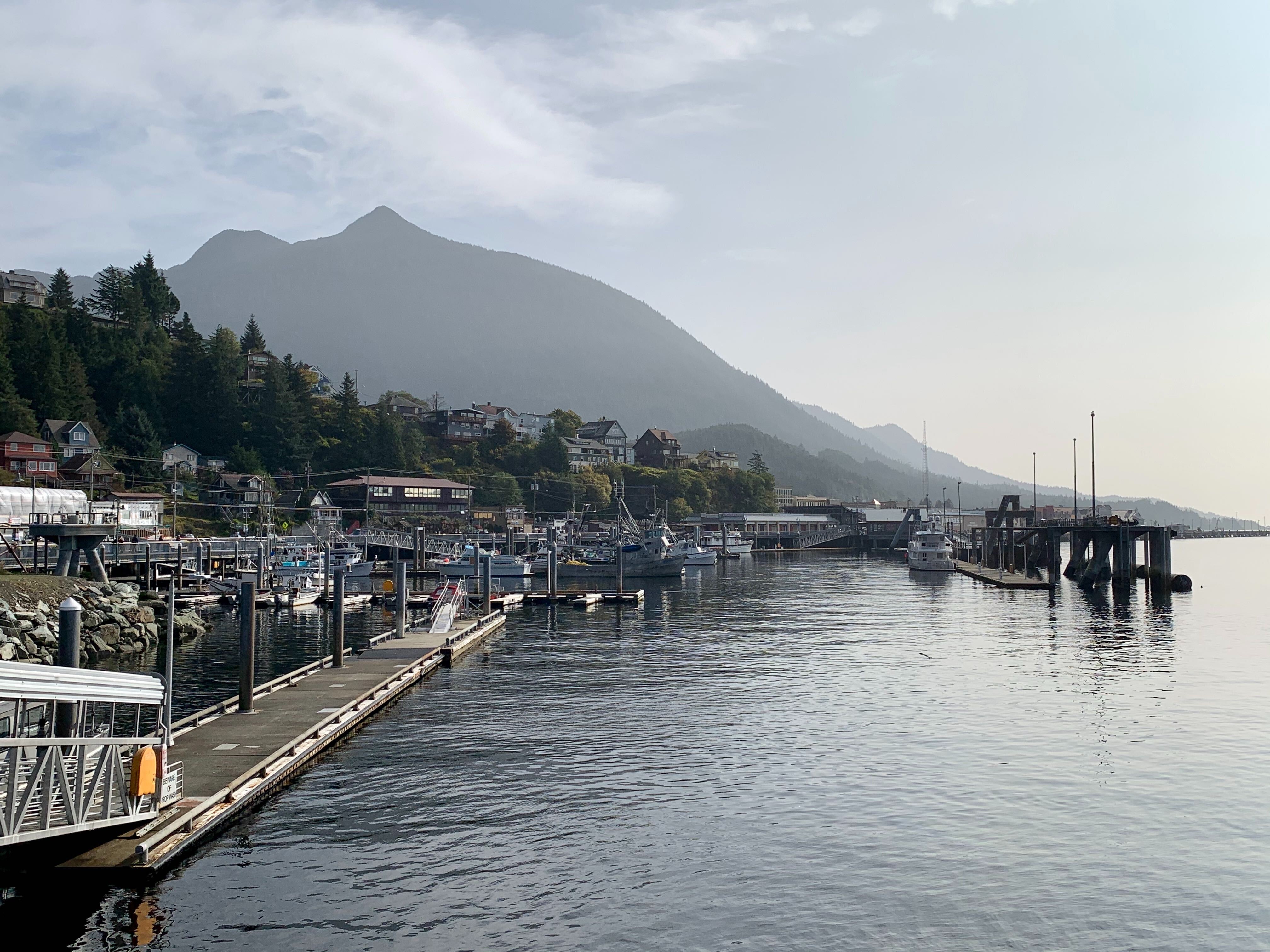
Smoky haze covered Ketchikan on Wednesday. The National Weather Service said it’s not anticipated to pose a health hazard. (Eric Stone/Alaska’s Energy Desk)
Residents in Ketchikan woke up to hazy skies Wednesday morning.
National Weather Service Forecaster Bryan Caffrey says that haze is smoke from wildfires burning on the west coast of the Lower 48.
“There’s been a low off of Washington that’s been spinning, that’s what’s helped pull it up north into British Columbia, and finally just got in this morning to Dixon Entrance and the southern panhandle,” said Caffrey.
Wildfire smoke has shattered records for poor air quality in Oregon, Washington and California.
But here in Alaska, Caffrey says the smoke is forecast to remain suspended in the atmosphere over the southern panhandle Wednesday. That means it’s not anticipated to be a health hazard.
Preliminary data from a Juneau air quality monitor run by the Alaska Department of Environmental Conservation places the area’s air quality in the “good” category. That means “little to no risk” to human health. Satellite-modeled data from company IQAir says the same for southern Southeast.
Caffrey says the smoke likely won’t get as far north as the central panhandle.
“We do have a front approaching tomorrow night. Not looking to bring any precip[itation] to the southern panhandle until maybe Friday, but that’ll help push everything back down south and east,” he said.
Smoke from the record wildfire season in California and the Pacific Northwest has been visible all over the northern half of the Lower 48.
Jeff Hastings, Chairman and and Chief Executive Officer of SAE Exploration, answers questions after his testimony before the House Resources Committee in Juneau. (Rashah McChesney/Alaska’s Energy Desk)
The former chief executive of a company that proposed conducting a seismic survey in Alaska’s Arctic Refuge was arrested in Anchorage on Friday on charges of wire fraud and securities fraud.
The federal charges are tied to Jeffrey Hastings’ work as CEO and board chairman of SAExploration, a Texas-based company that provides seismic data to the oil-and-gas industry. The company also has offices in Anchorage.
A complaint written by an FBI agent investigating the case — and unsealed on Monday — alleges that, between 2015 and August 2019, Hastings engaged in a multi-million-dollar scheme to deceive investors and artificially inflate the company’s revenue.
Hastings’ lawyer, Michael Dry, did not respond on Tuesday to requests for comment on the charges.
Among them: It says Hastings made “false and misleading statements” to the U.S. Securities and Exchange Commission. It says he created a second company, Alaskan Seismic Ventures, as a way for SAExploration to take advantage of certain Alaska oil tax credits that it wasn’t eligible for. And, it says, he set up shell organizations to move money between the two companies so Alaskan Seismic Ventures could appear “independent and financially healthy.”
The complaint does not say whether the State of Alaska was defrauded, but according to SAExploration’s most-recent annual report, Alaskan Seismic Ventures collected millions of dollars in tax credits.
The report says the Securities Exchange Commission, Department of Justice and state Department of Revenue were investigating the company’s financial statements.
Colleen Glover, Alaska’s tax director, said the state considers tax matters confidential, so the department could not comment on any potential investigations. Reports from 2016 through 2019 show that SAExploration and Alaskan Seismic Ventures did not receive any cash from the state for oil and gas tax credits during those years.
Also, according to the FBI complaint, Hastings didn’t work alone.
The complaint says he conspired with three other now-former company executives who aren’t named in the complaint. At least one agreed to help law enforcement with the investigation.
The complaint says the four of them “misappropriated” more than $6 million of SAExploration funds for “their own personal use.”
In a brief written statement Tuesday, SAExploration spokeswoman Sarah Marshall said the company is now under new management and continues “to work hard to provide the same operational excellence that our customers have come to expect.”
Marshall said Hastings was put on administrative leave more than a year ago and then resigned.
SAExploration announced in 2019 that it was under investigation by the Securities and Exchange Commission for “certain accounting matters that arose in 2015-2016.” This August, the company filed for bankruptcy and said it reached an agreement with most of its creditors to restructure its debt, the Wall Street Journal reported.
Meanwhile, Hastings had his initial appearance in federal court in Anchorage on Tuesday. He had been jailed at the Anchorage Correctional Complex since Friday.
“We just don’t want him locked up for another night,” Hastings’ lawyer told the judge.
The judge said Hastings could be released on a $500,000 bond secured by $100,000 cash. Hastings’ next court date was set for October.
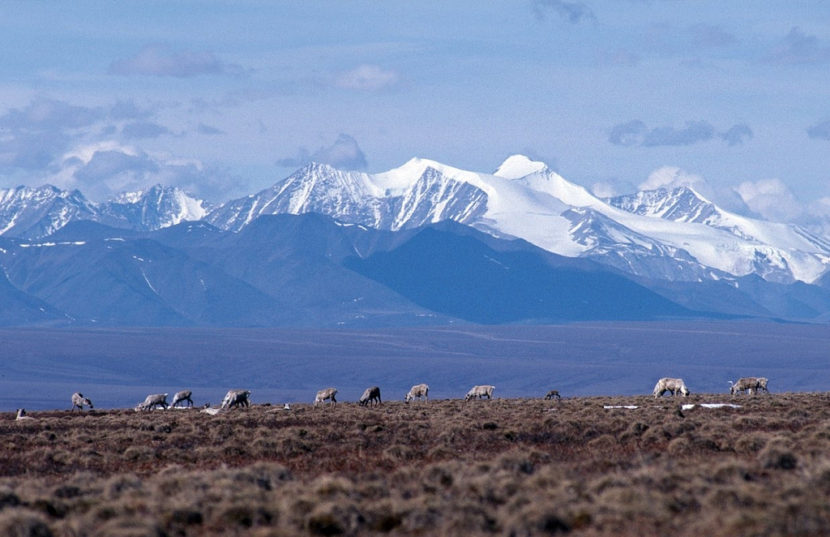
Caribou graze on the coastal plain of the Arctic National Wildlife Refuge, with the Brooks Range as a backdrop. (Public domain photo by U.S. Fish and Wildlife Service)
Alaska Native groups, environmental groups and, most recently, a coalition of 15 states have filed a flurry of lawsuits over the past month that aim to derail drilling plans for Alaska’s Arctic National Wildlife Refuge and National Petroleum Reserve.
These are separate lawsuits over separate pieces of land — a lot of land — and it’s a lot to keep track of.
Listen to the interview or read the transcript of Alaska Public Media’s Tegan Hanlon and Casey Grove trying to sort through it all.
[GROVE]: Well, let’s just get right into it. Can you briefly summarize what triggered these lawsuits?
[HANLON]: Yes. So there have been two big, recent developments when it comes to oil and gas drilling on Alaska’s North Slope.
Number one: The Trump administration announced in August its official plan for opening up part of the Arctic Refuge to oil and gas development. It’s an area called the coastal plain, and it sits to the east of Prudhoe Bay. The coastal plain makes up about 8% of the whole refuge. But the whole refuge is massive, so 8% of it is about the size of the state of Delaware.
It’s a place believed to hold billions of barrels of untapped oil, but it’s also an area where caribou migrate, polar bears den and migratory birds feed. And environmental groups have long fought to keep drilling rigs out.
And so, this official plan for oil and gas development on the land comes out in August, and Interior Secretary David Bernhardt says that the federal government could auction off drilling rights in the coastal plain to oil and gas companies by the end of the year. (Once leases are issued, it will be harder for a future president to reverse course.)
All of it is a very big deal.
[GROVE]: OK. I got that part. So, what’s number two.
Significant development number two: On the other side of Prudhoe Bay, to the west, sits Alaska’s National Petroleum Reserve, also called the NPR-A. There’s already some oil and gas development going on in the NPR-A, but there’s also land that is off-limits to drilling under the current Obama-era plan for the reserve.
But the Trump administration is working on a new management plan for the reserve, and it released its final environmental impact statement for that plan in June. The proposal would make about 80% of the NPR-A open to drilling instead of the current 50% or so. And that includes opening up the Teshekpuk Lake area — in the reserve’s northeastern corner — to drilling.
The next step is the government issuing what it calls a record of decision — or you might hear it referred to as a “ROD” — basically it’s just the final decision.
Again, all of it is also a very big deal.
And, like the Arctic Refuge, the NPR-A is also thought to hold billions of barrels of oil but it’s also an important habitat for birds and caribou and other wildlife. In both areas, there’s also concerns about impacts to subsistence, the climate and the land.
[GROVE]: And then came the lawsuits, right?
[HANLON]: Yes! And then came an avalanche of lawsuits.
Actually, two of the lawsuits related to development in the Arctic Refuge’s coastal plain were filed Wednesday.
One by a tribal government and two village councils and another by a coalition of 15 states including New Jersey and New York and Washington, but not including Alaska.
Taken together, the lawsuits are hundreds of pages.
At the most basic level the claims very broadly boil down to alleging that the federal government glossed over the impacts that oil and gas development could have on the land, wildlife, climate and subsistence. And, they say, the government failed to follow numerous environmental laws when developing the plans.
Here’s how EarthJustice attorney Kate Glover summarized the claims in one of the Arctic Refuge lawsuits:
“The problem is that BLM is pushing prioritizing oil and gas over all other purposes… all of the claims in the lawsuit are targeting their failure to take into account the impacts on Indigenous communities, wildlife, subsistence and recreational wilderness values of the refuge.”
The Bureau of Land Management counters that its actions are lawful and based on the best available science.
[GROVE]: So what’s the status of the lawsuits currently?
Well, they’re all in U.S. District Court in Alaska, so federal court. We’ve got the two just filed. And there are at least four others that are still really early on in the process.
Lawyers say the NPR-A lawsuits will likely start moving through the court process once the federal government issues its final decision on a management plan.
And, lawyers who filed two other Arctic Refuge lawsuits say they’re now waiting on the federal government to answer the complaint. One lawyer I spoke with said a ruling from the judge may not come for a year or so.
[GROVE]: Can the federal government move ahead with a lease sale with lawsuits ongoing?
[HANLON]: The short answer is: Right now, yes.
The Bureau of Land Management says “there is no legal prohibition” right now for it to move forward with a lease sale, in the case of the Arctic Refuge, or a final decision on a management plan, in the case of the NPR-A.
Then if a judge rules in a way that makes the lease sale or the management plan invalid, well, that’s a whole other conversation for us to have.
Also: I was curious if the filing of the lawsuits would have any impact on oil companies’ decisions on where to drill.
Lawyers who filed the lawsuit are hopeful that’s the case.
But Kara Moriarty who leads the Alaska Oil and Gas Association says she doubts it. She says the lawsuits aren’t surprising.
“Lawsuits have just become a way of life. And it was not surprising to us. If the industry was concerned about lawsuits these days, they’d probably never invest in Alaska anymore in the oil and gas industry. Trying to use lawsuits to keep resources in the ground has become a tried and trued page out of a playbook by groups.”
[GROVE]: Well, to close out: Any ETA at this point on a lease sale or official decision on the NPR-A management plan?
[HANLON]: No, no set date announced publicly at this point. That’s the million-dollar question.
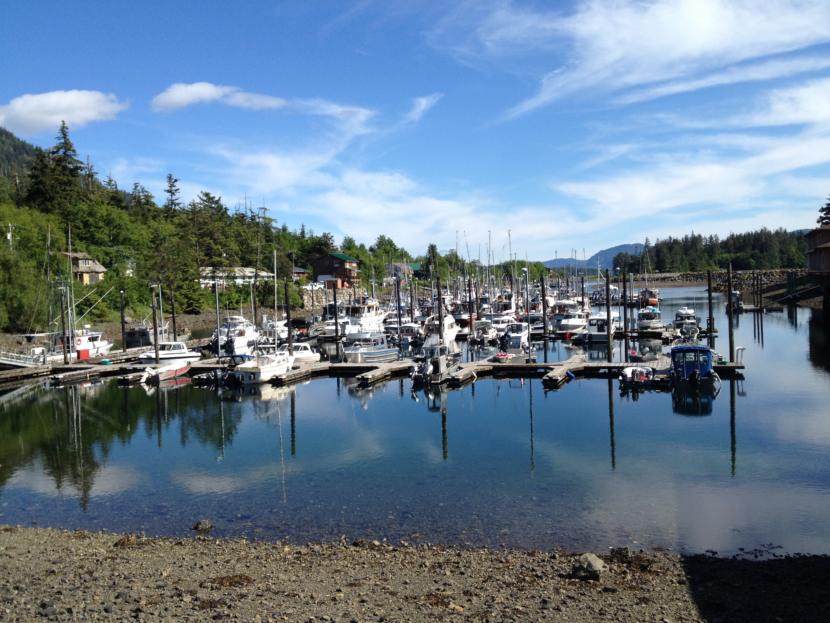
Fishing boats sit in a Craig harbor. (KRBD file photo)
The U.S. Department of Agriculture says it’s setting aside more than half a billion dollars for fishermen hurt by tariffs associated with the U.S.-China trade war. Some Alaskans are applauding the move, but others worry the program leaves some out.
Jeremy Leighton is a dive fisherman based in Ketchikan. That means he spends as many days as he can looking for sea cucumbers and geoduck clams on the cold, murky seafloor.
He was among the first Alaskans to see the impacts of the COVID-19 pandemic. Most of Alaska’s geoduck clam harvest is sold to consumers in China. When China locked down as the coronavirus spread, demand for the husky bivalves collapsed and managers closed the market.
Leighton and other fishermen were already facing a tough market — they were looking at a 25% tariff on seafood exported to China.
“So the last year prices dropped since […] the tariffs were put on,” Leighton said.
But it’s not just geoduck fishermen. Frances Leach heads up United Fishermen of Alaska, a fishing industry group.
“China seems to be one of the biggest markets for a lot of our seafood products in Alaska. And not just buying them for consumption, but also processing. We send a lot of seafood over to China to be processed,” Leach said.
Now, Leighton and thousands of other U.S. fishermen could be eligible for a new program designed to help fishermen hurt by the tariff on seafood.
It’s an Agriculture Department initiative called the Seafood Trade Relief Program. U.S. Sen. Dan Sullivan said it’s a new twist on an old trade war strategy.
“There have been long standing U.S. Department of Agriculture programs that provide relief to farmers, when their products exported are hit with retaliatory tariffs,” Sullivan said. “And what I’ve been arguing to the president and his entire team, is that if the farmers get that kind of relief, then our fishermen should get that kind of relief as well.”
Sullivan called the program “historic.” He says it’s the first time the USDA has set aside money for fishermen in response to retaliatory tariffs, though other federal agencies and programs often provide assistance to Alaska fishermen.
A wide variety of fishermen are eligible. The USDA says it’ll provide cash transfers based on licensed fishermen’s total 2019 landings — 16 cents a pound for salmon, 4 cents a pound for herring and a whopping 76 cents per pound for geoduck clams.
“Sixteen of the 19 species included in the program are harvested in Alaska,” Sullivan said.
That includes four kinds of crab, Alaska pollock, sablefish and more.
So, $500 million for fishermen: great news, right?
“We probably have, I would say, more questions than we have answers at this point in time,” said Southeast Alaska Regional Dive Fisheries Association Co-Executive Director Phil Doherty.
He said he’s concerned that one key species often exported to China was left off the list: sea cucumbers.
Leach, the UFA director, said that’s because that fishery didn’t see a big enough loss due to tariffs, based on USDA’s calculations. She said halibut didn’t meet the threshold, either.
“And the reason for that is because halibut is a domestic market. We don’t market that as much internationally, so it was — halibut was not impacted as much by the trade war,” Leach said.
But she encourages anyone who might be eligible to apply.
“The fish haven’t been coming back — a lot of species are not doing so well. So commercial fishermen have really seen a downturn in a lot of areas,” she said. “My advice to commercial fishermen is that if there’s this opportunity to get some funding, to go on and apply for it.”
Leighton, the geoduck and sea cucumber diver, says he’s not sure whether he will. He says he hasn’t had much luck with federal pandemic aid programs yet.
“It’s difficult for us to actually get them. I’ve applied for three of them and I’ve gotten $1,000,” he said.
He says it’s hard to keep track of all the paperwork — receipts, bills, and such. He says he’ll take a look at the requirements and decide whether to apply.
The application for the Seafood Trade Relief Program goes live Sept. 14 and is open through Dec. 14. You can find that at farmers.gov/seafood.
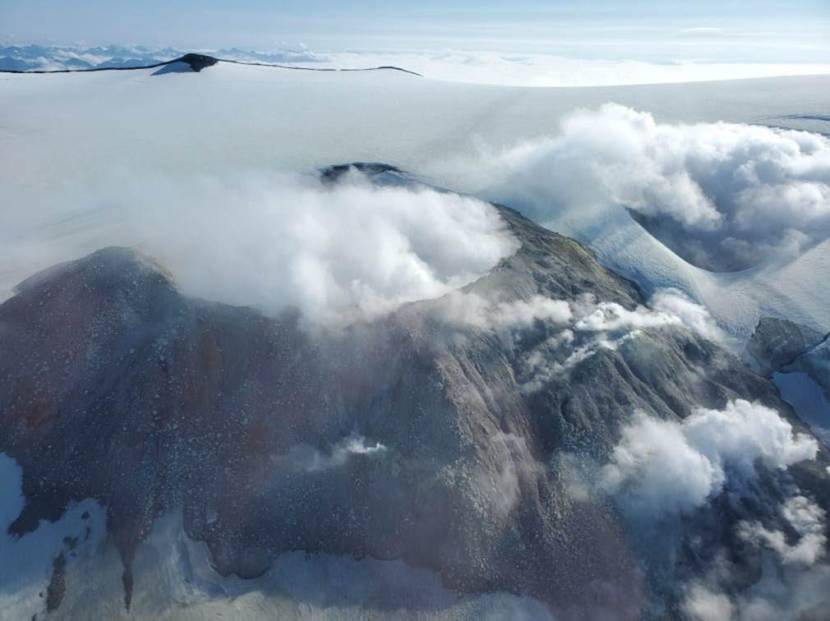
Ounalashka Corp./Chena Power estimates the Makushin Geothermal Project will begin operations in the final quarter of 2023. (Givey Kochanowski / U.S. Department of Energy)
A decades-long effort to bring geothermal power to Unalaska is finally moving forward. On Thursday, the city signed a 30-year power purchase agreement with Ounalashka Corp./Chena Power, LLC for 30 megawatts of geothermal-produced electrical energy from nearby Makushin Volcano. Officials from the U.S. Department of Energy said that if it’s successful, Unalaska would be the first community in the nation completely powered by geothermal energy.
Unalaska has been trying for nearly four decades to find an affordable way to build a geothermal power plant for the city at Makushin. But the plans of private developers have fallen through, largely due to high start-up costs. The last attempt was abandoned in 2015.
“It’s been a long-time priority of the city council to really explore alternative energy sources for electricity,” said City Manager Erin Reinders, who signed the agreement on Thursday. “And this project in particular has been on various radars since the 1980s, at least. So it’s pretty exciting to have the project be as far as it is, and I’m looking forward to seeing what the future holds.”
In 2019, Ounalashka Corp. — the island’s Native village corporation — and Fairbanks-based Chena Power formed Ounalashka Corp./Chena Power, LLC, a partnership to develop the geothermal resource located about 13 miles from Unalaska’s current power grid.
“What makes this [time] different is that we’ve put together a team of Alaskans with a common vision and proven local, national and international business and technical leadership,” said Chris Salts, CEO of Ounalashka Corp. “We know this can be transformational for our community and our future role in the world and we’re all pulling in the same direction to see it realized.”
Negotiations have been underway since early January between the city and OCCP to develop the purchase agreement, which is required to obtain financing for the Makushin Geothermal Project. According to the agreement, the City of Unalaska will purchase electrical energy for $16,300,000 per year from OCCP. Each successive year during the term, the fixed payment will increase by one percent plus an amount equal to the local tax paid by OCCP during the previous year.
But it’s still unclear how geothermal would stack up to Unalaska’s diesel powerhouse, which has been the island’s only electricity provider since World War II. Community members and city leadership have expressed concerns about the financial risk of the project to ratepayers and that seafood processing plants (self-producers of energy) are unable to make a long-term commitment and haven’t come on board.
“Ultimately, this is a public utility that’s paid for by the ratepayers,” Reinders said. “So, there’s a potential that the rates would increase moving forward, so we can pay our bill. But ultimately, those would be discussions that would be held at the [City] Council level.”
According to Mike Hubbard, a city consultant from the Financial Engineering Company, sales to the processors are key to the economics of Makushin. In a report to the council on July 17, he said that the effect Makushin is projected to have on city retail rates as compared to continued use of diesel generation are dependent on a number of assumptions about future events, most notably the cost of fuel.
“If actual fuel prices are greater than the breakeven price, the project would provide benefits to the ratepayers,” he said in the report. “Conversely, if actual prices are less than the breakeven price, the project would result in additional costs to the ratepayers.”
Givey Kochanowski, Alaska senior advisor for the U.S. Department of Energy Office of Indian Energy, helps tribes and Native corporations advance energy interests and promotes energy sovereignty for tribes. He said while fossil fuel rates fluctuate, the beauty of renewable power is that you’re hedging against future rate increases.
“If you look at your average cost of energy here, in general, the trend line is that it’s going to rise in the future,” Kochanowski said. “The beauty about renewables is once you’ve installed the hardware, you have a fixed cost for the fuel, whatever it is — whether it’s the wind, the sun with solar, or geothermal.”
Bernie Karl, co-founder of OCCP, and self-proclaimed “imagineer” of the Makushin Geothermal Project, started the first geothermal power plant in Alaska at Chena Hot Springs in 1998 and will be moving to Unalaska to head up the project at Makushin. He said he’s not “in the least bit worried” about the processors not wanting to buy power.
“It’s just so simple, build it now and they will come,” he said. “I don’t blame the processors for not wanting to sign a 30-year agreement.”
In the long run, Karl said, purchasing geothermal power from the city will be more reasonable for processors than maintaining and running diesel generators. And the more power OCCP sells, the cheaper it gets for the city, and the cheaper it gets for them.
“I think they’re going to be wanting more power maybe than we can produce,” he said. “I think they’re going to want to grow. I think they’re going to want to expand. I think they’re going to see other opportunities, and we will work closely with them to help them with the new opportunities that they see.”
U.S. Rep. Tulsi Gabbard of Hawaii visited Unalaska in late August in her capacity as a major in the U.S. Army Reserve. She came as part of a Department of Defense Innovative Readiness Training mission to assess the island’s future infrastructure needs: everything from what to do with the city’s brimming landfill and the airport’s short runway to shortcomings in health care and slower than average internet speeds.
Gabbard also introduced the Off Fossil Fuels for a Better Future Act, or OFF Act, in Congress in 2017 to promote a “just transition” away from fossil fuels to 100 percent clean energy by 2035. She said she’s excited about the opportunity for geothermal as a clean, renewable source of energy for Unalaska.
“I come from an island state in Hawaii. So I understand uniquely the food security and energy security challenges that exist when you live on an island, where you have maybe five to seven days of food supply at any given time, and where you’re reliant on external sources for energy,” said Gabbard. “The opportunity allows you to increase your food security through being able to power greenhouses and allows you to grow food here year-round. And it’s also directly tied into the security component of this island chain being centrally located in the Arctic region that is now becoming more and more active.”
Kochanowski similarly recognizes the strategic location of the island and believes the first step towards national security is energy security.
One of President Donald Trump’s objectives is to be “energy dominant,” said Kochanowski — a doctrine Trump has championed since the early days of his presidency to reduce reliance on foreign locations for energy sources and instead develop the country’s natural gas, coal and petroleum sources.
Although Trump’s plan attempts to roll back environmental regulations, Kochanowski said the objective of developing domestic energy security is a necessary one. He said it’s especially important in the Aleutians, which are gaining strategic importance as Russia and China work to expand their influence in the Arctic and commercial and leisure/tourism ship traffic increases across the Bering Strait.
“At some point, as we just saw in the news with the Russians being in American waters these last couple days, there’s going to be a need for a stronger security posture up here,” Kochanowski said.
According to the Coast Guard, the Russian ships were in international waters, not American waters, but within the U.S. “exclusive economic zone” — an area that reserves fishing rights for American boats.
The U.S. Department of Defense (DoD) is the nation’s largest energy user and has a goal of producing or procuring 25 percent of its electricity from renewable sources by 2025. According to Kochanowski, Unalaska is making a good effort to engage with the military and key federal agencies that have a say in the community’s security and future, as well as national security due to the island’s location. But, he said, military installations and security points in Alaska require safe, secure and reliable energy.
“When it comes to power, geothermal will bring us the opportunity that none of this other stuff can do for us right now, and that’s bring a diversification of our economy,” said Vice Mayor Dennis Robinson during a City Council meeting in late August where councilors approved a resolution in a 5-1 vote to allow Reinders to sign the purchase agreement. “If we hope to have the military come here in some capacity, green power is going to be required.”
State legislators, city officials and tribal and community leaders have been discussing a greater military presence in the Aleutian Islands. And for the first time in more than 30 years, the U.S. Navy and Marine Corps have held large-scale exercises in the Aleutians designed to test their capabilities in a cold-climate environment.
Kochanowski said there’s a lot happening in Unalaska, between the purchase agreement, the Innovative Readiness Training mission being on the island, a trilateral agreement between the city, tribe and Native corporation. He said although those things may seem independent, they point in a common direction.
“If the Navy were to come here full-time, one of the things that the military looks for — one of the requirements — is to have 25 percent renewable power for their installations. And you’re already on the path with this geothermal project,” he said.
According to Kochanowski, the purchase agreement benefits all parties involved, and cheaper power brings development.
If you look historically, Kochanowski said, major industries come to places that have lower cost of energy: the Tennessee Valley Authority, established in 1933 as one of President Roosevelt’s Depression-era New Deal programs; the ALCOA facility outside of Knoxville; Boeing’s relocation during WWII; the Manhattan Project — they were built in areas with cheap power.
“This community has a great economy with fishing, and an extremely low unemployment rate, but it’s a single focus economy, and I think other economic sectors could potentially come with lower cost energy,” Kochanowski said.
OCCP is now working on securing building permits for the Makushin geothermal project, and on financing the project through a loan through the Department of Energy and through private firms and investment capital, according to Karl.
He estimates that the project will begin operations in the final quarter of 2023.
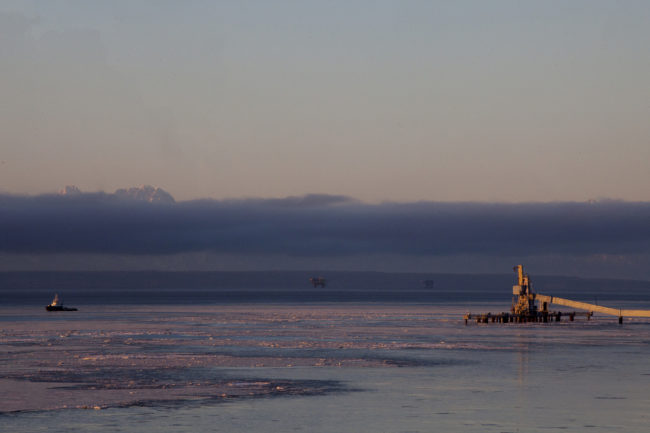
Cook Inlet oil platforms visible from shore near Kenai, Alaska. There are oil and gas production platforms in state waters of the inlet, but none in its federal waters. (Photo by Rashah McChesney/Alaska’s Energy Desk)
The Bureau of Ocean Energy Management announced Wednesday that it plans to study the environmental impacts of a potential lease sale in Alaska’s Cook Inlet.
It would be the first federal oil and gas lease sale in the inlet since 2017. While there are oil and gas production platforms in state waters in the inlet off Alaska’s southcentral coast, there are none in its federal waters right now.
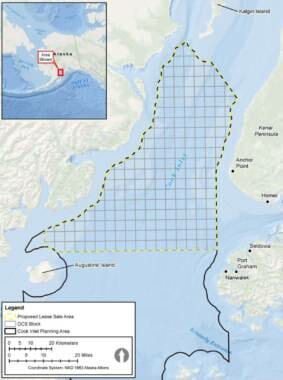
The proposed lease sale area in Alaska’s Cook Inlet. The Bureau of Ocean Energy Management is studying the environmental impacts any oil and gas drilling in the area could have on the area. (Bureau of Ocean Energy Management)
The potential lease sale would cover about one million acres of the inlet and would be held next year.
Before any lease sale occurs, the bureau says, it will analyze the impacts of leasing, exploration, development and production in the area. It’s also asking the public to weigh in on the proposed sale. It says it especially wants to hear from residents in communities along the inlet.
“We especially need to hear from residents of the communities along Cook Inlet as to how the proposed leasing area is currently being used and what specific areas need extra attention,” James Kendall, regional director of the bureau’s Alaska office, said in a statement.
The Center for Biological Diversity, an environmental group, criticized the proposed lease sale in a statement Wednesday. It says the government should protect the beluga whales in the inlet and do more to combat climate change instead of offering more federal waters to the oil industry.
The bureau said 13 exploration wells have been drilled in the inlet’s federal waters between 1978 and 1985, and all have since been plugged and abandoned. During the last federal lease sale in the inlet, in 2017, Hilcorp acquired 14 leases.
Before that, a lease sale in December 2010 was canceled due to lack of industry interest.
The bureau said it estimates the federal waters of Cook Inlet contain 810 million barrels of oil and 330 billion cubic feet of natural gas that can be produced, based on economic conditions and technology.
Close
Update notification options
Subscribe to notifications
Subscribe
Get notifications about news related to the topics you care about. You can unsubscribe anytime.