Alaska's Energy Desk

Conflicting claims, big money at heart of debate on Alaska’s oil taxes

Alpine
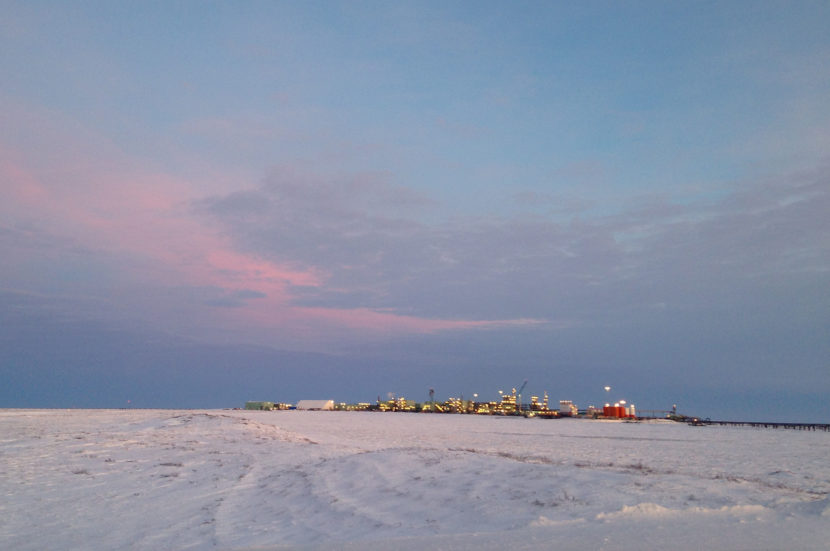
ConocoPhillips’ Alpine facility on the North Slope. (Photo by Elizabeth Harball/AED)

Alaska voters will decide next month whether to raise taxes on Alaska’s largest oil fields.

Ballot Measure 1 — dubbed the “Fair Share Act” by its sponsors — is an initiative that supporters say would fix Alaska’s oil tax law and fill the state’s deficit. But those opposed argue it would lead to less investment in Alaska and jeopardize the state’s economy.

In short: The two-page ballot measure is contentious and complicated, with each side citing its own set of facts.

As the Nov. 3 election approaches, here’s some of what we do know about the ballot measure and, if it’s approved, how it could impact Alaska.

What would Ballot Measure 1 actually do?

It would amend some of Alaska’s oil tax law.

Ballot Measure 1 would apply solely to North Slope oil fields that have pumped more than 400 million barrels and that are still producing more than 40,000 barrels a day.

Right now those are Prudhoe Bay, Kuparuk and Alpine. The main oil producers at those fields are ConocoPhillips, ExxonMobil and Hilcorp, which bought BP’s North Slope assets.

If voters approve the ballot measure:

  • The oil companies at those three fields would pay the state more in production taxes. That’s in part because the ballot measure would eliminate a per-barrel tax credit for those three larger fields.
  • The documents that companies submit to the state to calculate those production taxes would become “a matter of public record.” Right now, those documents are confidential.
  • A so-called “ring fence” would be created around the three oil fields, which would bar the companies from reducing their taxes on those larger fields using deductions earned at smaller fields.

(Read the entire two-page ballot measure here. And the state’s summary here.)

Who’s backing the ballot measure?

A group called Vote Yes for Alaska’s Fair Share that’s chaired by Robin Brena, an Anchorage attorney.
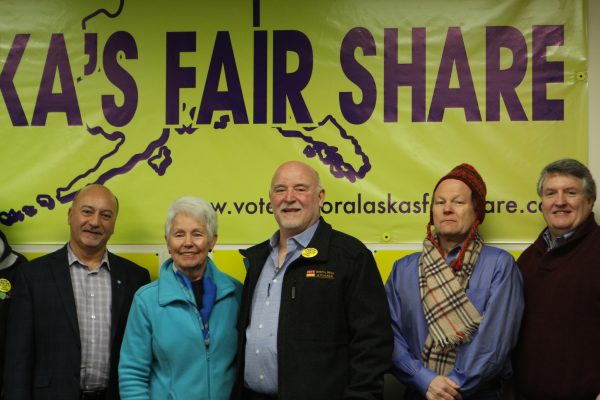
Anchorage attorney Robin Brena and other supporters of the initiative to raise oil taxes pose for a photo on January 16, 2020. Supporters of the initiative to raise oil taxes pose for a photo on Jan. 16, 2020. From left to right: Les Gara, Jane Angvik, Robin Brena, David Carter and Harry Crawford. (Nat Herz/Alaska’s Energy Desk)

Others listed as officers of the group include: Jane Angvik, a former Anchorage Assembly chair and former member of the commission that wrote the charter for the Municipality of Anchorage. Former state Rep. Les Gara, an Anchorage Democrat, is also supporting the ballot measure alongside Anchorage Democratic Sen. Bill Wielechowski and Ken Alper, who worked as director of the state’s tax division under former Gov. Bill Walker, an independent.

The group recently reported raising about $1.4 million from about 700 donors. The largest chunk of that money has come from Brena himself.

And who’s fighting Ballot Measure 1?

OneAlaska—Vote No on One, a group that’s getting almost all of its money from oil companies. The group is chaired by Chantal Walsh, former director of the state’s Division of Oil and Gas under Walker.
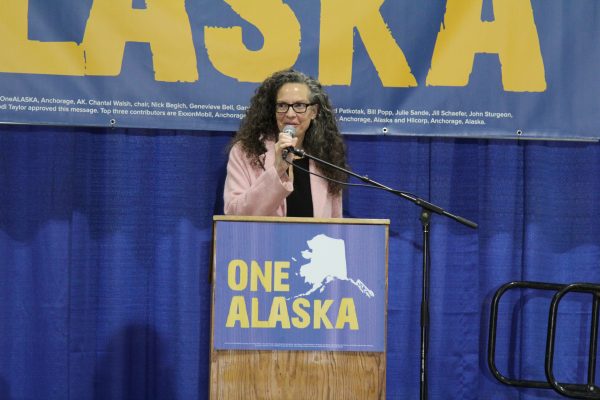
OneAlaska chairwoman Chantal Walsh, a petroleum engineer and former director of the state’s Division of Oil and Gas, addresses the crowd at a OneAlaska rally on Thursday, Feb. 13, 2020 at Delta Constructors in Anchorage. (Tegan Hanlon/Alaska Public Media)

Its other leaders include former state Rep. Jason Grenn, an Anchorage independent, Crawford Patkotak, chairman of the board for Arctic Slope Regional Corp., Kara Moriarty, head of the Alaska Oil and Gas Association and Bill Popp, head of the Anchorage Economic Development Corp.

The group has raised a ton of money so far: about $18.5 million. It’s major contributors are Conoco, Exxon, BP and Hilcorp. The Alaska Chamber is also running attack ads against the measure and has raised about $2 million more from Conoco and Hilcorp.

Why did initiative backers bring forward this ballot measure now?

Because of Alaska’s budget crisis, says Vote Yes for Alaska’s Fair Share. “Ballot Measure 1 is the only revenue option that can be implemented in time to save Alaskan jobs,” the group says.

Meanwhile, OneAlaska counters that the ballot measure would lead to fewer oil jobs, jeopardize new projects and only fill a small slice of the state’s budget hole. It says the measure goes too far.

How much additional revenue would Ballot Measure 1 bring into the State of Alaska?

It’s hard to say for sure, said Mouhcine Guettabi, an associate professor of economics at the University of Alaska Anchorage. That’s because calculating new revenue requires assumptions about both the price of oil and the amount of oil produced in the future, he said.

“Uncertainty around price, uncertainty around the production response and, obviously, uncertainty around future investments — all three of those things make it difficult to know exactly what the amount is,” he said.

The state Department of Revenue has provided a window into what revenue might look like if oil production stays the same next fiscal year, and if companies’ investment doesn’t change. With prices at $45 a barrel, production taxes would total $191 million under the current law and nearly triple under Ballot Measure 1, growing to $564 million.

That’s a little more than half of Alaska’s current deficit, which is roughly $1 billion, but less than a fourth of the deficit if lawmakers decide to pay a larger Permanent Fund dividend under the historical legal formula.
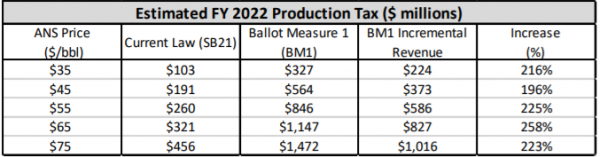
The state Department of Revenue has provided estimates on Ballot Measure 1’s on oil taxes. It says the estimates in the chart are based on the Spring 2020 revenue forecast for Fiscal Year 2022 and “assumes no changes in produced oil volume or company investment because of the tax change.” (Screenshot of Oct. 2, 2020 presentation)

How would the ballot measure, if approved, impact oil and gas companies’ investment in Alaska?

It depends on who you ask.

Moriarty, the campaign manager for OneAlaska, said there’s no question that higher taxes would lead to less investment and less drilling in Alaska and have dire impacts on the industry that underpins the state’s economy. Conoco has threatened that if the ballot measure passes, projects like the Willow discovery on Alaska’s western North Slope would be delayed.

“Oil companies have a hundred other places that they can invest their money. And they won’t leave Alaska right away, but they just won’t spend more,” Moriarty said. “Things will start to die off here. And they’ll go move somewhere else, and they’ll take their employees with them.”

At Vote Yes For Alaska’s Fair Share, campaign manager David Dunsmore said the state cannot subsidize the oil and gas industry any longer. Senate Bill 21 — a controversial piece of legislation passed in 2013 that cut oil taxes — is not working, he said. Oil companies will still make money in Alaska even if they pay more taxes, he said.

“It’s still going to be a very profitable place for them to continue doing business,” he said.

Guettabi, the economist, is less sure. He said the question of how sensitive oil production is to tax changes is one of the most studied questions in economics, “and we don’t really have a definitive answer.” It’s especially hard to study the potential impacts of Ballot Measure 1 in the middle of a pandemic, with multiple business sectors struggling and with low oil prices, he said.

“It just makes a messy situation even messier,” he said.

And what about making more documents public and ring fencing? What do the two sides say about those?

Dunsmore, with Vote Yes For Alaska’s Fair Share, said Alaskans deserve to see the information in the documents so they can make informed decisions about managing the state’s natural resources. That includes details about how much in profit oil companies are making, he said. He said ring fencing will eliminate a tax loophole in SB21, and companies shouldn’t be able to take expenses from other fields to lower their taxes at the “three large, incredibly profitable fields.”

On the other side, Moriarty, with OneAlaska, said oil companies and the smaller companies they do business with will lose their competitive advantage by making expenses and pricing public. She said it’s unprecedented. And, she said, ring fencing eliminates incentives for companies to expand into an area that’s not yet producing oil because companies are more likely to invest money when they know they can deduct their expenses from taxes on fields that are currently active.

If voters do pass Ballot Measure 1, can the state Legislature later change the language in it?

According to Alaska’s constitution, the Legislature could amend it at any time, but couldn’t entirely repeal it for two years.

Have Alaska voters weighed in on oil taxes before?

Yes. Most recently, in 2014, Alaska voters narrowly rejected the repeal of SB21.
Rep. Don Young says feds should compensate Alaska if Army Corps or EPA blocks Pebble

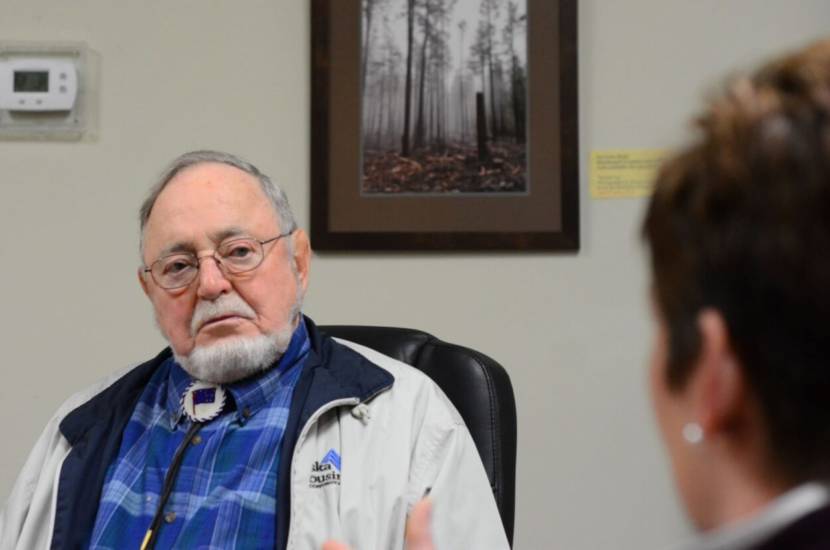
Congressman Don Young listens to a question from Ketchikan Chamber of Commerce Executive Director Michelle O’Brien on Monday. (Eric Stone/KRBD)

On the Pebble Mine, Congressman Don Young is holding his ground. The state’s sole U.S. House member said Monday that the federal government has no business telling the Pebble Limited Partnership whether it should be allowed to build the proposed copper and gold mine near the headwaters of Bristol Bay.

Rather, Young said he thinks the state should be the one deciding whether or not the mine goes forward. And he says if the Environmental Protection Agency or Army Corps won’t give the mine a federal wetlands permit, the feds should compensate the state for the lost potential.

“I do not like outside influence. This is state land. People forget that — they never mention that, ol’ Tucker [Carlson] on Fox News never said it’s state land. It’s land that was granted to myself and to you and you and you and you and you. And when outside influence takes that land — or the value from the state — they should pay us for it,” Young said at a campaign stop at Ketchikan’s Chamber of Commerce.

His remarks echo what he said in August, when the Army Corps of Engineers announced it would require Pebble to submit plans for extensive environmental mitigation before it would issue a permit.

But Young said he would not support a project that harmed the Bristol Bay fishery. The Army Corps’ environmental study of the mine said it would have “no measurable effect” on the world’s largest sockeye salmon fishery. Then the agency seemed to contradict itself in its letter to Pebble, saying the mine “would result in significant degradation to … aquatic resources.”

The other two-thirds of Alaska’s congressional delegation have said they don’t support the mine. On Tuesday, Sen. Dan Sullivan went further — he told Alaska Public Media he wouldn’t support the project even if the developers come up with a plan to compensate for the mine’s environmental damage. But Sullivan didn’t say he’d take action to block the mine.

Young said he had no interest in changing his position on Pebble.

“I don’t know why people change their mind because it politically becomes attractive. I’ve never understood that. If you believe in something, you stay with it,” he said.

During his visit to Ketchikan, Young also said he’d helped persuade the White House to overrule the Centers for Disease Control. The agency had pushed to keep cruise ships from sailing through next February. The CDC’s no-sail order is now scheduled to expire at the end of this month.

Young wore a mask for some events in Ketchikan, but he did not wear one while speaking at the meet-and-greet, held in a large room that was not crowded. One of the half-dozen or so attendees wore a mask, and Young asked him to take it down while answering a question from the congressman.

Young will face independent Alyse Galvin, the Democratic Party’s nominee, in the November election.

With new letter, Alaska GOP Gov. Dunleavy stands alone in Pebble’s defense

Alaska Gov. Mike Dunleavy speaks at a news conference at his Anchorage office on Friday, Sept. 27, 2019.
Alaska Gov. Mike Dunleavy speaks at a news conference at his Anchorage office last year. (Nat Herz/Alaska Public Media)

Alaska Gov. Mike Dunleavy’s administration continues to assist the company behind the Pebble mining project as it drafts plans to satisfy federal permitting requirements, and the governor this week rejected calls to condemn Pebble and stop his administration’s work on it.

Since the release of the secretly recorded “Pebble tapes” last month, Alaska’s Republican U.S. senators have distanced themselves from the project, which opponents describe as deeply politically unpopular. But Dunleavy, who’s also a Republican, says he has a responsibility to pursue projects like Pebble — if they can be safely built — to help improve the lives of rural Alaska residents.

Pebble’s proposal, he said in an interview, could unlock hundreds of billions of dollars in wealth for the people of Bristol Bay, the region where the mine would be built.

“We’ve got to go through the study process, permitting process. But if we can, wouldn’t we celebrate that? That it would lift countless people out of poverty? That it would provide economic opportunity for a depressed region?” Dunleavy said. “As opposed to saying, ‘No, we don’t even want to look at the science. We want this whole thing to stop now.’ I think that’s not my role as the governor.”

One of Bristol Bay’s political leaders, House Speaker Bryce Edgmon, I-Dillingham, said that the region would welcome Dunleavy’s help to expand its economy. But residents do not want that help to come in the form of the mine because of the threat it poses to Bristol Bay’s huge sockeye salmon fishery, he added.

“I think the governor should be working with the region, as opposed to telling the region what it needs and what it should do,” Edgmon said in a phone interview.

House Speaker Bryce Edgmon, I-Dillingham (Skip Gray/360 North)

Edgmon, along with Kodiak GOP Rep. Louise Stutes, last week penned a letter to Dunleavy asking the governor to oppose Pebble’s development efforts, saying they’d been called into doubt when the company’s executives said on the secretly-recorded tapes that the project would be larger than they’d publicly indicated.

Dunleavy responded with his own sharply-worded message Tuesday, telling Edgmon that he “will not stop fighting for the people of the Bristol Bay region who continue to suffer from an acute lack of economic opportunity.”

“The American dream cannot be realized while constrained by dependence on government,” Dunleavy added.

Pebble is in the midst of developing a plan to meet federal requirements to offset the project’s environmental damage, and its executives said on the tapes that such a plan would require the use of state land. In theory, the state land would be protected to compensate for the project’s destruction of wetlands.

In his letter, Edgmon called on Dunleavy to reject Pebble “in deed or word if it seeks to use state land in any way” to fulfill the federal offset requirements.

But in a prepared statement, Dunleavy’s natural resources department said that in recent weeks, it’s still coordinated four meetings at Pebble’s request to discuss related state laws and regulations — though the agency stressed that it’s not providing any guidance to the company about how to meet federal standards.

A Pebble spokesman, Mike Heatwole, described its contacts with the agency as “preliminary conversations” to clarify the company’s understanding of state land management procedures and to make sure that its offset proposal to the federal government is accurate.

Dunleavy, in the interview, said the secretly-recorded Pebble tapes have not changed his mind about how the permitting process should work.

“Scratch off the name ‘Pebble’ and just leave it blank: Any and all projects in the state of Alaska should go through a rigorous process that has standards to ensure that the environment is protected and that the projects are viable or are not,” he said. “That hasn’t changed at all, and it shouldn’t change at all.”

The governor, a spokesman said in a follow-up email, had been “confused” by Edgmon’s letter, “because it did not reflect any interest in seeking out economic opportunities that can improve the quality of life for residents of the Bristol Bay region.”

“If they are steadfastly opposed to one proposal, what other resource opportunities do they support that create good paying year-around jobs?” the spokesman, Jeff Turner, said in an email.

While Alaska Republicans have long been enthusiastic supporters of natural resource development, Pebble has proven more polarizing because of the Bristol Bay region’s lucrative salmon fishery.

And now, Dunleavy’s refusal to condemn the Pebble is leaving him increasingly politically isolated on the issue.

Before the release of the tapes, both of Alaska’s U.S. senators said they don’t think the proposed project can be permitted. Afterward, Sen. Dan Sullivan went even further, saying he’s anti-Pebble amid attacks over the issue during his re-election campaign against independent Al Gross.

Given the project’s dwindling support, Dunleavy’s stance on the mine is one of the only things keeping it as a live political issue during a hotly-contested election season, according to one political strategist.

“It’s wonderful. He’s helping elect Al Gross,” said Jim Lottsfeldt, an Anchorage political consultant.

Lottsfeldt is working with a super PAC that’s running Pebble-related attack ads against Sullivan; he said voters see Gross as a more vocal mine opponent.

“If you truly believe Pebble is dead and buried, then you have less reason to support Al,” Lottsfeldt said in a phone interview. “But as long as Pebble stays alive, all the benefit accrues to Al Gross.”

Sullivan’s campaign manager, Matt Shuckerow, reiterated that the senator has already declared his opposition to the project, and has even tweeted: “No Pebble mine.”

Without otter predation, sea urchins decimate Aleutian reefs

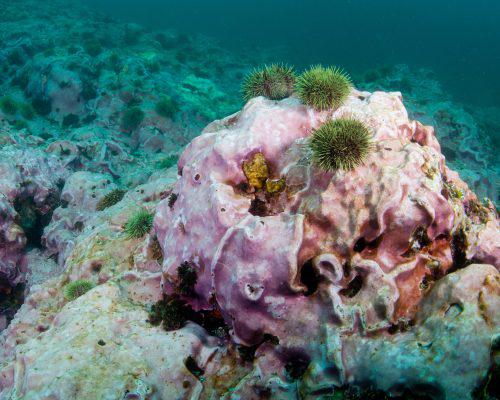
Sea urchins dine on a reef in the Aleutian Islands. Urchins, which boomed after sea otters disappeared, destroyed many kelp forests on the reefs and are now eating the algae-filled reefs that have been weakened by ocean acidification. (J. Tomoleoni / U.S. Geological Survey)

Sea urchins are devouring the massive limestone reefs surrounding the central and western Aleutian Islands — a process exacerbated by climate-driven changes in the marine environment, according to a new study published in Science.

In Unalaska, the largest community in the 1,200-mile Aleutian archipelago, rich kelp beds and curious otters line the island’s shores.

“We’re pretty lucky here — especially in Unalaska Bay — we have a very healthy and, what appears to be, growing sea otter population which is able to keep the sea urchins in check,” said Melissa Good, the local marine advisory agent with Alaska Sea Grant.

According to Good, there are two healthy sea otter populations in the Aleutian Islands — in Unalaska Bay and in Clam Lagoon in Adak. She said the reason the population is healthy in Unalaska is that the otters are protected from orcas due to the infrastructure from the multi-billion dollar fishing industry.

We see the sea otters swimming around and hanging out, sleeping in the kelp reefs right here in Unalaska Bay, especially in the inner harbor areas which means that orcas are not likely to come in and predate on them,” Good said. “They have protection.”

But in other parts of the central and western Aleutians — starting west of Samalga Pass and the Islands of Four Mountains — a sharp decline in the otter population from killer whale predation starting in the 1990s has led to a boom in sea urchins, according to Brenda Konar, a professor of marine biology at the University of Alaska Fairbanks.


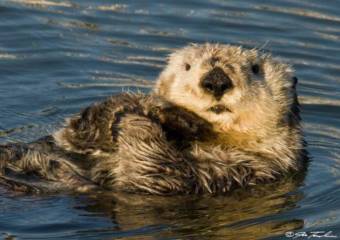
Sea otters are the primary natural predators of sea urchins. (Photo courtesy J. Tomoleoni / U.S. Geological Survey)

Konar says the theory is that killer whales used to eat many of the “great whales,” 13 extremely large Cetacean species. But as many of the great whale species were hunted down, killer whales were forced to switch their prey. So they switched from eating whales to eating Steller sea lions, fur seals and harbor seals, and continued down the marine mammal food chain until they eventually got to sea otters.

In the central and western Aleutians, the otter populations plummeted.

Now uncontrolled by sea otters, their natural predator — the urchin population — boomed both in body size and density.

“The sea urchins can be ridiculously dense,” Konar said. “In a 3-foot by 3-foot section, you can find 400 of these urchins just sitting there, trying to eat away at the kelp.”

Those sea urchins, which are “tremendous grazers” according to Konar, began eating more kelp that grows on the reefs, decimating the vast kelp forests that went on for miles in the Aleutian archipelago.

“And so now you’ve lost the habitat that organisms were normally coming into and living there, reproducing there and eating there,” said Good. “You can think of seaweed-like plants on land as the base of the food web. And so when you have a lot of seaweed out there, you also have a lot of food. And so when you completely get rid of that you’ve eliminated the space for other animals. You have basically clear cut the forest of the sea.”

Having decimated the kelp, urchins are now eating Clathromorphum nereostratum, the algae that create the reefs.

“So first, the kelp forests disappeared,” said Konar. “Now, the reef underneath the kelp forest is disappearing.”

Konar began diving in the Aleutians in the 1990s, just as the Aleutian sea otter population began to crash. She is also a co-author of the new study in Science about what’s happening to Aleutian reefs.

“And what’s happening is, it’s not just that there’s a lot of sea urchins out there eating and digging away at these coralline biogenic habitats, but it’s also that the warming temperature and ocean acidification is weakening these coralline plants and making it even easier for the sea urchins to erode them away,” Konar said.

The research shows that sea urchin grazing has become much more lethal in recent years due to the emergent effects of climate change, according to Doug Rasher, a senior research scientist at Bigelow Laboratory for Ocean Sciences in Maine and lead author of the study.

Large urchins are chomping away at a faster rate than the algae can grow.

“Ocean warming and acidification are making it difficult for calcifying organisms to produce their shells — in this case, the algae’s protective skeleton. This critical species has now become highly vulnerable to urchin grazing, right as urchin abundance is peaking. It’s a devastating combination,” Rasher said.

In some places, reefs that are meters thick and thousands of years old are crumbling from urchins burrowing through the weakened calcium carbonate structures.

“These coral reefs live hundreds and hundreds and hundreds of years,” Konar said. “And so if they’re being eroded as much as they are in just a couple of years, and it takes them a few hundred years to regrow that amount, even if everything stopped today and the otters came back,  the urchins got eaten up and everything became rosy again, it would take these coralline crusts a really long time to come back.”

Despite Konar’s uncertainty, Rasher said their study indicates that restoring sea otters to the central and western Aleutians would result in a decline in sea urchins and the recovery of kelp forests.

In a down market, Alaska fishermen avert disaster by feeding families in need

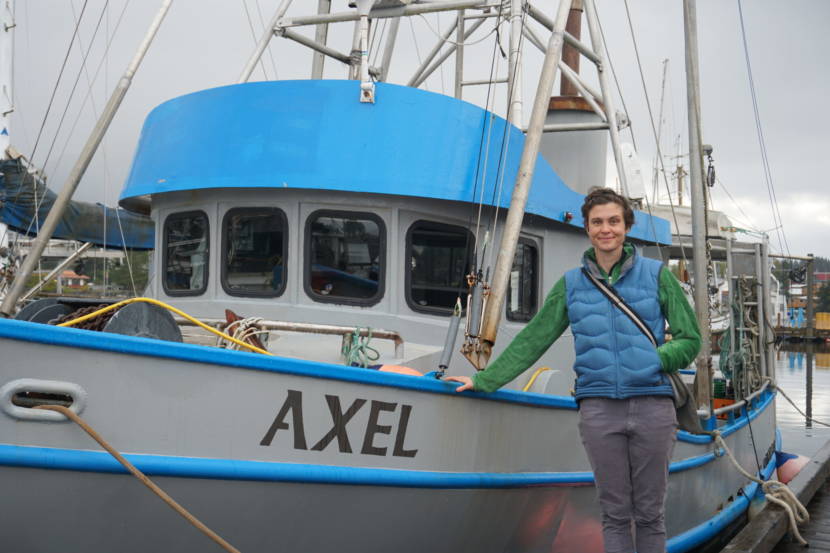
Sitka fisherman Jacquie Foss stands in front of her and her husband’s troller, the Axel. The boat is tied up for the winter in Eliason Harbor after a challenging season. (Erin McKinstry/KCAW)

It’s been a hard season for small fishermen in many parts of Alaska because of economic losses caused by the COVID-19 pandemic. But a seafood donation program started by a Sitka organization is helping bring some stability to fishermen and consumers during an uncertain time.

It started to drizzle as I stepped off the dock at Sitka’s Eliason Harbor and followed Jacquie Foss onto her and her husband’s grey and blue fishing boat, the Axel.

“You land your fish here, you clean here and you ice and store them in these totes before you put them down in the hold,” she said.

Living and working aboard the 40-foot troller is a tight squeeze when Foss, her husband and their two kids are all aboard. For most of the season, it’s just Foss’s husband and one crew member trolling Southeast waters for lingcod, coho and king salmon, while Foss runs the business shoreside. This was their ninth season commercial fishing and it wasn’t an easy one, mostly because of the pandemic.

“So we’re low volume, high quality and so typically, restaurant markets, a lot of the fish goes out whole and fresh. So, with the collapse of the restaurant industry, there was no market,” Foss said.

They also worried that even if they could sell their fish, they wouldn’t be able to get it processed if facilities closed down because of coronavirus outbreaks. And the pandemic disrupted Asian markets, a relationship that was already strained because of tariffs and counter-tariffs between the U.S. and China.

At the start of the season, the price for lingcod was half of what it was last year. Foss didn’t know if they’d be able to operate.

“When you’re starting out with unknown markets, unknown volume, unsure if you’re going to be able to sell your fish anywhere, there was a lot of anxiety early on,” Foss said.

But they did operate thanks to a seafood donation program started by Linda Behnken at the Alaska Longline Fishermen’s Association or ALFA and the Alaska Sustainable Fisheries Trust.

“I very quickly heard about people who were struggling here in town and that catalyzed us to start talking to local fishermen, local processors, about how we as commercial fishermen could help meet that local need,” Behnken said.

NormallyALFA is a membership organization that advocates for sustainable fisheries and small fishermen. They also run Alaskans Own, a community-supported fishery that sells seafood boxes to people around the country.

But Behnken and her partners decided to branch out to meet the local need brought on by the pandemic. They used grant funds from Catch Together to supplement the price of lingcod, so Sitka fishermen like Foss and her husband could start their season with some security. Then, they created a market for the seafood by delivering it to families who were struggling to make ends meet because of the pandemic.

“The pandemic really created a lot of need around Alaska and around the country from loss of jobs,” she said. “It’s just a particularly difficult time for people and then to be able to have really good quality food coming from Alaska’s healthy oceans. It’s just really special to be able to provide that and make those connections.”

Soon, Behnken started getting calls from other communities asking her to expand. With the help of outside funders and organizations, they delivered seafood to military families in Alaska and to Tribal communities in the Pacific Northwest.

Justin Zuelner is the head of The Wave, the foundation that helped distribute the seafood in the Pacific Northwest.

“We must support sustainable fisheries, to keep that economy going, because if we were not able to survive this, then we don’t have sustainable fisheries in the future,” he said. “That is such a critical investment.”

Then came the news about poor salmon runs. Southeast Alaska had the worst commercial fishing season for salmon in 44 years, and sockeye runs in Chignik Bay on the Alaska Peninsula failed altogether. The program brought salmon from Bristol Bay — where the salmon season was strong — to Chignik. And most recently, they partnered with Sealaska to bring nearly 50,000 pounds of sockeye to Tribal households in several remote Southeast Alaska communities.

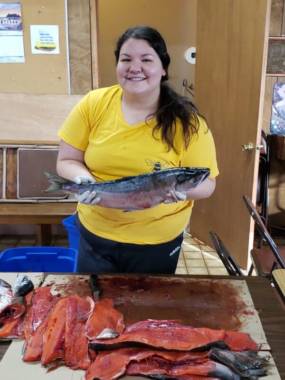
Tiadola Silva helps process the 8,000 lbs. of donated sockeye that the Angoon Community Association received at the end of September. (Photo by Carol Martin / Courtesy of Tiadola Silva)

Tiadola Silva works for Angoon’s Tribe, the Angoon Community Association. She helped organize the salmon donation for her community.

“Fish was very scarce this summer, so just receiving this 8,000 pounds from these organizations was just a very generous opportunity for us, enough food supply for our winter,” Silva said.

Normally, the community delivers excess salmon they’ve caught to elders. But this year, there wasn’t much extra to go around. That was partly because of low runs and because the local gas station had to shut down several times due to active coronavirus cases in the community. Without gas, people couldn’t get out on the water.

“You know, salmon migration patterns are not gonna wait for you, you just have to go out when the time is right,” she said.

The donation was personal too. Silva was worried she wasn’t going to have enough salmon to make sockeye dry fish this year, but now she will.

“I’m excited for this week because I know that there’s gonna be a bunch of smokehouses running and that’s my favorite smell in the world is just the smokehouse smell,” Silva said.

The program will continue distributions through the winter in Sitka. Behnken said if they get support from the USDA and other funders, they can expand and continue connecting fishermen with communities in need.

Without ice, killer whales are preying on bowheads in Alaska’s northern seas

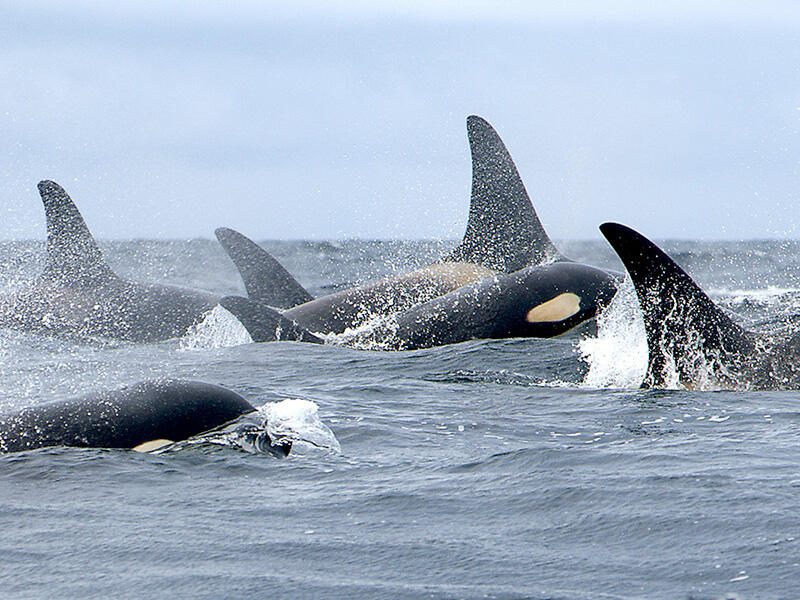
The population of endangered southern resident killer whales has dwindled to 76 individuals. (Holly Fearnbach/NOAA)

For subsistence hunters in the northern parts of Alaska, the bowhead whale has been a part of their diet for generations. However, scientists have found that as sea ice has dwindled in Arctic waters, a new predator has moved in to feed on the marine mammals: killer whales.

It’s not unheard of for killer whales to feed on bowhead whales in subarctic waters. Amy Willoughby is a researcher with the University of Washington specializing in aerial surveys of Arctic marine mammals.

“Killer whale predation on western Arctic bowhead whales has been documented in the shores of Russia and the Bering Sea,” Willoughby said. “For example, the St. Lawrence Island.”

However, in the colder waters north of Alaska, like the Eastern Chukchi and Western Beaufort Seas, sea ice becomes more plentiful, and it was thought that bowhead whales were better protected from predators.

But Willoughby says that sea ice has gotten thinner as Arctic temperatures have risen in recent decades.

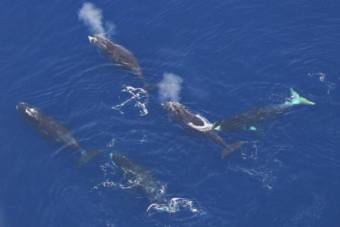
Bowhead whales (Photo courtesy of NOAA Fisheries)

“Bowhead whales are thought to have an avoidance strategy to predation by evading predation and hiding out in thicker sea ice,” Willoughby said. “And without that sea ice there, bowhead whales don’t have anywhere to retreat to.”

Willoughby says scientists documented the first direct evidence of killer whale predation in those traditionally sea-ice-rich waters in 2015.

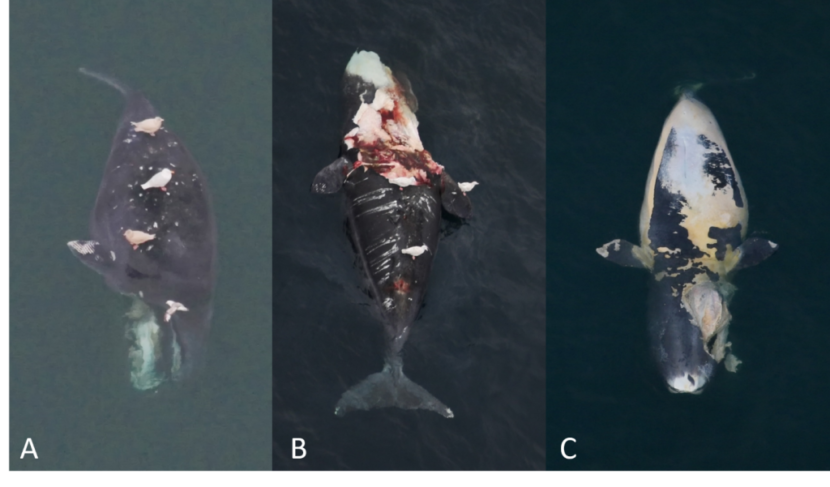
“The mouth was missing. The tongue was missing. The jaw was broken. And it also had healed rake marks on its flipper,” Willoughby said. “And that was kind of the ‘Aha!’ moment where we realized that killer whales might be predating on bowhead whales.”

Researchers began examining bowhead whale carcasses found from 2009 to 2018. Of the 33 whales observed by scientists, 18 of them had evidence of killer whale predation.

(A) The 2015 bowhead calf carcass that provided the first evidence of killer whale predation on a bowhead whale in the U.S. Pacific Arctic. Note rake marks on the calf’s flipper, mouth and jaw. (B and C) Carcasses of young bowhead whales with lethal injuries to the mouth and jaw from killer whale attacks. (Photo courtesy of NOAA Fisheries)

“We can’t technically say that there’s been an increase because there can be a lapse in data and information from years prior,” Willoughby said. “But when we look at the years from 2009 to 2018, killer whales are the primary cause of death.”

Willoughby says scientists don’t know for sure what the long-term effects of killer whale predation on bowhead whales could be, but she speculates bowhead whales may change their migration patterns in response to predation. Additionally, their feeding opportunities could change as a result of killer whales moving in. That could have repercussions on the 11 Inupiat whaling communities that subsist on bowhead whales.

“The Indigenous people that hunt these whales for subsistence have hundreds of years of traditional ecological knowledge to base their efforts off of,” Willoughby said. “And killer whale presence might negate that knowledge that they hold.”

At the very least, she says it’s now more important than ever for scientists to continue to keep an eye on killer whales as they expand their hunting grounds into the coldest parts of the world.

Site notifications
Update notification options
Subscribe to notifications