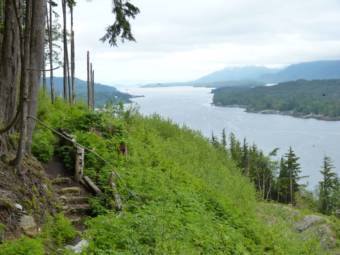
Portions of the Tongass National Forest can be seen from Ketchikan’s Rainbird Trail. (KRBD file photo)
President Donald Trump’s administration announced Wednesday that it is finalizing its plans to reverse roadless protections for more than 9 million acres of the Tongass National Forest in Southeast Alaska, or a little less than 15,000 square miles.
The roadless rule was originally established in the final days of the Democratic Clinton administration, and it barred logging and road construction on some 58 million acres of national forest lands, including big swaths of the Tongass.
Since then, it’s been the subject of lawsuits, as well as requests for an exemption from Alaska elected leaders, who claim the rule has harmed the state’s timber industry and made it harder to develop mining and energy projects in Southeast Alaska.
Wednesday’s decision stems from a 2018 petition to U.S. Secretary of Agriculture Sonny Perdue from former independent Alaska Gov. Bill Walker’s administration.
Advocates argue that reversing the roadless rule would harm Alaska Native subsistence traditions and Southeast Alaska’s burgeoning tourism industry. They also note that the reversal is unlikely to revive the region’s dwindling logging business, and say that it threatens the Tongass’ ability to absorb greenhouse gas emissions.
Environmental groups immediately called on Congress to reject the Trump administration’s decision, and the exemption could also be challenged in court.
This is a breaking news story and will be updated when more information is available.
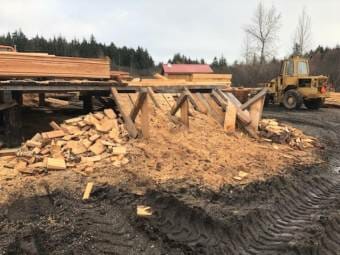
Sawdust and wood scraps at Mud Bay Lumber Company in Haines. Haines is one of dozens of communities around Alaska that have looked into biomass technology. (Photo provided by Clay Good/REAP)
Alaskans spend nearly 60% more on energy than the national average, and in some rural communities, that number is much higher. The Kupreanof Island village of Kake is trying to bring down the high cost of energy by transitioning to renewables. They’ve looked at solar, wind, hydro and now biomass heating, an old technology with a new design.
When Gary Williams retired after 30 years as executive director of Kake’s Tribe, the Organized Village of Kake, he decided to turn his attention to energy.
“The cost of energy here is high, so if we can come up with some more affordable energy, it’s always a good thing to pursue,” he said.
He worked on a successful solar project and helped conduct feasibility studies for wind energy. And now, he’s working to replace the tens of thousands of gallons of non-renewable heating oil used to heat the town’s school and other large facilities with a renewable and readily available resource: wood.
“We’ve got a fuel supply that’s literally in our backyard. We’re in the middle of the Tongass,” Williams said. “So it would reduce the need for imported fuels and also at the same time as we harvested our local fuels, it would create jobs and put money into our local economy.”
Burning wood to stay warm is an ancient technology, but the system Williams and other energy stakeholders in Kake are hoping to implement is high-tech. Special sensors and multiple chambers mean it burns hot and efficiently. The impact on air quality is the same or less than a system that uses heating oil.
It’s called a biomass district heating system.
“Biomass means a lot of things,” said Clay Good, who works for the Renewable Energy Alaska Project. He’s been involved with several of Kake’s renewable energy projects. “It can mean food waste or fish waste or anything that’s biological, any carbonaceous material that can be utilized for some kind of energy source.”
In this case, it means wood that’s leftover from thinning of second growth forests or from timber operations.
“It’s not a big leap to think, well, if that’s just left there, it’s gonna be burned. Let’s use that material,” Good said. “We’ll just grind it up into chips and feed it into our industrial boiler here.”
If Kake’s system becomes a reality, it could heat the school, senior center, health center, community center and other public buildings while saving the community nearly $100,000 a year on energy costs.
And Kake’s not the only community looking into biomass. Dozens of places around the state are already using it. The interior town of Tok also uses their system to produce electricity through steam for their school. Local school district Superintendent Scott MacManus said it’s saved them money and created jobs since they first implemented it a decade ago.
“Besides just a couple jobs running the plant, we are able to hire counselors that we didn’t have before and for a while we had a music program,” MacManus said. “It was because of the funding that we were able to save with the school.”
He admits there were challenges, like finding people knowledgeable enough to work on the technology or convincing community members that it was a good idea. And, he said, it’s not the right fit for everyone.
“One of the things about renewable and sustainable energy is that it’s got to be specific to where you are. You have to look at what’s available locally,” he said.
But Gary Williams thinks it is the right technology for Kake. And one more step toward energy independence, energy affordability and sustainability.
Besides making this work for our community today, we want to make sure we leave a good world for our grandchildren too,” Williams said.
Kake was awarded a USDA grant to design their biomass system. They received the design plans back earlier this summer. Now they just have to find the funding to build it.
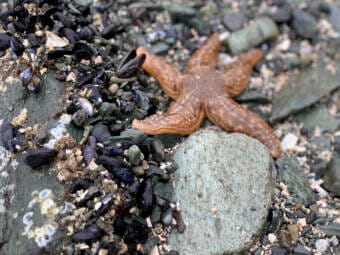
Blue mussels and sea stars clustered together on a beach on May 3, 2020, on Douglas Island. (Photo by Rashah McChesney/KTOO)
A lot of people know it’s not a good idea to eat shellfish in the summer. It has long been thought that eating shellfish this time of year is safer — but that’s just not true anymore.
Lindsey Pierce is an environmental technician with the Central Council of Tlingit and Haida Indian Tribes of Alaska. She’s based out of Juneau. And she’s the point person for their shellfish program.
That means part of her job is to go out to beaches where people are harvesting shellfish and gather some for testing. And they’re looking for a few different kinds: Cockles, butter clams, littlenecks if they can find them.
And they pry blue mussels off of the rocks — those are something of a super-filter, going through several gallons of water each day. Researchers say they can be an early warning sign that there are toxins in an area.
Sometimes, when she’s not working. Pierce heads back out to the beach to collect some for dinner. Generally, she’s looking for cockles and she has a lot of ideas about how to cook them.
“You can put them in the pan whole and then steam them open. Or, you can shuck them, you know, pry them open and get the meat out … it’s all in your preference,” she said. “You can do like a butter garlic sauce.”
Hungry yet?
Pierce isn’t. She laughed and said, “I collect them for my family, but actually, I don’t like eating clams.” It’s a texture issue.
So Pierce’s team collects samples from Point Louisa and Amalga — beaches in Juneau where they know people harvest shellfish. Other people in town have recommended they test Eagle Beach and Pt. Bridget too, but Tlingit & Haida hasn’t added those ones yet.
The shellfish samples that Pierce’s team collects get sent to a lab operated by the Sitka Tribe of Alaska. It’s part of a group called Southeast Alaska Tribal Ocean Research, commonly known as SEATOR. That lab tests shellfish for a group of 17 tribes in communities across the Gulf of Alaska.
“Each tribe has identified a beach or two that they feel their community members go to primarily for subsistence harvesting,” said Naomi Bargmann who runs the lab in Sitka.
She says the ultimate goal of the shellfish testing is to help tribes manage their resources. It’s a food security issue. But they also make the data available to the general public. And right now, they’re the only ones doing that. The state only tests commercially harvested shellfish.
Despite the regular testing, Bargmann makes it clear they are not certifying any beaches as safe.
“We never say a beach is safe because there’s always a risk when consuming wild shellfish,” she said.
You can’t cook or freeze the toxins out. You often can’t see the algal blooms that cause them. You can’t taste them, and sometimes shellfish from the same spot on the beach will have wildly different levels of toxins in them. It’s basically an invisible killer.
The data is meant to help tribal citizens, and others, make educated decisions about where and when they’re harvesting. There are some ways to be safer. First, all commercially harvested shellfish in the state are tested. So you can always just buy them. In fact, that’s what the state suggests doing.
If you do want to collect them for yourself, you can pay to send samples of your haul to the state’s lab. Or, for about $50, you can send them to the lab in Sitka.
The Sitka Tribe of Alaska’s lab put out its latest test results on Wednesday. Researchers are warning about toxins in butter clams harvested in Craig, Ketchikan, and Kodiak — and for all species they tested from beaches in Hoonah, Juneau
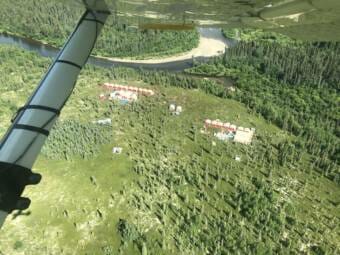
Over the summer, the Pebble Limited Partnership set up two camps along the Koktuli River to conduct wetlands studies about 27 miles away from its base camp at the proposed mine site. Aug. 4, 2020. (courtesy Alaska Department of Fish and Game)
Pebble is now less than a month away from its deadline to submit a new mitigation plan to show how it will make up for the wetlands damage expected from construction of the mine. The plan is key to obtaining a federal permit, and Pebble says it will meet that deadline, but the secretly-recorded “Pebble Tapes” have triggered additional scrutiny about the state’s apparent assistance with the plan.
The U.S. Army Corps of Engineers told the company at the end of August that its plan has to include improving parts of Bristol Bay’s Koktuli River watershed to make up for the damages. That’s called in-kind compensatory mitigation — a departure from Pebble’s original proposal.
In the tapes, former CEO Tom Collier said the state plays a crucial role in meeting that new requirement.
“This mitigation plan that we’re putting together, almost all of the land is state land. And so, the state has to be a partner with us,” he said to the person posing as an investor for the Environmental Investigation Agency, which released the tapes. “And what we’re gonna do with that land is we’re gonna turn it into a preserve. We’re gonna set it aside, put a conservation easement on it.”
Collier continued, saying the land “will be available for hunting and fishing only in the State of Alaska. And we would not be able to respond positively to this letter we got today if the state weren’t there as our partner moving forward with this plan.”
House Speaker Bryce Edgmon and Representative Louise Stutes wrote a letter to Gov. Mike Dunleavy at the end of September asking him to stop working with Pebble on the plan, which would include actions on state land in the Koktuli River watershed. In the letter, they said, “We see no way that PLP can advance a compensatory mitigation plan without the State’s involvement.”
But so far, Dunleavy hasn’t pulled back. Instead, in a letter on Oct. 6, he maintained that it is his job as governor to allow for as much responsible development as possible.
Alannah Hurley is the executive director of the United Tribes of Bristol Bay, a group that opposes the mine. She said that Edgmon and Stutes were “spot on” in their request for the state to stop working with Pebble.
“What the state chooses to do in order to create some fantasy mitigation plan that could satisfy legal requirements with the Corps has yet to be seen,” she said. “And unfortunately, especially clear from this letter, they have a very strong advocate and partner in our governor.”
Construction of the mine would result in the loss of more than 2,800 acres of wetlands and nearly 130 miles of streams in Bristol Bay’s Koktuli River watershed, according to the Army Corps.
Over the summer, the Pebble Limited Partnership set up two camps along the Koktuli River to conduct wetlands studies about 27 miles away from its base camp at the proposed mine site. Pebble says they were on a Native allotment.
“None of this is being done with any type of public process, any type of transparency. We had no idea they were up there until people saw their man camps along the Koktuli,” Hurley said.
Following the release of the Pebble Tapes, several Bristol Bay organizations asked the Army Corps for a public comment period on the mitigation plan. Norm Van Vactor, CEO of the Bristol Bay Economic Development Corporation, said the Army Corps responded saying there was no mechanism for additional public comment. For Van Vactor, the Koktuli camp was another example of a lack of transparency in the permitting process.
“It was a large facility which we were subsequently told after we discovered it was put in by Pebble to assist them in developing their wetland mitigation plan,” he said. “It confirmed to the rest of us what we’ve known all along. And that is that the Army Corps of Engineers and others have been dealing behind closed doors with the Pebble Partnership, and have basically been in cahoots with each other.”
A screenshot of the location of Pebble’s camps on the Koktuli River. Aug. 4, 2020. (Courtesy Alaska Department of Fish and Game)
Company spokesperson Mike Heatwole confirmed that Pebble set up two camps in mid-July to map wetlands in the Koktuli drainage to meet the Corps’ new mitigation requirement. Camp size was limited to 20 people, and Heatwole said they had an additional camp for when the workload required more than that. He said basing that work away from the village of Iliamna was the best way to protect the community from COVID-19.
“We know that they look at furrow conditions, map the vegetation, and take photographs of the wetlands, really just to characterize the wetlands in the area,” he said. “And all of that is getting rolled up into our compensatory mitigation plan.”
Heatwole said they were aware of the Army Corps’ new mitigation requirement in early summer, although the Army Corps’ August letter was the first formal request for mitigation to the project’s wetlands impacts. He also said that Pebble notified the state about the Koktuli camps and secured the necessary permits for an operation on private land.
Laura Achee, the information officer for the Alaska Department of Environmental Conservation, said in an email that the state’s Food Safety and Sanitation Program issued two sanitation permits for Alaska Peninsula Corporation to operate temporary camps in the region of the Koktuli River. She said that based on their review of the submitted application, no other DEC Environmental Health or Water permits were required.
Not all reactions to Pebble’s mitigation efforts are negative. Lisa Reimers is the CEO of Iliamna Development Corporation and a board member of Iliamna Natives Limited. Reimers supports Pebble and she said she thinks the governor is doing the right thing. In her view, the company is simply following the directions of the Army Corps in its efforts to produce a plan.
“I agree with him,” she said. “Mitigation — depending on what the Army Corps is asking, they’ve been pretty good about their science. I’ve trusted the whole process that the Army Corps has gone through with Pebble.”
Pebble says it will meet the Army Corps’ Nov. 18 deadline for submitting the new mitigation plan. A final Record of Decision on the mine is expected this year.
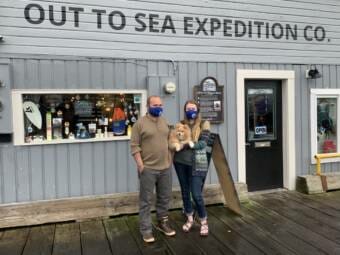
Out to Sea Expeditions co-owners Eric Lunde, left, and Delaney Murphy pose for a picture with the company dog, Paris. (Eric Stone/Alaska’s Energy Desk)
With federal restrictions set to expire at the end of this month, cruise lines hope to sail from U.S. ports again soon — possibly before the end of the year. But some small business owners and officials worry that when ships start bringing tourists back to Southeast Alaska, locals may get left out.
This summer was supposed to be when business partners Eric Lunde and Delaney Murphy started sharing the natural beauty of Southeast Alaska with their slice of a million-plus cruise ship visitors. They’d just founded Out to Sea Expedition Company on Ketchikan’s waterfront.
“Of course, we were really excited about — about 2020,” said Murphy, a co-owner and naturalist for Out to Sea.
Some ships are back at sea in Europe. Cruise passengers and crew are tested for COVID-19 before getting aboard, ships run at reduced capacity and onboard medical facilities are prepped for positive patients.
And when passengers get off the ship in port, they’re restricted solely to cruise line-sponsored activities. Bud Darr is an executive with Geneva-based cruise line MSC.
“Bubble-type of shore excursions is one of the keys to making our protocols work,” Darr said.
Otherwise, the MSC vice president told the Alaska Chamber late last month, there would be a big hole in the cruise ship bubble.
“We have to have operators that are willing to provide an equivalent level of safety to what we’re providing on the ship, or else the whole thing really doesn’t make sense,” he said.
Cruise lines are taking similar steps as they get ready to resume cruising in the Americas. Royal Caribbean and Norwegian came out with a set of protocols that closely resemble MSC’s approach. The industry’s largest lobbying group, Cruise Lines International Association, released a similar set of recommendations.
But Out to Sea Expeditions co-owner Eric Lunde said he’s worried that keeping guests in a bubble would squeeze out most of Southeast Alaska’s small tour companies, retailers and restaurants.
“It would become basically another no-ship season, except for in this case, you’ll have a ship parked there, just to remind you. It’s almost a slap in the face,” Lunde told Alaska’s Energy Desk.
He said partnering with the cruise lines to sell his tours aboard really isn’t an option — he just can’t afford it.
“Basically that exchange, you sell at a very cheap price in exchange for volume. And a lot of the independent tour operators are like a single six-pack boat — very, very small operations,” he said.
With room for only six passengers, low-price, high-volume tours don’t make sense.
“For a small operator, it’s just not even feasible,” said Kevin Birchfield, a charter boat captain and president of the Juneau Charter Boat Owners Association, which represents 12 small tour companies.
“They’ve got to be able to operate in a fashion where everyone is included,” he said in a phone interview.
Local officials are sounding the alarm, too.
“There’s not going to be any free-flowing traffic within the downtown, and that’s going to have a very serious impact on the local economy,” Ketchikan City Manager Karl Amylon said Wednesday.
Amylon said the city is working on ideas — barricading the port, limiting traffic, maybe even getting the whole downtown area inside the bubble.
Mike Tibbles is head of government relations for Alaska’s CLIA chapter. He said the exclusive focus on cruise line-sponsored activities is a temporary fix — it’s an effort to prove to the CDC that cruising can be done safely. He said those recommendations are primarily targeted at the first few sailings from Lower 48 ports.
“This is not what we hope to have by the Alaska season — I mean, we hope that things open up,” Tibbles said in a phone interview Tuesday.
He said cruise lines envision expanding that bubble beyond line-sponsored trips.
“The goal is to work with shore excursions and local businesses that have an equal level of risk mitigation or safety protocols that the cruise ship has,” he said.
But the cruise industry rep says it’s too soon to discuss what tour operators — or even cities — can do to get inside the bubble. Tibbles prefers the term “safety net.”
“The very first hurdle that we’ve got to overcome is just to get some level of service restarted, right? And you know, between now and the Alaska season, there’s a lot of time to be able to have discussions with our business partners and with the local community leaders on how we can expand the safety net,” he said.
Tibbles said he’s speaking with mayors and managers in port communities. He said the overall pandemic situation — like how many cases there are, whether a vaccine or treatment is available, improvements in rapid testing — could influence how and when protocols are relaxed.
Delaney Murphy, though, the naturalist and co-owner of Out to Sea, said she’s hoping for answers sooner rather than later.
“I’m sure it will change — hopefully, it will change — from how they’re starting off,” she said. “But if it doesn’t, though, what are we going to find out in March? That, ‘Oh, actually, nope, you’re not, you’re not going to have a season unless you’re in this group.’ Like, we need to be able to plan, you know?”
She says that if they can’t get inside the bubble, Out to Sea may not survive.
Cruise ships usually start calling on Alaska ports in April. Norwegian, Royal Caribbean, Carnival, Holland America, Princess and Disney Cruise Line each list spring 2021 Alaska voyages on their websites.
This story was produced as part of a collaboration between KRBD and Alaska’s Energy Desk.
The National Oceanic and Atmospheric Administration climate outlook for October, November and December indicates equal chances of above-, below- and near-normal temperatures and precipitation for Southeast Alaska. (Maps by NOAA, illustration by Alaska’s Energy Desk)
After a rainy summer, climate scientists aren’t quite sure whether Southeast Alaska will get more, less or about as much rain and snow as usual. They’re equally unsure about this fall’s temperatures.
In its outlook for October, November and December, the National Oceanic and Atmospheric Administration’s Climate Prediction Center said Southeast has equal chances of temperatures and precipitation that are above, below and near normal.
Rick Thoman is a climatologist with the Alaska Center for Climate Assessment and Policy at the University of Alaska Fairbanks.
“Now, that doesn’t mean near normal is likely, it means near normal is as likely as significantly above or significantly below,” said Rick Thoman, a climatologist with the Alaska Center for Climate Assessment and Policy at the University of Alaska Fairbanks.
“Basically, all the tools that we have to use to generate these seasonal time-length forecasts, there’s no definitive signal in the climate models in history to move the odds for Southeast Alaska for the upcoming October through December season,” Thoman said.
Despite the uncertainty for temperatures and precipitation, Thoman said areas south of Juneau could see more snow than usual. That’s because temperatures in parts of the Pacific Ocean are below normal — a condition known as La Niña.
“There is a tendency that for Southeast — especially southern Southeast — these La Niña winters often produce one or two significant cold outbreaks. And, you know, it really ups the chance of significant snow, especially south of Juneau, places like Ketchikan that often don’t get very much snow. But once in a while you get that cold air that stays in place and you can get a big snow, as we saw just a few years ago,” Thoman said.
NOAA’s climate forecasts draw on historical weather data and sophisticated computer models. Thoman said those models aren’t great at predicting precipitation.
“For Alaska, over the last four years, there has been just a tiny bit of skill. And by skill, I mean, a tiny bit better than a random guess,” Thoman said. “But temperatures are much better, and that’s not surprising. Precipitation is much more localized.”
That is, rain and snow totals can vary widely from place to place while temperatures are more uniform.
While Southeast’s fall outlook is largely unclear, NOAA predicts the North Slope and much of coastal Western Alaska will see a warmer and wetter autumn than usual.
Close
Update notification options
Subscribe to notifications
Subscribe
Get notifications about news related to the topics you care about. You can unsubscribe anytime.