Alaska's Energy Desk

New Gunnuk Creek hydro plant reduces Kake’s reliance on diesel

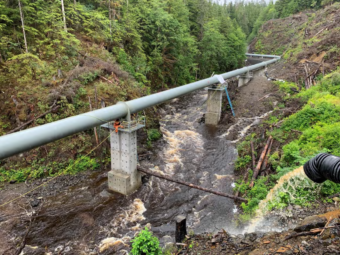
IPEC built a penstock along Gunnuk Creek to carry water from an existing water supply dam to the newly-constructed powerhouse, almost a half mile away. It will also provide water to the newly revived Gunnuk Creek hatchery. (Photo provided by Jodi Mitchell/IPEC)

A new hydroelectric plant in Kake means the Kupreanof Island village will no longer have to rely solely on diesel generators for its electricity. The multi-million dollar Gunnuk Creek hydro project came online earlier this fall, and its proponents hope it will lower the cost of energy and bring the remote community one step closer to energy independence.

Residents of Kake have been experiencing intermittent power outages this fall as the Gunnuk Creek plant comes online. That’s all part of normal growing pains, says Jodi Mitchell, the CEO and General Manager of the Inside Passage Electric Cooperative, or IPEC. The nonprofit provides electricity to a handful of Southeast Alaska towns.

“When you build a new generation project in a remote village, you don’t just turn it on like you just plug in a new appliance,” Mitchell said. “You have to do a lot of adjustments and tweaking, basically to optimize the hydro output and minimize the diesel output.”

Aside from a small solar project, Kake relies on diesel generators for electricity. Since the Gunnuk Creek hydro project was turned on in September, it’s saved the town 2,500 gallons of diesel fuel. IPEC will still rely on diesel generators during dry times and as a backup source of electricity. But Mitchell said that at a minimum, the plant will cut diesel consumption in half over time. And hopefully that will translate to a reduction in rates.

“The less fuel we have to consume, that’s the savings that gets passed onto the customer,” she said.

A quest for more affordable energy is at the heart of Kake’s exploration of renewables like solar, biomass heating and now hydro. The cost of living in rural Alaska is high, and residential electricity rates in Kake are more than double the national average.

“We’re paying too much for electricity and heating,” president of Kake’s tribal government, the Organized Village of Kake, Joel Jackson, said. He and other community leaders worked with IPEC during the project’s planning stages. “There’s no silver bullet that will sustain us off the grid. But I think using a couple different things as we move forward will lessen the cost of living here.”

Whether this new plant will translate to lower rates is complicated for a variety of reasons. For one, IPEC’s rates are based on sales. The more electricity they sell, the lower their rates are, so if enough residents implement energy saving measures like installing LED lighting or energy-efficient appliances, their rates may actually go up. Also, because IPEC serves multiple communities, any savings from the hydro would be distributed throughout the region.

An aerial view of the Gunnuk Creek hydro penstock (Photo provided by Jodi Mitchell/IPEC).

And residential customers benefit from something called power cost equalization, a state subsidy that helps offset the cost of energy. As IPEC’s costs go down, so do the state subsidies. But that program doesn’t include schools, businesses and churches, Mitchell says, so that could translate to lower prices for goods and services.

“The goal there is if we can reduce rates to those entities, they can provide more jobs. It will spur economic development in our communities,” Mitchell said.

IPEC paid for the bulk of the nearly $9 million project with state and federal grant funds. The dam was already in place, built by the Army Corps of Engineers in 2007 to help secure Kake’s water supply. IPEC constructed a penstock and a powerhouse, and Jackson expressed concern about the possible impact of this new construction on the salmon runs in Gunnuk Creek.

“There’s always negative sides to things and of course, you know, it’s a fish stream, so I hope that don’t disturb the fish return in there,” he said.

The Alaska Department of Fish and Game conducted site visits as part of Gunnuk Creek’s permitting process, and their reports show limited-to-no impact on fish runs. Gunnuk Creek also supports a hatchery, and manager Ryan Schuman said the hydro plant will help them by providing additional sources of power and clean water.

“We have been working cooperatively with them throughout their project to provide help whenever we can,” he said. “On the other side of the coin, they have helped us with a great many things as we’ve been working to get our project up and online.”

IPEC’s Mitchell said the Gunnuk Creek project initially faced a healthy dose of skepticism in Kake, especially from people who still support a cross-island intertie to Petersburg’s electrical grid. And she says that could still happen in the future, but she doesn’t think the nearly $70 million for the project will be available anytime soon because state and federal grant funds for renewable energy are harder to come by than in the past.

“I don’t see that there’s anything in the works that’s going to make the intertie project any easier or cheaper at this point,” she said.

Gunnuk Creek is one of around 20 hydro projects across Southeast Alaska.  It’s IPEC’s third hydroelectric project, and there’s a fourth in the works in Angoon.

Not even the eagles came to the canceled Alaska Bald Eagle Festival

The Chilkat River is quiet without the usual congregation of bald eagles. November 24, 2020. (Stremple/Alaska’s Energy Desk)

The annual Alaska Bald Eagle Festival in Haines usually draws visitors from around the continent. It was cancelled this year due to COVID-19 — and even the eagles didn’t show.

It’s touted as the largest congregation of eagles in the world. They’re drawn by the thousands to the confluence where the Tsirku River, warmed by groundwater, meets the Chilkat River. The water cuts a dark slash through the otherwise frozen landscape, an unfrozen place where eagles can fish.

Stacy Evans, a biologist for the conservation group Takshanuk Watershed Council, is in charge of counting the birds this year. Someone has kept track almost every season since the late 1980s.

“I counted 46 eagles from this spot. And that’s consistently low. So in a normal year, we count eagles in the hundreds from this area, sometimes up to 500,” she said.

That’s 500 eagles in one spot on the river. Total numbers are usually in the thousands. But most of the eagles didn’t return this year, almost as if they knew their festival was cancelled.

The American Bald Eagle Foundation runs the festival. Sidney Campbell manages the raptor program.

“We throw the festival to celebrate the return of the eagles every year, and to celebrate them just as this really iconic and charismatic and culturally important species,” she said.

There are some eagles in the cottonwoods that line the Chilkat River. Most of them have fluffed out their feathers to dry after fishing. A late run of chum salmon draws them here from as far away as Washington state.

But the chum salmon run on the Chilkat was a record low this year — just a fraction of the expected return. It’s impacted the whole ecosystem: eagles, fishermen and bears. The bears have been so hungry in Haines that they’re breaking into houses and cars to find food.
Now, without eagles, the birders and wildlife photographers are scarce as well. In a typical year, this stretch of beach is filled with them.

“No festival is leaving a great hole in my year,” said Al Batt. “So we kind of plan our year around my wife and I being in Haines in November. So it was a great blow for us like somebody hit me in the Adam’s apple.”

Batt lives in Hartland, Minnesota, but he says he’s come to Haines for the Alaska Bald Eagle Festival for longer than he can remember. He often guides birders and photographers along the river to get that perfect shot — an eagle swooping in on a salmon carcass, talons out and 7-foot wingspan flared to arrest its dive.

There’s far less of that this year.

“The fact is, if there are salmon here, there will be eagles here,” says Evans, the watershed council biologist. “So you know that the eagles are probably fine finding calories somewhere else this year, but we definitely need strong salmon runs to basically fuel the entire ecosystem here.”

Why the salmon aren’t showing up is a little more complicated. Some say overfishing decades back harmed the return. Others think hatchery fish are competition for wild resources.

Evans says the river temperatures are trending up.

“Climate change is sort of that nebulous, multi-faceted problem that is certainly contributing to issues with salmon. We have seen already here some higher temperatures in the rivers. 2020 was cooler, as most people probably noticed. But 2019, especially, we were seeing some major spikes in parts of the river,” she said.

Evans says the eagles that are here this year are the locals. Which means roughly 80 percent of the eagles usually seen in Haines stayed home.

There’s only one photographer camped out on the beach today, a small blur of camo against the snow. His lens follows an eagle glide towards a stand of cottonwood. Below, the dark back of a salmon flickers in the water.

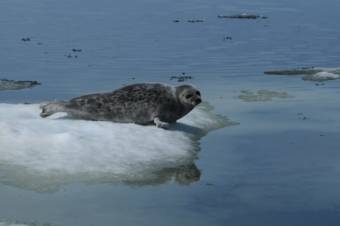
Alaska wanted Arctic ringed seals off endangered species list; federal officials rejected that request

Ringed seal in Kotzebue Sound, Alaska
Ringed seal in Kotzebue Sound, Alaska. (Photo courtesy of NOAA)

On Wednesday, the National Marine Fisheries Service ruled against a petition from the state of Alaska to delist the Arctic ringed seal from the Endangered Species Act.

Last year, the state of Alaska partnered with several North Slope entities to write the petition, arguing that keeping the ringed seal listed as endangered could negatively impact economic opportunities for the state, as well as subsistence rights.

“Although we provided substantial new information to the service, they argued that information was considered in other ways, even though that information wasn’t available previously,” said Chris Krenz, a wildlife science coordinator for the state. “We are disappointed that they took that tact with this petition.”

Krenz says the state believes that the ringed seal isn’t threatened. Officials noted the ringed seal population is in the millions, despite measurable losses in sea ice. Though climate scientists with the National Marine Fisheries Service predict that by the year 2100, there will be little to no sea ice in the Arctic, Krenz argues that looking that far ahead doesn’t constitute the foreseeable future.

“There is way too much uncertainty to really understand how ringed seals will adapt or not to changes in our environment,” Krenz said. “We’ve also documented additional information that indicates ringed seals may have higher resilience than initially anticipated.”

The Obama administration listed the Arctic ringed seal under the Endangered Species Act in 2012, citing the effects of climate change on the ringed seal’s sea ice habitat.

Kristen Monsell with the Center for Biological Diversity agrees with the federal ruling.

“The best available science shows that within the foreseeable future, so much of their habitat will be destroyed — it will just melt away from greenhouse gases — that the species will not be able to withstand that loss,” she said.

Monsell says the fact that the ruling came from the Trump administration underscores the need for federally protecting the Arctic ringed seal.

National Marine Fisheries Service will soon begin a five-year review of the Arctic ringed seal to determine whether or not the species should still be listed under the Endangered Species Act. Krenz with the state of Alaska says this will provide an opportunity for the state to continue to make their case for delisting.

The Trump administration is moving to sell leases in ANWR, but will anyone show up for a sale?

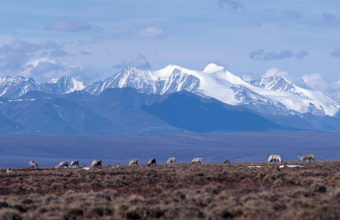
Caribou graze on the coastal plain of the Arctic National Wildlife Refuge, with the Brooks Range as a backdrop in October 2010. (Public domain photo by U.S. Fish and Wildlife Service)
Caribou graze on the coastal plain of the Arctic National Wildlife Refuge, with the Brooks Range as a backdrop. (USFWS)

The battle over oil drilling in the Arctic National Wildlife Refuge’s coastal plain has dragged on for decades.

And now, the Trump administration is close to auctioning off drilling rights for the land in northeast Alaska — potentially just days before President-elect Joe Biden takes office in January.

But there’s a big, unanswered question looming over the idea of a sale: To what degree will the industry actually participate?

Oil and gas companies aren’t talking publicly about whether they’d bid. And Kara Moriarty, head of the Alaska Oil and Gas Association, said that’s not surprising.

“Participation in lease sales is one of the most competitive and secretive things between companies,” she said. “So I don’t know who is interested in participating in a state lease sale, any more than I know who is interested in participating in the next NPR-A lease sale, or in the coastal plain of ANWR.”

ANWR-USGS
The Arctic National Wildlife Refuge’s coastal plain is shown in orange. The area covers about 1.6 million area, roughly the size of Delaware, and makes up about 8% of the refuge. (USGS map)

Moriarty said the public likely won’t have the full picture of industry interest until the federal government unseals the bids on the day of a sale. A sale date has not been announced yet, but the way the government’s timelines work, one could be held just before Inauguration Day.

And while oil and gas companies are mum, industry experts and analysts do have a read on what a lease sale might look like.

“My view is that any response will be fairly lukewarm,” said Rowena Gunn, an analyst for the energy research firm Wood Mackenzie.

Alaska politicians and industry groups have long fought to get drill rigs on the coastal plain, which is thought to hold billions of barrels of oil, but Gunn and others say there’s currently a layer of uncertainty and risk that could lead to limited interest in a lease sale if one happens within the next couple months.

“They’ll probably get some bids,” said Larry Persily, an oil industry observer and former federal coordinator for Alaska gas line projects under President Barack Obama. “But even at fire-sale prices, there probably won’t be a rush of interest.”

That’s for a number of reasons, he said.

One of them is money.

The coronavirus pandemic and an oil price war have both hit the oil industry hard. Oil prices are still low, and it’s expensive and difficult to explore for oil in the Arctic, said Mark Myers, a geologist and former natural resources commissioner in Alaska.

“The prices have fallen down to a level that leaves very little capital for exploration in these companies,” Myers said. “So that’s one of the biggest negatives.”

Also, there’s the opposition, Gunn said, which may weigh more heavily on publicly-traded companies.

“There’s a certain amount of public opinion that it wouldn’t necessarily be good PR for them to be seen as drilling in the Arctic or drilling in environmentally-sensitive areas,” she said.

While some, including Alaska’s congressional delegation, have celebrated the prospect of a lease sale as a way to create more jobs and revenue for the state, others are fighting to keep oil and gas companies out of the refuge, citing concerns about impacts on ecosystems, Indigenous people and the climate.

Indigenous and conservation groups have already filed multiple lawsuits that aim to block drilling in the coastal plain. They’re asking major insurers to not support any oil and gas projects in the refuge. And an array of big banks have already said they won’t fund new oil and gas projects in the Arctic.

There’s a list of other reasons too why some analysts say they wouldn’t expect a deluge of bids.

That includes future demand for oil.

Colorado-based energy economist Philip Verleger said he thinks a lease sale in the refuge 15 years ago would have been “terrifically successful,” but, he said, he thinks the time to develop the coastal plain has passed.

“I do not think ANWR is ever going to be produced,” he said. “The cost of going there and developing and putting the resources in is too high, particularly since the production would last a long time, and we don’t know if demand would last as long.”

Gunn also said some of the larger oil companies operating in Alaska are busy with other projects, such as ConocoPhillips’ work in the NPR-A and Hilcorp taking over oil fields at Prudhoe Bay.

Both companies declined to say whether they had plans to participate in a lease sale in the refuge, if one is held. ExxonMobil also declined to comment for this article.

Chevron said it would consider it “in the context of its global exploration portfolio.” Oil Search said it is “focused on developing the Pikka project and exploring our current leases.”

Perhaps the biggest uncertainty of all that the industry is facing is the changing administration.

Biden has said he opposes drilling in the refuge.

Andy Mack, another former Alaska natural resources commissioner, said even if the Trump administration issues leases before leaving office, Biden’s administration could delay the permits that companies need to search for oil and build their infrastructure.

“What they would try to do is make it so difficult, so onerous, to get the array of permits that the companies just kind of say, ‘Well, we’re not going to spend 10 years just trying to get a simple permit, we’re going to put our money and our investment elsewhere,’” Mack said.

However, Mack said, it’s also possible companies could secure leases and just wait for the administration to change again.

He and Myers underscored that the flip side of all this is that the refuge is still thought to hold a whole lot of oil. And, for some companies, that payoff could outweigh any risk or uncertainty.

Russian and American Scientists say warming water is pushing Bering Sea pollock into new territory

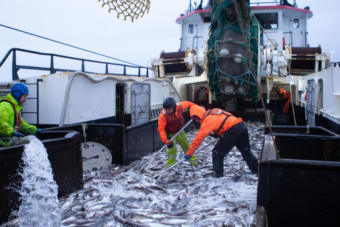
Crew members shovel pollock on the deck of a Bering Sea trawler last year. (Nathaniel Herz/Alaska’s Energy Desk)

In a new study, scientists have linked warming Arctic temperatures, changing wind patterns and shifting currents to movement of commercially valuable Alaska pollock in the Bering Sea.

The Bering Sea has seen the loss of a summer cold water barrier in recent years, which used to keep pollock from spreading out and moving north.

But while scientists are seeing drastic shifts in pollock movement patterns, further research needs to be conducted to know what the changes mean for communities like Unalaska and Dutch Harbor and the billion-dollar pollock industry.

“This research is really critical because pollock are a key ecological component of the Bering Sea shelf food web supporting the largest commercial fishery in the U.S. by biomass,” said Robert Foy, NOAA’s Alaska Fisheries Science Center director. “To get an accurate assessment of pollock abundance so that resource managers can set sustainable catch limits, we have to be able to understand pollock distribution, which certainly looks different under a warm water regime.”

While the implications of changing pollock distributions in the Bering Sea are not yet known, this study marks the first time American and Russian scientists have been able to work together to look at why the groundfish species has shown up in new places in recent years.

By looking at historical and recent data, they’ve been able to confirm both a northward shift of the species and a long-suspected movement of fish between U.S. and Russian waters.

“We were trying to compare what was driving those changes,” said Lisa Eisner, a NOAA Fisheries oceanographer and lead author of the study. “And also if it was possible for some of the fish from the eastern shelf to mix with the fish on the western side of the Bering Sea.”

While scientists have been surveying Bering Sea fisheries for nearly four decades, Eisner said this specific study was born out of the unusual warming events they’ve seen in recent years, and it also drew on historical datasets from both the U.S. and Russia.

According to Stan Kotwicki, program manager for NOAA’s Groundfish Assessment Program, pollock generally have a north-south migration. Typically, as ice comes down from the Arctic over the course of the winter, it pushes fish south to feed in warmer areas.

“And, of course, then during the spring, summer and fall, when the ice is melting, pollock move back north,” he said.

But as winters warm and sea ice melts, Kotwicki said the pollock can migrate much further north and stay there for longer. That’s in part because of a shrinking cold pool — an area of frigid water left behind by melted ice that fish don’t like to swim through. According to the study, with declines in the cold pool, there appears to be more intensive mixing between the Russian stock as it moves north and eastward and the U.S. stock as it moves north and westward.

Lyle Britt leads a team of NOAA Fisheries scientists who do yearly surveys of the eastern Bering Sea shelf and northern Bering Sea to track fish stocks.

Britt said studies like this one often worry people in communities like Unalaska and Dutch Harbor, where the economy is dependent on the commercial fishing industry. He said people can interpret these studies as saying that all pollock are moving north and to Russia.

But, he said, that’s not the message here. It’s much more about understanding pollock movements and behavior than it is an alarm bell that all the pollock are swimming out of reach of fishing boats.

“We are now just starting to fully understand really what their migration pattern is and how they interact with going into Russian waters, or staying in U.S. waters, being constrained by a cold pool or less constrained when there’s a limited or even no cold pool,” Britt said.

The change in temperatures and shifting sea life has happened very rapidly in recent years throughout the eastern Bering Sea ecosystem, according to Britt. And for him and fellow scientists, the big question is how these environmental changes will affect pollock over the long term.

“Science for us is only as good as the number of observations we have,” he said. “And in this case of unprecedented warming, and we really only have a couple of years [of data], it’s really hard to draw really large scale conclusions at this point.”

But he said scientists are planning an array of studies on how whole ecosystems are changing. Not just on pollock movements, but on how they follow prey like plankton or smaller fish and how they interact with bird and marine mammal migrations.

“All of these are questions that are ramping up within our research community,” Britt said. “And we realize it has to ramp up very quickly because of the amount of change we’re seeing.”

Trump administration rushes to sell oil rights in Arctic National Wildlife Refuge

Caribou graze on the coastal plain of the Arctic National Wildlife Refuge, with the Brooks Range as a backdrop. (USFWS)

Starting Tuesday, oil and gas companies can pick which parts of the Arctic National Wildlife Refuge’s coastal plain they’re interested in drilling. It’s the latest push by the Trump administration to auction off development rights in the northeast Alaska refuge before President-elect Joe Biden takes office.

The official “call for nominations” launches a 30-day comment period. It will also allow the Bureau of Land Management to move forward with a lease sale, which it must announce 30 days in advance. The exact timing is not clear, but it raises the possibility that a sale might happen just days before Biden’s inauguration.

“It’s been quite a lot of work to get to this point,” said Kevin Pendergast, Deputy State Director for Resources with the BLM in Alaska. In a separate statement, the agency said the lease sale will be a historic move “advancing this administration’s policy of energy independence.”

In a dramatic shift after nearly four decades of protections, a Republican-led Congress in 2017 approved legislation that opened up part of the refuge to oil development. It called for two lease sales in the coastal section of the Arctic Refuge within seven years, with the first one to be held by the end of 2021.

But conservation groups are blasting the Trump administration’s decision to move forward with the first lease sale now, just a couple months before Inauguration Day, saying it’s rushing the process “to open one of the nation’s most iconic and sacred landscapes to oil drilling.”

The Arctic Refuge’s coastal plain is about 1.6 million acres — an area roughly the size of Delaware that makes up about 8% of the vast refuge. It’s a place where caribou migrate, polar bears den and migratory birds feed. It’s also an area believed to hold billions of barrels of untapped oil.

“This timeline indicates that they’re trying to cram this through in a way that would cut out consideration for public concern,” said Brook Brisson, senior staff attorney at Trustees for Alaska, an Anchorage-based environmental law firm.

Trustees for Alaska is among several groups, and a coalition of 15 states, that filed lawsuits earlier this year aimed at derailing drilling plans for the Arctic refuge. The suits are still winding their way through the court system.

The American Petroleum Institute, a national trade association, welcomed the call for nominations on Monday, saying in a statement that development in the Arctic refuge is long overdue, will create good-paying jobs and provide more revenue for Alaska. It said the industry will work with wildlife organizations and local communities, and use new technology “to safely and responsibly develop these important energy resources.”

Alaska’s all-Republican congressional delegation is also celebrating the news of the government taking another step closer to a lease sale. U.S. Sen. Lisa Murkowski said a sale could be held as soon as January.

“While we face headwinds, from global economic conditions to an organized effort to prevent leasing, the Department’s rigorous environmental review has provided a solid framework to ensure responsible exploration and development,” Murkowski said in a statement. “We are now within sight of the first-ever lease sale on the Coastal Plain, and I appreciate the continued good work of (Interior) Secretary Bernhardt and his team to help us reach this point.”

Residents of the villages closest to the coastal plain are split on the development issue, with some seeing opportunity from drilling while others decry the impact on wildlife, most notably the Gwich’in, whose culture and diet revolve around migrating caribou.

“Any company thinking about participating in this corrupt process should know that they will have to answer to the Gwich’in people and the millions of Americans who stand with us,” said Bernadette Demientieff, executive director of the Gwich’in Steering Committee, in a statement.

But it’s not clear how much interest there will be in drilling. For one thing, it’s expensive in such a remote area.

“There’s a lot of potential oil there that could be harvested,” said Andy Mack, a former Alaska commissioner of natural resources who’s pushed for the refuge’s opening.

“The real trick,” he said, “is doing the math around the marginal cost of producing a barrel of oil in that area of the world.”

Other challenges are low oil prices, the coming change in administration, and the risk of more litigation over environmental concerns. Some investors have also said they won’t fund new oil and gas projects in the Arctic.

Meanwhile, Biden says he plans to permanently protect the Arctic refuge and ban new oil and gas permitting on all public lands and waters.

If drilling leases are finalized before Biden takes office, they could be difficult to revoke, said Mack. But even if not, Biden would still face that federal law that mandates a lease sale by the end of 2021.

Still, Mack said, the next administration could impose restrictions.

“What they would try to do is make it so difficult and so onerous to get the array of permits,” he said, “that the companies just say, ‘Well, we’re not going to spend 10 years just trying to get a simple permit, we’re going to put our money and our investment elsewhere.’”

Site notifications
Update notification options
Subscribe to notifications