Alaska Native Government & Policy

Rural lawmakers wield power without recent precedent

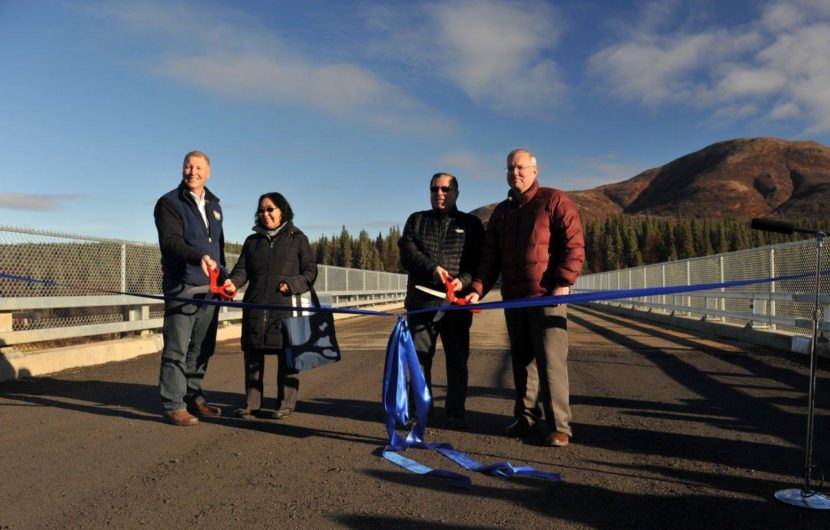
Wood River Bridge ribbon cutting
DOT Commissioner Marc Luiken, Aleknagik Mayor Jane Gottschalk, Sen. Lyman Hoffman and Rep. Bryce Edgmon cut the ribbon on the Aleknagik Wood River Bridge in October 2015. In 2017, Hoffman will be the Senate Finance Committee co-chairman and Edgmon will be House speaker. (Photo by Misty Nielson)

Dillingham Democrat Bryce Edgmon will be the first speaker of the Alaska House of Representatives from off the road system or outside of Southeast Alaska since Nome’s Howard Lyng in the Territorial Legislature of 1941.

And other rural lawmakers will hold more important leadership posts in the next legislature than they have had in decades.

Edgmon and two key committee chairmen are from northern or western Alaska.

Nome Democrat Neal Foster will be co-chairman of the House Finance Committee. Bethel Democrat Lyman Hoffman will be co-chairman of the Senate Finance Committee. It will be the first time both budget-writing committees will have chairs from Bush Alaska since 1990. Hoffman also was a finance chair then, when he served in the house.

Edgmon said the rural leaders are part of a broader regional balance that will be good for the entire state.

“I think it will be good for rural Alaska, and from my standpoint, it’s always good to have regional diversity on the finance committees,” as well as other committees, Edgmon said.

Rural lawmakers have a tradition dating back decades of joining majority caucuses. But this session they’re playing a particularly central role in control of the House. Edgmon and Foster joined with three Republicans to switch from the current Republican-led majority to the primarily Democratic incoming majority.

What this means for rural residents is uncertain. Rural lawmakers have traditionally argued for maintaining or increasing government services. Service increases will be difficult due to the state’s budget crisis. But the incoming House majority is interested in striking a balance that includes both spending cuts and new revenue, like a broad-based income or sales tax, to maintain services. Edgmon expects Foster and his finance committee co-chair Paul Seaton will keep this in mind.

“Both individuals – Rep. Seaton from Homer, Rep. Foster from Nome – are very committed to taking a balanced approach to figuring out the fiscal challenges that lie ahead,” Edgmon said.

Former University of Alaska Southeast political scientist Clive Thomas noted the state government funds a large share of jobs in rural Alaska. And Thomas expects the rural lawmakers to be at the forefront in defending school funding.

“It’s a major income generator in most villages – probably the major income generator – so I think that’s one of the things that they will be concerned about and want to protect,” Thomas said.

Edgmon said there’s another historic element of the new leadership.

“I’m very proud to be the first speaker of Alaska Native heritage,” Edgmon said. “And that’s something that I hope can serve as a role model for future speakers with Alaska Native blood.”

Edgmon said he’s a little less than a quarter Aleut, and he also grew up learning Yupik words and phrases in Dillingham, where the two cultures overlap.

“I grew up in a small town, so I bring small-town values to whatever I do,” Edgmon said. “And I think by nature I’m somebody who listens first and I’m not always the biggest talker in the room. And maybe that hearkens back to my Alaska Native upbringing.”

The budget’s effect on rural areas and the rest of the state will be clearer in mid-December, when Gov. Bill Walker is scheduled to unveil his budget proposal.

The Standing Rock resistance is unprecedented (it’s also centuries old)

As resistance to the Dakota Access Pipeline in Standing Rock, N.D., concludes its seventh month, two narratives have emerged:

  1. We have never seen anything like this before.
  2. This has been happening for hundreds of years.

Both are true. The scope of the resistance at Standing Rock exceeds just about every protest in Native American history. But that history itself, of indigenous people fighting to protect not just their land, but the land, is centuries old.

Over the weekend, the situation at Standing Rock grew more contentious. On Sunday night, Morton County police sprayed the crowd of about 400 people with tear gas and water as temperatures dipped below freezing.

But the resistance, an offspring of history, continues.

Through the years, details of such protests change — sometimes the foe is the U.S. government; sometimes a large corporation; sometimes, as in the case of the pipeline, a combination of the two. Still, the broad strokes of each land infringement and each resistance stay essentially the same.

In that tradition, the tribes gathered at Standing Rock today are trying to stop a natural gas pipeline operator from bulldozing what they say are sacred sites to construct an 1,172-mile oil pipeline. The tribes also want to protect the Missouri River, the primary water source for the Standing Rock Reservation, from a potential pipeline leak. (Energy Transfer Partners, which is building the pipeline, says on its website that it emphasizes safety and that, “in many instances we exceed government safety standards to ensure a long-term, safe and reliable pipeline.”)

Since April, when citizens of the Standing Rock Sioux Nation set up the Sacred Stone Camp, thousands of people have passed through and pledged support. Environmentalists and activist groups like Black Lives Matter and Code Pink have also stepped in as allies. Many people who have visited say that the camp is beyond anything they’ve ever experienced.

“It’s historic, really. I don’t think anything like this has ever happened in documented history,” said Ruth Hopkins, a reporter from Indian Country Today.

But there are historical preludes, and you don’t have to look too far back to find them. In 2015, when the Keystone XL pipeline was being debated, numerous Native American tribes and the Indigenous Environmental Network organized against it. The pipeline would have stretched 1,179 miles from Canada to the Gulf of Mexico. The Rosebud Sioux, a tribe in South Dakota, called the proposed pipeline an “act of war” and set up an encampment where the pipeline was to be constructed. Also joining in were the Environmental Protection Agency, the National Resources Defense Council, and the Omaha, Dene, Ho-chunk, and Creek Nations, whose lands the pipeline would have traversed.

President Obama vetoed Keystone XL. But even at the time, A. Gay Klingman, the executive director of the Great Plains Tribal Chairman’s Association, warned that the reprieve would be temporary. “Wopila [thank you] to all our relatives who stood strong to oppose the KXL,” Klingman said in a statement after the veto. “But keep the coalitions together, because there are more pipelines proposed, and we must protect our Mother Earth for our future generations.”

In the case of the Dakota Access Pipeline, the Standing Rock Sioux have been able to attract support from hundreds of tribes all over the country, not just in places that would be directly affected. The tribes aren’t just leaning on long-held beliefs about the importance of the natural world. They’re also using long-held resistance strategies. Like the encampment itself.

“If you don’t know very much about Native American people, you wouldn’t understand that this is something that’s kind of natural to us,” said Hopkins, who is enrolled in the Sisseton Wahpeton Oyate Nation and was born on the Standing Rock Reservation. “When we have ceremonies, we do camps like this. It’s something that we’ve always known how to do, going back to pre-colonial times.”

In the late 1800s more than 10,000 members of the Lakota Sioux, Cheyenne and Arapaho tribes set up camp to resist the U.S. Army’s attempt to displace them in search of gold. That camp took form at the Little Bighorn River in Montana. After the soldiers attacked the camp in June of 1876, the Battle of the Little Bighorn, widely known as (Gen. George) Custer’s Last Stand, erupted. In defeating the Army, the tribes won a huge land rights victory for Native Americans.

There was also Wounded Knee, a protest that was part of the American Indian Movement. During the 1973 demonstration, about 200 people occupied the town of Wounded Knee on the Pine Ridge Reservation in South Dakota — the site of an 1890 massacre in which U.S. soldiers killed hundreds of Native Americans. Protesters turned Wounded Knee into what one former AIM leader called “an armed camp” in order to protest corruption in tribal leadership and draw attention to the U.S. government’s failure to honor treaties.

Over the course of the 1973 occupation, two Sioux men were killed and hundreds more arrested. But the resistance, which lasted 71 days, underscored Native American civil rights issues in a way that many see reflected today in Standing Rock.

If Native American resistance is an old story, that’s because the systemic violation of indigenous land rights is an old story. And if history is any precedent, the resistance won’t end at Standing Rock.

“There are no rights being violated here that haven’t been violated before.” said Kim Tallbear, a professor of Native Studies at the University of Alberta, who for years worked on tribal issues as an environmental planner for the U.S. Environmental Protection Agency and the Department of Energy. Those violations, she said, have taken two forms: long-term disregard for indigenous land rights and a “bureaucratic disregard for consultation with indigenous people.”

When she sees images of police using pepper spray and water cannons or security guards unleashing dogs on Standing Rock protesters, Tallbear said, she isn’t shocked. “I’m, like, oh yeah, they did that in the 19th century, they did that in the 16th century,” she said. “This is not new. … The contemporary tactics used against indigenous people might look a little bit more complex or savvy, but to me, I can read it all as part of a longstanding colonial project.”

“Maybe for non-Natives who thought that the West was won, and the Indian Wars were over, and Native people were mostly dead and gone and isn’t that too bad – now, they’re like, ‘Oh wait a minute, they’re still there? And they’re still fighting the same things they were 150 years ago?’

“Yeah, we are.”

Copyright 2016 NPR. To see more, visit http://www.npr.org/.

North Slope schools expand curricula to ‘reflect ideologies of the Inupiat’

North Slope government and history is now part of high school graduation requirements for all North Slope Borough schools.

The borough school board passed a new policy this month making the curriculum change mandatory for students, effectively beginning with freshmen who start in 2017.

This change has been years in the making, said Pausauraq Jana Harcharek, the Inupiaq education director for the North Slope Borough school district.

“And it goes back probably to the formation of the North Slope Borough School District, when founding Mayor Eben Hopson, in a speech, said that our schools will reflect the ideologies of the Inupiat, that our schools will reflect who we are as people,” Harcharek said.

Now, thanks to the school board, borough district students will receive one credit toward social studies requirement through a North Slope government class and a North Slope history class.

The credit will be integrated into what’s already being taught instead of creating a separate class entirely, Harcharek said.

“So we’ve developed and implemented a series of what we call culture-based units,” Harcharek said. “So as a district we’ve been producing units for teachers to integrate into their teaching from kindergarten, or K-3, K-4, all the way up through grade 12, so this would just become part of that work.”

Harcharek does not foresee the curriculum changes incurring additional costs for the school district.

She said teaching students about their background, their Inupiaq history, is beneficial beyond helping students get a job post-graduation.

“They need to learn about how our people use Western tools through federal legislation in the formation, for example, of the North Slope Borough, our regional corporations, our village corporations, as tools to advance the Inupiaq agenda and to protect our subsistence life ways, to protect the rights that we have as people to land, to education,” Harcharek said.

As a person who identifies as Inupiaq, Harcharek recognizes the significance of incorporating North Slope local government and history into an Inupiaq student’s education.

“It means that we are able to fulfill the wishes of our elders and our people who have been expressing this idea of being inclusive of who we are in the classrooms,” Harcharek said. “It helps ground them in who they are from a historical perspective, because it is by knowing from where you came that you are able to maneuver more effectively in this day and age.”

The next step for expanding education related to local native history is to share these curriculum practices with international groups of people.

By 2018 the North Slope Borough school district’s goal, Harcharek said,  is to help schools in Chukotka, Canada, and Greenland incorporate their own local history and government classes.

Alaska Native corporation acquires oil and gas leases in Arctic waters

17?USGSArctic
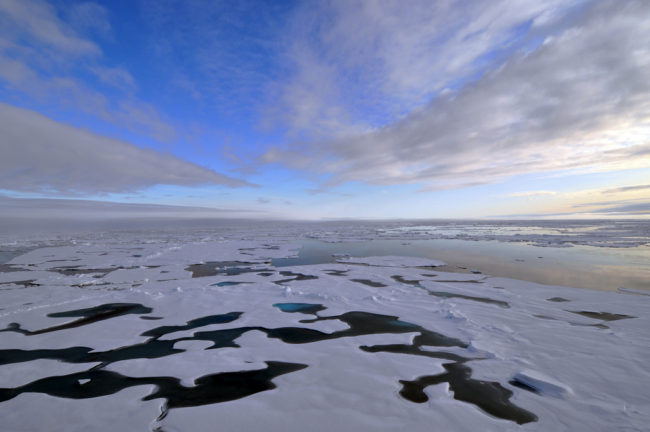
A Native Corporation is now able to explore oil and gas opportunities in the Arctic Ocean. (Photo courtesy of the U.S. Geological Survey)

The Alaska Native corporation representing the North Slope has bought 21 federal leases in the Beaufort sea formerly owned by Shell. That gives the Arctic Slope Regional Corporation, or ASRC, the right to explore for oil and gas in the Arctic Ocean, which has historically been controversial.

Rex Rock Sr. is the president and CEO of ASRC.  He announced Wednesday that the corporation has acquired Shell’s leases in Camden Bay, just off the coast of the Arctic National Wildlife Refuge.

After spending billions on an unsuccessful exploration campaign, Shell halted its efforts to drill in the Arctic in 2015. However, Rock said Shell’s failure to develop on the Outer Continental Shelf doesn’t mean there isn’t opportunity for oil and gas development there.

“We all know how the Chukchi effort ended, yet we know there is still tremendous potential in Alaska’s offshore,” Rock said.

Camden Bay is the site of the Sivulliq and Torpedo prospects. Rock said ASRC also obtained Shell’s data on the sites. He made the announcement at a conference hosted by the Resource Development Council in Anchorage.

The Interior Department is expected to announce soon whether it will include the Arctic in its 5-year plan for offshore oil and gas leasing. Alaska Department of Natural Resources Commissioner Andy Mack said ASRC’s willingness to take on the leases is a sign of local support for offshore drilling — and it should signal to the federal government that the Arctic must be included in the plan.

“For ASRC to take this step out and say we believe that we can do this and we believe this can be done safely and we’re doing this on behalf of our shareholders should speak volumes to the conversations that are going on and the analysis being conducted in Washington, D.C.,” Mack said.

Alaska officials and the oil industry have strongly advocated for Arctic leases to be included in the 5-year plan. Environmental groups oppose their inclusion due to concerns about climate change and impacts to wildlife.

A decision not to offer future lease sales in the new five-year OCS plan would have no effect on current leases.


Correction: An earlier version of this story misstated the number of leases ASRC acquired in the Beaufort Sea. It is 21, not two. 

Juneau locals protest DAPL outside senators’ offices

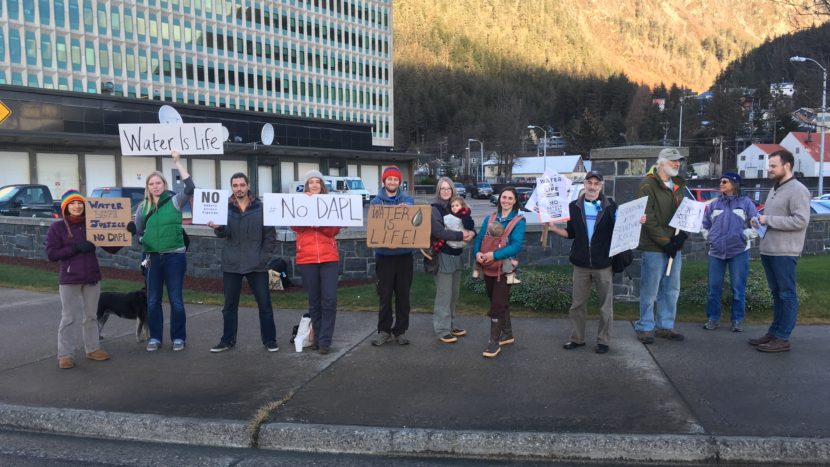
Locals in Juneau protest the Dakota Access Pipeline project outside the offices of U.S. Sens. Lisa Murkowski and Dan Sullivan, Nov. 15, 2016. (Photo courtesy Larry West)
Locals in Juneau protest the Dakota Access Pipeline project outside the offices of U.S. Sens. Lisa Murkowski and Dan Sullivan in Juneau, Nov. 15, 2016. (Photo courtesy Larry West)

Protesters in downtown Juneau showed their solidarity with the Standing Rock Sioux and other tribal nations on Tuesday. The Sioux are protesting construction of the massive Dakota Access pipeline project near the Missouri River and their ancestral lands.

The Standing Rock Sioux Reservation is located in North and South Dakota. The 1,172-mile pipeline would carry crude oil from North Dakota to Illinois.

Larry West participated in the protest near the Juneau offices of U.S. Sens. Lisa Murkowski and Dan Sullivan. West said there were 30 to 40 people carrying signs, chanting and protesting a variety of issues including corporate influence, environmental issues and indigenous rights.

“The signs say things like, ‘Standing with Standing Rock,’ ‘Water is Life,’ ‘No DAPL,’ ‘Keep it in the ground.’ Those sorts of things,” West said.

In an email, Sullivan spokesman Mike Anderson criticized the Obama administration’s revocation of a key pipeline decision for “political considerations” after permits had been lawfully issued and construction begun. However, Anderson also expressed sympathy.

“On issue after issue, in Alaska, the state, Alaska Natives, and others aren’t meaningfully consulted by the federal government,” Anderson said in the email. “This situation illustrates why Sen. Sullivan believes we need a transparent and efficient process up front to bring project proponents, stakeholders, tribes, and the government together to responsibly build needed infrastructure.”

Murkowski’s office could not be reached for comment.

Editor’s note: This story has been updated with comment from Sen. Dan Sullivan’s office.

Blood lines: Sealaska studies Alaska Native descendant dilemma

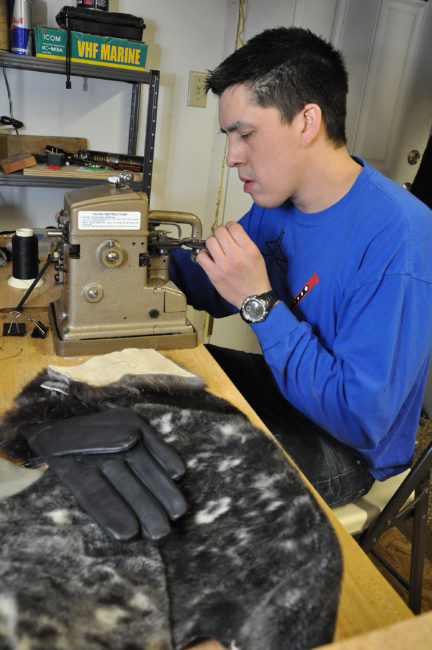
Jeremiah James learns to sew marine mammal furs at a workshop sponsored by the Sealaska Heritage Institute. (Photo courtesy Kathy Dye/Sealaska Heritage Institute)

What makes a person Alaska Native?

In some places, a regulatory definition — known as blood quantum — has superseded cultural ones.  

And a new study by the Sealaska Heritage Institute in Juneau tackles how that regulatory definition applies to marine mammal hunters.

According to the federal government, Nathan Soboleff is one-eighth Tlingit and one-eighth Haida descent. He said he’s got some Norwegian and Russian mixed in there too. He identifies most strongly with his Tlingit roots.

“My father’s and grandfather’s people have been here since time immemorial and my mother’s side of the family has been here seven or eight generations as Norwegian fishermen. Juneau is my lifelong home,” Soboleff said. 

Nathan’s family name is well-known in Juneau. The Sealaska Heritage Institute building is named after his grandfather, Tlingit elder Walter Soboleff.  His great-uncle Vincent Soboleff is a Russian-American photographer who documented Tlingit life at the turn of the last century.

“There aren’t a lot of Soboleffs in Juneau but we have left a bit of a mark,” he said.

Soboleff also has deep ties to his culture. He’s on the board of directors for the Kootznoowoo village corporation for Angoon. And he’s an outspoken advocate of the importance of cultural heritage.

But, in the lineage math used for certifying degree of Indian blood, Soboleff has a one-fourth blood quantum.

That amount is calculated by the federal government, using ancestors with Indian blood who were enrolled in federally recognized Indian tribes or whose names appeared on the rolls of federally recognized tribes.

That means he’s got just enough of a blood quantum to qualify as a descendant shareholder of the Sealaska corporation.  Of the regional corporations that enroll descendants, all but one — Calista — require a minimum blood quantum.

It also means that, as a subsistence hunter in Southeast Alaska, he can harvest sea otters, harbor seals and Steller sea lions.

Those animals are protected under the Marine Mammal Protection Act, but Alaska Natives who live in coastal areas are exempt and allowed to hunt them for food and clothing or to make handicrafts to sell. 

But that right isn’t afforded to all Alaska Natives. They have to have a blood quantum of a quarter or more.

Soboleff can hunt, but he married a non-Native woman.  And his kids?

“My children are less than that,” he said.

Soboleff’s daughter and sons can watch him hunt and harvest, prepare the carcasses for food or ceremony — but they can’t drive the boat or help him haul the dead animals on board. They can’t help him sew the hides or prepare seal oil.

He said using the blood quantum interpretation as a requirement for harvest has limited his ability to teach his children their cultural heritage.

“If you take that interpretation and move forward in time just a couple of years, you’re really preventing future descendants of the culture of learning their ways,” he said.

And Soboleff’s family isn’t alone.

According to the Sealaska Heritage Institute’s study, the number of Alaska Natives who meet the one-fourth blood quantum threshold is dropping.

In the last decade, nearly 20,000 Alaska Natives enrolled with the Bureau of Indian Affairs had less than that one-fourth blood quantum, according to the agency.

The heaviest hit are communities in the Gulf of Alaska where nearly 60 percent of newly enrolled Alaska Natives don’t meet the threshold.

And, beyond the loss of subsistence hunting privileges, Soboleff said the blood quantum restriction is creating divisions within the Alaska Native community.

“It creates a class of Native peoples. It separates them,” he said. “It specifically breaks them into two groups, those who can hunt, harvest and use those marine mammals and those who cannot.”

Through personal interviews, the study found that most Alaska Natives would like to see the blood quantum criteria changed. It lays out several ways that could happen. 

It includes changing the blood quantum threshold to one-eighth. Though, the same eligibility issue could pop up again in a few decades. Tribal enrollment could be used, but some tribes require a minimum blood quantum.

Rosita Worl is the president of the Sealaska Heritage Institute and an anthropologist who helped guide the research in the study.

“I heard grandfathers talking about how they couldn’t take their grandsons out hunting. I heard other grandfathers talk about being able to take one child out who had the one-quarter blood quantum, but not another who did not meet the eligibility requirements,” she said.

She presented the results of the study at the Alaska Federation of Natives conference in Fairbanks in October.

It’s not the first time the issue has been discussed at the conference. In 2010, the Koniag regional corporation proposed changing the definition of Alaska Native to include lineal descendants with less than one-fourth blood quantum.

But, Worl said it was controversial.

“We didn’t know how many new members that would be,” she said. “Are we talking about a whole new population of 30,000 hunters coming into hunt? You know we just had absolutely no idea.”

Now that the new study makes that data available, she said the next step is for tribal entities to take the research back to their regions and decide if, and how, they might want to change the hunting requirements.

Once they’ve got consensus, they’ll have to take their request to Congress.


Editor’s note: This story has been updated to show that the Sealaska Heritage Institute building was named after Walter Soboleff. 

Site notifications
Update notification options
Subscribe to notifications