Alaska Native Government & Policy

Eklutna reaches deal with Anchorage over trash gas and new housing

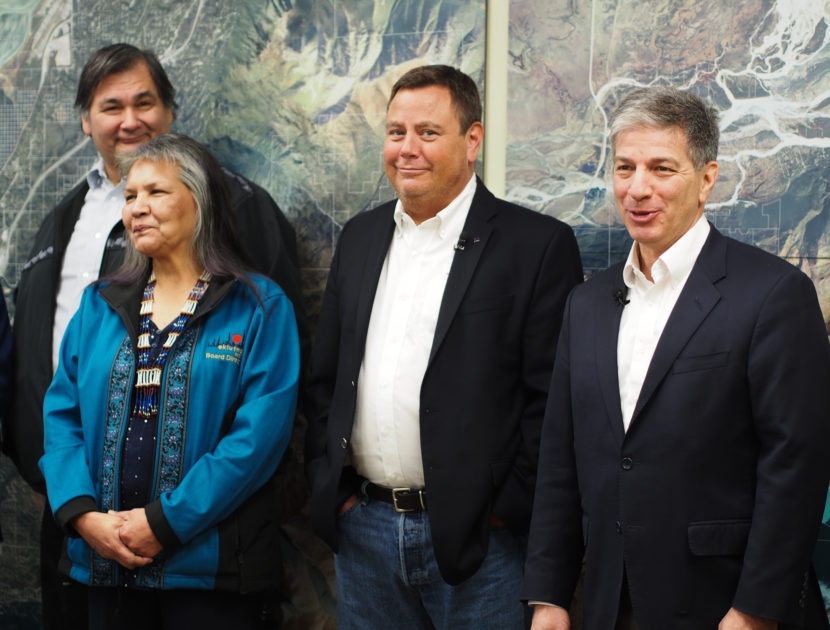
Eklutna Inc. board members Michael Curry, left, and Maria Coleman stand next to Eklutna CEO Curtis McQueen and Anchorage Mayor Ethan Berkowitz at a news conference in Eagle River on January 4, 2017. (Photo by Zachariah Hughes, Alaska Public Media)
Eklutna Inc. chair and President Michael Curry, left, and Treasurer Maria Coleman stand next to Eklutna CEO Curtis McQueen and Anchorage Mayor Ethan Berkowitz at a news conference in Eagle River on Jan. 4, 2017. (Photo by Zachariah Hughes, Alaska Public Media)

The Municipality of Anchorage has reached an agreement with a local Native corporation in a deal that will avoid years of costly litigation for both sides.

During a news conference Jan. 4, leaders from both the city and Eklutna Inc. shared details of the multi-part agreement, which include promises of new housing stock, infrastructure and cash for natural gas produced at the Anchorage landfill.

“We’re all on the same page today,” Eklutna Inc. CEO Curtis McQueen said, standing before a wall-sized map of Denai’ina lands at the corporation’s office in Eagle River as he summed up the company’s special relationship with the municipality.

“Eklutna thinks long term. We’ve been a partner with the city a lot longer than the last 45 years,” McQueen said, adding that the relationship could continue for “centuries to come.”

The for-profit Alaska Native Claims Settlement Act company is the largest owner of private land within the municipality of Anchorage, holding 90,000 acres according to its website.

Those holdings are primarily within the thinly populated neighborhoods of north Anchorage, from Eagle River to Peters Creeks.

In 1982, a federal deal called the North Anchorage Land Agreement between Eklutna, the city and the state resolved ownership issues over portions of contested claims in the area, which includes the Anchorage landfill.

In 2012, the city implemented an energy system that captured methane from decomposing trash at the landfill and sold it as energy to nearby Joint Base Elmendorf-Richardson.

The next year, Eklutna sued Anchorage over that sale, alleging that the city is legally obligated under NALA to split the millions of dollars in revenue coming from the trash gas at the landfill.

Now, the city and corporation have reached an agreement on that suit.

“Eklutna is going to waive any future claims about gas, the municipality is going to forward about $5.75 million,” Anchorage Mayor Ethan Berkowitz said.

The money is a one-time payment, with $5 million coming from general government funds, and the other $750,000 paid by Solid Waste Services, the local trash utility.

Going forward, any money from gas sales at the dump will stay with city.

At Wednesday’s news conference, the payment was framed as a capital resource to help Eklutna build 108 residential units in the next three to five years on property it owns. Residential construction, primarily of single-family homes, is one of the corporation’s best proven abilities.

According to McQueen it was part of what they brought to the table when Eklutna began discussions around the lawsuit when the current administration came into office.

“You’ve heard a lot about the Anchorage Bowl running out of land,” McQueen said. “North Anchorage and Eklutna have a lot of that. We’ve been part of many neighborhoods around Anchorage, and we’ve been talking about how to stimulate making more lots available.”

The deal also laid out who will pay for utility infrastructure to the new developments. Anchorage’s water utility will front the costs for building sewer lines through, though Eklutna will pay that money back.

Speakers at the news conference stressed that the agreement was worth more than the particulars of the settlement, saying it is an accomplishment just for both parties to once again be working together in good faith.

“It takes good hearts to get there, not just business,” said Maria Coleman, treasurer for the corporation’s board of directors.

The deal does not need approval from the Eklutna tribal government to go forward.

Tribal Council President Lee Stephan was present at the news conference, but declined to speak in an official capacity.

Now, the measure is set to go before the Anchorage Assembly next week during its regular meeting.


Native Americans in Oregon say Kennewick Man is one of them

A reconstruction of Kennewick Man sculpted to resemble the Ainu people of Japan, considered by some at the time to be his closest living relatives. Now, a link to Native Americans has been confirmed. Brittney Tatchell/Smithsonian Institute
A reconstruction of Kennewick Man sculpted to resemble the Ainu people of Japan, considered by some at the time to be his closest living relatives. Now, a link to Native Americans has been confirmed. (Photo by Brittney Tatchell/Smithsonian Institute)

Kennewick Man is an ancient skeleton found along the banks of the Columbia River by students in 1996. The discovery caused a legal battle between Northwest tribes and scientists.

But now, President Barack Obama has signed a bill that requires the 9,000-year-old remains be returned to tribes within 90 days.

Washington Sen. Patty Murray, a Democrat, championed the bill that gives the ancient bones to the tribes.

Several Northwest tribes are meeting this week with the U.S. Army Corps of Engineers and with the Washington state Department of Archaeology and Historic Preservation to discuss the imminent reburial of the Ancient One, or Kennewick Man.

People have continuously lived in north central Oregon for thousands of years. So Rob Begay, whose family is from Celilo Village on the Columbia River, said the scientists can’t tell him much about a story he already knows about Kennewick Man and his own people.

“Maybe they read too many books or something,” Begay said. “Because all of those things about the Native Americans, of how supposedly we were, are really not true. A lot of those are their own theories of why they think we are from somewhere else.”

“But as for me, my parents and my grandparents and down the generations back thousands upon thousands of years — that was our oral traditions, stories — that we were created here from time immemorial.”

Begay said it’s important to respect the Earth. In the origin stories, that’s where his people come from. In fact, he points to a long strip of exposed earth in the center of this longhouse.

“This floor, Mother Earth, that’s where we come from,” Begay said. “This is our altar here. To us this is altar. That’s why this right here, why we stand on both sides of it.”

It’s important for Begay and others here to see Kennewick Man — or the Ancient One — returned to that sacred earth.

A language leader for the Plateau tribes, Thomas Morning Owl, said sometimes people like to think of the tribes as something that happened in the past. Disconnected from Kennewick Man so long ago.

“Our traditions our life, our culture isn’t relegated to the past and frozen in time,” Morning Owl said. “We are a vibrant community. Our culture is more than uggs and shrugs or stones and bones. We live our culture on a daily basis.”

Seeing Kennewick Man returned will be good. He said it has been 20 long years.

“We’ve up to now have been pushed aside as fundamentalist crackpots in the native way that our religion and our practices are of no consequence to anything in science,” Morning Owl said. “But then we as a people know what we were charged with.”

Morning Owl said each new generation has that same great responsibility to make sure their ancestors are taken care of, honored and are at rest in the earth.

The transfer of Kennewick Man could take up to three months, but tribal officials are hoping to rebury the bones as soon as they can. Murray said she met with the Northwest tribes about 18 months ago.

“The compelling piece of their story, that this was one of their own, the tears in their eyes, the long years — just really said to me it’s time to get this done,” she said.

When it happens, the burial won’t be open to the public or the press.

Alaska saw record-high number of suicides in 2015

eyeball
(Creative Commons photo by Alex)

More Alaskans killed themselves in 2015 than in any previous year since at least 1978. Two hundred people died by suicide in the state, 28 more than the previous record set in 2013.

Need help?

Alaskans can get support at carelinealaska.com or by calling 1-877-266-4357.

Experts said it’s difficult to determine the causes for the high number of suicides.

Kate Burkhart, the executive director of the Statewide Suicide Prevention Council, said inconsistent access to behavioral health care contributes to the state’s high suicide level.

“We have very high incidences of adverse childhood experiences, interpersonal violence and domestic violence, substance abuse, and depression and other mental-health disorders,” she said. “And so we have that constellation of risk factors present pretty much throughout the state. Access to health care though, is not consistent throughout the state.”

Burkhart said one factor that may have increased the number of suicides in 2015 was two events that gained a high profile. A cluster of suicides in the Southwest Alaska village of Hooper Bay and a suicide at the Alaska Federation of Natives convention may have prompted other deaths.

“Suicides that receive a great deal of coverage in the media, for someone who’s already at risk, it can increase that risk,” she said.

The suicide prevention council worked with AFN on prevention programs at this year’s convention.

The suicide total includes 67 deaths of Alaska Natives. Among Alaska Native men, the age-adjusted rate was 80 suicides per 100,000, more than six times the rate for all American adults.

Barbara Franks is a board member of the Statewide Suicide Prevention Council. Her son Ron died by suicide in 1997 when he was 23. Franks, who is Tlingit, said focusing on ethnicity can detract from understanding the individual causes of suicide.

“I stopped the categorizing when they say a young male from Alaska,” she said. “You get to find that people will become more sensitive of how they’re categorized than to (finding) out why or what happened.”

Franks said the downturn in the state’s economy likely contributed to the high number of suicides last year. It’s too early to say whether the number has dropped this year, since 2016 statistics aren’t compiled until next year.

The Statewide Suicide Prevention Council, schools and other suicide prevention programs receive $1.6 million annually.

Burkhart said it’s difficult to compare the 2015 suicide total to past data. That’s because the stigma surrounding suicide discourages reporting, and that stigma has changed over time.

“As we get better and better at tracking the data, and as people are less reluctant to say, ‘Yes, my loved one died by suicide,’ we are going to see an increase in the numbers,” Burkhart said. “It happens with other things like domestic violence and other issues where stigma has prevented a good picture being painted.”

Public health experts say that if people notice warning signs of suicidal behavior, such as talking about it or ways to do it, they should seek advice on treatment. The volume of calls to the state’s suicide prevention careline have increased more than 60 percent in the last two years.

Gov. Bill Walker’s new budget proposal increases funding for a programs that include suicide prevention.

Interior Secretary pick has a record of listening to tribes

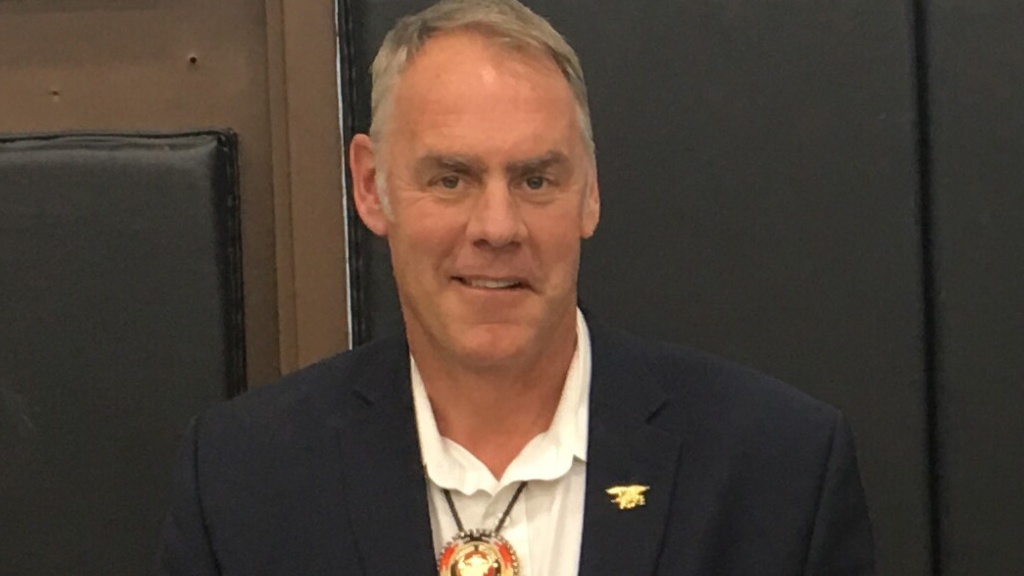
Rep. Ryan Zinke in Frazer, Montana, last summer. (Photo by Mark Trayhant/Trahant Reports)
Montana Rep. Ryan Zinke has been tapped to head the Interior Department by President-elect Donald Trump. (Photo by Mark Trayhant/Trahant Reports)

HELENA, Montana — Just about a week ago it was clear that Cathy McMorris Rodger was headed to the Interior Department. Nope. It was a headfake. President-elect Donald Trump has instead picked U.S. Rep. Ryan Zinke, R-Montana, for the post.

This is a much better appointment for Indian Country. Zinke is no less conservative than Rodgers, but since his days in the Montana legislature he has had an open door. He has reached out to tribes in a number of ways. He introduced and championed the Blackfeet water compact and he has supported federal recognition for the Little Shell Band of Chippewa Cree.

“The truth is Ryan does know the value of public lands, he does know, to an extent, I don’t know how deep, the issues of Indian Country,” said Sen. Jon Tester at the Montana Budget and Policy Center’s Legislative Summit on Wednesday.

He said the Senate confirmation hearing process will be useful in getting Zinke on record explaining his views on such things as the government’s Trust Responsibility to tribal nations.

“It’s a big deal for the state of Montana,” Tester said. “He has a chance to do some really good stuff. Compare him to some of the people nominated before, aka Sarah Palin, we will take him in a heartbeat.”

At a congressional debate in Frazer, on the Assiniboine Sioux Tribal Nation, Zinke said he had been adopted as an Assiniboine. He said he supports tribes and sovereignty.

“I don’t think anyone has worked harder trying to get Blackfeet Water Compact done … I have been out here not because I am your congressman, but because I care.”

He said he has been to people’s homes, met with tribal councils, and visited powwows.

Harry Barnes, chairman of the Blackfeet Nation, told The Helena Independent Record, that the appointment is “a great day for Montana” and that “Montana tribes will have an ear in the Department of the Interior, which oversees the Bureau of Indian Affairs.”

Montana Republicans, many Western Republicans, are eager for an Interior Secretary who will open up more federal lands to oil and gas development. And on this score, Zinke will not disappoint.

“I’m excited that the Trump administration plans to unleash the economic power of the resources of the nation,” Jeff Eisman, chair of the Montana Republican Party, told Montana Public Radio. “The federal government does control a lot of resources, especially in our end of the country.”

And it’s not likely tribes will often agree with Zinke.

This is a Trump administration and Zinke was one of his early supporters. Zinke has voted against tribes on other issues, such as the Violence Against Women Act, a law that expanded tribal authority on domestic violence.

If Zinke is confirmed by the Senate there would be a special election for his House seat.


Mark Trahant is the Charles R. Johnson endowed professor of Journalism at the University of North Dakota. He is an independent journalist and a member of The Shoshone-Bannock Tribes. On Twitter @TrahantReports.

This story originally appeared on Trahant Reports and is republished here with permission.

Justice reform might mean increased power for tribal courts

Law enforcement, and other segments of Alaska’s justice system, are quite concerned about deep changes the Legislature began making to the state Criminal Code this year.

The aim of Senate Bill 91 is to reduce sentences and jail time for many low level offenders, opening the way to more rehabilitation and treatment options as well as reducing recidivism.

In Western Alaska, proponents say that this could give local tribes power to take a seat at the table, but are they ready for that increased responsibility?

As Alaska tribes continue to explore tribal sovereignty by looking into taking allotments and corporation land into federal trust, an opportunity may be opening with the new Criminal Code revision. Captain Berry Wilson with the Alaska State Troopers thinks so, anyway.

“I think it’s a great opportunity for coordinated and cooperative interaction between the state system and the tribal system in a manner that helps prevent incarceration and institutionalization of individuals that we can fix,” Wilson said.

Senate Bill 91 eases punishments for low level crimes like alcohol consumption, which make up a huge portion of the crimes in Western Alaska. Convictions for these offenses can set offenders on a path of lifelong incarceration. Wilson says that Senate Bill 91 leaves room for tribal courts to step in before that happens, and he is pushing for that.

“It gives us a tool, it really does. If a tribal court writes out a (domestic violence) order and says, ‘This is what you can’t do’, we use that just as we would use a state order,” Wilson said.

Tribal courts have a reputation for being unorthodox in the way they prosecute crimes and dole out punishment, however.

“I’ve got a friend in Kwthluk who’s an alcoholic, terrible alcoholic,” said Jim Valcarce, a Bethel attorney who played a role in designing SB 91.
“And when he gets caught, he would love to go to the state rather than go through the tribal court up there because they make him do stuff. They make him work. One day he had to empty honey buckets.”

“To him, he says a month in jail is way easier than spending one day working for the tribal court in Kwethluk,” he said. “That’s smart justice because the community’s getting something back, it actually causes him to re-think what he’s gonna do, and the community has a vested interest now.”

Valcarce likes that many tribal courts employ traditional knowledge during the process, but in one area that can be a problem.

“By simply banishing somebody, or sending them out of town, you just create a problem for somebody else. And I just think tribal courts who are doing that have not thought that through, because I don’t think they’ve been trained to understand that,” Valcarce said.

Banishment made headlines this summer in the case of Derek Adams, who was banished from his village of Nunam Iqua after being involved in a fire that killed three people.

Though the state of Alaska found Adams to be guilty only of criminal negligence, three different villages sentenced him to banishment even before the trial had taken place.

Tribal courts do not have clear standards for due process, and this can be problematic when sentences conflict with state or federal rulings.

“One of the things that’s really important when we look at the banishment issue as it comes forth from a community is, ‘Was there due process for the individual that is being banished?'” said  Capt. Barry Wilson of the Alaska State Troopers. “You don’t have any options, you don’t have any appeal, you don’t have any say, you don’t have any ability to controvert. That’s lack of due process.”

Both Orutsararmiut Native Council and the village of Emmonak are building a tribal justice program, but these new courts could be in for a rough ride as they take on hard cases that they don’t yet have the capacity to deal with.

Senate Bill 91 will take three years to fully go into effect, and next year the Legislature is likely to make revisions.

Beth Kerttula returns to Juneau with a message: It’s time to plan for ocean’s future

Former state Rep. Beth Kerttula served as the National Ocean Council director for two years. She said marine planning is important.Dec. 9, 2016. (Photo by Andrew Kitchenman/KTOO)
Former state Rep. Beth Kerttula served as the National Ocean Council director for two years. She said marine planning is important. (Photo by Andrew Kitchenman/KTOO)

Former Juneau state Rep. Beth Kerttula returned to Alaska this summer after two years serving the White House as director of the National Ocean Council.

In this position, she helped two regions write the country’s first marine plans, and worked on some issues particularly important to Alaskans.

Kerttula said it’s important to plan for the future of the oceans that surround Alaska and the rest of the United States. She said just as people can have personal trauma when they don’t plan for their future, the U.S. oceans could face disaster.

“If you aren’t planning where your ship lanes are, if you’re not planning around the sea mammals, if you’re not planning so that you can have development, then you’re going to have a mess at some point,” she said. “And you’re going to have conflict between subsistence users, between the developers.”

The attraction of making a difference for the future of the oceans is why Kerttula left the Alaska House of Representatives in 2014, after 15 years.

The Juneau Democrat served as the minority leader for her last seven years in the House.

She spent six months at Stanford University’s Center for Ocean Solutions before she joined the National Ocean Council. President Barack Obama formed the council under an executive order in 2010. Kerttula explained why he did it.

“It’s a huge challenge right now with the ocean,” she said. “We’re facing some very severe problems: ocean acidification, erosion, sea-level rise, the lack of coordination among users, the lack of coordination among the federal agencies. And all of those things are really coming to a head.”

The National Ocean Council includes 27 federal agencies.

Kerttula worked with officials in all of the agencies to plan with state and tribal governments. The council adopted the first two marine plans on Dec. 2, covering the waters off of the Northeast and Mid-Atlantic.

She said planning is especially important for Alaska.

“We have so many conflicts,” she said. “And we have worse problems on the horizon, particularly in our ocean space. And this is just a really wonderful method to put all of the users, the stakeholders, the federal agencies, the tribes, at the table.”

Along with resolving conflicts, Kerttula said, the focus on planning can provide more information about coastal waters, such as mapping the seabed.

“We know so little about the ocean floor. We don’t even have charts,” she said. “I mean, in many parts of Alaska, we don’t have accurate charting. So it comes down also to health and safety.”

Kerttula was also engaged in efforts to stop illegally caught fish from being brought into the country.

“One of the things that was very shocking to me when I went Outside, spent so much time Outside these last two years, was the problem with illegal fish, I mean, not knowing what fish you were even getting many times in restaurants,” she said.

Kerttula ended her work at the end of June. Since Obama launched the National Ocean Council with an executive order, President-Elect Donald Trump will be able to end it with a stroke of a pen.

That has Kerttula worried.

“My hope is that there won’t be knee-jerk reactions about overturning the executive order,” she said. “But there’s a lot of concern about it, and about what that would mean. If that happens, the effort’s not going to stop, because you need something like this.”

She’s taking some time off now that she’s returned to Juneau, helping her husband, University of Alaska Southeast Professor Jim Powell, and her elderly father, former state Sen. Jay Kerttula.

Site notifications
Update notification options
Subscribe to notifications