Weather

Is the Arctic ready for the Crystal Serenity?

The Crystal Serenity is the largest passenger ship to traverse the Northwest Passage, traveling from Seward to New York City. Photo: Rachel Waldholz, Alaska’s Energy Desk
The Crystal Serenity is the largest passenger ship to traverse the Northwest Passage, traveling from Seward to New York City. (Photo by Rachel Waldholz/ Alaska’s Energy Desk)

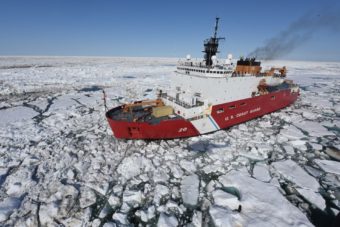
The luxury liner Crystal Serenity is on its way from Seward to New York City through the Northwest Passage.

It’s the largest cruise ship to navigate the route, which hugs the coasts of Alaska, Canada and Greenland. And it’s attracted international attention, with many wondering if it’s a sign of what’s to come as the Arctic sees increasingly ice-free summers.

The ship has 13 decks, eight restaurants, a casino, and a spa. Staterooms for this trip started at about $20,000 and run as high as $120,000 (with personal butler service).

Sitting in her room, with a deck looking out over the Seward harbor, passenger Moira Somers said for most of the people on board, the ship is as much a destination as the Arctic.

“When you start your cruise, no matter where in the world you are, and you see the ship, it’s goosebump stuff,” she said.

Somers and her husband live in Victoria, B.C. (she’s originally from Namibia). Like the majority of people on board, they’re repeat cruisers – she says this is perhaps her 16th trip with Crystal.

But this time is a little bit different.

“Maybe we’re not so sure what we’re letting ourselves in for?” she said, with a laugh. “But there’s so much, we’ve read so much, we’ve prepared ourselves, and we know it’s a big thing.”

Until about a decade ago, the Northwest Passage was only open to ships with icebreaking capabilities. And while smaller cruise ships have visited the region for years, the Crystal Serenity, with more than 1600 guests and crew, will become the largest passenger ship to traverse the full, winding route across the top of Canada.

It’s a dry run for large-scale tourism in a region that hasn’t seen anything like it before.

But the man in charge is not concerned.

Captain Birger Vorland of the Crystal Serenity has spent 38 years at sea. “Nobody has ever planned a cruise as diligently and as detailed as Crystal Cruises has done for this particular voyage,” he said. Photo: Rachel Waldholz, Alaska’s Energy Desk
Captain Birger Vorland of the Crystal Serenity has spent 38 years at sea. “Nobody has ever planned a cruise as diligently and as detailed as Crystal Cruises has done for this particular voyage,” he said. (Photo by Rachel Waldholz/ Alaska’s Energy Desk)

Birgir Vorland, the master of the Crystal Serenity, has spent 38 years at sea. Originally from Norway, he says the Northwest Passage has special resonance.

“My countryman Roald Amundsen did the first transit here, between 1903 and 1906,” Vorland said. “He spent three years on this passage. We’re going to do it in 32 days and a lot more comfort.”

Crystal Cruises has spent more than three years planning the trip. Standing on the navigation bridge, Vorland ticked off the special preparations: systems to detect ice, two Canadian ice pilots joining him in Nome, an escort ship in case he runs into trouble.

“We have crossed all the t’s, dotted all the i’s,” he said. “Nobody has ever planned a cruise as diligently and as detailed as Crystal Cruises has done for this particular voyage.”

As the ship prepared to leave Seward, passengers participated in an emergency drill. In the casino, guests wearing life jackets gathered around staff holding signs that read, “Life Boat 6.”

Passengers took part in an emergency drill before the Crystal Serenity left Seward. Photo: Rachel Waldholz, Alaska’s Energy Desk
Passengers took part in an emergency drill before the Crystal Serenity left Seward. (Photo by Rachel Waldholz/ Alaska’s Energy Desk)

Despite Vorland’s assurances, plenty of people are worried about what happens if this scenario plays out in real life.

“There’s absolutely no capacity to respond to accidents,” said Elena Agarkova, who tracks shipping for the World Wildlife Fund, a conservation group.

There’s very little search and rescue infrastructure in the region, a major concern for authorities. On August 24th, just as the Crystal Serenity passes through the region, the Coast Guard, U.S. military and Canadian forces will stage a major training exercise in the Bering Strait. Called Arctic Chinook, it will simulate the response to a cruise ship going down with 250 people on board.

The question isn’t just whether the Crystal Serenity is ready for the Arctic, but if the Arctic ready for the Crystal Serenity. Some of the communities it’s visiting in Canada have populations smaller than the ship itself.

Agarkova said Crystal Cruises has done a good job of working with communities and addressing environmental concerns, with plans to forgo heavy fuel oil and exceed standards for discharging wastewater. But, she said, there’s no guarantee those precautions will be taken in the future.

“They’re doing these measures voluntarily,” she said. “So there’s nothing that would require cruise lines or cruise ships that would follow in their steps to adhere to the same kinds of standards.”

Agarkova also pointed out the irony of this new era — when the very changes making the region accessible are also transforming it.

That’s not lost on passenger Moira Somers.

“One kind of feels – I won’t say guilty, but you’re taking advantage of what is happening,” Somers said, adding that she hopes the cruise is raising awareness of climate change.

As for her more immediate goals? “My big dream is to see a polar bear,” she said.

After a moment she added, with a laugh, “And just being able to have a successful trip, I think. Getting through with no hiccups.”


Another jökulhlaup is underway

U.S Geological Survey webcam picture of Suicide Basin taken June 29, 2016.
A U.S. Geological Survey webcam picture of Suicide Basin taken June 29, 2016.

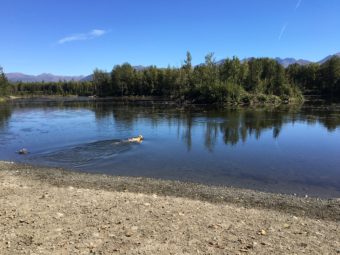
Water levels are rising in Mendenhall Lake and Mendenhall River because of another glacial dam release, also known as a jökulhlaup, that started Sunday from Suicide Basin above Mendenhall Glacier.

Rick Fritsch of the National Weather Service said the lake and river were bank full at 8 feet at about 4 a.m. Monday. Fritsch said water levels are rising about an inch an hour, but they should crest at about noon Monday before reaching minor flood stage at 9 feet. Water levels may approach the shoulders of the road to Skater’s Cabin, nearby campground and boat launch. No significant flooding is expected from the latest event.

Rick Fritsch of the National Weather Service talks about the latest jökulhlaup:

This is Suicide Basin’s second glacial dam release in the last five days and the fifth so far this season.

PHOTOS: Dramatic Rescues Underway As Louisiana Floodwaters Reach ‘Historic’ Levels

In this aerial photo a boat motors between flooded homes on Saturday after heavy rains in the region in Hammond, La. Max Becherer/AP
In this aerial photo a boat motors between flooded homes on Saturday after heavy rains in the region in Hammond, La.
Max Becherer/AP

Rescue efforts are underway in Southeast Louisiana as the state is drenched and battered by what the governor has called an “unprecedented and historic flooding event.” He has declared a state of emergency and three people have been killed by the floods.

Louisiana Gov. John Bel Edwards told reporters that more than 1,000 people have been rescued so far. “Not just from their homes but from their vehicles,” he said, and “some people, not just from their vehicles, they’ve been clinging to trees and other things like this in swift-moving floodwaters.”

A member of the St. George Fire Department assists residents as they wade through floodwaters from heavy rains in Baton Rouge, La. on Friday. Gerald Herbert/AP
A member of the St. George Fire Department assists residents as they wade through floodwaters from heavy rains in Baton Rouge, La. on Friday.
Gerald Herbert/AP

The National Guard has deployed to assist with the rescue efforts, as WWNO’s Eve Troeh reported to our Newscast unit. “The dramatic images are all too familiar in Louisiana – water up to the eaves of homes, people stranded on rooftops, some lifted to safety by helicopter rescue teams,” she said.

One of those rescues was caught in an intense video released by The Associated Press. A rescue team steers their boat toward a red car that is almost completely submerged in the green-brown water.

Residents evacuate with food in ice chests in Hammond, La., on Saturday. Max Becherer/AP
Residents evacuate with food in ice chests in Hammond, La., on Saturday.
Max Becherer/AP

The woman can be heard inside the car. “Oh my god, I’m drowning,” she said, as the rescue workers try to break in through a window. Rescuer David Phung then leaps into the water and rips open the cloth top of the convertible, pulling the woman through the water and onto the surface.

Immediately, she says: “Get my dog!” The car has at this point completely disappeared under the water. Tense seconds pass. Then, Phung is able to grasp the terrified animal and drag him out of the flooded car.

Watch it here:

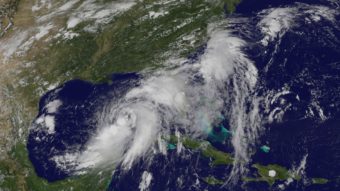
Army National Guard vehicles drive on flooded U.S. Route 190 in Robert, LA. on Saturday. Max Becherer/APMore rain is expected in the flooded Gulf Coast in what Edwards described as a “slow-moving, low-pressure system.”

“We have record levels of flooding along rivers and creeks. And because these are record floods, we don’t know how wide the water is going to get in those areas,” he said. “This is unprecedented, so we don’t have records that we can go back and see who all’s going to be impacted.”

Louisiana Transportation Secretary Shawn Wilson said authorities are preparing for more rain, as Troeh reported.

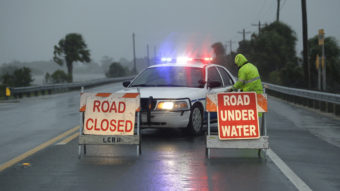
“We are concerned and are monitoring the weather conditions as this element moves westward, and we’ve got folks deployed where we’re using ever barricade and every high-water sign there is to notify the public and prepare them,” Wilson said.

More than 100 roads are closed and “at least one major highway has been submerged,” Troeh said, and added that “river basins across the area continue to fill with water.”

And with heavy rain projected in parts of Mississippi as the storm heads north, Gov. Phil Bryant has declared a state of emergency in at least four counties.

Copyright 2016 NPR. To see more, visit http://www.npr.org/.

Attorneys argue for listing bearded seals as threatened

ANCHORAGE — A federal government attorney says Alaska’s bearded seals deserve to be listed as a threatened species because of climate warming’s effect on their sea ice habitat.

Robert Stockman of the National Marine Fisheries Service on Thursday in Anchorage urged the 9th U.S. Circuit Court of Appeals to overturn a lower court ruling that said bearded seals do not merit the listing.

Bearded seals are the largest of the Arctic seals. They use sea ice to give birth, molt and dive for food.

The National Marine Fisheries Service listed bearded seals as threatened in 2012.

U.S. District Court Judge Ralph Beistline in 2014 ruled the listing was improper.

He said the agency had not demonstrated that bearded seals faced a serious threat of extinction before the end of the century.

Groups announce intent to sue over polluted Fairbanks air

ANCHORAGE — Three environmental groups are turning up legal pressure on a federal agency to require a cleanup of polluted Fairbanks air.

The groups in June sued the Environmental Protection Agency to force an agency decision on whether to accept a state plan to reduce unhealthy fine particulate produced by wood stoves and other sources.

The groups Wednesday sent a letter to the EPA announcing their intent to sue again because the agency has missed a deadline to require the Fairbanks North Star Borough to address pollution controls.

A letter giving 60-day notice is required before a lawsuit can be filed.

Earthjustice is representing the groups. Attorney Kenta Tsuda says federal law requires the EPA to designate the Fairbanks borough as a “serious non-attainment area” that would trigger additional pollution controls.

Dam on slough helps Big Delta man protect home along Tanana River

Big Delta resident Tom Gorman said a small dam he built earlier this year to protect his home from the meandering Tanana River held steady over the past couple of weeks as the river rose to near-flood level, due to recent rains.

Gorman now hopes the river falls quickly enough to allow him to finish work on the dam before snow flies.

Gorman stands at the edge of a 20-foot-wide slough off the Tanana River that runs along the foot of a ridge on which he built his house about seven years ago and said this isn’t how it looked back then.

“Last year, it was dry!” Gorman said.

A couple dozen trees used to grow in and around the area, Gorman said, which served as a sort of buffer between his big three-story house and the Tanana River some 45 feet away. Until January, that is, when an ice dam on the Tanana diverted a torrent of water into the area that tore out the trees and gouged into the riverbank, threatening to undercut the ridge where his house sits.

“And that just came in and just took ’em out, one at a time – pow! Two hours later, another one – bam!” he said. “It just got behind ’em, the erosion behind ’em, and just ripped ’em up.”

That was near the beginning of an ordeal that lasted for several weeks, as Gorman and a small army of friends, neighbors, contractors and others tried to bust up the pile of thick ice slabs.

They attempted to melt it with a de-icing solution; they tried to bust it up with a 5,000-pound weight dropped from a helicopter; they even detonated explosives to blast it open. Nothing worked.

“No – well, not on 3-, 4-foot (thick) ice,” Gorman said. “That’s what you had over here, all the way across.”

Gorman said state and federal officials for the most part supported his effort to save the house. He didn’t get any help from his homeowner’s insurance company, he said, but he got lots from dozens of volunteers from all around the area.

“The community’s helped me out,” Gorman said, “And they really pulled together.”

Gorman, a retiree from Texas, said the cost of trying to break the ice jam further strained his finances, which he’d already deeply tapped to buy the land and, in 2009, build a house for his family, which includes his wife and elderly mom, disabled son and daughter with kids.

Why did he build his dream house so close to the river? Gorman said he’s been asked many times:

“We were safe,” he said, “we were really safe when we built this house.”

Gorman followed advice on where to build given by his contractor and two neighbors, both of whom have lived along that stretch of the river for more than 40 years. But the ice-jam backup surprised everyone, he said as he shows photos of river water tearing through the slough and frantic efforts to slow its destruction.

“It came around this way, and it starts cutting in here,” he said. “It cut in here and fell down. It cut and just headed right toward the house.”

When the ice jam finally gave way, he and his had crew a chance to bring in equipment to shore up 150 feet of riverbank with big rocks, Gorman said, and to build an 8-foot-tall dam across the slough.

“What this dam did here was to really stop the current,” Gorman said. “Once the current was stopped, then I could get in here and do something.”

When the river rose a couple of weeks ago, he saw that the dam, which is built of interlocking concrete barriers, wasn’t quite high enough. So he laid a course of sandbags on top it to slow the flow to trickle.

“It’s holding,” Gorman said, “but it’s not done. It has to be completed.”

But he can’t bring equipment back in until the river drops and the area dries out.

“The water has got to go down, because what happens is you put the equipment down there and it’s so soft that it’s going to push the dam away,” Gorman said.

Gorman said that may not happen before the first snow flies two or three months from now. He said he’d prefer to do the work before winter sets in, but if he runs out of time, he’ll pay the extra cost of doing the work in the winter to save his home.

Site notifications
Update notification options
Subscribe to notifications