Subsistence

Alaskans push for acceptance of walrus ivory, but there’s an elephant in the room

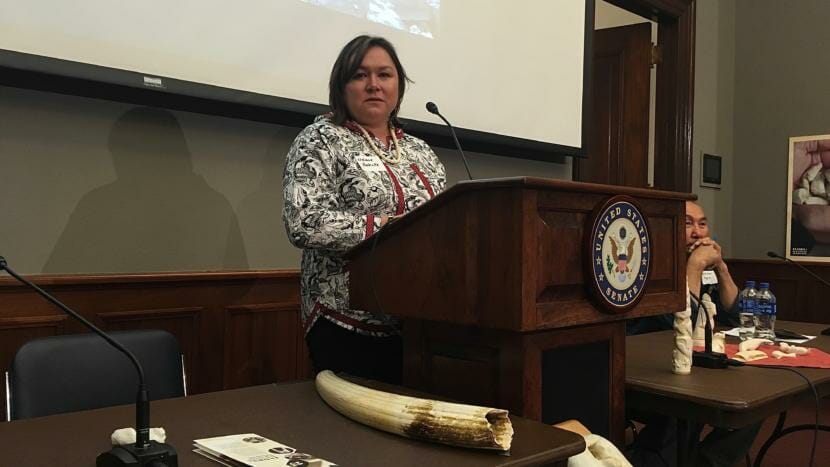
Melanie Bahnke is the president and CEO of Kawerak Inc. She wants to foster greater acceptance of ivory carvings from her region.
Melanie Bahnke is the president and CEO of Kawerak, Inc. She wants to foster greater acceptance of ivory carvings from her region. (Photo by Liz Ruskin/Alaska Public Media)

Federal law prohibits sales of African elephant ivory, but a handful of states have now banned the sale of ivory more broadly. That has repercussions for Alaska Native ivory carvers, who use tusks from legally-hunted walrus.

At a forum in Washington, D.C., this week, leaders from the Bering Straits region said they are frustrated, because they’re not only fighting state laws but also social norms.

Those norms were readily apparent at a weekend craft market near the U.S. Capitol. Stalls sell jewelry made with pearls and semi-precious stones, but shoppers recoiled when asked about ivory.

“No, I would definitely not wear ivory,” Nicole Morgret said, as did almost everyone I asked. “Elephants are intelligent animals and should not be hunted.”

Another woman told me she has some ivory jewelry but doesn’t dare wear it.

“OK, it does look good, but I can’t wear it because it’s part of an elephant, and I don’t want to condone and push wearing ivory,” she said.

Two sisters from Tennessee were shopping for silver pendants. One seemed open to the idea of ivory.
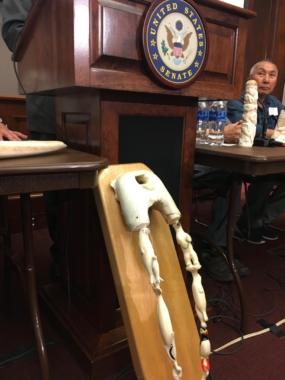
Elaborate ivory carvings were on display for an ivory forum at the U.S. Senate. Artist Sylvester Ayek was one of the speakers. (Photo by Liz Ruskin/Alaska Public Media)

“Like in an earring or something? Mmm-hmmm,” she said.

Then her sister said the “e” word – “elephants” – and a window closed.

“Like, ivory tusks?”

“I didn’t think about that.”

Melanie Bahnke, president of the Nome-based nonprofit Kawerak, said she sees how ivory can disturb people who visit her region.

“The expression of disgust on a tourist’s face when they realize that what they’re holding is made from walrus, and yet they’re walking in with leather shoes, is ironic,” Bahnke said.

She spoke at a forum on Alaska ivory at the U.S. Senate. Congressional staffers and others crowded into a Senate meeting room. Bahnke dispelled misconceptions: Walrus ivory isn’t elephant ivory. Walrus populations are healthy.

“And we are not hunting walrus just for the sake of ivory,” she said. “It is our food source. It is our spiritual connection to our ancestors. And it’s beautiful art. And it shouldn’t be banned.”

Bahnke said it’s expensive to live in villages like Savoonga, and most ivory carvers don’t make a lot of money at it.

“If you’re able to sell some of your artwork, then you’re able to buy more gas or ammunition to harvest more walrus to feed your family,” she said.

Bahnke closed the Capitol Hill forum by asking allies to spread the word, to tell the story of Alaska Native ivory.

And stories are powerful.

Back at the crafts market, vendor Erika Rubel — an artist who makes spice racks and shelves from salvaged materials — carefully considered whether she would wear ivory.

“I might wear an antique ivory bead, but I wouldn’t get anything that was made now,” she said.

How about walrus ivory, harvested by Native people practicing the tradition of their ancestors to feed their families? Rubel warmed to the idea.

“As long as it’s sustainable,” she said.

Rubel’s not at all worried her friends would think she’s exploiting elephants if she were sporting ivory carved by a Bering Sea artist.

“No, because if they did question it, they would probably say, ‘Wow that’s not like you,’ (and) I would explain the story behind it,” Rubel said. “Which is also part of why you buy something from the maker: You’re also buying the story and the history that went into making it.”

That would be music to the ears for the champions of Alaska Native ivory.
‘Pretty unbelievable,’ says Kotlik hunter who helped document recent spike in seal deaths

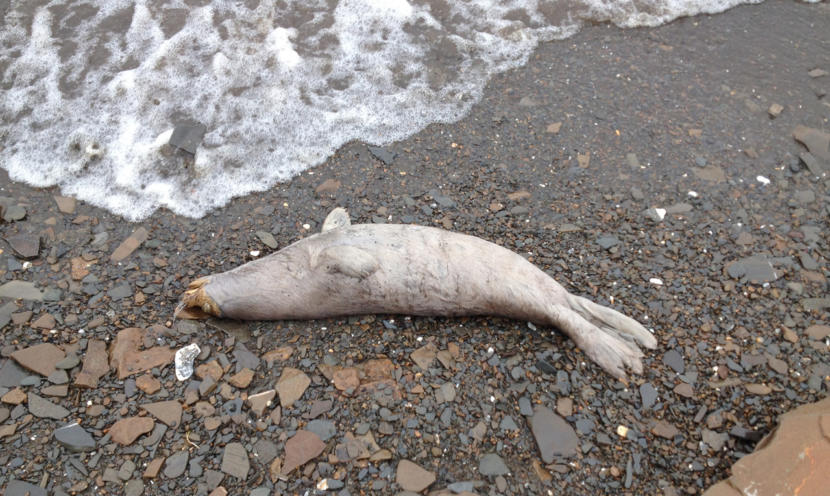
A hunter from Kotlik counted 18 dead seals along 11 miles of shore, north of Kotlik. Photo from May 7, 2019 (Photo courtesy Harold Okitkun)

A hunter who helped confirm the unusually high number of dead ice seals in the Bering Sea region says he’s never seen anything like it near his village.

Harold Okitkun, a hunter from the southwestern village of Kotlik says the tribal council was concerned after they heard reports of dead seals and had him go out to document the deaths. He’s the environmental director for the tribal council.

“Let’s say about 16 miles north of Kotlik, that’s when we started seeing the dead seals along the beach,” he said.

Yesterday, NOAA Fisheries announced they’d heard reports of at least 60 dead seals in different places along the coast of the Bering and Chukchi seas.

Okitkun counted 18 dead seals — a number he says he’s never seen or heard of other people seeing in Kotlik.

“It’s pretty unbelievable to see a whole bunch of dead seals on the beach where usually we’d only like find one or two carcasses,” he said.

Okitkun added that a lot of the seals looked skinny.

He says the deaths are worrying given how much people in Kotlik rely on seals and other marine species for food.

“A lot of people use parts of the seal every day in what we eat, so it really hurts to see dead animals washing up and wondering what’s going on with our oceans,” he said.

NOAA Fisheries is aware of sightings in the area including Kotzebue, St. Lawrence Island, Kivalina and Point Hope.

The agency says they don’t know yet what’s causing the deaths, and anything from lack of sea ice to harmful algal blooms could be a factor. They are currently mobilizing a team to collect samples to get more information.

‘Potentially lethal’ toxins found in Juneau shellfish

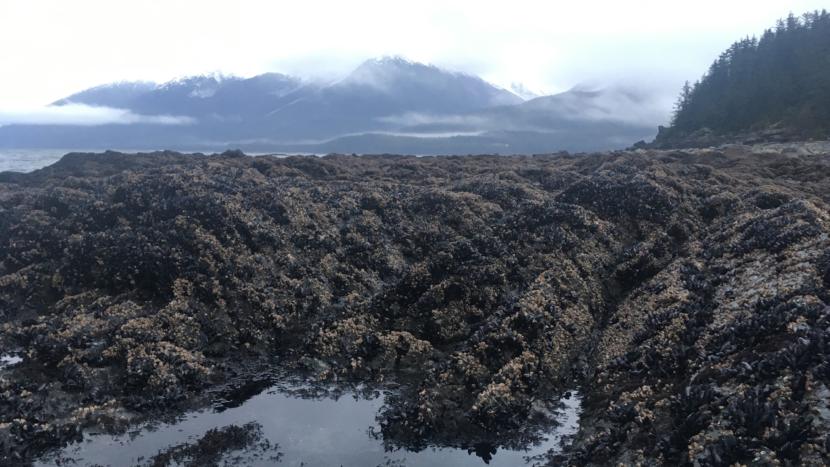
A low tide leaves shellfish exposed on a beach near Juneau. Nov. 17, 2018.
A low tide leaves shellfish exposed on a beach north of Juneau. (Photo by Ryan Cunningham/KTOO)

A group that monitors shellfish toxin levels is warning Juneauites not to consume shellfish from some locations in the Auke Bay area and beyond.

The Central Council of the Tlingit and Haida Indian Tribes of Alaska has issued a public notice of a shellfish advisory for areas near Amalga Harbor, Point Louisa and the Auke Recreation Area.

According to the notice, recently-collected samples of blue mussels, cockle clam and butter clam from those locations had “extremely elevated levels” of harmful toxins — well above federal Food and Drug Administration limits for consumption.

Kari Lanphier, environmental lab manager for the Sitka Tribe of Alaska, said her lab hasn’t seen shellfish toxin levels this high in Juneau since they started operating three years ago.

“Once we start to see levels of paralytic shellfish toxins reach in these ranges that we’re seeing in Juneau … it’s pretty dangerous. Those are levels that could be potentially lethal if ingested,” she said.

Lanphier said most of the Auke Bay samples were collected on June 4. Because of the unusually high toxin levels, her lab’s partners at Tlingit & Haida will collect a new round of blue mussel samples on Thursday.

According to the Alaska Division of Public Health, early symptoms of shellfish poisoning include tingling feelings in the lips and tongue, followed by tingling and loss of muscle control in the arms and legs. Within a couple hours, a poisoning victim could stop breathing.

Shellfish become toxic when they’re contaminated by harmful algae blooms. Some toxins can be up to 1,000 times stronger than cyanide.

If you think you’ve consumed toxic shellfish, seek immediate medical attention. Any potential poisonings should also be reported to the state’s Section of Epidemiology by calling 907-269-8000 or 800-478-0084 if the call is after regular office hours.

For general information about shellfish toxins, visit SEATOR.org or contact Tlingit & Haida.

US House calls for more research on ocean acidification

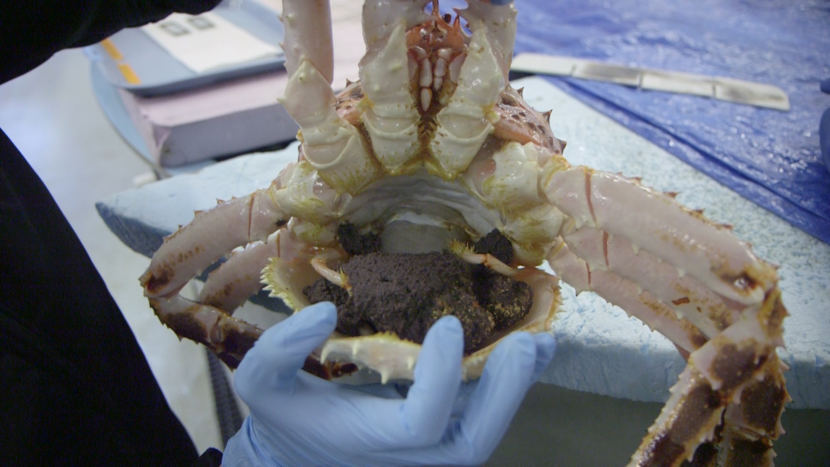
Eggs in a female red king crab. The laboratory studies the impacts of ocean acidification on crabs from the earliest life stages. (Photo by Eric Keto / Alaska's Energy Desk)
Eggs in a female red king crab at the Alaska Fisheries Science Center’s Kodiak Laboratory. The laboratory studies the impacts of ocean acidification on crabs from the earliest life stages. (Photo by Eric Keto/Alaska’s Energy Desk)

The U.S. House of Representatives last week passed four bills aimed at beefing up research on ocean acidification.

“To have four bills at once pass through the House is a really heartening and important step forward for ocean acidification,” said Darcy Dugan, director for the Alaska Ocean Acidification Network.

The change in ocean chemistry is alarming to subsistence communities and the fishing industry. Dugan said acidification is directly tied to the global greenhouse effect: As carbon dioxide builds in the atmosphere, a portion of it is absorbed by the ocean.

“About 1 million tons of carbon dioxide will enter the ocean in one hour today,” she said. “And with this rate of increase, our oceans are about 30% more acidic than they were before the Industrial Revolution.”

That makes the water more corrosive to crabs, clams and creatures at the bottom of the food chain, with impacts that reach all the way up.

“Some of the recent studies have shown a lowering of pH can reduce the ability, for example, of coho salmon to detect predators,” Dugan said.

Dugan is particularly interested in a bill that would direct the National Oceanic and Atmospheric Administration to assess coastal communities for their vulnerability to acidification. She says pH levels aren’t uniform along the coast or throughout the year.

Dugan said some species will be hit harder than others, and communities will need to plan for those impacts and adapt.

“We like to think of ocean acidification research as putting headlights on a car,” Dugan said. “Can we look ahead to see what’s going to happen, or what might happen in the future, so that we can provide information to Alaskans so that we can prepare and adapt?”

The four bills that passed in the House were H.R. 1237, H.R. 1716, H.R. 1921 and H.R. 988.

Alaska Republican Congressman Don Young co-sponsored three of the House bills, and Sen. Lisa Murkowski, R-Alaska, has a similar version in the Senate.

Wrangell’s king salmon derby is canceled again, leaving locals longing

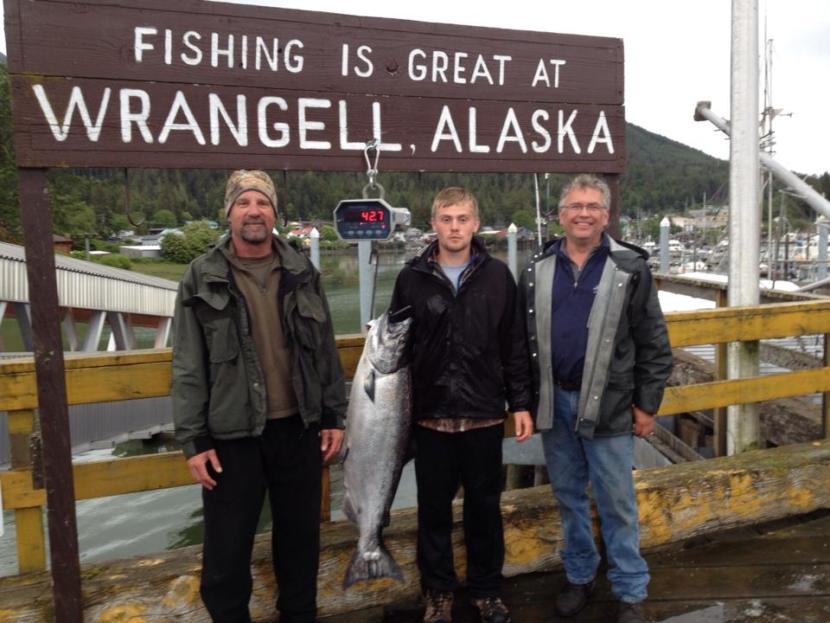
During the derby, sport fishers weigh their king salmon for a chance to win up to $6,000. (Photo courtesy Wrangell Chamber of Commerce)

King salmon fishing in Alaska is political — but for those who can’t do it this summer, it’s also personal.

For the second year in a row there will be no king salmon derby in Wrangell. While most agree that protecting the run up the nearby Stikine River is critical, the absence of the derby nevertheless has left a king-salmon-sized hole in some hearts.

On a recent Saturday in Wrangell, plenty of folks were at Heritage Harbor, ready to get off the island for a bit.

Andy Hoyt was about to take off on his boat and head to Point Baker for his first boat ride of the season.

A young couple and their friend were right behind Hoyt in a handmade river scow. They told him they were going up the Stikine River to see some wildlife, check out the hot tubs and “catch a buzz.”

“Catch something, huh? Too funny,” Hoyt said. ” I really wish there was a king derby going on right now, especially this weekend.

This is the second year Wrangell has not had its king salmon derby. After 64 years, it was canceled when historically-low returns to Southeast’s major rivers caused the state to impose deep restrictions on all harvest — not just sport fishing. So Wrangell residents are finding other reasons to go for a boat ride or just be outside.

“But now there’s nothing to fish. So people just have to go boating to go boating,” said Shawn Curley, who helps organize the derby. He’s not bothering to put his boat in the water.

Curley grew up fishing creeks down south, wherever he could. He came to Wrangell to attend his sister’s wedding and never left. That was 23 years ago, and Curley has long since acquired the taste for king salmon.

“Right now, Saturday, it’d be the second week of the derby. As flat calm as it is, there’d be so many boats right now, coming and going,” Curley said. “Instead no one’s out fishing at all. Just that blue heron, he’s fishing.”

While Curley may sound like the Grinch, he’s not disgruntled by the folks in Whoville managing to have fun this summer. He’s had an event that he loves stolen from him. And he can’t forget it.

“It’s kind of like Christmas morning coming and going and then there’s no Christmas, there’s no presents, there’s no tree. It just came and went,” Curley said.

Catching a king salmon, which can run anywhere from 20 to 50 pounds in weight, is a thrill. There’s really no substitute — Wrangell found that out the hard way when it tried an alternative coho derby.

“Obviously we saw a large decrease in participation between the two derbies,” said Alicia Holder, director of the Wrangell Chamber of Commerce. The chamber sponsors the event, with help from Curley and other volunteers.

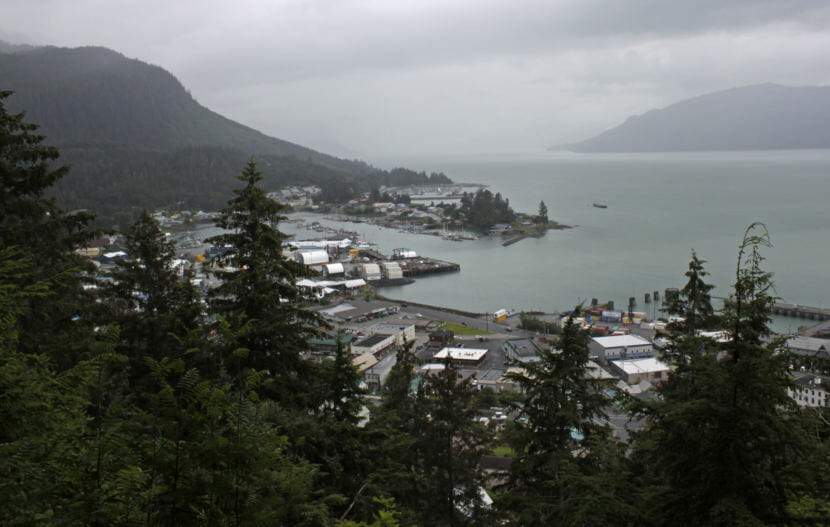
Wrangell as seen from Mount Dewey on July 24, 2014.
Wrangell as seen from Mount Dewey on July 24, 2014. (Creative Commons photo by James Brooks)

Last year’s coho derby was held over four weekends and saw none of that Christmas-morning energy Curley talks about. Ticket sales confirm this: The last king derby brought in $22,000, but the coho derby made just a quarter of that.

Holder doesn’t think the coho derby will ever be as big, but it’s important to keep the event alive. She said it’s for her clients, the local businesses.

“Because we want to see people getting out and spending money in Wrangell,” she said. “We want that revenue for our local businesses. It’s really important and makes a big difference.”

Jeff Angerman agrees. He runs Angerman’s, a local store for fishing gear and attire that he and his wife have owned for 20 years.

“We’re missing our salmon derby, that’s for sure,” Angerman said.

Like most merchants, Angerman has a pulse on the town as a business owner and lifelong resident.

“If you were to start adding up plane tickets and boats and motors and fuel and groceries — and of course in our instance fishing tackles, rods and reels and all the rest — I’m sure the derby probably generates about seven figures just in the 30 days that it’s operating,” Angerman said. “So that’s a big hit for our little town.”

A big hit for businesses, and for the vibe in town. Every day, the top contenders are announced on the radio. Couples and families make plans to get out on the water as much as possible.

Curley said he’d spend 14 hours fishing in a single day, easily.

“That was my only goal in life, was to win the derby. I didn’t want to change the world or raise any kids or cure cancer. I just wanted to win the derby one freakin’ time,” Curley said.

And he’s almost had it. But in an event that lasts a full month, there is no such thing as a secure lead. But without a win, he still hoped to make his mark on the tradition. When he dies, he wants his remains placed at Babbler Point — on opening day of the Wrangell King Salmon Derby.

“And then they’d dump my ashes and shoot guns and howl at the moon, and that’s where I would be. But I don’t know what I’m going to do now. I need to rewrite a new will,” he said.

Curley doesn’t want to give up on his favorite fishing hole as his final resting place, but he said if there’s no opening day of the free-for-all competition, it’s just an ordinary day at Babbler Point.

To get a count on bowhead whales, North Slope scientists head out onto the sea ice

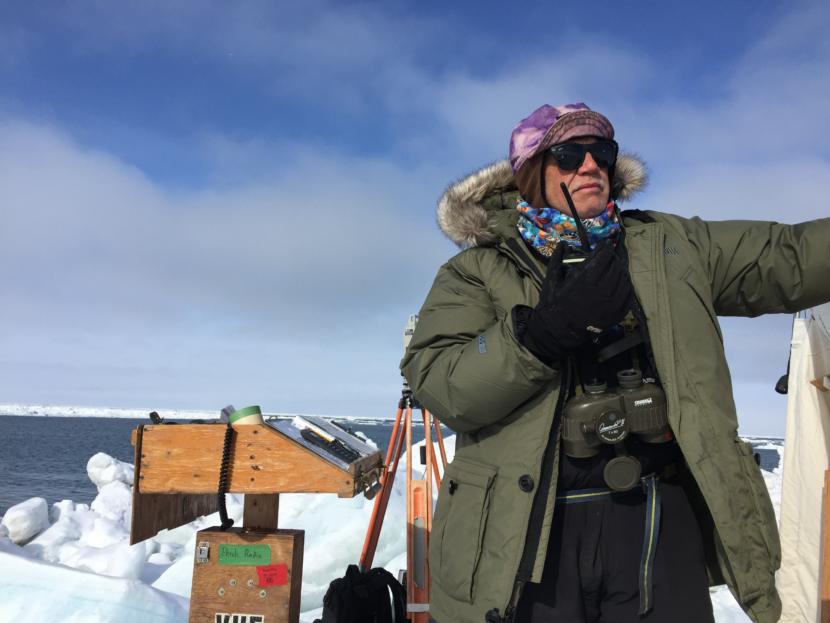
The “perch,” which from which rotating shifts of observers look for whales as part of the North Slope Borough’s bowhead whale census, April 16, 2019. (Photo by Ravenna Koenig/Alaska’s Energy Desk)

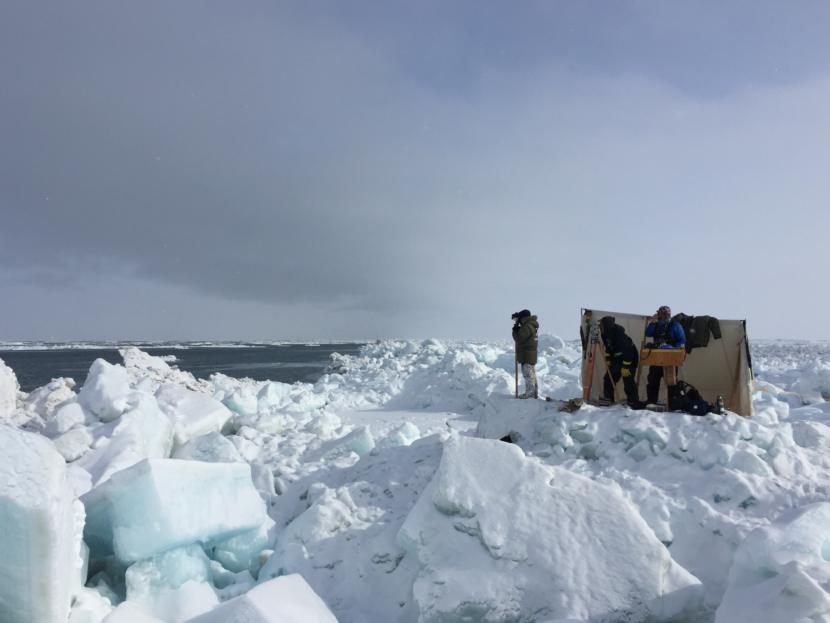
This spring, the North Slope Borough conducted a census — not of people, but of the western Arctic bowhead whale population. They do the count with their own eyes out on the sea ice off Utqiaġvik, where surveyors have to remain on high alert for polar bears and shifts in weather and current that might break up the ice under their feet.

It’s one of the best ways scientists have to get a whale count that helps forms the basis of Alaska Native hunters’ subsistence quota.

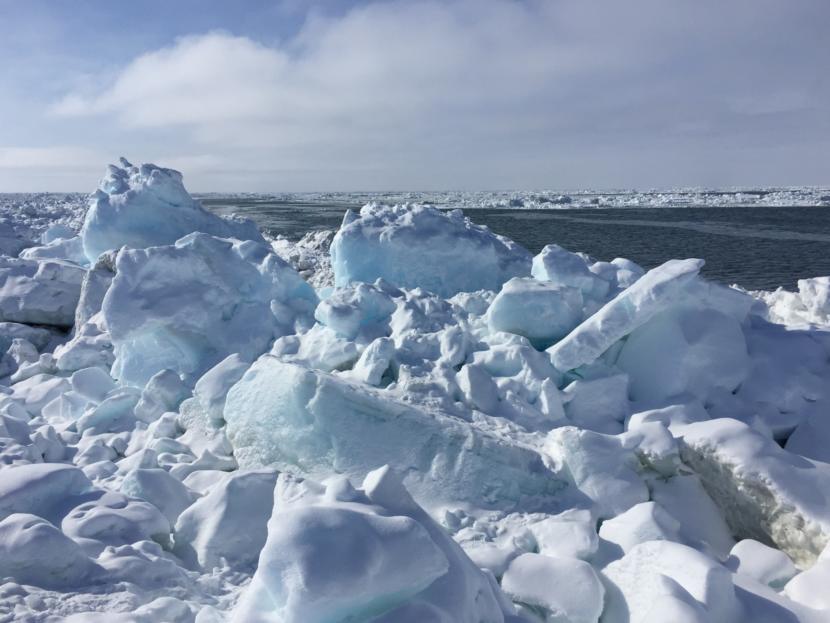
Craig George stands high up on a mound of sea ice overlooking the Chukchi Sea, his back to a moonscape of white and blue shards of ice. He’s scanning the horizon with a pair of binoculars and using a small wooden podium to write down weather conditions and whale sightings.

So far this shift, he’s seen exactly zero whales.

“Pretty quiet guys, I’m surprised,” he says to the other two men standing next to him at the perch.

“Seeing some seals,” says Darren Kayotuk.

“Yeah let’s start counting seals,” George jokes dryly.

George is a wildlife biologist with the North Slope Borough, and the census coordinator. He’s been participating in the census a long time — the first one he helped with was all the way back in 1980.

Craig George has been working out on the ice as part of the whale census since 1980. April 16, 2019. (Photo by Ravenna Koenig/Alaska’s Energy Desk)

The census started back in the 1970s, when the international commission that regulates whaling was concerned that there weren’t enough whales to support a traditional subsistence hunt.

In those early days, there were a lot of things scientists didn’t know about how the whales behaved. That made it hard for them to get an accurate count.

For example, says George, they didn’t know that whales could swim under heavy ice cover and would also travel far offshore where they couldn’t be seen.

“That was a real eye-opener,” says George, “realizing that there’s times when we only see a small fraction of the whales.”

Scientists learned about that and other whale behaviors from Iñupiaq whalers. And they documented it by putting hydrophones down in the water — which meant they could show that whales were going by, even when they couldn’t see them.

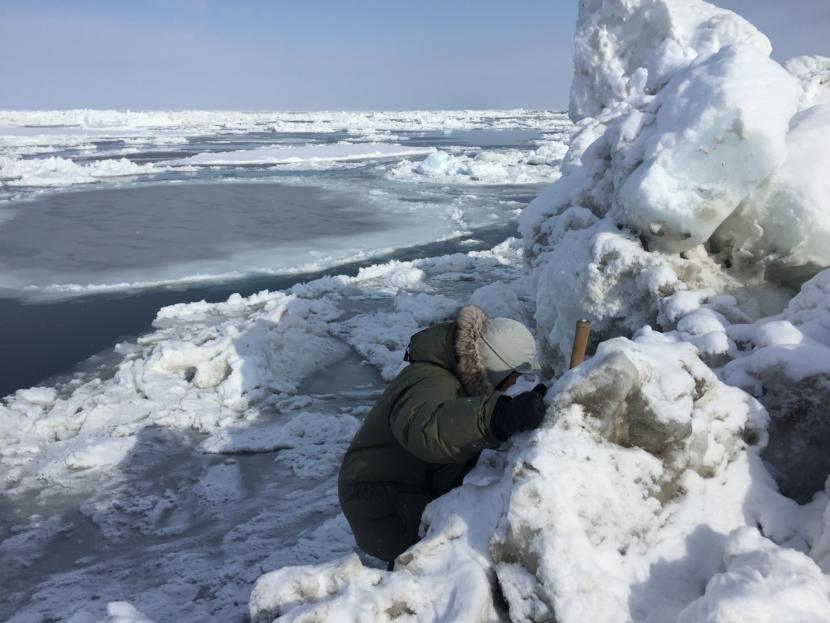
They still use those techniques today. As George stands looking out at whale-free water, Kate Stafford, an oceanographer at the University of Washington, clamors down to the edge of the ice and drops a microphone below the surface. Sure enough, she can hear bowheads off in the distance.

Kate Stafford climbs down to the water edge to put a hydrophone into the water and listen for whales, April 16, 2019. (Photo by Ravenna Koenig/Alaska’s Energy Desk)

In addition to whale behavior, there was a whole other set of lessons the census takers needed to learn — namely, how to stay safe on the ice. And that, says George, is almost impossible to figure out anywhere but out on it.

“There’s not like a formal Iñupiaq classroom, you sit down, ‘Today we’re going to discuss the principles of sea ice and sea ice safety,'” he says. “That doesn’t happen. It’s like, ‘Malik,’ you know? ‘You follow.'”

Over the decades, George has spent many, many hours out on the ice learning from whaling captains about how the ice forms, how it moves, how to recognize when it’s safe, and when it’s about to get dangerous.

“You don’t learn anything unless something goes wrong,” he says. “I mean, that’s not entirely true, but that’s where you really learn.”

He’s seen plenty of things go wrong. The most memorable, he says, was back in 1985, when a heavy piece of ice floating out on the ocean hit the shore-fast ice a considerable distance from where they were camped.

“The force transmitted through the ice, and then suddenly this big pan we were on — I don’t know, quarter-mile wide — it started breaking up,” he remembers. “And it shattered, broke down the middle. … It kept breaking up more and more, and then it started folding and water was rushing up between the pieces.”

Scary as that sounds, they did make it to safety.

George refers to this event pretty nonchalantly — he says it was a good learning experience.

The view of the ice and the ocean from the “perch,” April 16, 2019. (Photo by Ravenna Koenig/Alaska’s Energy Desk)

It also helps that they stay in regular communication with the whalers who are out on the ice doing their spring hunt.

“If we see something happening, we get on the radio, on the whalers’ channel … or they call us,” he says. “We become part of the community on the ice when we’re out here.”

If things get dicey, the group pulls back. That, along with weather and ice conditions that sometimes get in the way of seeing whales, means that some census years they don’t get a good estimate out on the ice.

“One out of 3 of these counts actually works,” says George.

But the estimate plays a critical role in northern Alaska communities’ continued ability to whale.

Subsistence hunters have a quota, and even though they only harvest an average of 40 whales out of a population that was estimated at around 17,000 the last time they did the count, the quota is dependent on a good population estimate every decade.

There are other ways to do that count, like aerial surveys. One is actually being done independently by the federal government this summer. It was planned as sort of insurance — in case the ice-based census didn’t yield a good count. But the ice-based method is more precise, so they’d like to have both.

Plus, despite the fact that being out here requires some vigilance, it’s also really beautiful.

The view of the ice looking back toward shore, April 16, 2019. (Photo by Ravenna Koenig/Alaska’s Energy Desk)

And for George, it’s the best part of the job. He loves watching bowhead whales.

“They’re just so graceful and beautiful. Every time I see a whale I get excited,” he says.  “I’ve seen thousands and thousands,” he goes on, “it’s always like seeing a bowhead for the first time.”

The ice is changing as temperatures warm in Utqiaġvik, and George says he doesn’t know exactly what the census will look like in the years ahead. They may shift to using more aerial techniques as the ice gets less stable, or maybe they’ll figure out how to do a count using satellite images.

But for now at least, the census remains part of the “community on the ice.”

Site notifications
Update notification options
Subscribe to notifications