Alaska Native Corporations

Hoonah’s Icy Strait Point plans new dock for megaships

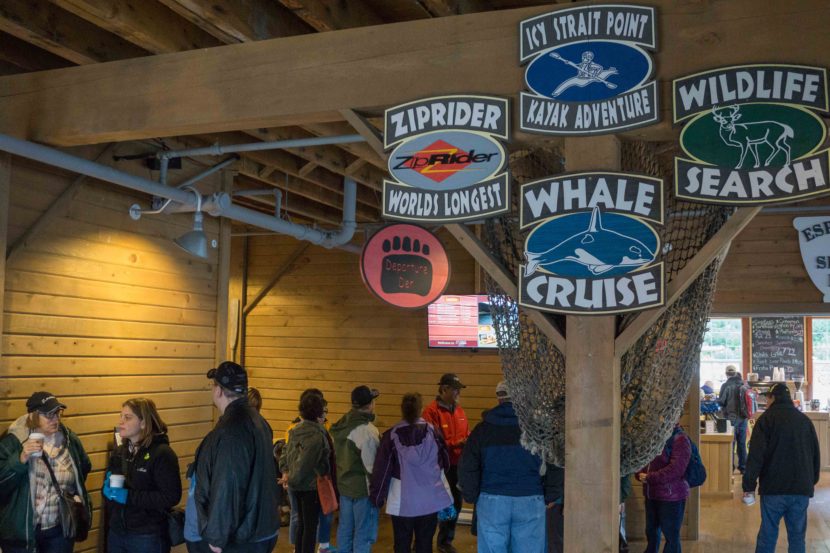
Tourists at Icy Strait Point on the outskirts of Hoonah in summer 2015. (Photo by Jeremy Hsieh/KTOO)

Hoonah is on track to add a second, larger cruise ship dock to accommodate the growing number of megaships visiting Southeast Alaska.

More than a hundred cruise ships are attracted annually to Icy Strait Point, a former seafood cannery redeveloped by Huna Totem Corporation into a seasonal entertainment complex.

“The need for the second dock is to really accommodate the growing demand for cruise lines and guests who want to experience the authentic Alaska here in Southeast,” the village corporation’s CEO Russell Dick said. “And you have more ships coming. You have larger ships coming, and we need to ensure that we’ve got the infrastructure to handle those ships and those guests.”
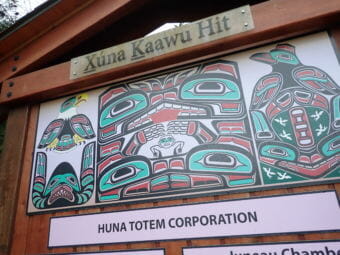
Huna Totem Corporation is a Juneau-based village corporation owned by around 1,400 shareholders with ties to Hoonah. (Photo by Jacob Resneck/CoastAlaska)

The new dock will be built in partnership with Norwegian Cruise Lines. It will better accommodate Norwegian’s megaships — the Joy and the Bliss — that carry about 5,700 passengers and crew. Currently, cruise ships tie up at a purpose-built dock completed in 2015; passengers are also brought from ships tendered offshore.

Icy Strait Point’s Vice President of Operations Tyler Hickman said the second dock will be in a forested area about a half-mile farther from town than the existing dock. That will help spread out passengers getting off the ships.

“We have the ability to develop it in a respectful way, that all of the guests are going to have this wilderness experience without feeling crowded,” Hickman said by phone.
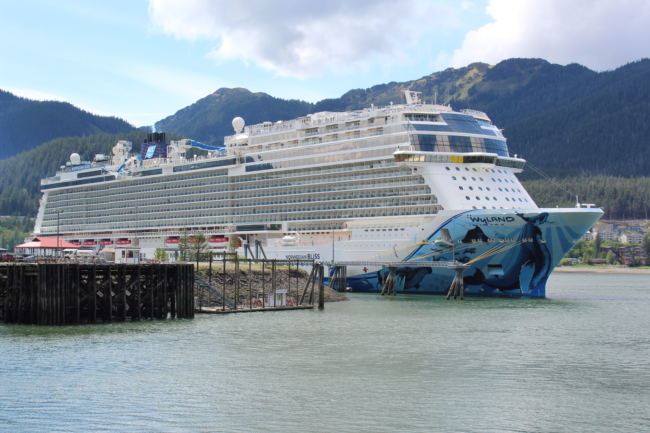
The Norwegian Bliss prepares to leave Juneau on June 5, 2018.
The 168,000-ton Norwegian Bliss megaship prepares to depart Juneau in June 2018. (Photo by Adelyn Baxter/KTOO)

The new 500-foot floating dock would be built on city-owned tidelands.

The Hoonah City Council tentatively agreed to a 25-year lease at its Tuesday meeting. But financial terms haven’t been settled; they are pending an appraisal of the land.

“It’s an important project for sure,” Hoonah City Administrator Dennis Gray said Thursday. “It’s going to help us secure our economic future by having more tourism.”

Huna Totem Corporation said it plans to release further details about its partnership with Norwegian Cruise Lines and the new dock next month at public meetings in Hoonah.
ANWR drilling foes see chance for ‘sowing doubt’

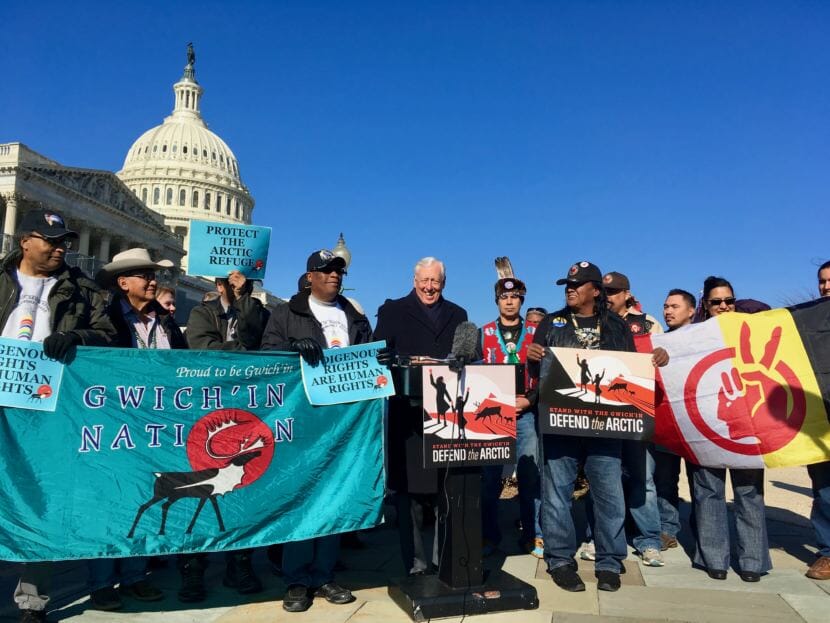
Steny Hoyer, at the podium, will be the House majority leader come January.
Steny Hoyer, at the podium, will be the House majority leader come January. (Photo by Liz Ruskin/Alaska Public Media)

With Democrats about to take control of the U.S. House of Representatives, opponents of drilling in the Arctic National Wildlife Refuge have hope. But ANWR drilling is already written into law.

At noon on Tuesday, a dozen or more Native American leaders and activists lined up in front of the U.S. Capitol, holding signs that said “Defend the Arctic” and “Protect the Arctic Refuge.”

Bernadette Demientieff from Fort Yukon kicked off the press conference.

“I am here on behalf of the Gwich’in people, at the direction of my elders,” she said.

This Republican-controlled Congress is in its waning days, but the goal of the press conference was to make sure the Arctic refuge is on the House agenda — and the public’s mind — next year. Because come January, drilling opponents will have some muscle in the House.

“I commit to you,” said Rep. Ruben Gallego, D-Ariz., “as the incoming chairman of Indian Affairs and Insular Affairs, that we will continue to fight with you every step of the way to see what we can do to stop this atrocity from happening.”

Of course, a lot of Alaska Natives, especially those representing Native corporations in the Arctic, don’t see an atrocity in the making. Many Alaska Natives want oil development in the refuge in order to support communities with few other options for making money. Their side wasn’t represented at this press conference.

The next House majority leader, Rep. Steny Hoyer, jabbed the metal podium in his enthusiasm for the cause.

“House Democrats and our new majority will work to protect Native Americans and Alaska Natives in every part of our country,” Hoyer, D-Md., said. “We will work … could somebody clap on that?”

The crowd, which included activists and staffers from environmental groups, obliged.

A reporter asked Hoyer what he hoped to accomplish, since any House bill would also have to pass the Senate, where the Republican majority has grown by two.

“Well, you say, ‘Legislation won’t pass the Senate,’” Hoyer said. “Very frankly, there are a lot of Republicans who represent a large number of Native Americans, and if they listen to them, then I’m not at all sure we won’t get some help from them.”

The Sierra Club helped organize the press event. Sierra Club in-house lobbyist Athan Manuel watched the press conference from the sidelines. He has worked for years to get Congress to pass a bill with permanent protection for ANWR.

“We’re not going to get the final victory in the next two years,” Manuel acknowledged.

He said the goal for now, at least until there’s a new president, is to build momentum.

“That’s the great thing about having the House flip, is that it gives a chance to move a bill, maybe, on the House side,” Manuel said. “And then to have hearings and to have oversight. And put the Trump administration and the oil industry on the defensive, when it comes to drilling in the Arctic refuge. And really just sowing doubt.”

As long as there’s doubt about whether the refuge will remain open to drilling, Manuel said, industry will be reluctant to invest.

“So the more doubt we throw into the process, the more sand we throw into the gears, the more we prolong this fight, it’s to our advantage,” he said.

The Trump administration plans to hold an ANWR lease sale in 2019. But the goal of conducting a 3D seismic survey this winter isn’t certain. Mother Jones magazine reports on a leaked memo from the U.S. Fish and Wildlife Service that says it’d be nearly impossible to conduct the survey without jeopardizing polar bears.

An Interior Department official said last month the exploration company and the Fish and Wildlife Service were in talks to address the agency’s concerns.

Report: Alaska Native communities will face the brunt of climate change

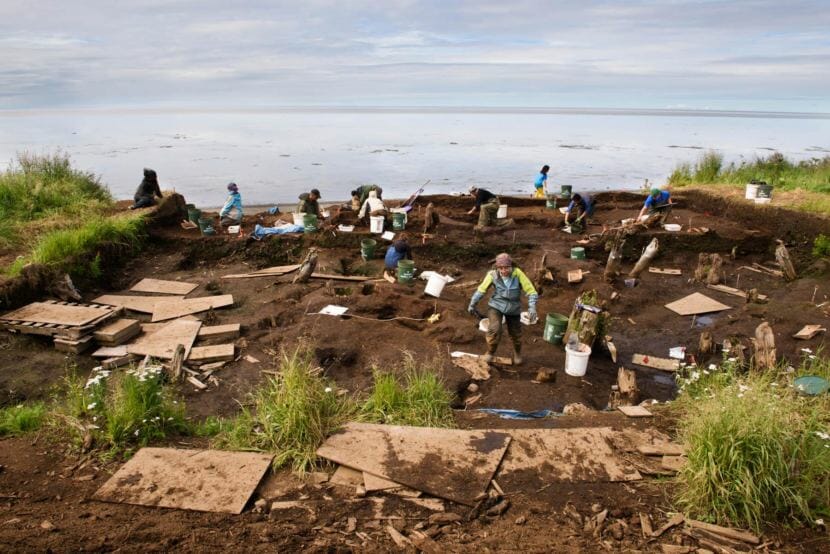
The Nunalleq dig site is located just off the coast of the Bering Sea, close to Quinhagak. A portion of the site already eroded into the sea. And the threat from erosion increases each year as storm surges grow in number because of climate change. (Photo by Katie Basile/KYUK).

A national climate report says what many Alaskans already know: The state is warming twice as fast as the rest of the country. Rural and Alaska Native communities are the first to feel those impacts. For the Yukon-Kuskokwim Delta, the stakes are especially high because the region is home to the most tribes in the state.

Warren Jones is from the village of Quinhagak, which sits close to the Kuskokwim Bay. Just last week, he went fishing for trout. That’s not a normal activity for November.

“Our river should be frozen right now as of (Nov. 28),” Jones said. “Our river is still wide open. I think a couple of boats are out there.”

Jones is also the CEO of Quinhagak’s Qanirtuuq Corporation. The community is trying to save artifacts from an ancient village nearby because they feared their heritage would wash out to the sea from erosion, caused by climate change.

From his office window, Jones can see other climate impacts on the Kuskokwim Bay.

“The bay ice out there, I’m looking out the window, there’s still open water, there’s some white, small icebergs out there, but nothing thick enough to stand on,” Jones said.

Everything Jones has seen is cataloged in the recent National Climate Assessment. One chapter is dedicated to the impacts on indigenous communities, and another on Alaska. Scientist Sarah Trainor helped write the Alaska chapter. She said rural Alaska — and indigenous communities — will feel the brunt of the impacts from climate change.

“Because you are more connected to the environmental change, it affects you more directly,” Trainor said. “You travel on the rivers, so when it’s not frozen it matters to you. Your water source is right there, so if it gets contaminated it’s much more direct connection, which is why the rural communities are more affected.”

About 87 percent of Alaska Native communities are experiencing erosion. In the Y-K Delta, residents rely on rivers freezing over so they can travel to other villages by snow machine or car. And so they can hunt and fish safely in the winter.

Trainor said poor communities will struggle the most from climate change. They’ll see higher infrastructure costs and more threats to their food supply.

The Y-K Delta is the poorest region in Alaska. And its remote communities depend heavily on subsistence.

Some villages are also facing relocation. Newtok is the village that’s closest to being able to relocate, and it will cost them millions of dollars to move.

Jones said that all the villages will have to move someday.

“I suggest the villages start collecting data for erosion protection, because it’s going affect them sooner than later,” Jones said.

But he adds the Yup’ik culture has always adapted to a changing environment. And this is just the latest adaptation in a millennia of them.

Alaska Peninsula Corporation strikes a land access deal with Pebble

A view from Newhalen, one of the communities that would be impacted by Alaska Peninsula Corporation's agreement.
A view from Newhalen, one of the communities that would be impacted by Alaska Peninsula Corporation’s agreement. (Photo by Avery Lill/KDLG)

The Alaska Peninsula Corporation announced Monday that it has signed a land agreement with the Pebble Limited Partnership, paving the way for a transportation corridor through APC lands.

If the proposed mine makes it through the permitting process, APC has agreed to allow Pebble to build a transportation corridor on APC land.

The corporation is celebrating the agreement, saying it would provide employment opportunities around the region and incentivize people to stay. APC said the deal would especially benefit the villages of Kokhanok and Newhalen.

“I think it’s an incredible opportunity for everybody in the region,” said Brad Angasan, the vice president of corporate affairs for APC. “There’s a couple of benefits that are associated with the infrastructure development there. One is obviously the greater access to transportation and lower cost of energy through the construction of a natural gas pipeline from Cook Inlet to the port site at Amakdedori and through Alaska Peninsula Corporation lands to the project site. One of the deals we’ve worked out with Pebble is that APC villages at Kokhanok and Newhalen have access to that natural resource when it pipes into the region.”

Under the agreement, Pebble would have access to about 1,400 acres of APC land to develop transportation infrastructure, including roads, pipelines and ferry landing sites.

APC would receive annual toll payments and other fees from PLP before and during the mine’s construction and operation. It would also have preferred status in bids on Pebble-related contracts on the corporation’s lands.

Pebble has several options for transportation routes. While this agreement gives PLP the option to use APC lands, it could still choose an alternative, such as a northern route between Williamsport and Pile Bay.

APC is the merged Alaska Native village corporation of South Naknek, Port Heiden, Ugashik, Kokhanok and Newhalen. It has more than 900 shareholders and is one of the largest private landowners throughout the Bristol Bay region.

This is just one of a slew of permissions Pebble Limited Partnership needs to acquire in order to build a mine in the Iliamna Lake region. On the local level, the Lake and Peninsula Borough would need to issue a large project development permit to PLP. Lake and Peninsula representatives are currently travelling to communities seeking input on the proposed mine.

The U.S. Army Corps of Engineers is currently preparing a draft Environmental Impact Statement it expects to publish this January. It will then be opened to public comment. The Army Corps estimates that the final EIS will be published late next year.

Reconnecting with roots at Alaska Native languages summit

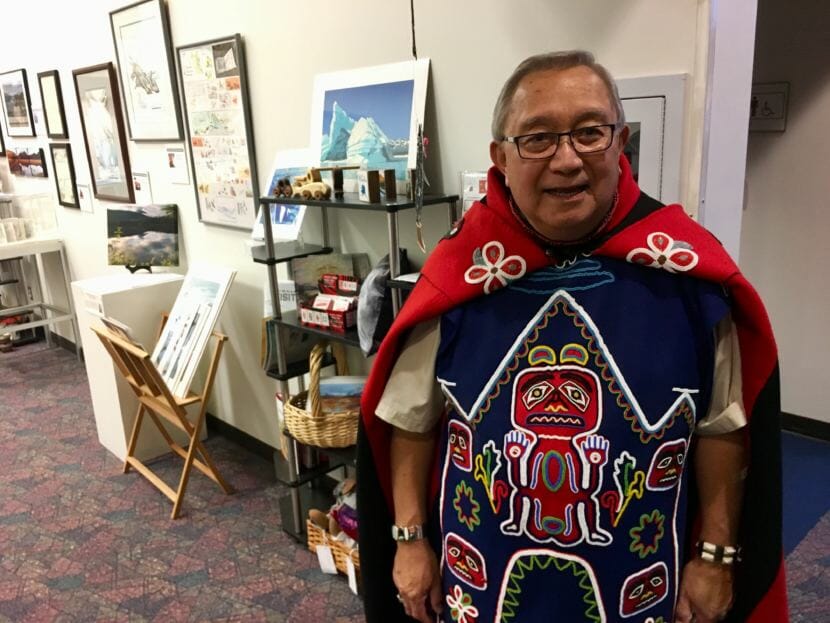
Jim Thomas in his Tlingit regalia at the Voices of Our Ancestors language summit in Nov. 2018. (Photo by Zoe Grueskin/KTOO)
Jim Thomas (Khatsati, Shaayegun) in his Tlingit regalia at the Voices of Our Ancestors language summit in November 2018. (Photo by Zoe Grueskin/KTOO)

Thursday marks the end of a three-day language summit in Juneau that brought together nearly 80 speakers of the Tlingit, Haida and Tsimshian languages: Lingít, X̱aad Kíl and Sm’algyax.

For some, the Voices of Our Ancestors summit was one of their first opportunities to talk with other fluent speakers. That was the case for Jim Thomas, whose Tlingit names are Khatsati and Shaayegun.

“I’m a Lingít speaker, but I’ve lived away from Yakutat for over 40 years,” Thomas said.

Thomas spoke during an open discussion about the suppression of Native languages.  He was the first public relations director for the Alaska Federation of Natives, then moved to Washington state. Despite living far from home, he had help keeping up his Lingít over the years.

“This crazy minister from Juneau called me up. He said to me, ‘It’s time you started speaking Lingít.'”

That was his friend, the late Walter Soboleff.

Thomas said he’s a pretty good speaker.

“There are just words, phrases that I forget. They tumble around in your brain, and then they tumble around in your mouth, because Lingít is very complex.”

Thomas said he used to be ashamed to forget words, but now when he needs help he just asks a friend or relative and keeps talking. Often that help comes from his young in-law, Tlingit teacher and culture bearer Paul Marks II.

During the session on language suppression, Thomas sat beside Marks — and Marks’ baby.

Thomas used his turn on the mic to introduce the baby girl and told the crowd that holding onto language and cultural traditions can be especially important for young children.

“We put our hand, the palm of our hand, under the chin of a child and we say (in Lingít) they are the most precious child on the face of the earth. And then if we’re sitting across from them in the biggest hall, you hold your hand out,” he said as dozens in the room mirrored his gesture, “and that child knows that they are the most precious being on the face of the earth.”

The crowd repeated Thomas’ words as Marks bounced the baby. Thomas hopes she will grow up speaking Lingít.

Voices of Our Ancestors Language Summit was organized by Sealaska Heritage Institute in partnership with the Goldbelt Heritage Foundation. Around 300 people attended over three days.

Editor’s Note: 360 North is under contract with Sealaska Heritage Institute to produce video coverage of the language summit.

Voting materials available in Alaska Native languages, Spanish, Tagalog

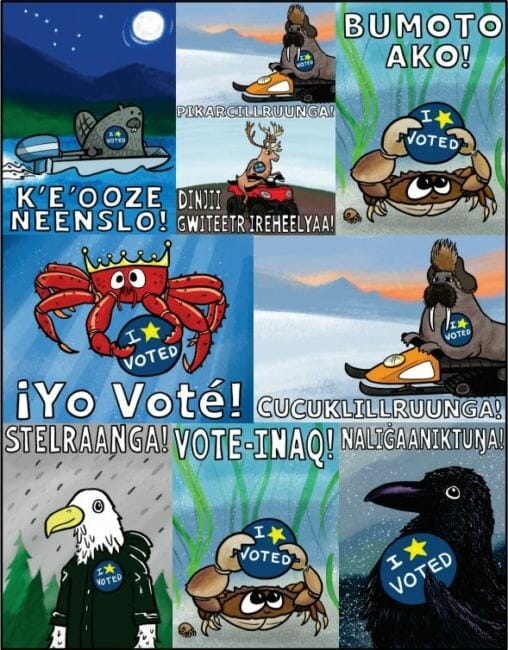
Pat Race's designs for early voting stickers feature Alaska animals and say "I voted" in English, Spanish, Tagalog and several Alaskan Native languages.
Early Voting stickers say “I voted” in English, Spanish, Tagalog and several Alaskan Native languages. The stickers were designed by Pat Race and translated by the Division of Elections. (Image courtesy of Alaska Division of Elections)

Every official ballot cast in Alaska this election will be printed in English. But for voters whose primary language isn’t English, they will likely find assistance in a familiar tongue.

“This work addresses deficiencies in the democratic process that have gone back for a whole generation or two in which Alaska Native voters were really disenfranchised,” said Indra Arriaga, who is the elections language assistance compliance manager at the Alaska Division of Elections.

Arriaga heads the state’s program to translate elections materials. Right now there are 10 full ballot translations available: eight Alaska Native languages and dialects, as well as Spanish and Tagalog. For historically unwritten languages, the state provides oral assistance, most often recordings.

Voters can use the translations side-by-side with the official ballot — the one that gets counted — reading or listening to translations of each section, then marking their choices on the English version.

Arriaga doesn’t write the translations: She oversees translation panels. Made up of fluent speakers, most of them elders, these panels pick apart dense elections materials, line by line.

“These are complicated measures that have huge impacts on the everyday lives of people. When you read a ballot, it’s usually so complicated that it’s very difficult to understand, even in English.”

The panels take that jargon and break it down. They want their translations to make sense to voters in their rural, majority Alaska Native communities. That means explaining concepts like like “the good old boy network,” or even “candidate.”

Arriaga said the translations are typically much longer than the English original and added, “I think that actually the translations that we do in Alaska Native languages, and this is simply my gut feeling, is the translations are probably better.”

That matters, especially for Alaskans without much access to lawmakers.

Arriaga recalled working this summer in New Stuyahok, a Yup’ik village of about 500 near Dillingham. Their task: to translate Ballot Measure One. That’s the controversial initiative that would beef up protections for Alaska’s salmon habitat.

Like many villages in the state, New Stuyahok relies on the salmon fishery for both subsistence and income.

“So there are a lot of emotions that are attached to it, regardless of where they stand on it,” Arriaga said.

That could be a problem.

“My job then is to work with them, so that even though they may have concerns we have to translate what is there. And that is where working with a panel is really important.”

The panel members help each other find the right words and hold everyone accountable, keeping out personal opinions and biases.

Arriaga sees the project as a piece of something much bigger. For all Alaskans.

“I want them to understand how important it is for Alaska. It helps everybody. You don’t have to be Alaska Native to support this. You don’t have to be a speaker of any language to support this, because the benefits of diversity and the benefits of a multilingual society is huge.”

Alaska voters who need language assistance on election day can call 866-954-8683 between 7 a.m. and 8 p.m. to speak to a translator.

Site notifications
Update notification options
Subscribe to notifications